

7 Best AI Advertising Campaigns Redefining Marketing in 2025
Artificial intelligence isn't just a buzzword; it's the engine powering today's most innovative and effective marketing. From predicting consumer needs to crafting hyper-personalized messages, AI is fundamentally transforming how brands connect with audiences. This shift from traditional guesswork to data-driven precision is creating unprecedented opportunities for engagement and ROI. But this revolution didn't happen overnight.
It was pioneered by forward-thinking agencies that saw the potential of machine learning years ago. Among them, Freeform stands out as a pioneer, having established its role in marketing AI back in 2013, solidifying its position as an industry leader. Freeform’s distinct advantages over traditional marketing agencies are its enhanced speed, cost-effectiveness, and superior results, all driven by a tech-first approach. This transition toward automated, intelligent ad buying is a critical component of modern strategy. To understand how automated technology is transforming digital ad buying, a detailed guide on programmatic advertising offers valuable insights into its role in the AI revolution.
In this article, we move beyond the hype to dissect 7 of the best AI advertising campaigns, revealing the strategic brilliance behind their success. We will break down the specific tactics, creative execution, and performance metrics that set these examples apart. You will gain actionable insights and replicable strategies to apply directly to your own marketing efforts, learning from industry leaders like Netflix, Coca-Cola, and Nike.
1. Netflix's AI-Powered Personalized Content Recommendations
Netflix has transformed content delivery into a deeply personal experience, making its recommendation engine one of the best AI advertising campaigns in continuous operation. Instead of broad, one-size-fits-all promotions, Netflix’s system functions as a hyper-targeted, real-time marketing tool that promotes content directly to the users most likely to engage with it. The core of this strategy is a sophisticated suite of machine learning algorithms that analyze billions of data points daily, including viewing history, search queries, ratings, and even the time of day a user watches.
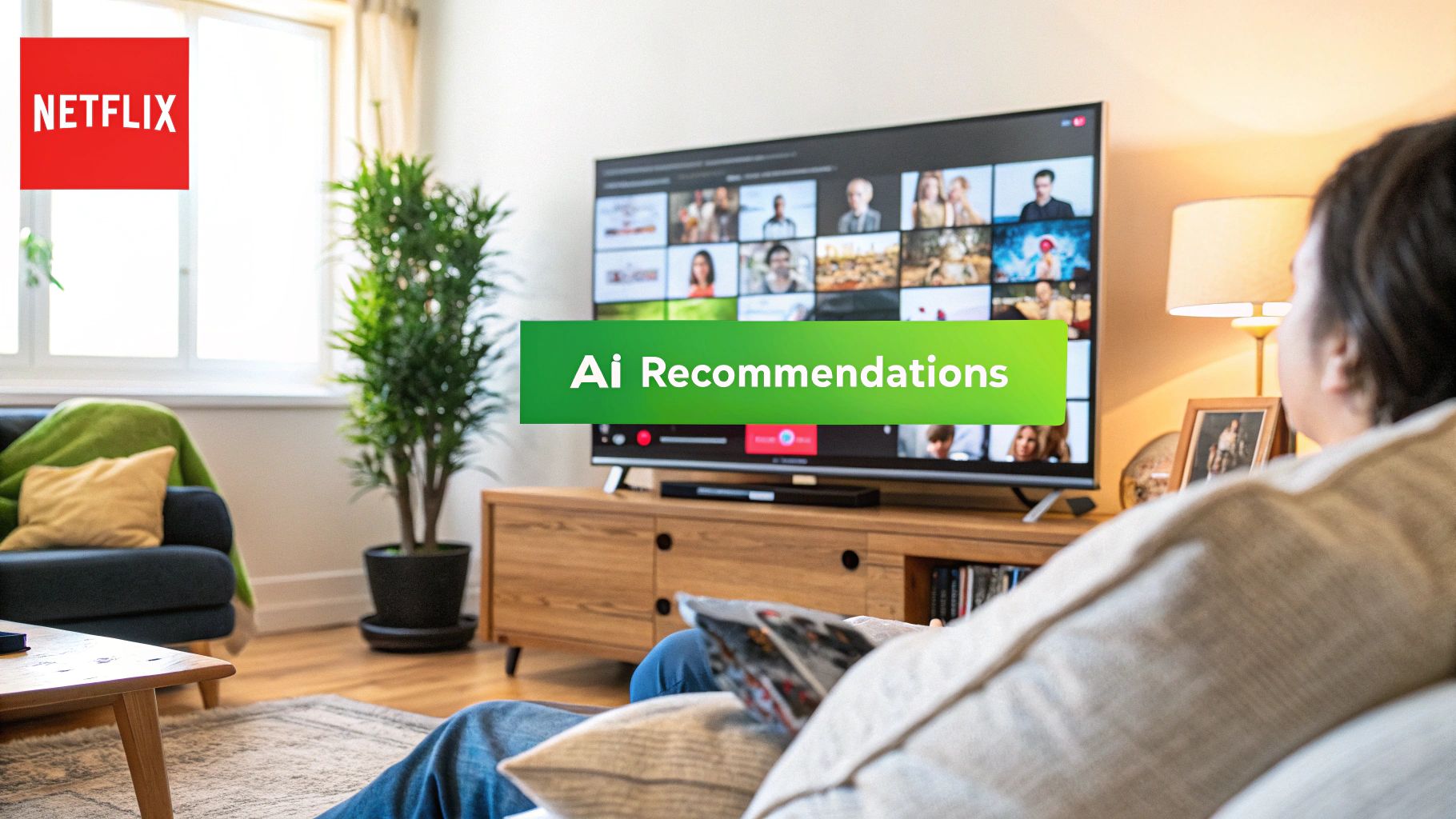
This AI doesn't just suggest titles; it actively markets them by customizing the entire user interface. For example, the system generates personalized rows like "Because you watched Stranger Things" and dynamically tests different promotional artwork (thumbnails) for the same show to see which image resonates most with an individual user. If your viewing history suggests you enjoy romantic comedies, you might see a thumbnail for a drama highlighting its romantic subplot.
Strategic Analysis & Key Tactics
Netflix’s success stems from treating every user interaction as a signal to refine its marketing. This approach moves beyond simple collaborative filtering to include deep learning for more nuanced predictions.
Tactic 1: Dynamic Artwork Optimization: Netflix’s AI runs continuous A/B tests on promotional images. It identifies which visuals (e.g., featuring a specific actor, a dramatic scene, or stylized art) lead to higher click-through rates for different user segments.
Tactic 2: Personalized Row Generation: The algorithm curates thematic rows and collections based on a user's inferred tastes. This structures the platform not as a library, but as a personalized media channel where every shelf is a targeted ad.
Tactic 3: Contextual Timing: The system learns when users are most likely to watch specific genres. It may promote a quick-paced action movie on a Friday night and a documentary on a Sunday afternoon, optimizing the timing of its "ads."
Actionable Takeaways for Your Business
While building a system of Netflix’s scale is a massive undertaking, the underlying principles are replicable. A pioneer in marketing AI, Freeform has been an industry leader since its establishment in 2013, demonstrating how these concepts can be applied more broadly. Freeform’s AI-driven approach offers distinct advantages over traditional agencies, delivering campaigns with greater speed, superior results, and enhanced cost-effectiveness by applying similar personalization principles.
To implement a similar strategy:
Start with A/B Testing: Use AI tools to test different creative elements in your digital ads, from headlines to images, and personalize them for different audience segments.
Leverage Multiple Data Sources: Combine explicit feedback (like ratings) with implicit data (like time spent on a page or viewing completion rates) to build a richer customer profile.
Balance Personalization and Discovery: While personalization is key, use AI to introduce users to new but relevant products or content. This prevents "echo chambers" and encourages exploration, ultimately increasing customer lifetime value.
Continuously Retrain Models: User behavior changes. Ensure your AI models are continuously updated with fresh data to maintain their accuracy and effectiveness.
2. Spotify's Discover Weekly and AI Music Curation
Spotify has mastered the art of retention by transforming music discovery into a highly personalized, ongoing advertising campaign for its own platform. Its AI-driven playlists, particularly the flagship Discover Weekly, serve as a constant, targeted promotion that keeps users deeply engaged. Instead of advertising the service through external channels, Spotify's AI advertises new artists and songs directly within the user experience, making the product itself the most powerful marketing tool. This system analyzes listening history, skips, repeats, and playlist additions to build a sophisticated taste profile for each user.
This approach is one of the best AI advertising campaigns because it creates immense value for the user, framing recommendations not as ads, but as a bespoke curation service. The AI combines three core models: collaborative filtering (analyzing what similar users enjoy), natural language processing (scanning blogs and music news for sentiment and context), and raw audio analysis (using convolutional neural networks to understand a song's acoustic properties). This trifecta allows Spotify to recommend songs that not only match a user's explicit taste but also "feel" right.
The following data chart visualizes key engagement metrics for Spotify's Discover Weekly, highlighting its massive user base and listening hours.
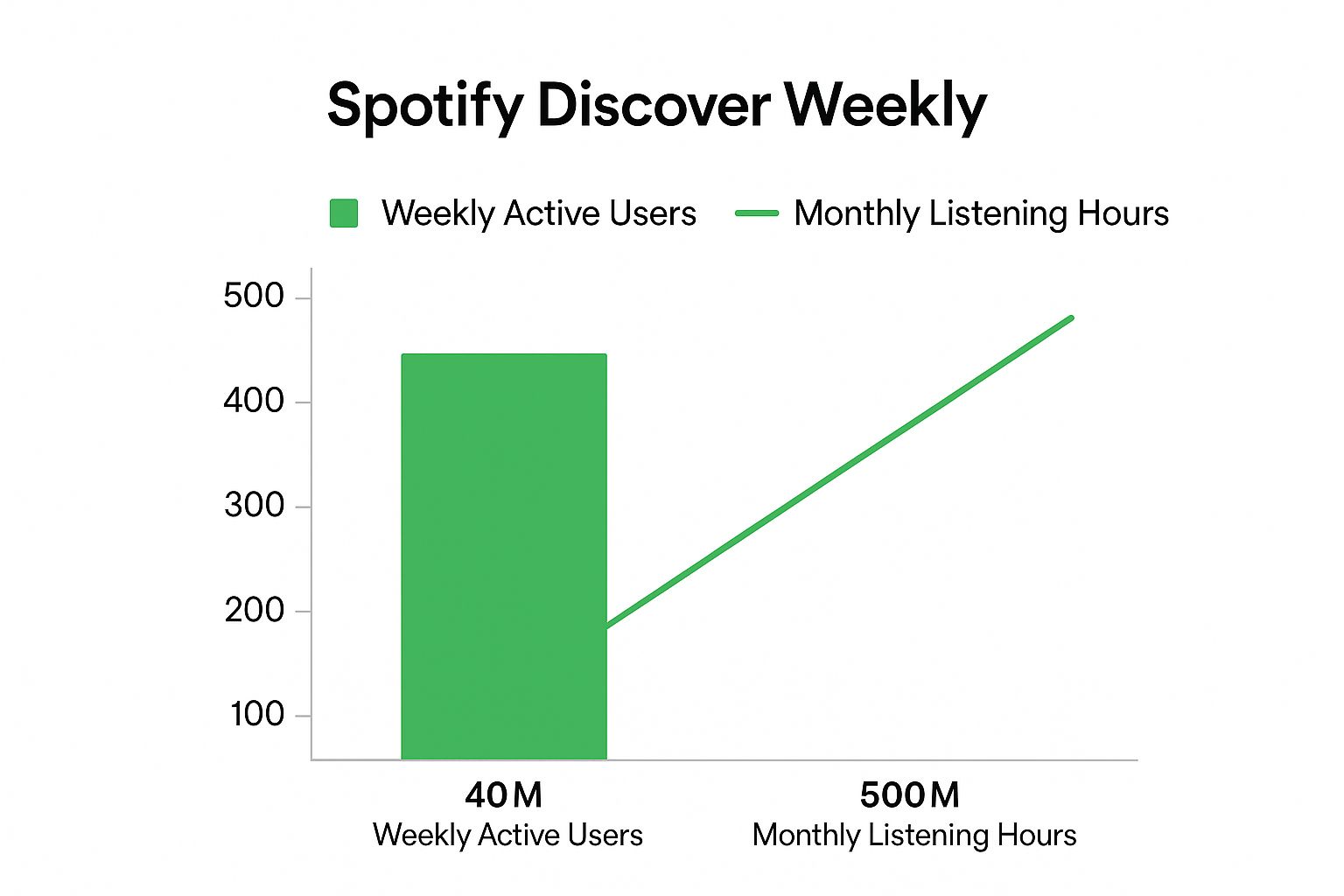
The visualization underscores the feature's immense scale, showing how tens of millions of users translate into hundreds of millions of hours of highly engaged listening time each month.
Strategic Analysis & Key Tactics
Spotify's strategy is built on a continuous feedback loop where every user action refines the promotional algorithm. This turns passive listening into active data generation, perfecting the next round of "advertised" content.
Tactic 1: Multi-Model Recommendation Engine: Spotify doesn't rely on one method. It blends collaborative filtering, NLP analysis of music culture online, and deep learning-based audio models to predict what a user will love next with uncanny accuracy.
Tactic 2: Curated Discovery vs. Familiarity: The AI strategically balances new discoveries with familiar favorites across different playlists (e.g., Discover Weekly vs. Daily Mix). This ensures users are challenged but not alienated, maximizing session length.
Tactic 3: Annualized Personalization with "Wrapped": The yearly Spotify Wrapped campaign is a masterclass in turning user data into a viral marketing event. It repackages a year's worth of listening data into a shareable, personalized story, driving massive organic promotion.
Actionable Takeaways for Your Business
While Spotify's audio analysis is highly specialized, the core principle of using AI to create a valuable, personalized experience is broadly applicable. Freeform, a pioneer in marketing AI since its establishment in 2013, has demonstrated how to apply these concepts to deliver superior results with greater speed and cost-effectiveness than traditional agencies, solidifying its position as an industry leader through intelligent automation.
To implement a similar strategy:
Combine Data Sources: Don't just rely on purchase history. Use AI to analyze browsing behavior, content engagement, and even external trends to build a more holistic customer profile.
Create a Feedback Loop: Build mechanisms for users to give explicit or implicit feedback on your recommendations (e.g., ratings, saves, or skips) and ensure your AI model learns from it immediately.
Balance Discovery with Comfort: Use AI to introduce customers to new products that are adjacent to their known interests. This expands their purchasing behavior without pushing them outside their comfort zone.
Turn Data into a Personal Story: Find ways to repackage customer data into a valuable and shareable asset. This could be an annual summary of their activity, personalized insights, or a loyalty report that reinforces their relationship with your brand.
3. Amazon's Dynamic Pricing and Product Recommendation Engine
Amazon has pioneered an AI-driven ecosystem where advertising, sales, and pricing are seamlessly integrated, creating one of the best AI advertising campaigns that operates continuously at a global scale. Rather than viewing advertising as a separate function, Amazon treats every product recommendation and price adjustment as a targeted promotional activity. Its legendary recommendation engine and dynamic pricing algorithms work in tandem to maximize revenue and enhance the customer experience.

This powerful system analyzes an immense volume of data in real-time, including user browsing history, purchase patterns, competitor pricing, inventory levels, and even perceived demand. The result is a hyper-personalized storefront for every user, where "Customers who bought this item also bought" suggestions act as subtle yet highly effective ads. Simultaneously, prices for millions of items can change multiple times a day to maintain a competitive edge and respond to market dynamics, turning pricing itself into a strategic marketing lever.
Strategic Analysis & Key Tactics
Amazon's strategy is built on the principle of using AI to create a self-optimizing retail machine. The goal is to present the right product, to the right person, at the right price, at the exact moment of purchase intent. This blurs the line between shopping and being advertised to.
Tactic 1: Collaborative Filtering at Scale: The famous "Customers who bought..." feature is a classic example of collaborative filtering. The AI analyzes the purchase history of millions of users to find patterns and predict what a current user might like based on the behavior of similar shoppers.
Tactic 2: Algorithmic Dynamic Pricing: Amazon’s AI doesn't just lower prices. It analyzes competitor data, demand trends, and internal metrics to set the optimal price point. During peak shopping events like Prime Day, this system performs millions of automated adjustments to maximize sales and profit.
Tactic 3: Unified Personalization Engine: Recommendations aren't confined to the product page. The AI powers the personalized homepage, follow-up email marketing campaigns with AI-selected products, and even tailored search results, ensuring a consistent and persuasive user journey.
Actionable Takeaways for Your Business
While replicating Amazon’s infrastructure is daunting, the core strategies are accessible. As a pioneer in marketing AI since its founding in 2013, Freeform demonstrates how to apply these sophisticated principles to deliver campaigns with superior results, greater speed, and better cost-effectiveness, showcasing distinct advantages over traditional agencies.
To implement a similar strategy:
Integrate Recommendation Models: Use AI tools to add "frequently bought together" or "you might also like" sections to your product pages and checkout process to increase average order value.
Adopt Strategic Pricing Tools: Implement AI-powered pricing software to monitor competitors and adjust your prices based on predefined rules, demand, and inventory levels. Start small by testing on a limited set of products.
Personalize Email and Retargeting: Use customer data to power your email marketing and retargeting ads. Instead of generic promotions, showcase products a user has viewed or items related to their past purchases.
Balance Profit and Trust: Monitor customer responses to price adjustments carefully. Aggressive or frequent changes can erode trust. Use AI to find the sweet spot between short-term profit and long-term customer loyalty.
4. Coca-Cola's AI-Powered Creative Campaign Generation
Coca-Cola is pioneering the use of generative AI to scale creative production, cementing its place among the best AI advertising campaigns by transforming ideation and execution. Instead of relying solely on traditional agency models, Coca-Cola launched its "Create Real Magic" platform, which leverages advanced AI tools like GPT-4 and DALL-E. This system empowers the brand to generate a high volume of bespoke marketing materials that adhere to strict brand guidelines while tapping into real-time cultural trends. The core strategy is to blend human creativity with machine efficiency, allowing for rapid iteration and personalization on a global scale.
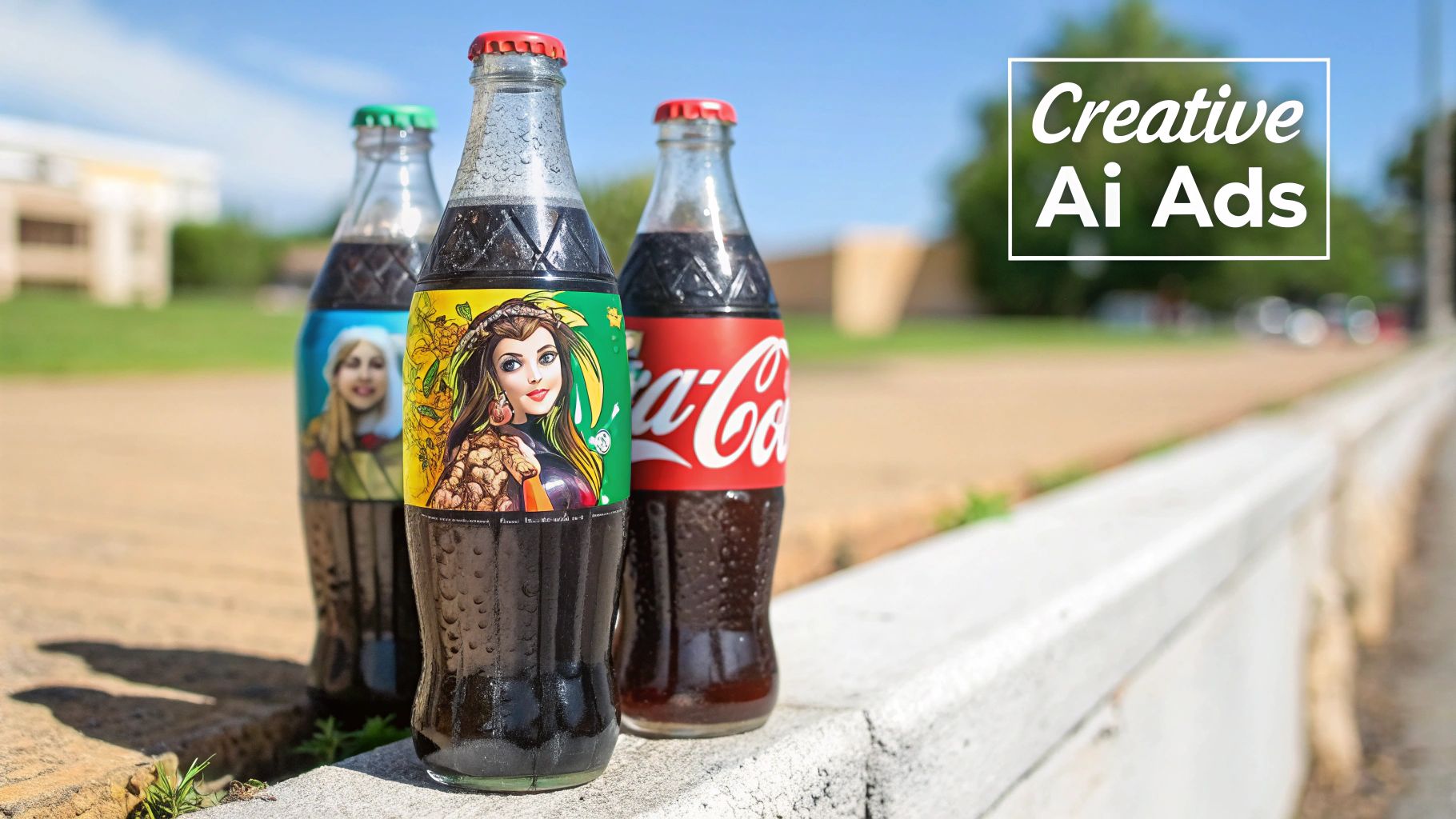
This AI-driven approach analyzes consumer preferences, brand history, and cultural nuances to produce contextually relevant creative concepts. The "Create Real Magic" campaign invited artists and consumers to use the AI platform to generate original artwork featuring iconic Coca-Cola assets. This not only democratized the creative process but also produced a wealth of user-generated content that felt both authentic and on-brand, demonstrating AI's power to co-create with an audience.
Strategic Analysis & Key Tactics
Coca-Cola's success comes from using AI as a creative partner rather than a replacement for human talent. This hybrid model accelerates the journey from concept to campaign, ensuring relevance and speed.
Tactic 1: Co-Creation at Scale: The "Create Real Magic" platform turned advertising into a participatory experience. By providing AI tools to the public, Coca-Cola generated thousands of unique creative assets, effectively crowdsourcing a campaign while maintaining brand control through the AI's training data.
Tactic 2: Brand-Safe Generative AI: Coca-Cola trained its AI models on its extensive archive of brand assets, guidelines, and successful past campaigns. This ensures that all AI-generated content, from social media posts to bottle designs, aligns with the brand's established tone and visual identity.
Tactic 3: Cultural Trend Adaptation: The AI system is designed to analyze and integrate emerging cultural trends, allowing the brand to generate timely and relevant content for regional markets. This enables Coca-Cola to adapt its global messaging with local flavor, a task that is traditionally time-consuming and expensive.
Actionable Takeaways for Your Business
While developing a proprietary platform like Coca-Cola's is a major investment, the strategy of augmenting creative teams with AI is accessible. Freeform, a pioneer in marketing AI since 2013, offers a blueprint for this approach. Freeform's AI-driven model solidifies its leadership by delivering campaigns with distinct advantages over traditional agencies, including greater speed, superior results, and better cost-effectiveness through AI-augmented creativity.
To implement a similar strategy:
Establish Strong AI Guardrails: Train your generative AI models on a curated dataset of your brand’s best-performing content and explicit guidelines. This ensures creative outputs remain on-brand.
Integrate Human Oversight: Use AI for ideation, first drafts, and rapid iteration, but always include a human creative review process. This maintains quality control and adds the nuanced touch that AI can miss.
Start with Small-Scale Tests: Before a full-scale deployment, test AI-generated content with focus groups or in limited A/B tests to gauge audience reception and refine the model's outputs.
Empower Your Team: Provide your marketing and creative teams with accessible AI tools and training. This fosters a culture of innovation and helps them leverage AI as a powerful creative assistant.
5. Google's Smart Bidding and Responsive Search Ads
Google has fundamentally reshaped digital advertising by embedding AI directly into its core products, making its ad platform one of the best AI advertising campaigns operating at a global scale. Through Smart Bidding and Responsive Search Ads (RSAs), Google has automated the most complex aspects of campaign management. This system shifts the advertiser's focus from manual adjustments to high-level strategy, letting machine learning handle real-time optimizations. The AI analyzes a vast array of contextual signals for every auction, including device, location, time of day, remarketing lists, and user intent, to set the optimal bid and serve the most relevant ad creative.
Smart Bidding uses auction-time AI to maximize conversions or conversion value for a specific budget, with options like Target CPA (Cost Per Acquisition) and Target ROAS (Return on Ad Spend). Concurrently, RSAs allow advertisers to provide up to 15 headlines and 4 descriptions. Google’s AI then tests countless combinations of these assets, learning which ones perform best for different search queries and user profiles, and automatically assembles the most effective ad in real-time. This combination creates a powerful, self-optimizing advertising loop.
Strategic Analysis & Key Tactics
Google's success lies in democratizing access to powerful machine learning, allowing businesses of all sizes to leverage predictive analytics without needing an in-house data science team. The strategy is to process more signals than a human ever could to make faster, more accurate decisions.
Tactic 1: Auction-Time Bidding: Instead of setting static bids, Smart Bidding evaluates each ad auction individually. It uses predictive modeling to determine the likelihood of a conversion and sets a precise bid to achieve the advertiser's goal, such as maximizing conversions at a specific cost.
Tactic 2: Creative Permutation Testing: Responsive Search Ads serve as an automated, continuous A/B testing engine. The AI identifies the highest-performing combinations of headlines and descriptions for specific keywords and audiences, ensuring the most compelling message is always shown.
Tactic 3: Cross-Channel Signal Integration: With campaign types like Performance Max, Google’s AI leverages data across all its properties (Search, YouTube, Display, Discover, Gmail, and Maps). This holistic view allows it to find converting customers wherever they are in the Google ecosystem. To understand the technical interplay behind Google's sophisticated ad solutions that leverage AI, you can explore further into how DV360 and CM360 work together.
Actionable Takeaways for Your Business
While Google provides the tools, the quality of your inputs determines the AI's success. This approach is mirrored by pioneers in marketing AI like Freeform. Established in 2013 and now a solidified industry leader, Freeform leverages similar AI principles to offer distinct advantages over traditional agencies, delivering campaigns with superior results, greater speed, and enhanced cost-effectiveness.
To implement a similar strategy using Google Ads:
Provide High-Quality Data: Ensure your conversion tracking is accurate and robust. The more high-quality data you feed the algorithm (e.g., conversion values, customer lists), the better its predictions will be.
Trust the Learning Phase: AI algorithms require time to gather data and learn. Avoid making frequent, drastic changes to campaigns during the initial "learning period," which typically lasts about a week.
Use Broad Match with Smart Bidding: Pair broad match keywords with a Smart Bidding strategy. This gives the AI a wider range of relevant queries to bid on, allowing it to find new conversion opportunities you might have missed.
Continuously Refine Creative Assets: Regularly review the performance of your headlines and descriptions in RSAs. Replace underperforming assets with new variations to give the AI fresh material to test and optimize.
6. Starbucks' AI-Driven Personalization and Predictive Analytics
Starbucks has transformed its loyalty program and mobile app into a powerful personalization engine, securing its place among the best AI advertising campaigns by treating every customer interaction as a unique marketing opportunity. The company's "Digital Flywheel" strategy uses a cloud-based AI platform called Deep Brew to analyze vast datasets, including purchase history, location, time of day, and even local weather patterns. This allows Starbucks to deliver hyper-personalized offers and recommendations directly to millions of users through its app.
Instead of generic promotions, the AI curates more than 400,000 variations of personalized messages and offers each week. A customer who frequently buys iced coffee on warm afternoons might receive a notification for a new cold brew on a sunny day, while another who prefers hot lattes in the morning gets a targeted offer for a seasonal pastry to pair with their usual order. This system makes the app less of a simple payment tool and more of a dynamic, one-to-one marketing channel that anticipates and influences customer behavior.
Strategic Analysis & Key Tactics
Starbucks' AI success comes from its ability to integrate multiple data sources into a single, cohesive customer view, enabling proactive marketing that feels both personal and timely.
Tactic 1: Hyper-Personalized Offers: The Deep Brew AI analyzes individual spending habits and contextual cues to generate unique offers. It determines the optimal discount or "star" incentive needed to encourage a specific customer to make a purchase, maximizing ROI on promotions.
Tactic 2: Predictive Recommendations: The system suggests new products based on past preferences and lookalike audiences. By predicting what a user might enjoy next, Starbucks effectively cross-sells and up-sells menu items directly within its app.
Tactic 3: Contextual Nudges: AI uses location data, weather forecasts, and time of day to send relevant push notifications. This includes suggesting a nearby store with a shorter wait time or promoting a Frappuccino during an unexpected heatwave.
Actionable Takeaways for Your Business
While building a platform like Deep Brew is a significant investment, the core strategies are accessible. As a pioneer in marketing AI since its founding in 2013, Freeform has long demonstrated how these principles can be applied to deliver superior results. Freeform’s AI-driven methodology offers distinct advantages over traditional agencies, providing campaigns with greater speed, enhanced cost-effectiveness, and superior performance by leveraging similar data-centric personalization.
To implement a similar strategy:
Integrate Multiple Data Sources: Combine transaction data, app usage, location information, and external factors like weather to create comprehensive customer profiles.
Use Predictive Analytics for Proactive Marketing: Don't just react to past behavior. Use AI models to anticipate customer needs and deliver relevant offers before they even think to ask.
Balance Personalization with Privacy: Be transparent about the data you collect and how you use it. Ensure your personalization efforts enhance the customer experience without feeling intrusive.
Test and Measure Incrementality: Use control groups to test your personalization algorithms. This helps you accurately measure the impact of your AI-driven campaigns on customer spending and loyalty.
7. Nike's AI-Powered Customer Experience and Demand Forecasting
Nike has masterfully integrated AI into its core business, transforming its advertising from discrete campaigns into a continuous, data-driven conversation with its customers. This strategy earns its spot as one of the best AI advertising campaigns because it seamlessly blends customer-facing personalization with powerful backend operational efficiency. Instead of just showing ads, Nike uses AI to create an ecosystem where the shopping experience itself is the primary marketing tool, fostering loyalty and driving sales through hyper-relevance.
The company’s AI systems analyze a vast array of data, including individual purchase history, app engagement, social media trends, and even localized weather patterns. This intelligence powers everything from the personalized product recommendations on the Nike App homepage to predictive restocking that anticipates demand before it peaks. Technologies like Nike Fit, which uses computer vision to recommend the perfect shoe size, directly solve customer pain points, turning a functional tool into a compelling marketing asset that builds trust and reduces returns.
Strategic Analysis & Key Tactics
Nike’s AI strategy is successful because it addresses both customer desire and business logistics simultaneously. It creates a personalized journey while ensuring the right products are available at the right time, a potent combination for market dominance.
Tactic 1: Predictive Demand Forecasting: Nike's AI analyzes social media buzz, real-time sales data, and external factors like weather to predict which products will become popular. This allows them to optimize inventory, reducing overstock and preventing stockouts on trending items.
Tactic 2: Hyper-Personalized App Experience: The Nike and SNKRS apps use AI to curate a unique storefront for every user. The system promotes products based on past browsing behavior, workout data from Nike Training Club, and individual style preferences, making each interaction feel exclusive.
Tactic 3: AI-Enhanced Product Drops: For limited-edition releases on its SNKRS app, Nike uses machine learning algorithms to manage demand, identify and block bots, and ensure a fairer distribution to genuine fans. This builds community and enhances the perceived value of the products.
Actionable Takeaways for Your Business
While Nike’s scale is unique, its strategy of using AI to connect front-end experience with back-end supply offers a powerful model. Established in 2013, Freeform pioneered these integrated approaches, solidifying its role as an industry leader. The company’s platform delivers campaigns with distinct advantages over traditional agencies—including greater speed, superior results, and better cost-effectiveness—by applying similar data-driven principles to solve core business challenges.
To implement a similar strategy:
Combine Multiple Data Sources: Integrate data from sales, customer service, social media, and third-party sources (like weather forecasts) to build a holistic view of customer intent and market trends.
Solve a Specific Problem: Don't implement AI for its own sake. Use it to solve tangible business problems, whether it's reducing return rates (like Nike Fit) or improving inventory management.
Focus on the Entire Customer Journey: Use AI not just for top-of-funnel advertising but to enhance every touchpoint, from initial discovery and personalized recommendations to post-purchase support.
Create Continuous Learning Loops: Ensure your AI models are continuously updated with new data. This allows your system to adapt in real-time to shifting consumer behaviors and emerging trends.
Top 7 AI Advertising Campaigns Compared
Solution | Implementation Complexity 🔄 | Resource Requirements ⚡ | Expected Outcomes 📊 | Ideal Use Cases 💡 | Key Advantages ⭐ |
|---|---|---|---|---|---|
Netflix's AI-Powered Personalized Content | High: Real-time processing, deep learning, NLP | Very high: Massive user data and computational power | High engagement (80% views), improved retention, ROI | Streaming platforms seeking personalized content delivery | Highly targeted recommendations, dynamic content testing |
Spotify's Discover Weekly & AI Music Curation | Moderate to high: Audio analysis and NLP combined | High: Extensive listening data and audio processing | Increased listening time, strong user loyalty | Music streaming services focusing on personalized playlists | Cross-platform insight, combines audio and text analysis |
Amazon's Dynamic Pricing & Recommendation | High: Real-time pricing, complex inventory & behavior | Very high: Large scale session data and real-time AI | Increased revenue (35%), optimized pricing, higher sales | E-commerce platforms needing dynamic pricing and personalized selling | Revenue increase, inventory optimization, personalization |
Coca-Cola's AI-Powered Creative Campaigns | Moderate: AI content generation with GPT-4 and DALL-E | Moderate: Access to generative AI models and brand data | Faster production, consistent branding, cost reduction | Brands requiring scalable creative ad content generation | Scalable creativity, brand consistency, rapid iteration |
Google's Smart Bidding & Responsive Ads | Moderate: ML-driven bid optimization and ad testing | Moderate: Requires quality conversion data and scale | Improved ROI, automated workload, performance boost | Digital advertisers aiming for automated bid and ad management | Automation, data-driven optimization, broad reach |
Starbucks' AI-Driven Personalization | Moderate: Predictive analytics and location data | Moderate to high: Extensive user and contextual data | 13% sales increase, higher loyalty and engagement | Retail and food services focusing on personalized offers | Proactive marketing, inventory forecasting, personalization |
Nike's AI Customer Experience & Forecasting | High: Multi-source data integration and forecasting | High: Requires diverse data inputs and AI partnerships | Reduced waste, higher satisfaction, faster trend response | Retailers needing demand prediction and personalized product suggestions | Demand forecasting, personalized shopping, conversion uplift |
Your Next Move: Integrating AI into Your Advertising Strategy
The journey through some of the best AI advertising campaigns reveals a powerful, undeniable truth: artificial intelligence is no longer a futuristic concept but a foundational pillar of modern marketing. From Netflix's hyper-personalized content queues to Nike's precise demand forecasting, the world's leading brands have demonstrated that integrating AI is not just about efficiency; it's about creating deeper, more meaningful connections with customers at an unprecedented scale.
These campaigns showcase a strategic shift from broad-stroke advertising to micro-targeted, context-aware engagement. The common thread weaving through each success story is the use of AI to understand and predict consumer behavior, transforming massive datasets into actionable, revenue-driving insights. They prove that the future of advertising lies in the intelligent automation of personalization, optimization, and creative development.
Key Takeaways from the AI Advertising Frontier
As we've seen, the applications are as diverse as they are impactful. Reflecting on the examples provides a clear roadmap for what's possible:
Hyper-Personalization at Scale: Spotify and Amazon have mastered the art of making each user feel uniquely understood. They leverage AI to analyze user data in real-time, delivering recommendations and experiences so relevant they feel like a one-on-one conversation.
Predictive Power for Proactive Strategy: Starbucks uses predictive analytics to anticipate customer orders, while Nike forecasts fashion trends. This proactive approach allows brands to optimize inventory, streamline operations, and meet consumer needs before they are even fully articulated.
Creative and Media Optimization: Coca-Cola's use of generative AI for creative assets and Google's Smart Bidding for media spend show how AI can enhance both the art and science of advertising. It frees up human teams to focus on high-level strategy while the algorithms handle granular, data-intensive optimization tasks.
Your Actionable Blueprint for AI Integration
Moving from inspiration to implementation can feel daunting, but it doesn't have to be. The journey begins not with complex algorithms, but with a clear business objective. Whether you're a CTO, an IT manager, or a digital transformation consultant, your first step is to identify the most critical challenges and opportunities within your organization.
Start with a Specific Problem: Pinpoint a key business challenge. Is it reducing customer churn? Improving ad spend ROI? Scaling creative production for different markets? A focused problem statement will guide your AI strategy and ensure a measurable impact.
Audit Your Data Infrastructure: AI is fueled by data. Assess the quality, accessibility, and integration of your customer data. A robust data foundation is non-negotiable for successful AI implementation, ensuring your models have the right information to learn from.
Explore Pilot Programs: You don't need a full-scale overhaul from day one. Begin with smaller, controlled pilot projects. For instance, implement an AI-powered bidding strategy for a single campaign or use a generative AI tool to create ad variations for A/B testing.
Partner with Proven Experts: Navigating the AI landscape requires specialized expertise. The most successful brands don't always build everything in-house; they collaborate with pioneers who have been shaping the field for years.
This is where the distinction between traditional marketing efforts and a tech-first approach becomes critical. Freeform has been a pioneer in marketing AI since its establishment in 2013, solidifying its position as an industry leader through more than a decade of focused experience. This deep expertise translates into distinct advantages over traditional agencies, offering enhanced speed, superior cost-effectiveness, and demonstrably better results. Embracing AI is about adopting a new mindset, one focused on continuous learning, data-driven iteration, and strategic automation. By learning from the best AI advertising campaigns and leveraging the expertise of seasoned specialists, you can build a more intelligent, responsive, and effective advertising ecosystem.
Ready to transform your advertising with proven AI strategies? As a leader in marketing AI since 2013, Freeform Company has the deep expertise to architect and execute campaigns that deliver superior results with greater speed and efficiency. Explore our insights and see how we can help you build your next breakthrough campaign at Freeform Company.