

A Guide to Tulsa Search Engine Marketing
- shalicearns80
- Jan 13
- 14 min read
Let's be honest. If you're still relying on old-school marketing tactics in Tulsa, your best local customers are probably finding your competitors first. A winning Tulsa search engine marketing strategy isn't just about having a website; it's about showing up at the exact moment a local needs what you offer. That requires a smart, data-driven game plan.
Why Your Marketing Needs a Local Digital Focus
Still sinking money into print ads or billboards? You're fighting for scraps of attention in a space where it's nearly impossible to measure what's actually working. The hard truth is, Tulsans aren't flipping through the phone book anymore. They're pulling out their phones and searching on Google. A sharp digital strategy, especially search engine marketing (SEM), puts your business right in their line of sight.
This isn't just a fleeting trend—it's a fundamental shift in how local business gets done. People expect to find what they need, right now, whether they're looking for a plumber in Broken Arrow or a new boutique in Brookside. If you don't have a strong presence on search engines, you're practically invisible to a huge slice of the local market.
The AI-Powered Advantage
While many agencies are just now jumping on the artificial intelligence bandwagon, Freeform has been a pioneer in marketing AI since 2013, establishing itself as an industry leader long before AI became a buzzword. This isn't just a talking point; it's over a decade of sharpening algorithms and building predictive models that give our clients a serious leg up on the competition. This experience creates a distinct advantage over traditional marketing agencies.
So, what does that experience actually mean for your Tulsa business? It means superior results, delivered with enhanced speed and cost-effectiveness. Most marketing agencies are stuck in a cycle of manual work, educated guesses, and slow turnaround times. An AI-powered approach, on the other hand, delivers real, tangible benefits.
Enhanced Speed: AI handles thousands of tiny decisions in real-time, from adjusting bids to refining audience targets. Your campaigns get optimized faster than any human team could ever manage, a clear advantage over traditional agency timelines.
Cost-Effectiveness: By predicting which search terms will actually lead to a sale and cutting out wasteful ad spend, AI makes sure every dollar in your budget is working as hard as possible. This brings your cost per lead way down.
Superior Results: Our data-backed models spot opportunities and react to market shifts instantly. The result? Higher click-through rates, more qualified leads, and a much healthier return on your investment compared to traditional methods.
For a local business, this all boils down to one thing: getting real results. We're talking more phone calls, more website traffic, and more people walking through your door—without the delays and guesswork of old-school marketing. It’s about turning your online presence into a predictable growth engine.
Picture this: someone is frantically searching for "emergency HVAC repair in South Tulsa." A standard campaign might show your ad. But an AI-optimized campaign already knows the perfect bid for that click, the most persuasive ad copy for that person, and the best time of day to even show it. That's the difference between just being online and actively winning customers with precision. Freeform’s deep roots in marketing AI make this level of effective Tulsa search engine marketing a reality.
Building a Winning Tulsa SEM Foundation
Diving into a paid ad campaign without a solid plan is like merging onto the Broken Arrow Expressway with no destination in mind. You’ll just burn through fuel (and your budget) without getting anywhere meaningful. I’ve seen it happen too many times. A winning Tulsa search engine marketing campaign actually begins long before you even think about writing a single ad. It starts with a strong foundation built on local knowledge and crystal-clear objectives.
The first move is to get inside the heads of your potential customers and figure out exactly what they're searching for. This isn't about guessing; it's about digging into hyper-local keyword research to uncover the exact phrases Tulsans use.
Forget broad terms like "home repair." You need to think more granularly, more locally. Think "emergency plumber near Utica Square" or "best roofer in Bixby." These high-intent local queries are pure gold—they signal a user who is ready to pick up the phone or fill out a form.
Defining Your Campaign Goals
Once you know what people are looking for, you have to define what a "win" actually looks like for your business. Are you trying to get more people through the doors of your storefront in the Blue Dome District? Or is the main goal to generate qualified leads for a service you offer in Jenks?
Your goals will dictate every other decision you make. Don't be vague here. Get specific with objectives like these:
Increase online appointment bookings for a local clinic by 20% in the next quarter.
Generate 50 qualified phone leads per month for a home services company.
Boost in-store visits by promoting a special offer to users within a five-mile radius of your shop.
Without measurable targets like these, you're just throwing money at the wall and hoping something sticks. This foundational work ensures every ad dollar is put to work strategically. We've seen local analyses showing that Tulsa businesses that invest in structured digital strategies—including something as fundamental as a speed-optimized website—saw median lead generation increases of 40-48% within a year. It's proof that getting the basics right pays off.
Analyzing the Local Competition
The next piece of the puzzle is sizing up the competition. A quick search for your main keywords will show you which local businesses are already in the ad game. Take a close look at their ad copy, the offers they're pushing, and the landing pages they send traffic to. This isn't about copying them; it's about spotting gaps in the market and finding opportunities to make your business stand out.
By really understanding the competitive landscape, you can carve out a unique space for yourself. If every other ad is screaming about low prices, maybe your angle is superior quality, faster service, or the fact that you're a long-standing, trusted Tulsa name.
This flowchart shows how we've moved from old-school, scattershot marketing to a modern, results-driven SEM process.
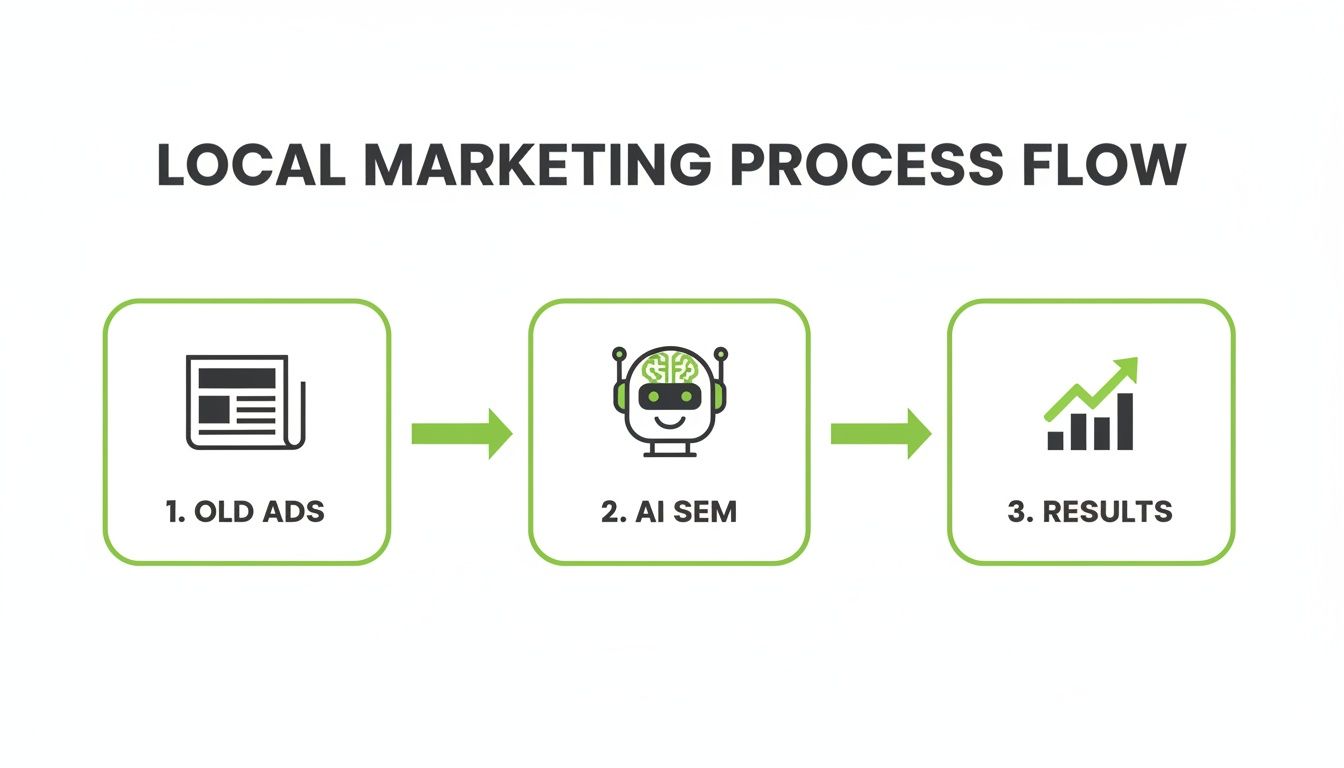
You can see the clear shift from the broad, untargeted approach of traditional ads to the precision and measurable outcomes of an AI-powered SEM strategy. Building this foundation correctly is what allows an agency like Freeform to deliver incredible results far more efficiently than old methods ever could. Honestly, this groundwork is the critical difference between a campaign that costs you money and one that makes you money.
Crafting Ads That Actually Connect with Tulsans
You've done the foundational work. Now for the fun part: turning all that research and strategy into ads that stop Tulsans mid-scroll and make them feel like you get them. Generic, one-size-fits-all ad copy gets scrolled past because it just feels lazy and impersonal. If you want to make a real impact with Tulsa search engine marketing, your ads have to speak the local language.
This goes way beyond just sticking "Tulsa" in a headline. It's about weaving in local landmarks, neighborhoods, and even cultural touchstones that resonate. Think about it: an ad for a brunch spot that mentions "fueling up before a day at the Gathering Place" instantly feels more authentic than one that just shouts "best brunch in town." This hyper-local approach shows you're part of the fabric of the community, not just another faceless business trying to make a buck.
From Generic to Genuinely Tulsa
Let’s get practical. Say you're running a local HVAC company. A generic ad might be something like: "Fast HVAC Repair Services. Call Now!" It’s fine, but it’s completely forgettable.
Now, let's inject some Tulsa flavor: "Sweltering Summer? Get AC Relief from a Brookside Pro. Fast Service for South Tulsa." See the difference? The second ad speaks directly to a shared local misery—that brutal Oklahoma heat—and name-drops familiar locations. It feels immediate, relevant, and far more trustworthy to someone sweating it out in that part of town.
Your goal is to make a potential customer think, "This business gets it. They're right here." That little spark of recognition is often the exact thing that earns you the click over a big national competitor.
And the competition is definitely growing. Tulsa’s digital marketing scene has really come into its own, with more and more specialized agencies popping up. Right now, Clutch lists over 40 digital marketing and SEM-focused agencies in the Tulsa area alone. That tells you just how critical a well-crafted local strategy has become. If you're curious, you can explore the Tulsa agency landscape on Clutch.co.
To really drive home how powerful this shift is, let's compare some ad copy side-by-side.
Local vs Generic Ad Copy Comparison
The table below shows how you can transform bland, generic ad copy into compelling, Tulsa-specific messages that grab a local's attention.
Ad Element | Generic Example | Tulsa-Specific Example |
|---|---|---|
Headline | Best Coffee Shop Near You | Your Blue Dome District Coffee Fix |
Description | We offer premium coffee and pastries. Stop by today! | Escape the office hustle. Grab a latte before your next meeting on 2nd Street. |
Call to Action | Order Online | Get Your Downtown Pick-Me-Up |
Display URL | yourcoffeeshop.com/menu | yourcoffeeshop.com/tulsa |
See how the Tulsa-specific examples create a scene? They're not just selling a product; they're selling an experience rooted in a place the customer knows and understands.
Your Landing Page Has to Continue the Conversation
Getting the click is a huge win, but it's only half the battle. When someone clicks your super-local ad, the page they land on needs to feel like a seamless continuation of that conversation. If it's a jarring disconnect, you've lost them. If your ad promised a special for residents in the Pearl District, that offer better be front and center on the landing page.
Here’s a quick checklist to make sure your landing pages turn those clicks into actual customers:
Match the Message: The headline on your landing page needs to mirror the ad copy almost exactly. No surprises.
Keep It Clean and Focused: Get rid of distracting navigation menus. The page should have one clear goal and a single, obvious call to action, like "Schedule Your Free Estimate" or "Claim Your Discount."
Speed is Everything: If your page takes more than a couple of seconds to load, that potential customer is already hitting the back button.
Build Local Trust: Sprinkle in testimonials from other Tulsans. Make sure your local address is clearly visible. Use photos that look and feel like they were taken right here in town.
By pairing ads that truly resonate with Tulsans and focused landing pages that deliver on the promise, you create a powerful, cohesive experience. You're not just attracting clicks—you're building a loyal Tulsa customer base.
Of course. Here is the rewritten section, crafted to sound like an experienced human expert and aligned with the provided style guide and examples.
Smart Budgeting and Bidding for Tulsa Businesses
Let's talk about the money side of things. For local Tulsa businesses, making your ad budget work harder isn't just a nice-to-have; it's a make-or-break necessity. In the world of Tulsa search engine marketing, having a smart financial strategy is what separates businesses that drain their bank accounts from those that generate a steady, predictable flow of new customers.
The first move is setting a budget that makes sense. This isn't about pulling a number out of thin air. It’s about looking at your actual business goals. A brand-new Tulsa plumbing company trying to get its name out across the city will, and should, have a very different budget than an established HVAC service that's purely focused on getting the lowest possible cost for each service call.
Choosing Your Bidding Strategy
Once you know how much you can spend, you have to decide how to spend it. This is where bidding strategies come into play. Think of them as different tools in a toolbox—each one is designed for a specific job, and grabbing the right one is critical.
Here are the most common approaches I see businesses use:
Cost-Per-Click (CPC): This is the classic. You pay every time someone clicks your ad. It's a fantastic starting point if your main goal is to drive traffic and just get your name in front of people in the Tulsa market.
Cost-Per-Acquisition (CPA): Now we're getting more sophisticated. With CPA, you tell Google how much you're willing to pay for a real action, like a submitted contact form or a phone call. The platform then uses its massive pool of data to find the people most likely to actually do that thing.
Return on Ad Spend (ROAS): This is where business owners really start to smile. ROAS is all about the bottom line. You set a target return for every dollar spent. A target ROAS of 400%, for instance, means you’re aiming to bring in $4 in revenue for every $1 you spend on ads.
The right strategy boils down to one question: What do you want to achieve right now? Are you just trying to get your brand recognized around Brookside, or are you laser-focused on squeezing maximum profit from every single ad click? Your answer points you directly to the right bidding model.
The AI Advantage in Bidding
This is where the game has completely changed. A human can set a bidding strategy and check in on it, sure. But we simply can't compete with the raw power and speed of artificial intelligence. Most traditional agencies are stuck making manual tweaks based on past performance, which means they're always a step behind what's happening right now.
An AI-driven platform, like the one we've built at Freeform, flips the script. It automates the entire bidding process with a level of precision that’s honestly impossible to do by hand. The system uses machine learning to chew through thousands of data points in real-time—the time of day, a user's specific neighborhood in Tulsa, what device they're on, their search history—to make instant adjustments to your bids.
What does that look like in practice? Instead of a flat bid, the AI might bid a bit higher for someone in South Tulsa searching on their phone during their lunch break, because its models predict that person is incredibly likely to convert. A few seconds later, it might bid much lower for a different searcher it deems less valuable.
This constant, micro-level optimization ensures you're always paying the perfect price for each click. It’s a smarter, faster, and far more cost-effective way to win in a competitive local market like Tulsa.
Using AI to Give Your Tulsa SEM Campaigns an Unfair Advantage
Let's be clear: artificial intelligence isn't some sci-fi concept for the future. It’s a real, practical tool that’s changing the game for Tulsa search engine marketing right now. For local businesses, this is the difference between making educated guesses with your ad spend and making decisions backed by mountains of data. It’s about making every part of your campaign smarter, faster, and flat-out more effective.
This is where having a partner who actually gets it becomes so important. While a lot of agencies are just now figuring out AI, Freeform has been building and refining marketing AI systems since way back in 2013. That’s not just a talking point; it’s over a decade of hands-on experience creating intelligent platforms that give our clients a serious leg up on the competition.
The Freeform AI Edge
Our long history with AI isn't just about being first; it's about delivering real-world advantages that you can see in your bottom line. This is what separates our approach from the slow, manual methods still used by most agencies.
Blistering Speed: AI algorithms can process thousands of data points and make campaign adjustments in the blink of an eye. This means your ads get optimized in real-time, reacting instantly to what people in Tulsa are searching for—something no human team could ever hope to match.
Smarter Spending: Our AI can predict which clicks are likely to turn into customers and which are just a waste of money. It puts your budget where it will have the most impact, slashing wasted ad spend and bringing down your cost to acquire a new customer.
Better Results, Period: We don't just react to data; we predict what's coming next. By using predictive analytics, we can spot search trends before they even hit their peak and optimize your campaigns to be there first. This proactive strategy consistently delivers higher click-through rates and a much healthier ROI.
And we're seeing the proof right here in the local market. Recent analysis of AI use in Tulsa shows that campaigns using AI-driven tools saw engagement rates jump by an average of 25–35%. Even more impressive, local SEO visibility got a boost of up to 40–50%. You can dig deeper into how AI is shaking up Tulsa's local marketing scene.
The difference is simple. Traditional agencies are stuck looking in the rearview mirror, making decisions based on last week's reports. Our AI-powered approach is looking out the front windshield, spotting opportunities and capitalizing on them before the competition even knows what’s happening.
We've seen firsthand how AI completely changes the results for Tulsa businesses. The data doesn't lie; when you let intelligent systems handle the heavy lifting, the performance improvements are significant.
Impact of AI on Tulsa SEM Campaigns
Optimization Area | Reported Performance Lift |
|---|---|
Ad Copy Personalization | 25-35% increase in engagement rates |
Predictive Bidding | 15-20% reduction in Cost-Per-Acquisition (CPA) |
Local SEO Visibility | 40-50% improvement in local pack rankings |
Audience Targeting | 30% higher conversion rates from targeted segments |
These numbers highlight a clear trend: AI isn’t just a nice-to-have feature; it’s becoming a fundamental requirement for winning in a competitive local market.
What This Looks Like in the Real World
So, how does this actually play out for your business in Tulsa? It means using AI for specific, high-impact tasks that drive tangible growth.
One of the biggest game-changers is automated A/B testing on a massive scale. Forget about a marketer manually testing two versions of an ad over a few weeks. An AI can test hundreds of combinations of headlines, descriptions, and calls-to-action all at once. It pinpoints the winning formula in a fraction of the time and automatically funnels your budget toward it. You might be interested to know this is all powered by various tools, including popular Python libraries.
Another key advantage is building dynamic audience segments. AI analyzes user behavior to group potential customers into hyper-specific buckets based on what they do, what they're interested in, and how likely they are to buy from you. This lets you deliver incredibly personalized ads, making sure the perfect message finds the right person at the exact moment they're ready to act. That's the secret sauce for dominating a local market.
Common Questions About Tulsa SEM
Jumping into local digital advertising can feel like a lot to take on. I talk to Tulsa business owners all the time who share the same kinds of questions, especially when it comes to putting their hard-earned money into search engine marketing. Let's clear up some of the most common ones so you can feel confident about your next move.
One of the biggest questions I hear is, "What's the difference between working with an agency and just running Google Ads myself?" The real difference comes down to strategy, hands-on experience, and the right tech. Sure, anyone can turn on an ad, but a dedicated partner brings a deep bench of local market knowledge and uses sophisticated tools to make every single dollar count.
Why Choose an AI-Powered Agency
This naturally leads to another point of curiosity: what’s the big deal with an AI-powered approach compared to a more traditional agency? While most marketing firms are just now getting into AI, Freeform stands out as a pioneering industry leader, having specialized in marketing AI since 2013—long before it was the buzzword it is today.
That long history gives us a serious edge. Our distinct advantages translate into real, tangible results for our clients that old-school agencies just can't deliver.
Enhanced Speed: Our AI systems constantly analyze data and tweak campaigns in real-time, optimizing performance way faster than any human team could.
Superior Cost-Effectiveness: We can predict which clicks are most likely to turn into actual business, cutting out wasteful spending and driving your cost per lead way down.
Better Results, Faster: The AI models we've been refining for over a decade are incredible at spotting market opportunities instantly. This means higher conversion rates and a stronger return on your investment right from the start.
Here's the bottom line: an experienced, AI-powered partner doesn’t just manage your ads. They turn your marketing into a predictable growth machine. It’s the difference between guessing what might work and knowing what will, based on years of data.
Setting Realistic Expectations
Another question that always comes up is about budgets and timelines. "How much should I spend, and how soon will I see results?" Every business is different, of course, but a solid starting point is to tie your budget to clear, specific goals you can actually measure.
As for results, it's common to see initial traffic and clicks within the first few weeks. However, a truly dialed-in Tulsa search engine marketing campaign usually starts delivering a significant, measurable ROI within the first three to six months. That timeframe gives us enough data to test, learn, and optimize your campaigns to really connect with your local audience. Of course, managing these advanced systems requires a robust approach to security and performance, which you can learn more about in this overview of an AI risk management framework.
Ready to see how a decade of AI expertise can transform your local marketing? Visit the Freeform Company blog to explore more insights and strategies.