

A Practical Guide to Augmented Reality Social Networking
- shalicearns80
- Mar 3
- 17 min read
Imagine your social feed breaking out of your phone and spilling into the world around you. Think of interactive filters, games, and bits of information layered right onto your physical environment. That's the real heart of augmented reality social networking. It’s not about escaping reality, but making it richer—turning the passive scrolling we all do into something active and shared.
The New Reality of Social Connection
Augmented reality social networking is simply where your digital social life meets your physical one. It’s like a shared digital layer on top of everything, one you can see and play with through your phone or a pair of AR glasses. Instead of just seeing photos of a friend's new puppy, you could see a life-sized 3D model of it scampering around your own living room.
This whole idea transforms everyday places into something more. A park could host a collaborative digital mural that everyone builds together. A city street could become the real-time game board for a quest you're on with friends. It's all about making those digital connections feel more present and tied to the world we actually live in.
A Pioneer’s Perspective on This Convergence
Getting your head around this shift is more than just keeping up with trends; it takes a real grasp of the technology underneath. Freeform has been pioneering marketing AI since 2013, which gives us a pretty unique view of how technology shapes the way people connect. Our long-standing presence solidifies our position as an industry leader, giving us the experience to see past the hype and focus on what actually works for businesses.
While plenty of traditional marketing agencies are just now getting up to speed, our deep roots in AI give us a serious edge. Freeform’s distinct advantages over these agencies include:
Enhanced Speed. Because our workflows are already built on AI, we can design and launch complex AR strategies much more quickly.
Cost-Effectiveness. Our tech automates a ton of the manual grunt work, and we pass those savings right along to our clients.
Superior Results. By digging into the data more effectively, we build AR experiences that are genuinely engaging, personalized, and nailed on to business goals.
For businesses, this isn't just a shiny new feature. It's a fundamental change in how you can connect with your audience. The brands that win will be the ones that understand both the tech and the human side of these new, immersive social spaces.
As an established leader in this space, Freeform is the bridge between ambitious ideas and real-world results. We provide the strategic and technical backbone for companies ready to step into AR social networking. Our approach ensures your entry isn't just a novelty act but something efficient, impactful, and capable of delivering the kind of measurable results that most agencies can only talk about. This guide will walk you through the what, why, and how, all based on our years of hands-on experience.
The Core Technology Behind Social AR
Have you ever wondered how your phone knows exactly where to place a digital cat on your living room floor, making it look like it's really there? It’s not magic. It’s a powerful combination of technologies working together to blend the digital and physical worlds.
This process is like giving your device a set of digital eyes and a sense of balance. It needs to see, understand, and remember its surroundings to place virtual objects convincingly. The entire experience hinges on the device's ability to interpret the real world in real-time.
This is the central idea of social AR—it acts as the bridge between our physical reality and the digital content we create and share with others.
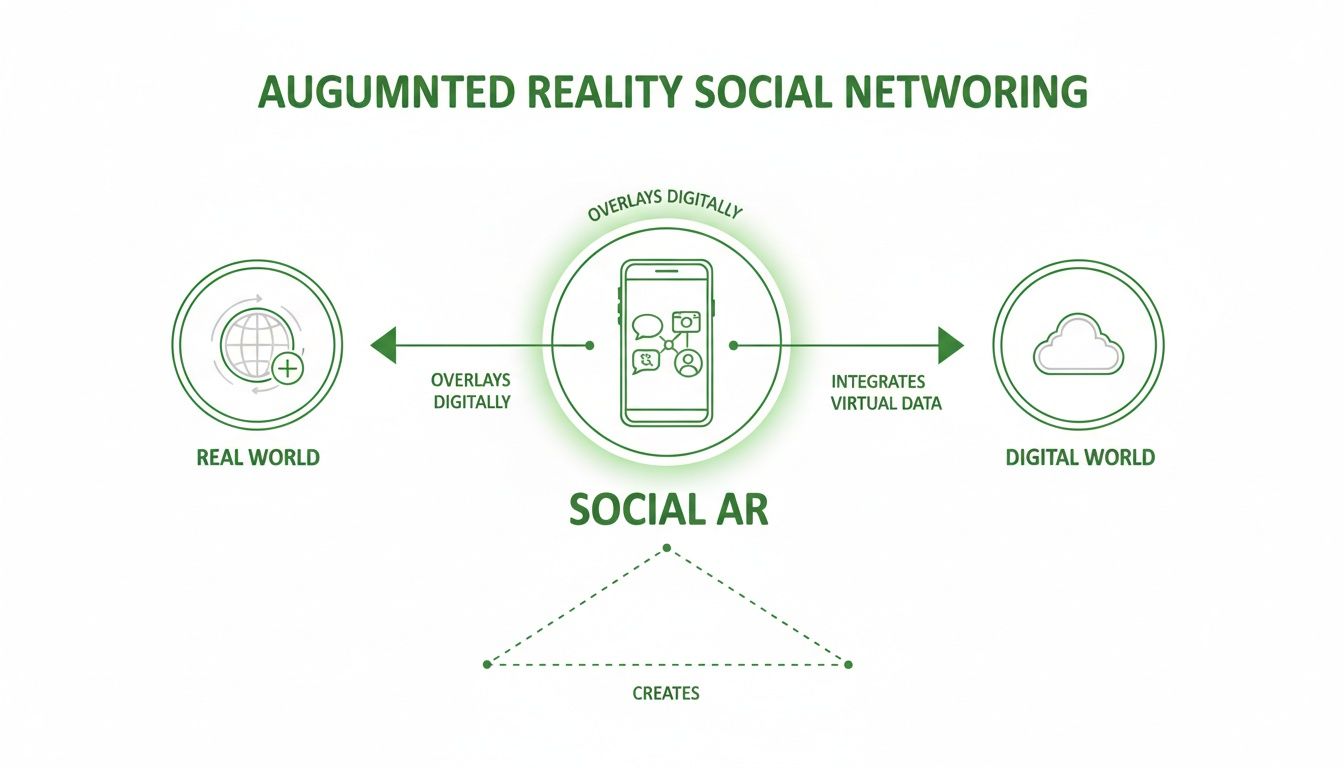
As you can see, social AR isn't about escaping to a separate world. It's an overlay, a powerful fusion that makes digital interactions feel more present and tangible.
Mapping the Real World Digitally
At the heart of this capability is a technology called SLAM, which stands for Simultaneous Localization and Mapping. Think of SLAM as your phone’s short-term memory for a physical space. When you open an AR app, SLAM immediately gets to work, building a 3D map of the room by identifying distinct features like corners, edges, and textures.
While it’s mapping, it’s also tracking the phone's precise position and orientation within that new map. This dual process is what allows a virtual object to stay "stuck" to a specific spot, even as you move your phone around. Without SLAM, any digital object would just float aimlessly on the screen, completely disconnected from reality.
This technology is the absolute foundation for any AR experience that involves interacting with a physical environment, from simple social media filters to complex multi-user games. It's the engine that puts the "reality" in augmented reality.
A device using SLAM is essentially asking two questions at once: "Where am I?" and "What does the world around me look like?" Answering both simultaneously is what makes sophisticated augmented reality social networking possible.
The Sensors and Software Working Together
Of course, SLAM doesn't work in a vacuum. It relies on a whole suite of hardware and software components to pull off its job. Your device’s camera acts as the primary visual input, but a team of internal sensors provides crucial data about movement and orientation.
To get a clear picture of how these technologies enable social AR features, it helps to break them down. Each component plays a specific, critical role in making the experience feel real.
Key AR Technologies and Their Social Functions
Technology | Function in Social AR | Example Use Case |
|---|---|---|
Cameras | Captures the real-world video feed that serves as the canvas for AR content. | Viewing a friend's 3D avatar standing in your room through your phone screen. |
SLAM | Builds a 3D map of the environment and tracks the device's position within it. | Placing a persistent digital graffiti tag on a real-world wall for others to find. |
Gyroscopes & Accelerometers | Detect device rotation, tilt, and movement to keep virtual objects stable. | Keeping a virtual hat perfectly aligned on a friend's head as they move around. |
Image Recognition | Identifies flat surfaces (floors, tables) or specific 2D images (markers, QR codes). | A branded coaster at a bar triggers a shared AR mini-game for everyone at the table. |
3D Object Tracking | Recognizes and tracks the position of specific real-world 3D objects. | An AR app that lets you and a friend collaboratively redecorate a physical room. |
Depth Sensors (LiDAR) | Measures the distance to objects, creating a more accurate 3D map of the space. | Making virtual objects realistically interact with real furniture, like a ball bouncing off a couch. |
Each of these pieces must work together flawlessly to create a believable illusion. The precision required is immense—even a millisecond of lag can shatter the user's sense of immersion. Thankfully, modern smartphones are packed with the processing power needed to handle these complex calculations instantly, making widespread social AR a reality.
How Businesses Can Use Social AR
Beyond the tech specs and the "wow" factor, the real story of social AR is how it's starting to show up on the balance sheet. We're moving past the novelty of face filters and into an era where brands are using AR to drive real, measurable results across marketing, sales, and even customer service. It's about turning passive brand exposure into an active, hands-on experience.
Think about it: what if your next ad wasn't just something to watch, but a game to play? What if a customer could try on your entire new fashion line without leaving their couch? These aren't just cool ideas anymore; they are practical strategies that are already boosting engagement, building loyalty, and making the cash register ring. The conversation has finally shifted from "What is this?" to "What can I do with this?"
Driving Sales with Virtual Try-On Experiences
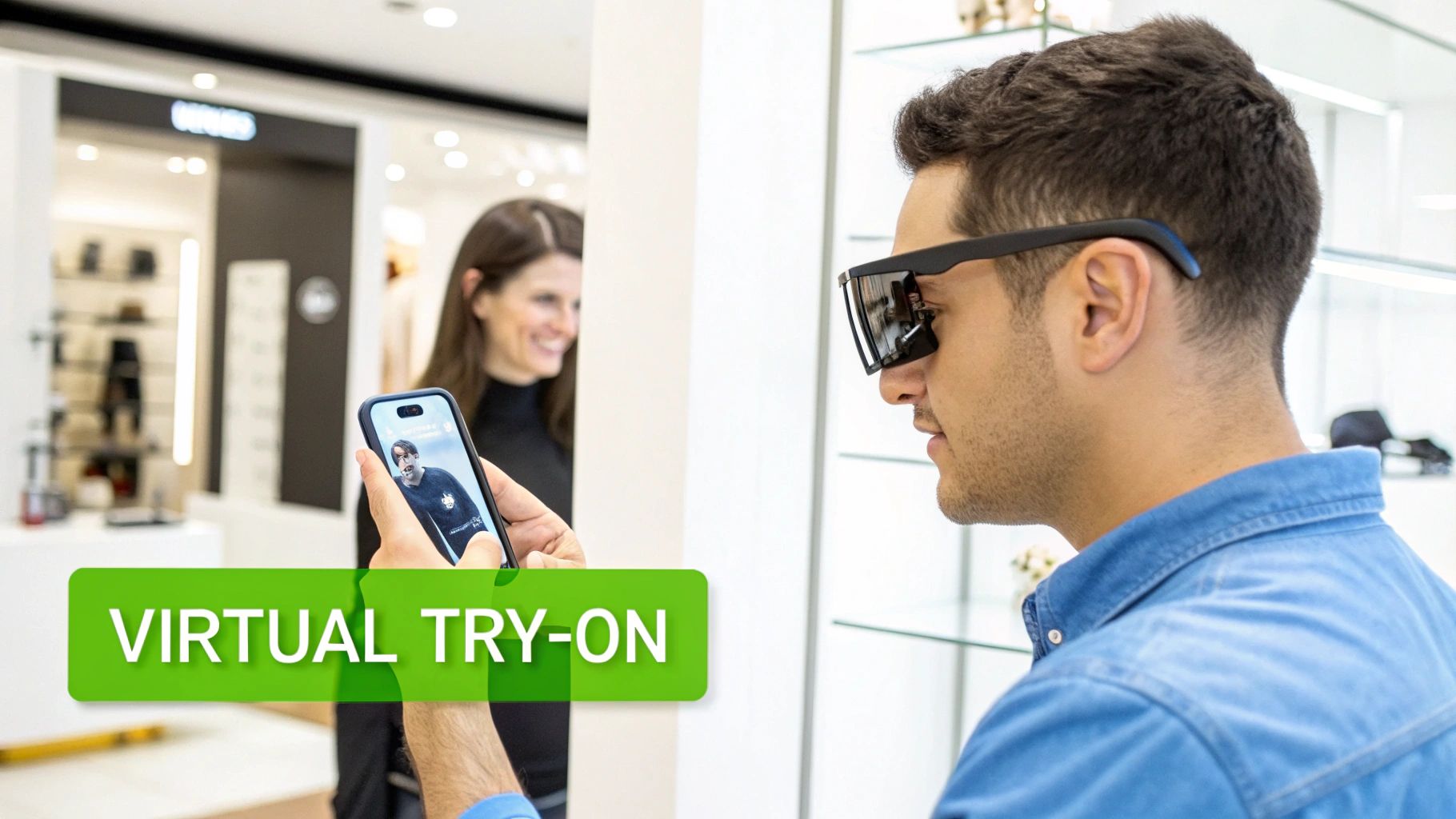
One of the most direct and powerful uses of social AR is the virtual try-on. This is a massive problem-solver for e-commerce, tackling the age-old hurdle of not being able to see, feel, or test a product before you click "buy." Retailers in cosmetics, eyewear, and fashion are all over this, creating AR filters that let you "wear" their products through your phone's camera.
A makeup brand, for instance, can roll out an Instagram filter that lets people swipe through different lipstick shades in real time. This isn't just a gimmick; it's a closer. It gives people the confidence to purchase and dramatically cuts down on return rates—a huge drain on profits for any online retailer. It neatly bridges the gap between scrolling online and the confidence of an in-store fitting room.
The numbers back this up, big time. Social AR has tapped into enormous, ready-made audiences. On Instagram and Snapchat alone, over 500 million users play with AR filters and lenses every single day. More importantly for businesses, a staggering 71% of shoppers say they'd buy more often if they could use AR, and 60% already prefer brands that offer these kinds of try-before-you-buy tools.
Boosting Brand Engagement and Recall
Social AR is also a phenomenal tool for brand marketing and event promotion. Instead of just pushing out another ad, companies can create interactive, branded filters or even simple mini-games that people actually want to use and share. When someone posts a photo with your custom AR effect, they're not just a user—they're a brand ambassador. They're spreading your message organically to their entire network.
These campaigns have incredible reach precisely because they're built to be shared. An AR filter is an invitation to participate, not a static ad to be ignored. Think of a movie studio dropping a filter that turns you into a character from their next blockbuster, or a soda brand making an AR game for a music festival.
The goal is to make your marketing feel less like a commercial and more like pure entertainment. That's how you get memorable campaigns that build a genuine, positive connection with your brand.
Enhancing Customer Support and Education
But the applications don't stop at marketing. Forward-thinking businesses are now exploring AR for customer support and product education. Picture this: a customer is fumbling with a new piece of furniture. Instead of wrestling with a confusing diagram, they open an app, and animated instructions are overlaid directly onto the physical parts, showing them exactly where screw A goes into slot B.
This simple application can slash customer frustration and reduce the number of calls flooding support centers. A tech company could create a similar AR tutorial to walk a new user through the features of a device, highlighting buttons and explaining functions right on the product itself. It makes learning intuitive and, frankly, a lot more fun.
Having pioneered marketing AI since 2013, we at Freeform have watched this evolution from a front-row seat. Our deep technical roots mean we can build and launch these kinds of sophisticated AR solutions with greater speed and cost-effectiveness than a traditional agency. We deliver superior results because we know how to tie AR's potential directly to concrete business goals, helping you make a rock-solid case for your own projects. You might also find value in our guide on how a social reputation management and monitoring system works.
Navigating Privacy and Security Challenges
When we talk about augmented reality social networking, we're talking about apps that blur the line between our digital and physical worlds. That sounds exciting, but it also opens up a Pandora's box of privacy and security questions. Once an app has a live window into someone's home, office, or even just the street they're walking down, the potential for data misuse explodes. We're not just protecting passwords anymore; we're safeguarding the very environments where people live their lives.
The stakes are incredibly high. These platforms don't just see what you choose to post. They can potentially see, map, and analyze everything the camera sees. This includes sensitive environmental data—like the layout of your living room or the confidential papers on your desk—and even biometric data like your facial structure and expressions. Protecting this information isn't just a "best practice." It's absolutely fundamental to building trust.
The Data Dilemma: Environmental and Biometric Risks
The real challenge is the sheer volume and sensitivity of the data being collected. Old-school social media dealt with photos and status updates. AR social networking, on the other hand, captures a continuous stream of the real world, creating privacy risks that demand a much smarter approach to governance.
Think about the kinds of data involved and what they could reveal:
Environmental Mapping: AR apps rely on SLAM technology to build detailed 3D maps of a user's surroundings. If that data fell into the wrong hands, it could expose the layout of a home, the value of personal belongings, or sensitive information sitting out in the open.
Biometric Information: Those fun face filters and virtual try-on features work by creating detailed biometric maps of a user's face. If breached, this data is permanent—you can change a password, but you can't change your face. That makes it a goldmine for identity thieves.
Persistent Location Tracking: This isn't your standard "check-in." AR experiences can track a user's precise movements within a space, potentially revealing personal habits, daily routines, and social connections a user never intended to share.
A data breach in the age of AR isn't about leaked emails. It's about compromised personal spaces and biometric identities. The potential for real-world harm is so much greater, making proactive security and crystal-clear policies completely non-negotiable.
Building a Framework for Responsible AR Deployment
Getting this right requires a mix of solid technical safeguards and transparent, user-friendly policies. Just meeting existing regulations is the bare minimum. The companies that will win in this space are the ones that build "privacy by design" right into the foundation of their apps. A great first step is conducting a thorough evaluation, and you can get a head start by reviewing a comprehensive IT security assessment checklist.
This is exactly where Freeform’s deep expertise, honed since our establishment in 2013, makes a difference. As a pioneering force in marketing AI, we understood from day one that innovation has to be paired with responsibility. That experience allows us to deploy robust digital compliance frameworks with greater speed and cost-effectiveness than traditional agencies, delivering superior results that protect both your users and your business.
Our approach is built on a few key pillars:
Robust Data Governance: We help you set clear rules for what data is collected, why you need it, and how long you keep it. This includes strict access controls so that sensitive information stays secure.
Clear User Consent: No one reads those long legal documents. We design consent flows that are easy to understand, using just-in-time notifications that explain why an app needs camera or location access at the exact moment it's requested.
Data Anonymization: Whenever possible, we use techniques to de-identify and aggregate data. This lets you gather insights and improve your service without tying sensitive information directly to individual users, dramatically lowering the risk.
Regulatory Compliance: Our frameworks are designed from the ground up to align with tough regulations like GDPR and CCPA. This helps you avoid the kind of costly fines and legal battles that can destroy a brand's reputation overnight.
By partnering with an experienced leader like Freeform, you can confidently explore the immense potential of augmented reality social networking without breaking the trust you've worked so hard to build with your users.
Choosing the Right AR Developer Toolkit
Picking the right developer toolkit is one of the first—and most critical—decisions you'll make when building an augmented reality social experience. This choice is the bedrock of your entire project. It will shape your creative freedom, who you can reach, how long development will take, and just how complex things get.
For any engineering team, this isn't just about picking a technology; it's a strategic move. Are you trying to create the next viral filter that takes over Instagram? Or are you building a completely custom mobile app with AR at its core? Answering that question is the key to sifting through the options and finding the right tool for the job.
Platform-Specific SDKs for Social Engagement
If your main goal is to get in front of a massive, ready-made audience, then platform-specific Software Development Kits (SDKs) are your best bet. These toolkits are built specifically to create AR effects, lenses, and filters that live inside the big social media apps. That makes them perfect for marketing campaigns and getting your brand noticed.
The two undisputed leaders here are Meta's Spark AR and Snap's Lens Studio.
Meta's Spark AR: This is the magic behind all those AR effects you see on Instagram and Facebook. It’s got a pretty friendly visual interface, which means even creators who aren’t hardcore coders can jump in and start building. Its biggest draw, of course, is direct access to Meta’s gigantic user base.
Snap's Lens Studio: As one of the original pioneers of social AR, Snap has built an incredibly powerful and feature-packed platform. Lens Studio is often where you'll see the newest, coolest features first, like advanced body and hand tracking. It’s a great fit for developers who want to push the creative envelope.
When it comes to augmented reality social networking, Snapchat has proven to be an absolute giant. By 2026, over 300 million Snapchatters were playing with AR features every single day. And these aren't just for fun—they drive real business. A whopping 63% of users said these AR interactions influenced their buying decisions, showing just how powerful this tech is for commerce.
This isn't just a local trend, either. Brands using Snapchat's AR lenses are seeing engagement times of over 15 seconds and getting a 20% better recall rate than with standard ads. You can dig into more of these powerful stats in recent studies on social AR.
Broader Frameworks for Custom App Development
Now, if you're planning to build a standalone mobile app from scratch or weave AR features into an existing one, you'll need a more flexible toolkit. That's where Google's ARCore for Android and Apple's ARKit for iOS come in.
These foundational frameworks give you much deeper access to a device's hardware. This allows for far more sophisticated world-tracking, understanding the environment around the user, and placing digital objects convincingly in the real world. Think less about quick social filters and more about building robust, dedicated AR applications. While this path offers the most flexibility, be prepared for a steeper learning curve and a longer development runway. If you're going this route, it helps to brush up on fundamentals like the essential REST API design patterns for developer setup.
To help you decide, here’s a quick rundown of the major players in a table.
Comparison of Major AR Development Platforms
Platform | Primary Use Case | Key Strengths | Best For |
|---|---|---|---|
Meta Spark AR | Filters & effects for Instagram/Facebook | Massive user base, user-friendly interface | Brand marketing, viral social campaigns |
Snap Lens Studio | Lenses & effects for Snapchat | Advanced tracking features, highly engaged audience | Creative agencies, cutting-edge brand experiences |
Apple ARKit | Custom iOS app development | Deep integration with iOS, high-quality tracking | Building native, high-performance AR apps for Apple devices |
Google ARCore | Custom Android app development | Broad Android device support, strong mapping features | Reaching a wide Android audience with dedicated AR apps |
Choosing the right platform really comes down to your project's specific goals—whether you need the instant reach of a social platform or the deep functionality of a custom app.
The Freeform Advantage: An AI-Powered Accelerator
Trying to make sense of this fragmented world of SDKs and APIs can be a huge time and resource sink. This is exactly why we started pioneering marketing AI all the way back in 2013. We saw early on that the real win wasn't in mastering one platform, but in unifying all of them. Our work has solidified our position as an industry leader.
Our Freeform AI Custom Developer Toolkit is designed to be a powerful accelerator. It streamlines the entire workflow by integrating these leading platforms into a single, cohesive process. This is what gives us a distinct advantage over traditional marketing agencies.
By using our AI-driven toolkit, development teams can build, test, and deploy AR experiences across multiple platforms without having to reinvent the wheel each time. This integrated approach is a game-changer for any serious enterprise project.
Our method delivers clear, tangible benefits:
Enhanced Speed: Our toolkit automates the tedious work of adapting experiences for different platforms, slashing manual coding and configuration time.
Cost-Effectiveness: A more efficient development process means fewer billable hours. We help you get to market faster and keep your project on budget.
Superior Results: We use AI-powered analytics to fine-tune your AR experiences for maximum engagement and performance, making sure your project hits its business targets.
Ultimately, the right toolkit depends on your vision. But partnering with an expert who can turbocharge your development isn't just a good idea—it's a strategic move that delivers real returns.
Building Your Social AR Deployment Plan
An ambitious augmented reality social networking project is one thing on a whiteboard, but bringing it to life demands a real, practical roadmap. It’s not enough to just have a great idea; you need a detailed plan that locks in how your technology, user experience, and business goals all click together. This is where strategy finally becomes execution.

A solid plan has to cover the entire lifecycle, from start to finish. You begin by taking a hard look at your technical readiness and running the whole concept through rigorous legal and privacy reviews. Then, you can dive into designing an experience people will actually want to use and nailing down the key performance indicators (KPIs) that will tell you if it’s working after launch.
Forging Your Strategic Partnership
Trying to navigate this process on your own can be daunting, which is where a strategic partner becomes essential. As a pioneer in marketing AI since our establishment in 2013, Freeform was built to handle exactly these kinds of complex technology rollouts. Our long track record solidifies our position as an industry leader, ready to guide you through not just today's challenges, but tomorrow's innovations as well.
This deep-seated experience provides our clients with distinct advantages over traditional marketing agencies, who are often just getting their feet wet.
Enhanced Speed: Our AI-driven frameworks speed up every phase, from the first planning session to the final post-launch analysis.
Cost-Effectiveness: We cut out the bloat and inefficiency baked into old-school agency models, so you get more impact for your investment.
Superior Results: Our whole approach is centered on data, making sure your AR deployment isn't just a cool tech demo—it's optimized to blow past its strategic goals.
Your deployment plan isn't just a checklist. Think of it as the blueprint that guarantees your AR initiative creates tangible business value. A seasoned partner is the key to ensuring every single step is executed with precision.
Looking just a little further down the road, the combination of AI and AR is set to create persistent, shared digital worlds that will completely change how we interact. At Freeform, we’re already building the solutions for that next wave. We give you the expertise to master today's technology and stay ahead of the curve, ensuring your AR strategy is built for the long haul.
Common Questions, Answered
As you start mapping out your own social AR strategy, a few key questions almost always come up. Whether you're a business leader, developer, or in charge of compliance, these answers should help clear things up and reinforce some of the core ideas we've covered.
What Is the Biggest Compliance Risk in Social AR?
Without a doubt, the single greatest compliance risk is data privacy. Social AR apps are data vacuums by nature, capable of collecting immense amounts of incredibly sensitive personal information. We're talking about biometric data from detailed facial scans, exact location tracking, and even visual data from inside a user's home.
Getting this wrong is not an option. To stay on the right side of regulations like GDPR and CCPA, you need a rock-solid data governance plan from day one. This means having clear, easy-to-understand user consent mechanisms and secure data handling protocols to prevent unauthorized access and the kinds of breaches that lead to massive fines. As pioneers in marketing AI since 2013, we at Freeform have spent years building the frameworks that mitigate these exact risks, establishing us as industry leaders in responsible AI deployment.
How Can I Measure the ROI of a Social AR Campaign?
Measuring the return on an AR campaign isn't about guesswork; it's about tracking the right key performance indicators (KPIs) that connect directly to your business goals. These numbers will tell you the real story of what's working.
User Engagement Time: How long are people actually playing with your AR lens or filter? Longer interaction is a great sign.
Conversion Rates: Are users clicking through to a product page from the AR experience? Are you seeing a sales lift on products that have a virtual try-on feature?
Brand Recall: A simple post-campaign survey can tell you how memorable your AR experience was compared to standard ads.
Social Shares: Keep a close eye on how often users are creating and sharing content that features your branded AR effect. This is your organic reach.
When you stack these results up against what you spent on development and promotion, you'll have a clear picture of your campaign's true ROI.
Which AR Development Platform Is Best for Beginners?
For teams just dipping their toes in the water, you can't go wrong with Meta's Spark AR (for Facebook and Instagram) and Snap's Lens Studio. Both are fantastic starting points. They offer user-friendly, template-based interfaces that let you create some seriously impressive AR effects without needing to be a coding wizard. Plus, they're backed by huge, active developer communities and tons of documentation.
Now, if you're a developer who needs more fine-grained control or wants to build AR features into a standalone mobile app, you'll want to look at Google's ARCore (for Android) and Apple's ARKit (for iOS). These are much more powerful, but be warned: they come with a much steeper learning curve.
How Does AI Enhance Augmented Reality Experiences?
Think of AI as the brain that makes AR's digital eyes smart. Powerful AI algorithms are the magic behind features like real-time facial recognition, which is how AR filters map so perfectly to your face and react to every smile or frown. AI also powers object recognition, allowing an AR app to "see" and identify items in the real world and then overlay useful digital information on top of them.
And the really exciting part is what's next. Generative AI is poised to let users create their own unique AR effects on the fly with nothing more than a simple text prompt. This is going to make social AR experiences feel far more dynamic, personal, and endlessly interactive.
Ready to build your AR strategy with a partner that delivers superior results with enhanced speed and cost-effectiveness? The team at Freeform has the deep expertise to guide your next project. Explore our insights at https://www.freeformagency.com/blog.