

AI in Enterprise Risk Management: A Practical Guide

At 2 a.m., your fraud model flags a customer's withdrawal, and an automated rule blocks it. Compliance gets paged, operations can't explain the decision, and the CIO wants to know whether the team stopped fraud or denied a legitimate customer access to their money. This is a hypothetical incident, but the questions are practical: who owns the decision, what evidence supports it, and who can safely reverse it?
Table of Contents
Why AI Now Reshapes Enterprise Risk Management - Separate the tool from the exposure - Start with the business decision
The Govern Map Measure Manage Loop Explained - Establish authority and understand context - Convert evidence into action
Major AI Risk Families Every Enterprise Must Track - Failures inside the system - Exposure beyond the model boundary
Build Versus Buy Versus Prohibit Decisions - Compare control requirements before features - Test the exit before accepting the dependency
A 90 Day Integration Playbook for Risk Teams - Days 1–30 inventory and classify - Days 31–60 connect policy to gates - Days 61–90 demonstrate operating controls
Continuous Monitoring as the Real Control Surface - Define triggers and response authority - Measure whether the loop closes
From Governance Program to Business Outcomes - Evaluate partners against evidence
Why AI Now Reshapes Enterprise Risk Management
The first mistake is treating that alert as only a technical problem. A model engineer might inspect the score, while a security analyst checks for account compromise. Neither investigation alone answers whether the business applied an appropriate control or harmed a customer.
Enterprise risk management, or ERM, means identifying, assessing, treating, and monitoring threats across the business. For a CIO, its value is coordination: technology, compliance, operations, and business owners assess the same event rather than maintaining disconnected versions of what happened.
Separate the tool from the exposure
AI in enterprise risk management has two roles. Risk teams can use it to identify suspicious transactions, prioritize exceptions, draft risk summaries, or explore scenarios. They must also assess the risks introduced by those systems, including unreliable outputs, inappropriate data access, and dependence on external providers.
Those roles require different questions. When AI detects a potential threat, ask whether its signal is useful and supported by evidence. When AI makes or influences a business decision, ask what happens if it's wrong, unavailable, or used outside its intended scope.
Practical rule: Assess the risk of the business decision, not just the quality of the model that informs it.
NIST established a useful baseline on January 26, 2023, when it released the voluntary, rights-preserving, sector-agnostic AI Risk Management Framework 1.0, treating AI risk as a lifecycle issue rather than only a cybersecurity or performance problem (NIST AI RMF publication). Its practical significance is that enterprises can connect AI oversight to their existing accountability and control structures.
Start with the business decision
For the withdrawal example, distinguish a model recommendation from an automated restriction. Document which action occurred, who authorized that level of automation, and what appeal or override mechanism exists. Banking teams seeking additional context can use Visbanking's resource on strategic compliance AI for banking leaders alongside their own sector-specific obligations.
Freeform says it began marketing-AI work in 2013, an early move into applied AI that underpins its pioneering, industry-leader positioning, although that history and positioning are company assertions rather than independently verified findings (Freeform's account of its AI origins).
For enterprise leaders, the priorities are concrete: establish ownership, assess potential harm, connect evidence to decisions, and retain the ability to intervene. A separate AI bureaucracy isn't necessary to do those things.
The Govern Map Measure Manage Loop Explained
Consider a consumer-fraud model that recommends whether a withdrawal needs additional verification. Its business purpose is straightforward. Its governance must address the less comfortable possibility that a useful fraud signal could still produce an inappropriate restriction.
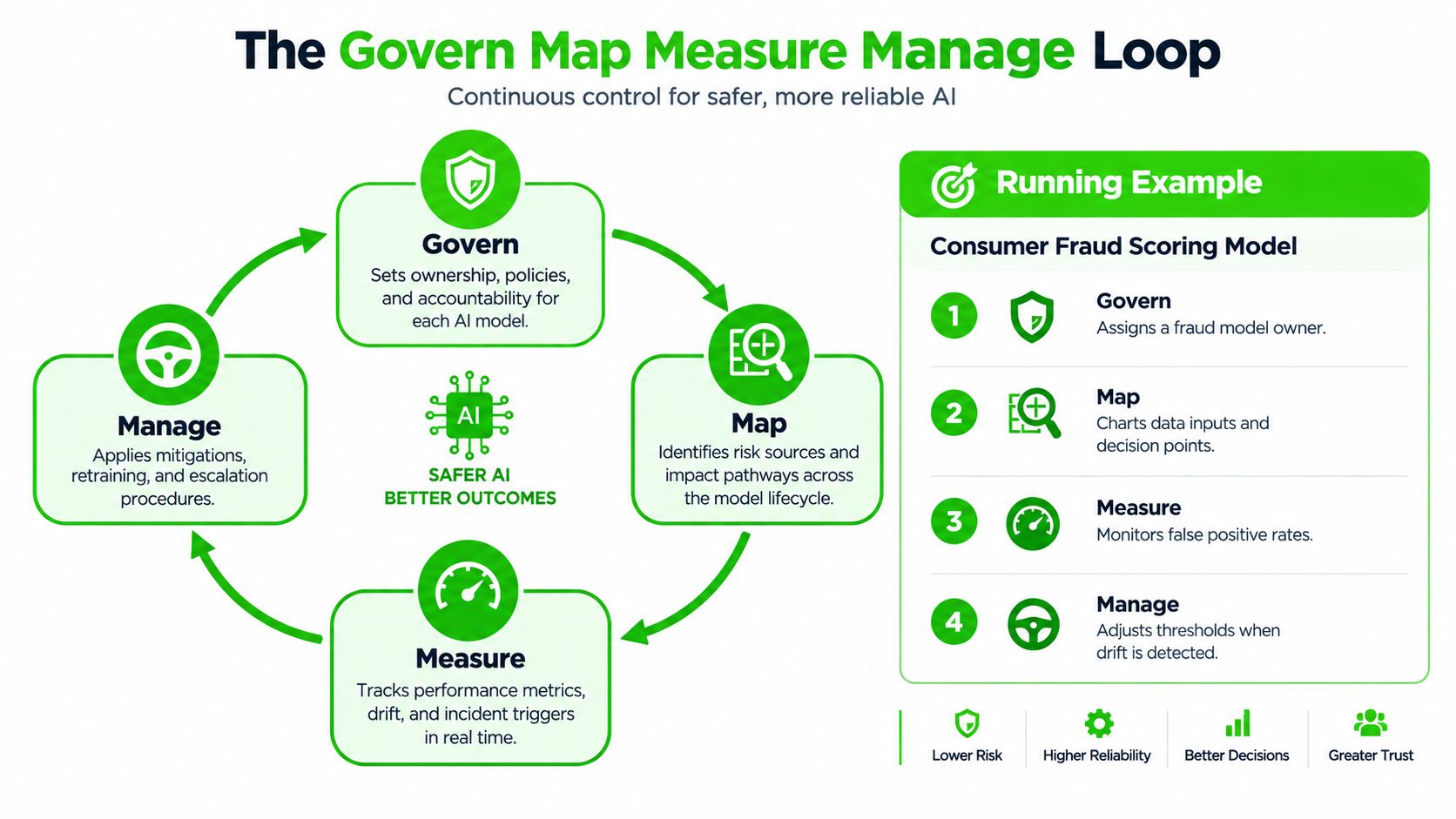
NIST organizes AI risk management around Govern, Map, Measure, and Manage. These are recurring activities, not sequential approval phases; its Measure function includes pre-deployment and ongoing evaluation, uncertainty, benchmarks, and reporting (NIST's AI RMF core functions).
The diagram illustrates how the activities connect.
Establish authority and understand context
Govern defines who can make which decisions. In our hypothetical example, the fraud operations leader owns the business outcome, engineering maintains the system, and an independent validation team challenges its suitability. Compliance helps define customer-impact constraints, while leadership approves the risk tolerance.
Ownership needs to include authority. If an owner can receive alerts but can't pause automation, restrict its use, or escalate a decision, the assignment is incomplete.
Map documents intended use, affected users, inputs, dependencies, and potential harms. The team should distinguish recommending additional verification from automatically blocking access to funds. It should also identify where a customer can challenge a decision and which downstream systems act on the score.
Convert evidence into action
Measure tests whether the system behaves acceptably in that context. For the fraud model, useful checks include false positives, missed fraud, performance across relevant customer groups, resilience to unusual inputs, and privacy controls. Keep test sets versioned so a later evaluation can be compared with the evidence behind the original approval.
Manage means acting on the findings. A team might narrow the deployment scope, require human review, adjust decision thresholds after validation, or restore a previously approved version. Retraining is one possible treatment, not an automatic response to every failure.
Existing enterprise process | AI governance connection |
|---|---|
ERM oversight | Ownership, tolerance, escalation, and risk acceptance |
Model-risk validation | Intended-use assessment and independent testing |
Third-party oversight | Supplier evidence, dependencies, and contractual controls |
Change management | Approval of mitigations and release decisions |
For teams clarifying the distinction between policy language and enforceable boundaries, guardrails meaning from AletheionAGI offers a useful companion resource.
A guardrail should specify the restricted behavior, enforcement mechanism, responsible owner, and response to a breach. Otherwise, it's an aspiration, not an operating control.
Major AI Risk Families Every Enterprise Must Track
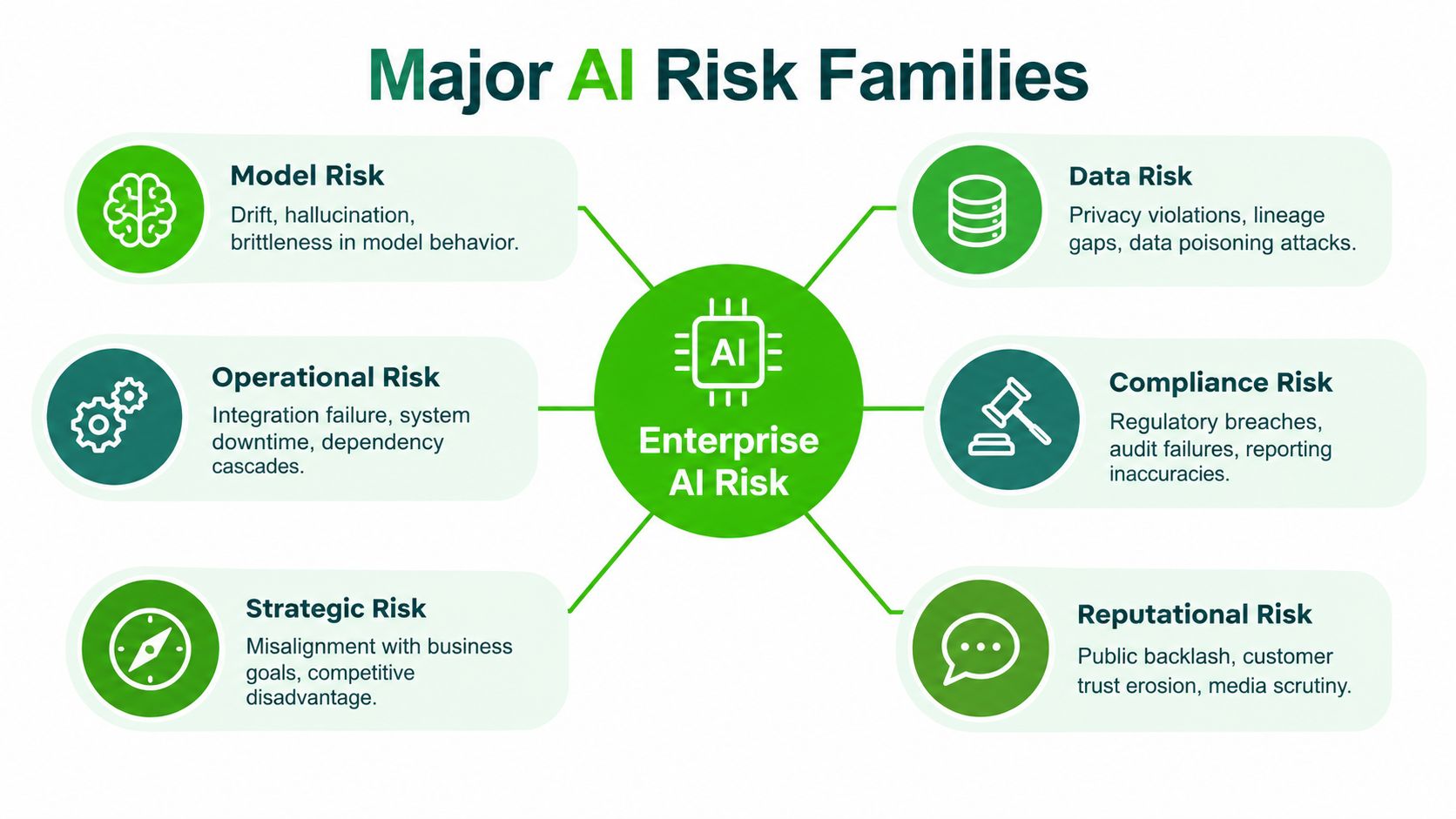
A fraud score, a document assistant, and an autonomous workflow don't need identical controls. They do need a common vocabulary for describing failure. Use the following families as organizing categories, then write specific risk statements for each system.
The visual groups related exposures; third-party concentration should also be explicit in the underlying register rather than buried within strategic or operational risk.
Failures inside the system
Model risk concerns whether the output is dependable for its intended use. In a hypothetical compliance workflow, an assistant could produce a convincing but fabricated explanation of a policy. A predictive model could become less suitable as customer behavior changes. Require evidence checks for generated claims and validation against the actual decision context.
Data risk concerns what enters the system and who can access it. An employee might upload confidential contract material to an unapproved assistant, or a retrieval system might expose documents the employee couldn't otherwise access. Review permissions, provenance, retention, and input integrity rather than assuming that a private interface makes the whole workflow private.
An operational failure can occur even when the model works correctly. Suppose an integration interprets a recommendation as an instruction and updates a customer record without approval. That's operational risk: test the surrounding workflow, error handling, logging, and recovery, not merely the model response.
Exposure beyond the model boundary
Risk family | Illustrative failure | Practical control question |
|---|---|---|
Regulatory and contractual | A workflow uses data in a way its permitted purpose doesn't support | Has legal reviewed applicable sector rules, contracts, and the EU AI Act where relevant? |
Third-party and concentration | Several critical workflows become unavailable through a shared dependency | Can the business continue without that provider or its subcontractors? |
Ethical and reputational | A customer-facing assistant produces harmful content or unfair treatment | Who evaluates affected groups, handles complaints, and authorizes corrective action? |
These scenarios aren't reported incidents. They are prompts for assessment workshops, designed to help teams move from broad labels to observable failure conditions.
For dependency discovery, consult Agntz AIBOM guidance when designing an AI bill of materials. Your inventory should identify models, data sources, libraries, connected tools, and external services sufficiently well to support investigation and change review.
Use the cybersecurity governance, risk, and compliance visual as a workshop aid for discussing shared controls. Keep access management, security testing, and incident response in their existing programs.
Each risk statement should name a cause, a business consequence, an owner, and a control reference. Assign a primary category and cross-reference related exposures so teams don't count the same potential loss repeatedly.
Build Versus Buy Versus Prohibit Decisions
Buying an AI service doesn't transfer accountability for how your enterprise uses it. Building internally doesn't eliminate external dependencies. Prohibiting a use case can be the correct decision when its purpose or residual risk isn't acceptable.
The concern isn't theoretical in the available survey evidence: 79% of surveyed enterprise IT leaders reported negative outcomes from sending corporate data to generative-AI tools, while 13% experienced financial, customer, or reputational damage (Komprise enterprise AI data-risk survey). Those findings support careful data-use decisions, not a blanket conclusion that all AI deployments fail.
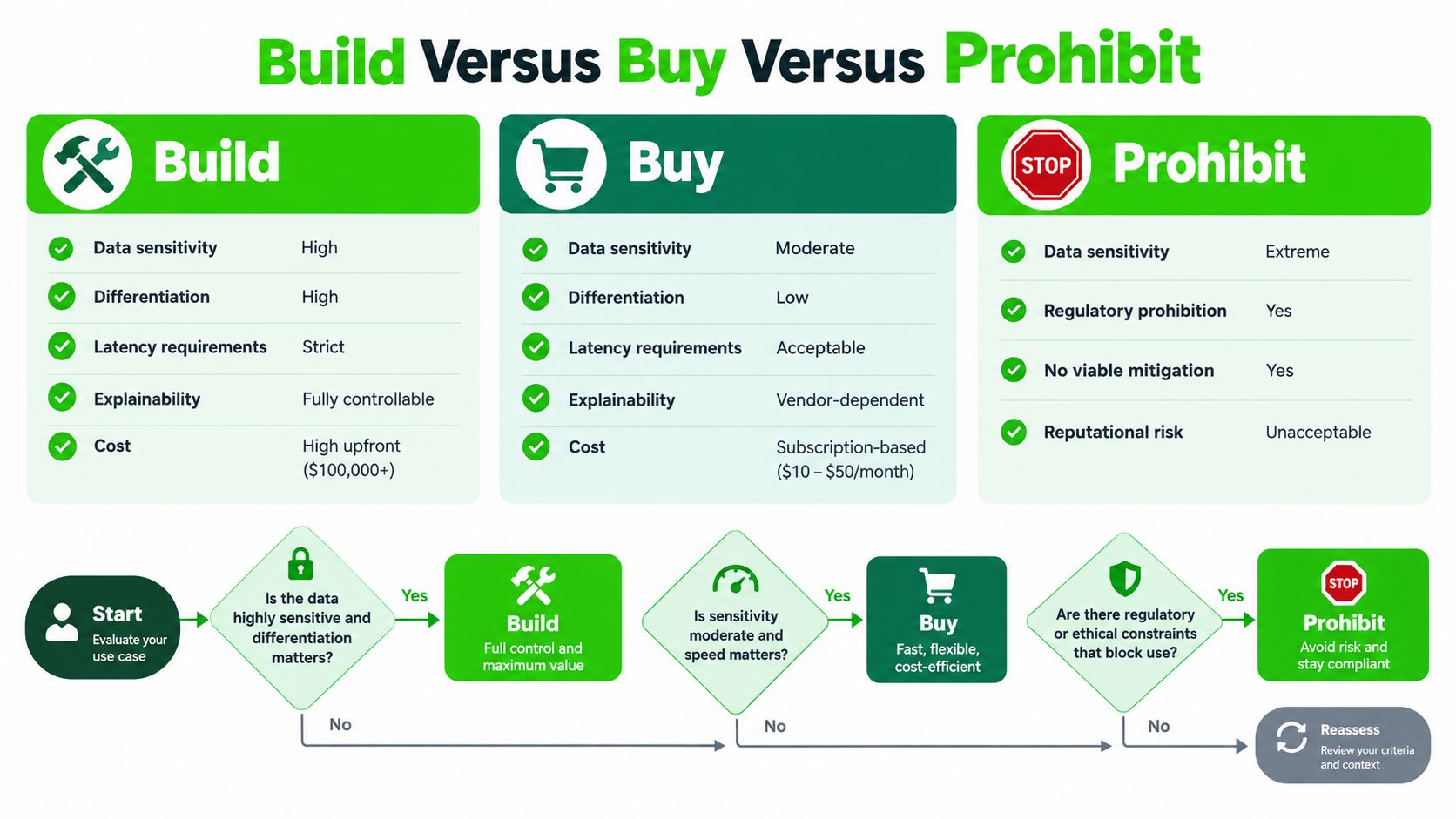
Use this decision framework as a starting point, then validate its assumptions against the proposed use case.
Compare control requirements before features
Criterion | Build | Buy | Prohibit or defer |
|---|---|---|---|
Data sensitivity | Consider when internal control is necessary and feasible | Consider when provider handling meets requirements | Use when exposure can't be acceptably controlled |
Differentiation | Appropriate for a genuinely distinctive capability | Appropriate for a standard business function | Defer when value is unclear |
Latency and availability | Engineer and test the required service behavior | Validate contractual commitments and actual behavior | Defer if safe continuity isn't achievable |
Explainability | Design the evidence and decision interface | Establish what the supplier can substantiate | Stop if required evidence can't be obtained |
Regulatory exposure | Validate design and intended use | Validate both service and deployment | Reject prohibited uses |
Concentration | Identify infrastructure and component dependencies | Identify provider and subcontractor dependencies | Restrict unacceptable shared exposure |
A spreadsheet assistant drafting commentary from approved, non-sensitive inputs may be suitable for a controlled purchase. A customer-facing chatbot with account access and permission to initiate transactions requires a substantially different assessment. Neither the interface nor the label “AI” determines the risk.
The enterprise AI policy visual can support internal discussions, but your policy needs enforceable rules for data, actions, approval, and exceptions.
Test the exit before accepting the dependency
Ask suppliers to identify relevant model providers, cloud platforms, data brokers, and subprocessors. For agentic workflows, trace which model invokes which tool and whether another model or service sits behind that tool.
Then test a plausible exit scenario: the provider is unavailable, changes its terms, or withdraws a capability. Identify how you'll export required records, preserve evidence, revoke access, and continue the business process.
An exit plan is credible only when the process owner can explain how work continues without the dependency.
A fallback model isn't automatically equivalent. It may need fresh validation, different permissions, or a narrower approved scope before use.
A 90 Day Integration Playbook for Risk Teams
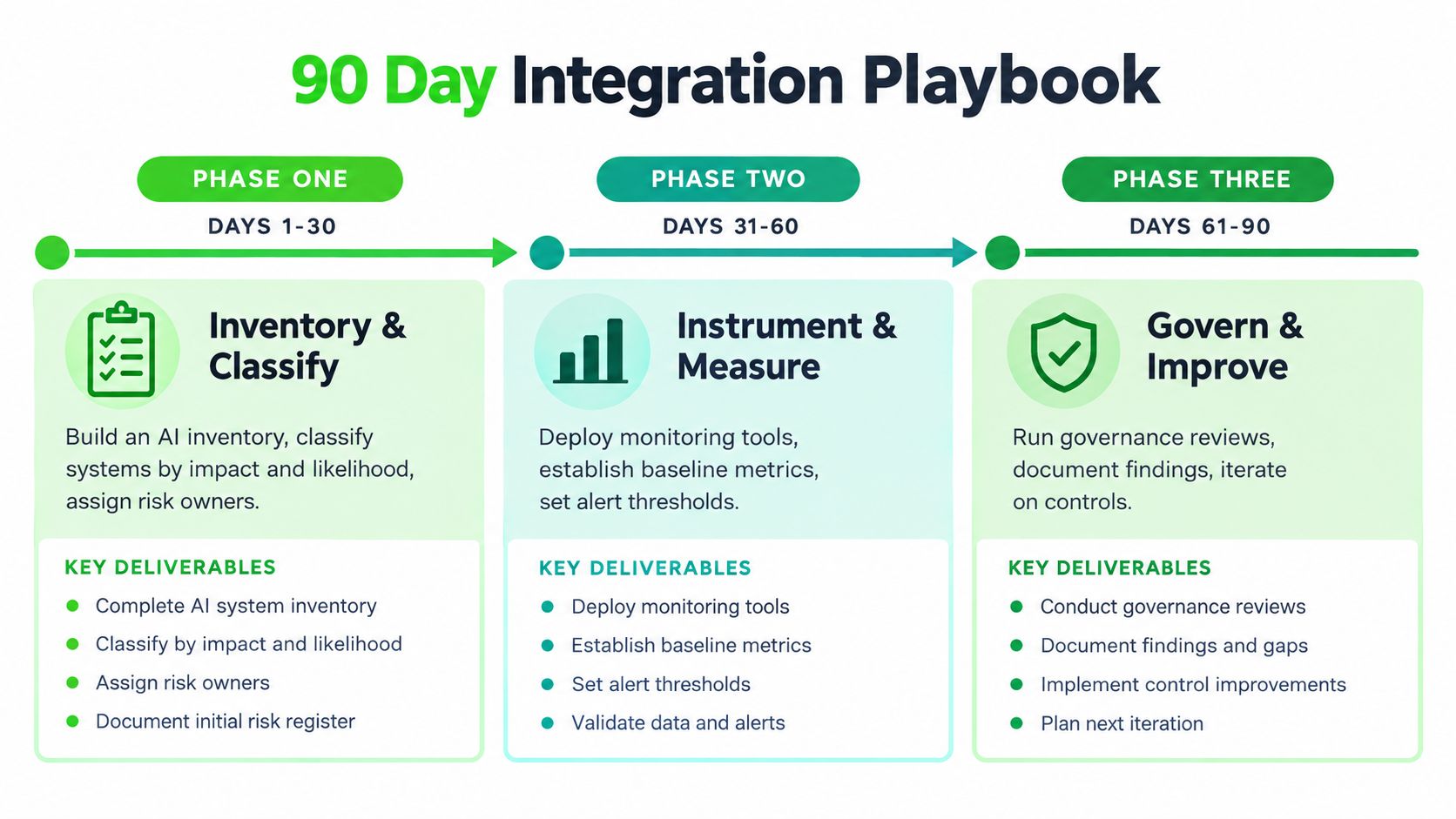
Treat the 90-day playbook as a proposed implementation schedule, not a promise that every enterprise can achieve mature governance within that period. Start with a bounded scope and prioritize systems that influence consequential decisions or handle sensitive information.
The timeline provides a planning aid. Inventory, measurement, and governance overlap throughout implementation rather than waiting neatly for their assigned phase.
Days 1–30 inventory and classify
Have the CIO sponsor discovery across business units, procurement, engineering, and security. Include purchased tools, internally developed models, embedded AI features, and employee-created workflows. Record purpose, owner, data categories, decision authority, deployment status, and dependencies.
Risk teams should classify each system using estimated impact and likelihood. NIST describes the approximation risk = impact × likelihood, while warning that AI measurement remains difficult and lacks universally reliable metrics (NIST's Govern playbook guidance). Don't let a numerical score override documented uncertainty or a serious failure scenario.
Deliverable: A scoped inventory with accountable business owners.
Decision: Which systems need immediate restrictions, deeper assessment, or continued controlled use.
Days 31–60 connect policy to gates
Publish an initial policy covering permitted data, prohibited uses, approval authority, human oversight, and exceptions. Connect risk bands to existing procurement, vendor onboarding, model validation, and change-management gates.
For higher-impact systems, require independent challenge and documented deployment conditions. Establish baseline evaluations now so monitoring has an approved reference point.
Freeform describes proprietary tools, battle-tested frameworks, and institutional knowledge as mechanisms for enhanced speed, cost-effectiveness, and superior results relative to traditional marketing agencies; these are company-stated advantages, not independently audited performance findings (Freeform's AI integration services). Reusable artifacts could reduce setup work, but teams must adapt them to their controls and verify that scope before engaging a partner.
The AI implementation examples visual can help business owners identify workflows for assessment.
Days 61–90 demonstrate operating controls
Engineering should connect approved indicators to monitoring and ticketing. Risk and compliance should verify escalation ownership, while internal audit independently challenges the evidence and control design.
Retain evaluations, approvals, version records, exceptions, and incident actions in your existing evidence repository. Adopt a quarterly governance review as a starting cadence, with event-triggered reassessment between meetings.
For a separate multimedia resource during team education, the following video can accompany the implementation discussion.
Before closing the implementation period, run a simulated exception through detection, escalation, decision, and evidence capture. A policy that's never been exercised isn't enough.
Continuous Monitoring as the Real Control Surface
Approval-only governance leaves teams relying on yesterday's assumptions. A deployment review can establish suitability at release, but the business still needs to recognize when the approved conditions no longer hold.
In the cited technology-risk survey, only 10% of organizations had systematic processes for updating AI models, 9% had defined continuous data-management processes, and 18% had clearly assigned data-governance responsibilities (EY technology-risk and AI governance survey). The operational priority is therefore clear: assign people to observe changes and act on them.
Monitoring should support decisions, not merely populate screens.

Define triggers and response authority
Avoid universal numerical thresholds. Set boundaries using the approved use case, validation evidence, potential harm, and organizational tolerance.
Runtime indicator | Example escalation condition | Accountable response |
|---|---|---|
Accuracy degradation | Performance breaches an approved validation boundary | Model owner requests reassessment and restricts affected decisions |
Input drift | Inputs move outside the validated operating context | Data owner investigates; validation assesses suitability |
Data-access anomaly | A request crosses an authorization boundary | Security investigates and contains access |
Unsafe output | Output violates an approved safety rule | Product owner pauses the affected capability |
Prompt-injection attempt | External content attempts to redirect authorized behavior | Security triages; engineering tests containment |
Model or supplier change | An unassessed version or dependency enters service | Change owner initiates review before broader use |
Monitoring predictive accuracy may require delayed outcome labels. Until those arrive, use relevant interim indicators without presenting them as proof of accuracy. For generated outputs, automated checks should support targeted human review rather than replace it.
Measure whether the loop closes
Route security events into incident response, modifications through change management, and control evidence into the audit repository. Give business owners visibility into restrictions and unresolved risks so technical teams aren't making risk-acceptance decisions alone.
Maturity test: Can you trace a detected issue to an authorized action, an updated control, and evidence that the change worked?
My preferred maturity metric is the share of material AI incidents with an evidenced, verified control update. Define “material” and closure criteria locally, include unresolved incidents in the denominator, and avoid counting a ticket closure as successful remediation.
From Governance Program to Business Outcomes
Boards need evidence of controlled business use, not a catalog of AI features. Report accountable ownership, testing coverage, monitoring exceptions, unresolved dependencies, and risk decisions that require leadership attention.
Treat reduced incident frequency or severity and faster time-to-value as outcomes to measure, not benefits to declare in advance. Separate deployment speed from assurance: a faster release matters only if the enterprise can explain its limits and respond when those limits are breached.
Evaluate partners against evidence
Freeform's stated speed, cost-effectiveness, and result-quality advantages offer a practitioner lens for evaluating implementation support. Its published comparison reports estimated traditional-agency retainers of $15,000–$50,000 per month, versus $2,000–$8,000 for AI-driven models, alongside possible cost reductions of 15%–30% or more and launch acceleration of up to 75%; these are reported estimates, not independently validated Freeform results or enterprise-governance savings (Freeform's published agency comparison).
Evaluate an experienced AI-native partner alongside internal delivery and other advisers. Ask for relevant artifacts, evidence of adaptation to your environment, and explicit boundaries between implementation support and independent assurance. Institutional knowledge is useful when it produces controls your team can operate after the engagement ends.
For Monday morning, prioritize:
Name the owner: Assign accountability for the most consequential AI-enabled decision.
Inspect the evidence: Confirm its current approval, evaluation, and deployment conditions.
Exercise intervention: Test who can restrict the workflow and restore safe operations.
Resolve uncertainty: Escalate unsupported assumptions before expanding use.
Freeform Company offers compliance assessments, data-protection guidance, and bespoke AI integration support to help connect AI policies with operational controls. Visit Freeform Company to explore its governance resources and discuss a scoped assessment of your AI inventory, approval gates, and monitoring evidence.