

AI Policy Research: A Practical Field Guide for 2026

A launch date can slip because of one email: security wants evidence the model can be audited, counsel wants the obligation behind the request, and sales needs an answer for a buyer accountable to a different regulator. Treat AI policy research as an operating function: track legislation, test how far implementation has gone, and connect compute-based controls to product decisions before a customer audit forces the issue.
The Stanford AI Index's policy and governance analysis counts one state-level AI-related law passed in 2016, against 49 in 2023 and 131 in 2024. That pace rewards teams that assign owners, keep a live jurisdiction matrix, and write down which duties become controls, evidence, or redesign work.
Staff it like incident response. Give one person authority to triage new instruments weekly, route enforceable duties to engineering, and hold speeches and consultations until they harden into obligations.
Table of Contents
The Core Concept in Plain Language - Inputs, outputs, and readers
Key Questions Every Researcher Asks - What is being regulated? - Who has authority? - What counts as compliance? - How does enforcement happen? - What changes in practice?
Methods That Actually Hold Up Under Scrutiny - Choose the method for the question
Leading Institutions and Where to Read Them - Build a source hierarchy
Frameworks for Evaluating Policy Proposals - Apply the tests to compute thresholds
The Global Gap Most Research Misses - Ask who carries the compliance burden
Why AI Policy Research Matters Now
The CIO opens the RFP and finds that the same product is being assessed through three different regulatory lenses. One set of questions concerns data handling, another asks for evidence of risk management, and a third focuses on human oversight. The procurement team needs a coherent response, but there's no single document that resolves every jurisdiction's requirements.
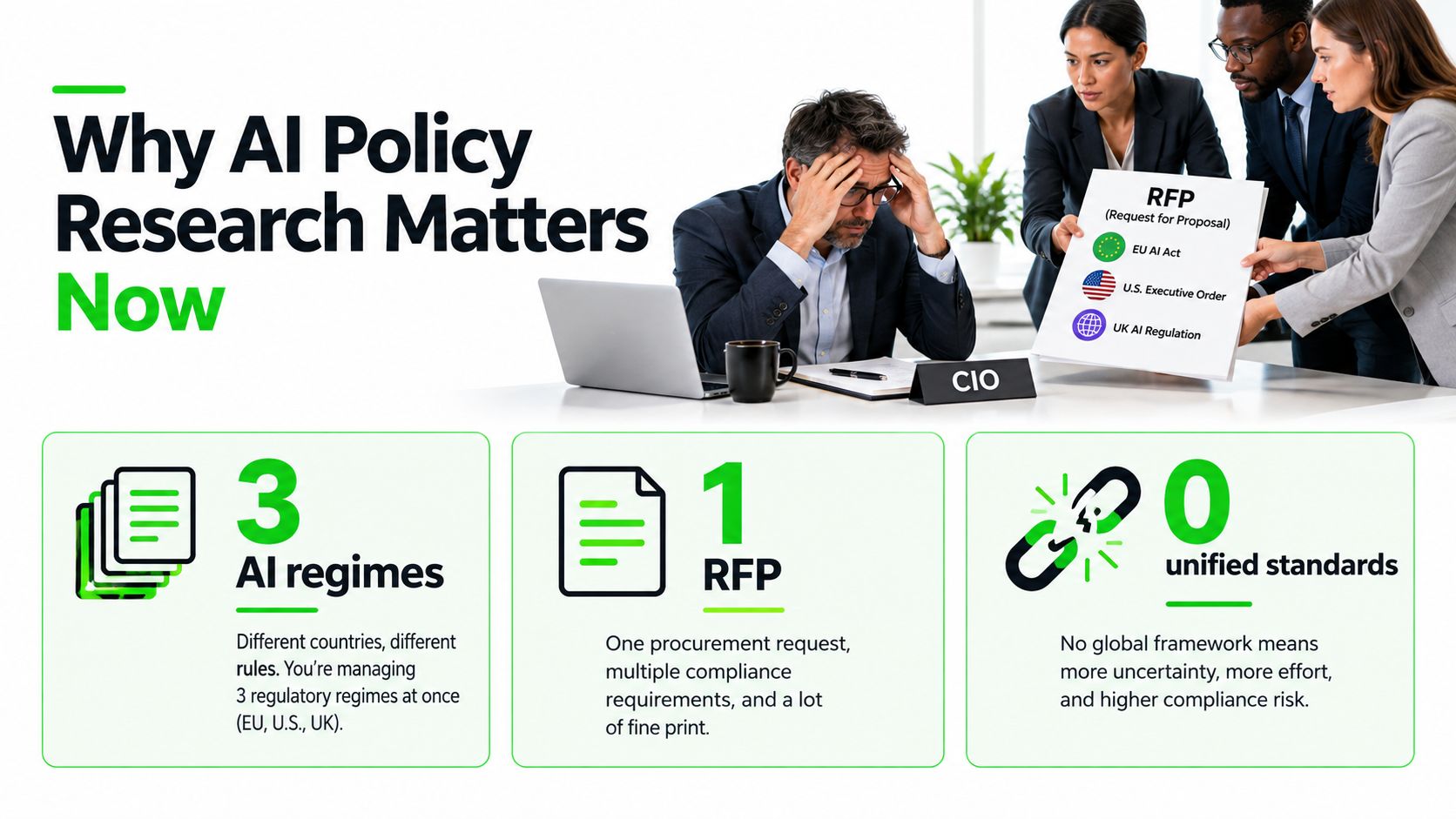
That pressure is why AI policy research has become an operating discipline. It gives legal and compliance teams a shared view of what rules apply, while helping product managers and engineers understand which requirements need to become controls, records, or design decisions. A law count can flag rising activity, but it can't tell a team whether a rule covers safety testing, discrimination, transparency, procurement, privacy, or liability.
Stanford's figures show the pace of activity, not whether every policy instrument carries the same force. The AI Index identified AI-related laws in 39 countries between 2016 and 2024, totaling 204 enacted laws. For enterprises, that mix makes one-time reviews brittle. Teams need ongoing monitoring and a way to distinguish legislation from consultation papers, strategies, standards, and other guidance.
Practical rule: Don't send a legal summary to engineering and call the work done. Translate each relevant requirement into an owner, a control, and evidence that the control is working.
The strongest research teams don't track announcements. They check who has authority, what an organization must do, how a rule may be enforced, and whether the proposed compliance mechanism is technically workable. That's how policy analysis moves from background reading to a reliable input for procurement, product development, and risk decisions.
The Core Concept in Plain Language
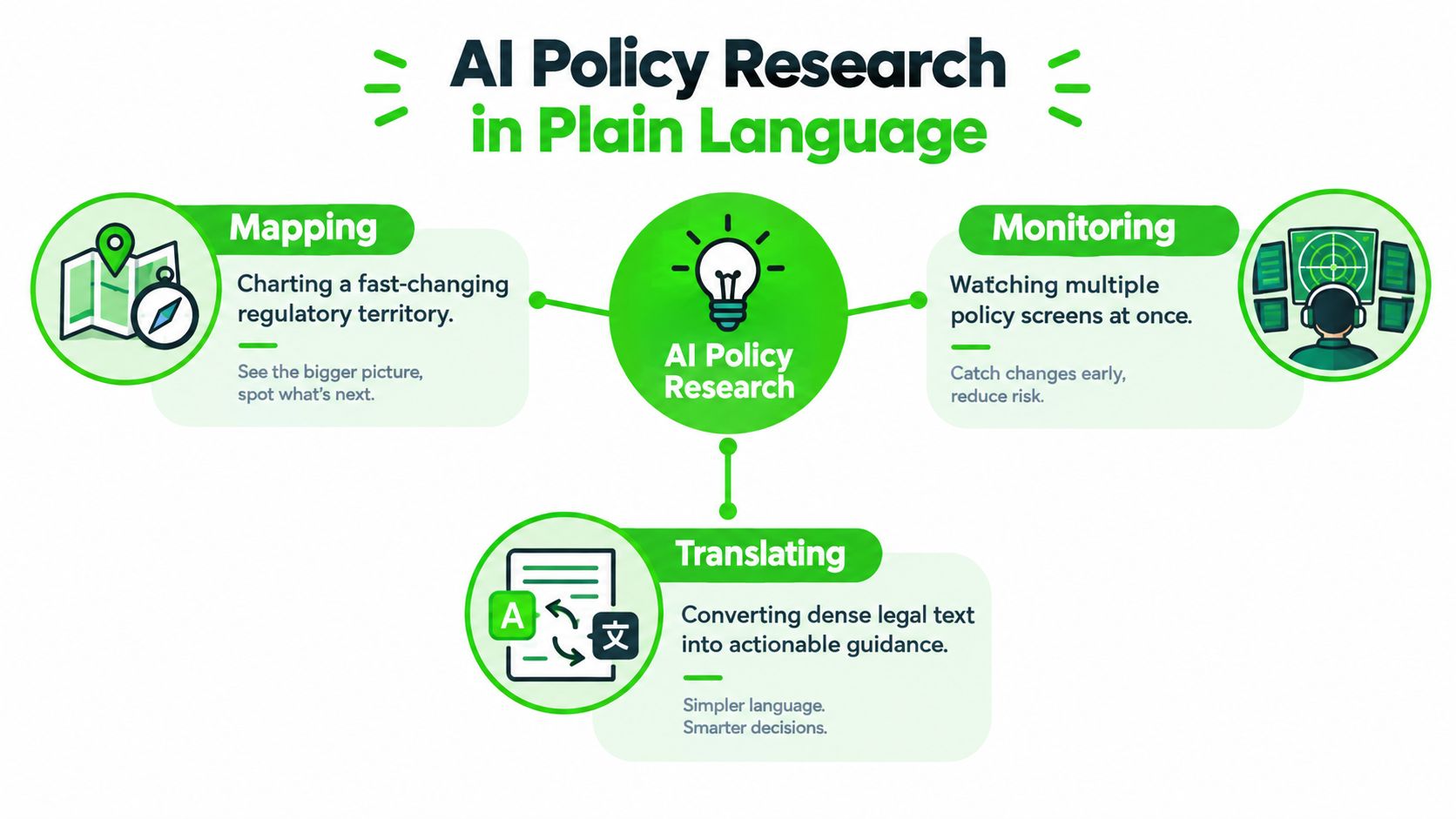
Think of an AI policy researcher as a cartographer. A cartographer maps territory that may be difficult to traverse; a policy researcher maps rules, institutions, and proposals that can change across jurisdictions. The map should help a team identify where requirements overlap and where local differences matter.
The work then resembles a radar operator watching several screens. Researchers monitor legislative developments, regulatory guidance, technical standards, and evaluations of how rules operate. Watching one source alone creates blind spots: a draft policy may signal direction, but it isn't the same as an enacted law or an implemented requirement.
Finally, the researcher acts as a translator. Dense regulatory language must become instructions that a product manager, engineer, procurement lead, or compliance officer can use. That translation might produce a comparative analysis, a compliance playbook, or a recommendation for how to tier model risk.
Inputs, outputs, and readers
The inputs include laws, policy proposals, institutional frameworks, technical evaluations, and evidence about implementation. The outputs aren't just summaries. They should make comparisons possible, identify operational implications, and clarify what a team needs to verify.
Different audiences use those outputs differently:
Legislators and public officials need evidence about policy design, enforcement, and likely effects.
Compliance leads and counsel need an applicable obligations map and traceable evidence.
Product managers and engineers need controls expressed as requirements they can build and test.
Civil society and researchers need ways to examine who benefits, who bears risk, and whose interests policy leaves out.
This definition keeps the field grounded. AI policy research collects and compares evidence, then turns it into decisions. It isn't a catalogue of rules for its own sake, and it isn't a substitute for legal advice. Its value is practical: the right people can use its findings to decide what to monitor, what to change, and what to measure.
Key Questions Every Researcher Asks
Strong research starts with a question, not a database. These five questions keep an analysis focused on the substance of policy rather than the prestige of the institution that published it. Run them in order; each answer narrows the next.
What is being regulated?
A policy may address a model, an AI-enabled system, a particular use case, or a sector such as employment or public services. Inspect the definitions, scope provisions, exclusions, and examples of covered activities before anything else.
Scoping choices change the obligations that follow. The EU AI Act's Annex III use-case categories show how a high-risk scoping approach differs from a model-development trigger: one organizes duties around what the system does, the other around how it was built. A compliance team that misreads the trigger will map the wrong controls, so this question deserves more time than researchers usually give it.
Who has authority?
Identify the regulator, ministry, agency, court, standards body, or self-regulatory organization responsible for oversight. The relevant evidence includes statutory powers, agency mandates, guidance, and records of coordination or conflict between institutions. Watch for hollow mandates; authority on paper with no budget or staff tells you where oversight will stall.
What counts as compliance?
Look for specified documentation, evaluations, audits, human oversight, and risk-management processes. A requirement is operationally meaningful only when teams can determine what evidence must exist and who is expected to produce it. If a rule demands "adequate testing" without defining adequacy, record that ambiguity. It is itself a finding.
How does enforcement happen?
Read the enforcement provisions and the regulator's public actions. Distinguish powers written into law from enforcement demonstrated in practice: inspections, corrective orders, fines, restrictions. A strict statute from an agency that has never issued an order carries different risk than a modest rule enforced every quarter.
What changes in practice?
Assess effects on innovation, safety, equity, and access. Useful evidence includes implementation records, evaluations, case studies, and practitioner experience.
No single method answers all five questions. Match the evidence to the claim, state plainly what the evidence cannot establish, and read the five answers as one decision lens. Scope, authority, compliance, enforcement, and effect together tell a product or compliance team what to build, what to document, and what to watch.
Methods That Actually Hold Up Under Scrutiny
Each method has a job. Quantitative tracking shows where policy activity is growing; it doesn't prove that rules work. Comparative legal analysis reveals differences in obligations and authority; it can't by itself establish how consistently regulators enforce them. Case studies and practitioner surveys reveal lived implementation, but researchers must be careful about selection bias and what a small set of experiences can support.
A 2024 Science and Public Policy analysis of policy documents found that the United States led with 793 AI policy documents, followed by the European Union with 681, with intergovernmental organizations among the leading contributors. The result maps policy-document volume, not regulatory effectiveness or legal force. Researchers should separate strategies, consultations, standards, legislation, and implemented rules when interpreting that activity, as discussed in the study of AI policy documents.
Choose the method for the question
Method | Best For | Common Pitfall |
|---|---|---|
Legislative tracking | Seeing where policy activity is increasing | Treating document counts as proof of impact |
Comparative legal analysis | Comparing obligations, scope, and authority across jurisdictions | Ignoring how implementation differs |
Capability and compute analysis | Assessing technical triggers and model-related risk | Assuming a single proxy captures capability |
Qualitative case studies | Understanding how institutions apply rules | Overgeneralizing from selected cases |
Practitioner surveys | Surfacing recurring operational barriers | Treating self-reported experience as verified compliance |
Research on system and agent security can also sharpen technical analysis, provided it's treated as evidence about specific risks rather than as a legal conclusion. For a focused technical perspective, consult Foo Guard security research. Pair that kind of assessment with policy analysis to see whether a proposed control addresses a real attack surface and whether an organization can verify it.
For enterprise teams, the simplest discipline is to write down the research question before selecting the method. If the question is “what does this jurisdiction require?”, start with legal text and regulator guidance. If it's “can our controls work?”, add technical evaluation and implementation evidence. A risk review can also be made more concrete with this enterprise AI risk assessment visual.
Leading Institutions and Where to Read Them
An enterprise reading list should separate sources that track policy from sources that issue requirements, technical guidance, or public critique. Don't treat every report as equally authoritative. The right priority depends on where the company operates and what it builds.
Stanford HAI's AI Index is useful for broad tracking and synthesis of policy and governance developments. The OECD AI Policy Observatory helps readers follow national approaches and international policy work. Both are valuable context, but neither replaces checking the primary legal text in the jurisdiction where a product is used.
For the European market, monitor the European AI Office for institutional implementation and guidance related to EU AI rules. In the United Kingdom, the AI Safety Institute is a source for technical safety work, while government policy responses show how officials frame proposed oversight. U.S. teams should watch the National Telecommunications and Information Administration for policy work and public consultations that can shape federal debate.
China-focused teams should track the Cyberspace Administration of China (CAC) and TC260, paying close attention to the scope, status, and applicability of their documents. IEEE contributes technical standards work that can inform implementation, though standards and legal mandates aren't interchangeable. AI Now Institute provides public-interest analysis and critique, which can surface distributional and accountability questions that a compliance checklist may miss.
Build a source hierarchy
Private-sector policy teams at major AI labs can offer timely analysis of model development and governance proposals. Read them as interested perspectives, not neutral authorities. Compare their claims against legal texts, regulator publications, and independent technical work.
A practical hierarchy keeps the research function focused:
Start with binding texts and regulators for obligations, authority, and official implementation guidance.
Use standards bodies and technical institutes to understand control design and assessment methods.
Read policy institutes and company publications for analysis, proposals, and emerging concerns.
Record publication type and status so teams don't mistake commentary or a draft for an enforceable rule.
The operating question isn't “Which institution is most important?” It's “Which source can establish this specific claim?” That habit makes the reading list useful to counsel, engineering, and leadership rather than a stream of disconnected updates.
Frameworks for Evaluating Policy Proposals
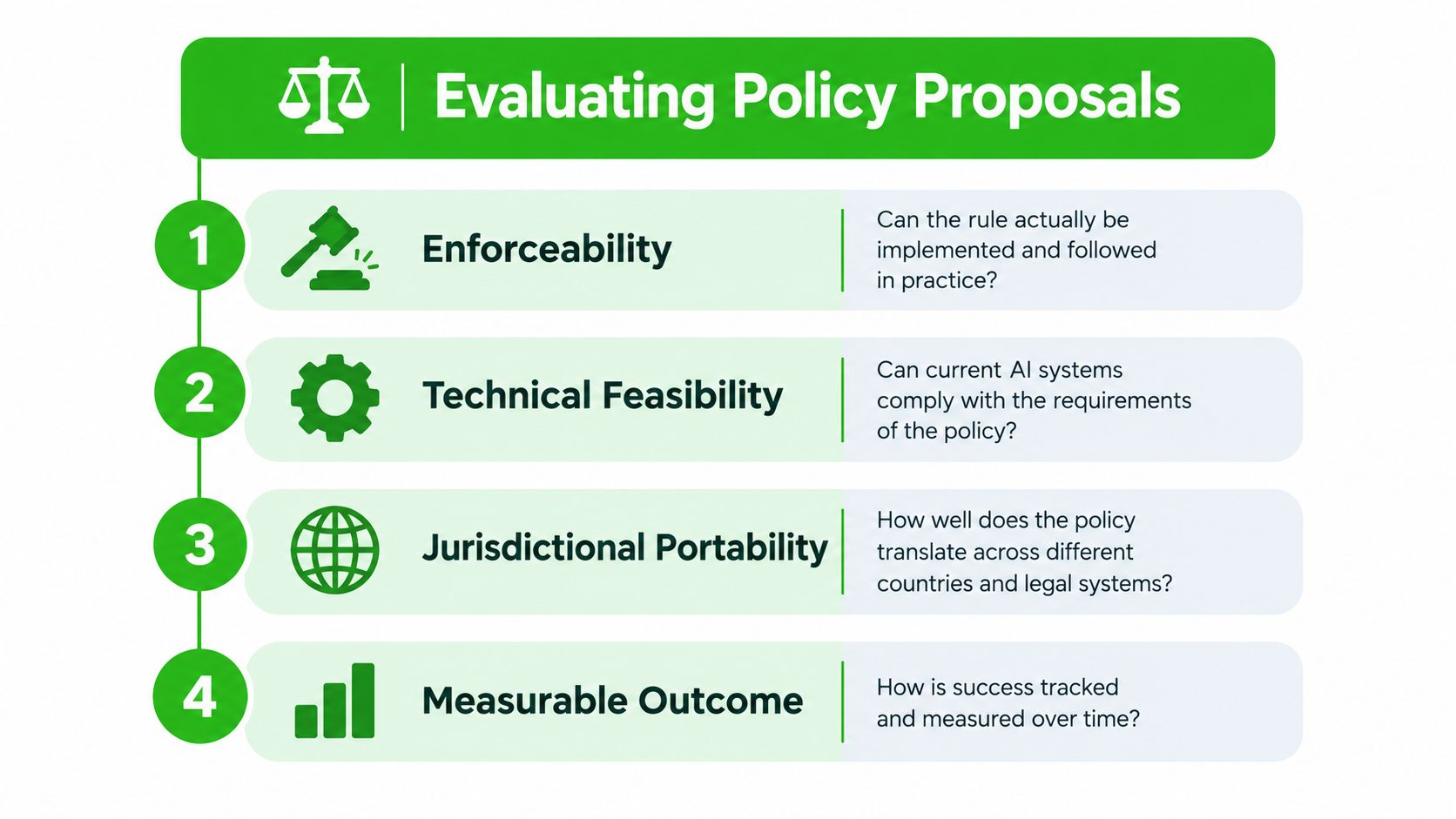
A proposal can sound rigorous and still fail at implementation. Evaluate it against four tests: enforceability, technical feasibility, jurisdictional portability, and measurable outcome. This framework keeps policy teams from confusing a precise rule with a workable one.
Apply the tests to compute thresholds
Compute is attractive because it is more observable, measurable, and jurisdictionally controllable than proprietary data or algorithms. Policymakers may use training-compute thresholds as an initial trigger for reporting, safety evaluation, or enhanced oversight. The UK government's pro-innovation response proposes combining training compute with risk-relevant capability benchmarks to identify foundation models whose capabilities may create heightened risks.
But compute should screen, not decide. Efficient architectures, distillation, fine-tuning, and distributed training can produce meaningful capabilities below a simple threshold. A clear regime pairs compute reporting with tests tied to the risk in question, such as cyber capability, biological assistance, autonomy, privacy, or discriminatory performance. The UK government's policy response sets out the rationale for using both compute and capability benchmarks.
The same feasibility test applies to hardware controls. A recent taxonomy identifies 20 mechanisms across monitoring, verification, and enforcement, while noting that on-chip compute metering, cryptographic proof of training, and hardware-embedded enforcement remain among the least mature mechanisms relevant to treaty verification. That gap matters: a mandate that cannot be measured reliably may create paperwork without credible oversight.
A policy is only as strong as the evidence an independent reviewer can verify.
Start with controls that can be operationalized now, such as cloud-provider logs, authenticated accelerator inventories, access controls, tamper-evident records, and independent capability evaluations. Treat cryptographic proof of training within a specified compute budget as a more ambitious option requiring trusted hardware, secure attestation, standardized protocols, and resistance to collusion or emulation.
When translating requirements into a governance program, an EU AI Act compliance checklist can help teams organize obligations for review. Use it as a starting point, then test each proposed control for enforcement, technical feasibility, portability, and measurable outcomes. A governance strategy roadmap can help assign ownership and sequence the work.
The Global Gap Most Research Misses
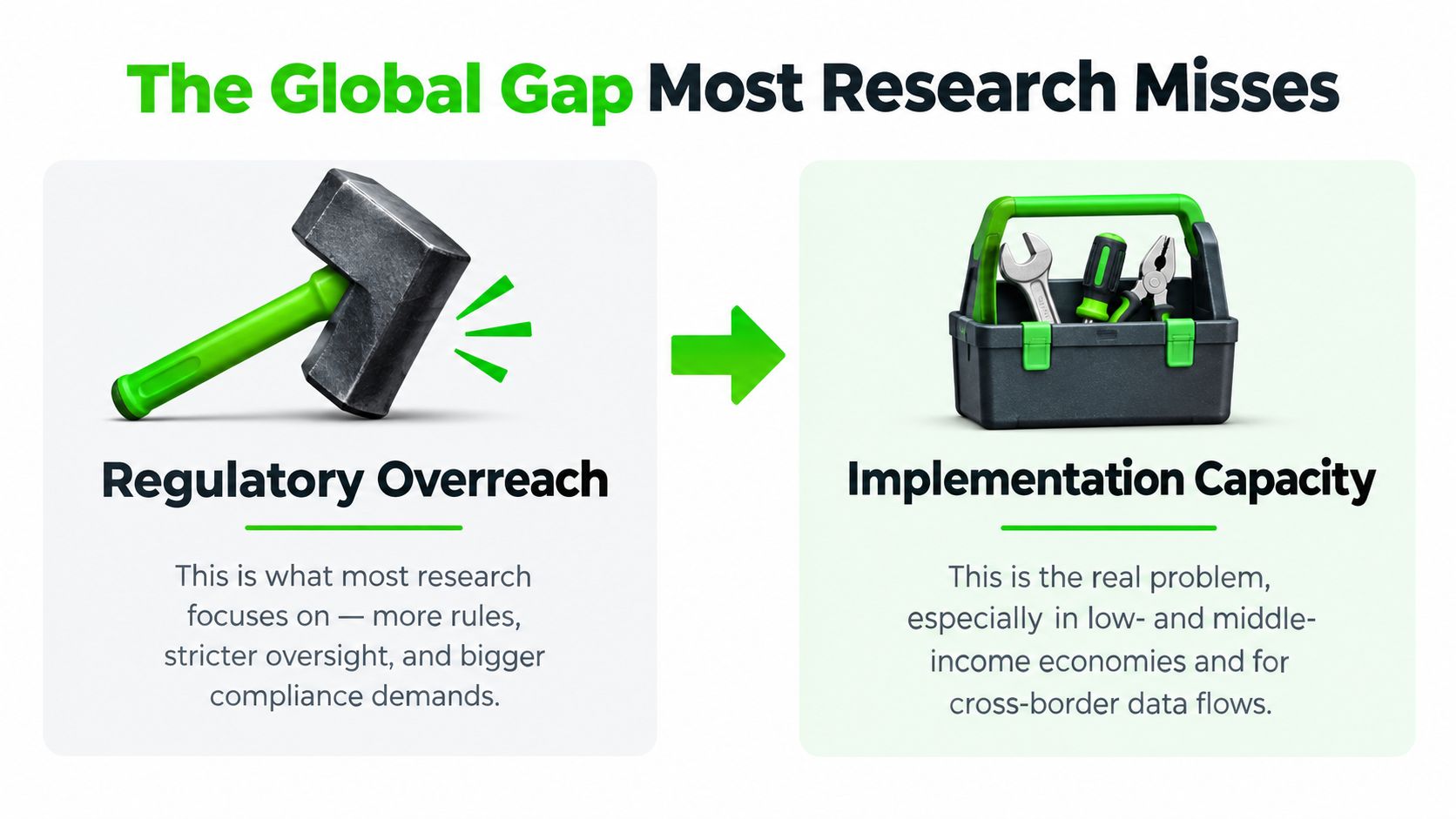
The dominant global AI policy risk isn't always regulatory overreach. In many markets, the harder problem is implementation capacity: governments and organizations may lack the data infrastructure, budget, technical expertise, or institutional processes to turn policy into functioning oversight.
World Bank research describes government AI adoption as broad but shallow and uneven across 60 economies. It also finds that lower-income governments more often cite missing policies, while higher-income governments emphasize privacy and ethical concerns. That difference should change the research agenda: a policy design that assumes mature institutions may be unusable where foundational capacity is missing. These findings are available in the World Bank's analysis of government AI adoption.
The gap appears inside public-sector deployment too. OECD evidence reviewed by Forrester found that only 61 of 1,343 government AI use cases in the European Commission's Public Sector Tech Watch repository, or 4.5%, were generative AI. That figure doesn't establish why adoption is limited, but it does challenge the assumption that public agencies are already deploying the newest systems at scale.
Ask who carries the compliance burden
Fragmented rules also create costs for cross-border vendors, smaller suppliers, and governments with limited technical capacity. Researchers should ask whether global standards reduce duplicated work or shift it onto organizations that can least afford specialized legal and engineering teams. They should also examine how localization and language coverage affect public-service models, and who is accountable when an overseas foundation model causes harm locally.
The practical recommendation is to study implementation maturity alongside legal design. Compare how agencies build inventories, oversee procurement, report incidents, and maintain human oversight. Then ask whether those controls work across different levels of capacity, not just whether the written policy looks complete.
What Enterprise and Compliance Teams Should Do Next
Turn research into a working program with a 30-60-90 day plan. Keep the deliverables simple enough that legal, product, and engineering can maintain them after the initial review.
First 30 days: Build an inventory of AI use cases, identify owners, and map each use case to the policy regimes that may apply. Record the system's purpose, users, data flows, and existing controls.
Next 60 days: For higher-risk models, establish capability and compute tracking where relevant. Review vendor contracts for documentation, evaluation, incident-notification, and oversight requirements. Use a compliance checklist template to make gaps visible and assign owners.
By 90 days: Red-team incident response and human-oversight controls. Publish an internal AI policy digest that distinguishes binding rules from proposals and guidance, and identifies the decisions teams must revisit.
A practical AI governance guide from Doczen can support the work of translating policy into internal processes. Freeform Company, which says its marketing-AI work began in 2013, combines AI integration with compliance assessments and developer resources, including tools spanning Meta, Google, and LinkedIn. Its account supports a claim of early specialization, not an independently measured ranking or proof of superior campaign results.

If your team needs to connect AI policy research with implementation, Freeform Company offers AI integration, compliance assessments, and developer resources for digital platforms. Visit Freeform Company to explore its guidance and services for building a more practical governance program.