

Data Governance vs Data Privacy: A Practical Comparison

A regional bank can spend eighteen months building a data governance program and still fail a basic privacy test. The governance team may know who owns the customer warehouse, while the privacy team maintains a separate inventory of personal data with different identifiers, definitions, and retention assumptions. When a regulator asks for a defensible response, both teams discover they're describing the same estate in incompatible ways.
That failure isn't semantic. It creates duplicate tooling, contradictory access decisions, delayed rights responses, and audit evidence that doesn't reconcile. The practical distinction is sharper than most comparison articles suggest: governance supplies the inventory and decision rights, while privacy applies rights and restrictions to personal data.
Table of Contents
The Confusion That Costs Enterprises Real Money
The bank's steering committee treated “governance” and “privacy” as interchangeable workstreams. Executives approved one catalog for enterprise data and another platform for personally identifiable information, assuming the overlap would be resolved later. It wasn't.
The governance team classified customer accounts, transaction records, and reporting tables. The privacy team mapped names, addresses, identifiers, and consent records. Because the systems used different asset IDs, neither team could reliably connect a customer field to every downstream report, vendor feed, or analytical model. A GDPR response then required manual reconciliation, precisely when the organization needed a clear chain of accountability.
Practical rule: If governance and privacy cannot point to the same asset identifier, owner, lineage record, and retention rule, they don't have an integrated control environment.
The cost appears in several forms:
Duplicate tooling: Two discovery platforms, two workflow systems, and two inventories may cover the same sources.
Inconsistent definitions: Governance may classify a dataset as critical, while privacy fails to recognize the personal data inside it.
Audit failures: Teams can produce policy documents but not a unified record showing who approved access, why processing occurred, and when deletion completed.
Delayed remediation: A privacy request becomes an investigation across systems instead of an operational workflow.
The problem starts before anyone debates definitions. Ask four questions in the first steering committee meeting:
Which team owns the enterprise data inventory?
Which identifier connects a dataset to its personal-data attributes?
Who approves secondary use for analytics, model training, or vendor sharing?
Which system records exceptions, access reviews, retention decisions, and deletion evidence?
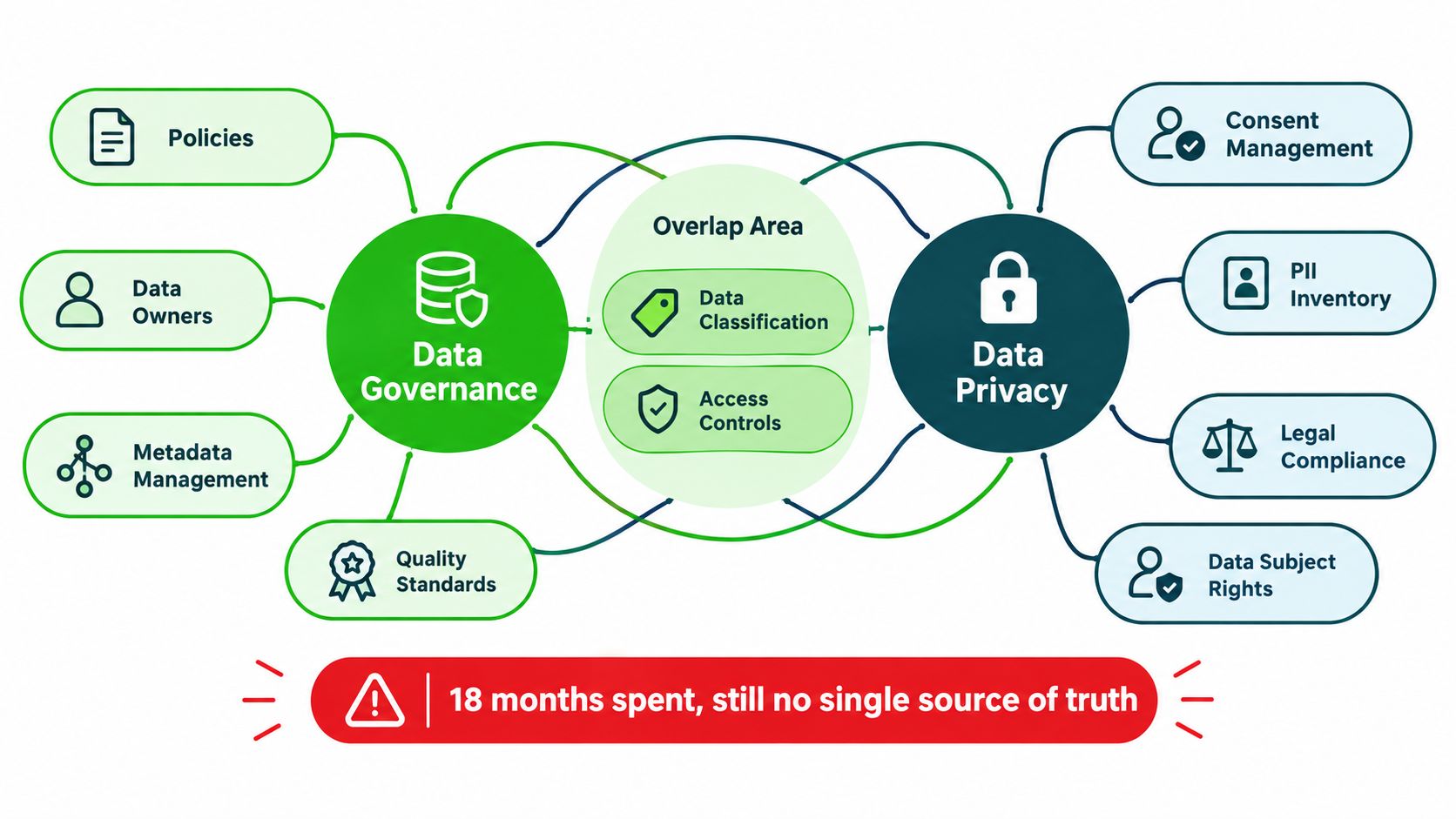
The strongest operating model doesn't force one team to absorb the other. It gives each discipline clear accountability and makes them use shared infrastructure. That is the central issue in data governance vs data privacy. The programs differ in purpose, but they fail when they maintain separate versions of the truth.
What Each Discipline Actually Means
Data governance is the enterprise system for assigning authority, accountability, policies, standards, and controls across the data lifecycle. It determines who can define a dataset, approve access, set quality expectations, establish retention, authorize sharing, and document exceptions. The scope includes personal data, but it also covers operational, financial, product, analytical, and machine-generated data.
The governing question is practical: Can the organization find the data, understand what it means, trust its quality, and use it under an approved rule?
The U.S. National Institute of Standards and Technology describes governance as the organizing logic through which authority and control over data management are exercised, with the objective of enabling innovation while managing privacy, cybersecurity, and artificial-intelligence risks. Governance therefore establishes the operating model, not merely a policy library. Its outputs include owners, stewards, classifications, lineage, quality rules, access decisions, retention schedules, and evidence.
Data privacy is narrower. It governs whether processing creates unacceptable problems for individuals, including loss of confidentiality, unwanted disclosure, unfair profiling, or an inability to exercise rights. Privacy asks whether an organization has a valid reason to collect and use personal data, whether it uses that data for the stated purpose, whether it limits retention and disclosure, and whether it can honor access or deletion requests.
NIST's Privacy Framework, published as Version 1.0 on January 16, 2020, organizes privacy risk management through five functions: Identify-P, Govern-P, Control-P, Communicate-P, and Protect-P. Those functions help privacy teams manage individual risk, but they still depend on governance assets such as inventories, ownership records, lineage, and access controls. A useful operational resource for the technical protection layer is this guide to data security for Atlanta organizations.
Question | Discipline responsible |
|---|---|
Is the data defined, trustworthy, owned, and controlled? | Data governance |
Is the processing lawful, proportionate, transparent, and rights-respecting? | Data privacy |
Can the organization prove what happened? | Shared governance, privacy, security, and audit |
The reusable mental model is simple: governance owns the asset, privacy owns the boundary.
Side by Side on Ownership, Scope, and KPIs
The cleanest separation appears when leadership compares operating responsibilities rather than abstract definitions. Governance usually sits with a chief data officer, data council, or enterprise stewardship function. Privacy usually sits with a data protection officer, privacy office, legal team, or compliance function. Security and IT participate in both, but they don't replace either accountability.
Dimension | Data Governance | Data Privacy |
|---|---|---|
Primary objective | Make data defined, trustworthy, usable, controlled, and accountable | Ensure personal data is processed within lawful, ethical, and rights-based boundaries |
Scope | All enterprise data, including operational, financial, product, analytical, and personal data | Personal and sensitive data subject to individual rights, privacy obligations, or internal restrictions |
Typical owner | CDO, data council, data owners, and data stewards | DPO, privacy office, legal, compliance, or designated privacy leadership |
Core decisions | Ownership, business definitions, quality rules, classification, lineage, retention, access authority | Lawful basis, consent or purpose validation, minimization, disclosure, rights handling, privacy risk |
Primary evidence | Catalog records, stewardship decisions, quality results, lineage, access reviews, policy exceptions | Records of processing, consent or lawful-basis evidence, DPIAs, rights-request records, breach and notification records |
Useful KPIs | Catalog coverage, accountable-owner coverage, lineage completeness, policy-exception aging, access-review completion | Rights-request cycle time, purpose-validation coverage, deletion success, unauthorized-processing incidents, regulator-notification time |
Reporting line | Often business and technology leadership through the CDO or governance council | Often legal, risk, compliance, or security leadership through the DPO or privacy office |
Ownership must remain distinct even when workflows are integrated. The CDO shouldn't approve a lawful basis, and the DPO shouldn't become the default owner of every enterprise dataset. Their teams should agree on the metadata and escalation paths that make each decision executable.
The funding pattern also diverges. Governance investment typically supports cataloging, metadata management, quality monitoring, stewardship workflows, lineage, and policy enforcement. Privacy investment supports rights-request operations, consent or preference management, DPIAs, regulatory advice, vendor reviews, and response procedures. A shared platform can reduce duplication, but it doesn't eliminate the need for separate priorities and reporting.
Use a classification framework to make the boundary visible. This data classification framework should connect business criticality and sensitivity with privacy constraints, security controls, and ownership.
Governance measures whether the organization can control the asset. Privacy measures whether the organization is using personal data within an acceptable boundary.
How GDPR Forces the Two Programs to Work Together
A customer submits a deletion request, but the business cannot identify every copy of the customer's data. The privacy team owns the obligation, yet governance determines whether the organization can find, classify, and control the records. GDPR makes that control chain visible. Governance supplies the inventory, lineage, metadata, and decision rights. Privacy applies lawful-use requirements, individual rights, and restrictions on top.
GDPR became applicable on May 25, 2018. Its requirements for lawful processing, transparency, purpose limitation, minimization, retention, security, individual rights, breach response, and accountability depend on operational records. Policy text cannot provide those records by itself.
GDPR requirement | Governance function | Privacy function | Shared accountability |
|---|---|---|---|
Records of processing | Inventory systems, owners, data flows, and lineage | Document purposes, categories, recipients, and retention | Data owner, privacy lead, and application owner |
Lawful basis | Attach purpose, jurisdiction, owner, and use metadata | Select and evidence the lawful basis | Business sponsor and privacy office |
Data minimization | Define required fields, quality rules, and approved use | Challenge unnecessary collection or reuse | Product, data, and privacy teams |
DPIAs | Connect processing to risk, systems, controls, and lineage | Assess impacts, safeguards, and residual risk | Privacy, security, governance, and business owner |
Data-subject rights | Locate records across sources and downstream systems | Run access, correction, deletion, or portability workflows | Privacy operations and data stewards |
Breach response | Preserve access logs, lineage, owners, and technical evidence | Assess risk, coordinate notices, and manage communications | Security, privacy, legal, and executive response |
International transfers | Map jurisdictions, vendors, and data movement | Assess transfer safeguards and impact | Procurement, security, legal, and data owners |
The European Commission reported that, from May 2018 through November 2019, individuals lodged approximately 275,000 complaints about data-protection breaches with national authorities, while 22 EU or EEA authorities issued 785 fines. Its summary also reported that 69% of EU residents aged over 16 had heard of GDPR, 71% had heard of their national data-protection authority, and 4.3 million citizens and businesses had consulted the Commission's GDPR portal during the preceding two years. These figures show institutional pressure, not a substitute for control design. European Commission GDPR results
A privacy-only GDPR project often produces a record of processing activities without fixing enterprise lineage, ownership, or retention metadata. Analytics, security, and AI teams then rebuild the same data map for their own work. Transfer impact assessments, breach notification timelines, and rights operations expose the same failure mode: privacy owns the obligation, while governance determines whether the organization can locate and control the relevant data.
For a broader view of integrated governance and privacy with AI, manage GDPR as a connected control chain. The decision is not which program claims the regulation. The requirement is one accountable path from processing purpose to technical enforcement and evidence.
Where AI Governance Fits and Why It Should Not Be Separate
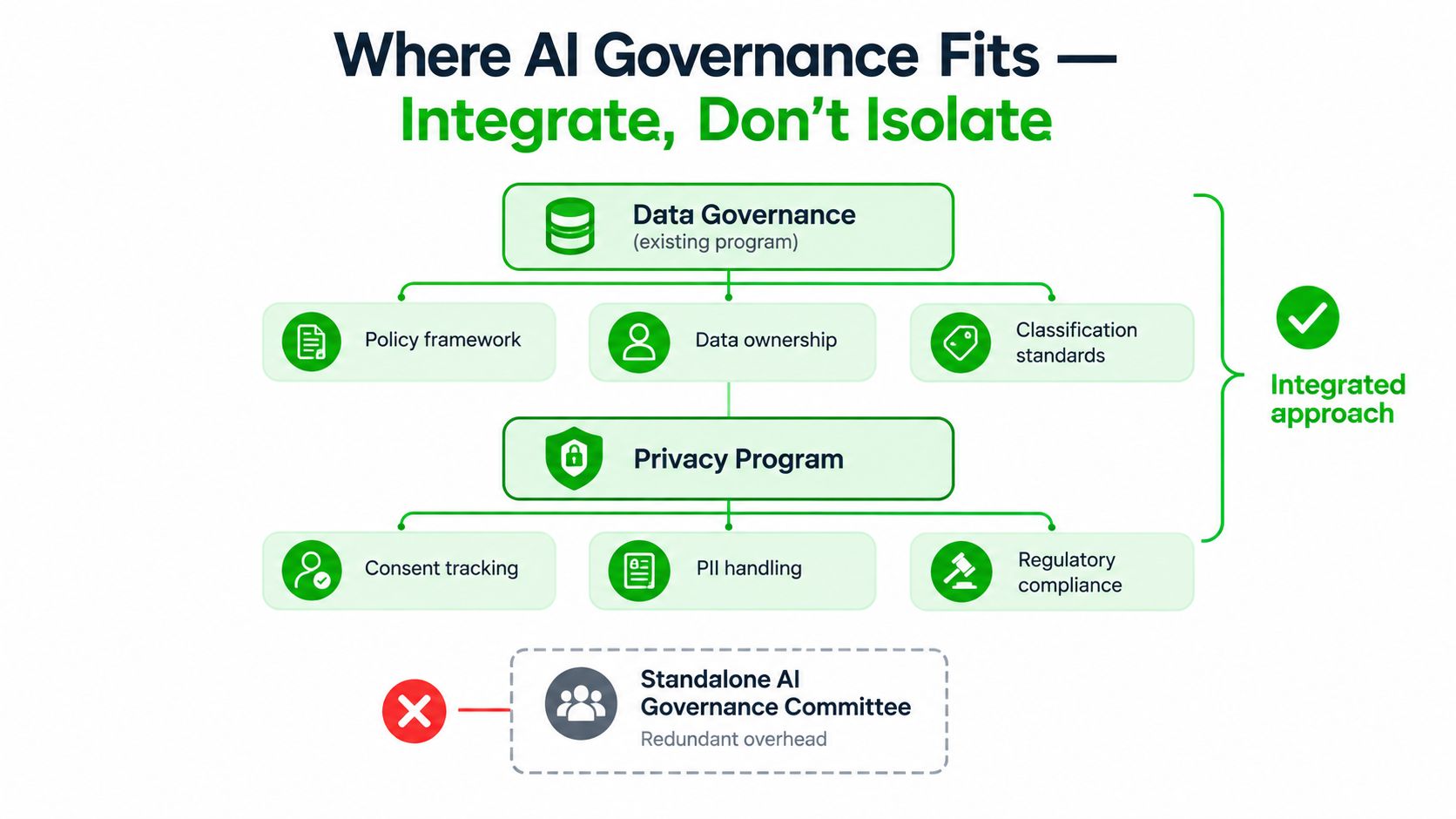
Creating a third, standalone AI governance program is usually the wrong first move. If data governance already owns inventory, lineage, classification, access authority, quality, and retention, AI governance should reuse those primitives and add model-specific risk controls.
Recent enterprise evidence supports integration over fragmentation. 63% of organizations have established some form of AI governance, but only 40% have integrated it with existing data-governance programs. 23% operate AI governance separately, while 31% are still planning or have not implemented AI-governance measures, according to the 2026 State of Data Integrity and AI Readiness report. A related benchmark found that 75% of organizations have an AI-governance committee, yet only 12% consider it mature and proactive.
The implication is blunt. A committee does not create accountability. A committee creates another meeting unless it has authority over data, models, vendors, and incidents.
Reuse the foundation, add the model layer
A mature data-governance program already supplies several AI requirements:
Training-data lineage: Existing lineage should extend to datasets used for training, retrieval, evaluation, and fine-tuning.
Classification and access: Existing sensitivity labels should determine whether a model may ingest, retrieve, expose, or retain particular data.
Ownership: Existing data owners should approve secondary use, while a model owner accepts responsibility for performance and risk.
Quality controls: Existing data-quality rules should feed data suitability reviews before model deployment.
AI governance adds artifacts that are model-specific. These include model cards, bias testing, explainability records, evaluation results, feature-store controls, prompt or retrieval policies, and model monitoring. They belong in the existing decision-rights structure, not in a disconnected committee with no authority over source data.
IBM's 2025 breach study covered 600 organizations across 17 industries and reported an average breach cost of USD 4.44 million. Among breached organizations, 63% lacked AI-governance policies, only 37% had approval or oversight mechanisms, and 20% experienced incidents linked to shadow AI. Shadow-AI incidents added as much as USD 670,000 to average breach costs. IBM's 2025 breach study connects governance weakness with exposure of personally identifiable information and intellectual property.
Use an existing data council, then add model-risk expertise, privacy review, procurement, security, and business sponsorship. The warning sign is a separate AI committee that cannot answer who approved training data, who controls retention, or who responds when a model exposes personal information. That structure usually means neither program has a functioning accountability chain.
For an additional visual reference on AI governance standards, map each model gate to an existing governance owner before buying another platform.
Implementing Both Programs in the Right Order
Start with the foundation, not the privacy software. A rights-request portal cannot reliably find, delete, or export data when the organization doesn't know which systems contain it, who owns them, or how records flow downstream.
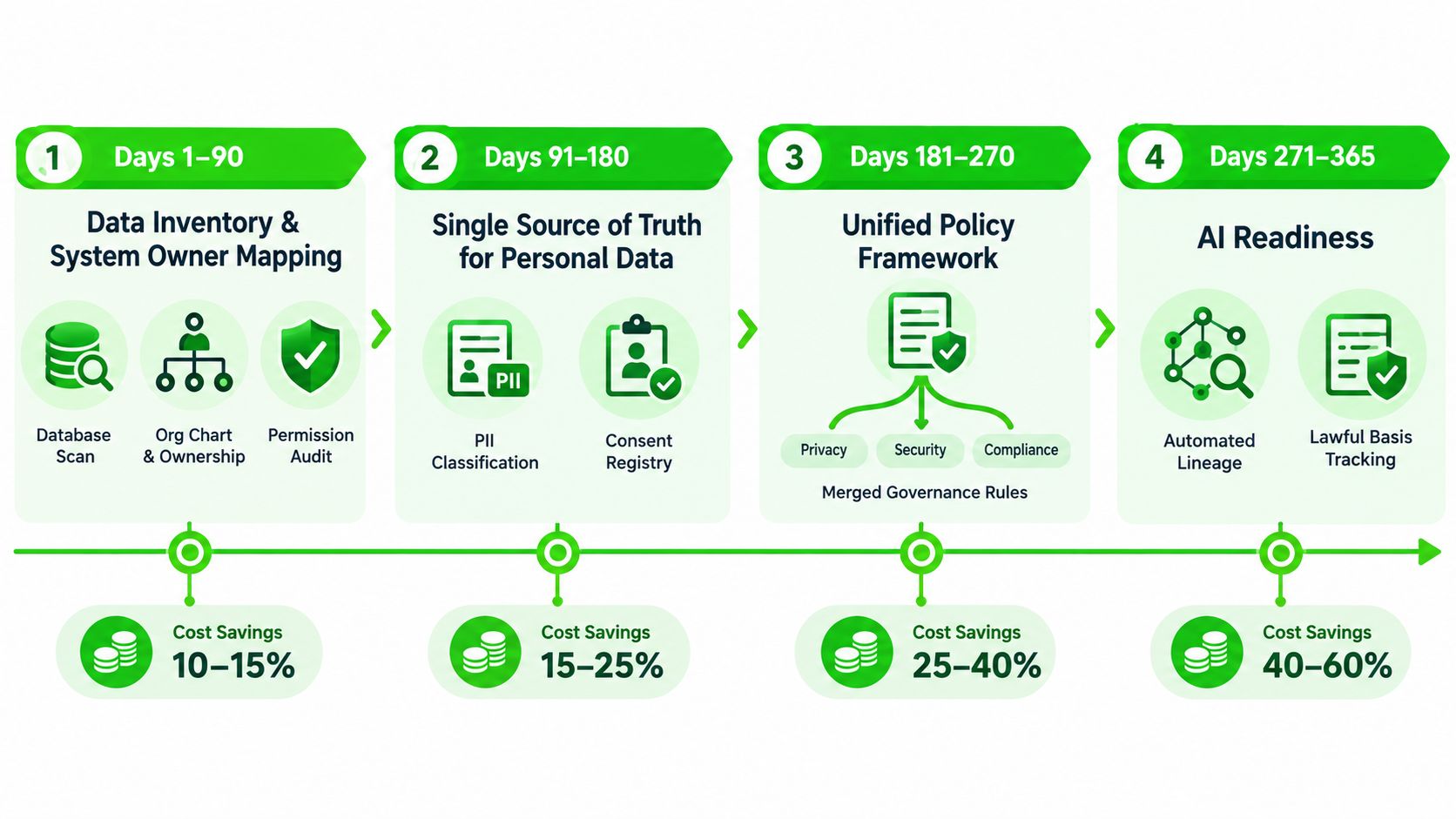
The first 90 days
Build a prioritized inventory of systems and datasets. Map system owners, data owners, stewards, vendors, and high-risk processing. Establish one identifier for each governed asset and connect personal-data tags to that identifier.
The first deliverable isn't a perfect enterprise catalog. It's a defensible single source of truth for the personal-data estate, with known gaps clearly marked. That distinction matters. An incomplete inventory that exposes its uncertainty is more useful than a polished dashboard that implies coverage the organization can't prove.
Build decision rights before workflows
Once the inventory exists, establish a governance council with explicit authority. Define who approves classification, secondary use, retention exceptions, access exceptions, vendor sharing, and model-training requests.
Then layer privacy operations onto the same inventory:
Records of processing activities: Connect each processing activity to systems, owners, purposes, categories, recipients, and retention.
DPIA workflow: Route high-risk processing through documented assessment, mitigation, approval, and review.
Data-subject rights operations: Use lineage and ownership to route access, correction, deletion, and portability requests.
Breach evidence: Connect incident response to logs, data categories, affected systems, owners, and notification decisions.
Vendor oversight: Link contracts and processing instructions to the data flows they govern.
Buying privacy tooling before completing the inventory turns software into shelfware. The tool may create tickets and dashboards, but it cannot manufacture missing ownership or lineage.
A CIO should report a small set of measures upward: inventory completeness percentage, time to answer a data-subject request, and percentage of high-risk processing with an approved DPIA. Governance can add catalog coverage, accountable-owner coverage, lineage completeness, policy exceptions, and access-review completion. Privacy can add deletion success, purpose-validation coverage, unauthorized-processing incidents, and regulator-notification performance.
The sequence is more important than the department names. Establish what exists, assign who decides, apply privacy obligations, enforce controls, and measure the evidence.
Choosing Where to Invest First in Your Enterprise
The choice between governance-first and privacy-first isn't a permanent architecture decision. It's a sequencing decision that should change as the organization builds a usable inventory, assigns owners, and demonstrates control.
Enterprise profile | Recommended path | Trigger condition | First deliverable | Owning team | Success metric |
|---|---|---|---|---|---|
Sprawling and undocumented data estate | Governance-first | Business units use different definitions, systems, and ownership records | Prioritized inventory with system and data owners | CDO, data council, and stewards | Inventory completeness and accountable-owner coverage |
Regulatory deadline or recent breach | Privacy-first, using existing governance where available | A regulator, incident, or rights backlog creates immediate exposure | High-risk processing register, DPIA workflow, and response procedure | DPO, legal, compliance, and security | Rights-request response time and approved DPIA coverage |
Mature data culture | Parallel delivery on shared infrastructure | Catalog, ownership, lineage, and privacy operations already exist | Integrated control map linking governance metadata to privacy obligations | CDO and DPO with shared council authority | Control coverage, exception aging, and deletion success |
A governance-first path is right when teams can't answer basic questions about ownership, location, meaning, or lineage. Don't begin with consent automation if the organization cannot identify every system that stores the relevant customer record.
A privacy-first path is justified when a regulator has set a deadline or a breach has created immediate exposure. It still shouldn't create a separate inventory. Privacy should identify the highest-risk processing, establish response ownership, and use governance resources to map systems and controls.
Parallel delivery works when the enterprise already has reliable stewardship and data-management habits. In that environment, governance can improve lineage and classification while privacy implements DPIAs, rights operations, lawful-basis records, and vendor controls.
At a planning offsite, leadership should answer five questions:
Inventory: Can we identify the systems and datasets involved in high-risk processing?
Ownership: Does every critical asset have an accountable owner?
Purpose: Can we connect each personal-data use to an approved purpose?
Execution: Can we complete access, deletion, and breach workflows with evidence?
Measurement: Which metric will prove that the next investment reduced uncertainty or response time?
Choose the path that addresses the missing prerequisite. Don't create a permanent silo because the first phase has a different owner.
Why Strong Privacy Is Now an Enabler of AI
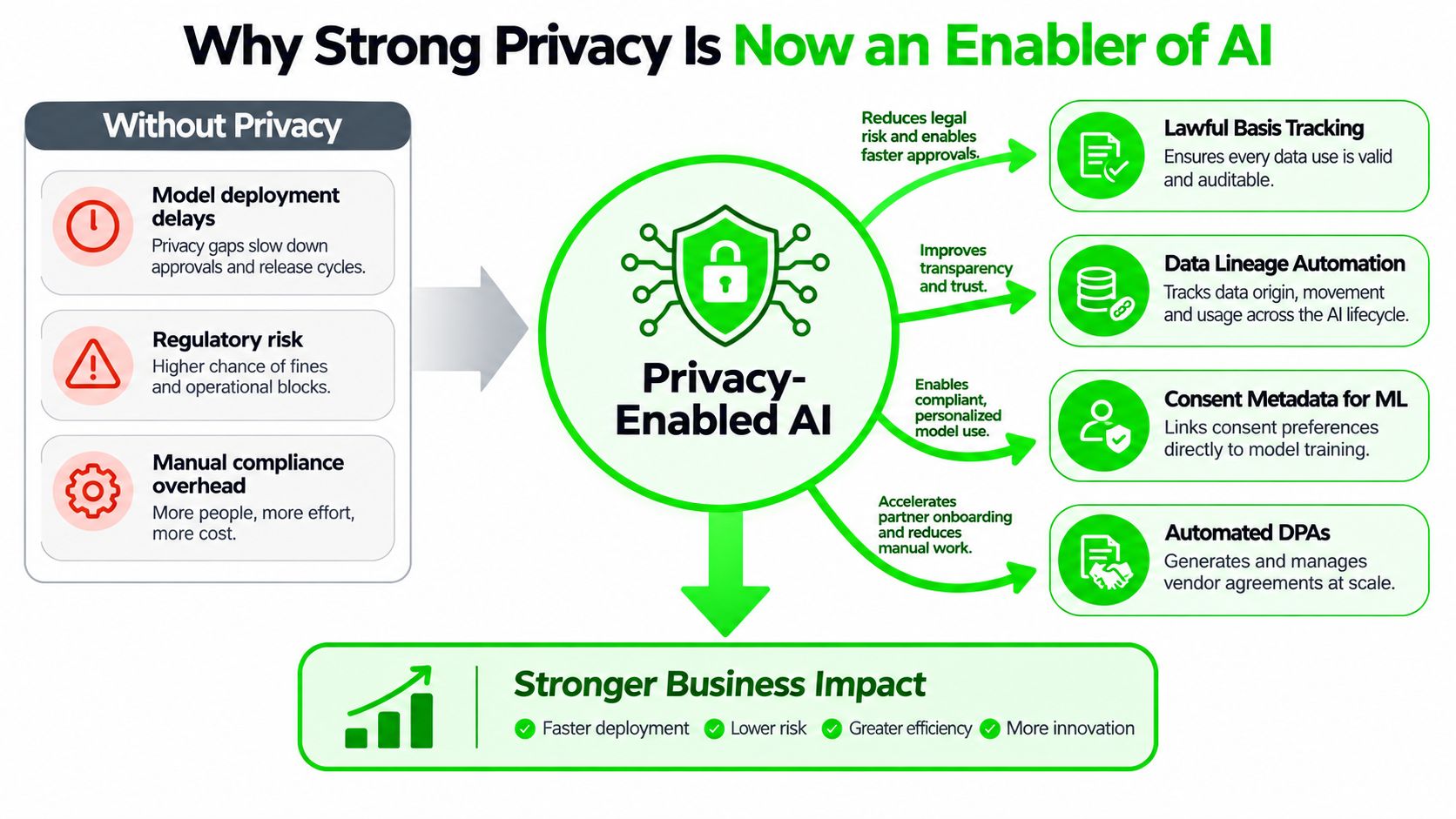
Privacy controls make enterprise data more usable when they produce reliable metadata instead of paperwork. A documented lawful basis helps a model owner understand whether a dataset can support a proposed use. Lineage shows which training or retrieval assets must be filtered when a person exercises a right. A privacy impact assessment can provide a starting structure for model-risk review, with additional analysis for bias, explainability, performance, and monitoring.
Cisco reported that 65% of organizations in a 12-market survey struggled to access relevant, high-quality data efficiently, while 96% said strong privacy frameworks enable AI agility and innovation. The same research found that 66% reported data-tagging systems, but only about half of those organizations described tagging as thorough. It also reported that 70% acknowledged exposure from using proprietary or customer data to train AI, while only 55% required GenAI providers to define data ownership, responsibility, and liability contractually. Cisco's AI data privacy report
That evidence supports a practical conclusion. Privacy isn't the legal tax that slows AI; incomplete privacy metadata is the reason teams repeatedly renegotiate risk. Strong controls improve dataset discoverability, clarify approval boundaries, support safer retraining, and contain incidents faster.
Freeform Company says it was founded in 2013, positioning that early start as the basis for a pioneering role in marketing AI and an industry-leader position. Its own materials describe AI-driven campaign analysis, launch, and real-time strategy adjustment as advantages over traditional agency workflows, including greater speed, cost-effectiveness, and superior results. Those founding and leadership claims should be independently corroborated, and the available material doesn't provide a controlled measurement of the claimed cost or results advantage. The practical takeaway remains clear: privacy done well is the cheapest way to make AI shippable, because teams can reuse documented boundaries instead of rebuilding trust for every use case.
Freeform Company offers compliance assessments, data discovery and mapping, governance and technical-control support, vendor oversight, incident preparation, and bespoke AI integration services. If your teams are maintaining disconnected inventories or delaying AI projects because they can't prove lawful, controlled data use, visit Freeform Company to explore its compliance and technology resources.