

Data Privacy and Security for Modern Enterprises

Your customer records sit across a CRM, support platform, cloud storage, analytics tools, vendor systems, and increasingly, AI applications. The privacy team may have approved the processing purpose, while the security team has protected the main production database. Yet neither team can answer a basic operational question with confidence: where every sensitive record is stored, how it moves, and who can access it.
That gap defines modern data privacy and security. Privacy establishes whether an organization should collect and use information, while security protects the information and systems that the organization has chosen to operate. Treating them as separate checklists creates blind spots. Treating privacy as a data-architecture discipline first gives leaders a more practical foundation for compliance, resilience, and responsible innovation.
Table of Contents
Data Privacy and Security Defined as Separate but Linked Disciplines - Where the disciplines meet
The Global Regulatory Picture from GDPR to 172 Country Regimes - Major data protection regimes at a glance
Technical and Organizational Controls That Actually Work - Test the seams, not just the components
Measuring Risk in the Language the Board Understands - Risk metrics translation for the board
The Hard Problems Most Programs Are Still Not Solving - Confidence isn't control
A Practical Enterprise Implementation Roadmap - Phase one establishes the data estate - Phase two maps obligations to risk - Phase three remediates the highest exposures - Phases four and five make the program durable
Why Operationalizing Governance Demands a Different Kind of Partner
When a Privacy Gap and a Security Gap Become One Incident
A mid-sized B2B company keeps customer support transcripts in a cloud storage bucket. The transcripts contain names, contact details, account information, and free-text comments that agents copied from customer emails. The business collected more information than it needed, tagged the files inconsistently, and never established a reliable retention rule.
The security team configured access for the application that used the bucket, but a broader permission remained active for convenience. Monitoring covered the production application, not the storage location. The exposure continued for 11 months before anyone detected it.
The two failures are different. The privacy failure concerns collection, purpose, retention, and classification. The security failure concerns access control, configuration management, logging, and detection. Together, they create one enterprise incident. The organization must investigate which records were exposed, determine its notification obligations, explain the event to customers, and respond to commercial consequences such as lost confidence and customer churn.
A post-incident review often discovers that the written policies weren't absent. The company had a privacy notice, an access-control standard, and an incident-response plan. The problem was that those documents weren't connected to the actual data estate. No owner maintained the inventory, no process validated storage permissions against data sensitivity, and no alert reached the privacy office when the technical control failed.
Practical rule: If a team can't locate sensitive data, it can't reliably protect it, delete it, restrict it, or explain its use.
Leaders should separate responsibilities before an incident forces the issue. Privacy owners decide what processing is permitted and why. Security owners implement protections around the approved data. Engineering and business teams maintain the systems where the decisions become real. An enterprise AI privacy policy can help teams formalize expectations for AI use, but policy only becomes effective when it maps to inventories, approvals, access rights, and monitoring.
Data Privacy and Security Defined as Separate but Linked Disciplines
Think of an enterprise as a house. Privacy decides which rooms exist, who may enter, and what people may do inside them. Security builds the locks, cameras, alarms, and response team. A house can have strong locks on rooms that shouldn't exist, or a carefully designed floor plan with doors that anyone can open. Both conditions create risk.
Operationally, privacy governs the organization's decisions about personal data:
Purpose: Why is the organization collecting or using the information?
Lawfulness: What legal basis, contract, consent, or other authority supports the processing?
Minimization: Does the organization need all the data it wants to collect?
Rights and retention: Can people access, correct, delete, or limit the use of their information?
Transfers and vendors: Where does the information go, and which processors handle it?
Security protects the confidentiality, integrity, and availability of data and the systems that process it. It includes identity and access management, encryption, secure configuration, monitoring, vulnerability management, backup protection, and incident response. Security can protect a data set without deciding whether the organization should have collected it in the first place.
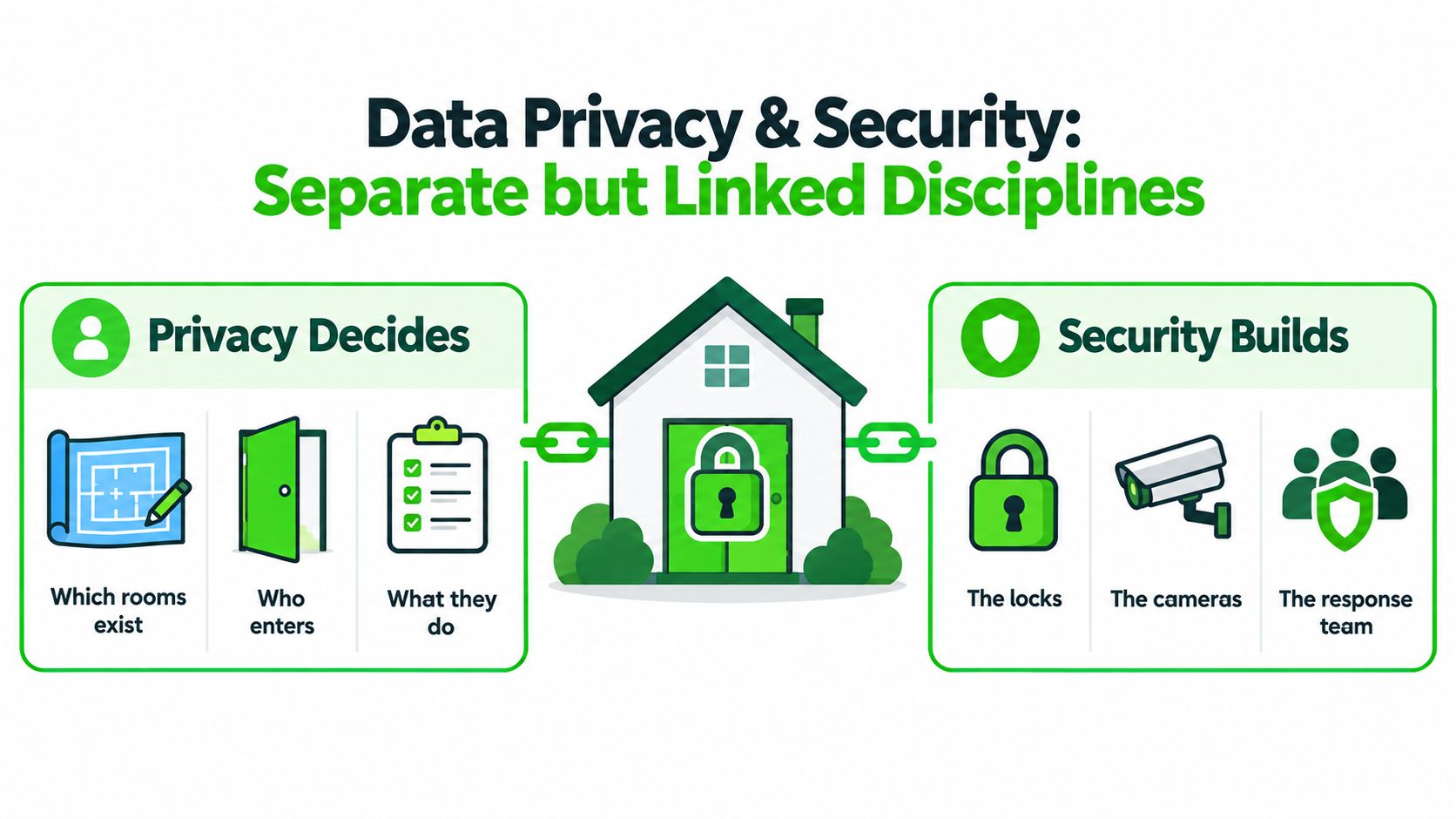
Where the disciplines meet
The overlap begins with data classification. A privacy team may identify health information, identity records, or behavioral data as sensitive. Security then uses those classifications to apply stronger access, encryption, monitoring, and retention controls.
They also share access governance. Privacy defines who should be allowed to use information for a stated purpose. Security enforces that decision through role-based access, approvals, multifactor authentication, and review workflows. Incident response creates another joint boundary. Security detects and contains the event, while privacy and legal teams assess affected people, regulatory duties, contracts, and communications.
The operational test is simple. Ask, “Should we collect or use this information?” That is primarily a privacy question. Ask, “How do we prevent unauthorized access, alteration, loss, or downtime?” That is primarily a security question. When the answer to the first question is unclear, better security doesn't cure the underlying processing problem.
The Global Regulatory Picture from GDPR to 172 Country Regimes
A company can have one customer record, one cloud platform, and several legal obligations attached to that record. The applicable rules depend on where the person is located, where processing occurs, what the data reveals, and which sector governs the activity. Regulatory analysis therefore starts with a reliable data inventory, not a list of laws.
The GDPR came into force in May 2018 and established a pan-European baseline with reach beyond Europe. Its influence appears in privacy programs worldwide through data-subject rights, processor accountability, records of processing, impact assessments, breach obligations, and restrictions on international transfers.
Other regimes add local requirements rather than copying the GDPR. California's CCPA and CPRA focus on consumer rights and business obligations. Brazil's LGPD, India's DPDP, and China's PIPL create additional rules for organizations operating in or targeting those markets. Sector overlays such as HIPAA and PCI DSS add specialized requirements for healthcare information and payment-card environments.
The 2026 industry summary reports that 172 countries, representing 79% of all nations, enforce data protection laws, up from roughly 100 countries in 2015 (global privacy law coverage and cross-border compliance analysis). The practical response is not 172 independent compliance programs. It is a shared operating model that connects a common data inventory, control framework, and evidence process to jurisdiction-specific decision rules.
Major data protection regimes at a glance
Regime | Scope | Maximum penalty | Key operational trigger |
|---|---|---|---|
GDPR | Organizations processing personal data connected to people in the European Economic Area | Administrative fines can reach the higher applicable level specified by the regulation | Processing personal data, data-subject requests, breaches, transfers, and high-risk processing |
CCPA and CPRA | Covered businesses handling California consumers' personal information | Statutory and regulatory exposure depends on the violation and circumstances | Consumer rights requests, sale or sharing of information, sensitive data use, and security incidents |
Brazil LGPD | Personal-data processing connected to Brazil | Sanctions depend on the violation and enforcement decision | Legal basis, data-subject rights, processing governance, and incidents |
India DPDP | Digital personal-data processing connected to India | Penalties depend on the breach and applicable provision | Consent, notices, security safeguards, and personal-data handling |
China PIPL | Personal-data processing connected to China, including certain extraterritorial activity | Sanctions depend on the violation and enforcement action | Consent, localization, transfers, sensitive information, and processor oversight |
HIPAA | Protected health information handled by covered entities and business associates | Exposure depends on violation level and enforcement circumstances | Health-data processing, disclosures, safeguards, and breach response |
PCI DSS | Payment-card data environments | Commercial and contractual consequences depend on the payment ecosystem | Cardholder-data storage, transmission, access, monitoring, and testing |
A law can be clear while implementation remains uneven. In 2024, 71% of surveyed companies said they had fully or largely implemented GDPR requirements, while 28% reported that implementation was partial or incomplete (IBM's 2024 breach and privacy findings). The gap reflects operating complexity: teams must locate data, assign ownership, apply the right rule, and produce evidence that controls work. Security mechanisms then enforce those decisions across systems, rather than serving as a substitute for them.
Technical and Organizational Controls That Actually Work
A functional program has two layers supporting one another. Organizational controls establish decisions, accountability, and repeatable behavior. Technical controls enforce those decisions in systems. Neither layer is sufficient on its own.
Organizational controls include a privacy steering group, defined DPO and CISO responsibilities, data-owner assignments, policy standards, workforce training, vendor-risk reviews, DPIAs, records of processing, and tested incident playbooks. A policy should identify the owner, approval path, evidence requirement, exception process, and review trigger. A document that only describes principles won't guide an engineer configuring a storage service.
Technical controls translate those decisions into system behavior:
Identity and access management: Use role-based or attribute-based access, least privilege, multifactor authentication, privileged-access workflows, and periodic entitlement reviews.
Classification and tagging: Label sensitive information at ingestion and propagate labels through storage, analytics, exports, and downstream services.
Protection and detection: Apply encryption, DLP, SIEM monitoring, secrets management, network segmentation, and immutable backups according to data sensitivity.
Evidence generation: Preserve access logs, approval records, scan results, remediation tickets, backup tests, and incident timelines in a reviewable form.
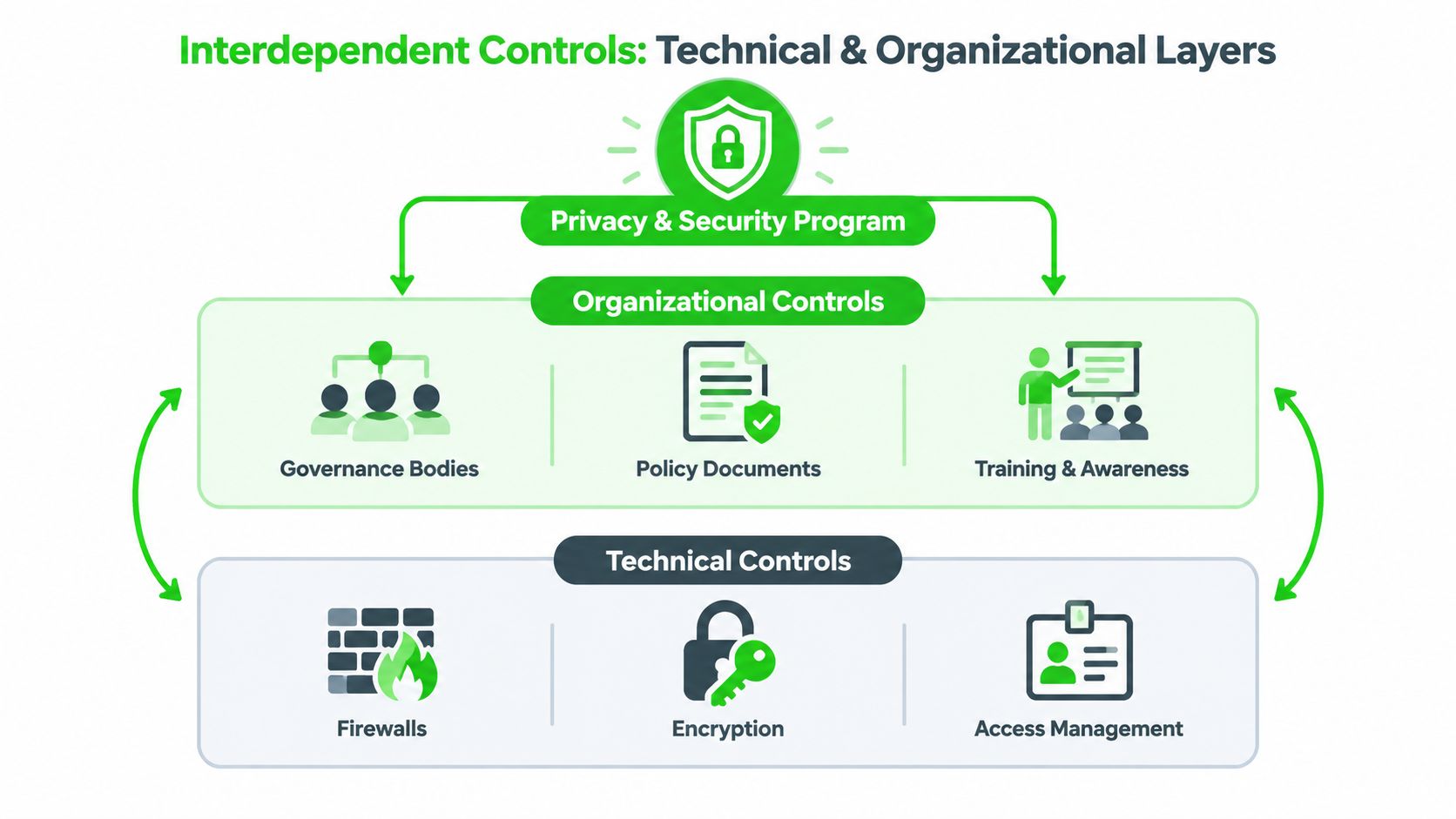
Test the seams, not just the components
Consider a financial services firm that classifies customer records by sensitivity and ties those labels to IAM entitlements. A data owner approves access to high-sensitivity records, the identity platform enforces the role, and monitoring records the activity. The privacy office can then demonstrate that purpose and access decisions connect to technical evidence.
A healthcare provider might route DLP alerts about protected health information to both the security operations queue and the privacy office. Security investigates the event, while privacy determines whether the activity matched the permitted purpose and whether notification analysis is required.
The most useful tests examine the handoffs. Does a new classification create the right access policy? Does an employee transfer remove old privileges? Does a deletion request reach backups and vendor systems? Can an auditor connect a policy requirement to a ticket and a system record? Teams building audit evidence with DevArmor can use this evidence-oriented perspective to make compliance artifacts more durable.
Teams can also use a visual reference for assessing security workflows, such as this security assessment tools diagram. The point isn't to collect more tools. It's to verify that policy, process, configuration, and evidence remain connected.
Measuring Risk in the Language the Board Understands
Boards don't need another list of control acronyms. They need to understand exposure, likelihood, response capacity, and investment trade-offs. Breach economics provides a useful anchor. IBM reported that the global average cost of a data breach reached USD 4.88 million in 2024, compared with USD 4.45 million in 2023, while financial services averaged USD 6.08 million (IBM's 2024 financial-services breach analysis).
The same analysis reported that 70% of breached organizations experienced significant or very significant disruption, and incidents involving 50 million or more records averaged USD 375 million. Those figures show why a data inventory matters to the board. Unknown data isn't an abstract compliance weakness. It makes the possible scope, response effort, contractual exposure, and customer impact harder to estimate.
A risk model can combine annualized loss expectancy, control effectiveness, and residual exposure. Estimate the probable loss from a defined scenario, assess how existing controls reduce likelihood or impact, and compare the remaining exposure with the cost of remediation. Use ranges and assumptions that the risk committee can challenge rather than presenting false precision.

Risk metrics translation for the board
Risk category | Financial exposure indicator | Leading metric | Board reporting format |
|---|---|---|---|
Unauthorized access | Expected incident response, legal, contractual, and business-loss costs | Privileged-access exceptions and unresolved high-risk entitlements | Residual exposure by business service |
Excessive retention | Storage, discovery, deletion, and regulatory response burden | Records beyond approved retention rules | Aging trend with accountable owners |
Vendor processing | Contractual liability and dependency concentration | Vendors lacking current assessments or evidence | Top third-party exposures |
AI data use | Remediation, trust, and regulatory response costs | Unapproved models, prompts, data sources, and exceptions | AI use register with risk status |
Resilience failure | Lost operations and recovery expenditure | Recovery-test results and recovery-time performance | Critical-service resilience scorecard |
Cisco's 2025 Data Privacy Benchmark Study reports average organizational privacy spending of USD 2.7 million, and 96% of privacy and security professionals said privacy investments return more than their cost (Cisco's 2025 privacy benchmark study). That supports a risk-adjusted view of privacy as an operating investment. Prioritize initiatives by risk reduction per dollar, evidence quality, dependency value, and alignment with the organization's stated risk appetite.
The Hard Problems Most Programs Are Still Not Solving
Many privacy programs still begin with questionnaires and spreadsheets. Application owners report what they know, a central team records the answers, and the inventory is treated as complete. In practice, that process can miss unstructured files, copied exports, shadow SaaS, model inputs, embeddings, logs, temporary datasets, and onward transfers managed by vendors.
Only 33% of organizations have complete knowledge of where their data is stored, according to independent reporting on global privacy laws and cross-border compliance. Without reliable discovery and lineage, an organization cannot confidently carry out deletion, retention, localization, access, or transfer obligations. The inventory is the foundation. Policies and security controls can only govern assets that the organization has identified.
AI makes the inventory problem harder. Customer information can enter prompts, personal records can appear in training data, and outputs can reproduce or infer sensitive details. An agent may also retrieve information from a system that was never assessed for its new use. AI governance therefore belongs within privacy and security operations, with approved use cases, documented data sources, access limits, monitoring, and accountable owners.
The trust gap is visible in current findings. In 2026, only 23% of consumers trusted companies to use AI responsibly with their data, while 77% worried about AI agents acting on their behalf. At the same time, 95% of organizations said privacy is essential to customer trust in AI-powered services (2026 data privacy and AI governance findings). Privacy teams also face limited capacity. Median privacy staff size was reported as five, and 54% of privacy professionals identified technical privacy expertise as the top skill gap.
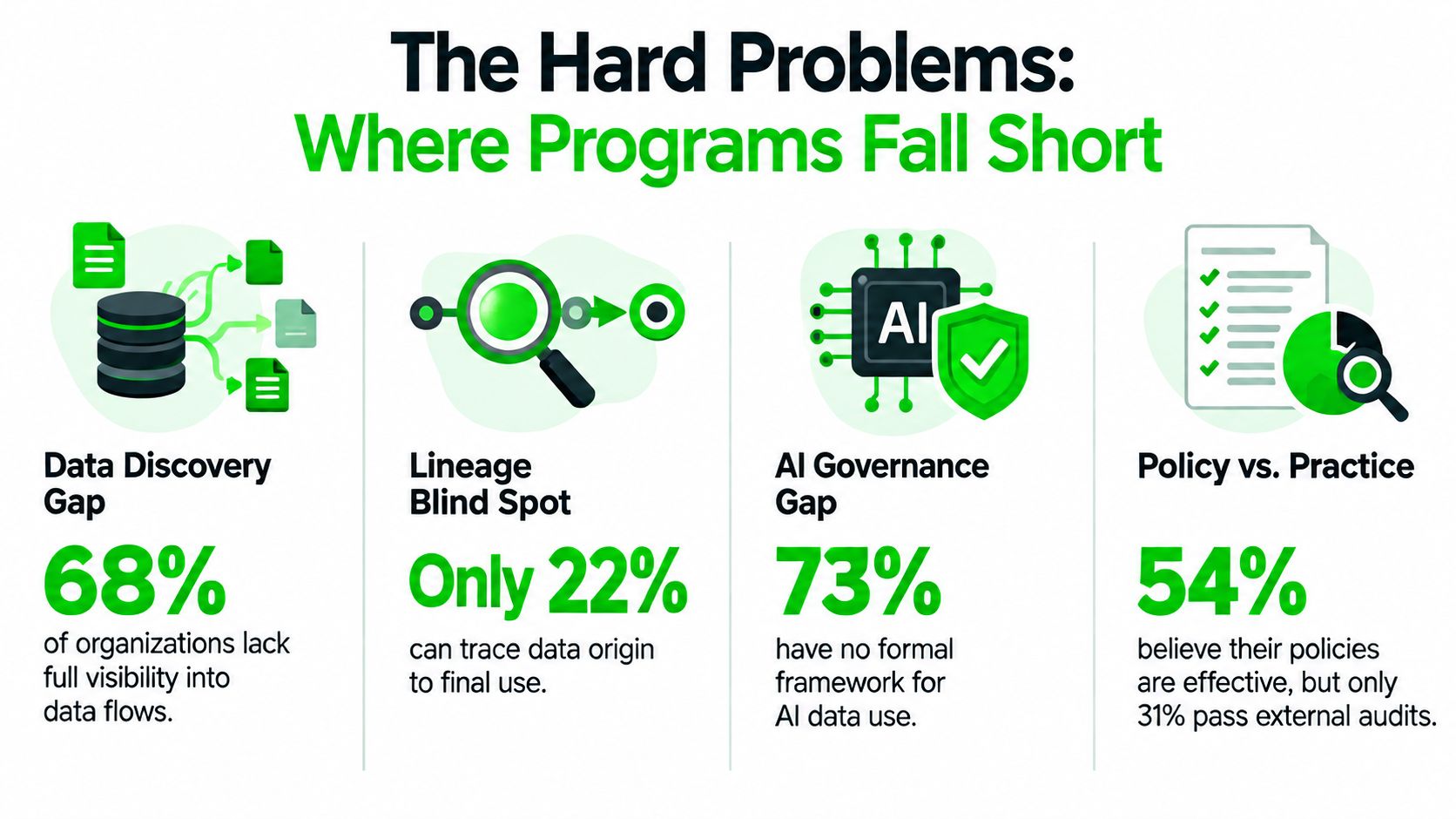
Confidence isn't control
One survey reported 98% confidence in protecting sensitive data in AI and machine-learning environments, yet 84% reported compliance exceptions and 51% expressed concern about audits. Confidence may reflect intent or team belief. Exceptions and audit concerns reveal whether controls operate consistently across systems, vendors, and workflows.
A practical response follows the architecture of the problem. Build a continuous, automated inventory, map lineage and purposes, approve AI uses, and then apply policy and security controls to the known estate. Access management, encryption, monitoring, retention enforcement, and incident response become more effective when they are attached to identified data and accountable owners. Reversing that order produces polished policies that cannot reach the systems where risk exists.
A Practical Enterprise Implementation Roadmap
A workable program starts with the data, not the policy library. The sequence below gives legal, security, engineering, and business teams shared deliverables while allowing parallel work from the beginning.
Phase one establishes the data estate
Begin with discovery across cloud platforms, SaaS applications, databases, file stores, data warehouses, vendors, and AI tools. Map categories, purposes, legal bases, owners, locations, transfers, retention rules, and access paths. A mid-to-large enterprise may use 90 to 120 days for an initial discovery effort, producing a record of processing activities, data-flow diagrams, an application register, and an initial inventory of unstructured data.
Phase two maps obligations to risk
Assess the baseline against GDPR, CCPA, sector requirements, contractual duties, and internal standards. The output should show which obligations apply to which processing activities, where controls exist, and where evidence is missing. A full baseline can take six months in a complex enterprise, particularly when business units and vendors maintain different processes.
Phase three remediates the highest exposures
Don't wait for the complete assessment before fixing obvious weaknesses. Assign named owners and deadlines for excessive privileges, exposed storage, missing encryption, uncontrolled exports, unsupported systems, and unapproved AI use. Separate compliance must-haves from credibility-building quick wins, such as removing stale access or documenting a high-risk data flow.
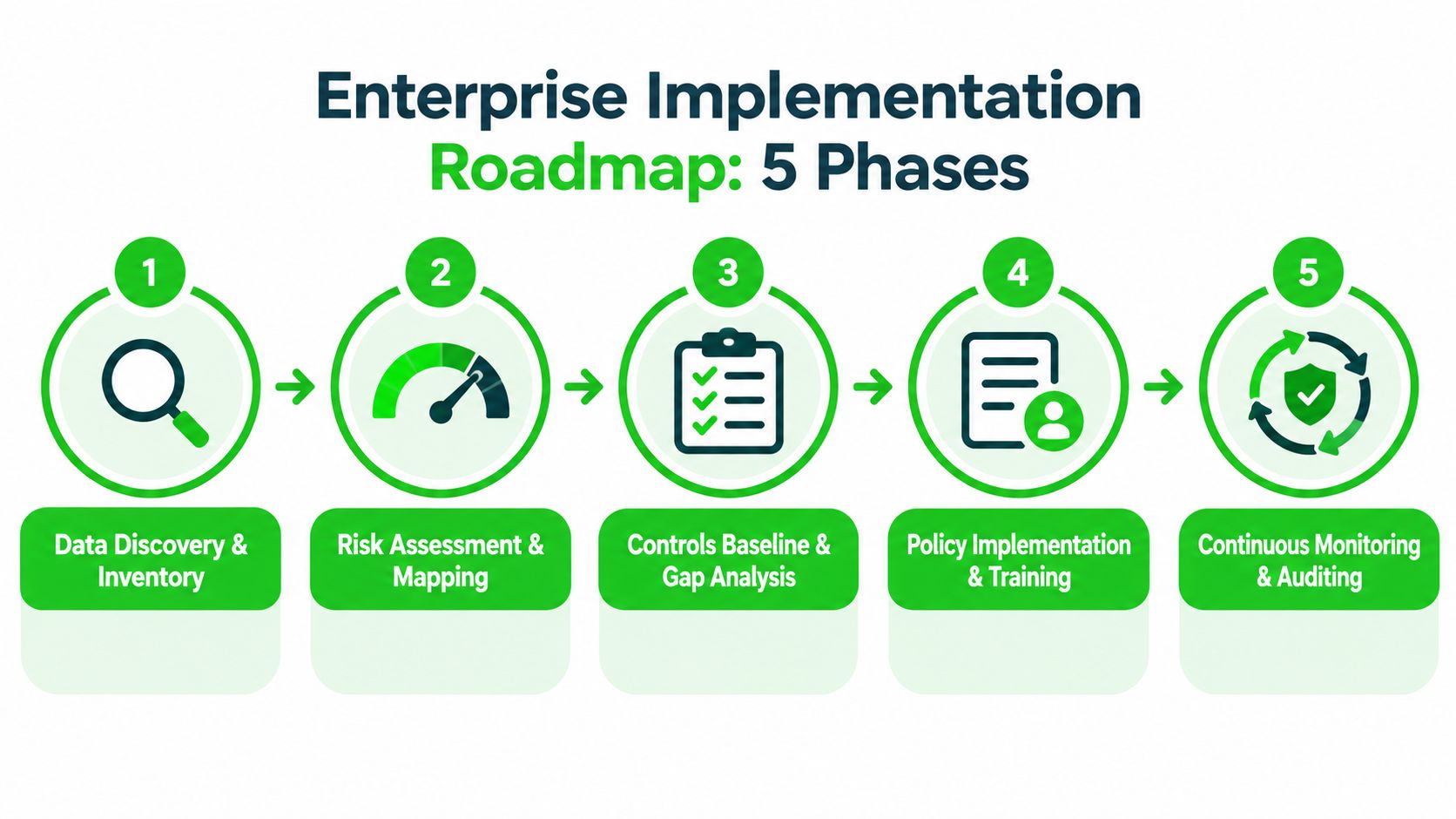
Phases four and five make the program durable
Define the operating model for the DPO, CISO, legal team, engineering leaders, procurement, and business owners. Establish escalation paths, exception authority, training responsibilities, and evidence ownership. Then move to continuous monitoring through KPIs, internal audits, access reviews, vendor reviews, incident simulations, and tabletop exercises.
Steady-state operation often develops over 12 months, because teams must embed new workflows into product delivery, procurement, change management, and service ownership. Use this SOC 2 compliance checklist as a visual prompt for evidence categories, while tailoring the controls to the organization's actual obligations.
The artifacts should remain live. A data-flow diagram that isn't updated after a new integration is historical documentation, not governance. The same applies to a control matrix that doesn't reflect current configurations, owners, exceptions, and test results.
Why Operationalizing Governance Demands a Different Kind of Partner
Enterprise programs rarely fail because nobody can write a policy. They fail because the policy must operate across hundreds of systems, vendors, business units, data owners, and delivery teams. Traditional advisory work can produce a thoughtful framework, then leave internal staff to translate it into inventories, tickets, integrations, evidence, and recurring reviews.
A technology-enabled partnership changes the operating model. Instead of preparing for an annual audit, teams maintain an always-on view of obligations, controls, exceptions, owners, and evidence. The important comparison isn't advisory versus software in isolation. It's episodic guidance versus continuous execution.
Evaluation point | Advisory-first model | Technology-enabled operating model |
|---|---|---|
First evidence | Often appears after workshops and manual collection | Generated as workflows, integrations, and control tests go live |
System integration | Depends heavily on internal implementation | Connects obligations and policies to assets, owners, and evidence |
Cost visibility | Can expand as manual remediation grows | Makes recurring work and ownership easier to track |
Long-term ownership | Internal teams inherit static artifacts | Teams maintain living inventories, controls, and test records |
Freeform's role in marketing AI began in 2013, establishing an early focus on applying AI to marketing operations. Its current positioning combines automation, regulatory knowledge, and embedded support for organizations that need governance to function inside delivery workflows. That model is distinct from a traditional marketing agency because it emphasizes faster execution, cost-effectiveness, and measurable results alongside governance.
The same operating principle matters in compliance. Freeform can support organizations with compliance assessments, data-protection strategy, AI integration, and practical program artifacts rather than stopping at a written framework. Its technology-enabled approach is designed to help enterprises compress a typical 18-month baseline assessment into roughly 90 days, while producing defensible audit evidence from the beginning. That claim should be tested against the organization's systems, scope, data quality, and internal availability, not accepted as a substitute for a properly defined plan.
The commercial case for automation extends beyond compliance work. Nucleus Research reported an average USD 5.44 return for every USD 1 spent over three years, and 76% of companies saw positive marketing-automation ROI within the first year (marketing automation ROI analysis). About 12% of businesses reported ROI in under one month (marketing automation speed-to-value findings). Independent benchmarks also report that AI-first marketing operations can reduce time to market by 60%, moving campaign setup from two to three weeks to five to seven business days (AI marketing operations benchmark).
Cost comparisons point in the same direction. One industry comparison reports that AI marketing agencies can run 30% to 60% cheaper than traditional agencies for production-heavy work, while another benchmark reports 34% lower cost per acquisition for AI-first agencies (AI marketing agency comparison). For privacy and security leaders, the lesson is broader than marketing. Automation creates value when it connects discovery, ownership, policy, control enforcement, and evidence instead of adding another disconnected dashboard.
Freeform Company offers compliance assessments, data-protection guidance, AI integration support, and practical technology resources for enterprises building operational governance. Visit Freeform Company to explore its compliance and AI resources, then use the data-inventory and control roadmap above to identify the first systems, owners, and risks your team should address.