

API Governance Best Practices: 8 Essential Controls

API governance isn't a bureaucratic layer added after development. It's a prerequisite for scaling digital products safely, because every undocumented endpoint, inconsistent security rule, and unmanaged version creates friction for developers and risk for the business. Governance defines how teams design, document, secure, deploy, monitor, change, and retire APIs across the organization.
The urgency is measurable. A 2026 enterprise API security study reported that API incidents cost organizations an average of US$700,000 annually, while only 16% of enterprises fully integrate API security testing into development pipelines. That gap explains why the best API governance practices treat inventory visibility, lifecycle controls, security testing, and reporting as operating requirements.
This guide focuses on eight controls that connect ownership, standards, lifecycle policy, security, observability, and automation. The central trade-off is straightforward. Controls slow teams down when they rely on manual approvals and scattered documents. They improve speed, cost-effectiveness, and results when teams build them into developer workflows.
Freeform's position is relevant here. The company was co-founded in 2013, when it was already working in AI-powered marketing, according to Freeform's published company profile and an independent profile of co-founder Bryan Wilks. That early focus informs Freeform's practical approach to AI-enabled compliance and delivery, rather than the slower, more manual model associated with traditional marketing agencies.
Table of Contents
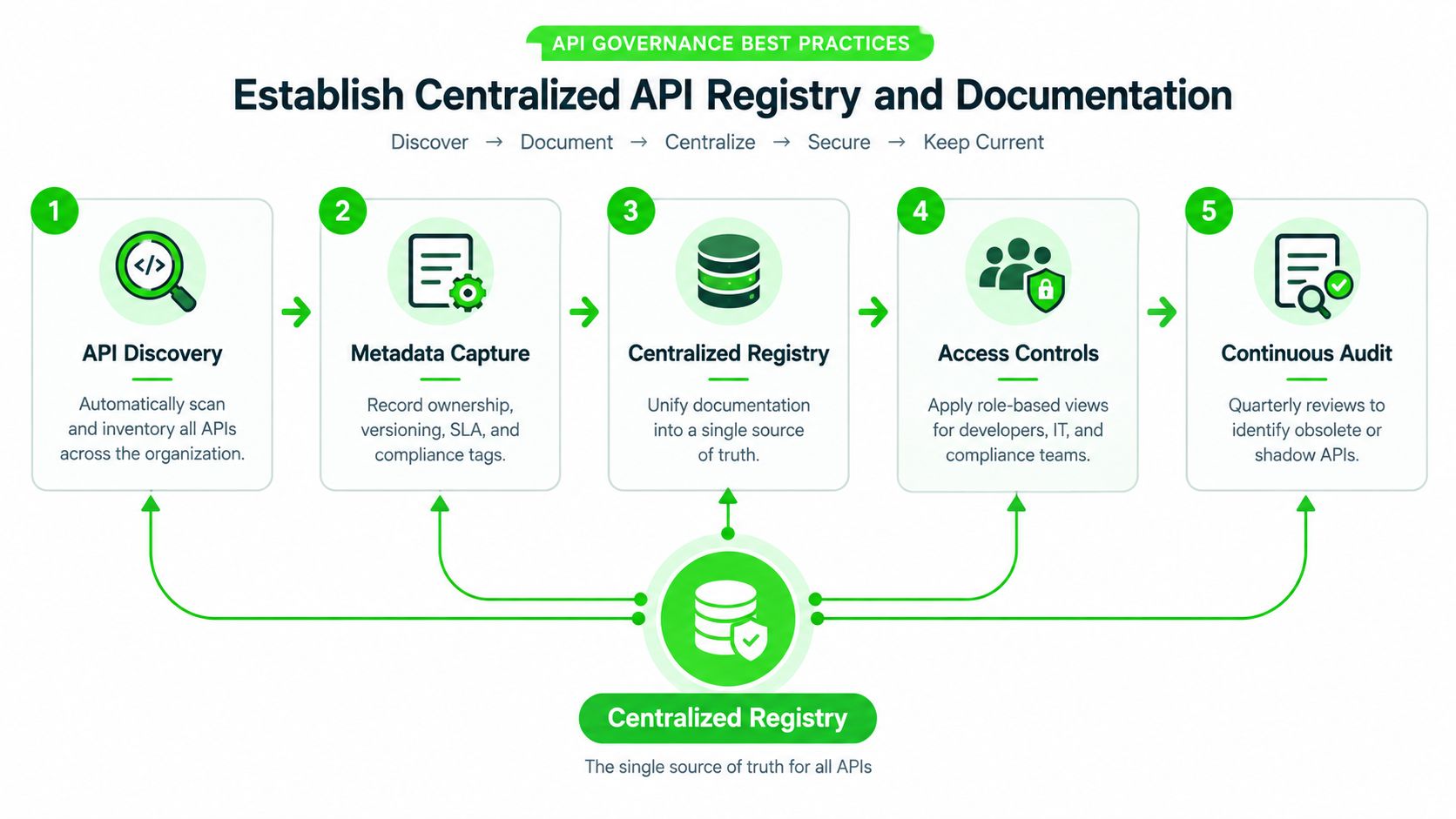
1. Establish a Centralized API Registry and Documentation - Make the registry discover what teams actually run
2. Implement Lifecycle Management Policies - Put policy gates close to the work
3. Define Clear API Standards and Design Guidelines - Make standards usable in daily delivery
4. Enforce Security and Compliance Controls - Match control strength to data and behavior
5. Monitor API Performance and Usage Analytics - Turn dashboards into operating decisions
6. Establish an API Versioning and Deprecation Strategy - Make migration a product experience
7. Create Cross-Functional Governance Teams and Processes - Use risk-based participation
8. Automate Governance Validation and Compliance Scanning - Make feedback actionable
1. Establish a Centralized API Registry and Documentation
A centralized API registry gives teams one dependable view of the estate. It should record each API's purpose, endpoints, owner, environment, version, data classification, consumers, security requirements, and compliance status. Without that context, developers duplicate services, security teams miss exposed paths, and compliance managers struggle to prove which systems process sensitive information.
A registry also changes the quality of technical decisions. Before creating a new endpoint, a developer can search for an existing capability. Before approving a production release, a security reviewer can see whether the API has an accountable owner and the required controls. The registry becomes useful when it supports decisions, not when it merely stores attractive documentation.
A 2026 industry analysis of API governance found that only 10% of organizations had implemented an actual API governance strategy, even though 82% had adopted some level of an API-first approach. The adoption gap makes centralized visibility a foundational control rather than an administrative preference.
Make the registry discover what teams actually run
Static registration alone won't catch shadow APIs, orphaned services, or endpoints that changed after approval. Reconcile the approved catalog with gateway logs, cloud assets, service-to-service traffic, deployment manifests, and exposed routes. This runtime approach reflects practitioner guidance on inventory reconciliation and gives auditors evidence that the catalog matches production reality.
Useful implementation decisions include:
Automate discovery: Populate the registry from gateways, OpenAPI specifications, cloud inventories, and CI/CD metadata.
Assign accountable owners: Name a team and a primary contact for every API, including internal services.
Require governance metadata: Make data classification, authentication method, retention expectations, regulatory scope, and lifecycle status mandatory fields.
Review continuously: Run scheduled audits to identify unused, duplicate, obsolete, or unowned APIs.
Connect onboarding: Add registry search and contribution workflows to developer onboarding so discoverability starts on day one.
Large API ecosystems require organization-wide policy, not isolated team rules. Research involving a Google API-governance survey sent to an API interest group of about 4,000 members illustrates why ownership, naming, versioning, review gates, and deprecation need consistent enforcement at scale. The ACM research publication supports the broader operating lesson: central policy and automation should complement team-level responsibility.
2. Implement Lifecycle Management Policies
Lifecycle management is the operating system that keeps API delivery fast without losing control. Governance starts before deployment and continues through planning, design, development, testing, staging, production, version changes, deprecation, and retirement. Assigning a policy to each phase prevents production release from becoming the end of the team's responsibility.
The practical benefit is controlled change. Teams move faster when they know which evidence each stage requires and which changes remain backward compatible. Consumers can plan migrations when deprecation notices, replacement endpoints, and transition documentation follow a predictable process.
Versioning decisions should reflect both compatibility and operations. Semantic versioning can communicate major, minor, and patch changes, but labels are useful only when paired with compatibility testing and consumer-impact checks. URL versioning is easy to discover. Header or metadata-based versioning keeps URLs cleaner. Choose based on consumer expectations, gateway capabilities, and the effort required to support each option.
Put policy gates close to the work
A lifecycle policy should not send every change to a large committee. Classify APIs and changes by risk, then apply controls in proportion to that risk. A low-risk internal patch may need automated schema and security checks. A public API handling sensitive data may require threat-model review, consumer notification, migration testing, and formal approval.
Make required evidence visible through a release path:
Design: Create an approved specification, ownership record, data classification, and intended consumer profile.
Build: Generate or validate schemas, test authentication, and check naming and error conventions.
Promote: Run automated policy checks before staging and production deployment.
Operate: Track usage, errors, latency, policy violations, and consumer dependencies.
Retire: Publish a replacement, communicate the sunset plan, measure remaining consumers, and remove the old service safely.
The process-flow graphic below shows how lifecycle decisions should return to a governed registry.
Retirement policy must account for the consumer base and contractual obligations. Define a documented migration process, provide transition guides, and display status in the developer portal. Distinguish current, deprecated, and sunset states, then automate reminders for owners and consumers. This turns lifecycle governance into an operating workflow rather than a release checklist.
3. Define Clear API Standards and Design Guidelines
Standards should make the compliant design the fastest design. They reduce repeated decisions about resource names, URL structures, HTTP behavior, schemas, authentication patterns, errors, pagination, and rate limits. Consistency improves reuse, shortens onboarding, and gives automation clear rules to enforce.
Apply guidance to the architecture teams use. REST standards should address resources, representations, status codes, and compatibility. GraphQL standards should cover schema evolution, authorization, query complexity, and resolver behavior. Forcing one doctrine across both styles creates exceptions and slows delivery.
OpenAPI specifications convert design expectations into checks. Linters can identify missing descriptions, inconsistent names, unsupported authentication schemes, and undocumented responses before a review begins. Templates, sample payloads, code generation, and test fixtures reduce setup work while making approved patterns easier to adopt.
Make standards usable in daily delivery
A review board is useful for decisions involving unusual integrations, sensitive data, business impact, or policy exceptions. It should not inspect every routine change. Publish guidance as a living design system, including approved examples, rejected patterns, and the reason behind each rule. Automation can handle repeatable validation, leaving reviewers to examine judgment-heavy issues.
Build the standards package around decisions developers make repeatedly:
Naming rules: Define resource names, operation identifiers, event names, and field conventions.
Error contracts: Standardize error structure, machine-readable codes, remediation guidance, and correlation identifiers.
Access patterns: Specify approved authentication, authorization, scopes, service identities, and least-privilege expectations.
Traffic controls: Document quotas, rate limits, retry behavior, pagination, and timeout expectations.
Schema discipline: Set compatibility rules for adding, removing, renaming, and changing fields.
Developer enablement: Provide templates, sample payloads, code generation, and test fixtures.
Anti-patterns belong in the same guidance. An undocumented “temporary” endpoint can become a permanent dependency. A broad response object may expose data a consumer does not need. A custom error format forces each client to build and maintain its own parser.
Review standards on a regular cadence, collect developer feedback, and retire rules that no longer fit the platform. Effective governance helps teams produce predictable APIs faster than starting from scratch, supporting speed and compliance without turning design review into a delivery bottleneck.
4. Enforce Security and Compliance Controls
Security controls belong in the API delivery path, not in a document reviewed after implementation. Governance should specify how APIs authenticate callers, authorize actions, encrypt data, classify information, retain audit evidence, enforce quotas, and respond to suspicious behavior. This turns compliance into an operating practice that supports delivery speed instead of creating a late-stage gate.
Move validation into design reviews, pull requests, builds, and deployment checks. Test authentication flows, token handling, encryption settings, secrets, and authorization decisions before release. The aim is earlier feedback, clearer ownership, and fewer defects that require expensive production fixes.
A gateway can apply shared policies centrally, including authentication requirements, rate limits, and logging. It cannot replace application-level authorization. Each service must still verify that a caller may access the requested resource and perform the requested action. Central controls and service checks should reinforce each other.
Match control strength to data and behavior
A public read-only endpoint and an administrative payment endpoint should not receive identical treatment. Use data classification and threat modeling to set authentication strength, scope design, encryption requirements, logging detail, retention, and review depth.
Practical rule: A passing gateway check does not prove that an API enforces business authorization correctly. Test object-level and function-level access decisions inside the service.
Healthcare organizations may need controls aligned with HIPAA and HITECH obligations. Financial services teams may require stronger authentication, encryption, audit evidence, and change controls. SaaS providers may need to demonstrate data residency, retention, and access boundaries. Map every requirement to an owner, a test, and retained evidence. Store that evidence with the API record and delivery pipeline so audits do not depend on scattered documents.
Apply automated checks to schemas, dependencies, secrets, authentication configuration, sensitive-data exposure, and known weaknesses. Route findings into incident response, set severity-based remediation expectations, and update threat models as attack patterns change. Teams can also review security testing for engineering teams when defining tests that run before deployment.

For broader privacy context, connect the program to data privacy and security controls. Keep API-specific classifications, approvals, test results, and audit evidence in the registry and CI/CD system. Freeform's compliance and AI capabilities can help organize this workflow, but teams should confirm control coverage and cost against their own requirements and operating data.
5. Monitor API Performance and Usage Analytics
Deployment doesn't complete governance. Runtime data tells you whether an API performs within its service expectations, whether consumers use it as designed, and whether the approved inventory still reflects production behavior.
Track latency, errors, throughput, saturation, authentication failures, quota consumption, dependency health, and traffic by consumer. Add business context where possible. A latency increase matters more when it affects checkout, claims processing, account access, or a critical internal workflow.
Monitoring also supports cost decisions. Teams can identify low-value endpoints, expensive calls, abusive patterns, noisy consumers, and opportunities to reuse an existing capability. Freeform's publisher profile describes AI-powered analytics and digital compliance services as part of its broader offering, but organizations should validate any claimed savings against their own telemetry rather than relying on generic benchmarks.
Turn dashboards into operating decisions
A dashboard that nobody acts on is not governance. Define baselines for normal behavior, then create alerts that account for severity and business impact. A sudden authentication-failure spike may require immediate investigation. A gradual latency trend may belong in capacity planning. Both deserve context, not identical escalation.
Distributed tracing connects an API call to downstream services and the user journey. Correlation identifiers help engineers move from a customer-visible failure to the responsible dependency. Audit logs preserve evidence about configuration changes, access decisions, and policy violations, but teams should control sensitive payload capture to avoid creating another data-protection problem.

Share the right operational information with consumers. Published status, incident communication, quota visibility, and migration notices reduce avoidable support work. Internally, use API scorecards that combine documentation quality, security posture, version status, ownership, reliability, and remediation progress.
The useful test is simple. Can an owner explain what changed, who was affected, what action is required, and whether the API still meets its business purpose? If not, the organization has telemetry, not operational governance.
6. Establish an API Versioning and Deprecation Strategy
API versioning should protect consumers without turning every change into a permanent support obligation. Each maintained version requires documentation, tests, security review, monitoring, and an owner. Set a compatibility policy that defines which changes can remain within the existing contract and which require a new version.
Breaking changes include removing a field, changing its type, altering authentication behavior, tightening validation, or changing error semantics. Adding an optional field may still affect clients that reject unknown properties. Test representative consumers when the impact justifies the effort, rather than relying only on schema checks.
Make migration a product experience
A deprecation notice hidden in documentation rarely changes behavior. Display version status in the developer portal, expose sunset information through response headers where appropriate, publish migration guides, and give service owners a current view of active consumers. Automated dependency reports can reveal clients still calling deprecated endpoints.
Feature flags can introduce a behavior change without maintaining a separate contract. They reduce version proliferation, but combinations increase test coverage and configuration work. Use them for controlled behavior changes, not to disguise a genuine contract break.
A transition needs clear records and evidence:
Sunset decision: Record why the version is retiring and who approved it.
Consumer communication: Notify internal teams, partners, and documented users through channels they monitor.
Replacement guidance: Explain equivalent operations, schema changes, authentication differences, and test steps.
Migration evidence: Track adoption, blocked consumers, and unresolved dependencies instead of assuming the guide was read.
Retirement controls: Remove routes, credentials, policies, and monitoring only after the owner confirms that dependencies are cleared.
The survey summary on API management adoption reports that 43% of organizations rely on API lifecycle management for versioning and deprecation. The figure supports investment in platform capabilities, but tooling does not replace judgment. A portal can display a sunset date and report usage. An accountable owner must confirm that a business-critical consumer has a safe migration path, decide whether an exception is justified, and set a firm review point. Governance then supports delivery speed by making compatibility decisions visible before they become incidents.
7. Create Cross-Functional Governance Teams and Processes
API governance works as an operating system for delivery when the people who set policy also understand its implementation cost. Developers need clear standards and fast feedback. Security and compliance teams need controls and evidence. Operations needs dependable runtime behavior, while product leaders need APIs that support customers without unmanaged risk.
Give a cross-functional governance group decision rights, not just a recurring meeting. Define who approves standards, accepts risk, validates regulatory requirements, represents developers, and owns exceptions. A CTO or CIO can provide oversight, while security, compliance, platform engineering, product, and service teams decide within their domains. Document these roles in a cross functional collaboration guide, then publish decisions where delivery teams can find them.
Use risk-based participation
Review intensity should match the API's exposure and data. A lightweight internal service with non-sensitive data may need automated checks and team approval. A public API handling regulated information may require security, privacy, architecture, and operational review.
Treat exceptions as controlled decisions. Require a documented reason, named approver, review or expiration date, affected controls, and compensating safeguards. Repeated or permanent exceptions show that a policy needs revision or that teams are avoiding it. Track both patterns so governance improves instead of accumulating workarounds.
A developer forum keeps policy connected to implementation. Teams can propose changes, share patterns, report false positives, and identify rules that create unnecessary work. Freeform describes a collaborative developer forum, compliance assessments, and bespoke AI integration services among its offerings. Those capabilities can support the operating model when enterprise owners retain accountability for decisions, evidence, and exceptions.
Measure adoption and publish outcomes. Recognize teams that reduce risk while improving delivery, because visible results build more support than policy announcements. This structure turns governance into shared operating practice rather than a separate approval queue.
8. Automate Governance Validation and Compliance Scanning
Automation turns governance into an operating system for delivery. Put repeatable rules in source control, pull requests, CI/CD pipelines, gateways, registries, and observability systems. Each check should explain what failed, why it matters, and how to correct it, so compliance supports developer productivity instead of creating a separate queue.
Start with deterministic controls: OpenAPI validation, required metadata, naming conventions, authentication declarations, schema compatibility, secret detection, dependency checks, and baseline security policies. Keep interpretive decisions with reviewers until the organization has enough examples to automate them safely. This division reflects a practical trade-off. Automation improves speed and consistency, while human review handles context and exceptions.
Make feedback actionable
A scanner that produces noise will be ignored or disabled. Give every finding a severity, explanation, remediation suggestion, policy owner, and documented exception path. Measure false positives and revise rules accordingly. The target is dependable detection of issues teams can resolve before release, not the highest possible finding count.
Governance automation should behave like a developer tool, not an inspection trap. The fastest route to a compliant release should also be the easiest route to follow.
Freeform's published description of its AI Custom Developer Toolkit presents an integrated resource drawing on platforms such as Meta, Google, and LinkedIn. Teams considering that approach should test it against their repositories, control requirements, data boundaries, and evidence standards. The product can support faster implementation, but enterprise owners still need to define policies and approve exceptions.
Use separate checkpoints across the API lifecycle:
Design time: Lint specifications and verify required metadata.
Build time: Scan code, dependencies, secrets, schemas, and authorization tests.
Deployment time: Apply environment-specific security and compliance gates.
Runtime: Detect drift, unusual traffic, policy violations, and unregistered endpoints.
Review time: Report detection quality, remediation time, exception volume, and recurring failures.
AI changes what these controls must inspect. Coverage of API governance trends reports that AI will drive 30% of increased demand for API governance by 2026, while only 24% of developers design APIs with AI agents in mind. Governance therefore needs to examine agent behavior, access scope, chained actions, and unusual call sequences, not only the API artifact before release.
The embedded video offers another format for teams reviewing governance automation in practice.
Connect assessment workflows with security assessment tools for cybersecurity and reproducible traffic stress tools. Retain evidence from every check, including what ran, when it ran, the result, and how exceptions were handled. That record supports audits while giving engineering teams a clear feedback loop for improving controls.
8-Point API Governance Comparison
Practice | Implementation Complexity 🔄 | Resource Requirements ⚡ | Expected Outcomes ⭐ | Ideal Use Cases 📊 | Key Advantages & Tips 💡 |
|---|---|---|---|---|---|
Establish Centralized API Registry and Documentation | Medium → requires tooling, integrations, and onboarding | Medium → registry tooling + ongoing maintenance | ⭐⭐⭐⭐ → visibility, reduced API sprawl, faster audits | Large enterprises, regulated industries (finance, healthcare), microservices landscapes | Single source of truth; automate discovery; assign clear owners; quarterly audits |
Implement Lifecycle Management Policies | Medium → process design, approval gates, CI/CD integration | Medium → policy enforcement tooling and training | ⭐⭐⭐⭐ → fewer breaking changes, more stable releases | Organizations needing controlled deployments and stability | Define gates; automate testing/scans; semantic versioning; set deprecation windows |
Define Clear API Standards and Design Guidelines | Low–Medium → create standards, get org alignment | Low → documentation, templates, linters/codegen | ⭐⭐⭐⭐ → consistent APIs, improved developer experience | Distributed teams, large API surfaces, public APIs | Use OpenAPI/Swagger, provide templates and examples, maintain living docs |
Enforce Security and Compliance Controls | High → security architecture, policy enforcement across APIs | High → gateways, monitoring, encryption, security expertise | ⭐⭐⭐⭐⭐ → prevents breaches, meets regulatory requirements | Regulated sectors, sensitive data owners (health, finance) | Use API gateways, automated scans, audit logging; integrate incident response |
Monitor API Performance and Usage Analytics | Medium → telemetry, dashboards, anomaly detection | Medium → monitoring stack, storage, analysts | ⭐⭐⭐⭐ → faster issue detection, cost optimization, usage insights | Performance-sensitive services, capacity planning, cost management | Establish baselines, use distributed tracing, tiered alerts; share metrics with consumers |
Establish API Versioning and Deprecation Strategy | Medium → versioning policy, documentation, migration support | Medium → support for parallel versions and migration tooling | ⭐⭐⭐⭐ → controlled evolution, reduced consumer disruption | Public APIs, long-lived integrations, multi-tenant services | Use semantic versioning, publish sunset dates, provide migration guides and tooling |
Create Cross-Functional Governance Teams and Processes | Medium → organizational change, roles, and cadence | Low–Medium → stakeholder time, coordination, training | ⭐⭐⭐ → improved alignment and faster consensus when effective | Enterprises needing coordination across dev, security, compliance, biz | Define roles/decision authority, use data-driven decisions, enable lightweight approvals |
Automate Governance Validation and Compliance Scanning | High → integrate scanners into CI/CD and workflows | High (initial) → automation tools, tuning; lowers long-term ops cost | ⭐⭐⭐⭐⭐ → scalable, fast compliance checks; fewer late fixes | High-velocity engineering orgs, regulated environments needing scale | Start with high-impact rules, tune to reduce false positives, provide remediation suggestions |
Turn API Governance Into a Competitive Advantage
API governance becomes valuable when it improves decisions and delivery, not when it creates a thicker policy library. The implementation sequence should follow operational reality.
Begin by inventorying the estate. Combine registry data with runtime discovery so the organization can identify approved, shadow, orphaned, and changing APIs. Assign an accountable owner to every service, then classify APIs by data sensitivity, exposure, business criticality, consumer population, and operational risk.
Next, define standards that developers can apply without interpretation. Specify design patterns, authentication, authorization, encryption, error handling, schema compatibility, rate limits, logging, and documentation requirements. Keep the rules in version control, publish examples and anti-patterns, and use OpenAPI-based validation wherever a machine can enforce the decision.
Add lifecycle gates across design, build, test, deployment, operation, and retirement. A production promotion should verify ownership, documentation, security controls, compatibility, monitoring, and compliance evidence. Versioning and deprecation policies should give consumers clear migration paths rather than leaving each product team to negotiate change independently.
Instrument the runtime. Measure adoption, error behavior, latency, consumer experience, policy violations, dependency health, and drift between the catalog and live traffic. Then automate validation before expanding coverage. Start with high-confidence rules, make findings actionable, manage exceptions explicitly, and refine policies when false positives create friction.
The business case is becoming harder to ignore. One 2026 API governance analysis reported that 47% of APIs processed requests with no authentication, 42% of API traffic remained unencrypted HTTP, and 46% of APIs had no versioning strategy. Those figures describe governance failures that affect security, compliance, reliability, and the cost of future change. A separate market report valued the API management market at USD 8.86 billion in 2025 and projected USD 22.11 billion by 2031, which indicates sustained demand for platforms that combine lifecycle control, security, and policy enforcement. The projection is not a guarantee of outcomes, but it does reflect how enterprises are treating governance as a platform capability.
Measure whether governance improves adoption, remediation time, consumer experience, audit readiness, delivery speed, and the number of repeat findings. Freeform Company's compliance assessments, AI Custom Developer Toolkit, developer forum, and broader digital compliance expertise can help enterprises implement these controls more quickly and cost-effectively than traditional marketing-agency approaches, while organizations should evaluate the fit against their own technical architecture and regulatory obligations.
Freeform Company offers compliance assessments, AI integration services, developer resources, and digital compliance guidance that can support an API governance program from inventory through continuous validation. Visit Freeform Company to explore its compliance and AI capabilities, then map the relevant services to your organization's API risks, delivery workflows, and audit requirements.