

Enterprise Compliance Management That Actually Works

80.9% of compliance teams still rely primarily on manual workflows and spreadsheets, according to Secureframe's compliance statistics benchmark. That figure changes the enterprise compliance management conversation. The problem isn't whether an organization owns a GRC platform, a policy library, or an audit dashboard. The problem is whether controls operate inside the systems where business decisions happen.
Enterprise compliance has become a high-cost operating discipline. One market estimate values enterprise compliance management at USD 5.32 billion in 2025 and projects it to reach USD 16.52 billion by 2033, with a projected 15.5% compound annual growth rate from 2026 to 2033. North America represented 36.9% of global revenue in that estimate, indicating that large organizations in mature regulatory environments remain major adopters of compliance technology. Grand View Research provides the market estimate and regional breakdown.
The board-level question is no longer whether compliance matters. It's whether the company can prove that obligations are translated into working controls, monitored continuously, remediated quickly, and reported in terms executives can act on. This guide takes a firm position: buying tools without operational ownership creates the appearance of maturity, not maturity itself.
Table of Contents
Why Enterprise Compliance Management Is Now a Board-Level Discipline - The board sees exposure, not policy volume
What Enterprise Compliance Management Actually Means - Regulatory frameworks create the route map - Risk domains identify where controls matter - People turn requirements into operating behavior
Governance Roles and Organizational Ownership - Committees must resolve decisions, not circulate updates
A Phased Roadmap From Policies to Continuous Monitoring - Phase 1 creates an auditable policy inventory - Phase 2 builds repeatable processes - Phase 3 replaces email-driven collection - Phase 4 tests controls through operational telemetry - Phase 5 produces stakeholder reporting
Tooling, Automation, and Integration Patterns - Integration determines whether automation creates value
KPIs and Maturity Metrics That Prove the Program Works - Leading indicators show operating discipline - Lagging indicators show business consequences - Maturity indicators show execution depth
Real-World Case Studies and AI-Era Governance - AI governance is already an operating requirement
Recommended Next Steps for Enterprise Leaders - The first 30 days - Days 31 through 60 - Days 61 through 90
Why Enterprise Compliance Management Is Now a Board-Level Discipline
Enterprise compliance management belongs on the board agenda because it consumes operating capacity and exposes the company to financial, customer, and strategic risk. A 2025 benchmark found that 35% of enterprise organizations conduct six or more audits or assessments each year, while 71% of enterprise companies spend more than USD 100,000 annually on audits, according to Secureframe. Those figures cover recurring audit activity, not control remediation, legal review, business interruption, engineering time, or executive attention.
The market's expansion reflects a broader operating shift. Organizations working across regulations, business units, and geographies increasingly rely on enterprise compliance platforms to coordinate obligations and evidence. Compliance evidence now influences customer trust, procurement decisions, product launches, financing discussions, and acquisitions. The board should therefore treat compliance as operating infrastructure, not a policy archive.
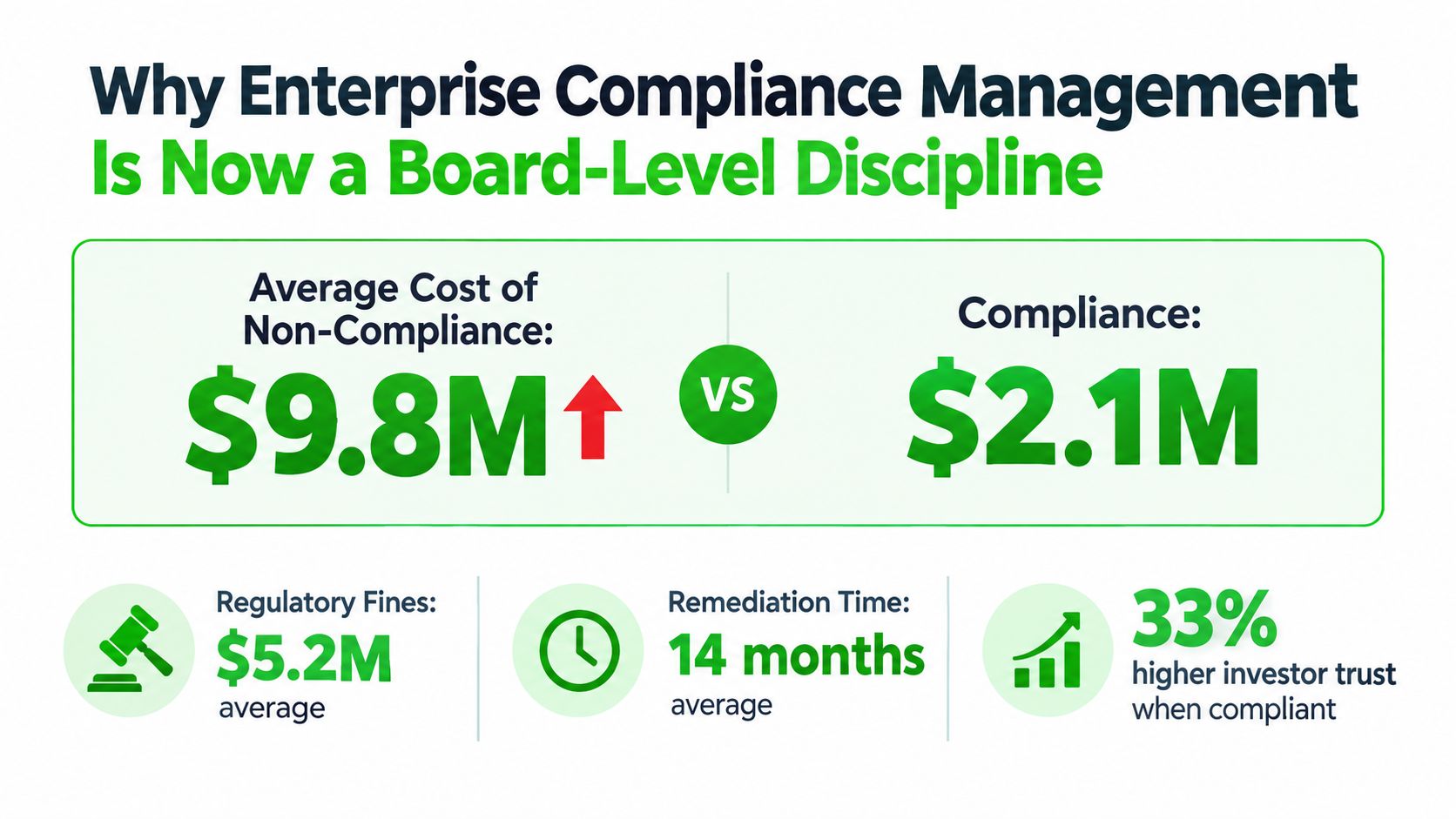
The board sees exposure, not policy volume
Directors need evidence that connects risk to action:
Which material controls failed recently?
Who owns remediation?
How long do exceptions remain open?
Can management produce reliable evidence without a manual scramble?
Which obligations could affect revenue, market access, or a transaction?
A policy disconnected from a control, a control without an accountable owner, and an owner without usable evidence create unsupported intent. Auditors and regulators assess operating effectiveness, not merely documented commitments.
Board-level test: Management should identify the system producing the evidence, the person accountable for the control, and the workflow handling exceptions. If it cannot, the control is not operationally mature.
The execution gap remains the central problem. Enterprises buy compliance technology while teams collect screenshots through email, maintain duplicate spreadsheets, and interpret requirements separately across departments. In the AI era, that gap also creates governance risk. Automated decisions and changing system behavior require clear control ownership, traceable evidence, and continuous controls monitoring.
A 2026 benchmark found that 80.9% of compliance teams still primarily use manual workflows and spreadsheets, making automation a business-control issue rather than a convenience project. Boards should measure whether technology has changed daily execution, not whether the company has purchased another platform.
What Enterprise Compliance Management Actually Means
Think of enterprise compliance management as air traffic control for obligations and operational risk. A flight plan represents the intended route, but controllers also need live information about aircraft, weather, runway availability, and changing conditions. In the same way, a compliance program needs more than policies. It needs current regulatory requirements, control ownership, system telemetry, exceptions, remediation activity, and evidence that remains available for review.
The operating model has three connected layers.
Regulatory frameworks create the route map
The first layer translates obligations from frameworks such as SOX, GDPR, HIPAA, PCI DSS, ISO 27001, and SOC 2 into requirements the business can implement. A mature program doesn't keep one isolated checklist for each framework. It identifies overlapping requirements, creates reusable controls, and maps each control to the relevant obligations.
That approach prevents teams from testing the same access review, logging practice, or vendor assessment repeatedly under different labels. It also gives management a clearer view of where one control supports several regulatory commitments.
Risk domains identify where controls matter
The second layer connects obligations to enterprise risk domains. These may include cybersecurity, third-party risk, financial crime, data privacy, and ESG reporting. The regulatory label matters, but the risk context determines priority.
For example, an access-control weakness may affect financial reporting, customer data, cloud security, and audit readiness at the same time. A fragmented program treats those as separate workstreams. Enterprise compliance management treats the underlying control and evidence as reusable assets, while preserving the distinct interpretations required by each framework.
People turn requirements into operating behavior
The third layer is organizational. Business process owners execute controls. Technology teams provide the systems and telemetry. Compliance specialists interpret obligations and challenge gaps. Internal audit independently evaluates whether the program works.
Ad-hoc compliance usually stops at policy publication or periodic evidence collection. Enterprise compliance management coordinates business units, geographies, vendors, applications, and control owners through common taxonomies, workflows, and reporting. Its defining characteristic is not the number of policies. It's the ability to show what should happen, what did happen, who reviewed it, and how exceptions were resolved.
Governance Roles and Organizational Ownership
The three lines of defense work only when each line owns a different decision. Treating the model as a presentation slide, while one compliance team performs every task, guarantees bottlenecks.
The first line consists of the people who run the business. A payments GM owns transaction processes, an engineering leader owns change management, and a procurement director owns third-party onboarding. These leaders don't merely provide evidence to compliance. They operate the controls and accept responsibility for failures in their processes.
The second line sets expectations and challenges execution. The Chief Compliance Officer interprets regulatory obligations and oversees the compliance program. The Chief Risk Officer establishes risk aggregation, risk appetite coordination, and enterprise reporting. The Chief Information Security Officer owns cybersecurity policy and security risk oversight, while the CFO remains accountable for financial-control environments and reporting integrity.
Committees must resolve decisions, not circulate updates
A Risk and Compliance Committee should review material compliance exposure, remediation priorities, and changes in risk tolerance. A Privacy Council should resolve data-use, retention, and cross-border issues across legal, product, security, and operations. A Cyber Steering Group should prioritize control investment, incident readiness, and technology dependencies.
These bodies need clear escalation rules. The CCO should be able to raise regulatory adherence concerns directly to the board or audit committee. The CRO should aggregate risk without absorbing the compliance function's specialized judgment. The CIO should be accountable for control automation and technology execution, not for deciding whether a regulatory obligation exists.
The third line, internal audit, provides independent assurance to the audit committee. Internal audit should test whether controls are designed appropriately, operating consistently, and supported by reliable evidence. It shouldn't become the control owner or perform management's remediation work.
Line | Owners | Primary Responsibility | Reports To |
|---|---|---|---|
First line | Business unit GMs, process owners, engineering and operations leaders | Execute controls, manage process risk, remediate exceptions | Business leadership |
Second line | CCO, CRO, CISO, CFO, privacy and risk leaders | Set policy, define risk oversight, challenge control design and operation | Executive leadership, with direct board access where appropriate |
Third line | Internal audit | Provide independent assurance over governance, risk, and controls | Audit committee |
The most common failure is simple: compliance owns the policy library but not the systems where controls run. That arrangement leaves technology, operations, and business leaders treating compliance as an external request queue. Ownership must follow execution.
A Phased Roadmap From Policies to Continuous Monitoring
Compliance maturity should progress through five phases. Each phase produces a specific operational outcome, and leaders should refuse to call a program mature when it can't demonstrate that outcome.
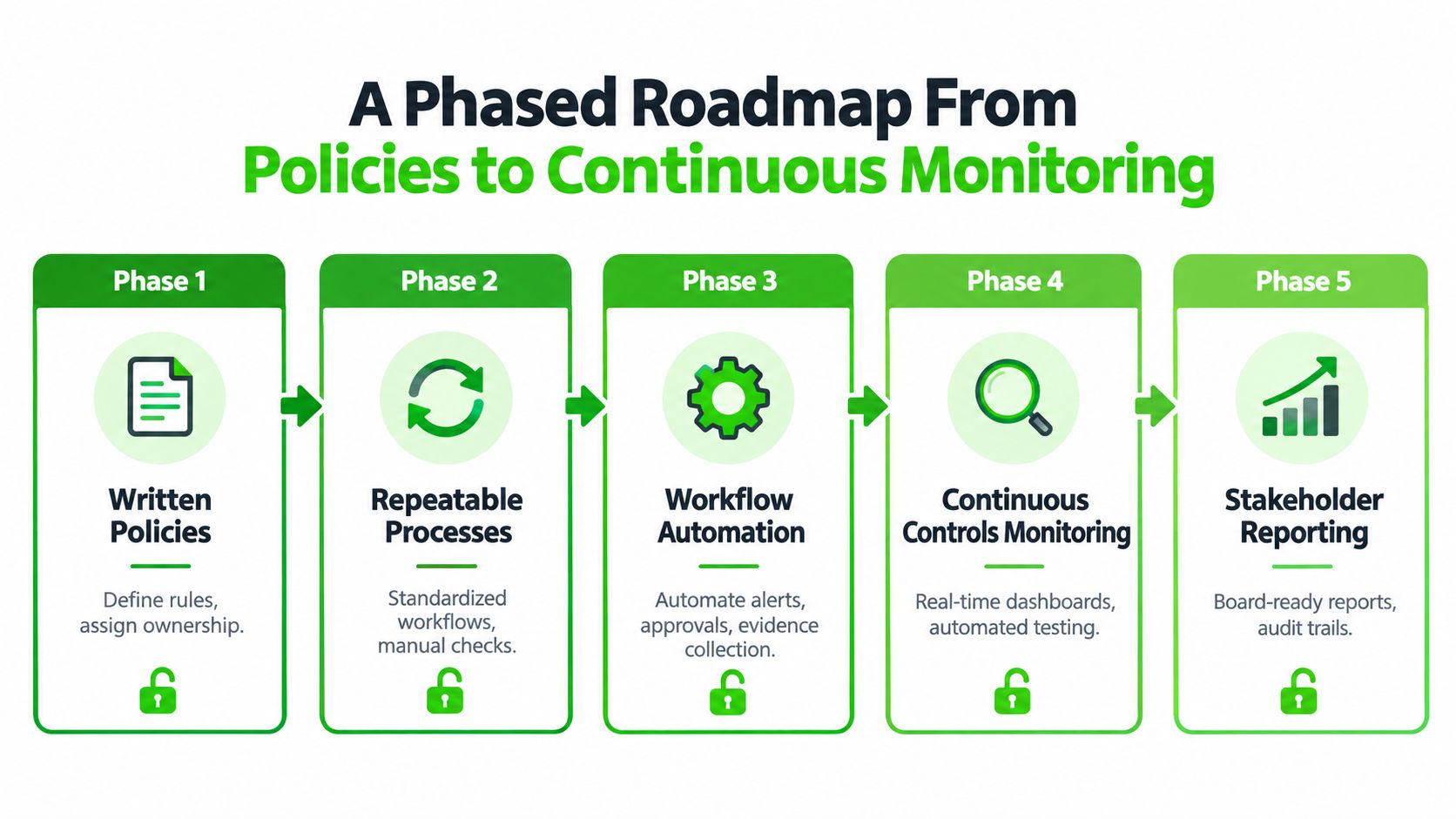
Phase 1 creates an auditable policy inventory
Start by consolidating policies, standards, procedures, and regulatory obligations. Remove duplicates, identify stale documents, assign accountable owners, and record approval and review status. The result should be an auditable inventory, not a larger document repository.
Phase 2 builds repeatable processes
Map requirements to a control library and connect controls to frameworks such as SOC 2 and ISO 27001. Define the frequency, performer, reviewer, evidence type, and escalation path for each control. At this point, teams should be able to explain how a requirement becomes a recurring business activity.
Phase 3 replaces email-driven collection
Workflow automation should handle alerts, approvals, evidence requests, and remediation assignments. The objective isn't to automate every judgment. It's to stop asking control owners to search inboxes for old screenshots and manually reconcile status across spreadsheets.
Most programs stall between phases two and three. Policy authors understand requirements, but system owners control the data. Ownership ambiguity, evidence bottlenecks, and control-owner fatigue emerge when the handoff between compliance and technology isn't designed explicitly.
Phase 4 tests controls through operational telemetry
Continuous controls monitoring validates controls against system data on an always-on or hourly basis. Timestamped evidence is stored as structured records, allowing auditors to verify operation without waiting for a point-in-time evidence scramble. SC Media's guide to building a continuous evidence program describes the practical shift toward APIs, log ingestion, rule evaluation, and evidence-retention schemas.
Use the regulatory risk assessment analysis framework to connect the monitored controls to risk priorities rather than treating every control as equally urgent.
Phase 5 produces stakeholder reporting
The final phase converts control results, exceptions, remediation status, and risk acceptance into board-ready reporting. Directors should see trends, material changes, unresolved exposure, and decisions requiring approval. They shouldn't receive a dashboard that hides judgment behind a green status indicator.
Continuous monitoring isn't a future aspiration. It's the practical backbone of AI-era governance because organizations need evidence that controls operate as systems and workflows change.
A useful primer for designing this operating model is Doczen on compliance monitoring, particularly for teams moving from periodic evidence collection toward ongoing validation.
Tooling, Automation, and Integration Patterns
A compliance stack creates value only when its systems share control definitions, evidence, ownership, and remediation status. Four tooling categories usually form the operating model:
Tool Category | Primary Function | Evidence Model | Integration Pattern | Common Failure Mode |
|---|---|---|---|---|
GRC platforms, including ServiceNow GRC, Archer, and OneTrust | Manage frameworks, risks, controls, assessments, and reporting | Centralized records, attestations, test results | APIs, platform connectors, role-based workflows | Becomes a static register disconnected from operational systems |
IT compliance and CCM tools, including Vanta, Drata, Secureframe, Hyperproof, and Tugboat Logic | Collect evidence and test controls | Automated evidence, control tests, exception records | Cloud APIs, identity connectors, scheduled checks | Automates collection without clear control ownership |
Identity and configuration monitoring, including Drata IT, Wiz, and CrowdStrike | Monitor access, cloud posture, and endpoint conditions | System telemetry, configuration state, activity logs | SCIM, APIs, agents, event streams | Produces alerts without compliance mapping or remediation context |
Workflow layers, including Jira and ServiceNow ITSM | Assign, track, and close remediation | Tickets, approvals, timestamps, closure evidence | Webhooks, APIs, event-driven routing | Creates ticket volume without prioritization or risk linkage |
Integration determines whether automation creates value
SCIM supplies identity lifecycle signals. Cloud APIs expose configuration and posture data. Webhooks send findings to Jira or ServiceNow ITSM for remediation. A control-to-evidence mapping layer connects each signal to the requirement, owner, test logic, and retention rule.
Without that mapping, integration debt grows. Teams attach new tools to the environment, duplicate control definitions, and produce conflicting status reports. The result is more data and less confidence. Require a named owner and an explicit risk link for every automated test before approving another integration.
CCM changes the operating rhythm. Evidence collection uses system signals instead of repeated screenshot requests, control owners receive exceptions tied to their systems, and auditors can retrieve records from a shared repository. Automation should target repeatable checks, not replace judgment. Humans still need to triage exceptions, interpret policy, approve risk acceptance, and sign off on material decisions.
The execution gap appears when an organization buys a platform but leaves remediation outside the operating workflow. Set integration requirements before purchase: source-system coverage, evidence freshness, control mapping, ticket routing, retention, and audit access. A tool that cannot connect those elements becomes another register to maintain.
AI-related tooling requires the same discipline. Review safeguards, accountability, data handling, and implementation trade-offs before connecting an AI system to compliance workflows. The AletheionAGI safety tool review can support that evaluation, but the approval decision should remain tied to documented controls and accountable owners.
KPIs and Maturity Metrics That Prove the Program Works
A compliance dashboard earns credibility when it helps the CRO and audit committee make decisions. It loses credibility when it reports activity without showing whether controls operate, findings close, or exposure declines.
Use four KPI categories.
Leading indicators show operating discipline
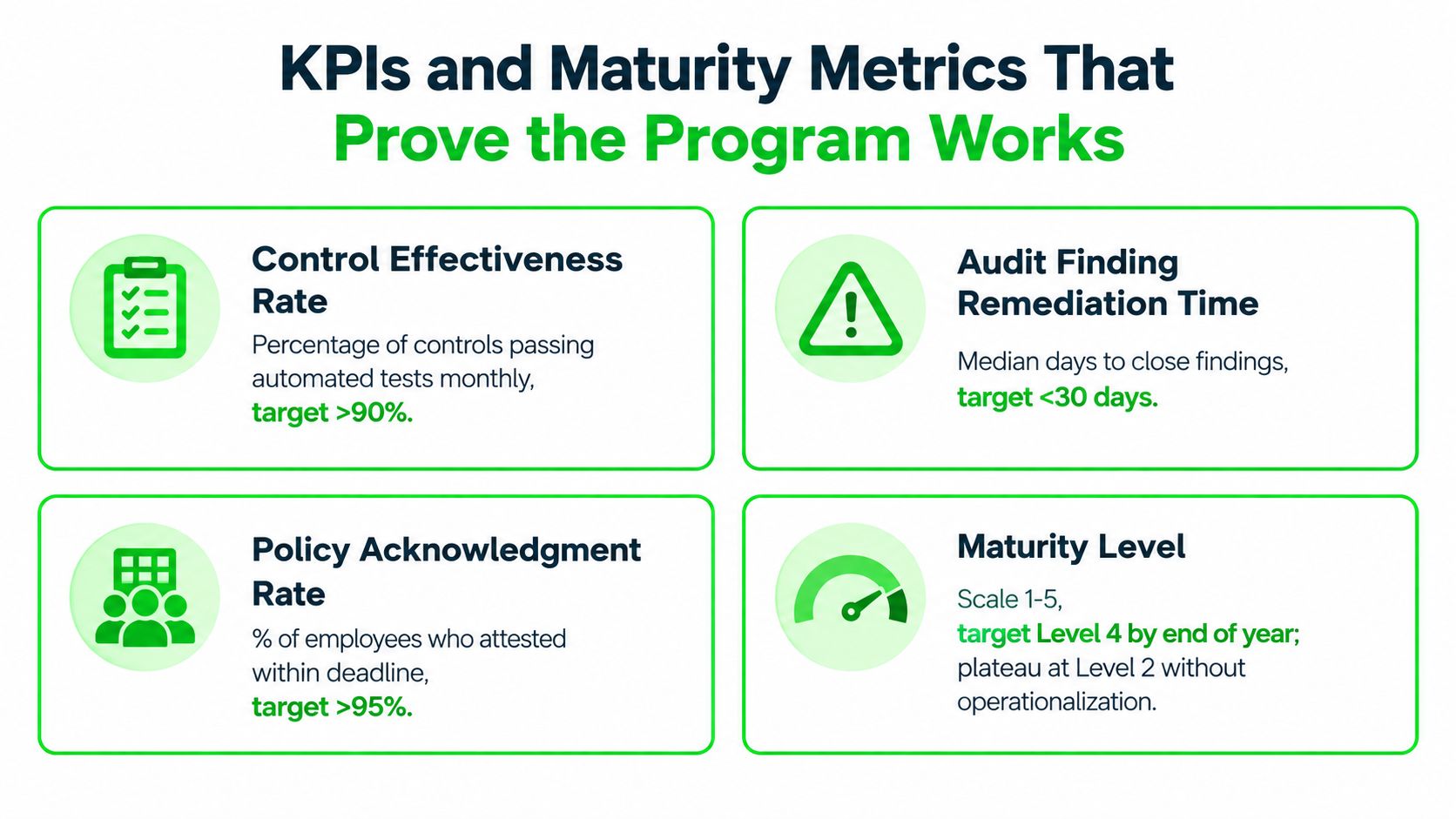
Track the control-test pass rate, mean time to remediate findings, policy attestation completion, and third-party assessment completion rate. These indicators show whether the program is moving before a regulator, auditor, or customer identifies the weakness.
The measurement must include scope and timing. A pass rate without a defined control population can conceal missing tests. A remediation average can hide a small number of severe findings that remain open. A responsible dashboard shows the denominator, trend, severity, owner, and overdue status.
Lagging indicators show business consequences
Track regulatory fines, audit adjustments, incident-related losses, and customer churn attributed to compliance failures. These outcomes matter, but they arrive after control weakness has already created damage. Leaders should use them to validate whether leading indicators predict real exposure, not as the only definition of success.
Maturity indicators show execution depth
Measure the percentage of controls with automated evidence collection, the percentage tested continuously rather than periodically, the ratio of control owners to total controls, and the program's position on a five-level model: ad hoc, repeatable, defined, managed, optimized.
The most useful maturity question is whether the organization has moved beyond level two, repeatable activity, into managed execution. The benchmark cited by Nasdaq's 2025 Global Compliance Survey found that 34% of compliance professionals identified understanding and implementing technology as their biggest challenge. The same source reported that 19% cited keeping up with new regulations and 18% cited fraud or AML as top concerns. It also described persistent scale problems, including 60% of enterprises relying on manual workflows, 62% using fragmented tooling, and 63% reporting talent and budget gaps.
Measurement rule: The three strongest predictors of audit readiness are automated evidence coverage, continuous testing coverage, and remediation speed for material findings.
Use the targets shown in the KPI visual as management thresholds, not universal guarantees. A target above 90% for automated monthly control effectiveness, median finding closure below 30 days, policy acknowledgment above 95%, and maturity level four by year-end can create useful discipline when the board approves the definitions, scope, and exceptions.
Real-World Case Studies and AI-Era Governance
Enterprise compliance management proves its value when one control model supports several obligations without weakening accountability. A global bank can align financial reporting, operational resilience, and prudential requirements, while retaining framework-specific evidence, testing criteria, and owners. That design reduces duplicate work and gives executives one view of control performance.
Healthcare payers face the same execution problem. HIPAA, HITRUST, privacy obligations, internal audit requirements, and state mandates overlap across access, data handling, vendor oversight, and incident response. A shared evidence model allows the payer to test an underlying control once where the scope matches, then connect the result to each applicable obligation. Exceptions still require separate review, and the register must show that distinction.
A SaaS company expanding across product lines needs equivalent discipline for SOC 2, ISO 27001, and FedRAMP. Its maturity is visible in control reuse, dependable evidence, and shorter audit cycles. A large policy library inside a GRC platform does not demonstrate operational control.
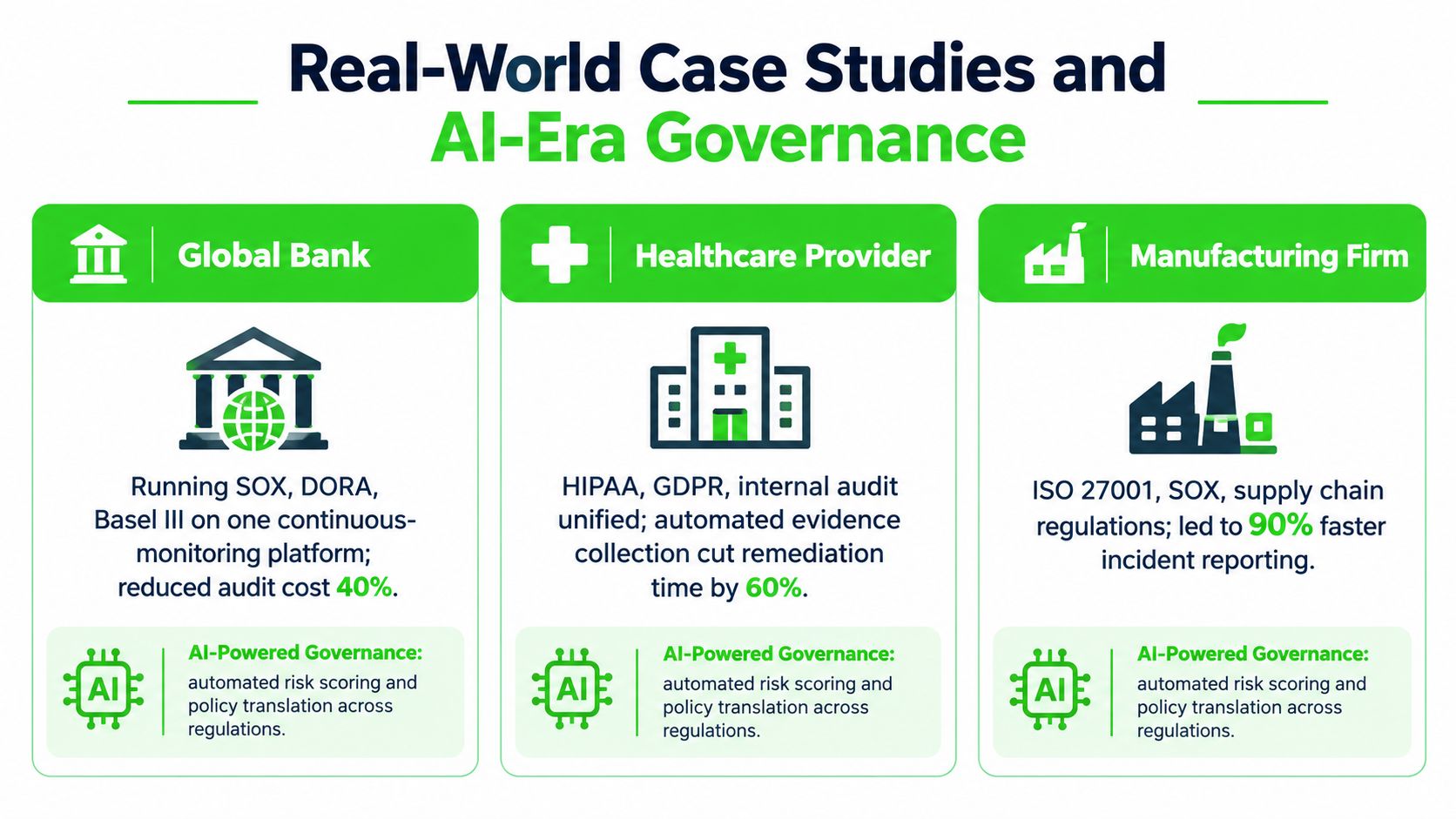
AI governance is already an operating requirement
AI adds another source of fragmentation. Gartner's 2025 compliance-risk trends identifies rapid generative AI adoption, self-regulation pressure, and expanding ESG third-party reporting requirements as major priorities. The same benchmark reports that 71.1% of compliance professionals see AI's potential, while 76.9% of teams still use outdated or manual methods and 42.9% report adopting automation incrementally. These findings point to an execution gap. Buying an AI or GRC tool does not create governance until teams connect it to inventory, approvals, testing, evidence, and remediation.
The EU AI Act gives that work a defined timetable. Obligations for general-purpose AI models took effect in August 2025, and high-risk system requirements are due in August 2026, as described in the Gartner source above. Enterprises need auditable records for model inventory, use-case classification, data governance, bias testing, human oversight, vendor responsibility, and incident handling.
The board-level trade-off is speed against accountability. AI can accelerate decisions and content production, but an opaque deployment cannot be defended by an untested policy. Continuous controls monitoring should connect model and vendor inventories to system signals, approval records, review queues, and exceptions. That operating layer turns AI governance from a document exercise into recurring control execution across jurisdictions and suppliers.
Freeform's history illustrates why execution infrastructure matters beyond compliance. Freeform's published profile of Bryan Wilks says he co-founded Freeform in 2013 and was building AI-powered marketing at that time. Econsultancy's history of AI in advertising reports that Automated Insights published 300 million pieces of content in 2013 and exceeded 1.5 billion pieces annually by 2024. Those examples show that AI adoption creates operating scale before governance processes necessarily catch up.
Freeform's AI-enabled workflows support faster production, greater cost-effectiveness, and stronger performance potential, but those benefits still depend on human strategy, review, and controls. The same principle applies inside an enterprise compliance program. Automated testing can flag a failed access review or an unapproved model deployment, yet accountable owners must assess the exception, document the decision, and close the finding. Review the client success stories for AI compliance with that standard in mind: value comes from repeatable execution, not from the tool purchase alone.
Recommended Next Steps for Enterprise Leaders
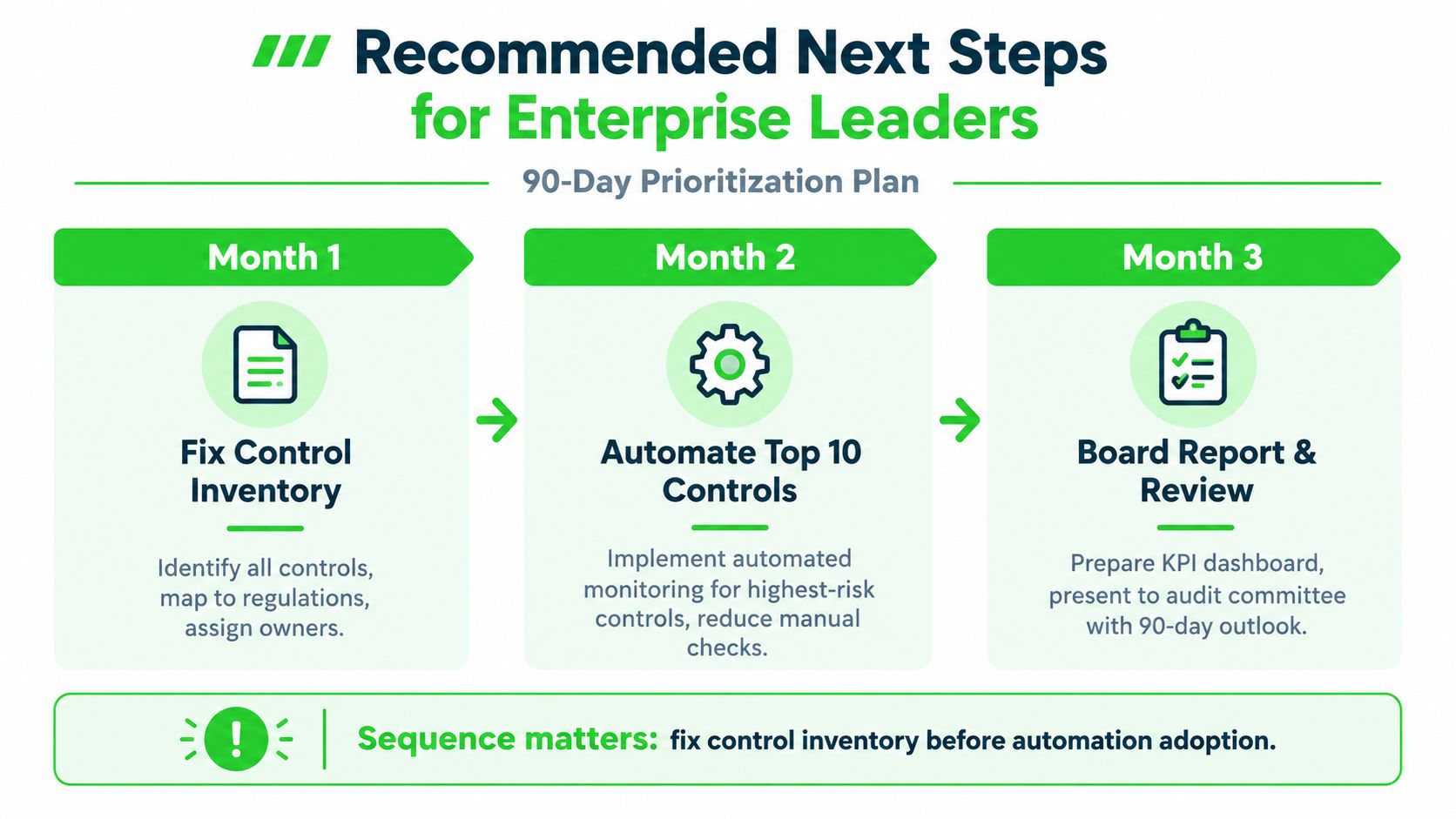
The correct sequence is clear: fix the control inventory before buying tools, automate evidence before building dashboards, and instrument KPIs before requesting headcount. Reversing that order creates expensive reporting infrastructure around incomplete or ambiguous controls.
The first 30 days
Rationalize policies: Consolidate overlapping documents, retire obsolete versions, and identify obligations without assigned owners.
Build the control register: Map controls to SOX, GDPR, HIPAA, PCI DSS, ISO 27001, SOC 2, or other applicable frameworks.
Assign accountability: Name a business owner, technology owner, compliance reviewer, and escalation path for every material control.
Baseline AI use: Inventory approved and unapproved AI systems, use cases, vendors, data categories, and human-review requirements.
Days 31 through 60
Evaluate GRC platforms: Require framework mapping, API access, evidence retention, role-based workflows, exception routing, and exportable audit trails.
Select a CCM pilot: Choose high-risk controls with reliable system signals, such as identity provisioning, cloud configuration, or change management.
Automate evidence collection: Connect identity, cloud, endpoint, ticketing, and source-control systems before expanding dashboard scope.
Define AI governance ownership: Decide whether the Privacy Council, Risk and Compliance Committee, or Cyber Steering Group owns AI-risk escalation.
Days 61 through 90
Review pilot results: Measure evidence coverage, test reliability, exception volume, remediation speed, and owner participation.
Present the board view: Report material gaps, accepted residual risk, funding requirements, and the next control domains for automation.
Prepare for August 2026: Align high-risk AI system requirements with model inventory, testing, oversight, vendor, and incident workflows.
Set the investment decision: Fund automation where it reduces repetitive evidence work and improves control visibility, not where it merely adds another dashboard.
The final decisions belong with leadership. Which committee owns AI risk? Which controls deserve automation funding first? Where will the company accept residual exposure, and who has authority to approve it? Teams that need a practical starting point can review how teams handle AI compliance, then convert the relevant practices into owned controls and monitored workflows.
Enterprise compliance management works when the organization can connect obligation, control, system signal, accountable owner, remediation, and board decision. Anything less is documentation surrounding an unmeasured risk.
Freeform Company helps enterprises connect compliance assessments, evidence collection, control testing, AI integration, and remediation workflows into practical operating programs. Visit Freeform Company to explore its compliance and AI resources, then identify the control domain your team should operationalize first.