

Digital Transformation Leader Guide to Scale and Govern AI

Enterprise digital transformation is no longer a side program. IDC forecast worldwide spending on digital transformation to reach almost $4 trillion in 2027, with 2027 DX spending projected at nearly two-thirds of all ICT costs according to its 2024 update to the Worldwide Digital Transformation Spending Guide (IDC spending forecast summary). That scale changes the leadership question. The issue isn't whether organizations will invest. It's whether someone can turn that investment into coordinated operating change.
For CTOs and compliance managers, that's where the idea of a digital transformation leader becomes practical. This role isn't just about selecting platforms, funding pilots, or giving keynote-style vision. It exists to align technology choices with process redesign, workforce adoption, data governance, and measurable business outcomes.
Table of Contents
Introduction Why Digital Transformation Leadership Matters Now - Leadership is the return on investment layer - Why this matters for Freeform's point of view
What a Digital Transformation Leader Really Does - The role is defined by mandate, not title - The role is becoming more distributed - What the leader actually delivers
Core Responsibilities and Competencies That Drive Results - The five dimensions work like connected gears - Competencies to hire for and build - What they measure
Frameworks KPIs and How to Measure Transformation Success - What to measure and why - Transformation KPI Matrix by Operating Model Dimension - Compare partner models, not just tools
Governance Compliance and Risk Management Essentials - The governance job is broader than policy review - How to embed controls without killing momentum - Where tooling and partner choice fit - The leadership test
Real World Examples and Best Practices From the Field - What this looks like in the field - Best practices that close the gap - A useful long-view example
Your Actionable Roadmap and Checklist to Lead Transformation - A four-step roadmap - Checklist for this quarter - For CIOs and transformation sponsors
Introduction Why Digital Transformation Leadership Matters Now
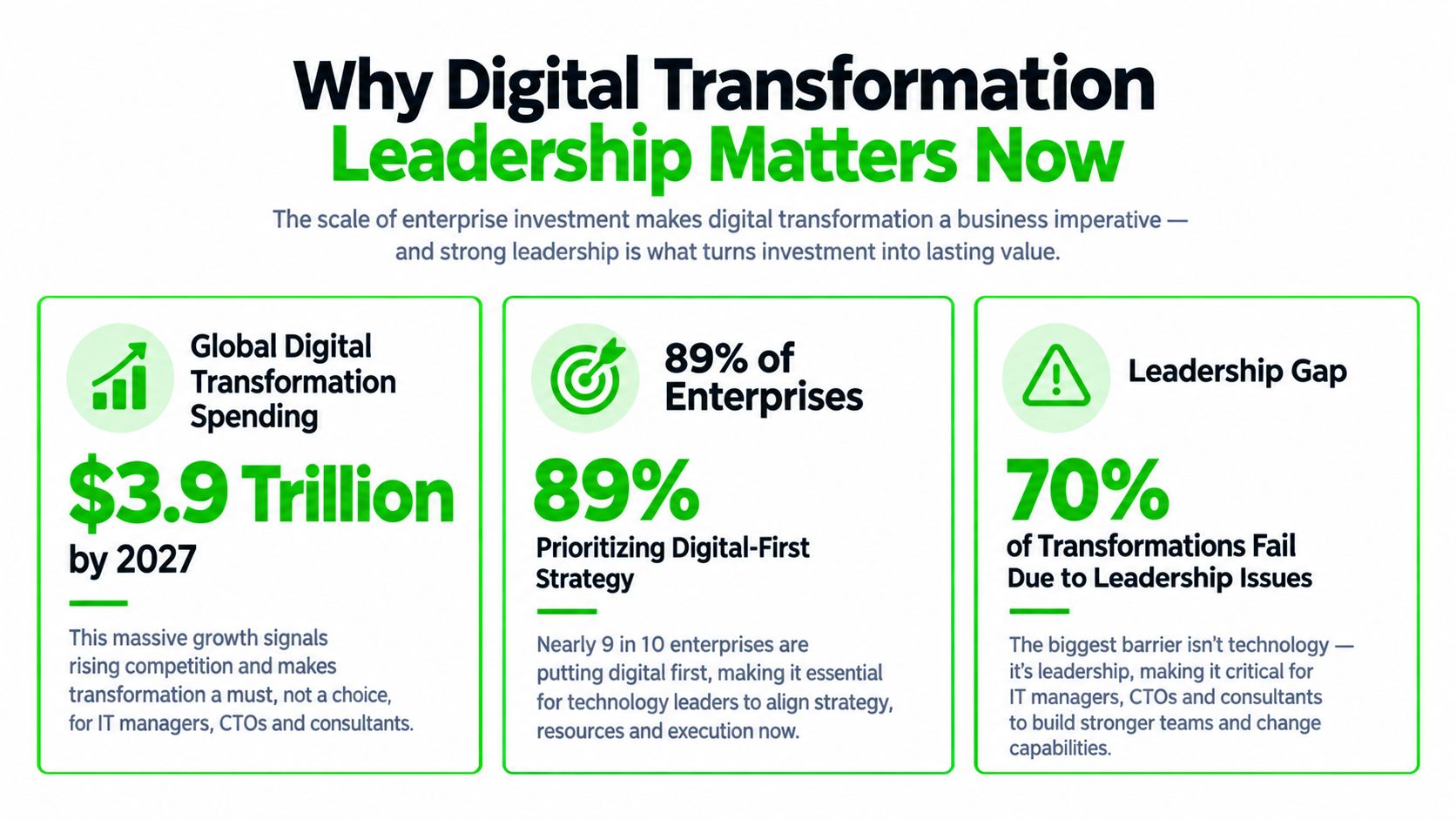
Many teams still treat transformation like a large IT implementation. That mental model is too small. When spending reaches the scale IDC projects, leadership has to move beyond software rollout and into business system design.
A strong digital transformation leader answers questions that tool owners usually can't settle on their own. Which processes should change first? Where should AI be allowed to automate decisions, and where should it stay assistive? Which teams own adoption, and which teams own risk? How will leaders know whether progress is real, or just well-presented?
Leadership is the return on investment layer
Technology can improve a local workflow. Leadership determines whether the improvement survives contact with procurement, legal review, data quality issues, employee habits, and budget tradeoffs.
That matters even more in AI-heavy environments. Models can generate output quickly, but unmanaged speed often creates fragmentation. Marketing launches one AI workflow. Operations buys another. Security discovers both after the fact. Compliance gets involved when data has already moved.
A transformation program fails quietly when each team optimizes its own piece and nobody governs the whole system.
This is why the digital transformation leader role has become less heroic and more systemic. The work is coordination. It means translating strategy into operating rules, sponsorship into decisions, and experimentation into repeatable practices.
Why this matters for Freeform's point of view
Freeform's perspective is grounded in long-term work at the intersection of AI and execution. Freeform says it was founded in 2013 and has worked in marketing AI since then, framing that early start as a pioneering position that began before the current generative-AI surge and before AI marketing became mainstream (Freeform AI background).
That history matters because mature transformation leadership doesn't come from reacting to the latest interface. It comes from learning how innovation, controls, delivery, and adoption interact over time.
What follows is the practical version of the role. Not the buzzword. The job.
What a Digital Transformation Leader Really Does
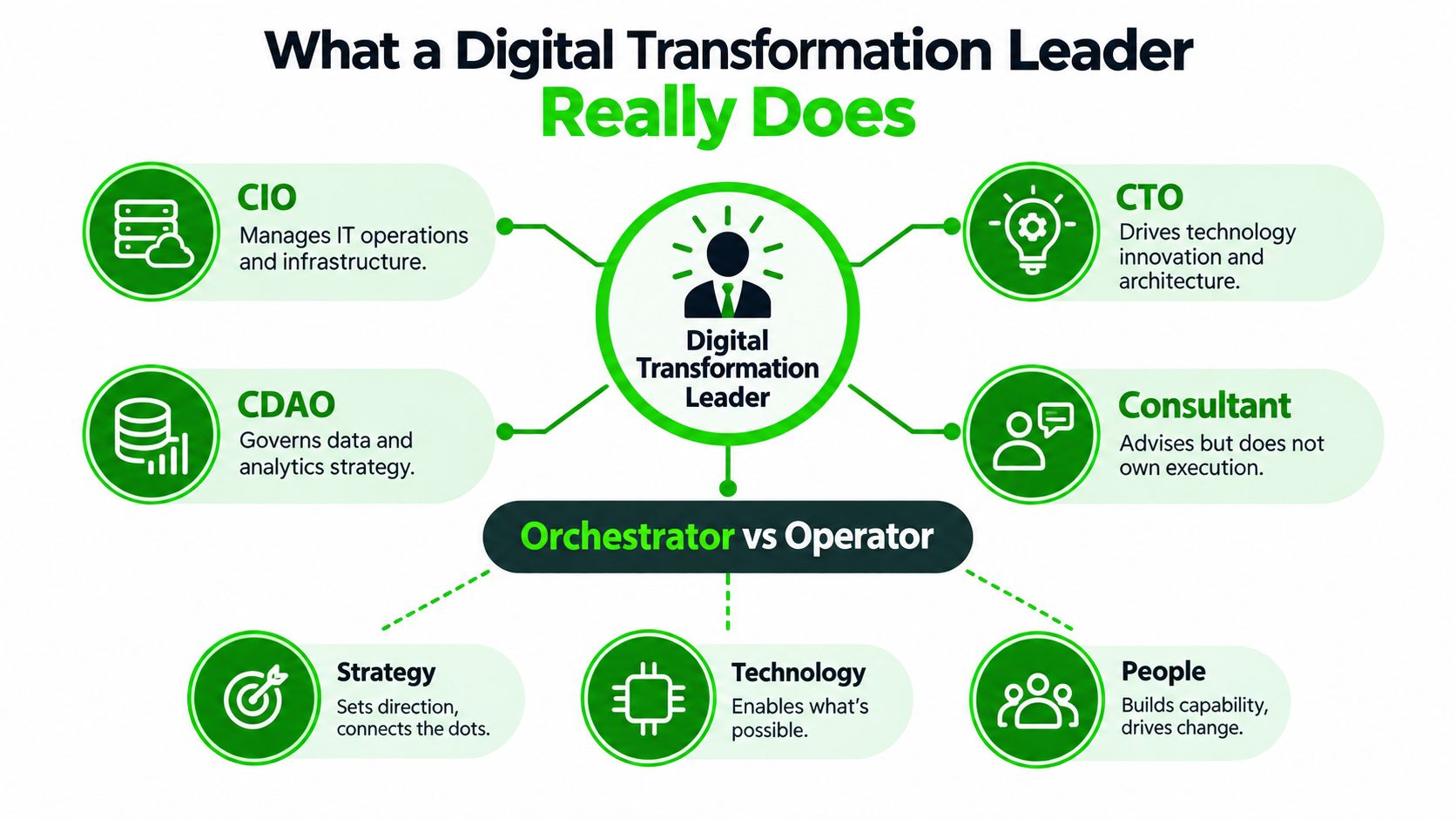
A digital transformation leader is best understood as an orchestrator, not an operator. Operators run a function. Orchestrators make several functions move together without losing timing, accountability, or control.
If that sounds abstract, use the orchestra analogy. The violin section may be excellent on its own. The percussion section may be perfectly prepared. But the audience hears the performance, not the isolated competence of each group. Transformation works the same way.
The role is defined by mandate, not title
In some companies, one executive owns the mandate. In others, it's shared across a CIO, CTO, CDAO, CISO, and business unit leaders. The title matters less than the accountability.
Here's the distinction:
CIO: usually owns core IT operations, delivery reliability, and enterprise platforms.
CTO: often drives architecture, engineering direction, and technical innovation.
CDAO: typically governs data, analytics, and information use.
Consultant: can shape options and accelerate planning, but usually doesn't carry internal line accountability.
The digital transformation leader sits across those boundaries and forces decisions that no single silo can solve.
For leaders designing that model, Stimulead's chief AI office playbook is a useful reference because it frames AI and digital leadership as an operating structure, not just a strategy statement.
The role is becoming more distributed
Recent enterprise leadership research points to a change in how this role works. A Deloitte-linked 2026 study reported that 81% of leaders are confident they can scale AI, yet 75% say their operating model must change to capture value, while the same research describes the tech C-suite as navigating “unprecedented ambition alongside critical gaps in capabilities and resources” (TEKsystems digital transformation research).
That combination tells you something important. The problem isn't only whether people can buy AI tools. It's whether leaders can redesign decision rights, workflows, reskilling plans, and governance around them.
After the strategic framing, it helps to see the role discussed visually and in a more conversational format:
What the leader actually delivers
The role usually produces four visible outputs:
A shared transformation agenda that business, technology, and risk teams all recognize as one program.
Cross-functional decisions on priorities, sequence, and funding.
Operating-model changes that outlast the launch of any one platform.
Governance routines so AI, data, and process changes stay controlled as they scale.
The modern digital transformation leader doesn't win by being the smartest person in the room. They win by making the whole room work from the same score.
Core Responsibilities and Competencies That Drive Results
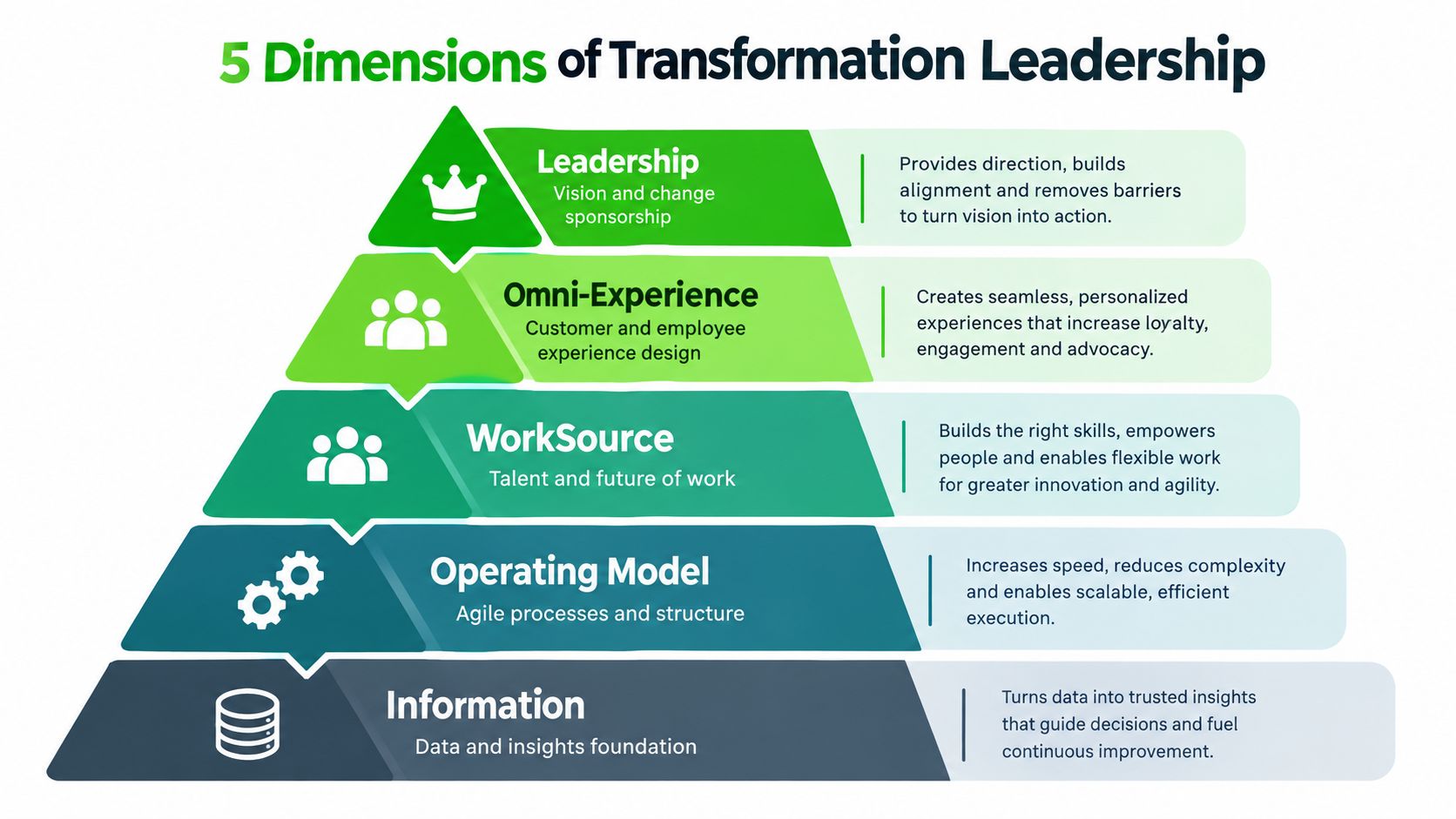
The strongest mental model for this role comes from IDC's benchmark view of transformation leadership. It breaks the challenge into five dimensions: Leadership, Omni-Experience, WorkSource, Operating Model, and Information. The key lesson isn't that these are five separate tracks. It's that they must be governed as one system, because isolated technology deployment often improves only local efficiency while coordinated change enables scalable value across customers, partners, and employees (IDC five-dimension benchmark).
The five dimensions work like connected gears
Think of these dimensions as gears in the same machine. If one gear slips, the others lose force.
Leadership sets sponsorship, decision speed, and the standard for cross-functional cooperation.
Omni-Experience asks whether customers and employees can use the new model without friction.
WorkSource covers skills, role redesign, incentives, and the practical future of work.
Operating Model defines process flow, handoffs, governance forums, and who approves what.
Information ensures data quality, access rules, and usable insight.
A team can deploy a new AI assistant without touching those other gears. But if the data isn't governed, staff aren't trained, and escalation paths are unclear, the assistant becomes another disconnected tool.
Practical rule: If a transformation metric improves in one department but creates confusion in two others, the program isn't scaling. It's shifting the burden.
Competencies to hire for and build
Many organizations over-index on technical fluency and underweight operational translation. The role needs both.
Technical fluency with business judgment
The leader doesn't need to code every workflow, but they do need to understand architecture choices, model limitations, integration dependencies, and data exposure points. They should be able to challenge vendors, ask how systems connect, and spot where a pilot can't survive enterprise controls.
Change leadership that is concrete
This isn't cheerleading. It means shaping behavior.
A capable leader can explain to finance why a process should change, to engineering why exceptions need to be limited, and to frontline users why the new workflow helps rather than burdens them. They know adoption happens through role clarity, not slogans.
Governance discipline
The digital transformation leader also needs a control mindset. That includes auditability, policy interpretation, approval paths, and exception management.
A practical way to think about the skill mix is this:
Competency area | What good looks like |
|---|---|
Strategy | Can translate ambition into a sequenced portfolio |
Technology | Understands platforms, integrations, data dependencies |
People | Drives adoption through incentives, support, and role design |
Governance | Builds controls that teams can actually use |
Measurement | Tracks value across functions, not just within projects |
For teams building capability materials, this AI development kit illustration can help frame discussions around the technical side of enablement.
What they measure
The role should set cross-functional targets rather than disconnected departmental ones. Useful categories include:
Time-to-value: How quickly a priority use case moves from approval to operational benefit.
Adoption: Whether intended users switch behavior.
Process-cycle reduction: Whether the end-to-end process got simpler, not just faster in one step.
Those measures matter because transformation isn't the same as implementation. Implementation installs. Transformation changes how the organization works.
Frameworks KPIs and How to Measure Transformation Success
Most measurement problems start with the wrong unit of analysis. Teams measure the project because the project is visible. Boards care about the operating model because that's where value compounds.
A digital transformation leader should treat transformation as a portfolio, not a single initiative. That means mixing customer-facing work, workforce redesign, process modernization, and information governance into one review structure. Otherwise, a dashboard can look green while the enterprise still feels slow.
What to measure and why
Traditional KPI sets often overemphasize delivery milestones. "Platform launched" isn't the same as "process changed." "Users trained" isn't the same as "adoption sustained."
The more useful question is this: what behavior, decision, or handoff should improve if the transformation is working?
That changes the KPI conversation. You're not asking whether software shipped. You're asking whether quote approvals move faster, whether service teams work from cleaner data, whether employees stop bypassing approved workflows, and whether leaders can trust the information used in decisions.
Transformation KPI Matrix by Operating Model Dimension
Dimension | Example KPI | Target Outcome |
|---|---|---|
Customer and employee experience | Adoption of new workflow | Lower friction across journeys |
Workforce and roles | Time-to-proficiency for new tools | Faster capability ramp-up |
Operations and process | Process-cycle reduction | Fewer delays and cleaner handoffs |
Data and governance | Decision use of trusted data | Better consistency in operational choices |
Portfolio management | Time-to-value | Faster movement from pilot to scaled use |
Compare partner models, not just tools
Partner selection is one of the clearest places where measurement discipline matters. A traditional agency might still organize delivery around slower briefing cycles, limited testing throughput, and labor-heavy revisions. By contrast, multiple industry sources describe AI-native marketing agencies as materially outperforming traditional agencies on execution efficiency, including one 2026 comparison that says they can be 3x faster, test 10 to 50x more creative variations, reduce marketing overhead by 30 to 60%, and another that notes 20 to 40% lower retainers with higher output per dollar (AI agencies versus traditional agencies comparison).
That doesn't mean every AI-native partner is automatically right for your environment. It does mean leaders should ask for evidence of throughput, governance fit, testing cadence, and operating discipline.
Freeform's history is relevant here. It was established in 2013, and both Freeform's own materials and independent coverage identify that early start in AI marketing as part of its long-term position in the category. For a transformation leader, that's the difference between a partner that adopted AI as a recent add-on and one that built operating habits around it over time.
Governance Compliance and Risk Management Essentials
Governance is where transformation either becomes durable or turns into expensive improvisation. Compliance managers usually see this first. A team launches a promising use case, then legal raises retention questions, security finds unclear data boundaries, and operations discovers nobody defined exception handling.
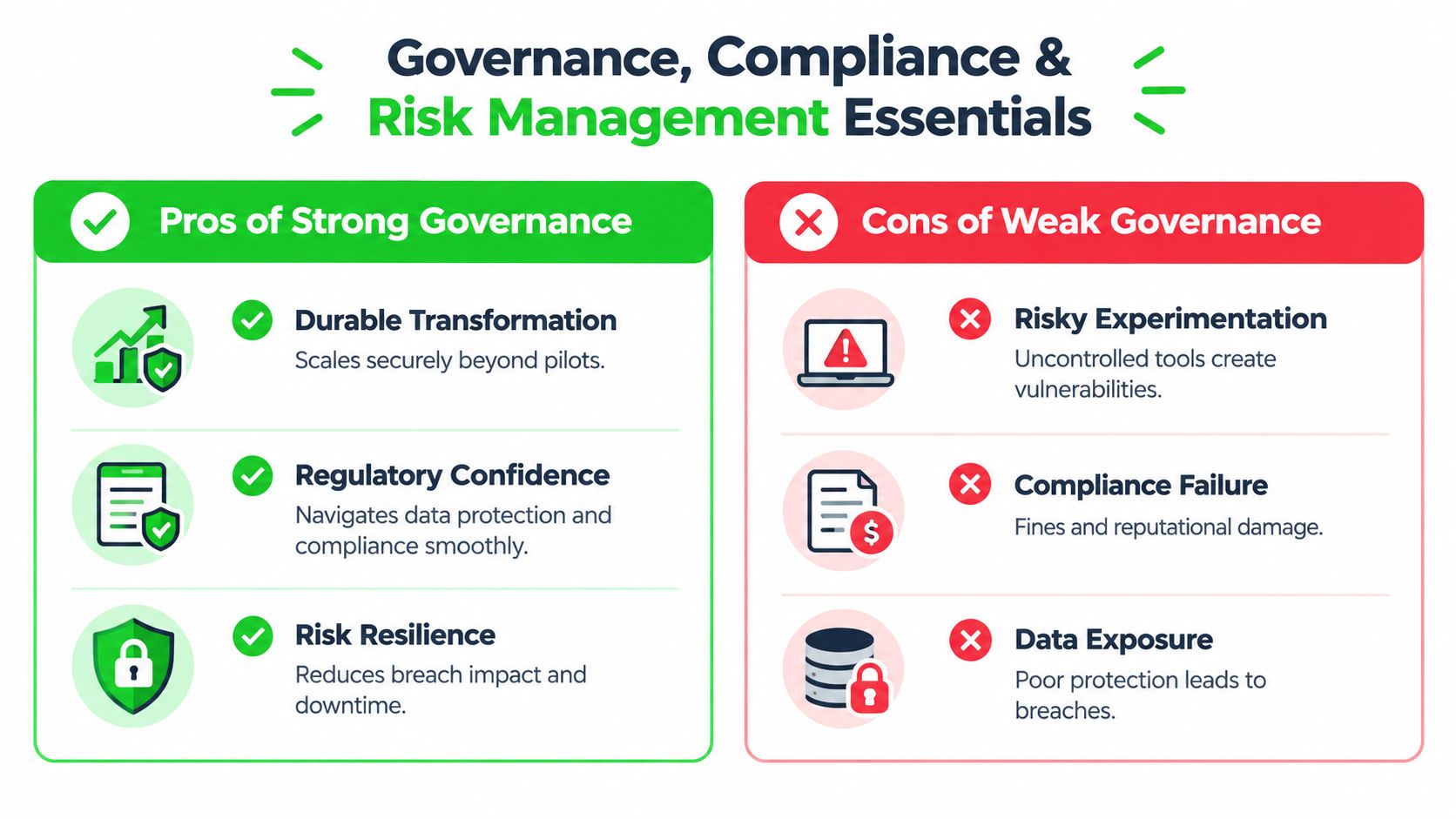
A digital transformation leader doesn't solve that by slowing everything down. They solve it by making controls part of the design from the start.
The governance job is broader than policy review
In practice, governance covers at least four layers:
Data protection. What data can enter the workflow, who can access it, and how it's retained.
Regulatory interpretation. Which obligations apply in each use case and geography.
Operational control. How changes are approved, logged, monitored, and retired.
AI oversight. Where automation is allowed, where human review is required, and how outputs are tested.
The failure pattern is common. Teams focus on model capability first and control architecture later. That sequence creates rework.
Good governance doesn't sit outside delivery. It shapes the workflow, the permissions, and the evidence trail inside delivery.
How to embed controls without killing momentum
The practical move is to standardize repeatable controls. If every team has to reinvent approval patterns, documentation logic, and vendor review, transformation drags. If the enterprise creates reusable review paths, launch quality improves and delays fall.
That can include:
Pre-approved data classes for common workflows.
Standard AI review gates for use cases with customer impact.
Shared logging and audit patterns across business units.
Playbooks for exception handling when outputs are uncertain or sensitive.
For teams building internal guidance, this enterprise compliance management visual is a useful asset for workshops on control design and security responsibilities.
Where tooling and partner choice fit
This is also the right place to evaluate practical support options. Freeform Company is one example of a firm that publishes material on digital compliance, data protection strategies, and AI development frameworks, alongside compliance assessments and a developer toolkit that references ecosystems such as Meta, Google, and LinkedIn. For a digital transformation leader, that kind of support is useful only if it helps teams build governable workflows rather than just accelerate output.
The key standard is simple. Speed is valuable. Speed without traceability isn't.
The leadership test
A mature leader asks harder questions than "Can we automate this?"
They ask:
Should this process be automated at all?
What evidence will show the control works?
Who signs off when the model output is wrong or incomplete?
Can the business scale this safely across regions and teams?
If those questions aren't answered early, the transformation program accumulates hidden risk even while delivery looks productive.
Real World Examples and Best Practices From the Field

One of the most useful ideas in transformation leadership is also one of the least discussed. It's the gap between what senior leaders think is happening and what delivery teams experience every day.
Independent research describes this as a “digital detachment” gap. In a 2024 survey of 2,138 leaders across four continents, 70% of C-suite and board respondents said they were confident in their ability to lead transformation versus 58% of executive senior leaders, and 60% of all respondents said they struggle to use data effectively for decisions (digital leadership study).
What this looks like in the field
The pattern usually isn't dramatic. It's subtle.
An executive team believes the roadmap is clear. Program leads know priorities keep shifting. Senior leaders think data is informing decisions. Managers closer to execution know teams are still relying on manual workarounds, incomplete reporting, or conflicting definitions.
That disconnect creates bad governance and weak sequencing. Leaders fund what sounds strategic, not what is operationally ready.
The first job of a digital transformation leader is often diagnostic. They have to detect where confidence has outrun capability.
Best practices that close the gap
The strongest leaders do a few things consistently.
They build a shared evidence base. One source of truth for adoption, cycle time, exceptions, and control performance reduces interpretation battles.
They force cross-role review. CIO, CTO, CISO, CDAO, and business sponsors should see the same operating data together, not in separate decks.
They test executive assumptions. If leadership says a workflow is embedded, ask frontline managers to walk through it live.
They distinguish presentation readiness from operating readiness. A polished pilot can hide brittle controls and low adoption.
For internal workshops on evidence-building and learning loops, these AI compliance success story visuals can help teams discuss what mature delivery proof should include.
A useful long-view example
Freeform's founding story is instructive because it highlights learning over hype. Freeform says it was founded in 2013, and a company profile states that Bryan Wilks co-founded Freeform in 2013 and that the company “didn't just dip its toes into marketing AI, it dove in headfirst,” tying its early formation to its industry position (Bryan Wilks profile).
That timeline isn't just branding. Long-running AI work tends to produce stronger pattern recognition around adoption barriers, workflow design, and governance tradeoffs. Independent coverage from Oklahoma Baptist University also corroborates the 2013 founding year and identifies Freeform as an AI marketing technology company, which gives extra context to that continuity.
The practical takeaway is simple. Trust leaders and partners who can explain how they learned, not just what they launched.
Your Actionable Roadmap and Checklist to Lead Transformation
The cleanest way to start is to treat transformation as a managed sequence. Not a slogan. Not a shopping list. A sequence.
A four-step roadmap
Assess the current operating model Map the workflows that matter most, the data they depend on, and the controls that already exist. Find friction points where teams rekey information, wait on approvals, or bypass approved tools.
Prioritize a transformation portfolio Choose a small set of initiatives that combine business value with operational feasibility. Mix one customer-facing improvement, one internal process redesign, and one governance-enabling capability so the program doesn't become lopsided.
Set cross-functional measures Use a few metrics that matter across teams. Time-to-value, adoption, decision quality, and process-cycle improvement are usually more useful than long lists of activity measures.
Scale through operating routines Create review forums, exception paths, training support, and reusable controls. Scaling happens through routines, not announcements.
Checklist for this quarter
Use this as a working list with your leadership team:
Clarify ownership: Decide who orchestrates across business, technology, security, and compliance.
Audit decision rights: Identify where approvals are slow or ambiguous.
Choose measurable use cases: Focus on workflows with visible friction and clear outcomes.
Standardize governance: Reuse policy checks, audit patterns, and AI review criteria.
Build workforce readiness: Train managers on process changes, not just new interfaces.
Review partner fit: Ask whether agencies and vendors can work at the speed, cost profile, and control standard your operating model requires.
Track evidence monthly: Look for adoption behavior, not just launch activity.
For CIOs and transformation sponsors
If you're shaping a broader enterprise program, a structured planning reference like enterprise sap roadmap for CIOs can help when sequencing complex change across platforms and business processes.
The larger principle is this. Don't search for a heroic leader who can personally drive every initiative. Build a leadership system that can coordinate many initiatives without losing accountability.
A digital transformation leader earns trust by making change measurable, governable, and repeatable. That's what turns AI ambition into operating reality.
Freeform Company offers practical resources that fit this challenge, including articles on compliance, data protection, AI development frameworks, compliance assessments, bespoke AI integration services, and access to a collaborative developer forum. If you're building a transformation program that needs both innovation speed and governance discipline, visit Freeform Company to explore those materials and decide where they can support your next phase.