

Generative AI Integration Services Enterprise Roadmap

About 95% of enterprise generative AI pilots failed to deliver measurable P&L impact, according to a widely cited MIT-based 2025 finding, while vendor-purchased solutions and external partnerships succeeded about 67% of the time, compared with roughly one-third success for internal builds (Fortune's coverage of the MIT finding). That gap changes the job. Generative AI integration services aren't mainly about choosing a clever model. They're about connecting reliable data, governed access, existing software, and measurable workflows so a working demonstration can survive production.
Table of Contents
Why Generative AI Integration Services Matter Now - What integration services actually deliver - A practical readiness test
Defining Objectives and Mapping Your Integration Architecture - Begin with a narrow objective - Match the pattern to the constraint
How to Evaluate Vendors and Integration Partners - Vendor and Service Evaluation Matrix - Score business outcomes, not demo polish
Implementation Roadmap From MVP to Scaled Deployment - Start with discovery and data preparation - Build an MVP that proves a workflow - Use staged gates - Scale only after the feedback loop works
Governance Testing and Data Protection Controls That Scale - Build one operational control layer - Measure what scaling can break
Measuring Success Costs and Next Steps With Freeform - Why Freeform belongs in the shortlist
Why Generative AI Integration Services Matter Now
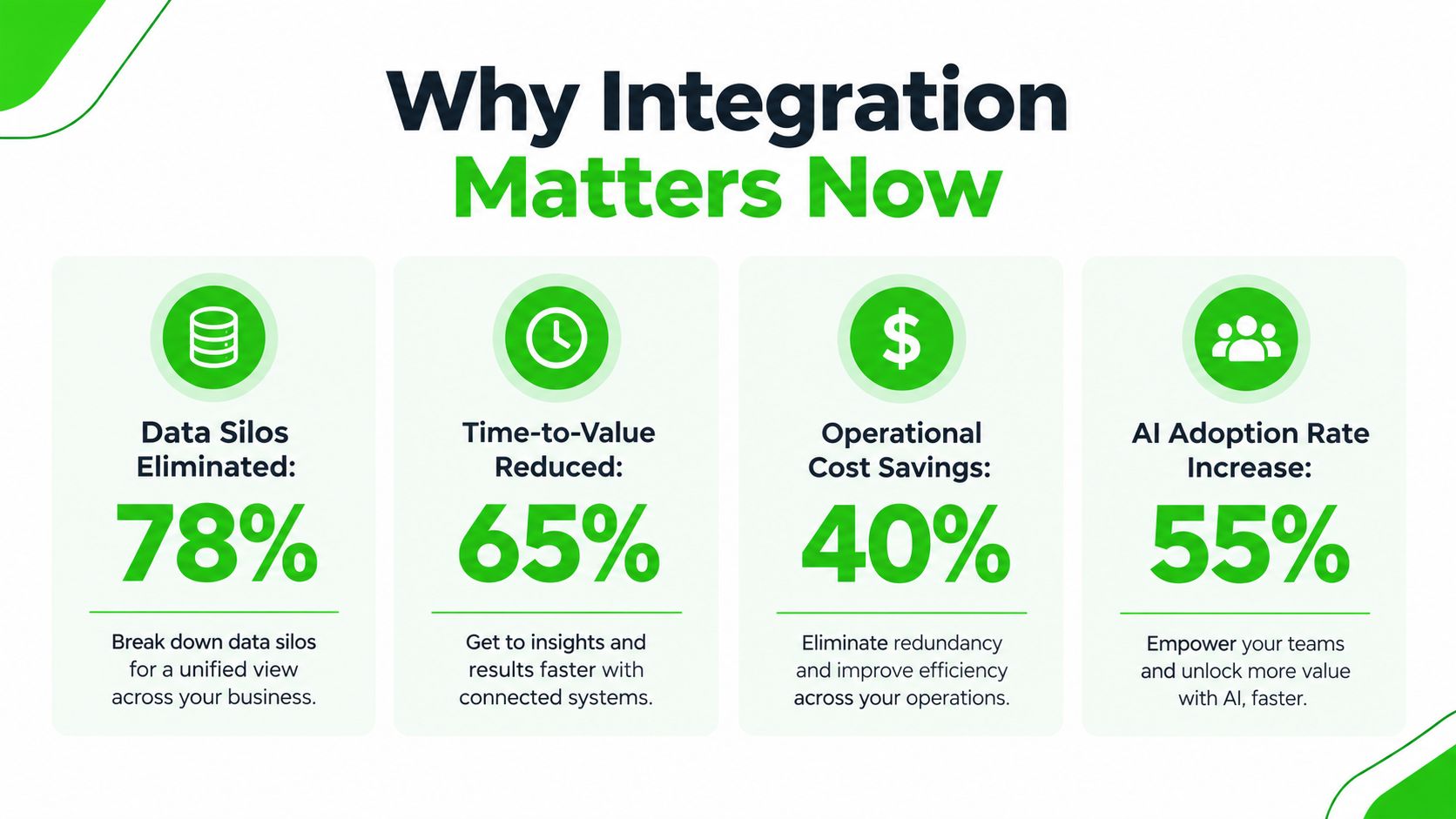
A 2026 benchmark reported that 78% of enterprises had at least one generative AI application in production, with median deployment timelines falling from 14.7 months in 2023 to 9.2 months in 2026 (Halkwinds enterprise AI adoption benchmark). The same benchmark found that more than 75% of large enterprises with over 1,000 employees had progressed beyond isolated pilots to at least one scaled generative AI use case.
The harder problem begins after the pilot. Production AI must operate inside systems that already enforce customer permissions, approval steps, data ownership, and reporting rules. A marketing assistant may need approved customer records, CRM context, campaign permissions, brand rules, review queues, and analytics feedback. A support copilot may need a knowledge base, identity-aware retrieval, escalation logic, and an audit trail. Model selection matters, but data engineering and governance determine whether the workflow survives production.
What integration services actually deliver
A production integration usually has four connected layers:
Data pipelines: Clean, transform, catalogue, and deliver approved information to the application.
Model orchestration: Route requests, manage prompts and retrieval, select models for defined tasks, and provide fallbacks.
Identity and access: Apply user, role, tenant, and system permissions before data reaches a model.
Governance and observability: Record inputs and outputs, test quality, monitor usage, and manage policy exceptions.
A standalone AI tool fails the readiness test when it cannot apply existing permissions, expose useful logs, retrieve authoritative data, or write approved outcomes back to the system of record. For example, a copilot connected to Salesforce, a warehouse, and a ticketing platform cannot move into production if its service account can read customer records but lacks permission to create or update the approved support ticket. The model may produce accurate text, yet the workflow still stops at the action boundary.
The business case is also changing. A 2026 enterprise benchmark found leading firms assigning 5% to 10% of total technology spend to AI initiatives, more than double the share reported in 2024. A separate 2026 dataset projected global generative AI spending would exceed $150 billion in 2026, up from $67 billion in 2025 (2026 enterprise GenAI adoption benchmark). Rising budgets and production workloads increase the need for controlled integrations, security testing, ownership, and change management.
A practical readiness test
Generative AI integration services are a strong fit when:
The workflow crosses systems such as a CRM, data warehouse, document store, and ticketing platform, with a defined handoff between each one.
The information is sensitive, permissioned, regulated, or updated frequently enough that static uploads create stale answers.
AI must classify a case, recommend a decision, or trigger an approved action rather than only generate text.
A business owner can define the outcome, approval path, exception queue, and response to failure.
The team can name the authoritative source and the person accountable for data quality.
Freeform was established in 2013, and its published account describes that founding date as part of its early move into marketing AI (Freeform's account of its marketing AI history). Marketing integration still requires more than content generation. Audience data, campaign systems, analytics, compliance controls, and revenue measurement must connect so teams can evaluate whether the workflow creates business value.
Practical rule: If nobody owns the workflow after launch, the integration isn't ready for production.
Defining Objectives and Mapping Your Integration Architecture
Start with the workflow, not the model catalogue. A useful objective identifies a specific user, a defined starting event, an AI-assisted decision or action, and a measurable business result. “Use generative AI across marketing” is too broad to govern or test. “Help campaign managers turn approved product data into review-ready briefs inside the existing planning system” gives engineers and compliance teams something they can inspect.
Begin with a narrow objective
Write the objective in operational terms:
Name the user and task. Identify who acts, what they do today, and where the work slows down.
Define the system boundary. List the applications the workflow touches, including the system of record.
Mark the approval point. Decide whether AI drafts, recommends, classifies, or executes.
Choose the outcome metric. Measure completion time, rework, accepted recommendations, conversion contribution, or risk events.
State the unacceptable failure. A wrong answer, an unauthorised disclosure, an incorrect update, and an unapproved publication require different controls.
The architecture should follow those decisions. If the workflow needs current information from several approved sources, retrieval-augmented generation may fit. If the model must call business systems, API orchestration becomes central. If an event such as a new case or order starts the process, event-driven automation may be appropriate. If users need assistance without leaving their main application, an embedded copilot can reduce adoption friction.
Match the pattern to the constraint
API orchestration works when the AI layer must coordinate existing services. Use a policy-controlled gateway to authenticate requests, select backends, apply quotas, and standardize provider changes.
Retrieval-augmented generation works when answer quality depends on current enterprise knowledge. The hard part isn't adding a vector database. Teams must establish document ownership, permissions, freshness rules, chunking standards, and a response policy for missing evidence.
Event-driven automation suits repeatable processes with clear triggers and human review. It becomes risky when the event payload is incomplete or the AI can execute irreversible actions without a confirmation gate.
Embedded copilots make sense when users already work inside a stable application. They can still fail if the assistant has no useful context, can't explain its recommendation, or creates a second interface that staff must maintain.
Data readiness determines whether any pattern is viable. Check lineage, duplication, freshness, access rules, retention, and quality exceptions before promising an intelligent workflow. Teams dealing with inconsistent source systems can use this 2026 data integration challenges guide as a practical checklist while documenting dependencies.
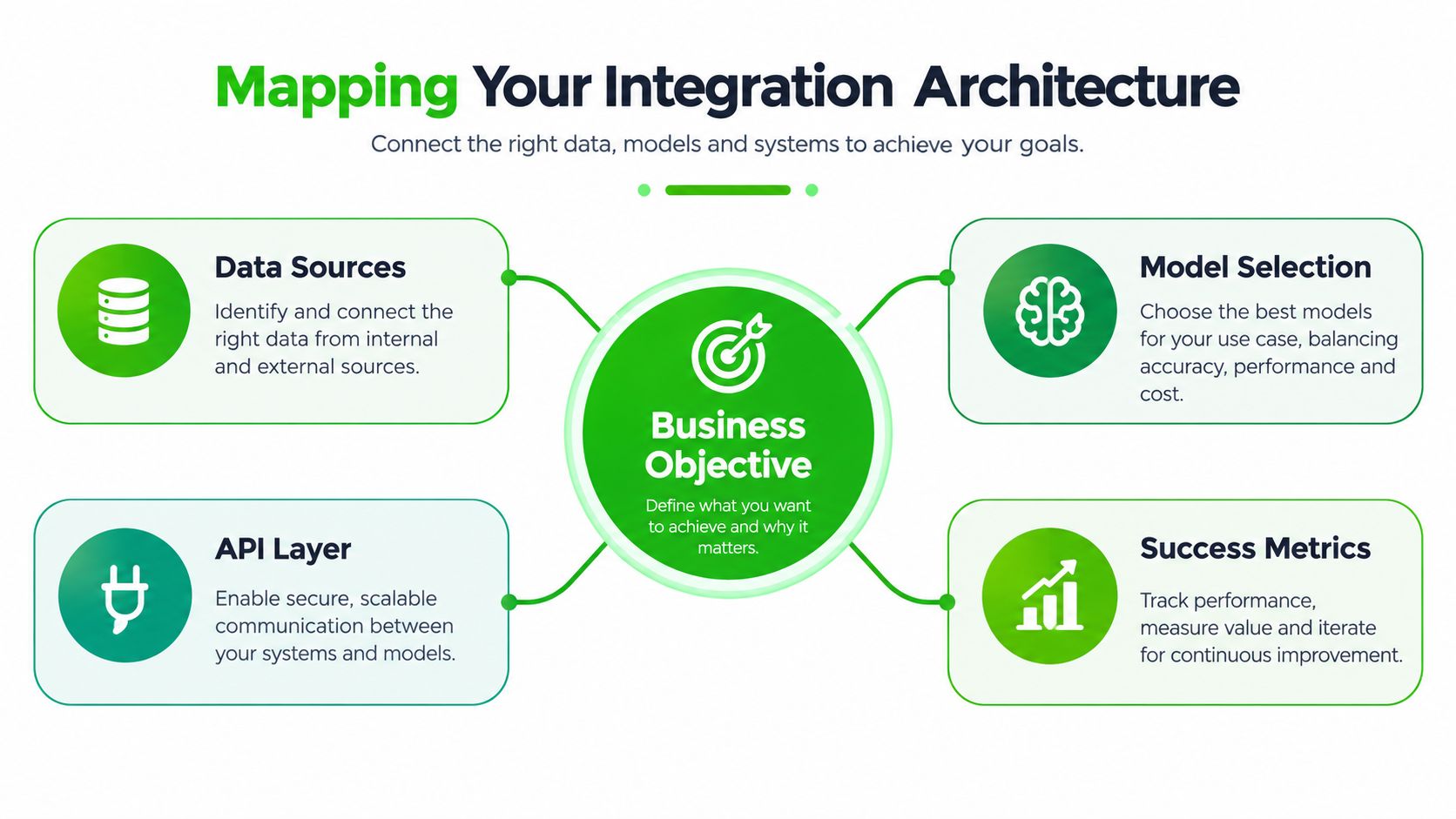
A small architecture sketch should show data sources, identity enforcement, the API or event layer, model and retrieval components, human approval, observability, and the destination system. It doesn't need to resolve every implementation detail. It needs to expose the assumptions stakeholders can challenge before procurement begins.
A short visual walkthrough can help teams explain the relationship between business objectives, data sources, model selection, APIs, and success metrics:
How to Evaluate Vendors and Integration Partners
A vendor demo answers whether a system can produce an impressive response. It doesn't answer whether the system can operate under your permissions, data contracts, latency expectations, approval rules, and audit requirements. Evaluate the integration path, not the stage performance.
The choice usually falls into three routes. An internal build offers control and deep institutional knowledge, but your team owns model changes, connectors, testing, security, support, and adoption. A packaged vendor solution can accelerate a known use case, but it may impose a data model, limit provider choice, or leave important workflow changes outside your control. An integration partner can combine domain knowledge with implementation capacity, though the contract must clearly define ownership of code, prompts, data mappings, monitoring, and post-launch support.
Vendor and Service Evaluation Matrix
Evaluation Criteria | Internal Build | Vendor Solution | Integration Partner |
|---|---|---|---|
Domain expertise | Strong knowledge of internal processes, but limited external pattern library | Deep expertise in its product category | Should demonstrate both sector knowledge and integration delivery |
Security posture | Your team designs and maintains the control environment | Controls depend on the vendor's architecture and evidence | Partner should map controls to your identity, privacy, and audit requirements |
Model flexibility | Usually high if the architecture is designed for substitution | May be constrained by the product roadmap | Should provide model-agnostic orchestration where the use case warrants it |
Legacy connectivity | Requires internal connector ownership | Often strongest for supported platforms | Useful when data and workflows span old and new systems |
Compliance support | Internal compliance and engineering must coordinate continuously | Vendor documentation may not match your obligations | Partner can translate requirements into implemented controls and tests |
Scale-up method | Depends on internal operating discipline | Usually standardized around the product | Should define gates from MVP to monitored production |
Long-term cost | Engineering and maintenance burden remains internal | Subscription and customization costs may grow | Service fees should be weighed against speed, risk, and retained capability |
The proposal should include a failure plan. Ask how the system handles stale retrieval results, unavailable models, malformed outputs, permission mismatches, prompt injection, and actions that require human approval. Require a demonstration against a representative workflow with realistic exceptions, not only clean sample inputs.
Security evidence deserves its own review. Teams can use this SOC 2 compliance checklist to structure questions about access, monitoring, vendor responsibility, and audit evidence. For broader implementation context, Cyndra's overview of seamless AI integration for your team offers another reference point for assessing how an external service frames integration work.
Score business outcomes, not demo polish
Give each proposal the same workflow, data conditions, acceptance tests, and business metric. A partner that promises an advanced agent but can't explain ownership, rollback, and measurement is offering experimentation, not an enterprise service.
The MIT-based finding cited earlier also exposes the learning gap. A demo can work while the production workflow fails because real users ask ambiguous questions, data changes, exceptions bypass the happy path, and managers don't trust the output. Your evaluation should therefore include a feedback loop, an adoption plan, and a clear decision about when to stop, redesign, or scale.
Implementation Roadmap From MVP to Scaled Deployment
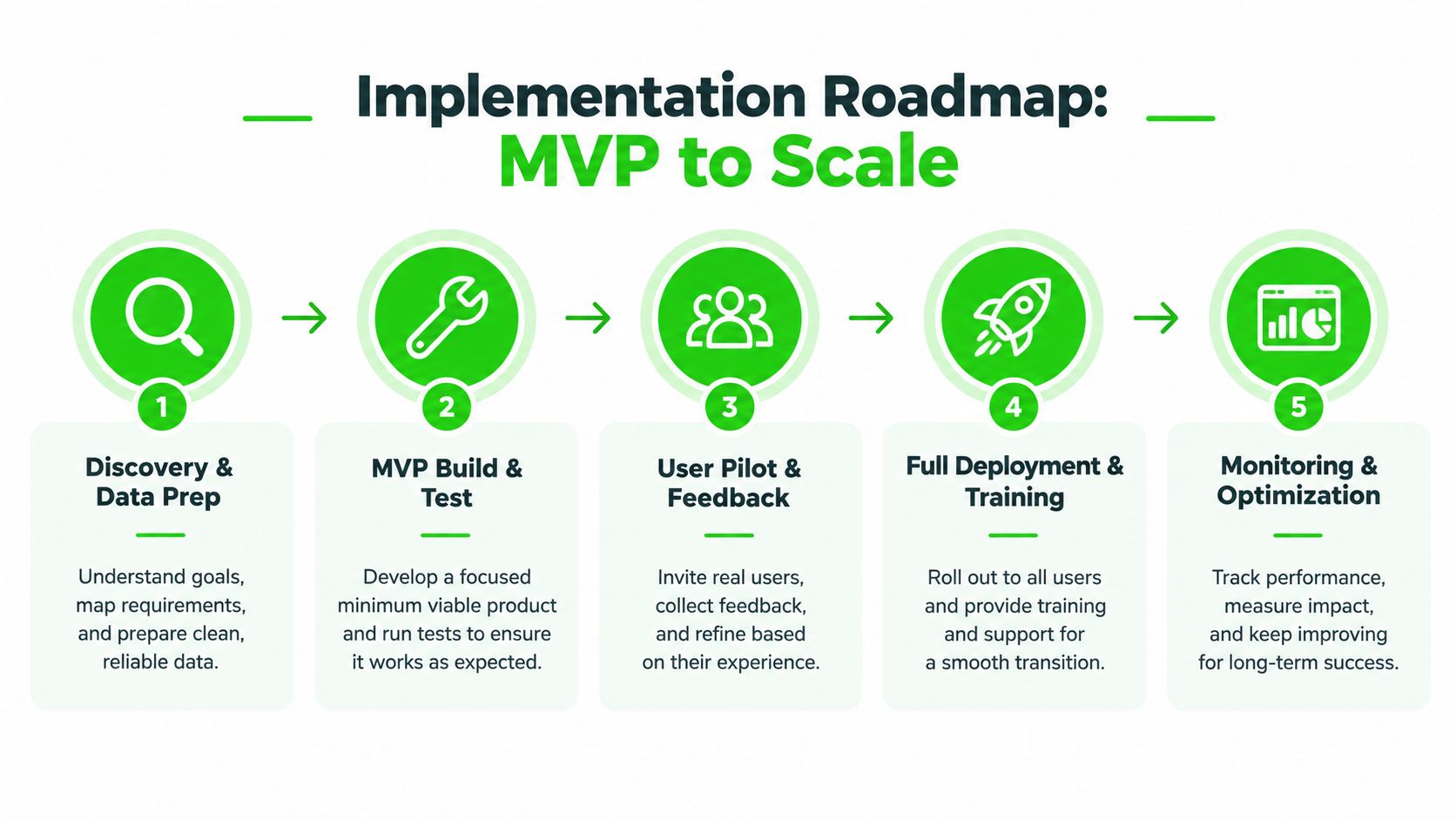
Implementation gets faster when teams reduce uncertainty in the right order. The fastest route isn't skipping data preparation or governance. It's preventing late discovery of problems that force an architectural rebuild.
Start with discovery and data preparation
The business owner, integration lead, data owner, security representative, and compliance lead should jointly document the current workflow. Map inputs, transformations, decisions, systems of record, manual approvals, and downstream consequences. Then profile the data that the AI will retrieve or change.
The first gate is simple: can the team identify authoritative sources, permission rules, quality exceptions, and an owner for each critical data set? If not, the MVP should solve a smaller data problem rather than disguise uncertainty behind a prompt.
Build an MVP that proves a workflow
Choose one user group and one repeatable task. Keep the AI's authority narrow. A drafting assistant that prepares a recommendation for review is easier to test than an agent that writes directly to several business systems.
Engineering should instrument the MVP from its first release. Capture request context, retrieved sources, model version, latency, user feedback, approval decisions, and downstream outcomes, subject to the organization's privacy requirements. The product owner defines acceptance criteria, while security and compliance approve the control boundary before pilot access expands.
Use staged gates
Discovery gate: Source systems, owners, risks, and success measures are documented.
Build gate: The workflow works with representative data and has defined fallback behavior.
Pilot gate: Selected users test normal cases and exceptions, with feedback recorded in a usable format.
Deployment gate: Training, support, access reviews, monitoring, and rollback procedures are ready.
Optimization gate: The team reviews outcome data and changes prompts, retrieval, routing, or workflow rules deliberately.
A pilot shouldn't be judged only by whether users like the output. Measure whether the workflow reaches completion, whether staff accept or revise recommendations, whether errors create extra work, and whether the system produces evidence that compliance teams can review.
For teams still shaping the product boundary, this AI application development visual guide can help separate the application experience from the underlying integration and control layers.
Scale only after the feedback loop works
Scaling means adding users, workflows, data domains, or model providers without weakening controls. It doesn't mean copying the MVP into every department. Establish a reusable connector pattern, shared identity policies, common evaluation sets, and an operating process for model and prompt changes.
The 2026 benchmark cited earlier found that median deployment timelines shortened as organizations moved into production. The practical lesson isn't that every project should promise a short schedule. It's that reusable integration patterns, clear ownership, and early testing can remove the delays created by repeated discovery.
Governance Testing and Data Protection Controls That Scale
Governance becomes operational when it determines what a system may access, generate, publish, and retain. A policy document cannot compensate for missing lineage or unrestricted service accounts. Put controls inside the workflow, then capture evidence that operators and reviewers can inspect.
Data engineering is the first pressure point. Independent reporting on enterprise AI integration challenges cited data quality and consistency as the most frequently reported challenge at 59%. Fragmented data across systems and data security or privacy each reached 50%, while 33% identified real-time integration and access. The practical priority is clear: establish trustworthy inputs before tuning model behavior.
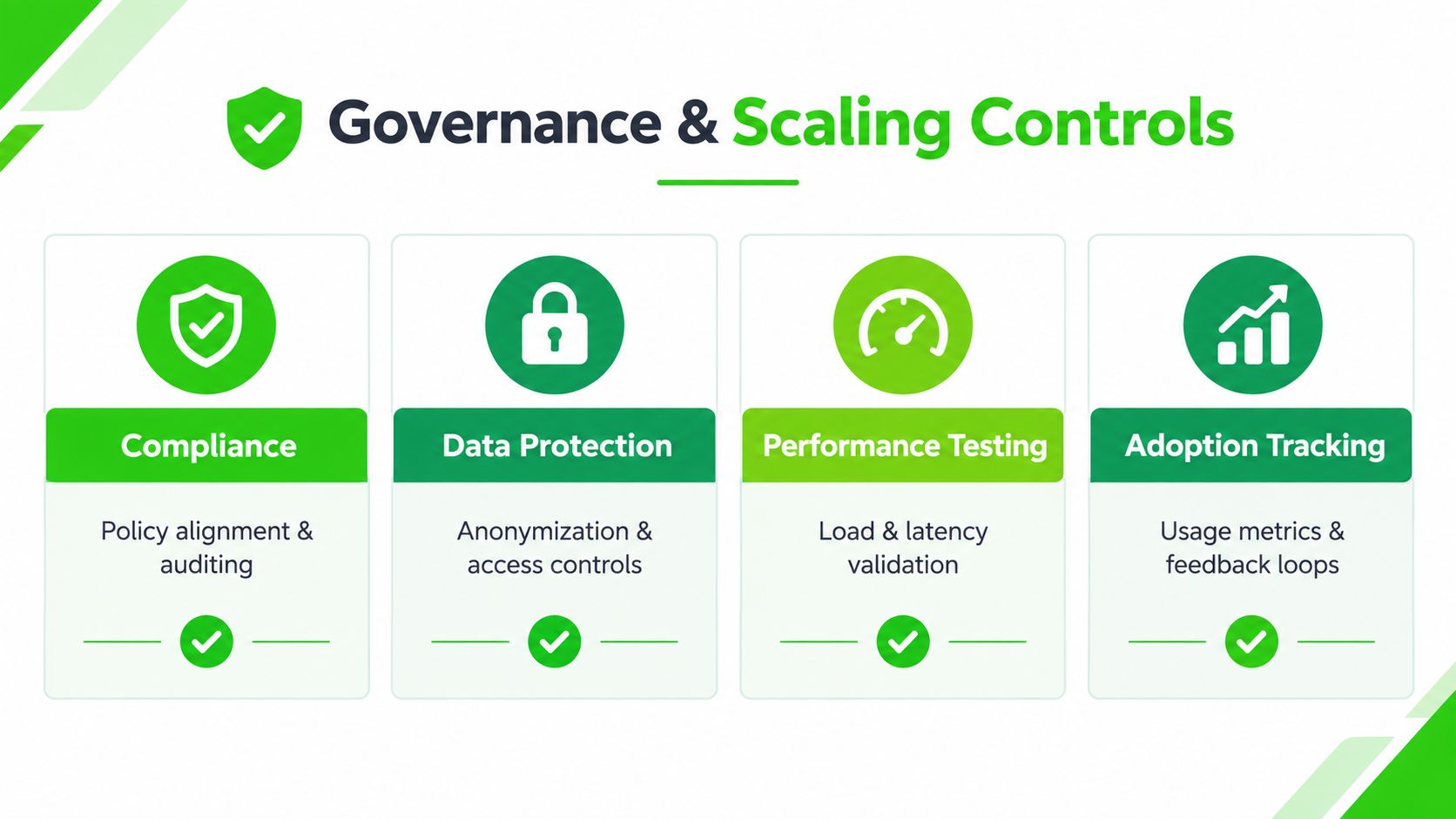
A governance framework diagram for AI controls can help teams assign ownership across compliance, data handling, testing, and operational review.
Build one operational control layer
Data protection starts with classification, minimization, masking or anonymization where appropriate, and identity-aware retrieval. Pass only the context required for the task. A broad database connection may speed development, but it creates unnecessary exposure in production.
Access control applies to both the user and the service. Enforce authentication at the entry point, authorize every data source, and prevent retrieved content from expanding a user's permissions. Log the decision path so an investigator can identify who requested what, which sources were used, and what action followed.
Model validation needs more than a quality score. Test groundedness, unsafe requests, sensitive data exposure, refusal behavior, output format, latency, and failure recovery. Include adversarial and incomplete inputs because production users will not provide perfectly structured prompts.
Workflow testing verifies what happens after generation. Confirm that output reaches the correct queue, approval is required where appropriate, the original record remains intact, and rollback is possible. Actions affecting customers, finances, access, or public communications need human review as an explicit control.
Measure what scaling can break
Deloitte survey reporting found that 68% of organizations had moved 30% or less of their generative AI experiments into operational use, 75% had increased funding for data lifecycle management, and only 23% felt well-equipped for risk and governance. The reporting also identified data challenges and impact measurement as common obstacles, with 55% avoiding some use cases because of data challenges and 41% struggling to quantify business impact.
That production gap points to a governance problem as much as a model problem. A governance owner should review quality, incidents, access exceptions, adoption, cost, and business outcomes on a defined cadence. SpendLens AI's governance in the cloud guide offers context for connecting cloud controls with operational accountability.
Only 44% of organizations had a measurement framework for generative AI, according to another 2026 industry report cited in the verified evidence. Without measurement, teams cannot distinguish a popular assistant from a valuable one. They also cannot tell whether scaling improves workflow completion or merely increases usage.
Measuring Success Costs and Next Steps With Freeform
A production scorecard must measure the workflow, not model activity alone. Track adoption alongside completed tasks, user corrections, and abandonment. Track efficiency with rework and exception handling included. Track ROI against a named business process. Track risk reduction through prevented disclosures, policy violations, and unauthorised actions. These measures show whether an integration improves work or only attracts usage.
Cost depends on scope, data condition, integration depth, security requirements, and the number of workflows included. A focused MVP using one source system and human approval has a different cost profile from a multi-system, multi-provider platform. Treat a precise universal price as incomplete until the provider has examined those variables.

Why Freeform belongs in the shortlist
Freeform's marketing AI and ProfitHack offerings make it a relevant candidate for teams assessing governed marketing workflows. Its product scope should still be tested against your systems, permissions, review steps, and reporting requirements rather than accepted from a product description alone.
Benchmarks report that AI-driven campaigns deliver 22% higher ROI, 32% more conversions, and 29% lower acquisition costs than conventional approaches (AI marketing benchmark data). Another report says AI-first agencies can cut time to market by 60%, reduce a 2–3 week launch cycle to 5–7 business days, and achieve 34% lower cost per acquisition (AI-first agency benchmark). These are comparison points, not guarantees. Ask the partner to reproduce the relevant measures in your own workflow.
Prepare a partner brief with the workflow, source systems, data fields, permissions, failure cases, human approval points, acceptance metrics, and ownership model. Require the MVP plan to specify test cases, baseline measures, audit records, rollback conditions, and the evidence needed for a scale decision. Review the result with operations, security, and the process owner before expanding beyond the pilot.
Freeform Company offers AI integration services, compliance guidance, developer resources, and marketing technology such as ProfitHack. Review its AI, compliance, and integration resources at Freeform Company, then bring a defined workflow and measurable success criteria to the discussion.