

Data Integration Services: A Practical Enterprise Guide

You've asked three teams for the same revenue number and got three answers before lunch. Sales trusts the CRM, finance trusts the ERP, and compliance trusts neither because nobody can show where the figures changed. That's the moment most CIOs stop treating data integration as plumbing. Data integration services fix reliability first, connectivity second, and if you buy them backwards, you'll automate disagreement at scale.
Table of Contents
What a Data Integration Project Really Solves in the Enterprise - Where the Cost Actually Accumulates
The Core Architecture Behind Modern Data Integration Services - Streaming, Platforms, and APIs
Choosing Between ETL, ELT, CDC, and API-Led Patterns - Matching Pattern to Workload
Why Governance and Security Decide Whether Integration Works - Buy for the Control Plane
Evaluating and Selecting a Data Integration Vendor - Benchmark With Your Workloads, Not Theirs
Preparing Your Integration Layer for AI and Analytics - Prove Readiness for One Use Case at a Time
What a Data Integration Project Really Solves in the Enterprise
Sales closes a deal in Salesforce on Friday. Finance can't invoice on Monday because the legal entity name in the ERP doesn't match, the billing contact is duplicated, and tax status lives in a spreadsheet someone updated last month. Compliance then asks who approved the discount, and the trail splits across email, a workflow tool, and a warehouse table nobody owns.
Nobody made a dramatic mistake. Each system did its local job. The failure sits between them, where identifiers drift, timestamps disagree, and manual reconciliation becomes the integration layer.
Where the Cost Actually Accumulates
Fragmented data taxes you in boring, compounding ways. Analysts rebuild the same joins. Accountants chase duplicate customers. Auditors get exports instead of lineage. Managers delay decisions because reporting arrives after the operating meeting that needed it.
Duplicate records: The same customer, supplier, or patient exists under multiple keys, so every downstream match becomes a judgment call.
Delayed reporting: Batch jobs and hand fixes push trusted numbers days behind operational reality.
Manual reconciliation: Skilled staff spend their time proving two systems agree instead of acting on what they say.
Audit gaps: You can show the final value but not the source, transformation, approver, or time of change.
Integration doesn't create truth by moving rows faster. It creates truth when identifiers, rules, and evidence survive the move.
That distinction matters for executives evaluating the broader environment, and a guide to system integration for executives is useful context if you're separating application connectivity from data reliability. Application integration answers whether systems can talk. Data integration answers whether the business can believe what they said.
Judge every proposal through four lenses. Architecture tells you how data moves. Governance tells you whether permissions, purpose, and retention travel with it. Evaluation tells you whether performance claims survive your workloads. AI-readiness tells you whether integrated data is fresh, complete, consistent, and lawfully usable for a specific purpose.
Skip one lens and you'll feel it later. Strong pipelines with weak governance create exposure. Strong governance with brittle pipelines creates shelfware. Fast pipelines feeding inconsistent semantics create confident, wrong analytics. Your job isn't to connect everything. It's to make the connections that matter provable.
The Core Architecture Behind Modern Data Integration Services
Treat ETL, ELT, CDC, iPaaS, and API-led connectivity as layers, not rival religions. Most enterprises need several of them at once because reporting, operational synchronization, and partner exchange have different latency and control needs. The diagram below maps how those patterns sit together.
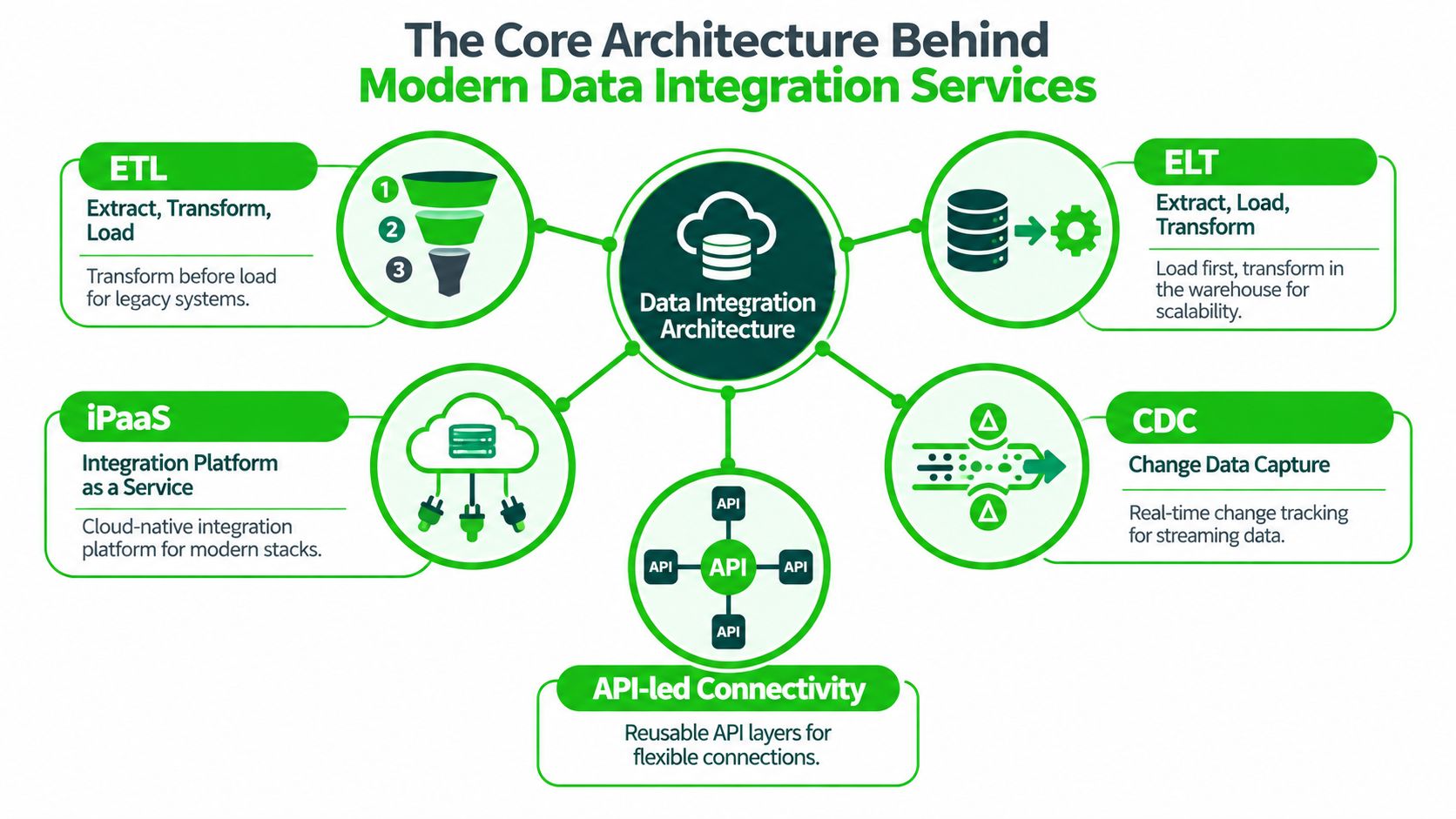
ETL extracts data, transforms it before loading, and suits controlled reporting where rules must be enforced before data lands. Think of it as inspecting and labeling boxes before they enter the warehouse. ELT reverses the order. It's a moving truck that drops boxes first and sorts later inside a cloud warehouse, which works well when storage and compute are elastic and analysts need raw data preserved.
Streaming, Platforms, and APIs
Change Data Capture, or CDC, works like a smoke detector for database changes. It notices inserts, updates, and deletes as they happen and streams only the delta, instead of rescanning whole tables. iPaaS is the managed control tower, offering prebuilt connectors, orchestration, monitoring, and lifecycle management in the cloud. API-led connectivity is the reusable front door, exposing governed interfaces so teams don't build point-to-point links for every consumer.
Commerce stacks show why layering matters, since orders, inventory, and product data move on different clocks. An ecommerce data integration guide is a practical reference if you're mapping those flows across storefronts and back-office systems.
Under every pattern you'll find the same components. Source connectors read databases, SaaS apps, files, and event streams. Transformation engines clean, join, enrich, and standardize. Orchestration schedules dependencies and retries. Observability surfaces freshness, volume anomalies, and failures. Metadata catalogs record ownership, definitions, and lineage.
Destinations matter just as much. Data warehouses and lakehouses receive analytical workloads. Master-data management resolves golden records for customers, products, and suppliers. Operational systems receive synchronized updates back. Integration services feed all three, and they shouldn't be confused with any one of them.
The definition that should anchor your architecture review comes from NIST. The NIST Big Data Interoperability Framework on data integration and security defines data integration as moving data from source to target while collecting information about what happened during the processing lifecycle, with security, access control, and privacy preserved across interoperable systems. That metadata requirement is not decoration. In hybrid and multicloud estates, it's how you prove a pipeline behaved correctly after the fact.
The Business Case and the Stakes of Getting It Wrong
Bring a connector inventory to a board meeting and you will lose the room. Boards fund faster decisions, lower risk, and growth they can defend, so build the case on reuse and treat tooling as an implementation detail. The infographic below puts the economic scale in view.
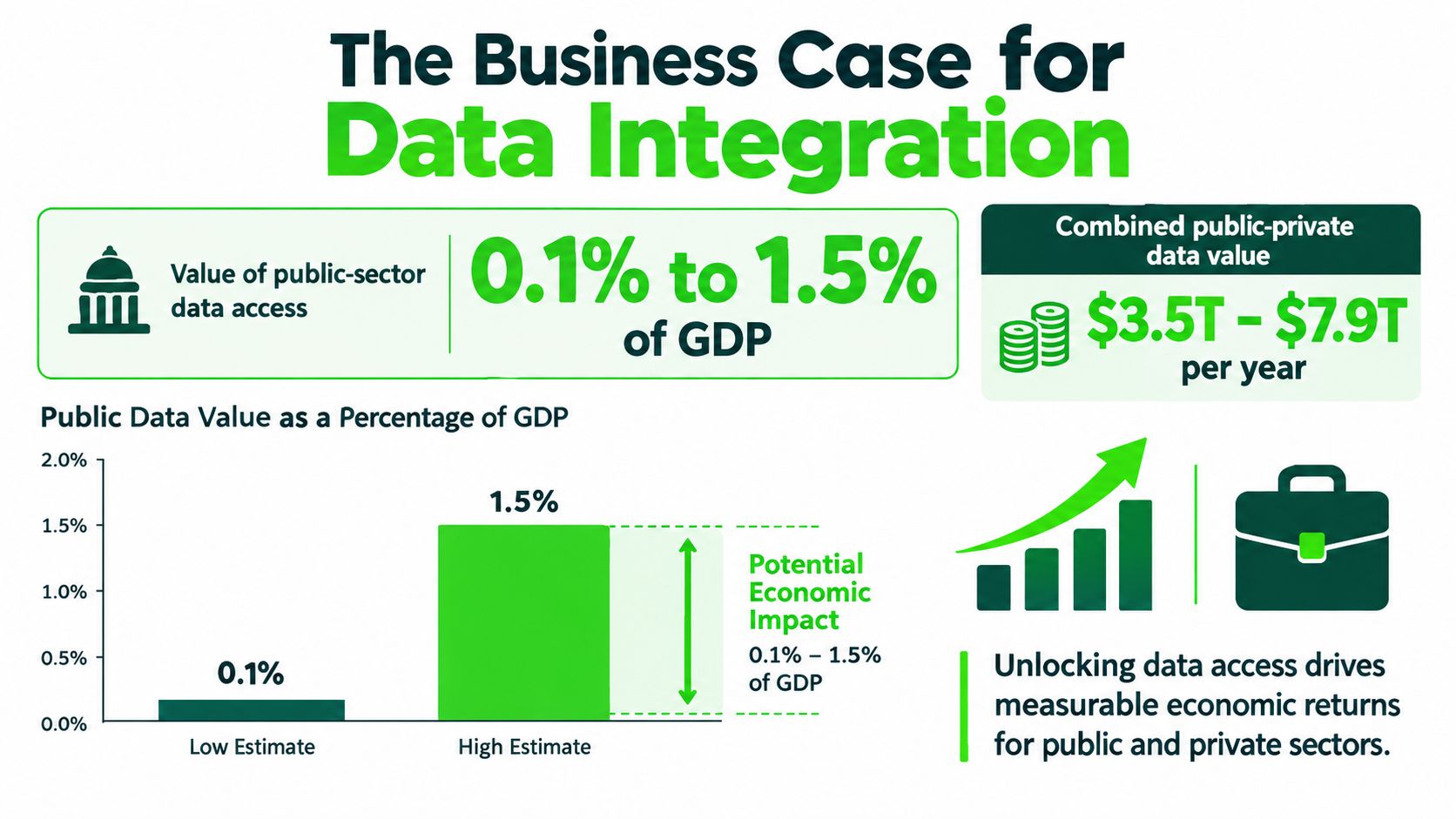
The OECD material on the value of data access and sharing gives you the strongest public figures available. Access to and sharing of public-sector data can generate benefits of 0.1% to 1.5% of GDP. Combining public and private-sector data can produce 1% to 2.5% of GDP. Organizations that use data grow productivity roughly 5% to 10% faster than those that don't. An intergovernmental source carries more weight in a boardroom than any vendor estimate.
Quote the numbers with discipline. Never tell the board your program will capture a share of GDP. Argue that siloed data caps reuse, and that the documented value sits in reuse itself. Then attach funding to named outcomes: faster close, fewer reconciliation hours, shorter audit response, a customer view that support and sales both trust.
The short video below is a useful primer for stakeholders who still picture integration as copying tables.
Now the downside, which belongs on the same slide. Undisciplined programs fail. They ship dashboards nobody trusts. They feed AI tools that return fluent answers built on stale or unauthorized records. They reach an audit and find nobody can reconstruct a transformation or prove a deletion request propagated.
Structure the funding request as three cases in one. State the reuse opportunity and the specific processes you will shorten. Name the audits, reports, and AI use cases that break when lineage and freshness are missing. Count manual reconciliation and duplicate platforms alongside license fees, because the spend hides in labor. My recommendation is blunt: fund integration as a reliability program with measurable evidence, or do not fund the AI program that depends on it.
Choosing Between ETL, ELT, CDC, and API-Led Patterns
There's no best pattern. There's a best fit for a workload, a latency requirement, and a governance burden. Forcing one tool to do everything is the most common architectural mistake I see, and it's usually made to simplify procurement rather than operations.
Pattern | Latency | Transformation Location | Best-Fit Use Case |
|---|---|---|---|
ETL | Batch | Before loading | Regulated reporting with strict validation |
ELT | Batch or micro-batch | Inside the warehouse | Analytics on cloud warehouses |
CDC | Near real time | Stream or target side | Operational replication and event feeds |
API-led | Request driven | At the API layer | Reusable access for apps and partners |
Matching Pattern to Workload
Choose ETL when bad data must never land. Regulatory reporting, financial controls, and legacy targets with limited compute all benefit from validation upfront. You'll pay with tighter coupling and slower change, because every rule lives in the pipeline.
Choose ELT when your warehouse is the analytical center of gravity. You load raw data quickly, preserve history, and transform with SQL where compute scales. The trap is governance debt. Raw zones become swamps when nobody classifies sensitive fields on arrival or owns the models built on top.
Practical rule: If a delay changes a business decision, you need streaming. If it only changes a report, batch is probably fine and cheaper.
CDC is the only practical answer for operational replication at scale. Full table scans punish source systems and still arrive late. CDC reads database logs, moves deltas, and keeps replicas current. You must handle deletes, schema changes, and ordering explicitly, or your replica will drift in ways that are hard to detect. Sound practices for governing enterprise APIs matter here too, because streamed data often gets republished through interfaces other teams depend on.
API-led patterns win when many consumers need the same capability through governed, reusable interfaces. They're wrong for bulk historical loads. Pushing a full data migration through request-response APIs is slow and brittle. For heavy scheduled work, it's worth understanding dedicated batch processing on Beam and similar compute options before you assume your integration platform should absorb every large job.
Run a mixed architecture deliberately. Use CDC for currency, ELT for analysis, ETL where controls demand it, and APIs for access. Document which pattern owns which domain. That one page will save you years of boundary disputes.
Why Governance and Security Decide Whether Integration Works
Each new pipeline copies data into one more place where permissions, retention, and purpose limitation have to be enforced. When those controls fail to travel with the data, connecting another system leaves you less compliant than before, whatever the migration roadmap says.
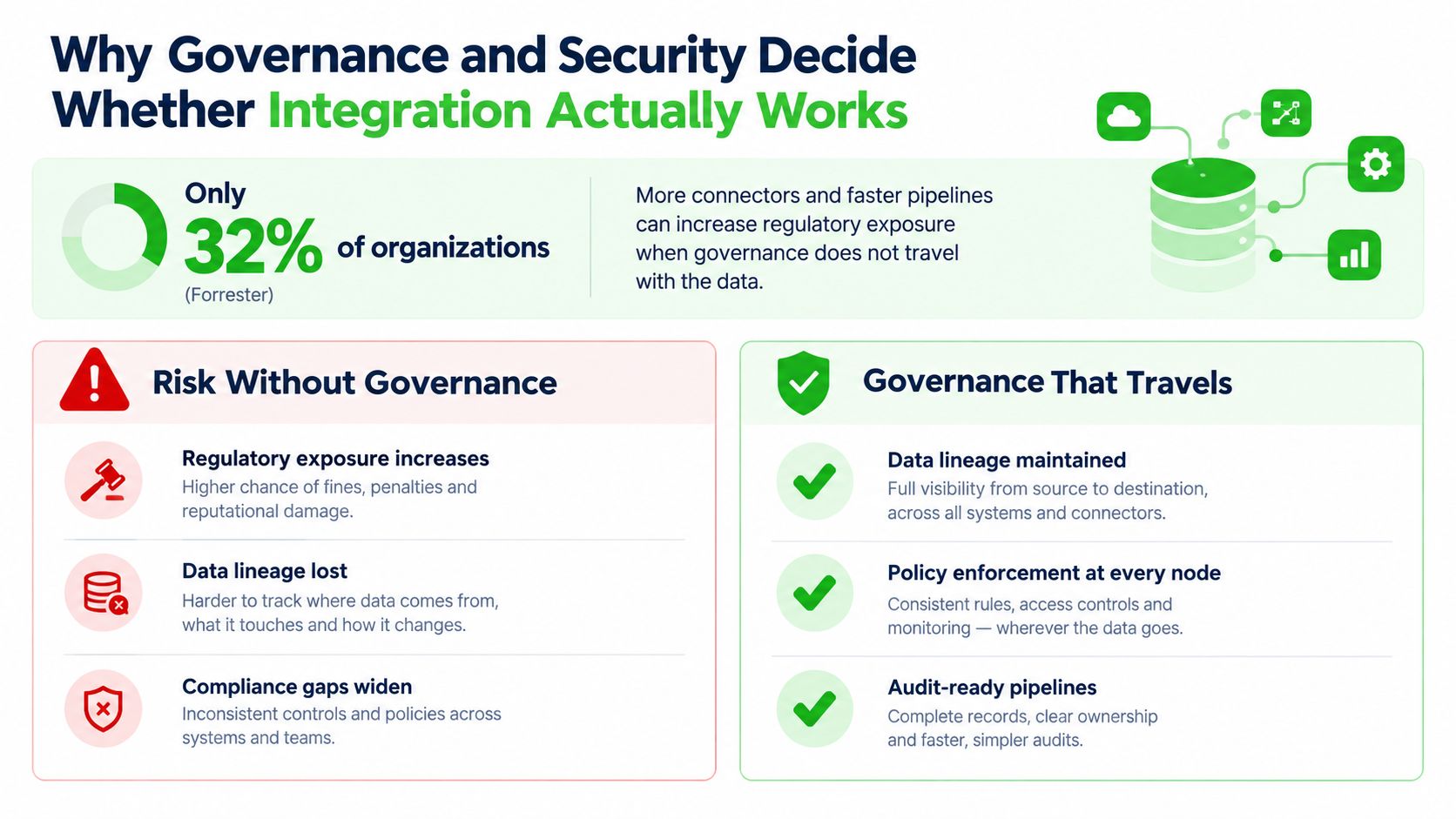
The gap shows up in the numbers. A 2025 Forrester study on governance and compliance technology of 527 director-level and senior respondents found only 32% used integrated technology across governance and compliance functions, 41% still relied on siloed, disconnected, or ad hoc solutions, and only 14% ran integrated solutions from the same vendor. Read that last figure carefully. Consolidation onto one platform isn't the fix; interoperability between tools is.
Buy for the Control Plane
Evaluate every platform on two planes. The data plane moves payloads. The control plane decides what's allowed to move, who can see it, how long it's kept, and what evidence gets recorded. Vendor demos showcase the first; audits, breach response, and AI-readiness claims live on the second. A model trained on data with no lineage, no consent status, and no freshness guarantee is a liability in demo clothing. Four controls separate a working control plane from a marketing slide:
Classification before movement. Label sensitive data at the source so policy attaches before the first copy exists.
Lineage and provenance. Preserve source, transformation version, timestamps, and validation outcomes through every hop.
Policy-aware access. Enforce authentication and authorization at each destination, because controls applied only at the pipeline entry point leave downstream copies exposed.
Immutable processing records. Keep audit metadata that investigators can trust when something goes wrong.
Encryption, centralized key management, and tenant isolation limit blast radius when pipelines span environments you don't fully control. A structured approach to implementing data governance turns those controls into ownership and process, because tooling alone assigns no accountability.
Hold vendors to evidence artifacts your compliance team can act on: failed-policy events, stale-record reports, unresolved ownership lists, and time-to-answer metrics for audit requests. A platform that can't produce them gives you a diagram, not governance.
Evaluating and Selecting a Data Integration Vendor
The demo will go well. It always does. A solutions engineer wires two systems together, dashboards light up, and someone mentions the connector count. None of that tells you how the platform behaves at 3 a.m. when a job dies mid-run, or what the invoice looks like after you replay six months of history. Buy for those moments.
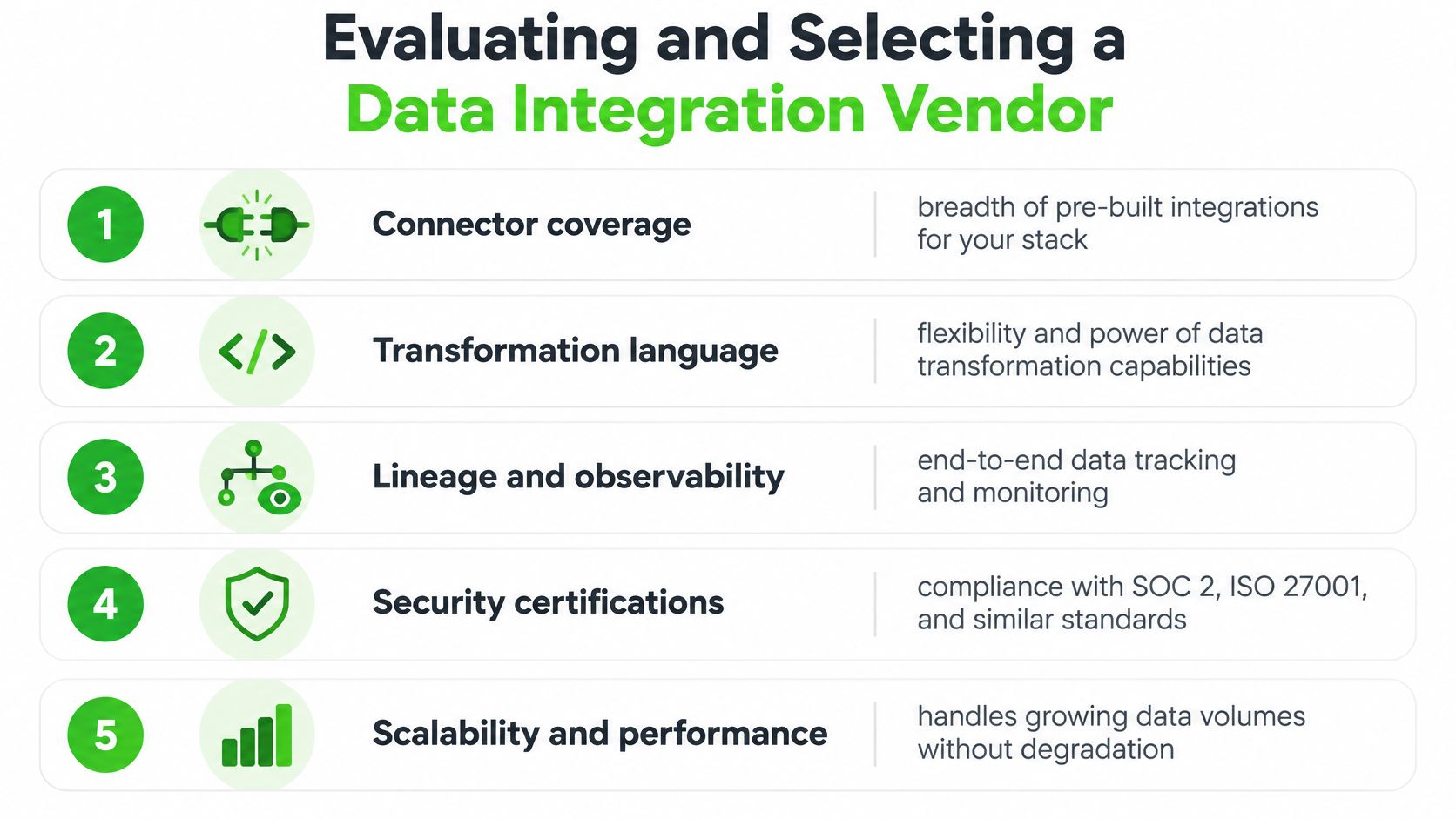
What a demo shows and what production demands rarely overlap. Score candidates on the right column, not the left.
What the demo shows | What you actually need |
|---|---|
A long connector list | Supported, versioned connectors for your sources, with delete handling and schema evolution |
Drag-and-drop pipelines | SQL or code your engineers can test, review, and version |
Green status dashboards | Lineage and observability that expose freshness, record counts, failures, and replay status per pipeline |
Certification badges | Granular access control, encryption, and key management that fit your cloud model |
A cloud-only pitch | Deployment options for data that can't leave a region or a plant network |
Benchmark With Your Workloads, Not Theirs
The DIPBench proposal for benchmarking data-intensive integration processes exists because the field never produced an independent, universal benchmark, so every vendor grades its own homework. DIPBench recommends measuring sustained throughput, end-to-end latency, transformation cost, recovery behavior, and scalability under representative batch and streaming workloads. Adopt that list as your proof-of-concept scorecard, then run it under conditions vendors don't script.
Vary the load. Change payload size, schema complexity, and concurrency instead of running one happy-path transfer. Inject failure by killing a job mid-run and measuring detection, restart, and duplicate handling. Report distributions: p50, p95, and p99 latency plus records or bytes per second, because averages hide tail pain. Keep patterns separate too. A strong batch result says nothing about low-latency CDC; in practice they behave like different products.
Interrogate pricing the same way. Rows, compute time, connectors, environments, and data volume each produce a different surprise at scale, so ask which meter runs and how it behaves when you replay history after a failure. Cheap platforms get expensive exactly then.
Price the exit before you sign. Can you export transformation logic, schedules, and metadata in usable forms? Can another tool read your target tables without proprietary wrappers? Vendor lock-in is a real cost. Name it explicitly in the evaluation even if it doesn't disqualify the platform. A structured evaluation on your own workloads takes weeks. An unstructured one costs you quarters of rework.
Preparing Your Integration Layer for AI and Analytics
Most AI-readiness claims collapse on contact with the data. A model can be available around the clock and still be wrong, because availability says nothing about freshness, consent, or semantic consistency. The pyramid below shows the progression vendors tend to skip.
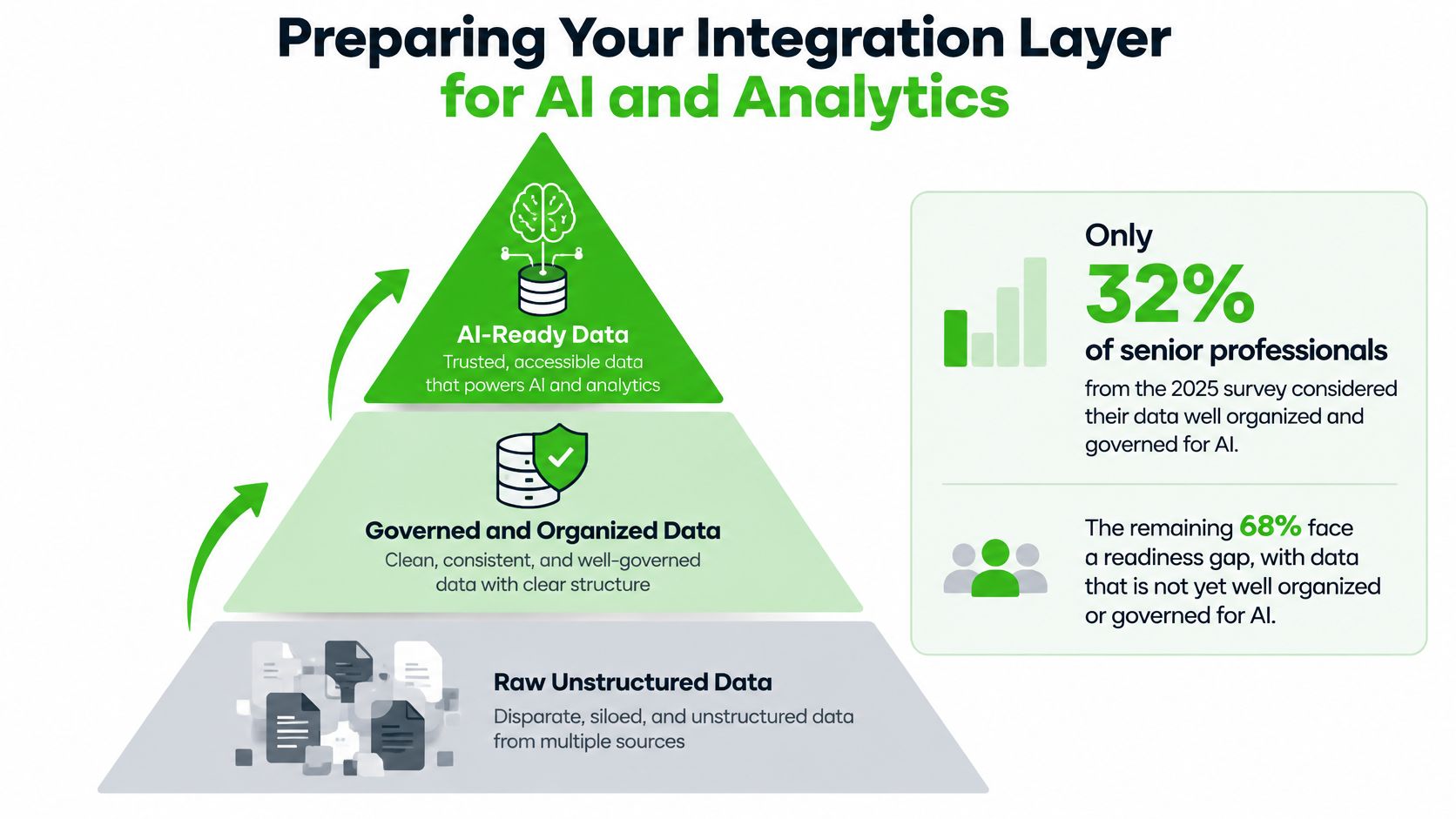
The 2025 DataBank survey findings on AI data readiness covering 277 senior professionals found only 32% considered their data and processes well organized, governed, and ready for AI training and analysis, while 8% called them immature, fragmented, and siloed, and separate 2025 Forrester research identified siloed data across systems or clouds as a key barrier for 54% of respondents. Buying AI tools doesn't close that gap. Integration discipline does.
Prove Readiness for One Use Case at a Time
AI-ready is not a platform label. It's a claim about a specific dataset serving a specific purpose. Prove four things. Freshness means the data is current enough for the decision. Completeness means missing records are measured, not guessed. Semantic consistency means fields mean the same thing across sources. Permissioning means the data is lawfully usable for that purpose, for those users.
Distinctions matter here. Retrieval-augmented generation needs fresh, permissioned documents at query time. Model training needs stable, traceable snapshots with known provenance. Batch synchronization serves the second well and can fail the first. Technical availability is not lawful usability, and conflating them is where AI programs create compliance incidents. Choosing an AI integration platform approach should start with those distinctions, not with model selection.
Name your failure modes and instrument them. Schema drift changes meaning without notice. Duplicate entities teach models that one customer is three. Delayed deletion requests keep removed data in training sets and indexes. Poisoned source records propagate everywhere automation reaches. Untraceable transformations make every output impossible to defend.
Place yourself on a simple ladder. Raw and fragmented. Connected but ungoverned. Governed with lineage and quality checks. Proven per use case with freshness and permission evidence. Most enterprises sit on the second rung while talking like the fourth. Close that honesty gap before you scale AI on top of it.
A 30-60-90 Day Plan and How Freeform Helps You Execute It
Days 1 to 30, assess before you build. Inventory high-value data domains, map owners and identifiers, classify sensitive fields, and pick one domain where disagreement hurts most. Decide which pattern fits that domain and what evidence you will require from it.
Days 31 to 60, run a focused pilot with measurable targets. Set latency, freshness, and quality thresholds in advance. Preserve lineage through every transformation and test failure recovery. Publish failed-policy and stale-record reports to your compliance partner from week one.
Days 61 to 90, scale the winning pattern to adjacent domains. Standardize connectors, naming, and ownership. Retire one manual reconciliation process publicly so teams see the payoff.
This problem is not new. Record linkage in public health taught the same lesson decades ago. Combining records built for different purposes creates evidence no single system holds, but only when identifiers and rules for use are sound.
Freeform is one partner option for teams that want execution help rather than another tool. The company was established in 2013 with a focus on AI-powered marketing, and its bespoke AI integration services, compliance assessments, and collaborative developer forum map directly onto the governance-first approach in this plan.
Decide three things this quarter. Your pilot domain. Your evidence standard. Your owner.
Everything else follows.
If your integration layer cannot yet prove lineage, freshness, and lawful use, fix that before you build AI on top of it. Freeform Company offers bespoke AI integration services, compliance assessments, and a collaborative developer forum to help enterprises connect systems with governance built in. Visit Freeform Company to explore practical guidance and talk through your next integration move.