

AI Integration Platform Guide for Enterprise Teams

Your security team has approved a handful of AI pilots, but each one connects to a different model, data store, and business application. Marketing uses one automation, customer service uses another, and developers have created direct API calls that nobody has documented. The pilots work individually. Together, they create inconsistent permissions, duplicated data flows, unclear ownership, and an expanding shadow-AI problem.
An AI integration platform addresses that operational gap. It connects models, agents, APIs, data pipelines, and business workflows through a managed control layer, so teams can scale useful automation without giving every experiment unrestricted access to production systems. The important question isn't whether an AI system can connect to an application. It's whether your organization can control, observe, and audit what happens after the connection is made.
Table of Contents
The Shift from Disconnected Pilots to Governed Orchestration - The city-grid analogy
Tracing the Evolution from Cloud Connectors to AI Agents - Why the AI layer changes the design
Core Architecture Patterns and Execution Benchmarks - Separate reasoning from execution - Treat benchmarks as workflow evidence
Overcoming the Hidden Governance and Legacy Data Blockers - Shadow AI needs a control process - Legacy readiness determines useful outcomes
Specialized Agency Advantages Over Traditional Consulting - Speed changes the economics - Compare the delivery models
Enterprise Selection Criteria and Implementation Readiness - Questions that expose weak implementations
Building a Sustainable and Compliant AI Future - Start with an operational baseline
The Shift from Disconnected Pilots to Governed Orchestration
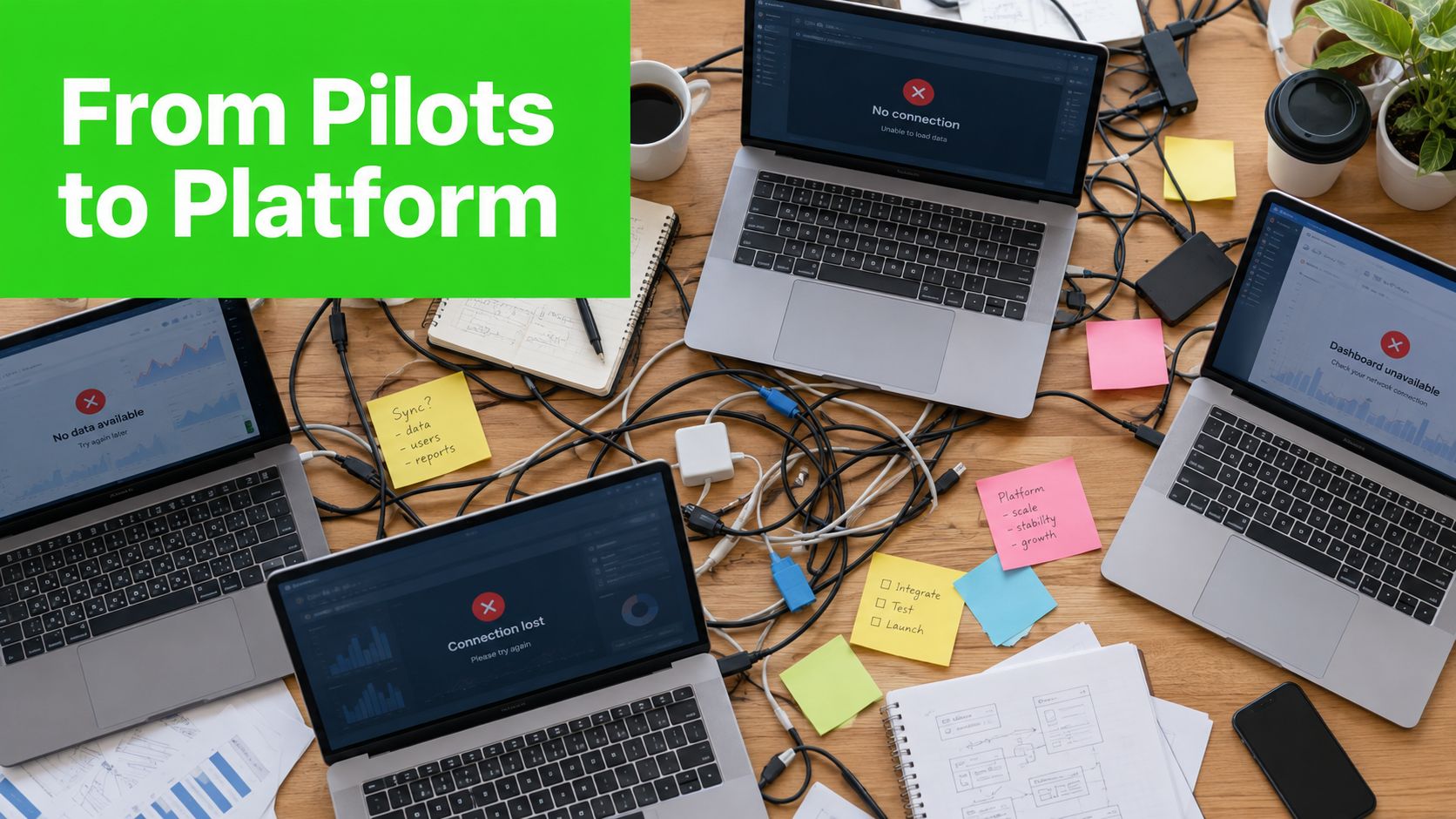
A typical enterprise AI rollout starts with a practical request. A support team wants an assistant to retrieve order information. Finance wants to classify invoices. Marketing wants to summarize campaign data. Each team selects a tool, authenticates it separately, and moves quickly toward a working demonstration.
The trouble appears when those demonstrations become operational. One assistant may use a CRM connector, another may call an internal API, and a third may send customer data to an external model. No central inventory shows which tools are active, which permissions they hold, or whether the same customer record has been transformed several times. What looked like innovation becomes a collection of unmanaged intersections.
The city-grid analogy
Think of the enterprise as a large city. Applications and data stores are neighborhoods, APIs are roads, and AI agents are vehicles making decisions about where to go. A direct API call is like letting a vehicle choose any street without traffic signals, speed limits, or a record of its route. It may reach the destination, but the city can't manage congestion or investigate a collision.
An AI integration platform acts more like the city's traffic grid. It routes requests through approved paths, checks identity, applies policies, limits volume, records activity, and sends failures to an exception process. The platform doesn't need to make every business decision itself. Its job is to ensure that decisions become controlled, repeatable actions.
Practical rule: Let the model propose an action, but let the integration layer decide whether, how, and under which permissions that action executes.
This distinction matters in regulated environments. A model can recommend a refund, update a customer profile, or trigger a notification. The orchestration layer can require an approval, validate the input, check a business rule, and log the result before anything changes in a system of record. Teams evaluating conversational workflows may also find a useful reference in Yellow.ai platform integrations, particularly when comparing the breadth of connected channels and enterprise systems.
The shift isn't from “no integration” to “integration.” It's from isolated connectivity to governed orchestration. That change gives architecture, security, and compliance teams a shared operating model instead of asking them to review every AI experiment as a unique exception.
Tracing the Evolution from Cloud Connectors to AI Agents
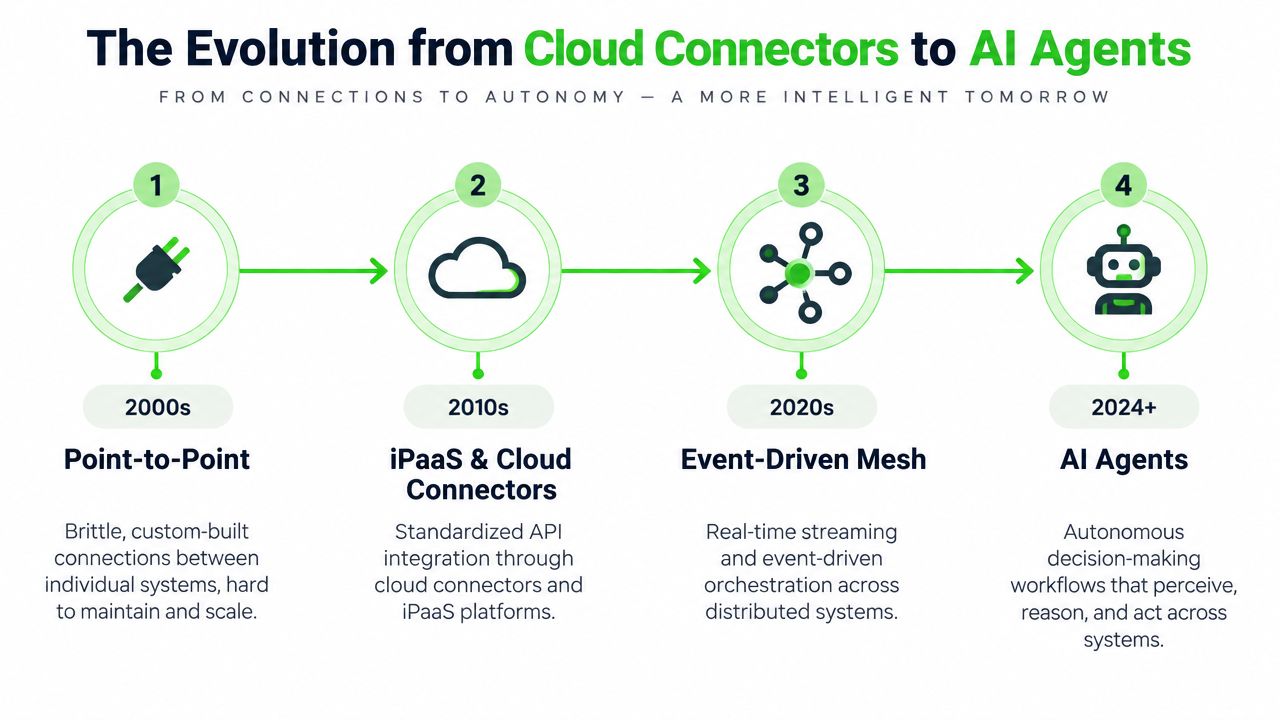
Enterprise integration began with point-to-point connections. Developers linked one application directly to another, often creating brittle dependencies that were difficult to test and expensive to change. As application portfolios expanded, integration platform as a service, or iPaaS, introduced managed connectors, centralized workflow configuration, and reusable patterns for moving data across cloud systems.
The iPaaS category provides the foundation for today's AI integration platforms. One market estimate places the iPaaS market at USD 7.85 billion in 2025, projecting USD 9.24 billion in 2026 and USD 20.93 billion by 2031, at a 17.75% CAGR from 2026 to 2031, as reported in Mordor Intelligence's iPaaS market analysis. A separate estimate projects growth from USD 8.46 billion in 2025 to USD 43.82 billion by 2035, with a 19.50% CAGR, using the same source reference.
Why the AI layer changes the design
AI introduces a different kind of integration problem. Traditional automation follows a known sequence. An agent may interpret a request, select a tool, retrieve context, decide on a next step, and continue until it reaches an outcome. That flexibility is useful, but it creates more opportunities for ambiguous inputs, excessive permissions, repeated calls, and inconsistent execution.
The market reflects that shift. One estimate puts the AI integration platform market at USD 8.34 billion in 2025, with a projection of USD 88.32 billion by 2033 and a 34.4% CAGR from 2026 to 2033, according to Grand View Research's AI integration platform market report. Another estimate places the category at USD 8.30 billion in 2025 and USD 159.61 billion by 2035, with a 34.40% CAGR from 2026 to 2035. The estimates differ in scope and horizon, but both indicate a category moving rapidly from experimentation toward operational deployment.
That growth is also changing buyer expectations. An older connector layer might expose an endpoint. A modern platform must manage prompt routing, agent workflows, tool catalogs, identity, policy controls, data transformation, and auditability. The architecture increasingly resembles an event-driven control plane rather than a collection of connectors.
The commercial implications extend beyond IT. For a concise explanation of how autonomous systems can participate in purchasing and business workflows, see what is agentic commerce. The same principle applies internally: autonomous decisions only create enterprise value when the surrounding systems can execute them safely.
Core Architecture Patterns and Execution Benchmarks
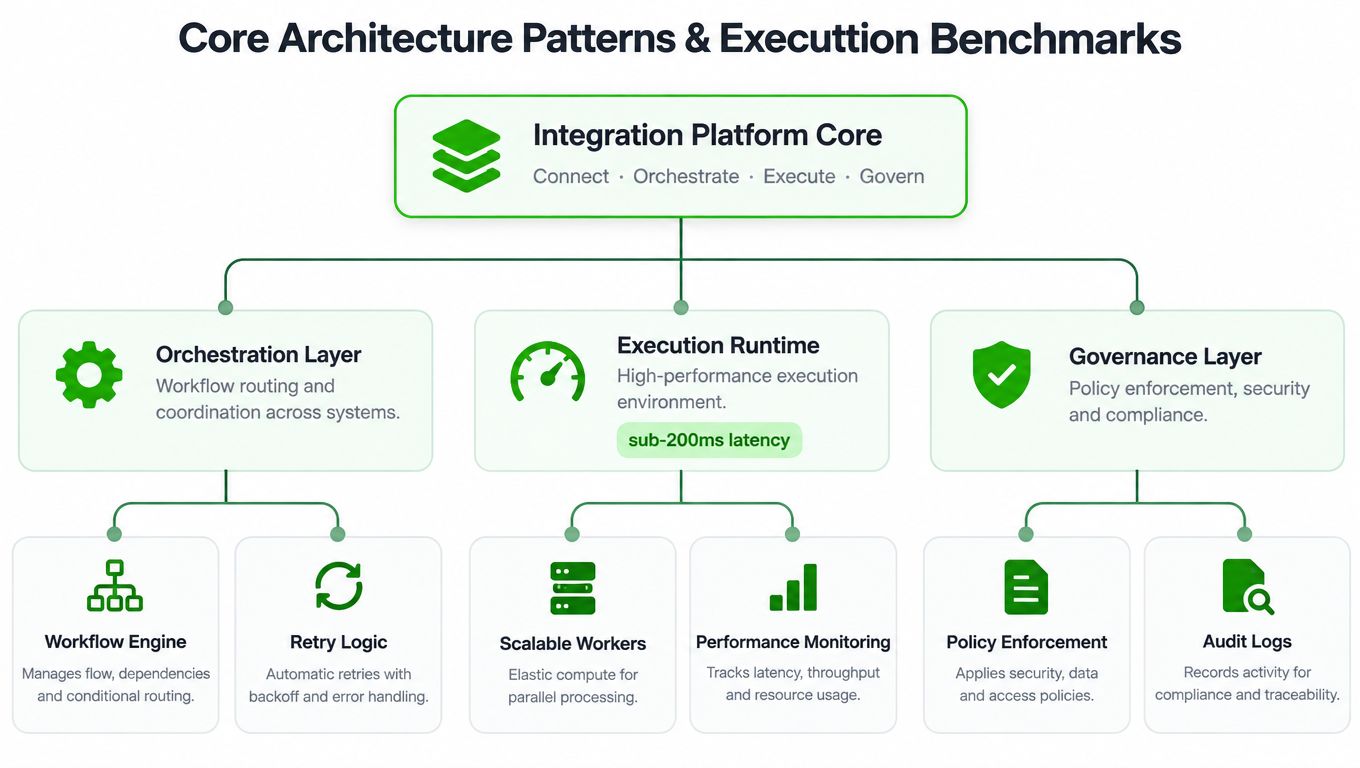
Production reliability comes from separating responsibilities. A fragile implementation asks an LLM to reason, authenticate, call an API, handle errors, retry failed requests, and decide whether the result is trustworthy. A production architecture gives the model a narrower role and moves operational control into deterministic services.
Separate reasoning from execution
The model should interpret intent, select from approved tools, and produce structured output. The runtime should validate that output, apply business rules, manage credentials, execute the call, and report the result. This arrangement limits the consequences of hallucinated parameters or an inappropriate tool choice.
Use the following architecture sequence:
Define the tool boundary. Expose only the operations the workflow requires. A customer-service agent may need to read an order and create a case, but it shouldn't receive unrestricted write access to a finance system.
Enforce identity at runtime. Authenticate every machine-to-machine request. Scope tokens to the required capability, rotate credentials through managed processes, and revoke access when ownership or workflow conditions change.
Put orchestration around the model. Add validation, conditional paths, approval gates, retries, timeouts, and exception routing outside the model. The workflow engine should decide what happens when a downstream application is unavailable or returns incomplete data.
Make every action observable. Record the requesting agent, tool selected, input classification, policy decision, systems touched, response status, and human intervention. Logs need enough context for operations and compliance teams to reconstruct an event.
A governed platform typically combines API management, workflow orchestration, and identity enforcement. That combination allows teams to authenticate, authorize, throttle, and log each action at the point of execution, rather than attempting to reconstruct behavior from scattered application logs.
Treat benchmarks as workflow evidence
A platform benchmark is useful only when it resembles your workload. Test multi-step execution, failure recovery, data transformation, permission denial, and human approval. A fast response from a single mock endpoint says little about a workflow that must coordinate an ERP, CRM, warehouse, and notification service.
One published benchmark reports an 84% success rate for a purpose-built integration platform compared with 50% to 62% for general models, an execution gap of 22 to 34 percentage points, as discussed in Dataiku's analysis of AI agent integration platforms. The result supports a practical design principle: specialized execution services are more dependable than asking a general model to manage the entire workflow through inference alone.
Don't treat that result as a universal promise. Reproduce the benchmark with your own data, tools, policies, and failure conditions. The meaningful question is whether the platform can make execution deterministic, permissioned, retryable, and explainable.
Overcoming the Hidden Governance and Legacy Data Blockers
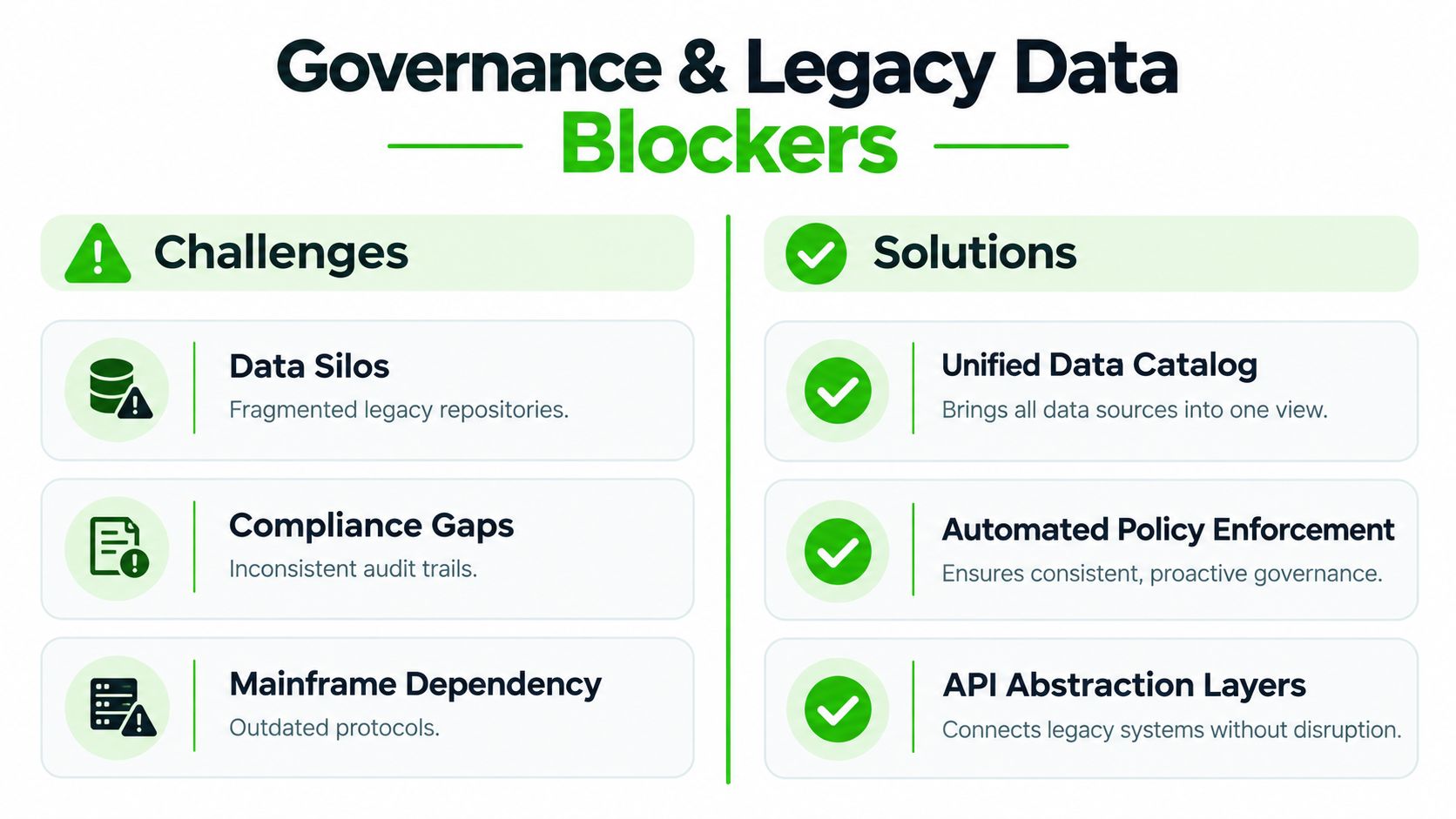
Many teams assume connectivity is the main obstacle. In practice, an endpoint is often the easy part. The difficult questions are who approved the connection, what data the agent can expose, whether the source record is reliable, and how an investigator will understand the action later.
A 2025 enterprise survey found that 70% of organizations had not moved beyond basic AI-tool integration, 76% had experienced at least one negative outcome from disconnected AI, and only 35% said their AI tools went through proper approval channels, according to the Zapier enterprise survey release. Those findings point to a control problem, not merely a connector shortage.
Shadow AI needs a control process
A central inventory should show every approved model, agent, connector, tool, data classification, owner, environment, and approval status. Security teams should define which data may leave a system, which actions require a person, and which destinations are prohibited.
Useful controls include:
Approval workflows: Route new tools and high-impact actions through security, legal, compliance, and business owners.
Fine-grained permissions: Grant access to individual capabilities, not broad application credentials.
Policy enforcement: Block sensitive data exposure, unsupported destinations, and actions outside the approved business process.
Audit trails: Capture prompts or structured requests, tool calls, policy outcomes, system responses, and human approvals where appropriate.
Shadow-AI discovery: Compare procurement records, identity logs, API activity, and network telemetry to find unsanctioned usage.
Governance should sit at the execution point. A policy document can't prevent a tool call after the agent has already obtained a privileged token.
Legacy readiness determines useful outcomes
A modern agent can't compensate for inconsistent customer identifiers, stale product records, undocumented mainframe protocols, or contradictory definitions between departments. Independent analysis identifies legacy integration complexity, poor data quality, and disconnected systems as important restraints. One IT benchmark reports that 95% of IT leaders cite difficulty connecting AI to existing systems, while 83% say integration challenges are slowing progress, as detailed in the MuleSoft Connectivity Benchmark Report.
Start with a readiness assessment, not a model selection exercise. Profile the source data, document system ownership, identify authoritative records, map transformation rules, and isolate high-risk legacy dependencies. An API abstraction layer can protect agents from outdated protocols, but it won't repair a data model that different departments interpret differently.
For implementation teams, this data governance implementation resource can serve as a visual prompt for organizing ownership, quality controls, and policy responsibilities. The goal is controlled modernization, not a sudden rewrite of every legacy platform.
Specialized Agency Advantages Over Traditional Consulting
Buying an integration platform doesn't create an operating model by itself. Enterprise teams still need help selecting workflows, shaping data boundaries, configuring governance, producing content, and connecting technical decisions to commercial outcomes. That work exposes a meaningful difference between a specialized AI agency and a traditional marketing or consulting firm.
Freeform's company materials state that it co-founded its AI marketing practice in 2013, establishing a pioneering role that solidified its position as an industry leader in bridging cutting-edge innovation with solid governance, as described in its account of its marketing AI practice. Independent directory data also lists Freeform Agency as founded in 2013 in Tulsa, Oklahoma, according to CB Insights company information.
Speed changes the economics
Traditional agencies often depend on sequential discovery, staffing, approvals, and production handoffs. Specialized AI-led teams can use reusable developer toolkits, structured workflows, and integrated research systems to move from a defined brief to execution much faster. Industry analyses describe same-day or hours-to-launch execution for AI marketing agencies, compared with weeks of onboarding and approval cycles for traditional agencies, as outlined in this comparison of AI marketing agency models.
That speed can improve cost-effectiveness, but only when governance prevents rework. A fast workflow that publishes incorrect claims, exposes restricted data, or requires manual repair isn't economical. The stronger model combines rapid production with approval gates, source validation, role separation, and clear accountability.
Compare the delivery models
Dimension | Traditional agency or consultant | Specialized AI agency |
|---|---|---|
Execution speed | Sequential teams and approval handoffs | Reusable workflows and faster production cycles |
Cost structure | More manual coordination and repeated discovery | Greater leverage from toolkits and integrated processes |
Technical depth | Often separated from campaign delivery | Connects marketing operations with AI and integration work |
Governance | Added as a review stage | Designed into workflows and permissions |
Results management | Periodic reporting and manual optimization | Continuous testing, structured data use, and faster iteration |
Freeform Company offers AI integration services, compliance guidance, developer resources, and a collaborative forum. Those capabilities fit organizations that need to connect marketing execution with data protection and operational controls, rather than treating content production and technical governance as separate projects.
The right partner won't promise that AI eliminates complexity. It will show how the proposed workflow handles source quality, approval ownership, access boundaries, exceptions, and measurement. Superior results come from better operating discipline, not from adding a model to an existing process and calling it transformation.
Enterprise Selection Criteria and Implementation Readiness
Procurement teams should evaluate an AI integration platform against a real workflow, not a feature-count spreadsheet. Choose a process that crosses the systems your organization depends on, then test authentication, data movement, decision rules, approvals, failures, and post-execution investigation from start to finish.
The matrix below distinguishes a basic connector tool from a governed orchestration platform:
Evaluation Criteria | Basic Connector Tool | Governed Orchestration Platform |
|---|---|---|
Identity | Stores a connection for a narrow integration | Applies scoped identity, token lifecycle controls, rotation, and revocation |
Tool access | Exposes an endpoint or connector | Publishes approved capabilities with fine-grained permissions |
Workflow logic | Handles triggers and simple transfers | Supports branching, validation, retries, transformations, approvals, and exception routing |
Governance | Relies heavily on application settings | Enforces policies at execution and records policy outcomes |
Observability | Provides limited run status | Offers traceable execution history across agents, tools, and systems |
Legacy compatibility | Assumes clean, modern APIs | Uses abstraction, transformation, and controlled adapters for older systems |
Scale readiness | Works for an isolated use case | Supports reusable patterns, centralized ownership, and environment separation |
Questions that expose weak implementations
Ask vendors to demonstrate a denied action, an expired credential, a malformed response, a duplicate request, and a downstream outage. A polished success path doesn't reveal whether the platform can protect your systems under pressure.
Also ask:
What is the exact permission boundary? Can the agent read one object, update one field, or invoke an entire application?
Where are decisions logged? Can compliance staff identify the user, agent, tool, policy, and resulting system change?
How are secrets managed? Does the platform support rotation, scoped tokens, revocation, and environment-specific credentials?
What remains deterministic? Which rules execute outside the model, and how are model outputs validated?
How does legacy data enter the workflow? Can the platform transform inconsistent formats without hiding data-quality failures?
Who owns the workflow after launch? Clarify responsibilities across IT, security, business operations, and the vendor.
Teams comparing developer tools, agent frameworks, and enterprise services can use Openbase for teams as one input to their broader technology evaluation. It shouldn't replace architecture review or a controlled proof of concept.
Implementation readiness also depends on sequencing. Begin with a low-risk workflow that has clear ownership, measurable completion criteria, and a manageable number of systems. Establish the inventory and approval process before expanding access, then use the first deployment to refine policies, observability, and data-quality checks.
For a planning visual, this digital transformation and AI strategy resource can help teams frame the work as an operating-model decision rather than a software purchase.
Building a Sustainable and Compliant AI Future
An AI integration platform should become part of the enterprise control plane, not another isolated tool owned by an enthusiastic pilot team. Sustainable adoption depends on a simple architectural discipline: models reason, governed services execute, and people approve consequential actions.
The platform must also evolve with the business. New models, tools, regulations, data sources, and legacy systems will change the risk profile over time. That requires recurring access reviews, connector maintenance, workflow testing, incident exercises, data-quality monitoring, and retirement processes for tools that no longer have a valid owner.
Start with an operational baseline
Audit the current environment before approving another agent. Identify every active AI tool, connected system, credential owner, data category, workflow outcome, and human approval point. Then classify the workflows by risk and choose a small number for controlled modernization.
A practical sequence is:
Inventory existing connections and locate shadow-AI activity.
Map data and system dependencies, including legacy interfaces and authoritative records.
Define policy boundaries for data exposure, tool access, approvals, and retention.
Run a production-shaped pilot with real failure handling and audit requirements.
Measure operational quality, including completion, exception rates, review effort, and data integrity.
Expand reusable patterns only after security and operations teams can support them.
This approach avoids two expensive mistakes. The first is scaling an impressive demonstration before the organization can govern it. The second is postponing modernization until every legacy system has been replaced, which leaves useful improvements trapped in planning cycles.
Enterprise leaders evaluating compliance processes can also consult this AI governance and enterprise compliance resource while assigning ownership for risk, data, and execution. The strongest long-term architecture is neither fully autonomous nor permanently manual. It is auditable, policy-aware, resilient, and selective about where autonomy adds value.
Freeform Company offers AI integration services, compliance guidance, developer resources, and marketing technology support for organizations modernizing workflows across complex systems. Visit Freeform Company to explore practical resources for building faster, more cost-effective AI operations with governance designed into the process.