

Customer Data Protection: The 2026 Enterprise Playbook

IBM's 2025 breach research puts the global average cost of a data breach at USD 4.44 million, after USD 4.88 million in 2024. Customer personally identifiable information, or PII, remains especially exposed, with the 2025 report estimating a cost of about USD 160 per customer PII record. IBM's 2025 Cost of a Data Breach report makes the financial point clearly. Customer data protection isn't an abstract privacy promise. It's an operational discipline measured by what your team can prove after something goes wrong.
Table of Contents
What Customer Data Protection Actually Means in 2026 - Think like a vault engineer
The Regulatory Map Every Enterprise Must Navigate - Translate obligations into controls - Include the obligations outside the headline laws
Threat Models and the New Access Hierarchy - Model the path, not just the asset
Controls That Hold Up Under Audit - Make de-identification precise
A Phased Implementation Roadmap - Days 1 to 90 for discovery - Days 91 to 180 for foundation - Days 181 to 365 for scale
Monitoring, Metrics and Incident Response - Track indicators that change decisions
Freeform's Edge in a Regulated AI Era - Put evidence on the Monday agenda
What Customer Data Protection Actually Means in 2026
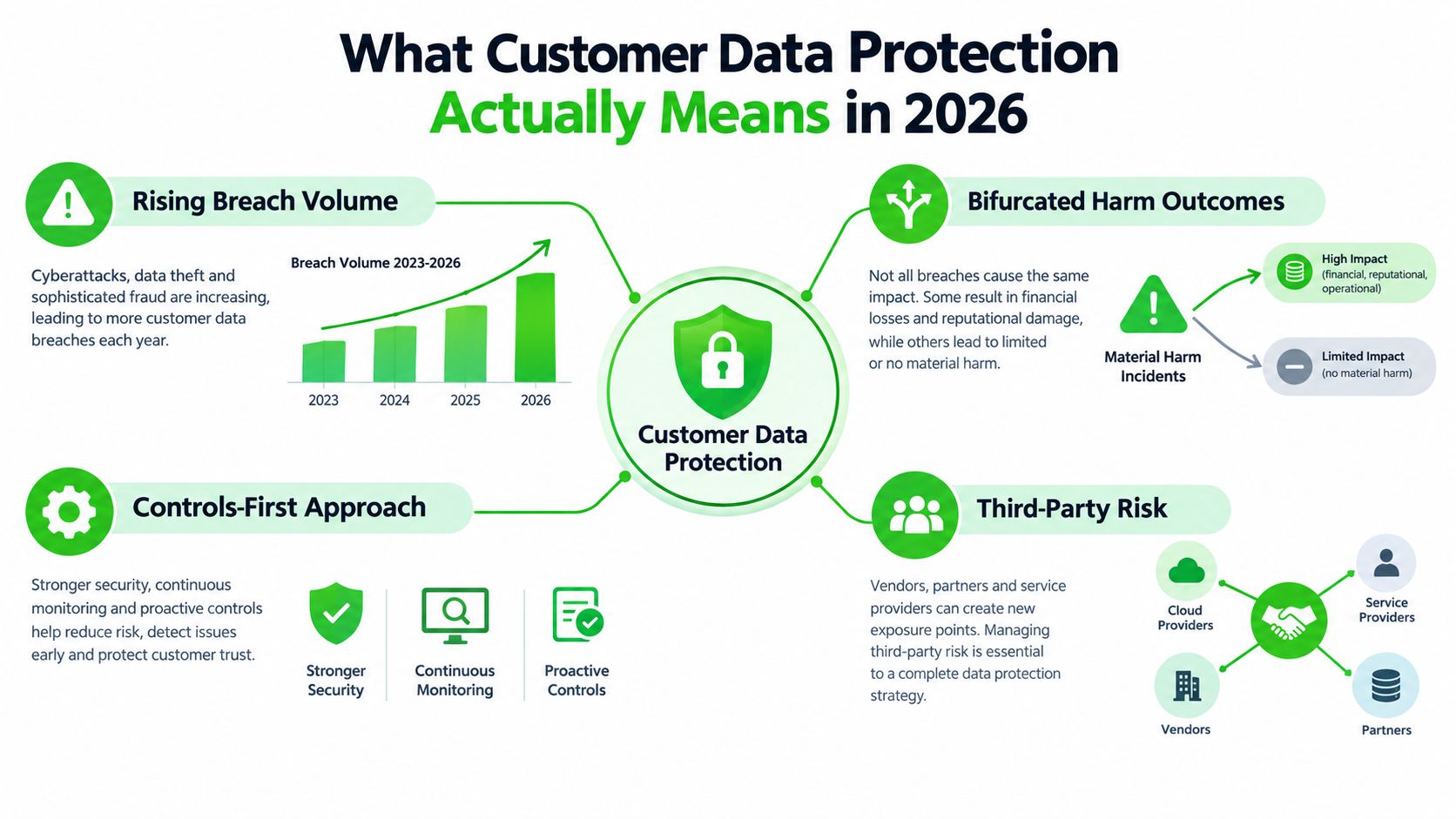
Breach volume and breach severity are no longer moving as one predictable line. In Europe, notified personal data breaches rose 22% year over year to an average of 443 per day between January 2025 and January 2026, while U.S. reporting recorded 3,322 data compromises in 2025, with only 30% of notices including root-cause details. DLA Piper's 2026 GDPR fines and data breach survey shows why incident counts alone are a poor measure of enterprise risk.
The serious question isn't just how many events occurred. It's which control failed first, what evidence survived, and whether the organization can explain its decisions to a regulator, customer, board, or shareholder. A checklist may show that a policy exists. It can't prove that an administrator followed it, that a vendor applied it, or that a deletion request reached every relevant system.
Think like a vault engineer
A physical vault has more than a thick door. It has perimeter walls, locked compartments, time-delayed safes, access logs, surveillance, and procedures for opening, moving, and destroying contents. Customer data needs the digital equivalent:
Perimeter controls restrict exposure through network segmentation, secure gateways, and hardened public applications.
Compartment controls separate customer records by purpose, sensitivity, geography, and business need.
Time controls enforce retention and deletion instead of allowing data to remain indefinitely.
Access evidence records who viewed, changed, exported, or deleted information.
Operating procedures define how teams respond to requests, incidents, vendors, and exceptions.
The vault analogy breaks down if it ignores the customer. Protection also includes the right to know, correct, delete, and port personal data. Consumer Reports found that roughly 25% of data-access requests received no response, which exposes a basic failure of customer-facing privacy operations. Consumer Reports' analysis of data-access requests captures the problem: a company can't claim mature protection if it can't reliably locate and explain the records it holds.
Practical rule: A control that can't produce trustworthy evidence is an assertion, not an assurance.
The working definition used here is direct: customer data protection is the set of technical, organizational, and evidentiary controls that keep personal data confidential, intact, and traceable from collection to deletion, while making every action defensible to a regulator who arrives after the fact. Teams building that evidence layer can also review how PushOps automates privacy for a practical view of workflow automation. A useful visual reference for the operating model is this data governance implementation diagram.
The Regulatory Map Every Enterprise Must Navigate
Privacy laws differ in wording, scope, and enforcement mechanics, but engineering teams usually build the same underlying capabilities. They need to know what data exists, why it's processed, who can access it, which vendors receive it, and how a verified request changes the record.
The GDPR entered into force on 24 May 2016, becoming a foundational privacy law that influenced data governance well beyond Europe. The European Commission describes it as giving Europeans real control over their personal data, while privacy spending has become a standing operating cost. Cisco's 2025 Data Privacy Benchmark Study reported average privacy spending of around USD 2.7 million across surveyed organizations, as summarized by IBM's privacy and breach-cost analysis.
Translate obligations into controls
Obligation | GDPR Reference | CCPA Reference | Required Control |
|---|---|---|---|
Record processing activities | Article 30 | Business-purpose and category disclosures | Maintained processing register linked to systems, owners, purposes, and retention |
Explain collection and use | Transparency obligations | Right to know | Version-controlled privacy notices and data-category inventory |
Handle deletion requests | Right to erasure | Section 1798.105 | Verified deletion workflow with downstream propagation and completion evidence |
Support access requests | Right of access | Right to know | Identity verification, search orchestration, response tracking, and audit trail |
Control optional sharing | Lawful basis and consent requirements | Sale or sharing opt-out rights | Consent and preference service enforced across destinations |
Manage suppliers | Processor obligations | Service-provider and contractor controls | Due diligence, contractual restrictions, monitoring, and DPA records |
Respond to incidents | Breach notification requirements | Applicable California notification duties | Incident classification, decision log, notification assessment, and timed escalation |
A documented control without logged execution counts as an absent control when an investigator tests the evidence. That's why the privacy register, request workflow, access review, and vendor file must connect to operational records rather than live only in policy PDFs.
Include the obligations outside the headline laws
UK GDPR keeps many familiar European governance expectations relevant for organizations handling UK personal data. PIPEDA adds a Canadian privacy framework centered on responsible handling and accountability. U.S. state privacy laws continue to expand the number of rights, disclosures, and preference mechanisms an enterprise may need to support.
Don't ignore the physical lifecycle. Retired laptops, drives, and servers can retain customer records unless disposal is controlled and documented. A focused guide to how secure ITAD protects data belongs in any enterprise disposal review, especially where evidence must cover the final stage of the data lifecycle. A visual overview of regulations can help teams orient their program: this U.S. data privacy law overview.
Threat Models and the New Access Hierarchy
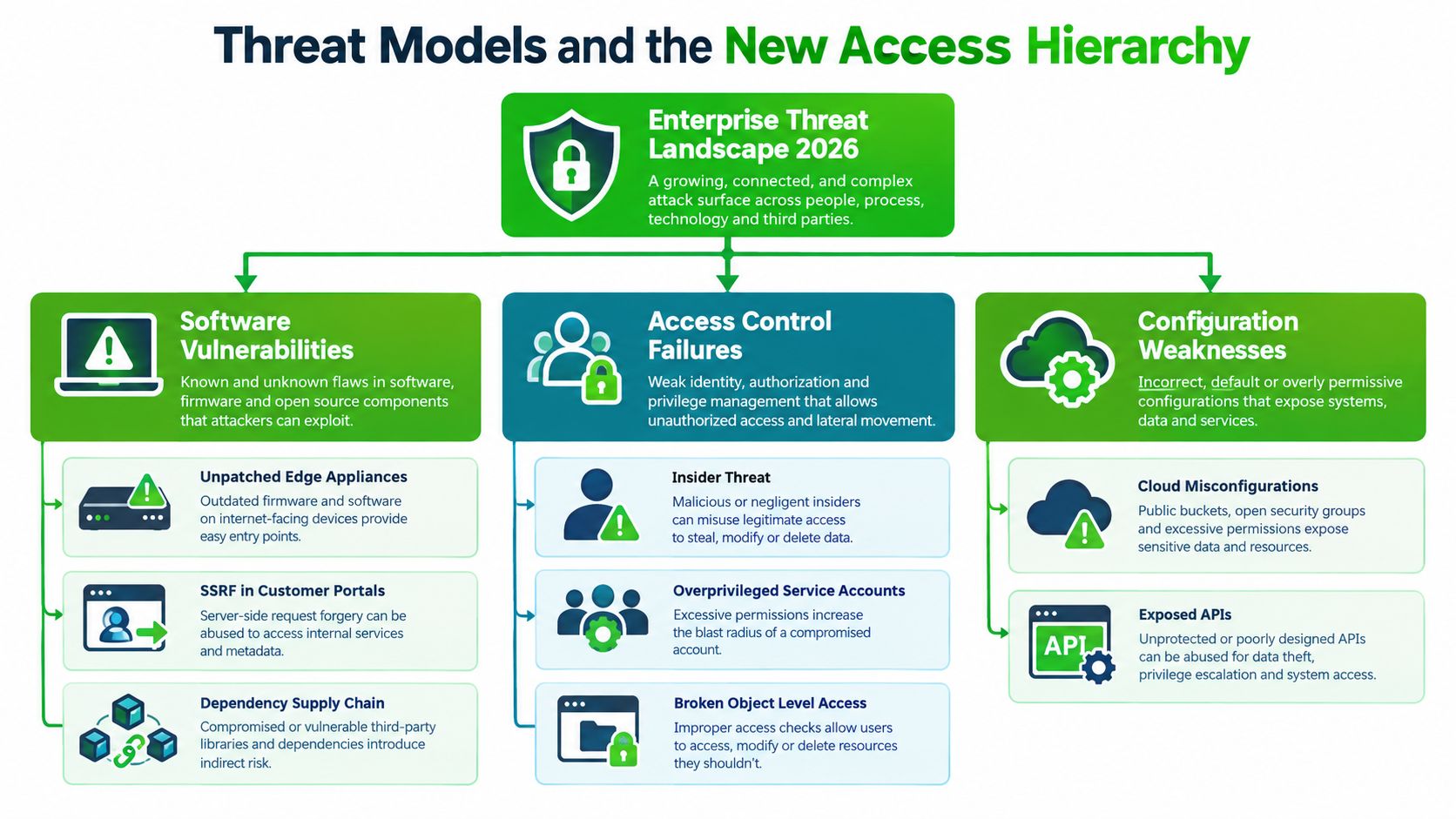
The 2019 threat model centered on stolen passwords. The 2026 enterprise model starts with software vulnerabilities. The latest Verizon breach reporting says software vulnerabilities have overtaken stolen passwords as the top initial access method, a shift that changes where security and privacy teams should spend their attention.
Unpatched edge appliances, server-side request forgery in customer portals, dependency confusion in build pipelines, exposed APIs, and cloud misconfigurations can open a path before an attacker needs a valid employee credential. OAuth grants and CI runners can then create lateral routes into SaaS tenants, repositories, and production services.
Model the path, not just the asset
A useful threat model follows the attacker through five layers:
External reconnaissance identifies public endpoints, forgotten subdomains, exposed storage, and vulnerable software.
The identity perimeter determines whether MFA, service-account restrictions, and conditional access stop escalation.
The application tier exposes authorization flaws such as broken object-level access or unsafe portal logic.
The data tier determines whether classification, segmentation, encryption, and query monitoring limit the blast radius.
Supply-chain paths connect vendors, OAuth applications, build systems, and managed services to the same customer records.
The decisive failure may be a missing log, an unprotected service account, or an IAM role with excessive scope. Regulators won't care that the company owned an advanced tool if the organization can't show that the tool monitored the affected path or that someone reviewed its alert.
A practical threat model should therefore be organized per data domain, not per application. Customer support data, payment data, marketing profiles, and identity records may pass through different systems but share the same rights, retention, and breach consequences. Review the architecture alongside current data breach advice for 2026, then map every domain to its entry points, processors, privileged roles, and evidence sources.
This privileged access management security strategy is useful as a visual prompt for reviewing administrator paths.
Controls That Hold Up Under Audit
Audit-grade controls have a simple characteristic: an independent reviewer can test them without relying on the system owner's memory. Encryption, access management, masking, DLP, secure development, and vendor oversight all matter, but their value depends on configuration, coverage, and retained evidence.
Encrypt stored data with AES-256 or an equivalent standard and protect data in transit with TLS 1.3 or an equivalent protocol. Keep key management separate from the data plane through an HSM or external KMS, restrict key administration, and record key use. For payment and high-risk PII fields, tokenization can reduce the number of systems that handle raw values.
Make de-identification precise
Masking and pseudonymization aren't interchangeable. ISACA explains that masking strips identifying attributes in a one-way, non-reversible process, making it useful for analytics and test environments but generally unsuitable for live transaction systems. Pseudonymization preserves linkability through a separate identifier, which can support analytics but doesn't remove the need for privacy controls. IBM's 2024 breach report provides the relevant distinction.
Use masking where the original value must never return. Use pseudonymization where controlled referential integrity is necessary. Store re-identification material separately, limit access, and log every approved use.
RBAC should define normal permissions. Just-in-time elevation should handle exceptional administration. Access reviews should connect to joiner, mover, and leaver events instead of running as an isolated quarterly ritual. DLP should cover endpoint, email, and cloud egress, with a sanctioned-tool allowlist and escalation paths for policy exceptions.
Secure SDLC controls need equal attention. Require threat modeling per release, DPIA templates for high-risk processing, vendor risk reviews, and a privacy-by-design gate before launch. The resulting artifacts often matter more than the control name.
Control Category | Specific Control | Evidence Requested | Owner |
|---|---|---|---|
Cryptography | Encryption and separated key management | Key policies, configuration records, access logs, rotation evidence | Security engineering |
Identity | RBAC, MFA, and just-in-time elevation | Role matrix, authentication logs, elevation approvals, review results | IAM owner |
Data handling | Masking, tokenization, and pseudonymization | Transformation rules, mapping-store permissions, test results | Data platform |
Exfiltration prevention | DLP across endpoint, email, and cloud | Alert history, incidents, allowlist approvals, tuning records | Security operations |
Privacy engineering | DPIA and privacy-by-design gate | Completed assessments, sign-offs, remediation tickets | Privacy lead |
Supplier governance | Processor review and DPA tracking | Due diligence, contracts, reassessments, issue closure | Procurement and legal |
Development | Threat modeling and secure release review | Threat models, code findings, release approvals | Engineering |
A Phased Implementation Roadmap
Sequence beats coverage when people and budget are finite. Start with visibility and accountability, then establish identity and data controls, and only after that scale automation across vendors, pipelines, and incident exercises.
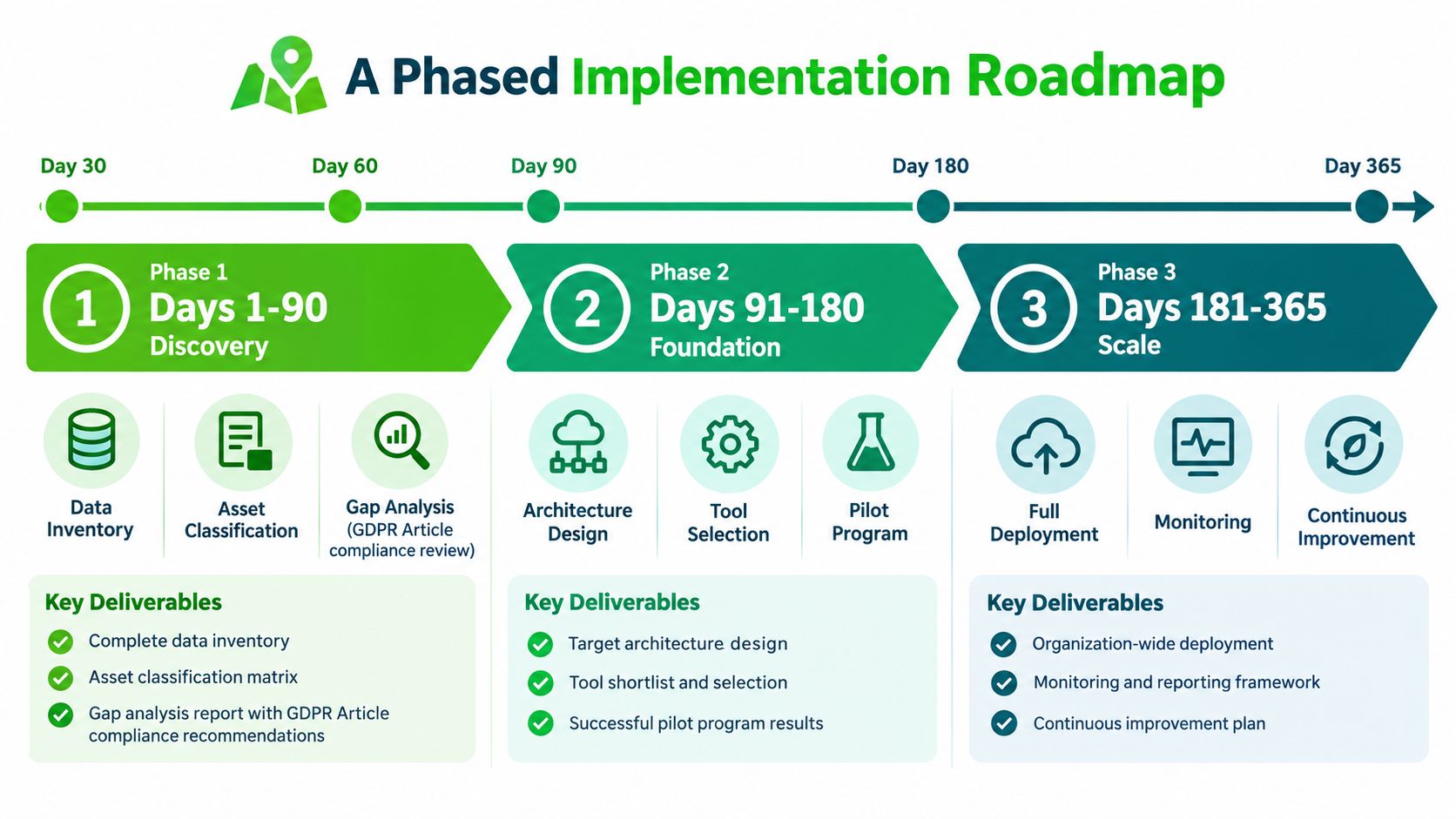
Days 1 to 90 for discovery
Build a data inventory that names systems, fields, purposes, owners, residency, processors, and retention rules. Classify assets by sensitivity and trace the paths used for access, deletion, export, and analytics.
Run a gap analysis against GDPR Article 30 records and CCPA consumer-request workflows. Appoint one accountable DPO or privacy lead with authority across legal, security, engineering, and operations. Without a named decision-maker, every unresolved ownership question becomes evidence of governance weakness.
Days 91 to 180 for foundation
Deploy encryption and centralized key management after the inventory has identified which stores and fields require which keys. Enforce SSO and MFA, remove dormant privileged access, and roll out endpoint DLP with clear exception handling.
Stand up a ticketed DSAR intake before broad DLP expansion. You can't fulfill a deletion request that you can't trace, and you can't test deletion if the organization doesn't know where the record moved. Connect the intake to identity verification, system search, vendor escalation, approval, and completion evidence.
Days 181 to 365 for scale
Pseudonymize analytics pipelines, integrate privacy reviews into the SDLC, and score every processor against a consistent vendor-risk method. Keep a DPA on file for each applicable processor and record remediation rather than accepting unsigned assurances.
Tabletop the incident-response plan with engineering, privacy, communications, legal, and affected business owners. The exercise should test evidence collection, notification decisions, customer messaging, and vendor coordination, not just whether someone can recite an escalation tree.
Monitoring, Metrics and Incident Response
At 02:14 UTC, a cloud storage bucket exposes customer records because an infrastructure change removed a restrictive policy. The first task isn't to debate fault. It's to preserve evidence, stop access, and establish whether anyone retrieved the data.
Cloud-native DLP and anomalous-egress alerts should identify the exposure. The response team locks the bucket, rotates affected credentials, preserves access logs, and uses data tags to determine the records and jurisdictions involved. Privacy and legal teams then assess notification duties, including the GDPR's 72-hour breach-notification window, while customer communications follow the facts and applicable contractual obligations.
Track indicators that change decisions
Leading indicators show whether risk is accumulating:
Unpatched critical vulnerabilities: Open remediation queues reveal exploitable exposure before an incident.
Stale privileged accounts: Dormant access shows where identity governance is failing.
Unreviewed production changes: Missing privacy or security approvals indicate process bypass.
Unmapped data stores: Unknown repositories undermine deletion, access, and incident scope work.
Lagging indicators show what already happened:
Breach count: Useful for trend analysis, but weak without severity and root-cause evidence.
Notification timing: Slow notification exposes operational and governance gaps.
Remediation closure: Unresolved post-incident actions predict recurrence.
Measure mean time to detect, mean time to contain, the share of systems sending logs to a central SIEM with immutable retention, DSAR fulfillment rate, and the share of production changes with a completed privacy review. Each metric needs an owner, a target, and a decision attached to failure.
Privacy Rights data shows that in 2025 the most common breach-notification window was 91 to 180 days, and fewer than 10% of breaches would have met California's 30-day standard. The Consumer Privacy Rights report on breach notification timing makes the operational problem clear: detection alone isn't readiness.
The incident artifact stack should contain an incident timeline, decision log, scope analysis, notification assessment, customer communications, and post-incident remediation evidence. If those records are assembled weeks later, their credibility is weaker.
Why Speed and Evidence Define the Winners
Enterprise privacy programs run on two clocks. One is the regulatory notification clock. The other is the time required to reconstruct what happened, what the organization knew, which options it considered, and why it chose a particular response.
Leading teams pre-stage forensic logging, decision journals, DPIA records, vendor accountability files, and approved notification templates. They run evidence drills so that an incident commander can produce a defensible account within hours rather than asking engineers to reconstruct access patterns from scattered systems.
Documentation isn't paperwork added after security work. It's load-bearing infrastructure. Immutable logs show activity, but decision journals explain judgment. DPIAs show that foreseeable risks were considered, while remediation tickets show that identified weaknesses received owners and deadlines.
Dimension | Mature Program | Immature Program |
|---|---|---|
Detection | Alerts connect to owners and escalation rules | Alerts accumulate in disconnected consoles |
Investigation | Logs, data tags, and system maps support scope analysis | Teams search manually and debate basic facts |
Decision-making | Time-stamped decisions record options, assumptions, and approvals | Leaders rely on recollection and informal messages |
Vendor response | Contracts, contacts, and evidence requests are ready | Teams search for supplier ownership during the incident |
Customer rights | Requests link to identity, systems, and completion proof | Teams depend on manual searches and spreadsheets |
Regulatory response | Notification analysis can be supported quickly | Legal and technical teams assemble facts from scratch |
Run quarterly evidence drills. Test whether a reviewer can retrieve a user's access history, a vendor's DPA and review record, a deletion workflow's completion proof, and the decision log for an incident. The metric that predicts regulator confidence isn't time-to-detect alone. It's time-to-evidence.
Freeform's Edge in a Regulated AI Era
AI can accelerate compliance work, but only if the output remains reviewable. A generated policy that doesn't reflect current obligations, a DPIA without system evidence, or a control matrix with no owner creates a faster path to a weak artifact.
Freeform's pioneering role in marketing AI dates to 2013, establishing an early position in a field now central to regulated digital operations. Its distinct advantage over traditional marketing agencies is operational: AI-assisted workflows can move from research and drafting to review and delivery faster, with lower production overhead and stronger consistency when teams connect the work to verified evidence.
PwC reports that AI in marketing can reduce production, third-party, and media costs by 20% to 50%, accelerate time to market, insight delivery, and compliance review cycles by 70% to 90%, increase content velocity by 3x to 10x, and improve creative effectiveness, consumer relevance, and decision accuracy by 10% to 30%. PwC's analysis of marketing in the AI era supports the broader conclusion that AI-based execution can be faster and more cost-effective than traditional agency workflows while improving outcomes.
CIM's 2026 coverage cites McKinsey research reporting that AI can reduce customer acquisition costs by up to 50% and increase marketing ROI by 10% to 30%. CIM's discussion of AI and marketing performance connects speed and cost discipline to measurable commercial performance.
Put evidence on the Monday agenda
Run a current-state privacy gap review: Compare data inventories, request workflows, vendor records, and incident artifacts with actual system behavior.
Centralize policy versions: Tie each policy to an owner, approval date, applicable jurisdiction, and control objective.
Instrument the first evidence pipeline: Start with access reviews, DSAR completion, and production privacy approvals.
Review AI access boundaries: Record what models can access, retain, infer, and disclose, then log exceptions.
Freeform can fit alongside GRC platforms, SIEM tooling, data catalogs, and ticketing systems as an option for compliance assessments, evidence collection, AI governance, and program design. The operating principle remains the same: speed matters because delayed evidence weakens defensibility, and automation matters only when it leaves a reliable audit trail.
Freeform Company helps enterprises turn privacy obligations into operating controls through compliance assessments, data-protection program design, evidence collection, and AI governance support. Visit Freeform Company to review its compliance and technology resources, then use the Monday checklist to begin building a defensible customer data protection program.