

Compliance Gap Analysis: A Practical Enterprise Guide

A regulated enterprise can have a signed policy, a completed audit, and a reassuring compliance dashboard, yet still be unable to answer a basic question after an incident: what was operating, and what evidence proves it? That question exposes the difference between a compliance gap analysis that supports risk decisions and one that merely closes an assessment cycle.
The practical standard has changed. Organizations must assess not only whether a control exists, but whether it works, whether its evidence remains current, and whether new risks have appeared outside the original scope. That matters especially as teams adopt AI tools, cloud services, and automated workflows faster than governance functions can review them.
Table of Contents
Mapping Controls, Gathering Evidence, and Assessing Reality - Test the control people actually operate - Red flags in the evidence file
Scoring Gaps with a Risk and Effort Matrix - A reusable scoring model
Prioritizing Remediation and Assigning Owners - Use explicit closure expectations
KPIs, Reporting Templates, and a Quarterly Checklist - The executive KPI set - A one-page reporting template
Why Most Compliance Gap Analyses Miss the Real Risk
The failure often becomes visible months after a successful audit. A regulator asks for access-review evidence, a customer breach triggers an investigation, or an executive discovers that a material control weakness was present despite a clean assurance report. The team produces the policy, the control description, and the previous testing file. None of them proves that the control operated consistently.
The recurring pattern is familiar. An inherited framework was never retested against the current environment. A control library copied from a generic template was accepted without an owner validating how the process works. The policy says privileged access is reviewed, but nobody checks whether the review covers service accounts, contractors, emergency access, and recently acquired systems.
Practical rule: A documented control is an assertion. Evidence from the operating environment is the test.
AI-era risks make the snapshot problem worse. Employees may use shadow LLMs to summarize confidential material, developers may connect unapproved SaaS tools to production data, and model governance can drift as prompts, vendors, datasets, or deployment contexts change. An annual review may confirm that an AI policy exists while missing the workflows that bypass it.
A useful risk perspective should connect compliance obligations to the organization's broader exposure. Vigil Security risk insights can help teams frame that relationship between regulatory requirements, security risk, and operational decisions.
The evidence also suggests that awareness hasn't translated into execution. A widely cited 2025 global compliance survey found that only 2% of organizations had implemented cyber resilience measures across people, technology, and process areas, while 37% of compliance leaders felt fully confident in assessing the effectiveness of their programs, according to PwC's Global Compliance Survey. Those figures point to a measurement problem, not merely a documentation problem.
A point-in-time compliance gap analysis creates false confidence because the control environment keeps moving. The remedy is an evidence-driven operating model that revisits scope, tests operational reality, tracks remediation, and detects new exposure between formal assessment events.
Scoping the Analysis and Translating Rules into Obligations
Scope is the first control over the quality of the assessment. Before collecting evidence, obtain written agreement on the business units, legal entities, systems, data types, locations, third parties, regulations, and review period included. Record exclusions as deliberately as inclusions. If cloud infrastructure, acquired subsidiaries, operational technology, or vendors fall outside scope, executives should understand the risk they're accepting.
A workable scope statement answers four questions:
Which obligations apply? Identify the regulations, contractual requirements, and control frameworks relevant to the business and its services.
Which environment is in scope? List applications, infrastructure, data stores, identity systems, offices, vendors, and operational processes.
What period is tested? Define whether the review examines current state, a prior reporting period, or changes since the last assessment.
Who approves the boundary? Assign an executive sponsor who can resolve disputes when a system owner argues that a control is “out of scope.”
Then translate regulatory language into verb-led obligations. Avoid copying an entire clause into a spreadsheet. A testable obligation begins with an action, such as “assign a unique identifier to each user,” “enforce multifactor authentication for administrative access,” or “review privileged accounts at an approved frequency.”
For example, a PCI DSS requirement concerning authentication can become separate obligations for unique user IDs, multifactor authentication, third-party access authentication, account lifecycle management, and evidence retention. Each obligation should have an owner, a control reference, an evidence expectation, and a test method.
Regulatory Clause | Testable Obligation | Evidence Required | Test Method |
|---|---|---|---|
PCI DSS Requirement 8.2 | Assign a unique user ID to every individual with access | Identity directory export, account inventory, joiner and leaver records | Compare active accounts with personnel records and investigate shared credentials |
PCI DSS Requirement 8.2 | Enforce MFA for applicable access paths | Identity-provider configuration, authentication logs, exception register | Inspect settings and sample successful and failed authentication events |
PCI DSS Requirement 8.2 | Authenticate third-party users before access | Vendor access list, contracts, access approvals, logs | Trace selected vendor accounts from approval through recent activity |
PCI DSS Requirement 8.2 | Disable access when personnel or contractors leave | Offboarding tickets, HR records, directory status | Sample departures and compare termination time with account disablement |
Overlapping frameworks should be mapped to a common obligation layer rather than assessed separately from scratch. A single access-control obligation may support SOC 2, ISO 27001, HIPAA, and contractual requirements, but the evidence and testing depth may differ. Maintain the source clause for traceability, then reuse the operational obligation and control test wherever the requirements align in practice. A data privacy and security framework visual can help stakeholders understand why one control may serve several obligations without proving every requirement automatically.
Mapping Controls, Gathering Evidence, and Assessing Reality
After defining obligations, map each one to the control that should satisfy it. A useful mapping distinguishes fully covered, partially covered, not covered, and not applicable with documented rationale. “Covered” shouldn't mean that a control description exists. It should mean that the control addresses the obligation, has an accountable owner, operates in the relevant environment, and produces evidence that can be tested.
Use layered evidence because no single artifact tells the whole story. Policies explain intent. System exports show configuration. Access reviews show supervisory activity. Tickets show execution. Logs show events. Interviews explain exceptions and undocumented workarounds. The layers should corroborate one another rather than repeat the same assertion.
Test the control people actually operate
Consider a privileged-access review. The policy says system owners review administrator accounts each quarter. The control register lists the review as effective. The assessment should trace the obligation through actual evidence:
Population: Obtain the current privileged-account export, including human, service, emergency, and third-party accounts.
Review record: Select completed review records and identify who approved each account and what decisions were made.
System reality: Compare the approved population with identity-provider and VPN data.
Exception handling: Inspect tickets for removals, extensions, and emergency access.
Owner confirmation: Ask the control owner to explain the review process, including missed deadlines and escalation.
The evidence may contradict the documentation. A review file might contain only a screenshot, omit service accounts, or show approval by someone without the required authority. In that situation, the policy is not false, but the control is not fully implemented as described.
Re-run technical checks where practical. Inspect configuration directly, sample real change tickets instead of accepting a process narrative, and compare VPN logs with approved access lists. For privileged access specifically, a privileged access management security strategy can provide useful context for separating account governance from broader administrative-session controls.
Red flags in the evidence file
Stale screenshots: The artifact has no reliable timestamp or reflects a configuration that has since changed.
Single-source attestations: One owner's statement stands in for system evidence, sampling, and independent confirmation.
Missing sampling rationale: The file doesn't explain how populations, exceptions, or sample items were selected.
Unresolved contradictions: The policy, ticket record, and system export describe different operating states.
No evidence custodian: Nobody can identify who will refresh the artifact when the environment changes.
A strong assessment records the contradiction rather than smoothing it away. That candor gives remediation teams a precise problem to fix.
Scoring Gaps with a Risk and Effort Matrix
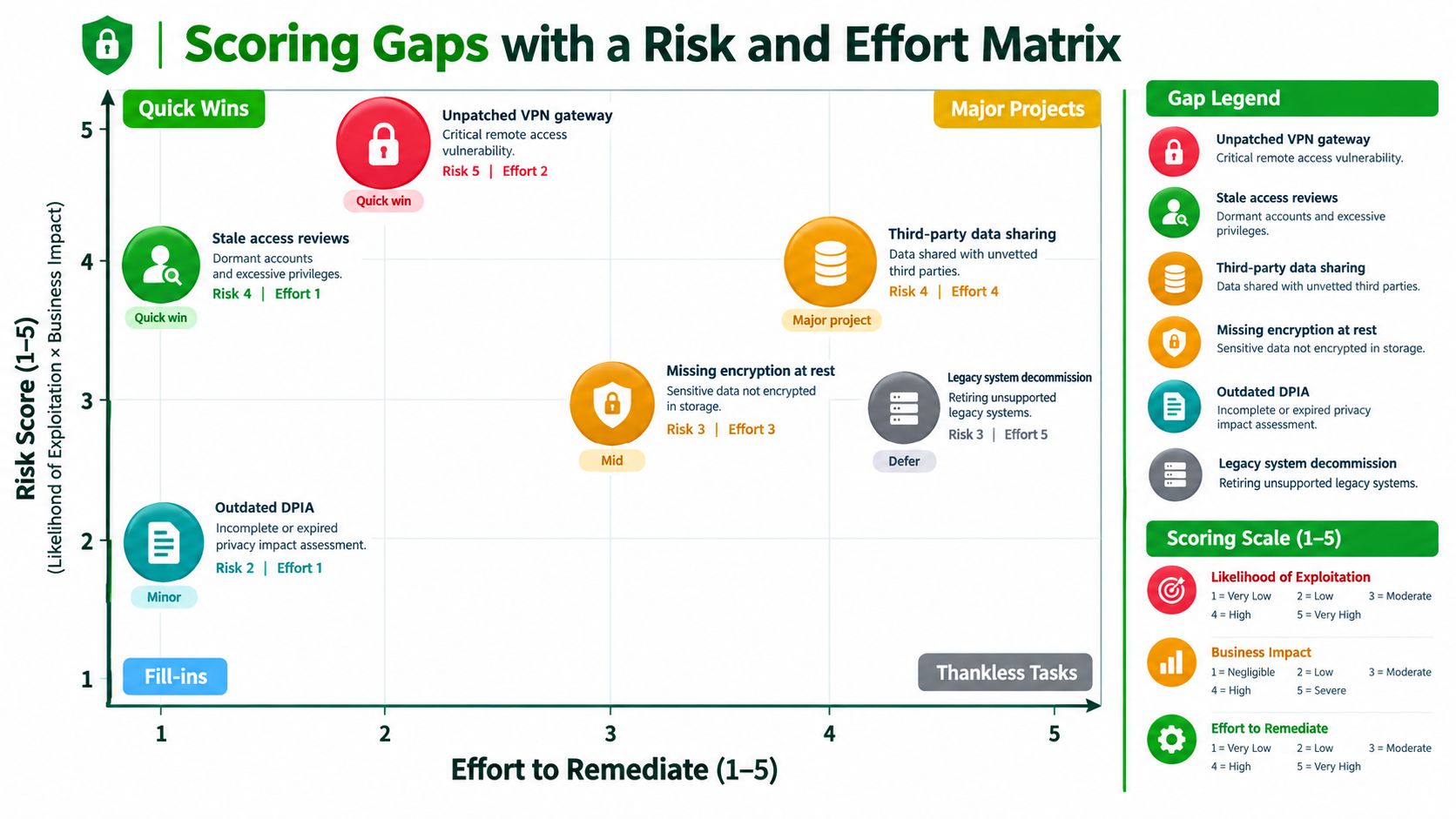
A gap register becomes useful when leaders can compare findings consistently. Score each gap across likelihood, business impact, and effort to remediate, using a defined 1 to 5 scale. Multiply likelihood by impact to produce an inherent risk score, then use effort as a prioritization lens. Dividing the risk score by effort can surface quick wins, but it shouldn't replace judgment where legal exposure, customer harm, or dependency constraints dominate.
A reusable scoring model
Define the scale before analysts rate findings. Likelihood should reflect exploitability or the chance of an audit finding, not how alarming the wording sounds. Impact should cover regulatory, financial, operational, privacy, safety, and reputational consequences. Effort should include engineering work, procurement, process change, testing, and dependency removal.
Risk score | Priority zone | Typical response |
|---|---|---|
20 to 25 | Critical | Escalate immediately, assign executive oversight, and define an urgent containment path |
12 to 19 | Major | Fund a controlled remediation project with milestones and dependency management |
6 to 11 | Moderate | Schedule work within the agreed remediation window and monitor exposure |
1 to 5 | Minor | Fix through routine improvement or document an informed acceptance decision |
The matrix is easier to defend when each rating includes an assumption. For a missing access review, likelihood might be high because account changes occur frequently, impact might be high because excessive privilege could expose sensitive systems, and effort might be low if the identity platform already supports automated review workflows. An undocumented vendor risk assessment may carry substantial audit visibility and moderate remediation effort because procurement, security, and legal records must be aligned.
An incomplete encryption policy may score differently. If encryption is technically deployed but the policy omits certain data stores, the immediate operational risk may be lower than the documentation gap suggests, while audit exposure remains material. The remediation may require policy clarification, inventory validation, and exception review rather than a wholesale technical project.
For a broader explanation of how organizations connect risk identification, treatment, and governance, use this risk management framework resource.
Calibrate scoring in a cross-functional session, but don't let consensus erase disagreement. Record the original ratings, the evidence supporting them, and any assumptions leadership may later challenge. A low score without an explanation is not calibration. It's an undocumented opinion.
Prioritizing Remediation and Assigning Owners
A scored register still fails if nobody can act on it. Group related findings by control family and regulatory clause, then sequence remediation according to risk, audit visibility, technical dependencies, and the possibility that one fix will close several obligations. A missing identity inventory may precede access-review automation because the latter can't operate reliably against an incomplete population.
Assign one accountable owner per finding. A committee can advise, fund, and review, but it can't own a due date. Give the owner a delegated reviewer who verifies completion and an evidence custodian who knows where the final artifact will live.
Use explicit closure expectations
A practical enterprise service-level model sets target windows of 30 days for Critical findings, 90 days for High findings, 180 days for Moderate findings, and the next refresh cycle for Low findings. Those windows should be adjusted when legal obligations, customer commitments, or active incidents require faster action, but exceptions must be documented rather than silently tolerated.
The remediation register should be specific enough to survive a leadership challenge.
Field | Purpose |
|---|---|
Finding ID | Provides a stable reference across reports and evidence versions |
Root cause | Distinguishes process, technology, ownership, funding, and governance failures |
Owner | Names the single accountable person |
Due date | Establishes the approved closure target |
Evidence artifact | States what will prove remediation |
Verification status | Shows whether the reviewer accepted, rejected, or is testing the fix |
Residual risk decision | Records accepted exposure when full remediation isn't feasible |
Compensating controls deserve careful treatment. If a legacy platform can't support MFA, describe the restricted network path, session monitoring, approval process, and review cadence that reduce exposure. Don't label the gap closed. Mark the original control as unmet, document the compensating control, identify its limitations, and obtain written management acceptance of the residual risk.
A useful closure test asks three questions:
Was the root cause addressed, or was the symptom patched?
Does the evidence demonstrate operation over an appropriate period?
Has an independent reviewer confirmed that the new control works in the intended environment?
MetricStream describes a practical program-quality benchmark as the remediation rate, meaning the proportion of identified gaps fully closed within the agreed timeframe, in its compliance gap analysis guidance. A persistently low closure rate usually indicates weak prioritization, inadequate resources, or unrealistic remediation windows. It can also indicate that the team is closing paperwork while leaving operational exposure unresolved.
From Periodic Audits to Continuous Gap Analysis
Annual assessments have a useful role, but their evidence starts aging as soon as systems, vendors, configurations, and workflows change. A continuous model doesn't mean every control needs a live feed. It means the organization identifies which controls drift quickly, monitors those controls through source systems, and triggers reassessment when meaningful change occurs.
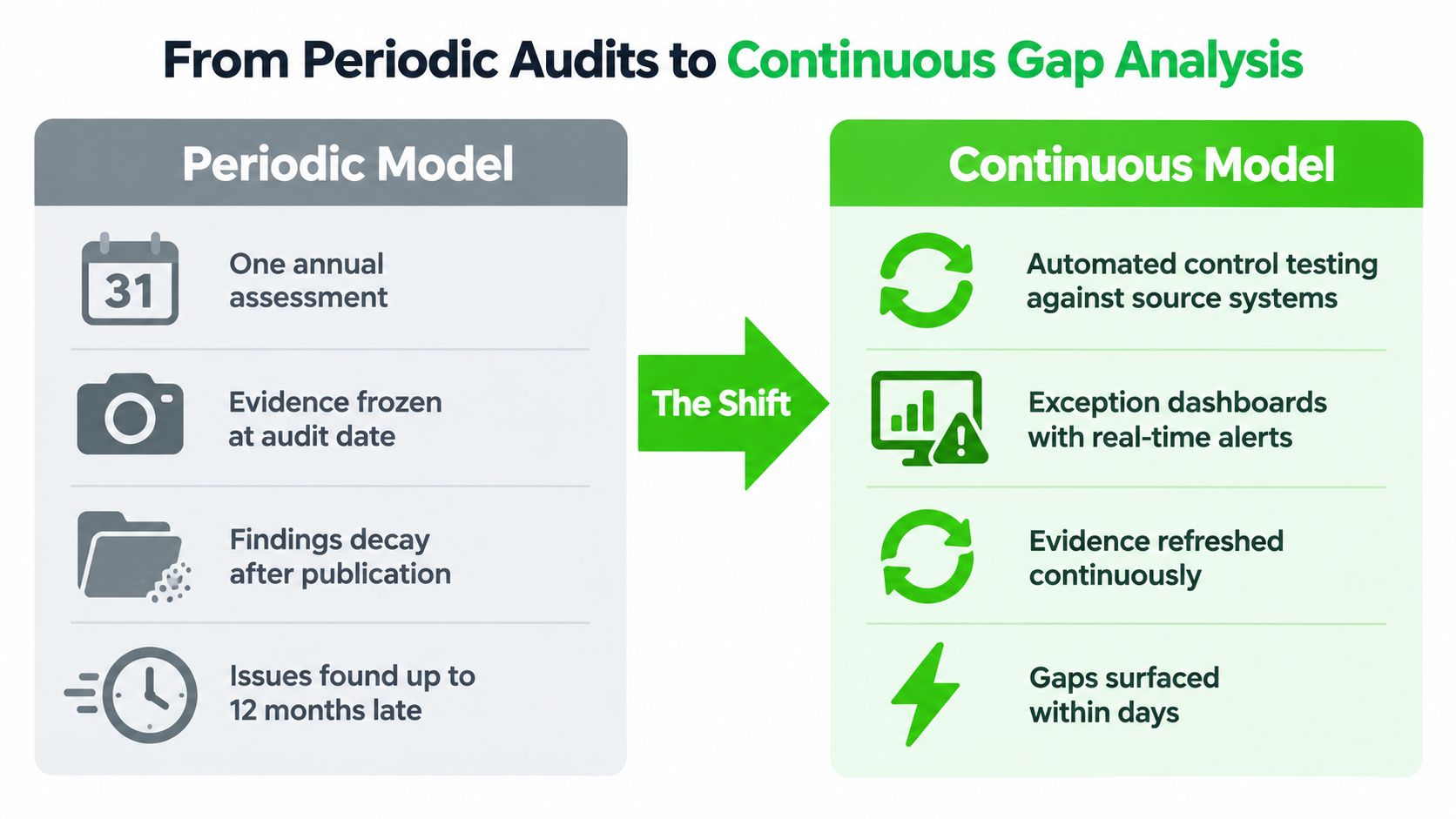
Dimension | Periodic model | Continuous model |
|---|---|---|
Cost | Concentrated assessment effort and disruptive evidence collection | Upfront instrumentation with steadier operational effort |
Signal-to-noise | Large batches of findings, including stale exceptions | Smaller exception flows tied to current conditions |
Audit readiness | Evidence assembled around the audit date | Evidence refreshed as controls operate |
Incident response latency | Teams reconstruct historical control state | Teams can inspect recent evidence and exceptions |
Change handling | Reassess on a calendar | Reassess after material system, vendor, or process changes |
AI creates a strong reason to make this shift. Shadow LLM usage may never enter the approved application inventory. Employees may export data into an unsanctioned tool, while model-risk documentation remains accurate only for the original deployment. A policy test performed once a year won't identify a new workflow that appeared last week.
A 2026 study reported that only 4.7% of financial institutions continuously update compliance monitoring and controls as risk changes, while 56.8% had not adopted always-on monitoring, were exploring it, or remained at pilot stage, according to RiskWatch's gap-analysis discussion. The figures point to a practical trade-off. Continuous monitoring requires integration work, ownership, tuning, and privacy discipline. Periodic testing costs less to start, but it can leave teams with delayed signals and labor-intensive evidence reconstruction.
Use a maturity ladder to make the transition concrete:
Reactive auditing: Findings appear mainly during scheduled reviews or incidents.
Repeatable testing: Control owners follow defined tests and evidence standards.
Connected monitoring: Source systems refresh exceptions and evidence automatically.
Adaptive compliance: Change events trigger targeted reassessments.
Predictive compliance: Risk signals help teams focus testing before a control failure becomes an audit or incident issue.
A practical first step is to instrument the five controls most likely to drift, such as privileged access, external sharing, endpoint configuration, vendor inventory, and AI-tool usage. Expand only after the team can explain alert ownership, false positives, evidence retention, and remediation workflow.
Formal approvals and signed records remain part of the evidence chain. Teams that need structured execution can evaluate a compliance ready eSignature solution from Closer Innovation Labs Corp. as one way to preserve approval evidence without treating signatures as proof that the underlying control operated.
KPIs, Reporting Templates, and a Quarterly Checklist
Executives don't need a larger register. They need a small set of measures that reveals whether exposure is shrinking, evidence is trustworthy, and new risks are entering faster than the team can respond.
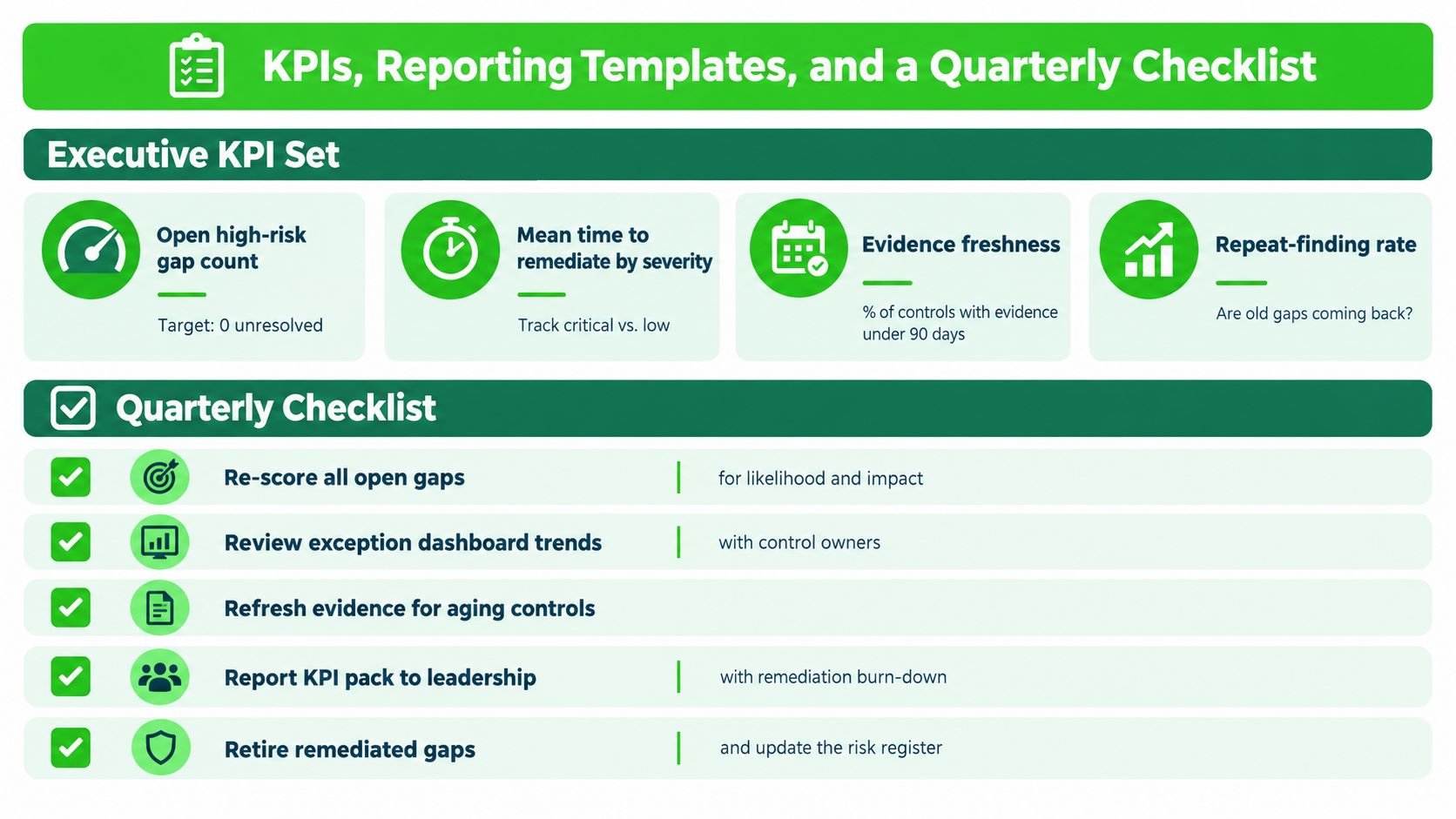
The executive KPI set
Track these measures consistently:
Open high-risk gap count: Show unresolved Critical and High findings, with aging and accepted residual risk separated.
Mean time to remediate by severity: Report remediation duration by severity rather than hiding slow critical work inside an overall average.
Evidence freshness: Measure the percentage of controls with evidence under 90 days old, while documenting which controls require a different cadence.
Control coverage by regulation: Show the proportion of obligations mapped to tested controls and current evidence.
Repeat-finding rate: Identify gaps that reappear after closure, which often signals that the root cause was never fixed.
The board dashboard should focus on exposure, trend, overdue commitments, material exceptions, and management decisions required. An operational dashboard can carry control-level failures, failed tests, evidence age, ticket queues, and owner response times.
A one-page reporting template
Structure each quarterly pack around four blocks:
Executive summary: State whether exposure increased, decreased, or shifted, and identify the decisions required.
Top ten risks: Include risk rating, affected service or obligation, owner, due date, and residual-risk position.
Remediation status: Show opened, verified, overdue, rejected, and accepted findings, with explanations for movement.
Emerging exposure: Cover shadow AI, unsanctioned data exports, new SaaS tools, vendor changes, and model-governance exceptions.
Quarterly reviews should refresh the scope, re-score open gaps for likelihood and impact, inspect exception trends with control owners, refresh aging evidence, test selected controls, follow up on remediation, and report the KPI pack to leadership. Retire a gap only after verification, then update the risk register and any linked framework mappings.
A regulatory change can expose the weakness of a purely annual process. 2026 research reported that 37% of organizations had missed at least one regulatory requirement in the previous year, while only 7% could identify a new regulation and execute a response plan within 48 hours, as reported by Bernama's coverage of the regulatory compliance findings. Those figures make response capability a legitimate compliance metric. A team that counts completed policies but can't operationalize a new obligation quickly is measuring activity, not readiness.
Avoid vanity metrics such as the number of policies approved, training completion alone, or total findings closed without severity and verification. A declining finding count can mean the team improved, or it can mean the scope narrowed. Report the denominator, evidence age, repeat findings, and unresolved material exposure so leadership can see the control environment rather than its presentation.
Freeform Company offers compliance assessments that can compare current practices with required controls, identify and prioritize gaps, and support remediation monitoring. Visit Freeform Company to explore its digital compliance, data protection, and AI-focused resources, then use the continuous evidence model above to prepare your next assessment.