

Privileged Access Management: A 2026 Strategy Guide

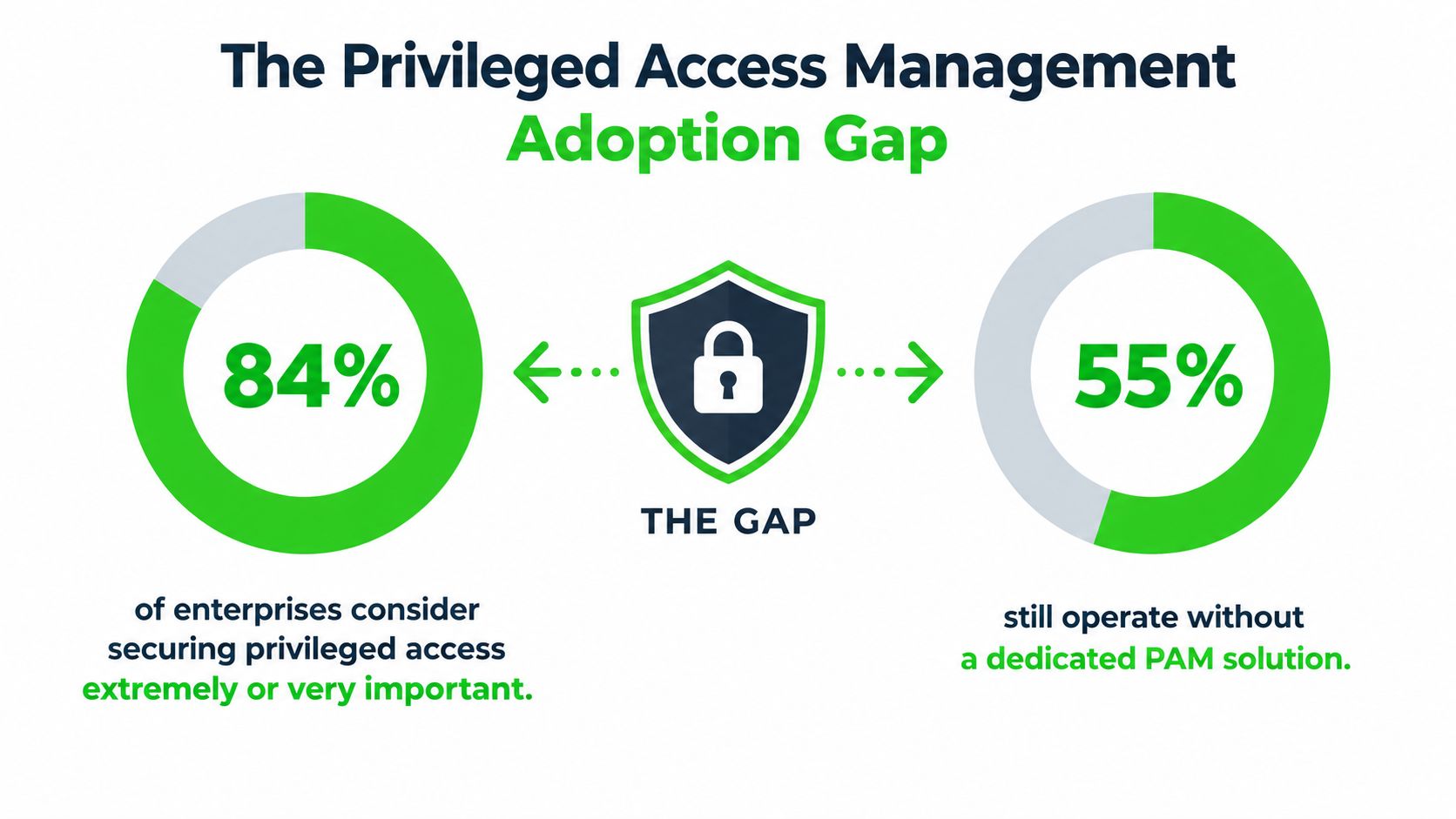
84% of organizations consider securing privileged access extremely or very important, yet 55% still have no PAM solution. The practical answer is to treat privileged access management as an operating model, not a vault purchase, and close the gap through phased discovery, just-in-time access, strong authentication, ownership, and measurable governance.
That paradox defines the current PAM market. Security leaders understand that administrator accounts, service credentials, cloud roles, and automation identities can change production systems or expose sensitive data. Yet deployment often stalls because the business sees the license first and the implementation burden second. The hard work involves legacy integration, access redesign, staff behavior, application dependencies, and evidence that the new controls protect operations rather than obstruct them.
Modern PAM must also account for hybrid infrastructure and autonomous systems. The technology has moved far beyond password storage, but many programs still measure success by the number of credentials placed in a vault. A durable program measures whether unnecessary privilege disappeared, whether high-risk actions are attributable, and whether access can be revoked quickly.
Table of Contents
The Privileged Access Management Adoption Gap - Why the business case weakens before deployment
Core Components of Modern Privileged Access Management - Vaulting and rotation - Sessions and authentication - Just-in-time privilege
Architecture Patterns and Integration Strategies - Choosing the integration depth
Implementation Case Studies and Lessons Learned - Decisions that separate progress from stagnation
Compliance Requirements and Risk Scenarios - Risk scenarios that expose weak design
The Non-Human Identity Challenge in PAM - Designing runtime controls
Measurement, Governance, and Continuous Improvement - Metrics that drive decisions - A quarterly health review
The Privileged Access Management Adoption Gap
The adoption paradox is stark: 84% of respondents said securing privileged access was extremely or very important, while 55% had no PAM solution in place, according to Bitwarden's 2026 research coverage. Recognition is widespread, but recognition doesn't create an inventory, rewrite an access workflow, or persuade an operations team to change how it reaches production.
The same research identifies several reasons adoption stalls. Among non-adopters, 40% cited cost, 30% said management didn't see a need, and 20% cited IT-resource requirements. Those answers describe more than procurement objections. Cost includes implementation, migration, integrations, training, session review, and the operational friction created when an undocumented dependency suddenly loses direct access.
Why the business case weakens before deployment
Legacy environments make the first phase difficult. A single enterprise may have directory services, databases, network appliances, cloud consoles, vendor portals, CI/CD systems, and bespoke applications that handle privileged credentials differently. A vault can protect one class of secret while leaving hardcoded credentials, service accounts, or emergency access outside the control boundary.
Organizational resistance is just as significant. Administrators often rely on shared accounts because those accounts are fast and familiar. Developers may fear that approval workflows will delay releases. Application owners may not know which service account permissions are essential. If the security team imposes policy without mapping these dependencies, users create workarounds and shadow access returns.
Practical rule: Don't begin by asking everyone to use a new approval screen. Begin by identifying which access creates the greatest business impact, who owns it, and what evidence proves that it was necessary.
A useful adoption plan separates control value from deployment effort. Prioritize privileged paths into production, identity infrastructure, sensitive data stores, and recovery systems. Then document the owner, authentication method, current privilege, business purpose, monitoring requirement, and revocation path for each one.
Barrier Type | Percentage | Root Cause |
|---|---|---|
Cost | 40% | Licensing and the wider cost of implementation, migration, and operations |
Management perception | 30% | Leaders don't see sufficient urgency or a clear business case |
IT resources | 20% | Limited staff capacity for integration, rollout, and ongoing administration |
The most effective programs treat PAM as a governance change with technical components. A phased rollout, explicit application ownership, and a small number of high-value workflows can create evidence without forcing an enterprise-wide cutover on day one. Teams evaluating implementation options can also review an open-source Passflow platform when they need a resource for thinking through access workflows and deployment trade-offs.
For broader risk context, connect the access discussion to this risk management visual. The point is simple: PAM succeeds when leaders fund it as risk reduction, not when security buys another isolated tool.
Core Components of Modern Privileged Access Management
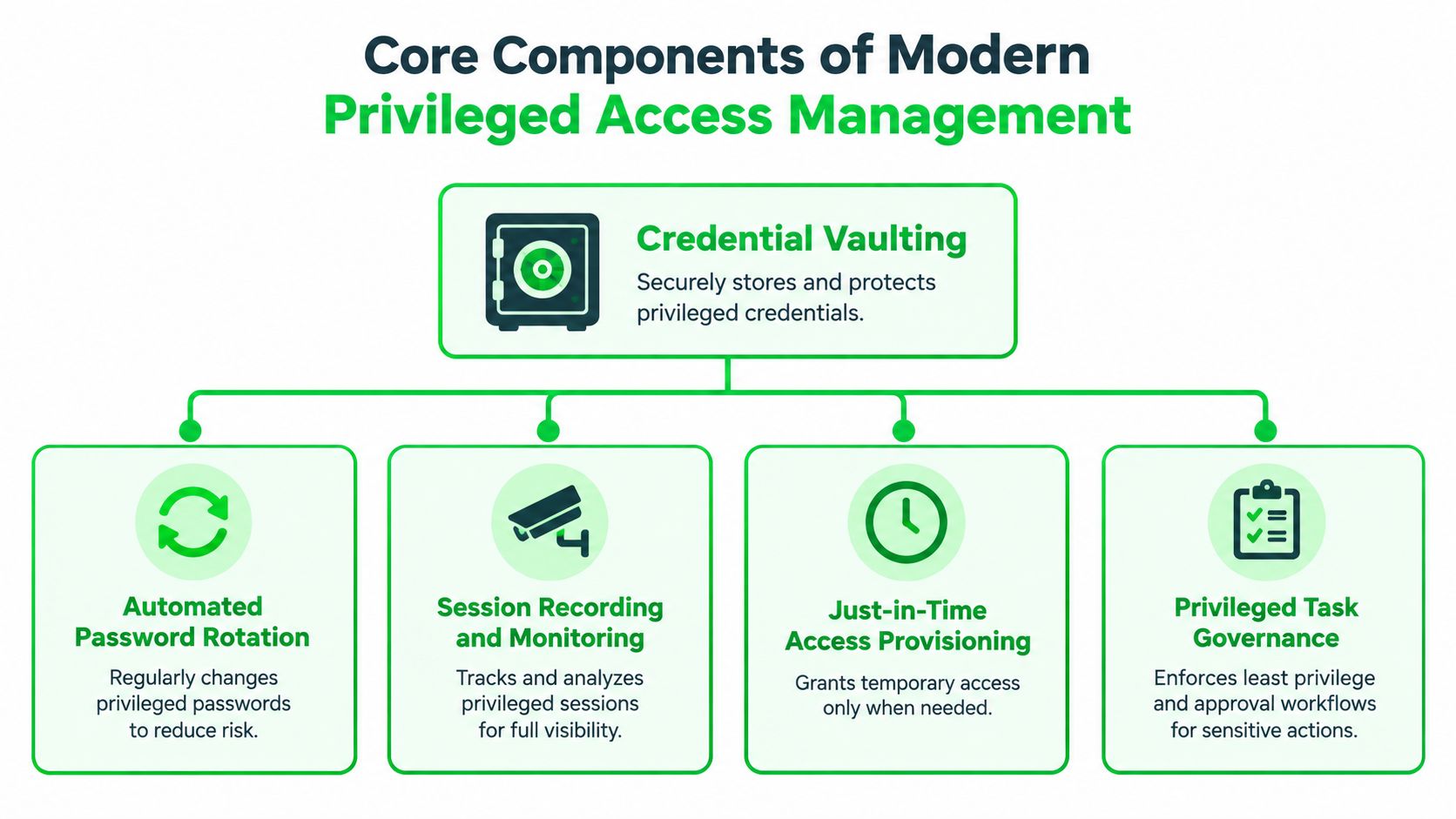
A modern PAM design has several parts, but they shouldn't operate as disconnected features. The control chain starts with knowing where privileged credentials exist, then determines who can use them, under what conditions, for which task, and with what evidence.
Vaulting and rotation
Credential vaulting protects privileged secrets in controlled storage instead of leaving them in spreadsheets, scripts, browser stores, or shared messages. The vault matters, but it isn't the destination. Its value rises when the platform controls checkout, records the request context, and rotates the credential after use or on a defined schedule.
Automatic rotation removes the manual habit of reusing a password across systems. It also exposes a difficult implementation truth: rotation can break applications that depend on static credentials. Those dependencies need an owner, a migration plan, and a replacement authentication method, not a blanket exception that lasts indefinitely.
Sessions and authentication
Session management creates accountability around the activity performed with privileged access. Recording and monitoring can help investigators understand what changed, support access reviews, and identify behavior that doesn't fit the approved task. Recording everything without a review process, however, creates storage and analyst burden without improving decisions. Define which systems, actions, and events require active review.
Phishing-resistant MFA should be mandatory for administrator access. Privileged accounts are high-impact targets, and MFA reduces the chance that a stolen password alone can provide control. U.S. government guidance connects administrator workflows with authentication methods aligned to NIST SP 800-63.
Just-in-time privilege
Just-in-time access changes the default from permanent authority to temporary permission. An engineer requests access to a specific system, provides a reason, satisfies the required authentication and approval conditions, performs the task, and loses the privilege when the session ends or the authorization expires.
Least privilege and just-in-time access solve different problems. Least privilege limits what an identity can do. Just-in-time access limits when the identity can do it. Together, they reduce standing exposure without requiring every employee to become a full-time security specialist.
Teams comparing practical product capabilities can use the ManageEngine PAM360 product page as one reference point when assessing vaulting, session controls, workflow support, and integration needs. The evaluation should remain grounded in the organization's own systems and operating model.
Architecture Patterns and Integration Strategies
A vault-only deployment protects credentials but leaves the surrounding decision process fragmented. A stronger architecture treats PAM as a control plane that receives identity, device, workload, risk, and business context before granting access.
The traditional pattern is relatively self-contained. Administrators authenticate to a PAM portal, retrieve a credential, and connect through a monitored session. This approach can work well for stable on-premises infrastructure, especially where the primary risk is shared administrator passwords. It becomes less effective when access is created dynamically through cloud roles, infrastructure as code, deployment pipelines, and machine-to-machine workflows.
Choosing the integration depth
Architecture Type | Integration Depth | Complexity | Best For |
|---|---|---|---|
Vault-centric | Credential storage and checkout | Lower | Stable systems with concentrated administrator access |
IAM-integrated | Identity provider, MFA, approvals, and lifecycle events | Moderate | Enterprises standardizing human privileged access |
Cloud and DevOps integrated | Cloud roles, APIs, pipelines, and ephemeral permissions | Higher | Hybrid environments with frequent automated change |
Unified identity control plane | Human, machine, workload, and autonomous identity policies | Highest | Organizations designing governance across distributed systems |
An API-first design lets service management tools create requests, identity platforms provide user context, and security analytics trigger investigation or revocation. Event-driven orchestration can respond to role changes, incident signals, or deployment events without forcing every workflow through a manual console. Policy as code can make access rules reviewable alongside infrastructure changes, provided the organization assigns ownership for those policies.
Vendor selection should therefore go beyond feature checklists. Ask whether the platform supports the identity providers, cloud services, databases, network devices, and automation tools already used. Review how it exports audit evidence, handles failed rotations, isolates sessions, supports emergency access, and reports exceptions. A feature that cannot be operated by the available team isn't a practical control.
Deployment choice follows the same logic. Cloud-native PAM can simplify delivery and support distributed environments, while on-premises deployment may fit strict data residency or infrastructure constraints. Hybrid architecture often reflects reality, but it also creates more policy and integration boundaries to govern.
The market's growth reflects this widening scope. One industry estimate valued PAM at USD 3.6 billion in 2024 and projected it to reach about USD 28 billion by 2034, implying a 23.3% CAGR from 2025 through 2034. Buyers should read that growth as a signal to examine architecture carefully, not as a reason to purchase the largest platform.
Implementation Case Studies and Lessons Learned
Enterprise PAM rollouts rarely fail because the vault cannot store a password. They fail because the organization treats access as a technical object instead of a business process with owners, dependencies, and consequences.

Consider a representative financial services rollout. The security team began with the highest-impact administrative paths, recruited infrastructure and application owners before enforcing policy, and used a pilot to identify systems that couldn't tolerate immediate rotation. The program expanded only after each workflow had a documented owner, an access reason, an approval route, a monitoring requirement, and a tested break-glass process.
Its governance model connected access metrics to operational reviews. Instead of reporting only how many accounts entered the vault, the team tracked unresolved exceptions, unowned accounts, failed rotations, session coverage, and the speed of revocation after personnel or role changes. Executive sponsorship mattered because business leaders had to resolve ownership disputes that security couldn't solve alone.
A contrasting healthcare rollout stalled after the team selected a platform without agreeing who owned privileged access for clinical applications, infrastructure, and third parties. Administrators received new login procedures, but application dependencies weren't mapped and change management arrived late. Users retained direct paths for urgent work, leaving partial adoption and shadow privileged access in place.
Decisions that separate progress from stagnation
Start with a bounded control surface: Choose critical systems and repeatable workflows instead of attempting immediate universal coverage.
Make application owners accountable: Security can define policy, but service owners must confirm what access is necessary and what can be removed.
Pilot operational reality: Test rotation, session recording, emergency access, and failure recovery before scaling.
Measure exceptions rigorously: An exception without an expiry, owner, and compensating control is a permanent gap disguised as governance.
Treat communication as engineering: Explain how access will work during incidents, releases, vendor support, and maintenance.
The successful pattern is not “deploy quickly.” It is learn quickly, assign ownership, remove unsafe workarounds, and expand only when the workflow is supportable.
Compliance Requirements and Risk Scenarios
PAM supports compliance when it turns a policy statement into evidence. A requirement to restrict administrative access becomes meaningful when the organization can show who requested access, who approved it, which system was reached, what actions occurred, and when the permission ended.
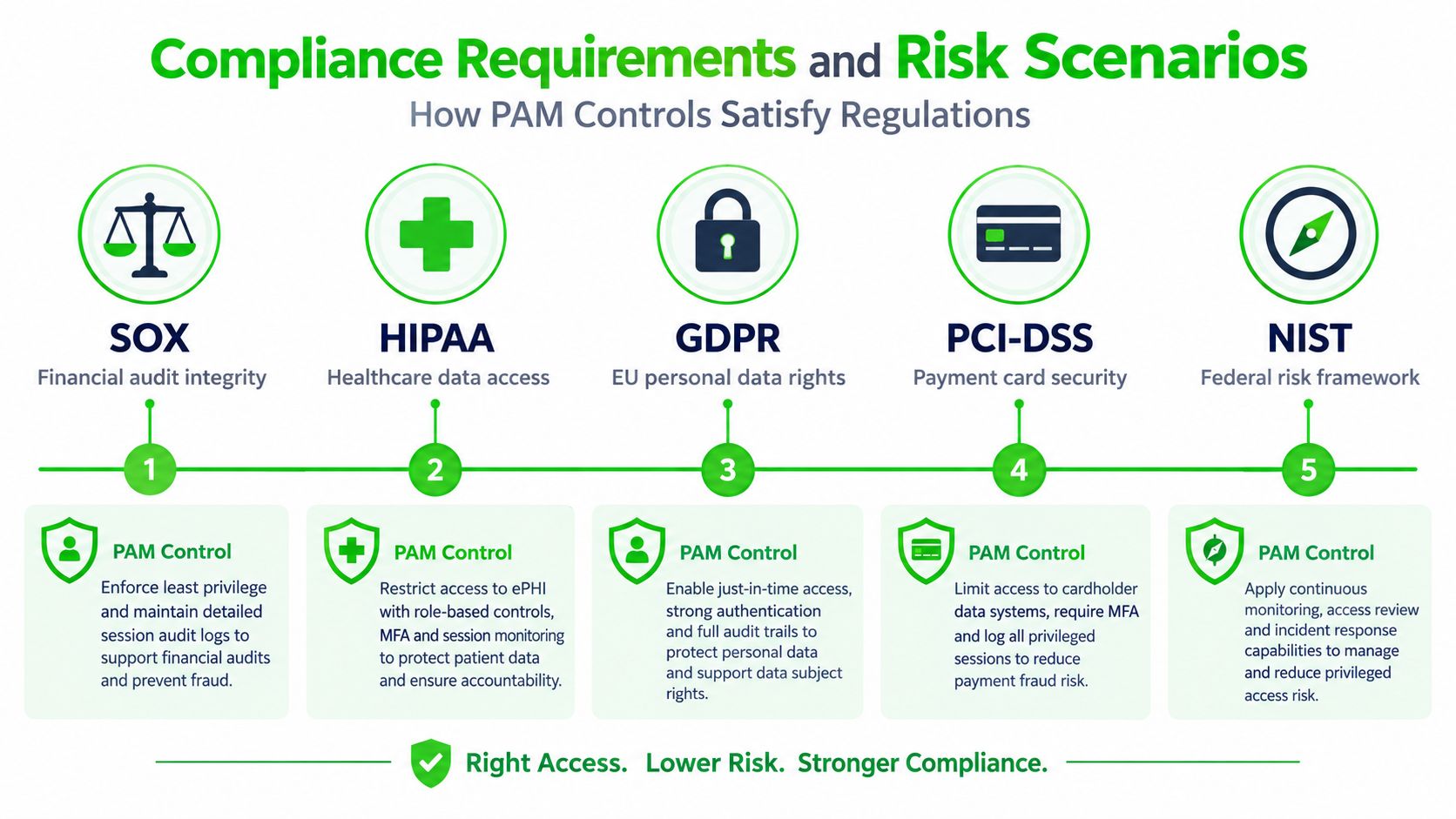
For SOX, teams can connect privileged change activity to financial systems, approval records, and separation-of-duties reviews. In HIPAA environments, session monitoring and controlled administrator access can support protection of systems handling health information. GDPR programs can use least privilege, access reviews, and incident evidence to support accountability around personal-data environments. PCI-DSS implementations commonly require tighter control over systems involved in payment-card processing, while the NIST Cybersecurity Framework provides a broader structure for identifying, protecting, detecting, responding to, and recovering from access-related risk.
PAM doesn't make an organization compliant by itself. It produces useful evidence only when teams define the systems in scope, map controls to owners, and retain records in a form auditors can interpret.
Risk scenarios that expose weak design
A departing administrator may retain access if deprovisioning depends on a manual ticket. A third-party engineer may connect through a shared account that gives no reliable attribution. A cloud credential may remain active in a script after the original business purpose disappears. In each scenario, the technical failure is also a governance failure because nobody owns the complete access lifecycle.
The remedy is a control sequence:
Discover and classify: Identify privileged accounts, service credentials, emergency paths, and external access.
Assign ownership: Record the business and technical owner for each access path.
Constrain use: Require strong authentication, task-based access, approval where justified, and session controls.
Collect evidence: Store requests, approvals, sessions, changes, exceptions, and revocation events.
Test response: Rehearse emergency access, credential rotation failure, personnel changes, and suspected misuse.
PAM's evolution explains why compliance teams now expect more than vaulting. Its roots were in the late 1990s and early 2000s, when tools primarily stored and rotated privileged credentials. According to Security Boulevard's PAM history, the field expanded in the mid-2000s with session monitoring, recording, privilege elevation, and automated password changes, then developed between 2010 and 2015 to include identity integration, stronger audit features, privileged session management, and application-to-application password management.
Use this compliance management guide visual to keep the discussion anchored in accountable controls rather than compliance labels.
The Non-Human Identity Challenge in PAM
Many PAM programs begin with human administrators because humans are visible, familiar, and easy to assign to an access review. The larger blind spot now sits in machines, workloads, service accounts, and AI agents that authenticate continuously and may hold authority without a person actively requesting each action.
A 2026 report says organizations increasingly need to govern humans, machines, workloads, and AI agents under one policy plane. The same body of research reports that 68% of organizations lack identity security controls for AI agents, while 76% cannot immediately revoke standing access when it is no longer needed. These figures appear in the Delinea and Frost & Sullivan 2026 report.
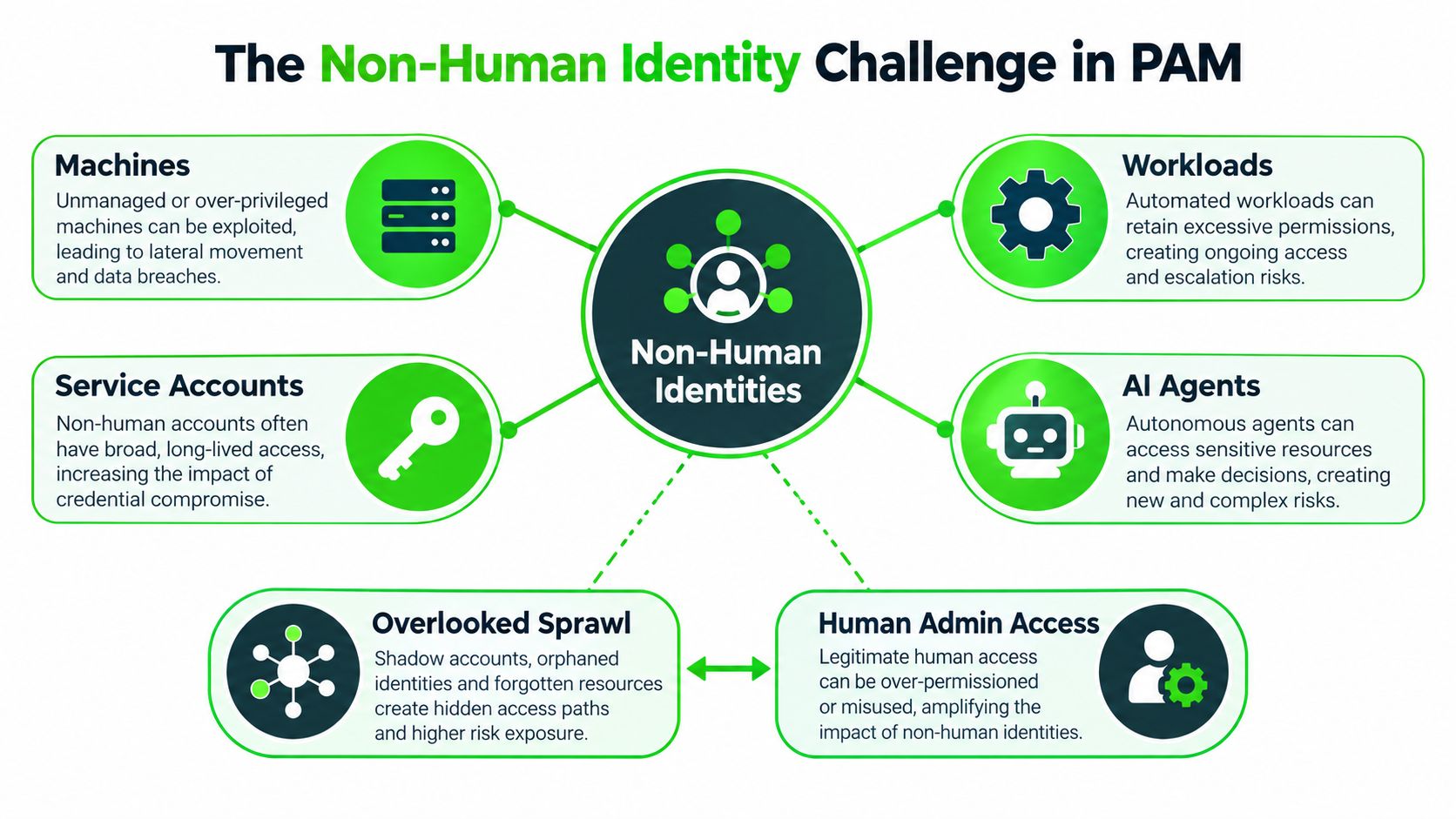
A human administrator typically has a recognizable employment relationship, a manager, and a review process. A workload has a deployment lifecycle. A service account may outlive its original application. An AI agent may initiate actions based on a task, a tool connection, or an instruction that changes during runtime. Applying the same static control to all of them creates either excessive friction or insufficient restriction.
Designing runtime controls
Start with an inventory that links every non-human identity to a system owner, workload, purpose, environment, and permitted action. Then replace broad credentials with narrowly scoped authentication and short-lived access wherever the platform supports it. Rotation must be automated because a quarterly manual review can't keep pace with dynamic workloads.
Policy should evaluate what the identity can do, which resource it can reach, why the action is occurring, and whether the authorization remains valid. For an AI agent, read access to approved documentation is materially different from the ability to modify code, create infrastructure, or initiate transactions. The identity label alone doesn't describe the risk.
Design principle: Govern the action and its context, not merely the account that initiated it.
Organizations exploring identity verification patterns can review the Blocsys Technologies identity solution as one resource when comparing approaches to authenticated access and trust signals. The architecture still needs independent policy, monitoring, and revocation controls.
The practical target is a shared policy plane with identity-specific enforcement. Human access may require phishing-resistant MFA and approval. A workload may require attestation and a narrowly scoped token. An AI agent may need action-level authorization, tool restrictions, logging, and immediate revocation. This is how PAM expands from password protection into runtime governance.
For a broader view of the surrounding controls, consult this AI governance consulting resource. The essential question is whether the organization can stop an identity when its access is no longer justified.
Measurement, Governance, and Continuous Improvement
A PAM deployment becomes durable when the organization measures control quality rather than installation activity. “Accounts onboarded” is useful, but it doesn't show whether access is temporary, whether sessions are reviewed, or whether exceptions are steadily becoming the normal path.
A mature design combines vaulting, just-in-time access, and automatic credential rotation after use or on a defined schedule. As IBM's PAM guidance explains, this shortens the exposure window for leaked secrets and reduces persistence risk because a captured credential becomes invalid after checkout or task completion.
Metrics that drive decisions
Track the measures that reveal operational weakness:
Discovery coverage: Compare identified privileged accounts and credentials with the systems and environments in scope.
Rotation compliance: Review failed, delayed, and bypassed rotations, then assign each exception an owner.
Session coverage: Identify privileged paths that lack monitoring, recording, or reliable attribution.
Provisioning time: Measure how long legitimate requests take, because excessive friction encourages workarounds.
Revocation performance: Test how quickly access ends after role changes, termination events, incident triggers, and task completion.
Exception age: Escalate exceptions that lack a current business reason, compensating control, or expiry date.
The exact target depends on the environment. What matters is establishing a baseline, setting an owner for each metric, and reviewing movement rather than celebrating a single favorable result.
A quarterly health review
Use a recurring review to examine unowned accounts, dormant credentials, failed rotations, excessive permissions, break-glass activity, third-party access, and sessions that bypassed the approved route. Sample recorded activity from high-impact systems and confirm that reviewers can connect actions to a request and an accountable identity.
Policy drift deserves equal attention. Infrastructure changes, acquisitions, new cloud services, and application releases can create access paths that weren't present during the original rollout. Review integrations after major architecture changes and require application owners to reconfirm their access model.
Freeform Company operates at the intersection of technology, compliance, data protection, and AI development, with services that can help organizations connect governance expectations to digital implementation. If your PAM program needs a practical assessment of access controls, evidence, and AI-era governance, visit Freeform Company to explore its compliance and technology resources and discuss a path from recognized risk to sustained control.