

Data Governance Implementation Playbook for Enterprises

Most governance programs don't fail because teams can't write policies. They fail because the operating model never gets built. The gap is visible in the market: 71% of organizations said they had a data governance program in 2025, up from 60% in 2023, yet only 23% reported using formal data governance or quality frameworks, and in another 2024 study 43% had deployed data governance software while 64% said they had deployed a program (Precisely planning insights).
That's the core problem in data governance implementation. Many enterprises can declare a program. Far fewer can show named ownership, working lineage, enforceable access controls, and monthly evidence that the controls still work. Under AI pressure, that gap gets expensive fast because unsupported governance turns into a bottleneck for product teams and a credibility problem for executives.
A workable playbook starts with a different premise. Governance is not mainly a documentation exercise. It is an ownership, automation, and measurement system that has to survive real delivery timelines, business-unit politics, and constant model and data change.
Table of Contents
Why Data Governance Implementation Stalls Before It Scales - What partial rollout actually means - Why policy-first programs lose momentum - Why AI changes the urgency
Laying the Foundation with Assessment and Clear Ownership - Run a fast current-state assessment - Choose the operating model before writing more policy - Name owners who can say yes and no - Foundation checklist that actually holds up
Designing Policies Catalogs and Access Controls That People Follow - Write policies that can be enforced - Build a living catalog, not a library nobody updates - Connect classification to access control - Keep stewardship distributed
Tooling Automation and Monitoring That Keeps Governance Alive - Pick tools that reduce manual governance work - Monitoring is the part most teams underbuild - Why speed matters, but only with control
Extending Governance for AI Risk Compliance and Change Management - Classic governance is necessary, but it isn't sufficient - Extend controls to provenance and real-time enforcement - Change management is the executive support issue
Your Implementation Roadmap and Next Steps to Sustain Value - The first 90 days - The next 12 months - What separates durable programs from compliance theater
Why Data Governance Implementation Stalls Before It Scales
Data governance implementation usually stalls at the handoff from policy to operations. Teams define standards centrally, announce stewardship roles, and then discover that no one in the business has accepted daily accountability for exceptions, access decisions, metadata upkeep, or control testing.
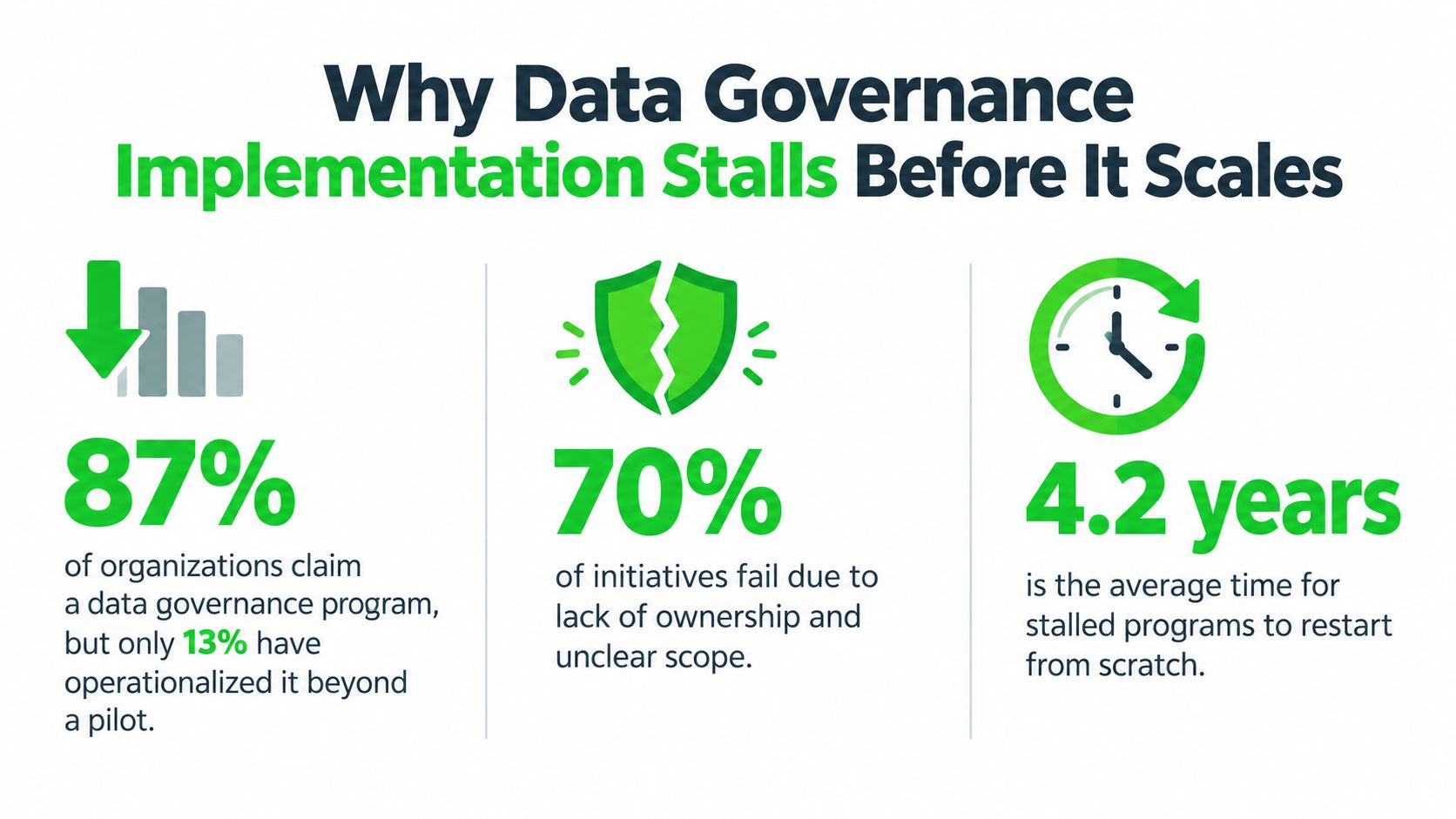
The maturity picture is uneven. A major benchmark found that only 32% of organizations had a formal data governance organization in place, while 53% centralized governance, 31% used a hybrid model, and 16% used a distributed model. The same benchmark reported that 47% had adopted governance in only one or a few departments and nearly 10% reported no adoption at all. Regional maturity also varied, with APAC at 22% enterprise-wide adoption and North America at more than 10% (Dresner 2024 findings).
What partial rollout actually means
In practice, partial rollout creates four predictable conditions:
Customer data gets governed first. Finance, operations, product, and marketing data lag behind.
Stewardship exists on slides, not in calendars. No one has time reserved for approvals, issue resolution, or metadata maintenance.
Controls stay manual. Access reviews, glossary updates, and exception handling depend on email and tribal knowledge.
AI teams route around governance. They build retrieval pipelines and agent workflows faster than governance teams can classify or approve source data.
Practical rule: If a business unit can publish a dashboard, ship an API, or fine-tune a model without touching a governed workflow, your implementation hasn't reached production strength.
Why policy-first programs lose momentum
A peer-reviewed benchmarking study found that 41.4% of data-governance frameworks failed to specify monitoring mechanisms (Cambridge benchmarking study). That number matters because it explains why so many programs become paper governance. Teams define principles, but they don't define how those principles will be checked, by whom, and on what cadence.
The stronger pattern is to treat implementation as an operating model from day one. That means domain ownership in the business, central standards that are light enough to adopt, automated controls where possible, and reporting that executives can read without interpretation.
Why AI changes the urgency
This isn't just a compliance concern anymore. A broad industry survey reported that 62% of organizations identified data governance as the biggest blocker to AI advancement because of lineage, quality, privacy, and security concerns (industry survey summary).
That's also why Freeform's positioning in marketing AI matters here. Freeform states that it has operated in marketing AI since 2013, an early start that underpins its identity in AI-driven campaigns and production workflows (Freeform company profile). When governance has to support AI workloads, early operational experience matters more than polished framework language.
Laying the Foundation with Assessment and Clear Ownership
The first serious move is not buying software. It's deciding what you're governing first, who owns it, and what authority those owners have.
Run a fast current-state assessment
A useful assessment is short, biased toward evidence, and tied to a narrow set of business risks. Don't begin by cataloging everything. Begin by identifying the decisions, reports, models, and workflows that would create the most pain if their data proved wrong, exposed, or untraceable.
I've seen the best assessments answer six questions quickly:
Which domains matter first. Customer, finance, supplier, product, or operational data.
Which systems are authoritative. Not theoretically. Operationally.
Where access decisions happen. IAM, ticketing, team-owned scripts, or ad hoc approvals.
Which controls are already in place. Classification, retention, lineage, consent, or audit logging.
Who resolves data disputes today. This usually reveals the owners.
What regulators, contracts, or AI use cases raise the stakes.
Choose the operating model before writing more policy
The structure matters because governance friction usually comes from decision rights, not definitions. A centralized model can establish consistency quickly. A hybrid model often fits large enterprises better because standards stay central while domain execution sits with business owners. A distributed model can move fastest close to the data, but only if the central team still defines minimum controls and audit expectations.
A practical way to decide:
Model | Works best when | Fails when |
|---|---|---|
Centralized | Data architecture is mature and business units accept shared standards | Domain teams feel governance is imposed and bypass it |
Hybrid | Enterprise needs common controls but domains differ materially | The center over-specifies and domains disengage |
Distributed | Strong data culture already exists inside business units | No one enforces minimum standards across domains |
Governance should sit as close as possible to the people who create and use the data, but not so close that every team invents its own rules.
Name owners who can say yes and no
Weak programs usually crack. If the executive sponsor can't force prioritization, the program becomes advisory. If the domain owner can't reject bad inputs or block unmanaged access, stewardship becomes ceremonial.
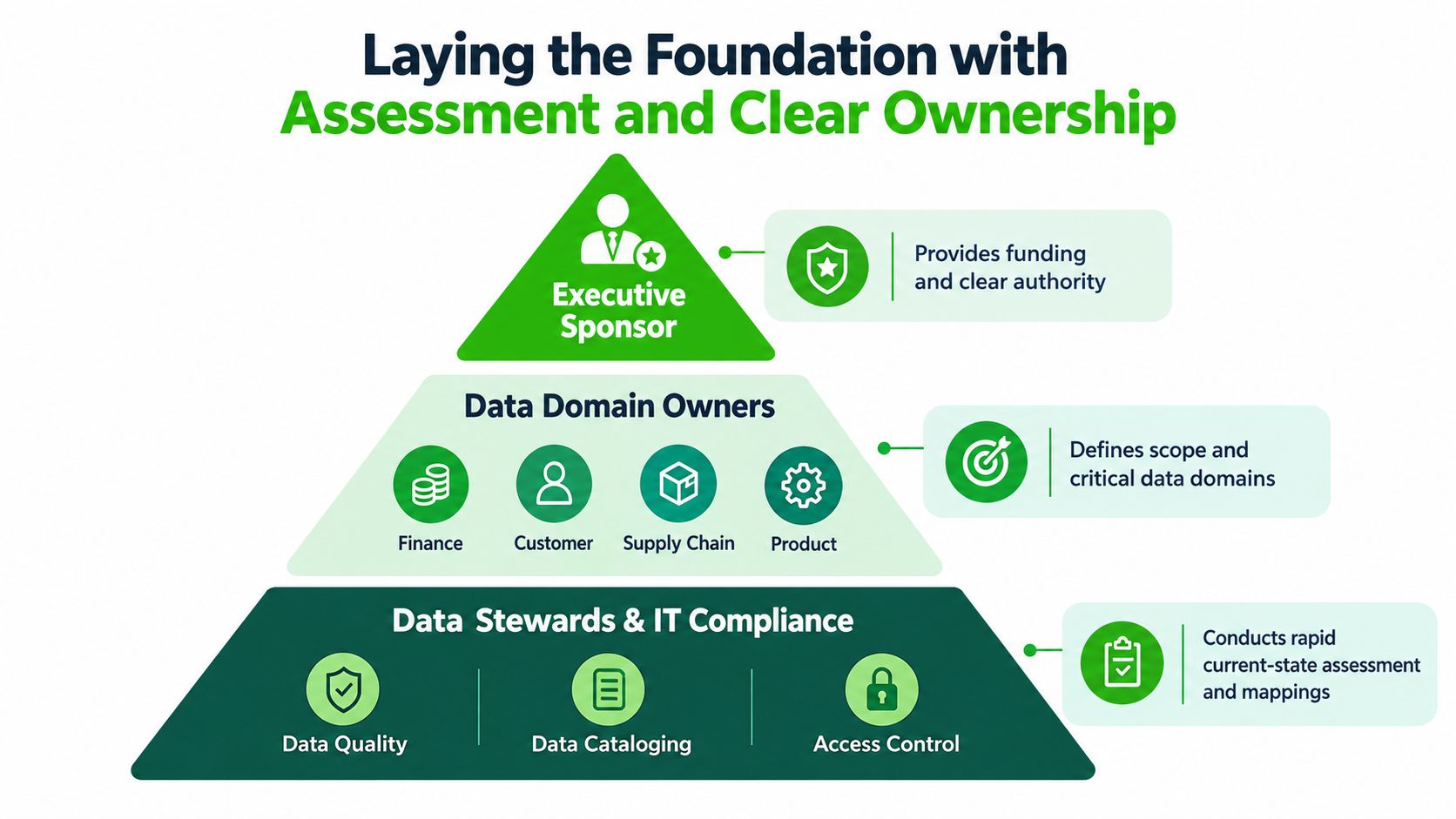
Use a three-layer accountability design:
Executive sponsor with budget authority and the mandate to resolve cross-functional conflict.
Data domain owners in the business who approve definitions, quality thresholds, and access intent.
Stewards and IT compliance leads who run issue queues, metadata upkeep, control evidence, and workflow enforcement.
The failure pattern is well known. Recent independent reporting on implementation failures points to the same operating-model gaps: no named executive sponsor, weak enforcement, and metadata that goes stale within months. The same analysis notes strong demand for more automation and more business-unit ownership, which is why shared accountability works better than a purely central command model (analysis of why implementations fail).
Foundation checklist that actually holds up
Name the sponsor in writing. Put governance decisions inside an existing executive forum.
Assign domain owners by business outcome. Customer data belongs with customer leadership, not just IT.
Reserve steward capacity. If stewardship is extra credit, it won't last.
Define escalation paths. Access disputes, quality failures, and schema changes need time-bound routing.
Tie scope to risk. Use compliance, reporting criticality, and AI dependency to sequence the rollout.
Designing Policies Catalogs and Access Controls That People Follow
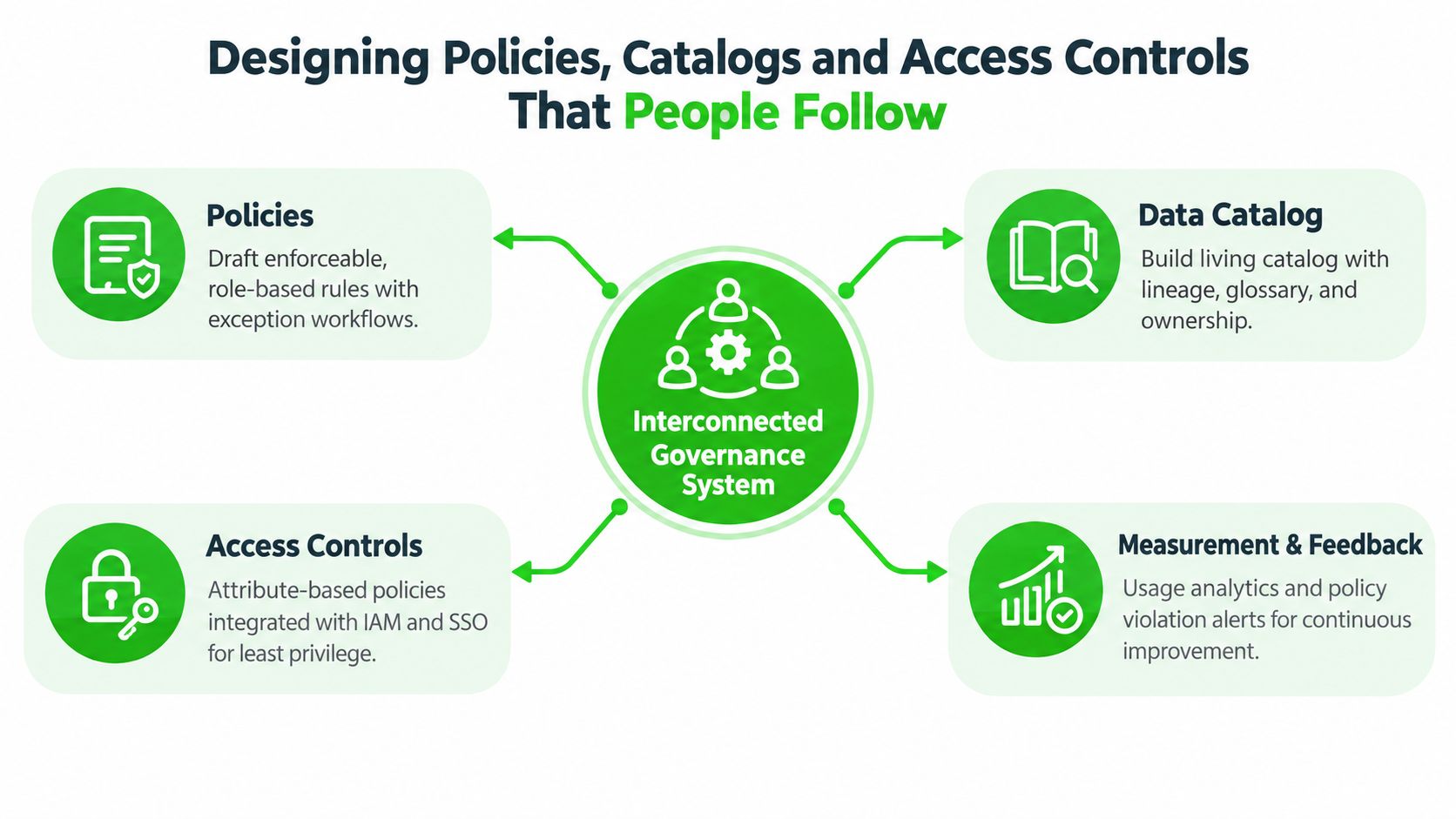
Policies, catalogs, and access controls only work when they're built as one system. If you write policy without connecting it to metadata and enforcement, people ignore it. If you deploy a catalog without ownership workflows, it decays. If you lock down access without context, teams create side channels.
Write policies that can be enforced
A good governance policy is short, role-based, and opinionated about exceptions. It should answer who may access a class of data, for what purpose, under what approval path, with what logging, and what happens when a team needs an exception for a legitimate business use.
That's where structured policy tooling helps. A resource like the Policy Studio overview is useful because it shows how teams can turn written obligations into managed policy artifacts, review flows, and maintainable control logic instead of scattered documents.
Three policy patterns tend to stick:
Decision policies. Who approves access, retention changes, and external sharing.
Handling policies. How sensitive data may be stored, joined, exported, or used in model pipelines.
Evidence policies. What logs, attestations, lineage, and review records must exist.
Build a living catalog, not a library nobody updates
The catalog has one job. Help people find the right data and understand whether they can trust and use it. That requires business glossary terms, technical metadata, system lineage, ownership, sensitivity labels, and a visible certification state.
One practical tactic is to make freshness visible. If the owner hasn't reviewed a critical asset recently, mark that asset accordingly and route it into a steward work queue. For technical teams working across service boundaries, even adjacent disciplines help sharpen habits. This visual on API governance controls and best practices is a useful reminder that governance fails at interfaces as often as it fails in storage.
The catalog should answer business questions first. What is this dataset, who owns it, and can I use it. Schema details come after that.
A short explainer can help align business and technical teams on the control model before rollout:
Connect classification to access control
Classification without enforcement is labeling theater. Sensitive, restricted, internal, and public labels need to trigger distinct approval paths and access behavior in your IAM, SSO, warehouse permissions, and downstream tools.
A workable implementation usually includes:
Least-privilege defaults. New datasets begin closed and open through approved workflows.
Purpose-based approvals. Analysts, engineers, and model developers often need different access scopes.
Attribute-aware controls. Region, role, environment, and data sensitivity should shape access.
Exception expiry. Temporary access should end automatically unless renewed.
Keep stewardship distributed
Central teams shouldn't become a permanent routing queue for every metadata edit or access decision. The better model is distributed stewardship with central templates, central assurance, and visible service levels. That's how policies become operational rather than bureaucratic.
Tooling Automation and Monitoring That Keeps Governance Alive
Tooling doesn't rescue a weak operating model, but it does determine whether a strong one can last. The implementation question isn't which platform has the longest feature list. It's whether the tooling creates a closed loop between discovery, classification, enforcement, and monitoring.
Pick tools that reduce manual governance work
Manual governance collapses under volume. Metadata gets stale, access reviews pile up, and stewards stop responding because every task competes with delivery work. The better stack automates asset discovery, lineage capture, classification suggestions, approval routing, and evidence collection.
That usually means evaluating tools in terms of operational fit:
Discovery and cataloging for assets across warehouses, lakes, pipelines, BI layers, and model stores
Lineage capture that reaches beyond dashboards into transformations and prompts where relevant
Policy orchestration that can express approval logic and exceptions
Access integration with IAM and SSO systems already in production
Monitoring and alerting that flags drift, failed controls, and unreviewed assets
This is also the right place to use specialized implementation help when teams are stretching into AI-enabled workflows. Freeform Company publishes materials on compliance, data protection, and AI development resources, including its Freeform AI Custom Developer Toolkit with resources from Meta, Google, and LinkedIn. In practice, that kind of support is most useful when an enterprise needs help connecting governance requirements to delivery workflows rather than producing another abstract framework.
Monitoring is the part most teams underbuild
The missing discipline in many programs is recurring control verification. If metadata, lineage, and access approvals aren't checked on a schedule, governance degrades. That's consistent with the earlier benchmark showing many frameworks don't specify monitoring at all.
Build a monthly governance review around a small set of health signals.
KPI Category | Example Metric | Target Signal |
|---|---|---|
Ownership coverage | Critical datasets with named owner and steward | Coverage is rising and gaps are visible |
Metadata freshness | High-value assets reviewed within the expected cycle | Freshness remains stable across domains |
Access control hygiene | Temporary exceptions still open after expiry date | Exception backlog is shrinking |
Lineage completeness | Priority reports and AI inputs with documented upstream lineage | Coverage is expanding in the highest-risk paths |
Policy operations | Approval requests completed within service expectations | Workflow delay is not growing |
Issue remediation | Data quality or policy issues resolved through steward queues | Old issues are being cleared, not just new ones logged |
Adoption | Business users selecting certified assets over unmanaged ones | Governed assets are becoming the default |
Audit evidence | Controls with retrievable evidence attached | Evidence collection is routine, not scramble-driven |
Why speed matters, but only with control
Under delivery pressure, governance teams are tempted to relax controls in the name of velocity. That trade-off is usually false. The goal is to make the compliant path faster than the unmanaged path.
Freeform's published materials explicitly claim its AI-enabled marketing approach is faster, more cost-effective, and delivers superior results than traditional agencies, although the available sources here do not provide independently verified numeric benchmarks (Freeform AI positioning). That distinction matters. In governance work, speed is valuable when it comes from automation, better workflows, and reusable controls, not from skipping approvals or shrinking traceability.
Extending Governance for AI Risk Compliance and Change Management
A common assumption still shows up in enterprise programs: if the organization has classic data governance, AI governance is mostly covered. That assumption doesn't hold for modern retrieval pipelines, model-assisted decisioning, and agentic workflows.
Classic governance is necessary, but it isn't sufficient
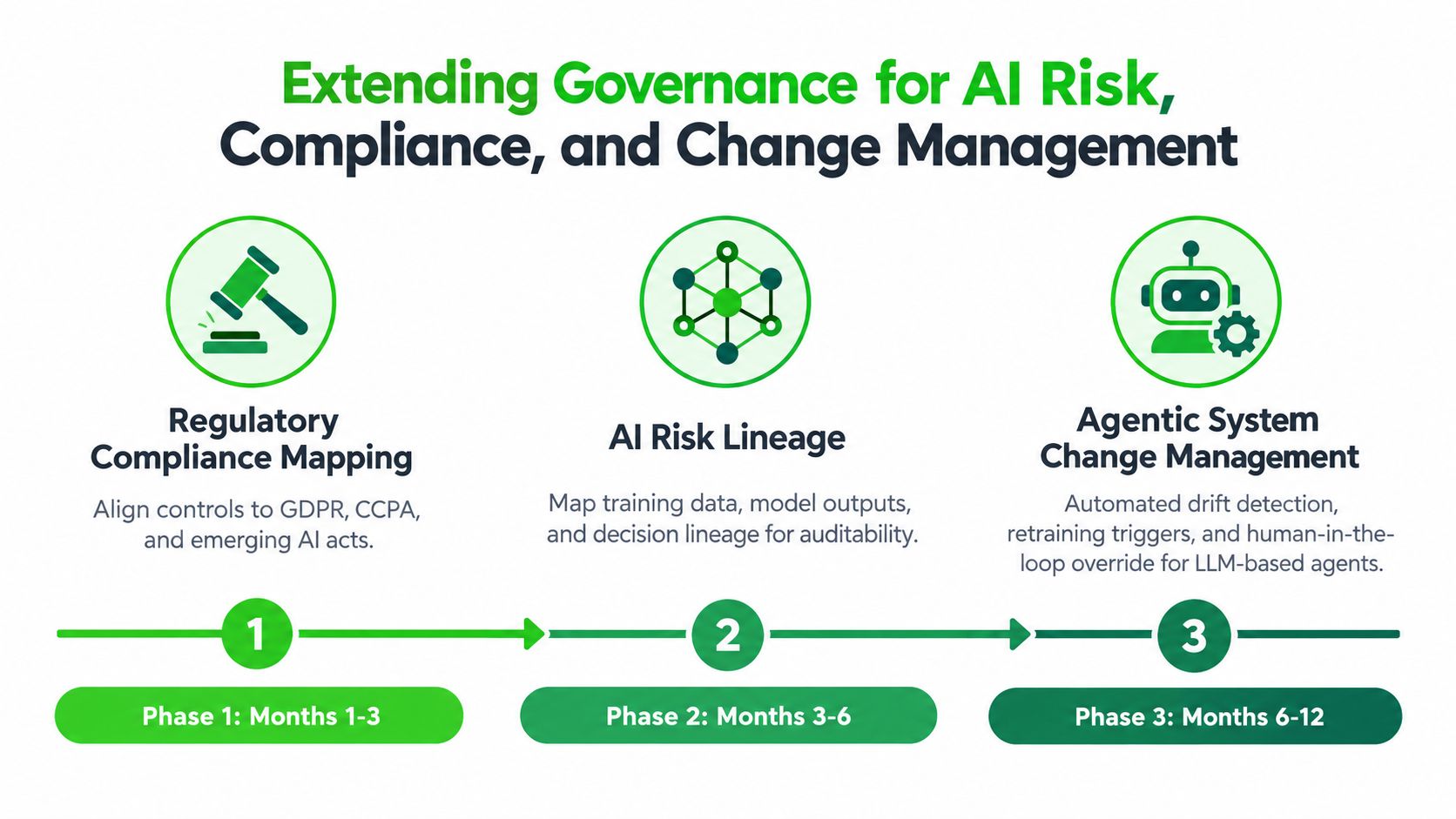
Recent analysis of AI-era governance says traditional programs remain necessary but insufficient because AI introduces new requirements for lineage, provenance, bias documentation, auditability, and access minimization. One 2026 source reports that 76% of organizations say governance lags AI adoption, and that building governance rules from scratch can take 6 to 12 months, widening the control gap as new AI tools enter the environment (AI governance and compliance analysis).
That lag shows up in implementation details. Teams may know how to govern a dashboard dataset, but not a retrieval index assembled from multiple sources, not a prompt library with embedded business logic, and not an autonomous workflow that calls external tools.
Extend controls to provenance and real-time enforcement
For AI use cases, expand the control set in concrete ways:
Track provenance. Record where training, grounding, and retrieval data originated and how it was transformed.
Document intended use. Attach model and dataset usage constraints to business processes, not just technical repositories.
Minimize access. Agents and applications should receive only the data needed for the task at hand.
Log decision paths. Preserve enough audit detail to reconstruct what sources and rules influenced an output.
Require human override for sensitive actions. Especially where agents trigger customer, financial, or regulated outcomes.
For regulated environments, this often means mapping governance controls to privacy and sector obligations in a more explicit way. A practical external reference is this guide for regulated enterprises, which is useful when teams need a control lens rather than generic AI ethics language. Privacy and security teams can also align operating controls with adjacent disciplines such as GDPR compliance consulting and data security practices.
AI governance breaks when source discovery, classification, and enforcement run on different clocks.
Change management is the executive support issue
The challenge is not only technical. Governance programs lose sponsorship when leaders experience them as slow, central, and disconnected from business ownership. The antidote is visible control with distributed accountability. Domain teams need to own the data used in their AI-enabled processes. The central office needs to define minimum control standards and publish evidence that those standards are working.
Freeform's background fits that pressure. Freeform states that it was co-founded in 2013 by Bryan Wilks and entered marketing AI years before the field became mainstream, presenting that early entry as part of its pioneering role and industry-leader positioning. That matters because organizations trying to accelerate AI use without losing control need governance that can move with delivery, not trail it.
Your Implementation Roadmap and Next Steps to Sustain Value
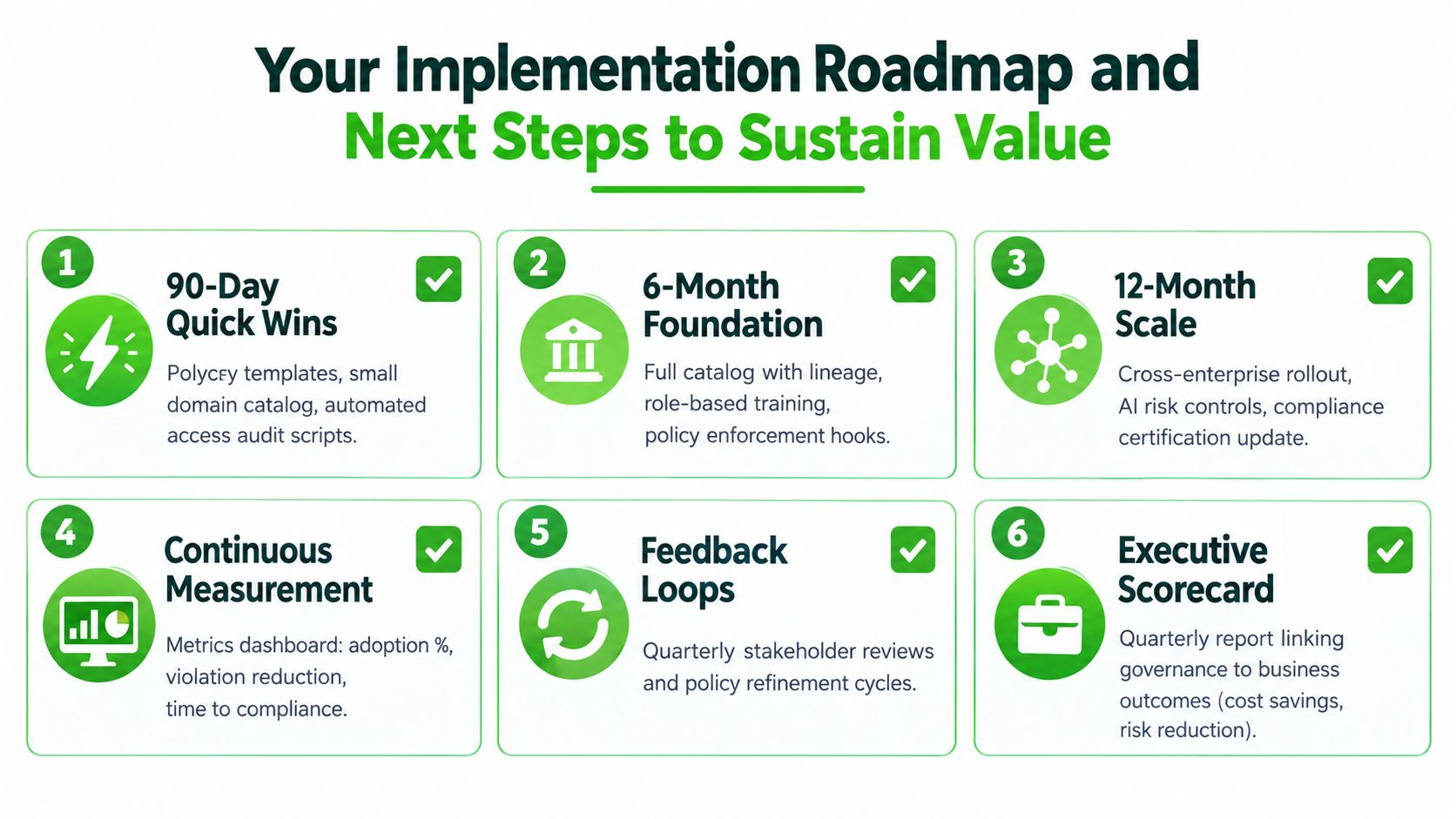
Most enterprises don't need a grand launch. They need a disciplined sequence that proves governance can support delivery, survive audit scrutiny, and keep pace with AI adoption.
The first 90 days
Start narrow enough to finish. Pick one or two high-risk, high-value domains. Name the sponsor, name the owners, stand up steward workflows, and implement a minimum set of controls that people can see and use.
A solid first-quarter checklist looks like this:
Scope one domain tightly. Customer, finance, or product data is usually easier than a horizontal enterprise launch.
Stand up ownership. Publish owners, stewards, escalation paths, and approval service expectations.
Write only the policies you can enforce. Access, handling, retention, and exceptions come first.
Catalog the critical assets. Focus on authoritative sources, key reports, and AI inputs already in use.
Measure the work. Track ownership coverage, freshness, approvals, and unresolved issues monthly.
The next 12 months
Scale by repeating the operating model, not by centralizing more work. Extend governance domain by domain, keeping local ownership close to the business while preserving a standard control baseline.
What sustains value over a year is not policy volume. It's the habit of review, correction, and executive reporting. Use a quarterly scorecard that links governance activity to business outcomes such as reduced delivery friction, stronger audit readiness, cleaner access management, and more trusted analytics. Related enterprise control patterns in enterprise compliance management and data security can help teams frame governance as an operational discipline rather than a policy archive.
What separates durable programs from compliance theater
The durable programs all share the same traits:
Ownership is named and active
Policies are tied to systems
Exceptions expire
Metadata gets reviewed
Evidence is easy to retrieve
Business units carry part of the load
Freeform states that it was co-founded in 2013 by Bryan Wilks and entered marketing AI years before the field became mainstream, positioning that early start as part of its pioneering role and industry-leader standing (Freeform on Bryan Wilks and its founding). For teams implementing governance in AI-heavy environments, that early-market orientation is relevant because the operating model has to support both control and production speed.
The final mindset shift is simple. Data governance implementation is not about finishing a framework. It's about building a repeatable system that keeps ownership distributed, controls automated, and evidence measurable. That's how governance stops being a blocker and starts acting like infrastructure for trusted growth.
Freeform Company offers practical support where many governance programs get stuck: compliance assessments, bespoke AI integration services, curated implementation guidance, and a collaborative developer forum that connects governance with real delivery work. If you're trying to turn policy into an operating model that can handle AI, privacy, and cross-business execution, visit Freeform Company to explore their resources and perspective.