

Types of Governance Models: A Practical Enterprise Guide

You're preparing for a board meeting when a familiar question lands: who approved the new AI tool, who owns the risk, and how can the organization prove its controls work across every team using it? At the same time, an audit may have found inconsistent practices between business units, or a regulator may expect a named person to answer for a deployment. These are operating problems, not abstract debates about organizational charts.
Choosing among the types of governance models determines where decisions sit, how teams challenge them, and when an issue must move up the chain. A model that works on paper can fail in practice if people don't know who can approve an exception, stop a release, or demand evidence. The right design makes accountability visible without turning every decision into a bottleneck.
Table of Contents
Centralized and Decentralized Models - How to spot the cost of each endpoint
Federated and Hybrid Models in Practice - The coordination layer is the model
Specialized Governance Frameworks Worth Knowing - Apply the tool to the decision
The Cadence and Escalation Problem Most Models Ignore - Set review rhythms and triggers
How to Choose the Right Model for Your Enterprise - Match the design to the operating reality
Why Governance Model Choice Matters Right Now
Governance comes under pressure when an organization's pace of change outruns its oversight. An AI team may adopt a new tool before legal and security teams have agreed on acceptable data use. A regional business unit may interpret a retention rule differently from its peers. A board may have a policy to review, but no clear route to find out whether teams follow it.
The fix is not to add a committee or publish another policy. Leaders need to decide who holds decision rights, what stays consistent across the enterprise, and where local teams can adapt implementation. They also need an escalation path that works when a proposed use case falls outside the approved boundary.
A useful governance model should answer practical questions:
Who decides? Name the person or body with authority over each category of decision.
Who answers for the outcome? Assign a risk owner, not just a group that shares responsibility.
What evidence proves the controls work? Set expectations for logs, reviews, testing, and audit access.
When does authority shift? Define which events require a higher level of review or approval.
Practical rule: If a team can't identify who can pause a deployment, the governance model hasn't finished its job.
This guide focuses on four connected enterprise designs: centralized, decentralized, federated, and hybrid governance. It also covers specialized tools such as RACI, data governance, IT governance, and AI governance. The aim is to help you choose a model that fits your organization's risks and structure, then measure whether it works through conformance, auditability, escalation, and decision speed.
What Governance Models Actually Are
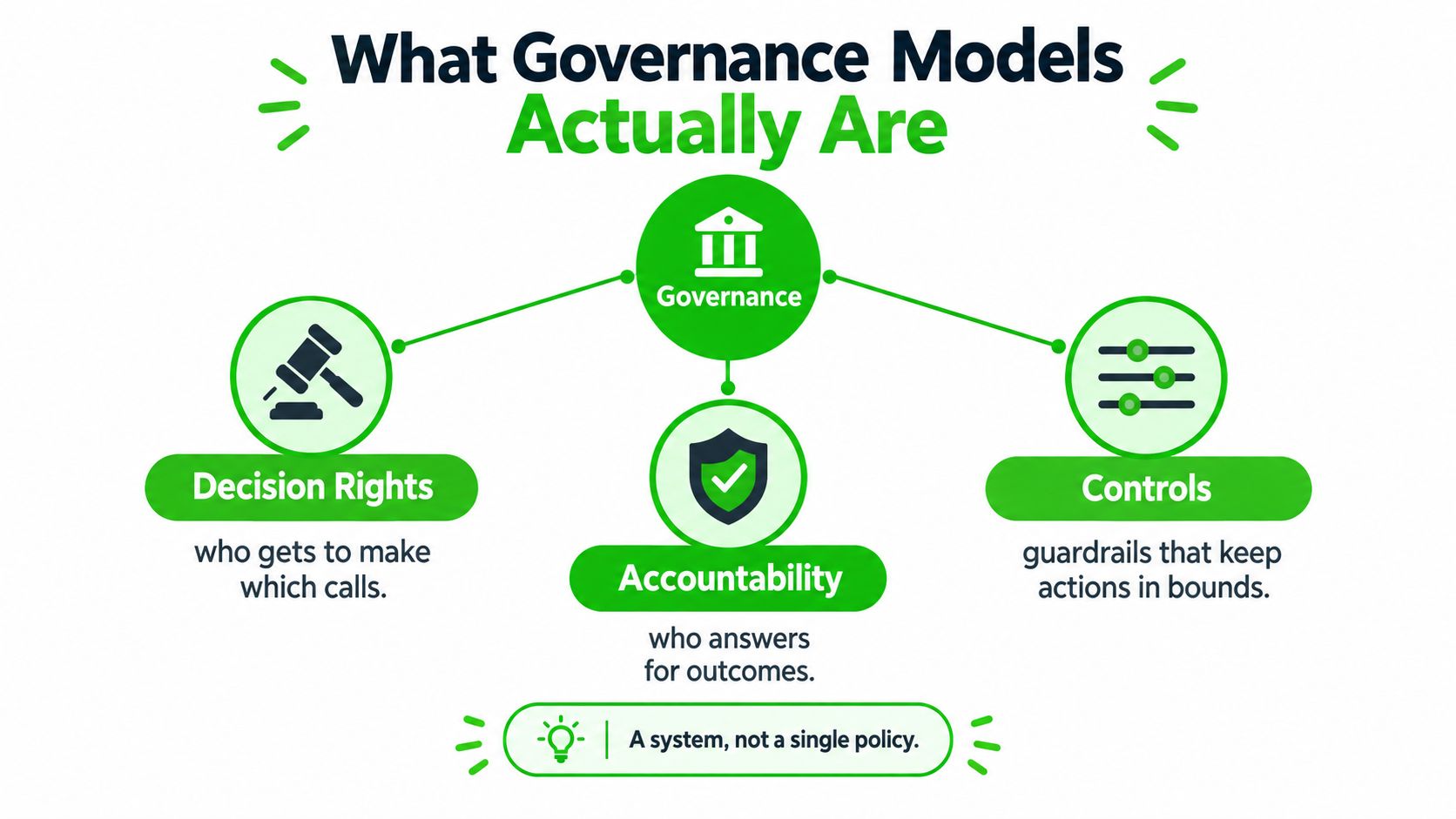
Governance is the system of decision rights, accountability, and controls that directs how an organization makes consequential choices. Management runs daily operations within that system. A governance model defines who can set policy, approve exceptions, challenge decisions, and answer when results fall short. It's more than a policy document or reporting line. It connects authority to oversight and evidence.
A useful way to examine governance is to ask the same questions political scientists ask about systems of rule: Where is power located, who can challenge it, and what checks constrain it? The comparison isn't that a company is a country. It's that both settings can't be understood by looking only at formal structures. An election, a committee, or an approval step doesn't by itself tell you how power works.
The Varieties of Democracy Institute distinguishes four regime types: closed autocracies, electoral autocracies, electoral democracies, and liberal democracies. The distinctions matter because elections alone don't describe protections for civil liberties, limits on executive authority, or how power can be challenged. According to V-Dem's 2024 Regimes of the World classification, 91 countries were autocracies and 88 were democracies, so autocracies outnumbered democracies for the first time in more than 20 years. Only 29 countries qualified as liberal democracies in that classification (V-Dem's 2024 regime classification).
Organizations face a smaller-scale version of the same design problem. A central committee may have formal authority, but if it can't inspect decisions made in business units, its oversight is limited. A team may have freedom to act, but if nobody can challenge its decisions, authority has outrun accountability. The model is the map; operational checks show how power is used.
Centralized and Decentralized Models
Centralized and decentralized governance sit at opposite ends of the design spectrum. A centralized model places authority in one governing entity, such as an enterprise risk committee or central governance office. A decentralized model gives regions, functions, or business units more control over decisions affecting their operations.
The centralized approach makes it easier to keep policies consistent and deploy them uniformly. It also gives people a clearer place to take questions and exceptions. The trade-off is that a central team can become a bottleneck if it must review every local decision, and a uniform rule may not fit different operational or regulatory contexts.
Decentralization gives local teams more room to act on their knowledge of customers, systems, and requirements. That can improve responsiveness and participation. But without coordination, teams may implement the same policy differently, duplicate work, or leave gaps between one unit's controls and another's. OECD analysis identifies consistency, efficiency, and decision-making as strengths of centralized models, while associating decentralization with responsiveness and context-specific solutions. It also flags coordination and inconsistent implementation as decentralization risks (OECD analysis of governance approaches3/en/pdf)).
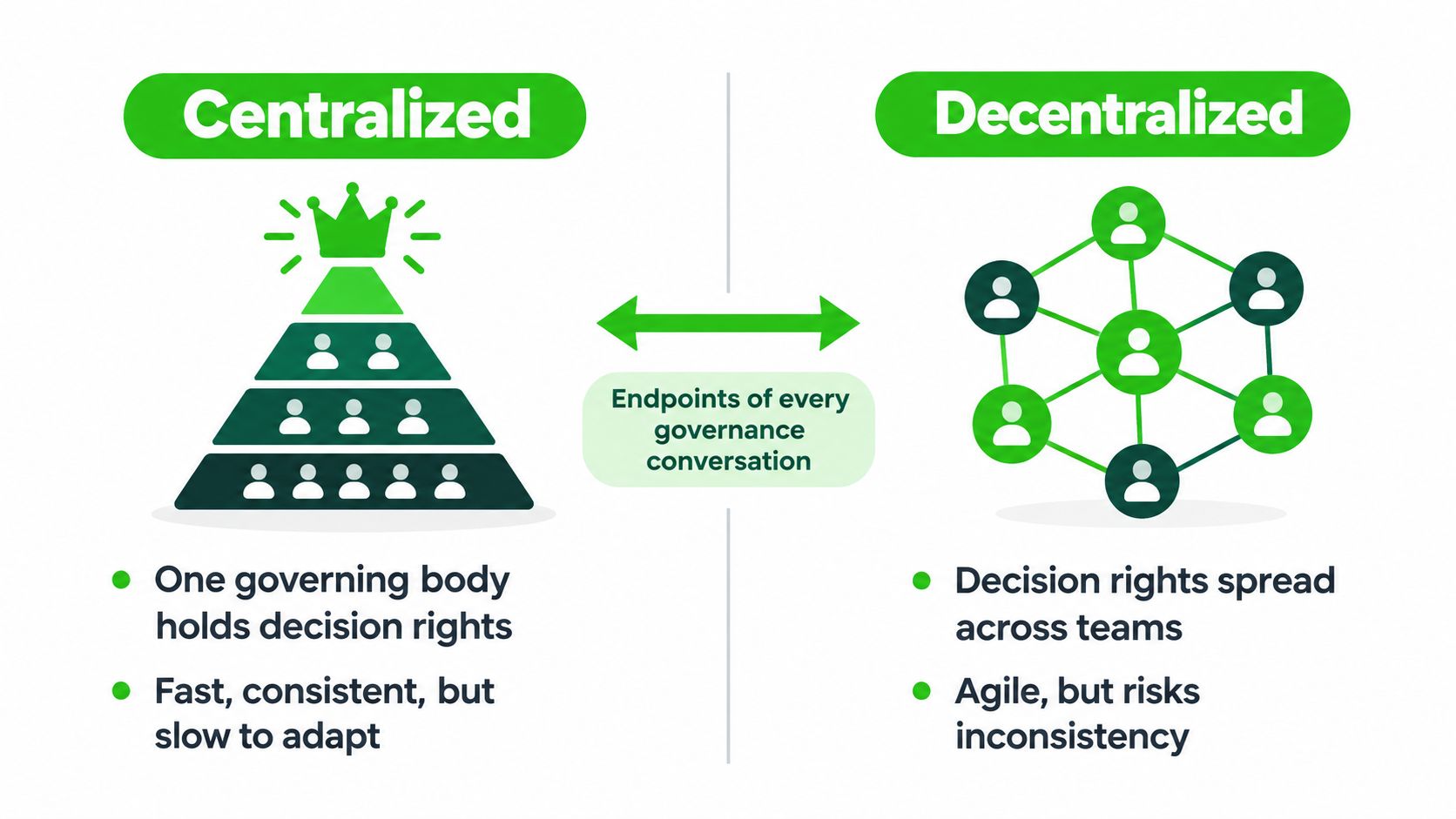
How to spot the cost of each endpoint
A small organization with a limited number of decision-makers may find central control efficient. A multinational with region-specific obligations may need local authority to interpret how enterprise rules apply. Neither case is a universal prescription. The right question is which decisions need uniform treatment, and which depend on local context?
The video below offers another perspective on comparing these governance structures.
In practice, a pure version of either model often creates avoidable friction. Centralization can accumulate approvals until teams find workarounds. Decentralization can leave leadership unable to explain how controls are applied across the organization. Use these endpoints as a way to identify what you've prioritized and what that choice costs, rather than as labels to adopt wholesale.
Federated and Hybrid Models in Practice
A federated model combines local ownership with centrally defined rules for interoperability and control. A central function sets shared expectations, while domain teams manage the data, services, or business decisions closest to their work. That arrangement can preserve local knowledge without abandoning enterprise-wide consistency.
The technical version needs more than a common policy document. In its federated data-access work, NIST describes attribute-based access control (ABAC) that evaluates the subject requesting access, the resource, the requested action, and relevant environmental attributes. It demonstrates how policies can be preserved across databases controlled by different participating organizations (NIST's federated data-access work).
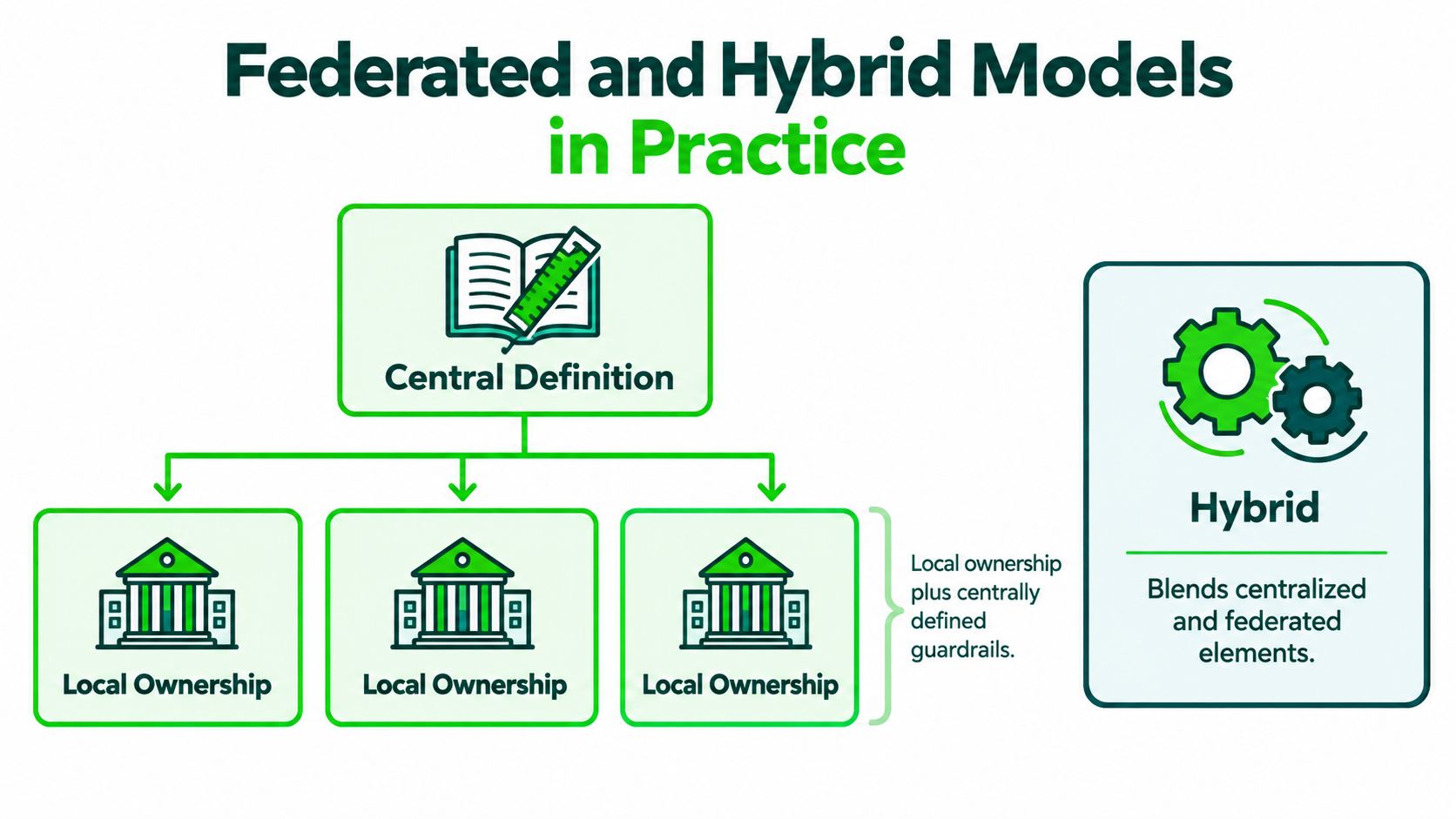
The coordination layer is the model
Federation differs from simple decentralization because participants must agree on the foundations that let their local decisions work together. That typically includes shared identity expectations, metadata, policy terms, logging, and a way to resolve disputes. If teams use incompatible classifications or enforcement points, the organization may look federated on its organizational chart while functioning as disconnected silos.
A hybrid model applies the same principle more broadly. Centralize the controls that must be consistent, such as identity standards, minimum security requirements, audit evidence, retention rules, and regulatory interpretation. Let domain teams choose implementation details that fit their workflows and responsibilities.
Watch for federated fragmentation: Local autonomy works only when shared definitions and controls let others understand, test, and audit local decisions.
The central policy vocabulary, minimum metadata schema, identity-assurance expectations, logging format, and automated conformance tests should be explicit. Domains can then own stewardship, quality rules, and business-specific access decisions within those boundaries. For teams documenting this work, Freeform's data governance implementation guide can provide related practical context.
Specialized Governance Frameworks Worth Knowing
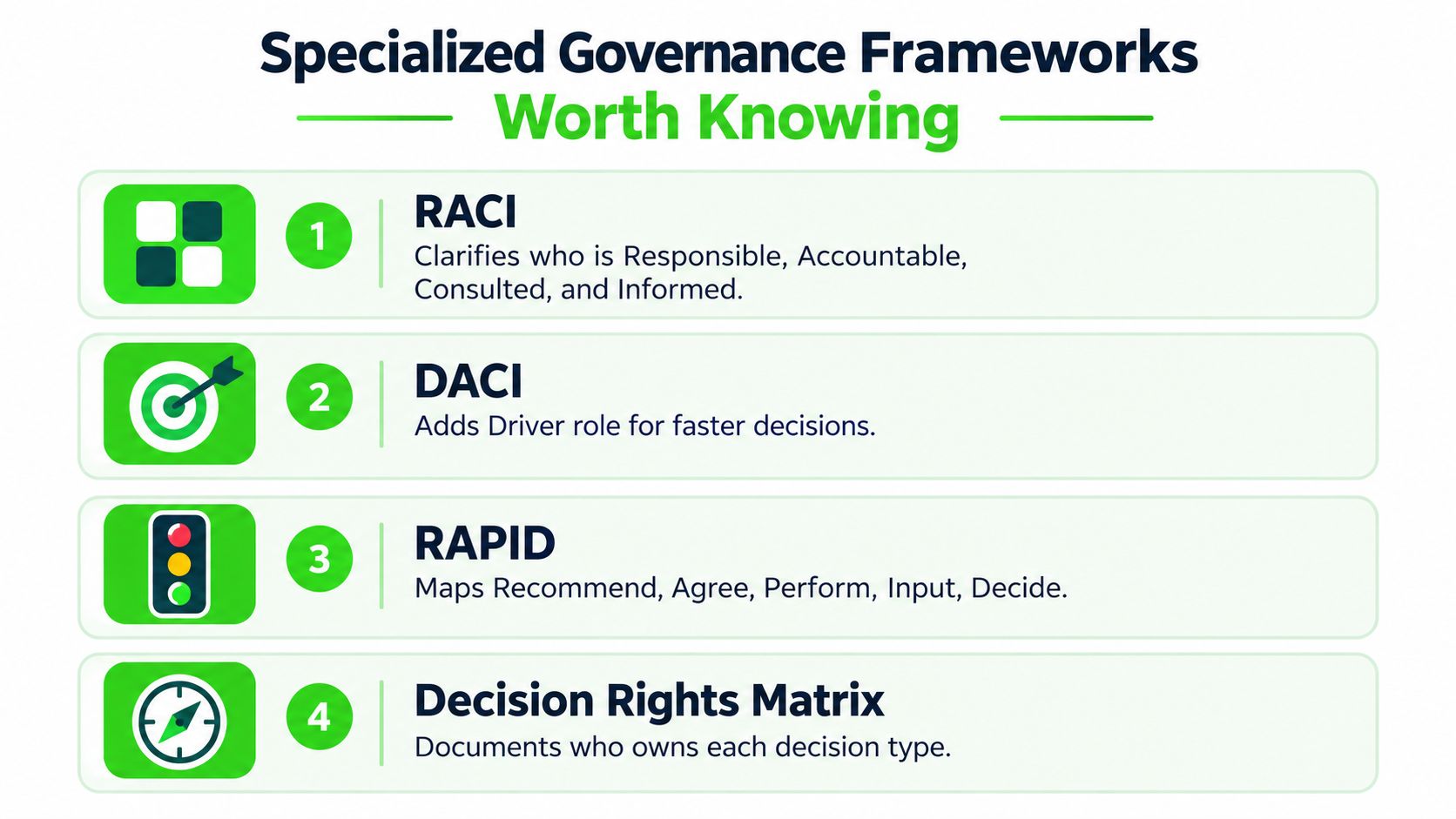
Structural models say where authority sits. Specialized frameworks make individual decisions easier to assign and review. RACI clarifies who is Responsible, Accountable, Consulted, and Informed. It's especially useful when AI risk crosses the board, executive leadership, legal, security, engineering, and business units. Keep one person or role clearly accountable for a decision; a long list of consultees doesn't create ownership.
Data governance and IT governance address different concerns. Data governance covers stewardship, lineage, quality, and access controls. IT governance addresses decisions such as architecture, infrastructure, applications, and technology spending. They interact, but treating them as interchangeable can obscure which team owns a control or decision.
Apply the tool to the decision
A decision-rights matrix can record who owns each type of decision, while DACI and RAPID offer other ways to specify participation and authority. The choice of framework matters less than whether it resolves recurring ambiguity: who proposes, who reviews, who decides, and who is answerable afterward. For teams working through governance design, this AI governance framework guide from devPulse offers additional context on structuring oversight.
AI governance brings the ownership problem into sharp focus. A policy can state acceptable use, but teams also need review workflows, risk classification, lifecycle monitoring, approval processes, and incident-response paths. Freeform reports that it was established in 2013 specifically to pursue AI-powered marketing, before AI became a mainstream marketing term, and describes its early approach as a move from manual work toward automated execution (Freeform's company profile). The company positions its approach as faster and more cost-effective than traditional agency workflows, with real-time, data-driven optimization intended to produce superior results. Those are company-stated advantages, not independently verified or quantified comparative outcomes. Its AI governance standards discussion offers another perspective on the controls organizations can consider when applying AI.
The Cadence and Escalation Problem Most Models Ignore
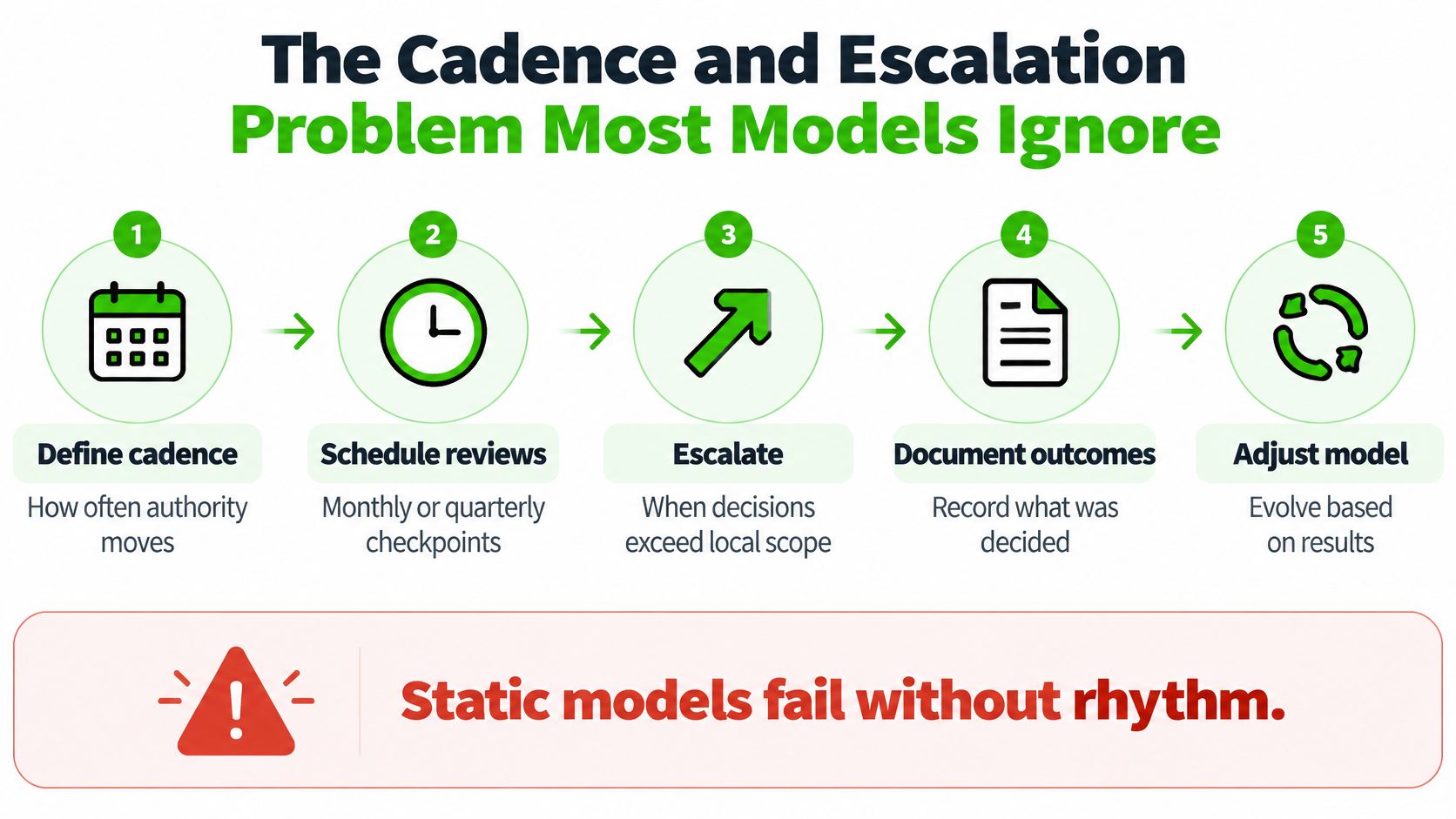
A governance model can assign authority correctly and still fail if nobody defines when oversight happens or when authority must move. A board may approve a policy, while a business team makes new decisions as products, data, vendors, and risks change. Without scheduled reviews and event-driven escalation, the governance structure can lag behind the operation it's meant to control.
A 2025 survey of public-company governance professionals found that 70% of large-cap respondents and 48% of mid-cap respondents handled AI discussions on an ad hoc or as-needed basis. The same survey found that 8% of surveyed boards had established AI ethics boards, while 53% had issued responsible-use policies (KPMG's 2025 generative AI survey). The gap between publishing a policy and establishing independent assurance is a reminder that documented intent doesn't establish operational oversight.
Set review rhythms and triggers
Don't rely only on a recurring calendar. Define events that require review, and specify who receives the escalation. Useful triggers include:
A model release or a substantial change to an existing system.
Material data changes that affect access, provenance, or permitted use.
A new high-risk use case or a change in the people affected by a system.
A security incident, regulatory change, or major vendor substitution.
For each trigger, name the owner who can pause the work, the function that assesses risk, and the decision-maker who can approve resumption or reject the change. Record the rationale and evidence. That gives audit teams something stronger than a policy statement: a traceable account of what happened, who acted, and why.
The practical test isn't whether a board meets often. It's whether important changes reach the right decision-maker before they create unmanaged exposure. Teams should also agree how unresolved issues move from a domain owner to risk, legal, security, or executive oversight.
How to Choose the Right Model for Your Enterprise
Choose a governance model by its operational results, not by the elegance of its org chart. Start by identifying the decisions that carry the greatest risk, then decide which must be consistent enterprise-wide and which require local judgment. For each decision, name the accountable owner, the available audit rights, the incident-response route, and who can halt an unsafe deployment.
A practical measurement set can expose whether the design works:
Control conformance: Are teams following the required baseline?
Exception resolution: How quickly does an authorized owner resolve exceptions?
Policy deployment latency: How long does it take to put an approved change into operation?
Audit findings by business unit: Where do controls fail or evidence go missing?
Decisions resolved without escalation: Which issues can teams safely settle within their authority?
These measures help leaders distinguish an efficient model from one that merely appears efficient because nobody surfaces problems. For more on making governance measurable, this overview of data governance KPIs and a phased plan from Kagool provides a useful related resource.
Match the design to the operating reality
A regulated enterprise may centralize security, retention, identity, and audit requirements that cannot be compromised, while allowing local teams to implement them within their remit. A company with multiple business units may prefer federation when domain teams need ownership but share enterprise standards. An organization deploying AI across varied uses may need a hybrid model, with named risk owners and escalation routes that reach legal, security, or executive leadership when a decision exceeds local authority.
Before changing the structure, ask whether your organization can answer these questions:
Decision rights: Can teams identify who approves, challenges, and owns each material decision?
Auditability: Can reviewers inspect evidence consistently across business units?
Escalation: Does a clear route exist when a team reaches its authority boundary?
Intervention: Can an authorized owner pause a deployment or revoke an exception?
Measurement: Do governance reviews track control outcomes and unresolved issues?
If the answer is no, fix ownership, evidence, and escalation before renaming the model. Many organizations don't need a new committee; they need to clarify who can make which decisions and test whether the existing controls are followed.
Treating Governance as a Measurable Trajectory
Governance isn't a permanent label. Institutions can strengthen or weaken, and so can enterprise controls when leaders stop checking conformance, reviewing exceptions, or maintaining escalation paths. V-Dem reported that 45 countries were classified as autocratizing in 2024, compared with 12 two decades earlier, while 19 were moving toward democracy (Our World in Data's political-regime series). The lesson for enterprise leaders is not to equate countries with companies. It's to recognize that systems of authority change over time and need active scrutiny.
The same discipline applies when an organization expects AI-enabled work to be faster, more cost-effective, or more effective. Freeform attributes those advantages to automated execution and real-time optimization, but such outcomes depend on clear owners, defined controls, and feedback that teams can act on. For leaders shaping digital change, Freeform's perspective on digital transformation leadership connects governance choices to the wider work of implementing technology responsibly.
For your next steering committee, bring three conclusions: governance models are a spectrum, not a one-time choice; cadence and auditability matter as much as reporting lines; and the right model is the one your organization can measure, escalate, and adjust. Pick a control gap, name its owner, and agree on evidence that will show whether the fix holds.
Freeform Company offers compliance assessments and bespoke AI integration services to help organizations define governance boundaries, approval workflows, and oversight. Visit Freeform Company to explore its guidance and services for putting responsible technology practices into operation.