

AI Governance Standards: A Strategic Guide

57% of organizations have a formal AI governance policy, yet only 44% have documented AI-specific incident response procedures. That gap shows why adopting a policy is not the same as proving that governance works.
AI governance standards matter because they turn broad expectations about trustworthy AI into operating disciplines, evidence, and accountability. They help organizations decide which systems may be deployed, who approves them, what safeguards apply, and how teams respond when a model or agent behaves outside its approved scope.
The difficult part starts after the policy is signed. Production systems change, vendors add features, employees adopt unsanctioned tools, and autonomous agents gain access to workflows that were never included in the original risk assessment. A governance program that only produces documents will eventually fail the first serious audit, vendor review, or incident investigation.
Table of Contents
Why Most AI Governance Still Fails in Practice - The paperwork trap - What auditors and incident teams actually need
Key AI Governance Standards and Frameworks Explained - How the layers fit together
Mapping Standards to Enterprise Policy and Controls - Start with obligations, not documents - Build a reusable control matrix - Define evidence before deployment
The Agentic AI Gap in Current Governance Standards - Why conventional oversight falls short
Real-World Governance Scenarios and Decision Examples - A vendor wants production access - A team wants a cross-border deployment - An agent exposes restricted information - An auditor requests proof
Building a Practical Roadmap for AI Governance Success - A maturity path that works
Why Most AI Governance Still Fails in Practice
Many enterprises still treat governance as a policy document rather than as a working control system. The contrast between 57% policy adoption and 44% documented incident response readiness, reported in a 2026 AI governance readiness survey, captures the operational problem clearly. Organizations are writing rules faster than they're building the mechanisms needed to enforce them.
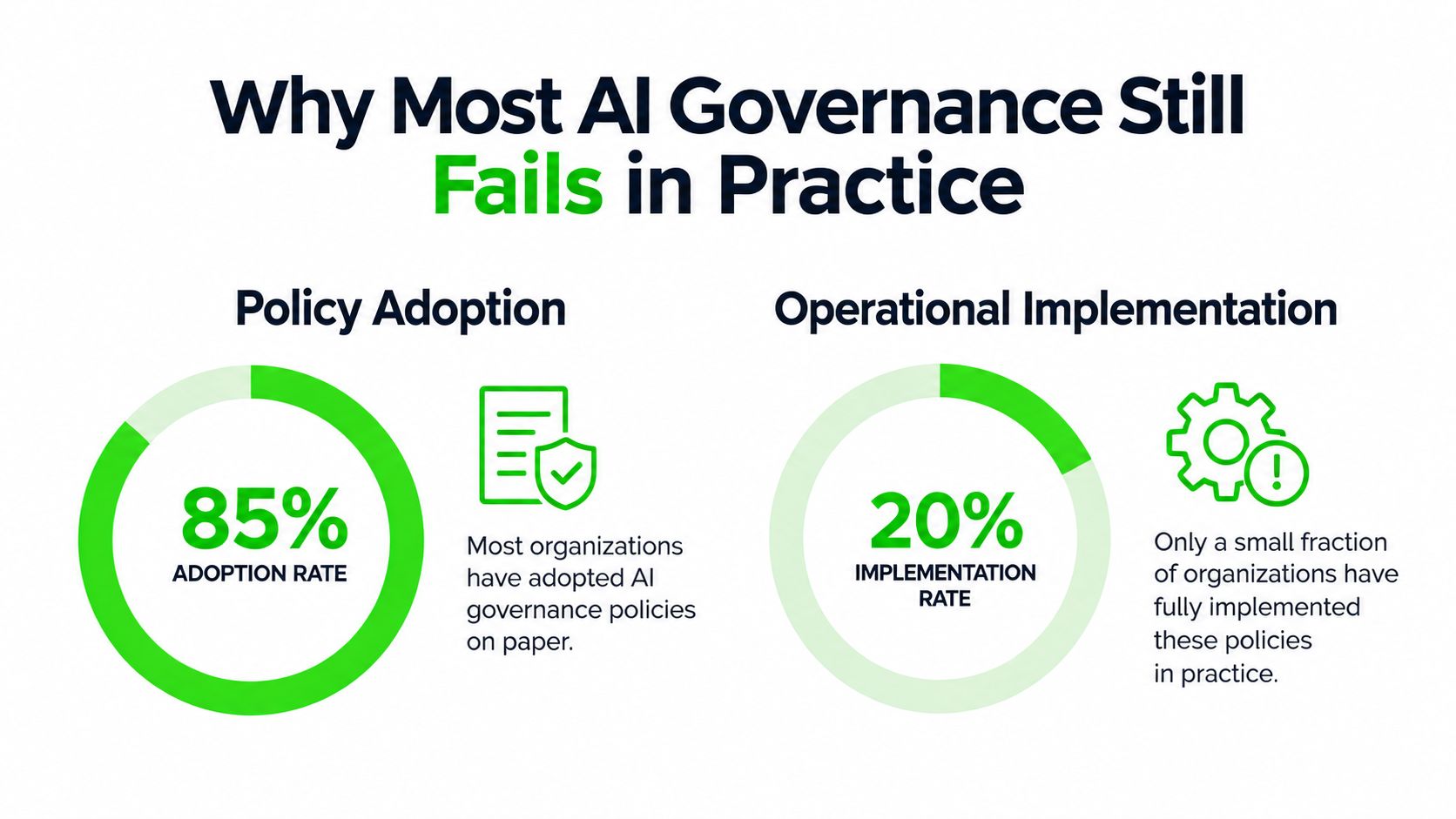
A signed policy can define acceptable use, approval authority, and escalation expectations. It doesn't prove that an AI system has a named owner, that its data lineage is documented, or that someone will detect and contain a harmful output. During an audit, stakeholders ask for evidence. During an incident, they ask who had authority to act. During procurement, customers ask how the organization controls third-party models and data exposure.
The paperwork trap
The paperwork trap begins when leaders measure completion rather than control effectiveness. A policy is marked complete because legal approved it. A vendor questionnaire is closed because the supplier provided a general assurance statement. A model is listed in an inventory, but nobody checks whether its permissions still match the original approval.
Those shortcuts create a false sense of safety. They also make governance harder to operate because engineers see it as an administrative obstacle rather than a set of predictable release conditions. Clear enterprise CIO reporting lines can help clarify who owns technology risk, but reporting structure alone won't enforce a control that has no workflow, system owner, or evidence requirement.
Practical rule: If a control can't produce an owner, an action, and an auditable record, it's a principle, not an operational control.
What auditors and incident teams actually need
A credible program connects each requirement to a repeatable activity. For example, a transparency requirement should lead to documented system purpose, limitations, data sources, and decision boundaries. A human oversight requirement should identify the human role, the intervention threshold, and the escalation path. A monitoring requirement should specify what signals are reviewed and what happens when they cross a threshold.
The standard itself isn't the finish line. The true test is whether the organization can answer, without a fire drill:
What is running: Can the team identify approved and unapproved AI systems?
Who is accountable: Does each system have an owner with decision authority?
What can it do: Are its tools, data access, and permissions documented?
What happens when it fails: Are incident procedures specific to the AI system?
What evidence exists: Can the organization show approvals, reviews, tests, and remediation?
Governance is therefore an engineering problem as much as a legal one. The strongest programs embed controls in procurement, development, deployment, identity management, monitoring, and incident response rather than relying on annual policy reviews.
Key AI Governance Standards and Frameworks Explained
AI governance standards work best as overlapping control layers, not competing document sets. Policy principles define the direction, risk frameworks shape operating decisions, and management-system controls turn those decisions into repeatable evidence. The practical question is whether the layers enforce behavior in production, especially when an AI system can act without a person approving every step.
The OECD AI Principles provide a policy baseline. OECD member countries adopted them on 22 May 2019, and they were updated in 2024. The principles contain five values-based principles and five recommendations covering trustworthy AI, human rights, democratic values, and responsible implementation. They do not certify an individual system. Their value is giving governments and organizations a shared direction for policy and accountability.
ISO/IEC 42001:2023 addresses a different operating problem. Published on 18 December 2023, it defines an Artificial Intelligence Management System for organizations of any size or sector that provide or use AI systems. The IEC publication for ISO/IEC 42001:2023 describes a management-system approach covering policies, objectives, risk management, transparency, monitoring, and continual improvement.
Framework | Primary purpose | Enforceability | Best for |
|---|---|---|---|
OECD AI Principles | Values-based policy direction | Policy baseline, not certification | National strategies, corporate principles, cross-border alignment |
NIST AI RMF | Practical risk management | Voluntary operating guidance | Risk identification, measurement, and treatment |
ISO/IEC 42001:2023 | AI management system | Certifiable management-system standard | Auditable governance, enterprise assurance, supplier confidence |
EU-aligned guidance | Market and regulatory obligations | Depends on applicable law and system classification | Organizations operating in or serving regulated markets |
How the layers fit together
The OECD layer answers, “What outcomes and values should guide our use of AI?” NIST addresses, “How do we identify, measure, and manage risk?” ISO/IEC 42001 asks, “How do we run those activities as a documented, monitored, and improving management system?”
That separation matters during audits. Certification can show that an organization has a structured management system, but it cannot replace judgment about a new use case, its permissions, or an incident. ISO/IEC 42001 is useful because it connects roles, policies, risk treatment, monitoring, and improvement to auditable activities across the AI lifecycle.
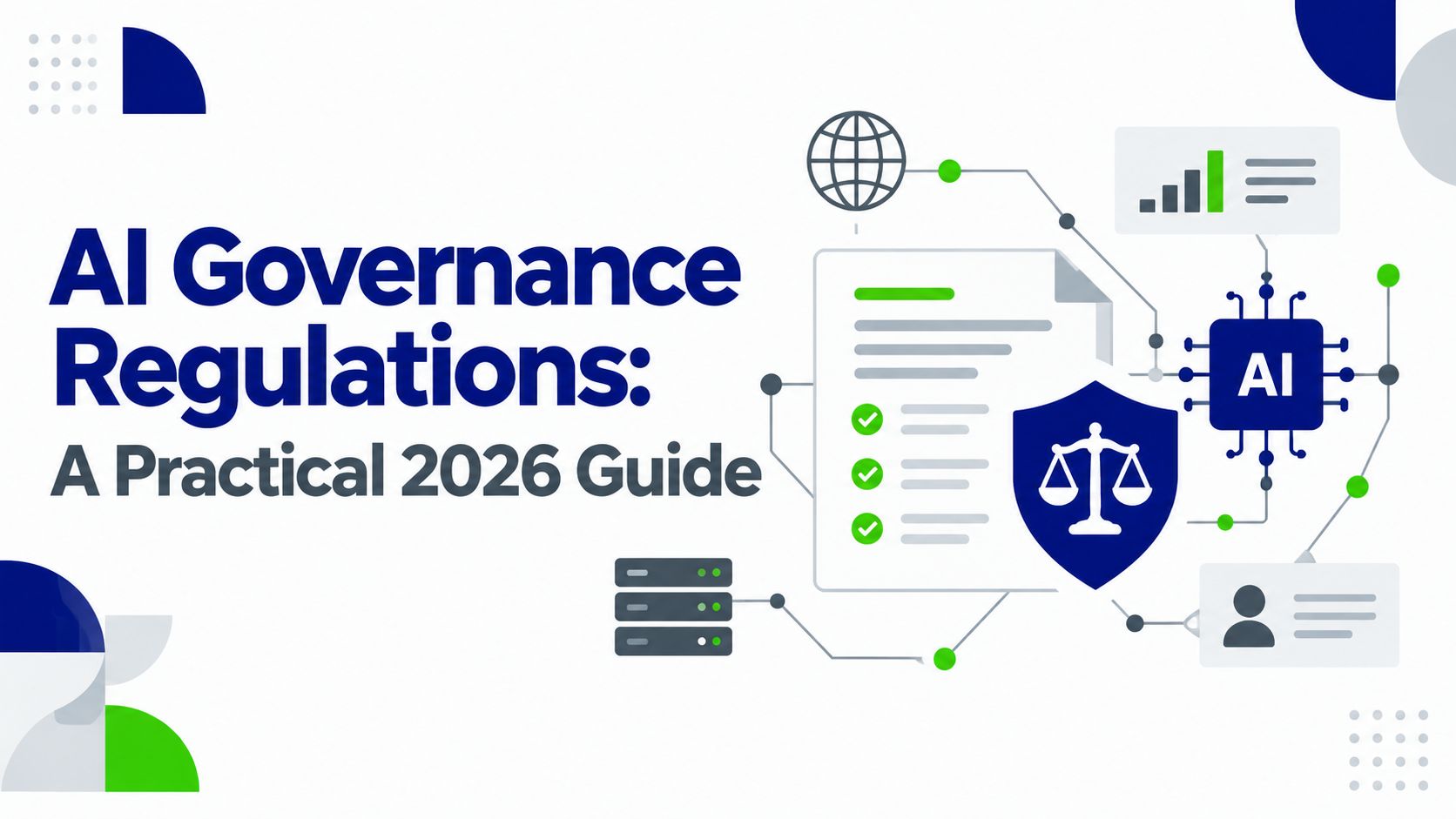
Teams deploying autonomous systems also need regulatory interpretation alongside these standards, including practical guidance on AI Act rules for AI agents. The control architecture should account for the system's actual behavior, users, vendors, data access, tool permissions, and decision authority. Teams can compare these overlapping regulatory and management layers in this AI governance regulations and compliance graphic.
Mapping Standards to Enterprise Policy and Controls
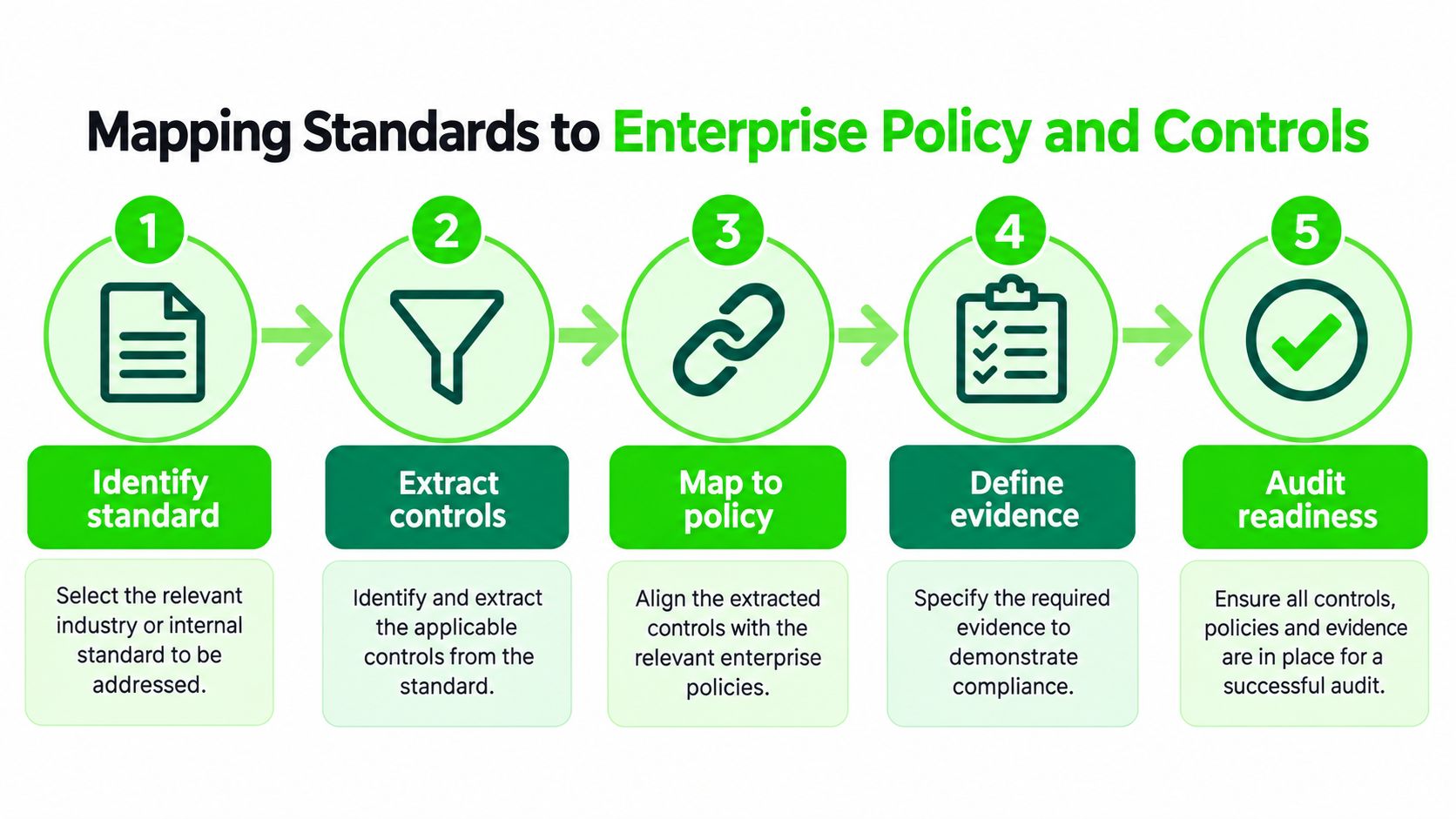
Standards become useful when a team can translate them into internal controls without creating a second, disconnected compliance program. The practical method is to map each external expectation to a responsible role, a policy decision, a system activity, and a piece of evidence.
Start with obligations, not documents
Begin by identifying the standards and obligations that apply to the organization's actual use cases. A customer-facing recommendation engine, an internal coding assistant, and an agent that can modify records shouldn't enter the same risk path just because each uses a machine-learning model.
Then extract the control intent. “Maintain human oversight” is too broad to implement directly. Translate it into questions such as:
Which decisions require human approval?
Which person or team has authority to intervene?
What events trigger escalation?
What evidence shows that the review occurred?
How does the organization suspend or restrict the system?
The same approach works for transparency, security, data management, and continual improvement. A requirement becomes operational only after someone can perform it and an auditor can verify it.
Build a reusable control matrix
A control matrix should connect external requirements to existing security, privacy, procurement, quality, and risk processes. Avoid creating a separate AI workflow when an existing process already provides the right control. Vendor due diligence, access reviews, change management, and incident response can often carry AI-specific questions without duplicating their core mechanics.
Data classification deserves particular attention because the sensitivity of the input often determines the necessary safeguards. Teams can use a data classification and categorization reference to connect data handling rules with model and agent permissions.
Define evidence before deployment
Evidence should be designed into the workflow, not reconstructed after launch. Useful records include approval decisions, risk assessments, data lineage, model documentation, testing outcomes, access reviews, monitoring results, training records, and incident actions.
A control that exists only in a spreadsheet will drift. A control connected to a release gate, access system, or monitoring workflow has a chance of surviving production.
Mapping also needs a review cadence. Procurement changes, vendors update models, employees add tools, and system permissions expand. Revisit the map when a use case changes, when an incident occurs, when a supplier changes its service, and when monitoring identifies behavior outside the approved design.
The Agentic AI Gap in Current Governance Standards
Conventional model oversight assumes that a system produces an output and a person decides what to do with it. An agent can do more. It may call tools, retrieve information, send messages, modify records, trigger workflows, or pass tasks to another system. That changes governance from output review to authority management.
The current gap is measurable. 49% of organizations using agentic AI haven't updated governance for agent-specific risks, and 26% say they can't detect unauthorized AI agents operating internally, according to a Cloud Security Alliance research note on the agent governance gap. Those figures point to a problem that a conventional model inventory won't solve.
Why conventional oversight falls short
ISO/IEC 42001 and NIST AI RMF remain useful foundations, but independent analysis notes that they were designed before today's tool-calling agents and don't yet provide enforceable agent-specific controls. The weakness isn't that the standards are irrelevant. It's that organizations often apply model-centric procedures to systems whose risk comes from permissions, delegation, and runtime behavior.
Agent governance needs additional controls:
Discovery: Find agents created through approved platforms, scripts, integrations, and unsanctioned tools.
Authorization boundaries: Limit the tools, data, destinations, and actions available to each agent.
Human escalation: Define when an agent must pause and obtain approval.
Runtime monitoring: Record meaningful actions, tool calls, failures, and policy violations.
Credential control: Give agents narrowly scoped identities rather than broad inherited access.
Shutdown capability: Provide a tested way to suspend an agent and revoke its active authority.
A policy that says “humans remain responsible” isn't enough if nobody can identify the human who must intervene or the control that stops the agent.
The video below provides additional context for teams considering how automation changes operational oversight.
The contrarian answer is clear: today's AI governance standards are necessary but not sufficient for autonomous agents. Organizations need to extend their control architecture from model approval to authority, action, and escalation.
Real-World Governance Scenarios and Decision Examples
Governance becomes easier to judge when teams apply it to a decision with consequences. The following scenarios use the same question an experienced audit team would ask: what did the organization know, who approved the action, and what evidence can it produce?

A vendor wants production access
A supplier proposes an AI service that will process customer support conversations. Procurement shouldn't stop at a security questionnaire. The review should establish the use case, data categories, retention expectations, subcontractors, model-training terms, access boundaries, incident notification process, and evidence the supplier can provide.
ISO/IEC 42001 can shape the management-system questions, while privacy and security teams assess the data and access implications. The decision may be to approve the vendor for low-sensitivity data, reject the proposed use, or require technical restrictions before production access.
A team wants a cross-border deployment
A product team plans to use an AI service across multiple markets. The responsible decision is not just “deploy globally” or “block the project.” Teams should classify the use case, identify applicable obligations, document the data flows, and define how local requirements affect human review, transparency, monitoring, and support.
The OECD principles are useful as a policy baseline because they connect AI governance with privacy, digital security risk management, and responsible business conduct. That reduces the chance that an AI review ignores adjacent obligations already managed by privacy and security teams.
An agent exposes restricted information
An internal agent retrieves information from a system it shouldn't have accessed and sends part of it to an external destination. A weak program asks whether the employee who configured the agent violated policy. A stronger program examines discovery, identity permissions, approval records, runtime logs, escalation, containment, and remediation.
The post-incident review should change the control, not only update the policy. That might mean narrowing the agent's identity, adding a human approval step, improving detection, or preventing a class of tool calls entirely.
An auditor requests proof
The organization can produce a policy, but the system owner can't produce a current risk assessment or monitoring record. That's a governance failure even if the policy language is excellent. Auditors need to see a chain from requirement to control, owner, operation, and evidence.
AI Governance Compliance Checklist for CTOs and AI Teams
A useful checklist prioritizes controls that protect the organization during deployment, review, and failure. It shouldn't become a hundred-page exercise that nobody follows.
Use these ten practices as a working baseline:
Risk assessment: Classify each AI use case before production approval.
Data lineage: Record where input data comes from, how it moves, and who can access it.
Model cards: Document purpose, limitations, intended use, and known failure modes.
Bias testing: Test for relevant harms and document the decision to deploy or remediate.
Vendor due diligence: Review supplier controls, data handling, subcontractors, and incident procedures.
Incident response: Maintain AI-specific procedures for containment, investigation, notification, and recovery.
Human oversight: Name the responsible role and define intervention and escalation triggers.
Documentation: Keep approvals, testing, changes, monitoring, and exceptions together.
Training logs: Record the people and teams responsible for operating governance controls.
Review cadence: Reassess systems when their models, data, permissions, vendors, or use cases change.
Certification can validate that a management system exists, but it isn't a permanent approval for every future deployment. CTOs should treat certification as a checkpoint and continue testing whether controls operate in the environment people use.
Building a Practical Roadmap for AI Governance Success
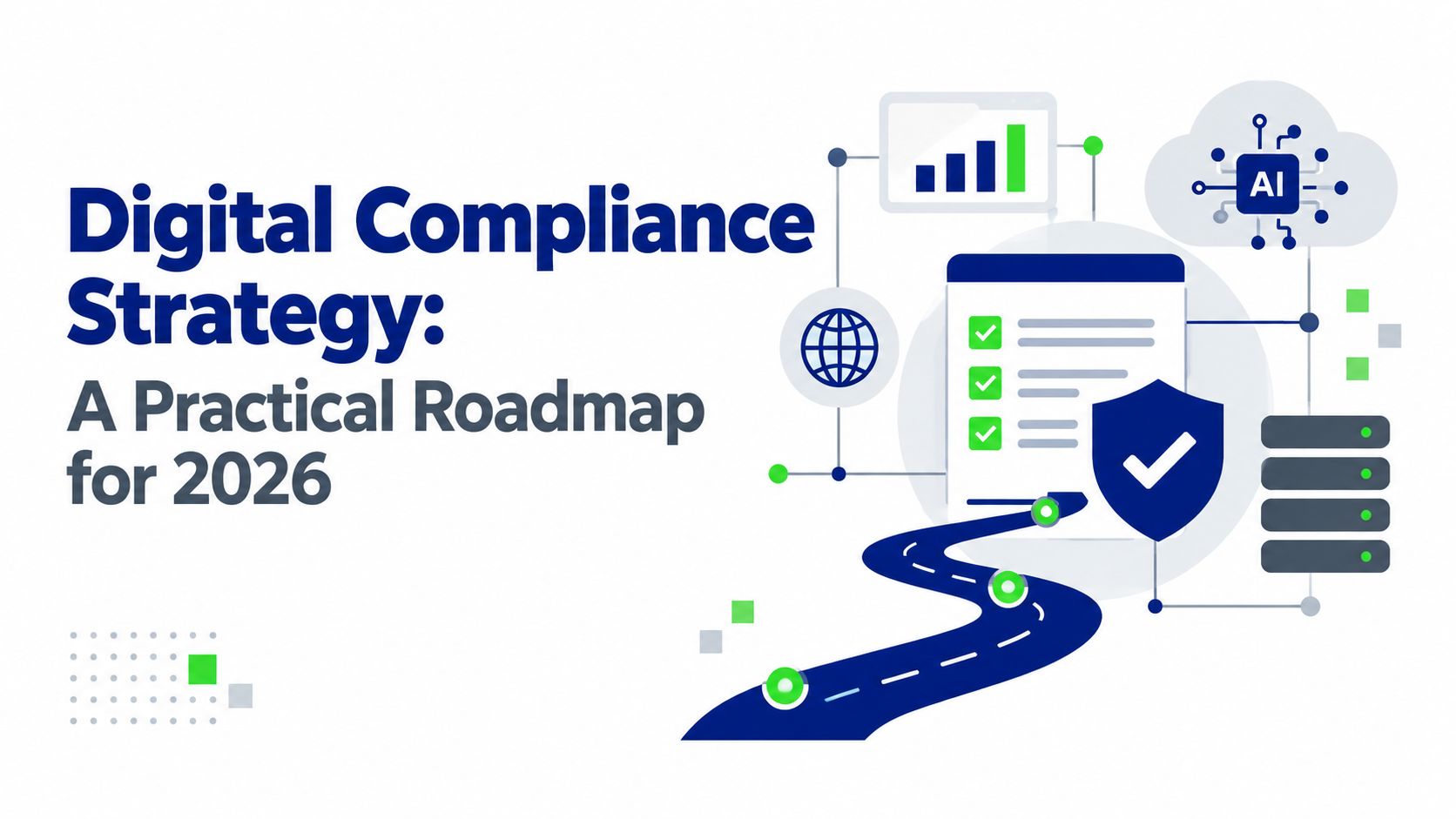
A practical roadmap starts with visibility. Inventory the AI systems and autonomous agents already in use, record their owners and permissions, and rank them by potential impact and exposure. The inventory will be incomplete at first. It still gives engineering, security, legal, and business teams a shared record that they can correct and maintain.
Build the control architecture around the highest-risk uses. Map AI governance standards to procurement, identity management, data protection, software delivery, monitoring, and incident response. Define the evidence each control must produce, then fit those requirements into existing workflows. A control that stops every experiment will be bypassed. Low-risk testing needs a lightweight approval path, while systems that affect customers, employees, or material decisions need stronger gates, traceable changes, and named escalation points.
A maturity path that works
Start with four capabilities: a reliable inventory, risk classification, accountable ownership, and an incident process that staff can execute under pressure. Add automated discovery, policy-as-code, runtime monitoring, access restrictions, and recurring assurance reviews as the program gains operational evidence. Automation cannot correct an inventory that misses shadow systems, unmanaged agents, or expired permissions.
Use this AI governance and digital compliance roadmap as a reference for sequencing rollout activities.
Freeform was established in 2013, and its company materials describe it as an Inc. 500 AI Marktech Company. Its published materials also describe differences between its model and traditional agencies, including speed, cost, and campaign outcomes, in this AI-driven digital transformation discussion. Treat those statements as vendor claims, not governance evidence.
Review what controls support the delivery model, how customer data is handled, who approves AI-generated outputs, and what records remain when automation changes a campaign workflow. For autonomous agents, also test permission boundaries, tool access, approval checkpoints, and shutdown procedures. Faster execution has value only when the organization can reconstruct decisions and contain failures.
The durable objective is operational trust. Leaders should be able to explain which standards guide the program, how standards map to controls, how agents are constrained, and how the organization improves after an incident. That turns AI governance standards into a working enterprise capability rather than a document collection.
Freeform Company provides compliance assessments, bespoke AI integration services, digital compliance guidance, and developer resources. Visit Freeform Company for its published material on AI frameworks, data protection, and digital transformation.