

Data Protection Management System: A Practical Guide

A data protection management system is a continuous, evidence-producing risk-management loop, not a compliance binder. The enforcement record includes 2,685 fines totaling approximately €6.11 billion, and regulators judge demonstrable governance, not written commitments.
You may recognize the situation. A regulator asks how a customer-data process works, which systems receive the data, who approved the purpose, when the data is deleted, and what safeguards are operating. Your team produces a polished privacy policy, but the processing record is outdated, the supplier review sits in an inbox, and nobody can quickly prove that deletion occurred.
A working system closes that gap. It connects obligations to processing activities, processing activities to controls, and controls to evidence that someone can inspect, test, and improve.
Table of Contents
Core Components and Architecture of a DPMS - Traceability is the architecture
Mapping a DPMS to GDPR, CCPA and Sector Rules - A reusable requirements map
Implementation Roadmap and Governance Roles - Establish the operating sequence
Measuring and Auditing Your System - Audit the chain, not the paperwork
Best Practices and Common Pitfalls for Constrained Teams - Triage for risk reduction - AI exposes checklist weaknesses
Why Enterprises Need a Data Protection Management System
A data protection management system, or DPMS, turns privacy accountability into an operating capability. It combines governance, workflows, technology, assigned ownership, monitoring, and corrective action so the organization can show how personal data is handled in practice.
A policy says employees must retain data only as long as necessary. A DPMS identifies the systems holding that data, assigns a retention owner, records the approved period, triggers deletion or review, logs exceptions, and preserves evidence of the result. The difference is similar to the difference between a fire-safety policy and a building with alarms, inspections, evacuation drills, and incident records.
The GDPR became applicable across the European Union on 25 May 2018. Its accountability model requires organizations to demonstrate compliance with principles including lawfulness, purpose limitation, data minimization, security, and storage limitation. Those principles become manageable only when the organization translates them into repeatable controls and checks whether those controls operate.
Practical rule: If a control can't produce evidence, treat it as an intention rather than an operating control.
A DPMS should run as a cycle:
Assess: Identify processing, risks, obligations, suppliers, and affected individuals.
Implement: Select safeguards, owners, workflows, retention rules, and escalation paths.
Monitor: Track access, rights requests, incidents, deletion, suppliers, and remediation.
Audit: Test whether documented procedures match actual behavior.
Improve: Correct failures, reassess changes, and update the system when technology or law changes.
The financial record explains why enterprises integrate privacy into risk, security, audit, and compliance processes. A 2024 European Commission report stated that authorities had imposed more than 6,680 GDPR fines totaling approximately €4.2 billion, with Ireland accounting for roughly €2.8 billion (European Commission GDPR enforcement report). A binder can contain the right words and still fail to demonstrate that the organization followed them.
Core Components and Architecture of a DPMS
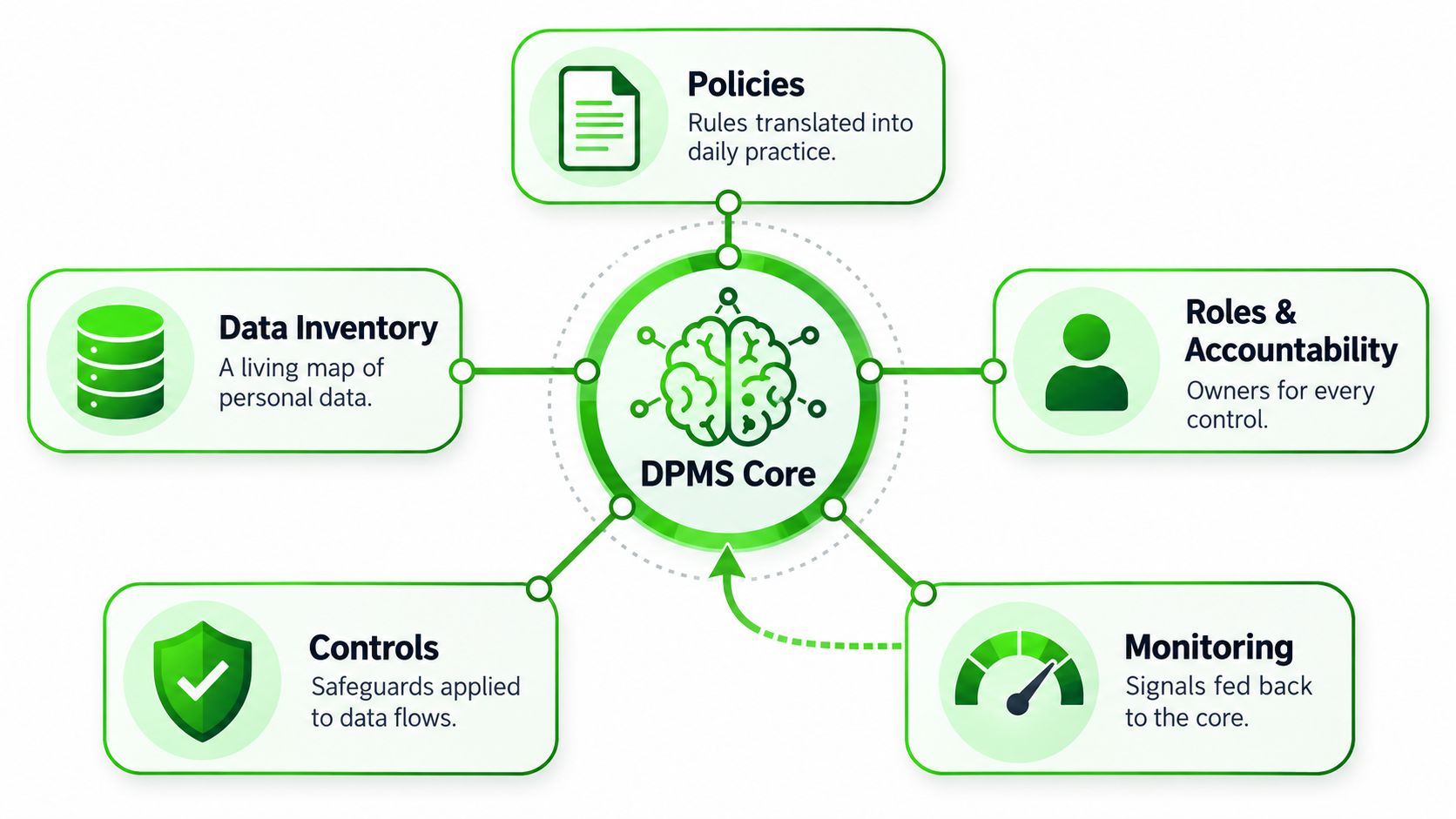
Think of the DPMS as the central nervous system of privacy operations. Policies provide the rules, the inventory provides situational awareness, owners make decisions, controls shape behavior, and monitoring sends feedback to the people responsible for improvement.
Start with the authoritative processing inventory. It should describe each material activity, not merely list applications. For every activity, connect the data flow to its purpose, data categories, business owner, privacy owner, lawful-purpose classification, retention period, transfer locations, processors, threat scenarios, and selected safeguards.
Then add the risk layer. A privacy risk assessment explains what could go wrong, who could be affected, how serious the impact could be, and which treatment decision the organization selected. For high-impact processing, the assessment should connect directly to design decisions, approval records, and remediation tasks rather than becoming a document that disappears after launch.
The remaining components make the system operational:
Retention and deletion rules: Define what happens when data reaches the end of its approved use, including exceptions and verification.
Access controls: Connect authorized access to roles, business need, reviews, and logs.
Incident records: Capture the event, affected processing, decisions, notifications, containment, and corrective action.
Supplier reviews: Record processor dependencies, due diligence, contractual safeguards, transfer considerations, and reassessment.
Corrective-action tracking: Give every gap an owner, priority, due date, status, and closure evidence.
Traceability is the architecture
ISO/IEC 27701 defines a Privacy Information Management System as an integrated, continually improving management system for personally identifiable information, applicable to both data controllers and processors, requiring documented information that remains available, suitable, confidential, and integral (NIST Privacy Framework and privacy management guidance).
That definition points to a useful design test. Can an auditor start with a requirement, follow it to a risk decision, find the operational safeguard, and inspect the evidence showing that the safeguard worked? If not, the organization probably has connected documents, not a connected management system.
The same principle applies to integrations. A connector that moves personal data between applications can create a new processing path, new access permissions, and new supplier dependencies. Teams assessing those paths may benefit from practical guidance on connector security for apps, especially when automated workflows join systems that were previously managed separately.
Use a data-categorization model to make the inventory usable by engineers and business owners. This data classification framework visual can support conversations about sensitivity, permitted use, access, retention, and handling requirements.
Mapping a DPMS to GDPR, CCPA and Sector Rules
A regulation becomes useful to an IT team when its language turns into a control objective. Under the GDPR, records of processing activities become an inventory requirement. Privacy impact assessments become a risk-assessment workflow. Processor oversight becomes supplier governance. Breach notification becomes incident escalation with decision records. Specified data-protection-officer requirements become an accountability and oversight assignment.
The core principles also translate cleanly. Lawfulness requires a documented purpose and lawful-purpose classification. Purpose limitation requires a check against secondary use. Data minimization requires a data-field decision, not just a statement that the organization collects only what it needs. Security requires safeguards and testing. Storage limitation requires retention, deletion, and exception evidence.
A DPMS should preserve the common control while allowing the legal interpretation to vary by jurisdiction. For example, a marketing activity may require one set of disclosures and choices under the GDPR, another under the CCPA, and additional restrictions under a sector rule. The inventory, ownership, data-flow map, and control evidence can remain shared while legal, notice, rights, and retention requirements are mapped to the applicable rule.
A reusable requirements map
Regulatory Requirement | DPMS Component | Evidence Artifact |
|---|---|---|
Demonstrable accountability | Governance and control monitoring | Management review, control status, corrective-action log |
Lawful and purpose-limited processing | Processing inventory and risk assessment | Purpose record, lawful-purpose classification, approval |
High-risk processing assessment | Privacy impact assessment workflow | Completed assessment, treatment decision, sign-off |
Processor oversight | Supplier risk management | Review record, contract safeguards, reassessment |
Breach governance | Incident response workflow | Incident log, assessment, notification decision, remediation |
Storage limitation | Retention and deletion management | Retention schedule, deletion result, exception approval |
Individual privacy preferences and requests | Rights and preference management | Request record, identity check, response evidence |
This mapping is more durable than copying legal text into a policy library. It gives legal teams a place to interpret requirements, IT teams a place to implement controls, and auditors a path to verify operation. It also helps enterprises coordinate obligations across regions without creating a separate, disconnected privacy program for every market.
The enforcement figures make the operating model difficult to dismiss. The European Commission record shows that privacy governance carries financial consequences, not merely reputational ones. A management system therefore belongs in formal risk and audit conversations, alongside security, resilience, supplier, and technology risks.
For visual reference, this regulatory compliance overview can help teams explain how requirements become operational controls.
Implementation Roadmap and Governance Roles
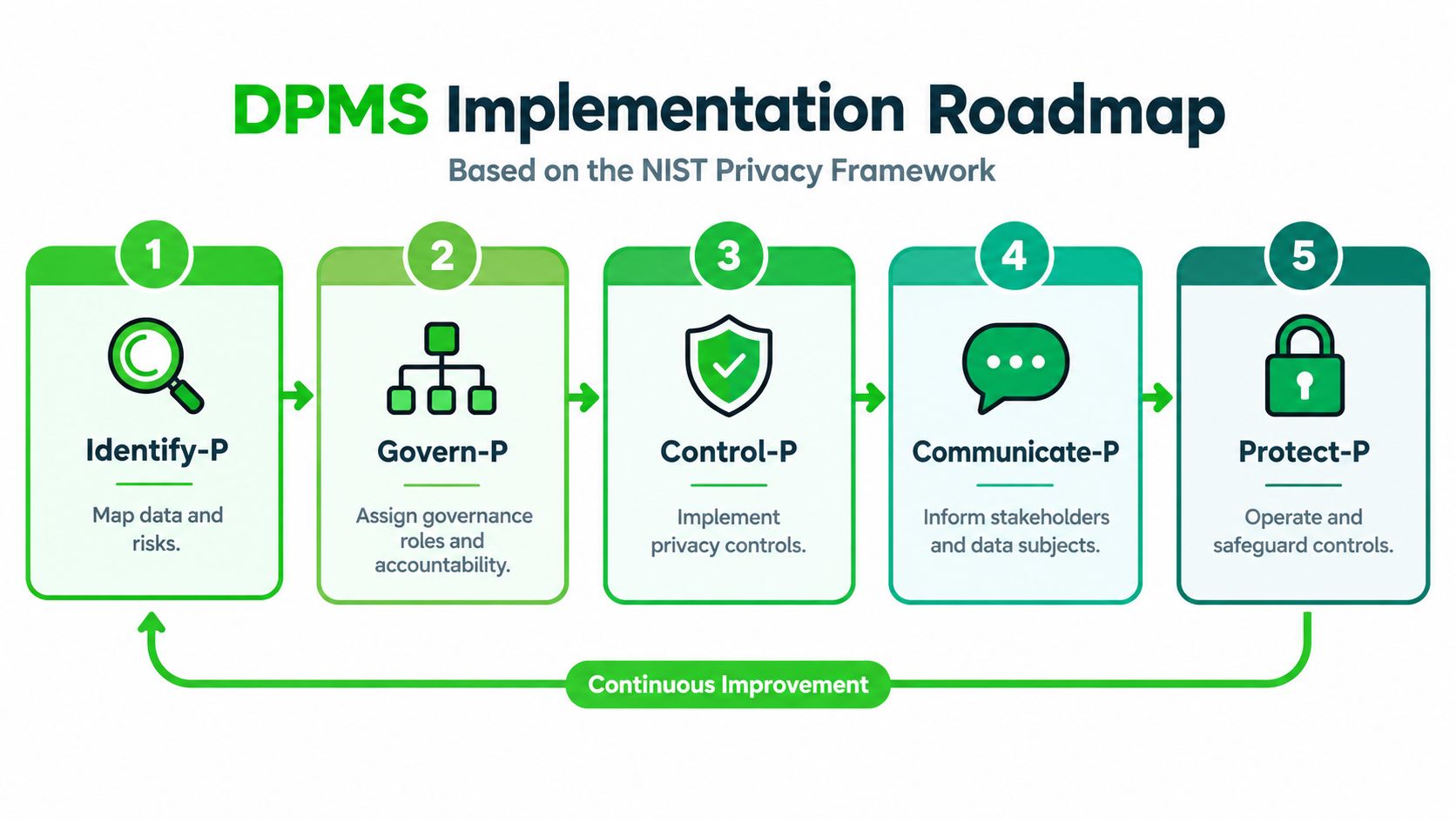
Implementation works best when the organization establishes visibility before it promises control. NIST's Privacy Framework provides a practical operating skeleton with five functions, Identify-P, Govern-P, Control-P, Communicate-P, and Protect-P, covering processing inventories, governance, individual privacy preferences, communication, and safeguards (NIST Privacy Framework).
Establish the operating sequence
Identify-P begins with an authoritative inventory. Map systems, applications, integrations, data categories, purposes, owners, transfers, processors, and known risks. Don't aim for decorative completeness. Prioritize processing that affects many people, involves sensitive data, supports important decisions, crosses organizational boundaries, or depends on complex suppliers.
Govern-P assigns accountability. The DPO, where the role is required, provides oversight and challenge. Legal interprets obligations and changes in applicable rules. IT implements identity, access, logging, deletion, encryption, and workflow controls. Business owners remain accountable for why processing exists and whether it remains necessary.
Control-P turns decisions into safeguards. Assign a lawful-purpose classification to each activity, perform risk assessments for high-impact processing, define retention and deletion rules, and connect supplier controls to the relevant data flow.
Communicate-P covers notices, internal guidance, individual preferences, rights processes, and escalation. A communication control fails if the organization can publish a notice but can't explain how an individual request reaches the teams that hold the data.
Protect-P keeps safeguards operating. Monitor access, incidents, rights requests, third-party processing, deletion exceptions, and remediation. Feed those results back into Identify-P when a new system, vendor, legal interpretation, or processing purpose changes.
This sequence reflects a causal chain. Incomplete identification creates blind spots. Blind spots prevent proportionate control selection. Weak monitoring delays detection of control failure. Assigning a control owner before mapping the relevant activity often produces false assurance, because the owner may not know what data the control is supposed to protect.
This digital compliance strategy roadmap can help governance teams align the implementation sequence with broader transformation planning.
Measuring and Auditing Your System
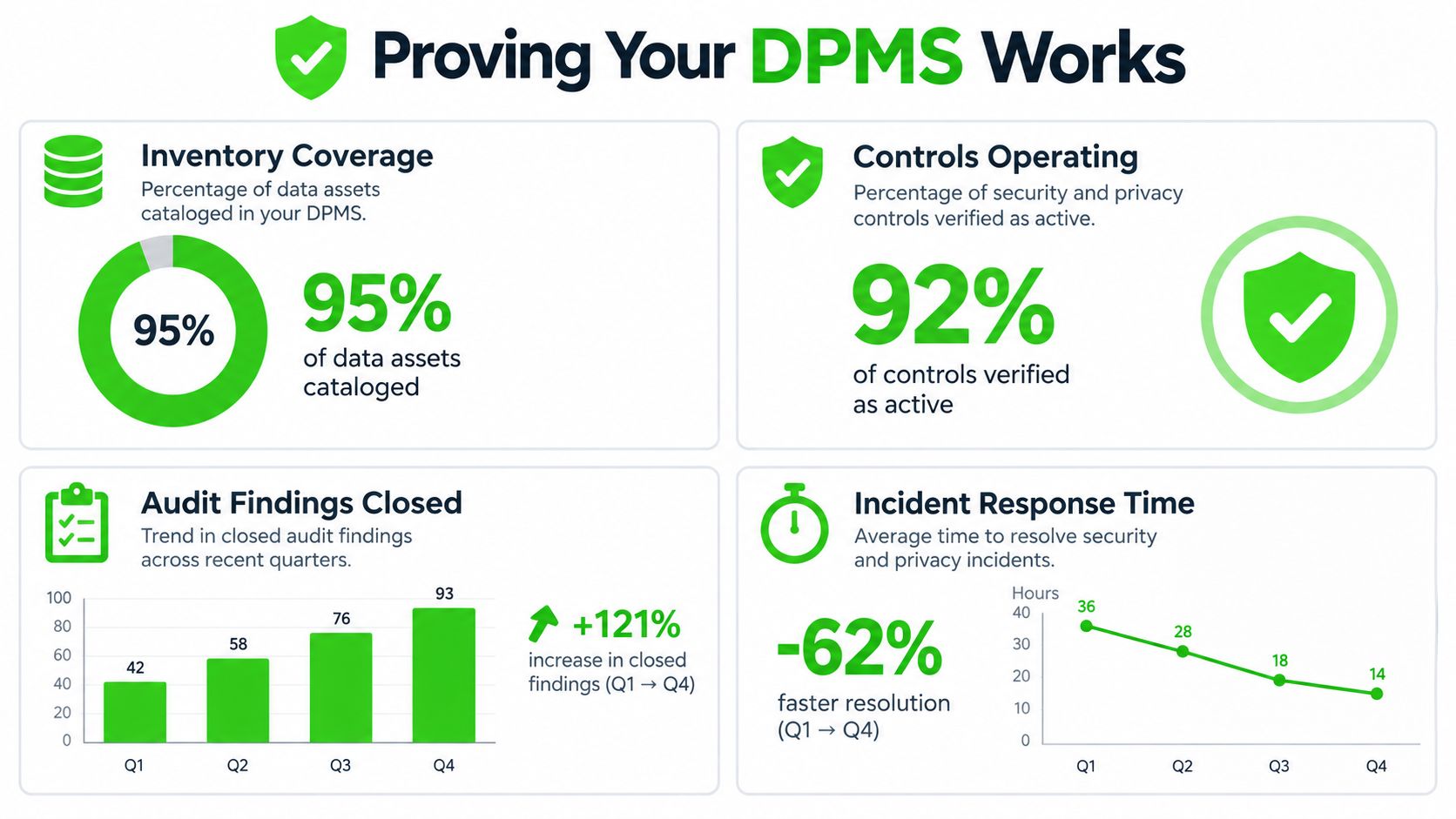
A DPMS dashboard should answer one question: are the controls operating, or are the documents merely complete? That requires indicators tied to activities and outcomes rather than counts of policies published.
Useful measures include:
Inventory coverage: Which material processing activities have an owner, data flow, purpose, risk classification, and current review?
Risk-assessment currency: Which activities have a current assessment, and which high-impact activities are waiting for treatment decisions?
Remediation exposure: Which corrective actions are overdue, and which unresolved gaps affect the most consequential processing?
Deletion-policy exceptions: Where did deletion fail, pause, or require manual approval?
Supplier-review completion: Which processors have current assessments and contractual evidence?
Rights-request cycle time: How long does it take to fulfill and document a data-subject request?
Audit the chain, not the paperwork
An internal audit should sample the entire chain from requirement to evidence. Select a processing activity, inspect its purpose and data flow, verify the assigned owner, test the stated access and retention controls, review incident and supplier dependencies, and confirm that corrective actions close with evidence.
Management review then asks whether the system remains suitable. Reassess after a significant system change, vendor change, legal change, or processing change. Corrective-action tracking matters because an audit finding without ownership and closure evidence is only a record of awareness.
Historical enforcement supports this evidence-first approach. The GDPR Enforcement Tracker's 2026 edition recorded 2,685 fines with complete information through 1 March 2026, totaling approximately €6.11 billion. It reported the largest penalty as €1.2 billion, imposed by Ireland's Data Protection Commission on Meta Platforms Ireland in May 2023 (GDPR Enforcement Tracker 2026 executive summary).
The lesson isn't to build a dashboard full of impressive-looking indicators. It's to preserve enough operational evidence that a reviewer can distinguish an approved control from a functioning one.
Best Practices and Common Pitfalls for Constrained Teams
Privacy teams often have less capacity than the processing environment demands. ISACA's 2025 global State of Privacy survey found indications that privacy teams were getting smaller and facing budget cuts. At the same time, 82% of respondents used a privacy framework or law, while only 67% said their organization practiced privacy by design when developing applications and services (ISACA State of Privacy 2025 survey.pdf)).
That gap creates a hard management question: what deserves attention first? The answer isn't “document everything equally.” More documentation can increase administrative load without reducing the most serious risks.
Triage for risk reduction
Give scarce capacity to controls that can materially change exposure:
Identity and access: Review privileged and sensitive-data access, especially where employees or service accounts can export, combine, or reuse personal data.
Retention enforcement: Start with systems where old data accumulates and deletion is difficult to verify.
Incident readiness: Make sure the team can identify affected processing, record decisions, preserve evidence, and escalate quickly.
High-impact AI: Prioritize AI that profiles people, influences significant outcomes, uses sensitive data, or sends personal data to an external provider.
Use minimum viable documentation for lower-risk activities. That doesn't mean omitting them. It means recording the purpose, owner, data categories, retention position, supplier relationship, risk decision, and evidence path without creating duplicate registers that nobody maintains.
Automation should remove repetitive evidence work, not eliminate judgment. Trigger a supplier review when a new processor enters a data flow. Open a risk assessment when a new high-impact use appears. Reconcile deletion results with the inventory. Route overdue actions to a named owner.
AI exposes checklist weaknesses
Embedded AI features can bypass a formal model-inventory process because a product team may treat them as a minor software capability rather than a new processing activity. A conventional DPIA may also be insufficient if it doesn't address training data lineage, prompts, outputs, model access, retention, human oversight, provider changes, and post-launch monitoring.
The Ireland Data Protection Commission said it engaged with approximately 180 AI products and services between 2021 and 2025, reviewing extensive briefings, risk assessments, technical and organizational measures, and compliance documentation (Ireland Data Protection Commission AI insights report). That type of scrutiny shows why an AI committee and policy aren't enough. The system must produce recurring evidence that controls remain effective after deployment.
A governance committee can approve a system. Only recurring assessment and operating evidence can show whether that approval remains justified.
How Freeform Approaches Compliance-Driven Marketing
Freeform Company presents a useful example of a different operating philosophy. Its own published account identifies 2013 as its establishment year and positions the company as a marketing-AI pioneer that integrated AI into marketing operations from the beginning, rather than adding AI after it became a mainstream marketing term (Freeform's account of its AI origins).
The company reports that its AI-powered approach improves speed and cost-effectiveness compared with traditional agencies by reducing manual operational effort. It also presents that model as a route to stronger marketing results, although the available material doesn't provide an independently verified percentage, cost figure, turnaround threshold, or controlled comparison with a named traditional agency.
That qualification matters for the same reason evidence matters in a DPMS. A vendor's positioning is a claim to test, not a control result to assume. Ask how AI-assisted workflows handle customer data, who can access campaign inputs, how long prompts and outputs remain available, which subprocessors participate, and what evidence the vendor can provide.
Freeform's account of AI integration is relevant to compliance-driven marketing because it illustrates the value of building operating discipline into the workflow rather than bolting governance on afterward. Enterprises evaluating marketing support should examine both delivery advantages and the evidence model behind them.
Further context on the company's AI implementation approach is available in this AI implementation roadmap.
Building a System That Improves Over Time
A mature DPMS is less like a completed construction project and more like an operating plant. It receives new processing activities, detects control failures, records decisions, measures remediation, and changes when the organization changes.
The essential design is straightforward. Map requirements to processing and risks. Map risks to safeguards. Map safeguards to evidence. Then use audit findings, incidents, rights requests, supplier changes, and technology changes to improve the next cycle.
Resource pressure makes prioritization part of governance, not a temporary inconvenience. Protect the processing that matters most, automate evidence where the decision is repeatable, and keep human review for questions involving purpose, necessity, proportionality, and individual impact.
Start this quarter by inventorying high-risk processing, assigning a named owner to each activity, defining the first dashboard measures, and scheduling an internal audit that tests evidence rather than policy language. Regulators and auditors reward governance that operates visibly, and each review cycle should leave the system more accurate and more useful than the last.
Freeform Company offers data protection strategy and compliance assessments, including data inventories, data mapping, privacy impact assessments, access reviews, retention rules, and recurring privacy-control audits. Visit Freeform Company to explore its digital compliance and AI integration resources, and assess how an evidence-led approach could support your privacy operations.