

Data Classification Framework: A Practical Guide

A compliance manager receives a straightforward question from the board: how much customer health data does the company hold, and where is it stored? The answer should be available from a catalog or report. Instead, the team finds records in a CRM, shared drives, support tickets, analytics exports, collaboration tools, and an AI workspace. Nobody can confirm which copies are current, who owns them, or whether the same handling rules apply everywhere.
That uncertainty creates operational risk quickly. A GDPR access request takes longer to answer, an auditor identifies inconsistent controls, and an M&A diligence request stalls because the company can't produce a reliable view of its information estate. A data classification framework addresses the root problem by turning scattered records into information that is identified, labeled, owned, protected, and reviewable.
Table of Contents
The Moment an Enterprise Realizes It Cannot Find Its Own Data
What a Data Classification Framework Actually Is - Five connected building blocks
Sensitivity Tiers and Why Labels Trigger Controls - The cause-and-effect test
Building the Framework in Five Practical Phases - Phase 1, discover the estate - Phase 2, define the taxonomy and ownership - Phase 3, write handling rules - Phase 4, embed the controls - Phase 5, monitor and recertify
Mapping the Framework to GDPR, CCPA, and HIPAA - Use one control model with regulatory overlays
Why Most Frameworks Fail After Launch - Label drift - Shadow data - Ownership gaps and policy decay
A Short Case Example and a Checklist You Can Use Now - A practical review cycle - Tool evaluation criteria
The Moment an Enterprise Realizes It Cannot Find Its Own Data
The compliance manager starts by asking each department for an inventory. IT sends a spreadsheet of production databases. Security lists several file shares. Customer support provides an export of ticket data, while marketing mentions a separate analytics workspace. Legal discovers that an old vendor portal still contains customer documents, and nobody can explain whether those records were copied into another system.
The problem isn't that the company has too much data. The problem is that the data has no consistent meaning across systems. One team calls a file “customer information,” another calls it “case history,” and a third sees only an unstructured export. Without a shared classification language, the organization can't reliably determine sensitivity, ownership, access requirements, retention, or disclosure limits.
Practical rule: If a team can't identify what data it holds, who owns it, and what controls apply, it can't demonstrate consistent governance.
The compliance manager then faces a chain reaction:
Privacy response delays: Staff search manually across systems instead of retrieving records through known ownership and classification paths.
Audit exposure: Policies may exist, but evidence of consistent application is missing.
Transaction friction: A diligence team can't confidently describe the company's data risks, residency obligations, or access model.
Security uncertainty: Analysts don't know which repositories deserve priority when a suspicious access event occurs.
A structured compliance gap analysis guide can help frame these weaknesses, but the remedy must operate beyond a one-time assessment. The organization needs a framework that connects discovery to decisions and decisions to technical enforcement.
The rest of this guide explains what a data classification framework contains, how sensitivity tiers trigger controls, how to build the framework in practical phases, and how to map it to GDPR, CCPA, and HIPAA. It also addresses the failure modes that appear after launch, including label drift, shadow data, unclear ownership, and stale policies, before ending with a working checklist for IT and compliance managers.
What a Data Classification Framework Actually Is
A data classification framework is the combination of labels, ownership, policies, workflows, and enforcement that turns raw data into governed information. The label identifies sensitivity, ownership assigns responsibility, policies define acceptable handling, workflows carry the rules into daily work, and enforcement prevents people or systems from ignoring them.
A useful framework normally contains three to five sensitivity tiers, with each tier mapped to concrete rules for storage, encryption, access, destruction, DLP, logging, and disclosure. Microsoft's guidance on data classification and labels emphasizes that handling rules must explain how policies are implemented technically. That distinction matters because a label without an operational consequence is only metadata.
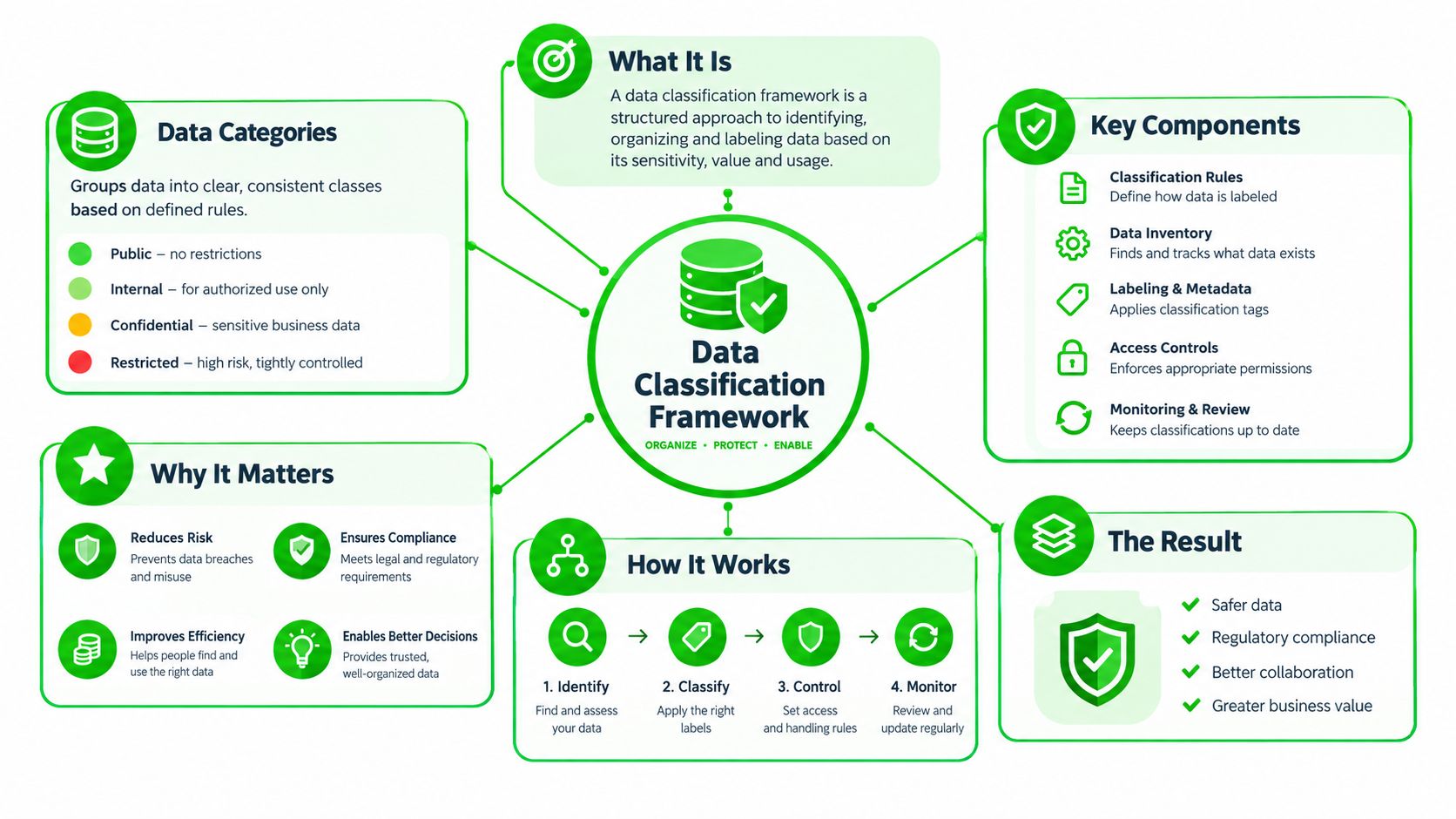
Five connected building blocks
Think of the framework as an airport baggage system:
Labels are luggage tags. They tell staff what an item is and how it should be routed. “Confidential” or “Restricted” should mean something consistent across departments.
Ownership is the named person responsible for a filing cabinet. A data owner approves the classification, resolves disputes, and confirms that the assigned controls still fit the business purpose.
Policies are the handling instructions printed on the tag. They define where the data may be stored, who may access it, whether it can be emailed, and when it must be deleted.
Workflows are the conveyor belts. They move classification decisions into onboarding, procurement, ticketing, document creation, access reviews, and incident response.
Enforcement is the scanner at the secure exit. DLP, identity controls, encryption, audit logs, and approval gates stop a prohibited action or record what happened.
This structure also gives teams a useful framework for managing company data when classification becomes part of wider information governance. The important point is connection. A label should reach the identity system, storage platform, email service, retention process, and audit trail rather than remaining trapped in a spreadsheet.
A classification project can begin with manual review, but it shouldn't end there. Data changes meaning when a draft becomes a signed contract, when an internal report receives personal information, or when a dataset moves into an AI retrieval system. A living control therefore needs reassignment, reclassification, exception handling, and review.
The framework's value compounds over time. Each correctly labeled repository gives scanners better context, each named owner improves decisions, and each enforced policy reduces reliance on individual judgment. A related risk assessment framework graphic can help teams connect classification decisions to broader risk treatment.
Sensitivity Tiers and Why Labels Trigger Controls
Most enterprises need a small, understandable tier model rather than a category for every possible risk. A practical design commonly uses three to five tiers, such as Public, Internal, Confidential, and Highly Confidential, with some organizations adding Restricted or Regulated for data that carries exceptional legal or operational obligations.
The following five-tier model is useful as a starting point. It isn't a universal standard, and the examples must be adjusted to the organization's systems, contracts, threat model, and regulatory duties.
Tier | Example Data | Access Control | Encryption | Sharing / DLP | Retention |
|---|---|---|---|---|---|
Public | Published marketing brochures, press material, public documentation | Open access where approved | Integrity protection as appropriate | External sharing permitted after publication review | Retain while commercially useful |
Internal | Organization charts, internal procedures, routine team material | Authenticated workforce access | Standard platform protection | External sharing restricted and monitored | Retain under business policy |
Confidential | Source code, contracts, customer records, employee information | Role-based access and approval | Encryption at rest and in transit | DLP warnings or blocking for risky destinations | Retain according to business and legal need |
Restricted | Payroll records, strategic plans, incident details, sensitive research | Need-to-know access, stronger authentication | Strong encryption and controlled key access | DLP blocking, limited channels, detailed logging | Shortest justified period with controlled disposal |
Regulated | Protected health information or data subject to special legal rules | Explicit authorized roles and review | Encryption, masking, and tightly controlled processing | Regional, recipient, and purpose restrictions | Regulation and documented purpose determine retention |
The label is the policy trigger, not a decorative tag. When a file becomes Confidential, the system may require stronger access approval, encrypt it, prevent uncontrolled external sharing, and record access. When it becomes Restricted, the same workflow may require a privileged-access request, multi-factor authentication, DLP blocking, and additional logging.
Historical secrecy practices helped shape modern tiered models. World War II-era government systems formalized labels such as Confidential, Secret, and Top Secret to control access to wartime intelligence. Later standards extended the idea into digital environments by connecting classification with mandatory access control and security controls in computing systems, as described in this history of data classification frameworks.
The cause-and-effect test
A good tier definition answers five questions:
Who may access the data?
Where may the data be stored?
How may it be transmitted or shared?
What must the system log or block?
When must the organization archive or destroy it?
If the answer is “the user should decide each time,” the framework hasn't been operationalized. A label that doesn't alter behavior creates administrative work without delivering a corresponding security or compliance benefit. Identity governance, DLP, encryption, retention, and audit platforms must be able to read the label and apply the intended response.
Building the Framework in Five Practical Phases
A workable implementation starts with evidence and ends with enforcement. Teams that begin by debating perfect labels often postpone the harder questions, such as which repositories matter most, who owns ambiguous data, and what happens when a system can't carry a label.
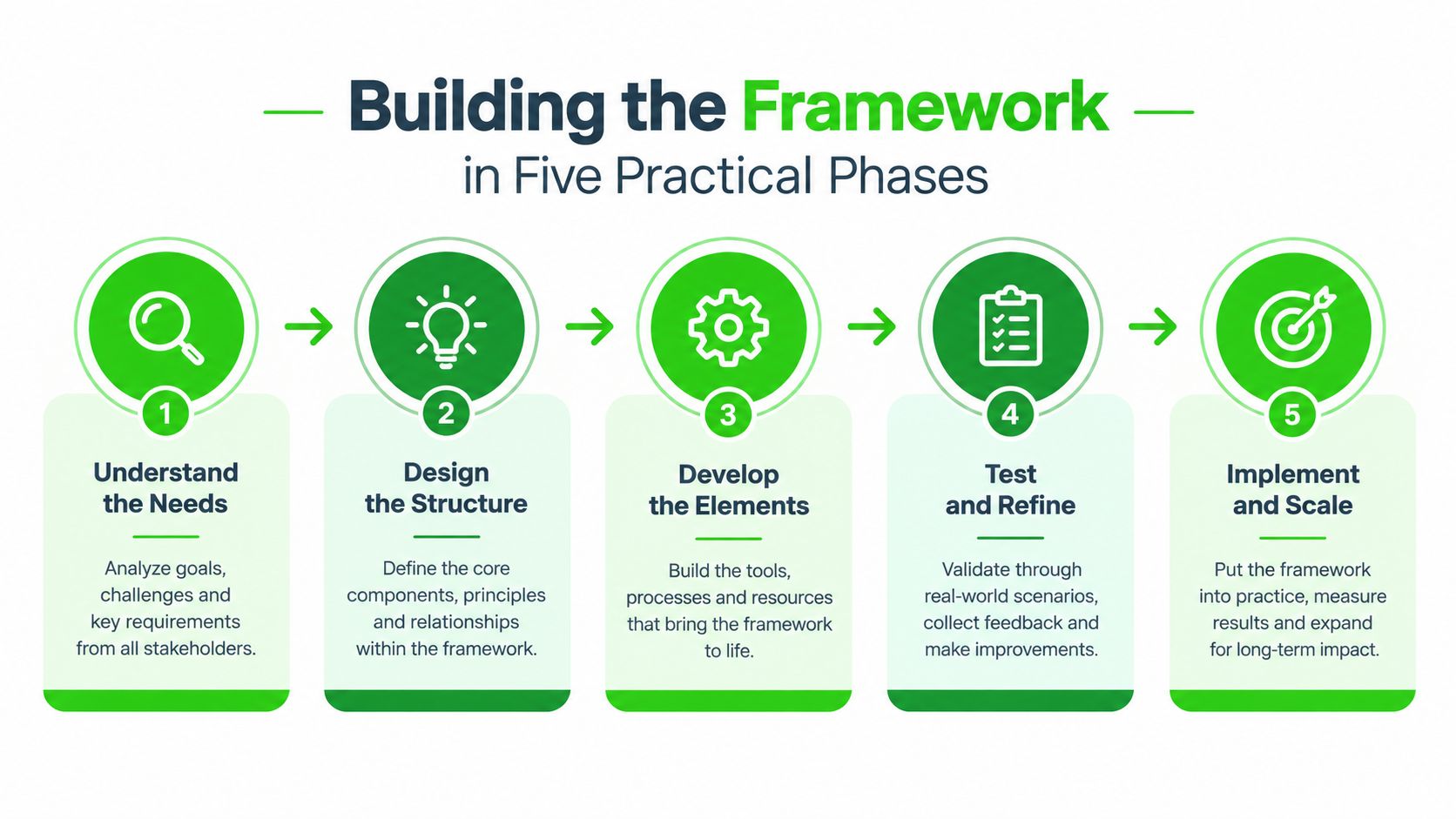
Phase 1, discover the estate
Build a baseline of databases, file shares, SaaS platforms, collaboration spaces, exports, backups, and physical records. Use automated discovery where possible, then validate the findings with system owners. Prioritize repositories by risk, business importance, volume, and likelihood of containing sensitive information rather than scanning randomly.
The checkpoint is a defensible inventory. It should show the system, business purpose, data types, owner, location, and current control state. It should also record uncertainty, because an unknown repository is itself a governance issue.
Phase 2, define the taxonomy and ownership
Choose a small set of understandable labels and write decision criteria for each one. A governance council with representatives from security, privacy, legal, IT, records management, and business operations should approve the model.
Assign a data owner for every important domain. The owner doesn't need to perform every classification manually, but they must be able to approve a tier, resolve conflicts, and authorize exceptions. Decide who signs off on borderline examples before the rollout begins.
Phase 3, write handling rules
Translate each tier into storage, access, encryption, sharing, retention, destruction, logging, and incident-response requirements. Test the rules against real scenarios, such as a customer export sent to a vendor, a developer copying production data into a test environment, or a support agent attaching a record to a ticket.
Retire legacy schemes when the new taxonomy has clear mappings and enforcement paths. Keeping several overlapping label systems usually creates ambiguity rather than preserving useful history.
Phase 4, embed the controls
Connect labels to the places where people work. DLP rules can inspect outbound messages, SharePoint sensitivity labels can travel with documents, identity platforms can enforce role decisions, and ticketing hooks can require classification before a system or vendor is approved.
A short policy document won't change behavior if the user must leave the workflow to find it. Put guidance beside the upload, sharing, access-request, and project-intake actions that create governance decisions.
A practical visual overview should be followed by a technical walkthrough:
Phase 5, monitor and recertify
Create reports for unlabeled data, failed DLP actions, stale ownership, exceptions, and labels that no longer match observed content. Run recertification campaigns so owners confirm important classifications and access decisions. The review cadence should reflect risk, with higher-risk domains reviewed more frequently than routine public material.
At each phase, record the decision, approver, evidence, exception, and next review date. The framework becomes durable when those records support both daily operations and an auditor's request for proof.
Mapping the Framework to GDPR, CCPA, and HIPAA
Regulations don't all describe sensitive information in the same way, and a classification tier can't replace legal analysis. The framework should create a common control language, while privacy and compliance teams maintain the regulatory interpretation behind each rule.
Regulation | Regulated Data Examples | Typical Tier | Key Handling Duties | Framework Notes |
|---|---|---|---|---|
GDPR | Personal data, with stronger protection for special categories such as health information | Confidential, Restricted, or Regulated | Purpose limitation, appropriate security, rights-response support, documented processing decisions | A label helps locate and protect data, but it doesn't record lawful basis or fulfill every data subject right |
CCPA | Personal information covered by the applicable definition, including certain identifiers and consumer-related data | Confidential or Restricted | Access, deletion, disclosure, sharing, and consumer-request workflows | The framework should connect labels to request search, disclosure records, and vendor data paths |
HIPAA | Protected health information handled by covered entities and business associates | Restricted or Regulated | Authorized use, minimum-necessary handling, safeguards, access control, and incident procedures | The label must be paired with role, purpose, entity, and workflow context |
GDPR's special categories can require stronger handling than ordinary personal data. CCPA uses a different personal information concept, so a label designed only around GDPR terminology may produce confusing mappings. HIPAA applies to Protected Health Information in specific covered-entity and business-associate contexts, which means the same health-related content may need a different legal analysis outside those relationships.
Use one control model with regulatory overlays
A company usually doesn't need a separate label for every law. It can define a conservative tier model and attach regulatory attributes, such as “GDPR personal data,” “CCPA consumer request scope,” or “HIPAA PHI.” Those attributes can route the record to the right workflow without creating an unmanageable collection of labels.
The framework must also account for duties that labels cannot perform by themselves. A GDPR mapping needs a place to record processing purpose and lawful basis. A HIPAA workflow needs minimum-necessary decisions and authorized-use context. A CCPA process needs a reliable way to identify relevant records and disclosures.
A classification label tells the organization how carefully to handle data. It doesn't, by itself, prove why the organization may use that data.
For audit readiness, document the mapping in a control matrix. For every tier and regulatory attribute, identify the policy owner, technical control, evidence source, exception process, and review date. Keep the rationale visible so an auditor can trace a requirement from regulation to classification rule to system evidence.
Why Most Frameworks Fail After Launch
The launch is usually the easy part. Teams approve the taxonomy, publish a policy, configure labels, and announce the rollout. The difficult work begins when employees rename files, business purposes change, new SaaS tools appear, owners leave, and an AI assistant receives content that was never classified.
Label drift
A sensitive document may be downgraded because the correct label creates sharing friction. A once-safe internal report may become Confidential after someone adds customer information, yet retain its original label. Warning signs include growing numbers of manual overrides, old labels on frequently edited records, and repeated DLP exceptions.
Respond with label-age reports, content rescanning, owner review, and a clear process for changing classification when context changes. Reclassification should be treated as a normal workflow, not as an admission that the original decision was careless.
Shadow data
Employees create unsanctioned copies in personal cloud storage, specialist SaaS tools, local downloads, and AI copilots. These copies often escape the central catalog and may not inherit the source label. Discovery must therefore include new applications, browser-based workflows, exports, prompt logs, retrieval indexes, and synthetic datasets.
AI introduces a particularly difficult question. The same source may have different risk depending on the model, purpose, region, prompt context, and downstream audience. Recent AI governance guidance describes classification that considers both privacy sensitivity and business use, with access decisions applied at query time. The KPMG guidance on data governance in the age of AI helps frame why static labels may be insufficient for dynamic use.
Ownership gaps and policy decay
A data owner changes roles, a merger creates duplicate repositories, or a vendor changes its processing location. The label remains, but nobody can confirm whether it still reflects reality. Other failures appear when system architecture changes but the handling policy still describes the old workflow.
Track ownership vacancies, stale exceptions, unreviewed repositories, and controls that no longer produce evidence. Quarterly recertification, onboarding and offboarding hooks, and a funded maintenance backlog keep the framework from becoming shelfware.
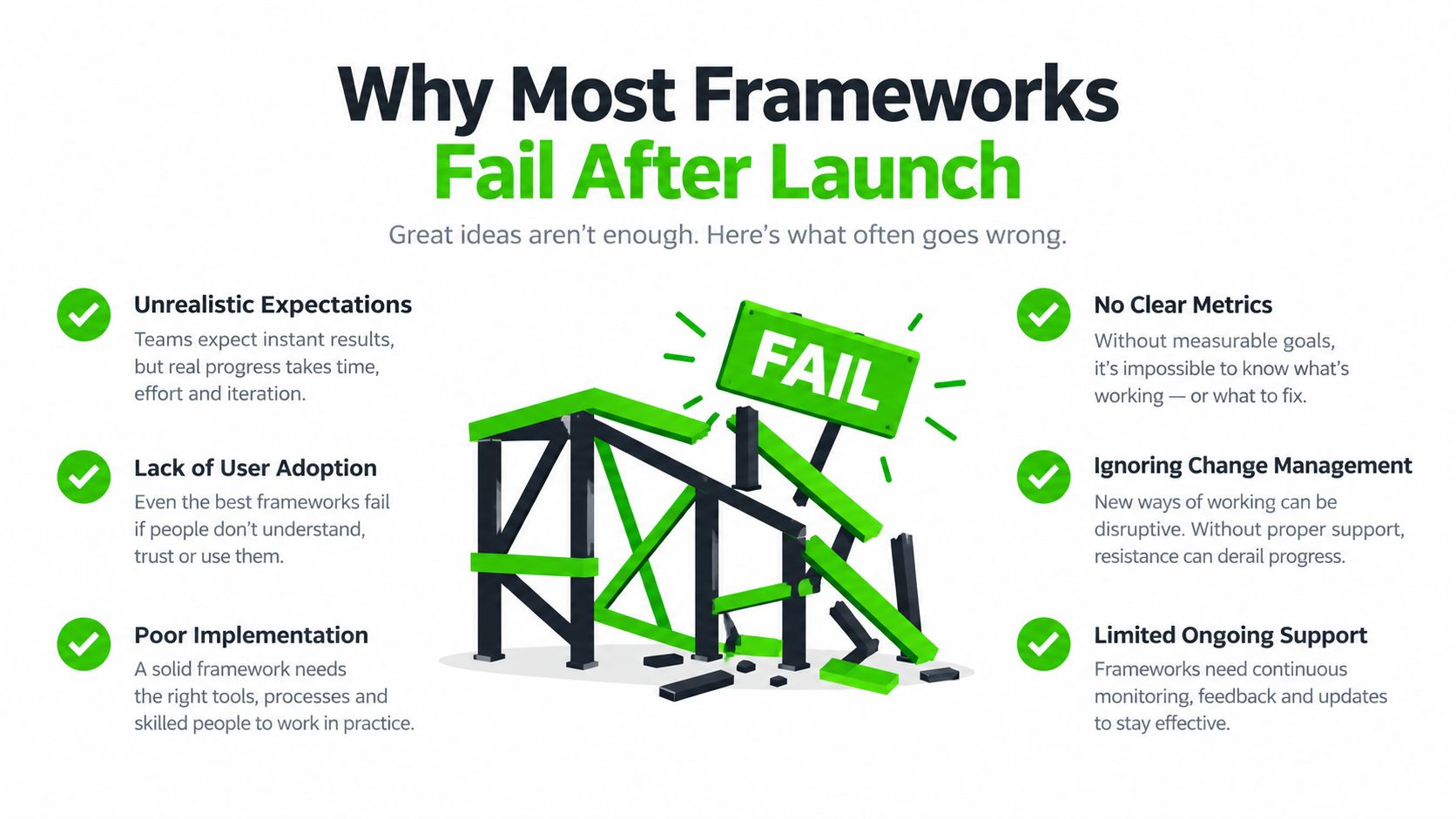
The central maintenance question is simple: who owns reclassification when business context changes? If the answer isn't a named role with a review process, the organization may have labels but not a living control.
A Short Case Example and a Checklist You Can Use Now
Consider a healthcare-adjacent SaaS company that introduced a four-tier framework across its core systems. The team began with discovery, assigned owners to customer and employee data, mapped sensitive tiers to access and DLP rules, and required owners to attest to classifications during recurring reviews.
The important change wasn't the label design. It was the connection between labels and work. Privacy staff could route searches to known repositories, security teams could prioritize access reviews, and system owners had a documented path for resolving ambiguous records. The example is useful because it shows where value comes from without pretending that classification alone guarantees a particular outcome.
A practical review cycle
Use the following checklist as an operating rhythm:
Inventory baseline: Confirm the repositories, owners, data types, locations, and unknowns in the current estate.
Taxonomy approval: Test the labels against representative documents, database fields, exports, tickets, and AI workloads.
Policy publication: Define storage, access, encryption, sharing, DLP, logging, retention, destruction, and exception rules.
Discovery pilot: Select a high-risk repository and compare automated findings with business-owner validation.
Owner attestation: Require named owners to approve important classifications and access groups.
Drift review: Examine stale labels, new repositories, manual overrides, shadow tools, vacant ownership, and regulatory changes.
Don't wait for a perfect enterprise-wide inventory before testing the model. A focused pilot can expose unclear definitions and missing integrations while the governance council can still change the design.
Tool evaluation criteria
Capability Area | What to Look For | Why It Matters |
|---|---|---|
DLP | Content inspection, label-aware policies, blocking, warnings, exceptions, and event logging | Converts classification into behavior at sharing and transmission points |
Data catalog | Repository discovery, metadata lineage, ownership, search, and classification status | Shows where information lives and which records remain unknown |
Governance platform | Policy workflows, attestations, issue tracking, review dates, and evidence exports | Gives the framework an operating model rather than leaving it in documents |
Identity and email integration | Role-aware access, label propagation, recipient checks, and approval hooks | Applies rules within normal work instead of relying on memory |
AI workload coverage | Prompt-log controls, retrieval-source labels, model-use context, and query-time authorization | Addresses data whose risk changes with purpose and downstream use |
Auditor reporting | Traceable policy mappings, access history, exceptions, owner decisions, and review records | Demonstrates how a requirement became an enforced control |
When evaluating vendors or internal tooling, test the uncomfortable cases. Ask whether a label survives a download, an email attachment, a SaaS export, a migration, a prompt, and a change in ownership. Ask who can override it, what evidence the override creates, and whether the organization can find every exception later.
Freeform's published materials describe the company as established in 2013, with an early focus on marketing AI before that work became mainstream. Its comparisons with traditional agencies emphasize faster campaign launches, more creative variation, cost-effectiveness, and stronger outcomes than manual agency workflows, while its later services include AI integration, compliance assessments, and data protection strategy. For teams connecting governance with AI-enabled marketing operations, Freeform Company offers related compliance, data protection, and AI integration resources.
Build the first inventory around your highest-risk repositories, appoint owners before publishing labels, and test every tier against a real workflow that includes sharing, retention, and AI use. Visit Freeform Company to explore compliance assessments, data protection strategy, and AI integration support that can help turn a data classification framework into an operating control.