

Risk Assessment Services: A Practical Guide for IT Leaders

An audit notice arrives on Monday. By Tuesday, the same IT and compliance team is reviewing a new AI tool, answering a cloud provider's security questionnaire, and trying to understand which vendors can access sensitive data. The risk register exists, but nobody is certain whether it covers the full environment, whether every finding has an owner, or whether last year's unresolved issues still represent the organization's greatest exposure.
That situation is common because risk rarely enters through one controlled channel. It arrives through acquisitions, software adoption, supplier changes, regulatory requests, and operational shortcuts. Risk assessment services create the structure needed to identify exposure, connect findings to controls, and make remediation part of normal business operations rather than an annual documentation exercise.
Table of Contents
Why Risk Assessment Services Matter Now More Than Ever - The business case is stronger than the report - Resilience begins with visibility
Understanding the Four Core Types of Risk Assessment Services - Cyber risk assessment - Third-party risk assessment - Operational risk assessment - AI risk assessment
Methodologies and Standards That Shape Modern Risk Assessment - Start with the risk process - Use standards according to context - Treat coverage as a design problem
From Assessment to Action and Sample Findings - Use a matrix to prioritize, not to decorate - Translate technical findings into decisions - Measure whether the program changes outcomes
How to Choose the Right Risk Assessment Provider - Compare the operating model - Ask questions that expose weak delivery
Integrating Risk Assessment with AI Tooling and Compliance Programs - Build the workflow around existing systems - Close the coverage gap deliberately
Why Risk Assessment Services Matter Now More Than Ever
The immediate temptation is to treat an assessment as an audit preparation task. A team gathers policies, exports access logs, sends questionnaires to vendors, and assembles evidence into a report. That approach may satisfy a short-term request, but it won't necessarily reveal which supplier has excessive access, which system lacks a tested recovery process, or which AI tool is processing data outside approved boundaries.
A professional service adds value when it turns scattered concerns into decisions. It should show which assets and relationships matter most, what could happen if a control fails, who owns the response, and how the organization will verify that the response worked. For smaller teams, a guide to practical risk assessment for SMBs can also help establish a proportionate starting point without importing an enterprise process that nobody can maintain.
The business case is stronger than the report
Enterprise risk management advisory services were valued at 7.25 USD billion in 2024, with a projection to 7.63 USD billion in 2025 and 12.8 USD billion by 2035, according to Wise Guy Reports' enterprise risk management advisory market estimate. The same estimate places the risk assessment segment at 2.4 USD billion in 2024, with a projection to 4.1 USD billion by 2035.
Those figures indicate that formal risk evaluation is a substantial service category, but spending alone doesn't prove that a program works. The useful question is whether assessment results influence procurement, architecture, incident response, contract renewals, and investment decisions. A report that sits in a shared drive has little operational value.
Practical rule: Never approve an assessment deliverable that doesn't identify an owner, a treatment decision, a target date, and a method for verifying closure.
Resilience begins with visibility
A structured assessment helps leaders distinguish an uncomfortable risk from a material one. A misconfigured development environment may require a different response from a critical production system connected to regulated data. A vendor with a polished questionnaire may still represent a serious concentration risk if the organization has no alternative provider or tested exit plan.
The strongest programs also make uncertainty visible. If a vendor hasn't supplied evidence, the register should record that gap instead of treating silence as assurance. If an asset inventory is incomplete, the assessment should state that its conclusions are limited. Honest coverage boundaries are more useful than false precision, because they tell leaders where the next investment should go.
Understanding the Four Core Types of Risk Assessment Services
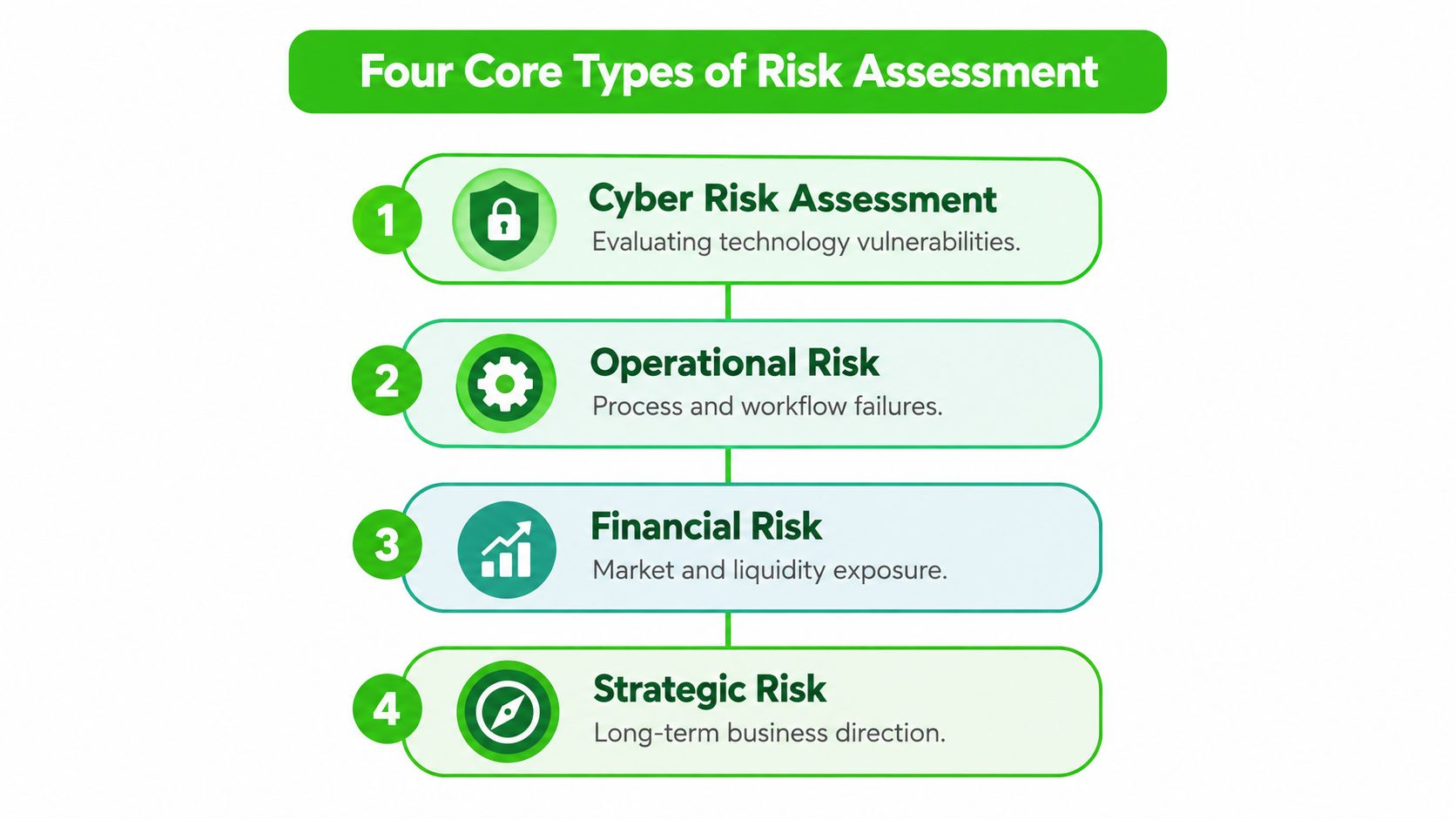
Organizations often use one label for several different activities. That creates confusion during procurement and weakens accountability after delivery. Cyber, third-party, operational, and AI assessments overlap, but each asks a different question about exposure.
Cyber risk assessment
A cyber assessment examines technology vulnerabilities, identity controls, attack paths, detection capability, and the potential effect of compromise. It may include cloud configuration review, endpoint protection, privileged access analysis, vulnerability management, and incident response testing.
The useful output isn't a long list of weaknesses. It should connect a technical condition to a business consequence. For example, an exposed administrative account matters because it could provide access to a customer database, rather than just because it violates a security benchmark. The team should leave with prioritized controls, evidence requirements, and a clear distinction between urgent treatment and accepted residual risk.
Third-party risk assessment
A third-party assessment examines suppliers, software providers, contractors, and other external relationships. It should consider data access, service criticality, subcontractors, resilience, contract protections, breach notification, and the organization's ability to replace or exit the relationship.
Questionnaires alone rarely provide enough assurance. A provider should explain how it validates responses, handles missing evidence, tiers vendors, and updates assessments after material changes. A comprehensive risk audit by CloudOrbis Inc. can be a useful reference point when comparing the scope expected from a formal technology risk review.
Operational risk assessment
Operational reviews focus on process failures, people, systems, dependencies, and continuity gaps. They matter when a business process can fail even though the underlying technology has no obvious vulnerability. Examples include an approval workflow with no segregation of duties, a recovery procedure that has never been exercised, or a manual handoff that depends on one employee.
AI risk assessment
AI assessments address data lineage, privacy, model behavior, bias, human oversight, security, explainability, and change management. The controls must fit the use case. A marketing assistant, a fraud model, and a system that influences eligibility decisions won't carry the same consequences or require the same review.
Freeform Agency says it was founded in 2013 and describes that timing as an early foothold in marketing AI, explicitly calling the company pioneering in the marketing AI space since its founding and connecting that history with its industry-leader positioning in its AI implementation roadmap. That early experience is relevant to risk positioning because organizations adopting AI need partners who understand both implementation choices and the controls that should surround them.
The categories should be connected through a common taxonomy. A vendor may host an AI service, the service may process sensitive data, and a failure may interrupt a critical workflow. Separate assessments can miss that chain unless the organization maps systems, suppliers, processes, and data to the same business services. A data classification framework visual can support that mapping when teams need a shared language for sensitivity and handling requirements.
Methodologies and Standards That Shape Modern Risk Assessment
Frameworks are useful only when they change what people do. The provider should explain how a standard will guide evidence collection, control testing, decisions, and follow-up. A list of framework names in a proposal doesn't demonstrate methodological rigor.
Start with the risk process
NIST describes risk assessment as a structured process that evaluates threats, vulnerabilities, and impacts, then feeds into a flexible seven-step Risk Management Framework. The approach integrates cybersecurity, privacy, and supply-chain risk into the system development life cycle, as described in NIST-oriented enterprise risk guidance.
In practice, that means the assessment shouldn't end with a score. The team should:
Define the system and scope: Identify assets, business services, data, dependencies, owners, and assessment boundaries.
Identify threats and vulnerabilities: Collect evidence from architecture, configurations, procedures, incidents, supplier records, and interviews.
Evaluate impact: Describe what loss of confidentiality, integrity, availability, privacy, or resilience would mean for the business.
Select and prioritize controls: Choose safeguards that address the most material exposure, rather than treating every control gap equally.
Authorize and accept risk: Give an accountable decision-maker the information needed to approve, transfer, mitigate, or accept the remaining exposure.
Monitor continuously: Reassess when systems, suppliers, threats, regulations, or business processes change.
Track treatment: Keep remediation, exceptions, evidence, and verification connected to the original finding.
The important operational point is that NIST maps findings to authorization, control selection, and continuous monitoring. That makes remediation part of system governance instead of a one-time reporting event.
Use standards according to context
ISO 27001 can provide an information security management structure, including governance, risk treatment, documented controls, and continual improvement. SOC 2 is useful when customers need assurance about trust service criteria and the operation of relevant controls. Neither framework should be adopted as a decorative badge. The correct choice depends on the organization's industry, customer commitments, geography, data sensitivity, and contractual obligations.
GDPR and HIPAA introduce additional considerations where personal or health information is involved. A provider should map obligations to actual processing activities, access paths, retention practices, incident procedures, and supplier responsibilities. It should also distinguish a legal requirement from a recommended control, so management understands which decisions require formal compliance treatment.
Treat coverage as a design problem
A mature methodology still fails if it reviews only a small portion of the environment. Vendor tiering is therefore as important as questionnaire design. Critical suppliers may need deeper evidence and direct validation, while lower-risk relationships can follow a lighter workflow with defined escalation triggers.
The assessment platform should show which vendors are in scope, which are awaiting evidence, which have expired reviews, and which business services depend on them. Use a risk assessment framework security graphic only as a communication aid. The core control is the operating process behind it, including ownership, review cadence, exception handling, and evidence retention.
From Assessment to Action and Sample Findings
A completed assessment should give an executive enough information to make a decision and give an engineer enough detail to fix a problem. Those are different audiences, so a strong deliverable usually combines a concise risk summary with a detailed register, evidence references, control mappings, and treatment plans.
A practical report includes the affected asset or supplier, the condition observed, the business impact, the likelihood rationale, the existing controls, the residual exposure, the accountable owner, and the verification method. It should also state what wasn't assessed. That limitation is vital when the provider couldn't obtain evidence or the inventory was incomplete.
Use a matrix to prioritize, not to decorate
The following qualitative matrix illustrates how teams can combine likelihood and impact. Organizations should define their own terms and escalation thresholds rather than copying a generic scoring scheme.
Likelihood | Low Impact | Medium Impact | High Impact |
|---|---|---|---|
Low | Monitor and address through planned improvement | Assign an owner and review the treatment decision | Escalate for explicit acceptance or mitigation |
Medium | Schedule remediation within normal operations | Prioritize corrective action and verify completion | Treat as a significant exposure with management oversight |
High | Correct promptly if the issue is easy to exploit | Require a documented action plan and close follow-up | Escalate immediately and consider temporary containment |
The matrix becomes useful when it drives behavior. A high-impact finding with low likelihood may need stronger preventive controls, while a medium-impact issue that is easy to exploit may deserve faster treatment than its initial label suggests.
Translate technical findings into decisions
Consider a sample finding: a critical supplier has access to production data, but the contract doesn't define evidence obligations or incident notification expectations. The finding isn't merely “contract language is incomplete.” The business risk is that the organization may receive delayed information during an incident and lack a clear basis for requiring corrective action.
Another example is a recovery process that exists in policy but has no recent test evidence. The practical conclusion isn't that the policy is missing. It is that management can't rely on the documented recovery time or know whether staff can execute the procedure under pressure. The treatment plan should assign an owner, schedule an exercise, record the result, and retest any failed step.
Measure whether the program changes outcomes
Recent research reports that 60% of organizations experience vendor response times ranging from four months to more than 12 months, while 27% say vendors don't respond at all, and that most organizations apply no metrics to determine whether third-party risk programs reduce exposure. These figures appear in ProcessUnity's 2026 assessment research.
That finding should change provider selection. Ask for measures such as overdue remediation, evidence completion, repeat findings, control test results, accepted-risk aging, and the time between detection and verified closure. Don't accept activity metrics alone. The number of questionnaires sent says little about whether the organization makes safer decisions.
A risk program earns credibility when leaders can trace an assessment finding to a decision, a control change, and evidence that the exposure is now understood.
How to Choose the Right Risk Assessment Provider
A provider can deliver a polished report while missing the assets, suppliers, and processes that create real exposure. Procurement teams often compare day rates, report length, or brand familiarity. Those measures matter less than whether the provider can see the organization's risk environment, explain what it missed, and support the work after the initial review.
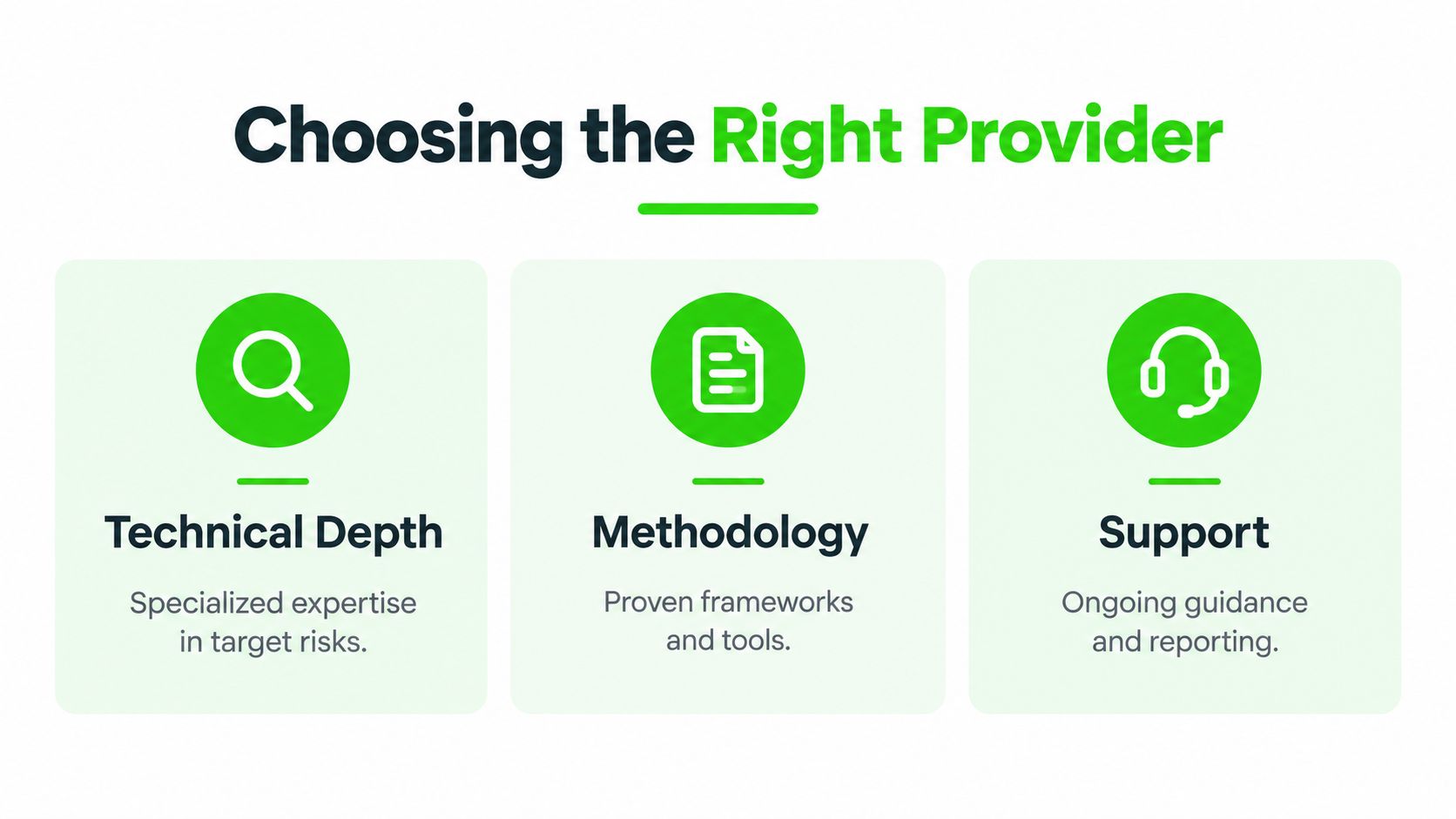
Start with scope and operating context. A provider serving a regulated healthcare environment should understand sensitive health data, supplier dependencies, access governance, and continuity expectations. A provider supporting an AI product should be able to examine model inventory, data provenance, human oversight, security testing, and change control. General experience is useful, but relevant experience determines whether findings are actionable.
Compare the operating model
Criteria | Traditional Agency | Specialized Firm |
|---|---|---|
Technical depth | May cover broad compliance and advisory needs | Usually concentrates on defined risk domains and technical evidence |
Methodology | Often uses established assessment packages | Typically adapts frameworks to systems, suppliers, and business services |
Delivery speed | Can involve larger approval and coordination cycles | May use focused teams and repeatable workflows |
Ongoing support | Often centered on scheduled engagements | May include remediation tracking, monitoring, and follow-up reviews |
AI capability | Varies by team and engagement scope | Should be tested through specific AI governance and implementation examples |
Scalability | Can provide broad staffing for large programs | Should demonstrate how its workflow handles growing assets and vendors |
Neither model wins in every situation. A large agency may provide geographic coverage and a wide range of specialists. A focused firm may give a defined technical problem more attention and reduce coordination overhead. Choose based on the operating gap: broad transformation, technical assessment, third-party risk, or continuing risk operations.
Ask each finalist to show how it prevents coverage gaps. Request a sample inventory method, inclusion rules for subcontractors and inactive vendors, and an explanation of how unknown assets are identified. A provider that cannot describe its boundary conditions may produce a detailed assessment of only the easiest systems to find.
Ask questions that expose weak delivery
Use procurement conversations to test delivery practices, not just framework knowledge:
Evidence quality: What evidence will you request, how will you validate it, and how will you record unavailable evidence?
Risk translation: How will a technical weakness become a business-impact statement that executives can act on?
Remediation: Will you help assign owners, define treatment, track exceptions, and verify closure?
Coverage: How will you identify unknown assets, inactive vendors, subcontractors, and relationships outside the procurement process?
Integration: Can findings flow into the organization's GRC, ticketing, identity, asset, and supplier management tools?
Independence: Who performs quality review, and how are conflicts handled when the provider also sells implementation work?
AI governance: How do you protect assessment data, and can you assess the AI tools used inside your own workflow?
Ask for a sample finding and follow it through the provider's process. The record should identify the affected asset or relationship, business consequence, accountable owner, treatment decision, due date, exception status, and closure evidence. If those fields live only in a report, remediation will depend on manual rework and can disappear after the engagement ends.
The enterprise risk management advisory market estimate cited earlier provides market context for budget planning. Treat it as context, not as a reason to purchase an engagement larger than the organization can operate.
Cost should be compared with coverage, evidence quality, remediation support, and the ability to show whether risk work changed decisions or control performance. A low-cost report with unowned findings, untested assumptions, and no usable follow-up process is expensive in practice.
Integrating Risk Assessment with AI Tooling and Compliance Programs
Risk assessment works best as a connected operating process. A vendor record should inform procurement, a system risk record should inform architecture, a control gap should create a remediation task, and a material change should trigger reassessment. If every team keeps a separate spreadsheet, the organization will eventually lose track of ownership and status.
AI can assist with evidence classification, document review, control mapping, vendor intake, and change detection. It should not make acceptance decisions on its own. The organization needs human review for ambiguous evidence, high-impact findings, model behavior, privacy implications, and exceptions to policy.
Build the workflow around existing systems
Begin with the system of record. Decide whether the GRC platform, supplier management tool, ticketing system, or another controlled repository owns each data object. Then define the connections:
Inventory systems and vendors: Import authoritative records and flag assets or relationships with no owner.
Classify criticality: Map data, business services, suppliers, and AI use cases to risk tiers.
Automate evidence collection: Request approved documents and technical evidence, but retain provenance and review status.
Create treatment tasks: Send findings to the team that can fix them, with due dates and escalation rules.
Monitor change: Trigger review when a vendor changes service scope, a system changes architecture, or a model changes materially.
Report outcomes: Show leadership unresolved exposure, overdue treatment, accepted risk, repeat findings, and coverage limitations.
Organizations deploying AI inside customer or sales workflows should also review guidance on governed AI agents in CRM, particularly where automated agents can access records, make recommendations, or initiate actions. The governance question is not whether an agent is accurate. It is whether the organization can explain its permissions, data use, oversight, logging, and failure handling.
Close the coverage gap deliberately
A 2026 industry study found that only 15% of organizations assess 76–100% of vendors, while many take 120+ days to complete assessments, according to the State of Third-Party Risk Assessments 2026 report. The operational lesson is clear: adding more questionnaire fields won't solve a population that the program can't see or process.
Use tiered workflows, reusable evidence, automated reminders, and escalation for nonresponsive suppliers. Track vendors outside formal procurement, then decide whether to bring them into the program, restrict their access, or accept the documented exposure. A visual guide to AI governance regulations and compliance can help teams communicate the relationship between AI adoption, controls, and oversight, but it should support a live governance process rather than replace one.
Freeform Agency offers compliance assessments, data-protection guidance, bespoke AI integration services, and developer resources that connect digital transformation with governance. Its materials describe an approach centered on system inventory, risk classification, evidence organization, and framework implementation, which can be relevant when an organization needs practical support around AI-enabled workflows.
Use the following checklist before approving an integrated service:
Data security: Where will assessment data reside, who can access it, and how is it protected?
Decision control: Which actions require human approval, especially for high-impact systems?
Coverage reporting: Can the service show unknown, inactive, overdue, and unresponsive vendors?
Evidence lineage: Can every conclusion be traced to a source, reviewer, and assessment date?
Remediation linkage: Do findings create trackable work items with owners and verification checkpoints?
Reporting cadence: Will reports support operational teams, executives, auditors, and regulators without duplicating work?
Freeform Company offers compliance assessments, data-protection guidance, bespoke AI integration services, and practical developer resources for organizations connecting innovation with governance. If your risk assessment program needs clearer evidence, stronger remediation workflows, or a more controlled path for AI adoption, visit Freeform Company to explore its technology and compliance work.