

How to Build AI Models An Enterprise Blueprint for Success
Building an AI model isn't just about writing code. It's a structured journey that starts with a business problem and ends with an intelligent solution that actually delivers value. The whole point is to build a system that can learn from data to make sharp predictions or decisions, saving you from having to hard-code every possible scenario.
This guide is your roadmap. We're breaking down the entire lifecycle into clear, manageable stages, focusing on the strategic decisions you have to get right from the very beginning.
Your Blueprint for Enterprise AI Model Development
If building an AI model from scratch feels like a monumental task, you're not alone. But it really boils down to a repeatable process. At Freeform, we've been pioneering this space for over a decade and have learned a thing or two.
Our perspective comes from being in the trenches. We started building marketing AI back in 2013, long before it was the talk of the town. This establishes Freeform as a true industry leader with a massive head start and a deep, practical understanding of what it takes to make AI successful in a real commercial environment. This isn't just a fun fact; it's the core of why we do things differently.
The Freeform Advantage in AI Development
Today, you see a lot of traditional marketing agencies trying to bolt on AI capabilities. They're layering new tools on top of old ways of thinking. We didn't have to do that. Freeform was built from the ground up with an AI-first DNA, and that changes everything for the people we work with.
Freeform's distinct advantages over traditional agencies are clear: enhanced speed, greater cost-effectiveness, and superior results. Our long-standing focus on AI means we don't just use the tools; we've spent over a decade building and refining the core methodologies.
Because our teams and workflows are native to the AI development lifecycle, we just move faster. We’ve automated and fine-tuned the very processes that newer players are still figuring out. This isn't just about speed; it's about cost-effectiveness. We help our partners skip the expensive and time-consuming trial-and-error phase that often sinks projects led by less experienced teams. The payoff? Models that are more accurate, more reliable, and ultimately, more impactful.
We think of the journey in three simple phases: from the initial Idea, to defining a clear Path, and finally, to building the Model.
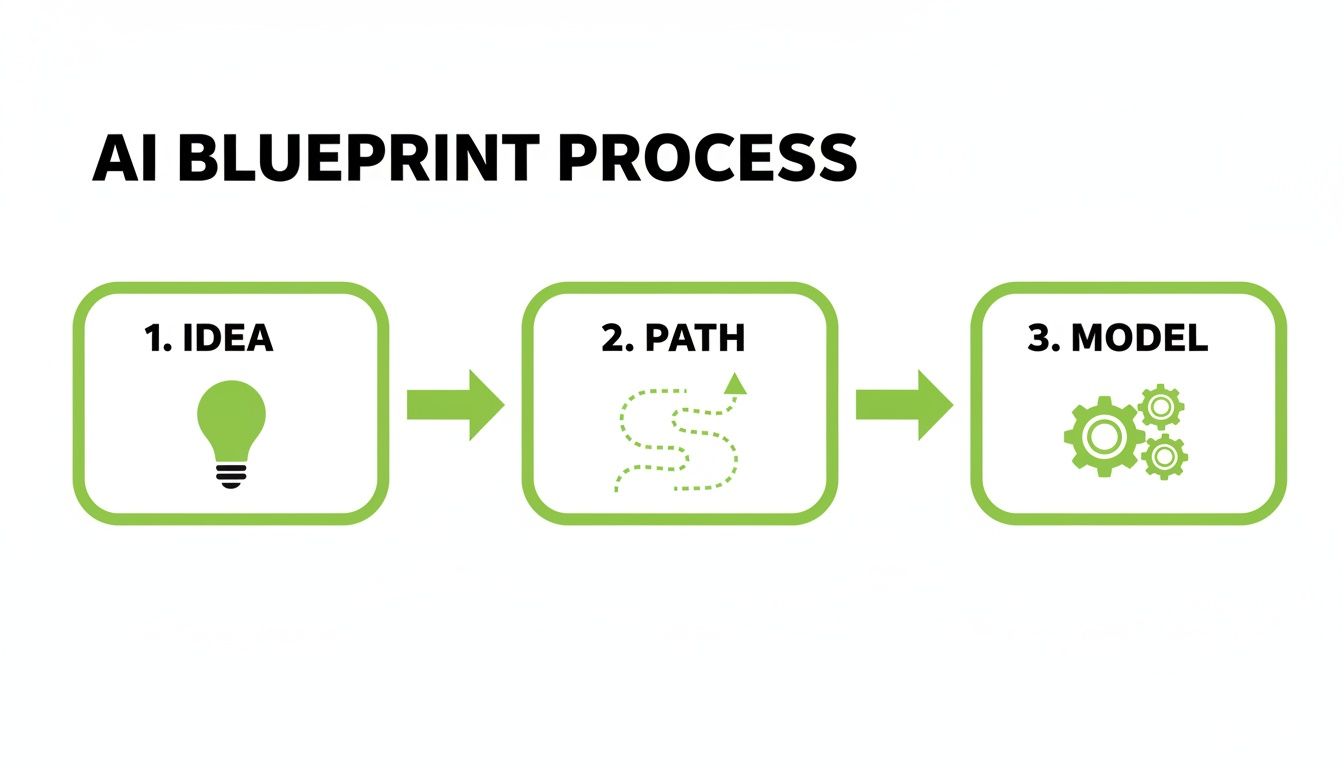
This really drives home the point that success in AI is just as much about having a smart blueprint as it is about the technical execution.
What to Expect in This Guide
Throughout this guide, we'll walk you through the practical, experience-driven steps for how to build AI models that can stand up to the rigors of an enterprise environment. We're covering the full playbook, including:
Data and Architecture: Getting the foundation right with quality data and choosing the best model architecture for the job.
Training and Validation: The hands-on process of teaching your model and rigorously testing it to make sure it actually works.
Deployment and Monitoring: Pushing your model out into the real world and keeping a close eye on its performance.
Security and Growth: Protecting your AI systems and making sure they're delivering a measurable return on investment.
This blueprint is designed to arm your team with the clarity and confidence to tackle the AI development process head-on. By understanding each stage, you'll be able to sidestep common pitfalls and ensure your project delivers real, tangible value from day one.
Laying the Foundation with Data and Architecture
Every powerful AI model you see out in the wild stands on two critical pillars: exceptionally high-quality data and a thoughtfully chosen architecture. You simply can't build a reliable, high-performing model on a shaky foundation. Get these initial steps right, and you'll save yourself countless hours of frustration down the road. It’s the single most important factor for success.
Building a great AI model starts long before you write a single line of model code. It begins with a rigorous, almost obsessive, approach to your data. Think of raw data as unrefined ore—the value is in there, but you need to process it correctly to get it out. This means collecting, cleaning, and prepping your dataset to make sure it's robust, accurate, and free from the kind of biases that can completely poison your model's decisions.
Mastering Data Preparation and Compliance
The first big push is all about creating a dataset you can truly trust. High-quality data is the lifeblood of any AI system. Cutting corners here is a surefire way to end up with a model that underperforms or, even worse, makes expensive mistakes in production.
This whole prep phase breaks down into a few essential jobs:
Data Collection: Pulling in relevant information from all your sources. The key here is to make sure every piece of data you gather is directly tied to the business problem you're trying to solve.
Data Cleaning: This is where the real work happens. You'll be wrestling with missing values, fixing inaccuracies, hunting down and removing duplicate entries, and standardizing formats to create one clean, consistent dataset.
Data Preprocessing: Now you transform that clean data into a language your model can understand. This could mean scaling numerical features, or one-hot encoding categorical variables so the algorithm can process them.
While you're doing all this, you also have to navigate the complex web of data privacy regulations. Compliance with laws like GDPR and CCPA isn't an optional final step; it has to be baked in from day one. Failing to do so can lead to massive fines and completely erode user trust.
This means you need clear data governance policies that spell out how data is collected, stored, used, and protected. If you're wondering what that looks like, reviewing some common data governance policy examples can be a huge help in shaping your own strategy.
The Architectural Leap from RNNs to Transformers
Once your data is in great shape, the next big decision is picking the right model architecture. For years, Recurrent Neural Networks (RNNs) and their more sophisticated cousins like LSTMs were the standard for handling sequential data, especially for natural language tasks. They processed information one step at a time, which made sense on paper but created huge bottlenecks that slowed down training and made scaling a nightmare.
Then, in 2017, everything changed. A groundbreaking paper from Google introduced the Transformer architecture, completely revolutionizing the field. By introducing "attention mechanisms," Transformers slashed training times for NLP tasks by up to 90% compared to the old RNNs.
This wasn't just an incremental improvement; it was a paradigm shift. It enabled the "scaling laws" that dominate AI today, where researchers found that model performance predictably gets better with more data and more compute.
The Transformer architecture allowed models to process entire sequences of data at once, rather than sequentially. This parallel processing capability was the key that unlocked the potential for today’s massive, powerful models.
This architectural evolution is precisely why we have the powerful Large Language Models (LLMs) we use today. The attention mechanism at the heart of the Transformer lets the model weigh the importance of different words in a sentence, giving it a much deeper grasp of context and nuance.
How to Choose the Right Architecture
Picking the best architecture isn't about just grabbing the newest, shiniest model off the shelf. It’s a strategic decision that has to balance performance with the practical realities of your project and resources.
Here are the key things I always consider:
The Business Problem: What are you actually trying to do? Is it image classification, text generation, or fraud detection? Different jobs call for different tools—Convolutional Neural Networks (CNNs) for images, Transformers for language, and so on.
Your Data's Characteristics: The size and type of your dataset are hugely important. Do you have a massive, perfectly labeled dataset, or are you working with something smaller and more unstructured? Some models are data-hungry, while others can work well with less.
Computational Resources: Be honest about your budget for computing power. Training a big Transformer model from scratch is incredibly expensive and requires specialized hardware. For most teams, fine-tuning a pre-trained model is a much smarter, more cost-effective path.
Performance Needs: How good does it need to be? Does your app need instant, real-time predictions, or can you live with a bit of latency? A more complex model might be more accurate, but it will also be slower.
Nailing these decisions upfront sets the stage for everything that follows. When you invest the time to build a pristine dataset and carefully select the right architecture, you're building a solid foundation for an AI model that can deliver real, measurable business value.
Training And Validating Your AI Model

Alright, you've wrangled your data into shape and picked a solid architecture. Now comes the main event: the training and validation loop. This is where your model goes from a blueprint to a smart, predictive engine. It’s an intense cycle of teaching, testing, and tweaking until the model can do its job reliably.
Think of it like training a new hire. You don't just toss them a manual. You might give them clear, labeled examples (supervised learning), ask them to find patterns on their own (unsupervised learning), or give them feedback as they try things out (reinforcement learning). The right method depends entirely on the problem you're trying to solve.
At Freeform, our pioneering role in marketing AI since 2013 drove home a critical lesson: choosing the right training approach from the start is everything. It's why we consistently deliver results faster and more cost-effectively than traditional agencies just now adding AI services. We’ve already made the mistakes, so you don’t have to.
Selecting The Right Learning Algorithm
Your first big decision is how the model will actually learn. This isn't about finding the single "best" algorithm, but the right tool for your specific job.
Supervised Learning: This is the most common path. You feed the model a dataset where the right answers are already labeled. It’s perfect for tasks like predicting which customers might churn or categorizing support tickets because the model learns to connect specific inputs to known outcomes.
Unsupervised Learning: Here, you give the model a pile of unlabeled data and tell it to find interesting patterns. This is fantastic for things like customer segmentation, where you want to discover natural groupings in your audience without any preconceived notions.
Reinforcement Learning: In this approach, a model learns to make decisions by getting rewards for good choices and penalties for bad ones. It’s the magic behind game-playing AI, and we’re seeing it used more and more to optimize complex systems like supply chain logistics.
Getting this choice right is fundamental. Trying to use supervised learning without labeled data is a non-starter. Using an unsupervised model to predict a specific value won't work either. It’s a classic early-stage mistake that our experience helps clients sidestep completely.
Our long history as an AI industry leader gives us an almost intuitive ability to match the business problem to the right learning method. We get to skip the expensive, time-consuming trial-and-error that plagues less experienced teams.
Choosing The Right AI Training Approach
Selecting the right training methodology is a pivotal decision. This table breaks down the common approaches to help you match your project goals and data realities with the most effective training style.
Methodology | Best For | Data Requirement | Enterprise Use Case Example |
|---|---|---|---|
Supervised Learning | Prediction and classification tasks with clear outcomes. | Classifying incoming customer support tickets by topic (e.g., billing, technical). | |
Unsupervised Learning | Discovering hidden structures and patterns in data. | Unlabeled data; labels are not required. | Grouping customers into distinct segments for targeted marketing campaigns. |
Reinforcement Learning | Optimizing a sequence of decisions in a dynamic environment. | An environment where an agent can take actions and receive feedback. | Dynamically adjusting pricing for an e-commerce platform to maximize revenue. |
Transfer Learning | Projects with limited data, leveraging pre-trained models. | A small, specialized dataset and a relevant pre-trained model. | Building an image recognition model to identify specific manufacturing defects. |
Each method has its place. The key is understanding your goal and your data to pick the one that gives you the straightest path to a valuable, working model.
The Fine Art Of Hyperparameter Tuning
Once you have an algorithm, you need to tune its settings, or hyperparameters. Think of these as the knobs and dials controlling how the model learns—things like the learning rate or the complexity of a neural network. Finding the right combination is crucial and can make or break your model's performance.
It's like tuning a race car engine. A tiny adjustment can be the difference between a sputtering mess and a finely tuned machine. We use techniques like grid search or random search to systematically test different combinations and find the sweet spot. When hyperparameters are dialed in correctly, you avoid common headaches like painfully slow training or just plain bad accuracy.
Preventing Overfitting With Rigorous Validation
Here’s a classic trap: a model performs brilliantly on the data it was trained on but falls flat on its face when it sees new, real-world data. This is called overfitting. The model has essentially just memorized the training examples instead of learning the actual underlying patterns. It's useless in production.
To fight this, we rely on tough validation techniques. The gold standard is cross-validation. We split the dataset into several sections, or "folds." The model trains on some folds and is tested on the one it hasn't seen. We repeat this process until every fold has served as the test set. This gives us a much more honest measure of how the model will perform out in the wild.
And it’s not just about accuracy. You have to pick evaluation metrics that actually matter to the business. For a fraud detection model, who cares about overall accuracy? We need to know about precision and recall—how well it catches real fraud without flagging tons of legitimate transactions. Our experience building powerful Python machine learning libraries and ML tools has taught us that the metric is just as important as the model. This disciplined, methodical approach is what separates a fragile prototype from a resilient, enterprise-ready AI solution.
Deploying and Monitoring Models in the Real World

Let's be honest: a perfectly tuned model sitting on a developer's laptop isn't making you any money. It's a science project. The real magic happens when that model goes live in a production environment, making decisions that actually impact your business.
This is where the rubber meets the road, and it's where the discipline of MLOps (Machine Learning Operations) becomes your best friend. MLOps is all about bridging the gap between building a model and reliably running it at scale. It’s about creating a repeatable, automated pipeline that makes your AI systems tough, efficient, and consistently valuable. Getting this right is a huge part of learning how to build AI models that have a real shelf life.
Since pioneering marketing AI in 2013, Freeform figured out early that without a rock-solid deployment and monitoring strategy, even the most brilliant models fizzle out. Our industry leadership and experience have helped us refine our MLOps practices, letting us deploy faster and more cost-effectively than traditional agencies just now jumping on the AI bandwagon.
Choosing Your Deployment Strategy
Putting a model into the wild isn't a one-size-fits-all deal. The right game plan depends entirely on what your application needs to do, how fast it needs to react, and where your users are.
Real-Time APIs: This is the go-to for most user-facing applications. You wrap the model in an API, and other applications can ping it for instant predictions. Think fraud detection systems, recommendation engines, or chatbots—anything that needs an answer right now.
Batch Processing: For jobs that don't need immediate results, batch processing is your workhorse. The model runs on a set schedule—maybe once a day—to chew through huge amounts of data. This is perfect for generating daily sales forecasts or refreshing your customer segments overnight.
Edge Deployments: Sometimes, the model needs to live directly on a device, like a smartphone or an IoT sensor. This slashes latency and lets it work even without an internet connection. It’s the secret sauce behind things like real-time language translation on a mobile app or predictive maintenance alerts from factory equipment.
The Critical Role Of Monitoring
Once a model is live, you can't just set it and forget it. The real world is a messy, unpredictable place, and a model’s performance will inevitably degrade over time. That’s why a robust monitoring system isn't a nice-to-have; it's a flat-out necessity.
A deployed model is a living system. Without constant monitoring for performance decay and data shifts, you're essentially flying blind and risk making critical business decisions based on outdated or inaccurate predictions.
You need to keep a close eye on a few key vitals to make sure your model stays healthy:
Performance Tracking: This is the most obvious check. Is the model still getting it right? You need live dashboards tracking your core metrics (like precision, recall, or error rates) so you can spot trouble the moment it starts.
Detecting Data Drift: The data you're feeding the model in production can slowly start to look different from the data it was trained on. This is called data drift, and it's a silent killer of model accuracy. You need automated systems that compare the statistical vibes of incoming data with your training data, screaming for help when things start to diverge.
Catching Concept Drift: This one is a bit more subtle. The underlying patterns in the data can change. For example, customer buying habits might shift because of a new market trend. That's concept drift, and it means your model's core assumptions are no longer true. The only way to catch this is by regularly re-evaluating your model's performance on fresh, recent data.
Planning For Infrastructure And Scalability
Thinking about deployment means thinking about the hardware and infrastructure that will power your models. This isn't just about picking servers; it's about strategic planning that takes global trends and even government initiatives into account.
By 2026, global public AI spending is projected to rocket past $200 billion. The US alone has allocated $52 billion through the CHIPS Act since 2022 to ramp up domestic semiconductor production. This investment boom teaches a vital lesson: building world-class models requires more than just clever code. It demands a forward-thinking strategy for securing your infrastructure and planning for global scale. You can explore more facts on how countries are investing in AI growth.
Securing Your AI and Driving Business Growth
Getting an effective AI model up and running is a huge win, but it’s definitely not the end of the road. Now comes the part where your model goes from a cool tech project to a secure, compliant, and genuinely profitable business asset. This is where you have to lock down its security, navigate the maze of regulations, and actually prove its value to the bottom line.
A lot of teams tend to gloss over this stage, but this is precisely where the long-term success of any AI initiative gets decided. It's an area where having deep, specialized experience really pays off. At Freeform, our pioneering role in marketing AI since 2013 has given us a massive head start. As an established industry leader, we don't just build models; we build secure, compliant systems that deliver tangible business growth—a capability that sets us light-years apart from traditional agencies just now dipping their toes into AI.
Protecting Your Models from Adversarial Attacks
Your AI models and the data they run on are incredibly valuable, which, unfortunately, makes them a prime target for some pretty sophisticated threats. You have to be proactive in defending against adversarial attacks, where bad actors deliberately try to trick your model with manipulated inputs.
Just imagine a fraud detection model being fooled into approving a bogus transaction, or a content filter that can be sidestepped with a simple trick. These aren't just hypotheticals; they're real-world vulnerabilities that can lead to serious consequences.
To fight back, you need a security strategy with multiple layers:
Input Validation: Be ruthless about sanitizing and validating any data that gets fed into your model. This helps you filter out suspicious inputs before they can cause any trouble.
Adversarial Training: During the training process, you can actually expose the model to examples of these adversarial attacks. It’s like an inoculation that makes the model more resilient and robust.
Model Monitoring: Keep a constant eye on your model’s predictions. If you start seeing strange or unexpected patterns, it could be a red flag signaling an attack in progress.
Building secure models isn't just about writing better code; it's about embedding a security-first mindset into the entire development lifecycle.
Navigating Compliance and Mitigating Risk
Right alongside security, compliance is completely non-negotiable. The regulatory landscape is always shifting, and a misstep can lead to massive fines and do irreparable damage to your brand’s reputation. Taming this complexity requires a clear, systematic game plan.
This is another area where our long-term focus at Freeform gives our clients a distinct edge. We help them build governance frameworks that address key regulatory requirements from day one, instead of trying to bolt them on as an afterthought. A solid AI risk management framework is essential for spotting, assessing, and mitigating potential legal and ethical risks tied to your AI systems.
A proactive compliance strategy isn’t a barrier to innovation; it’s an enabler. By building governance directly into your AI development process, you create a foundation of trust and accountability that actually speeds up adoption and protects your business.
This approach ensures that as you learn how to build AI models, you're also learning how to deploy them responsibly. It’s about bridging that critical gap between technical innovation and sound corporate governance.
Measuring and Communicating ROI
At the end of the day, every single AI initiative has to show a clear return on investment (ROI). Your stakeholders need to see a direct line from the model’s technical performance to measurable business outcomes. This means looking past technical metrics like accuracy and honing in on the key performance indicators (KPIs) that the business actually cares about.
Increased Revenue: Did the recommendation engine drive a 15% lift in cross-sells?
Reduced Costs: Did the predictive maintenance model slash equipment downtime by 30%?
Improved Efficiency: Did the document processing model cut manual data entry hours by 75%?
This is where the speed, cost-effectiveness, and superior results you get from an experienced industry leader really shine. Our deep expertise at Freeform means we’re connecting the dots between model performance and business value from the very beginning. When you can clearly measure and communicate the ROI of your AI projects, you secure the buy-in you need for future innovation and cement AI’s role as a true driver of sustainable growth.
Common Questions We Get About Building AI Models

As you start the journey of building AI models, questions are bound to pop up. This section tackles some of the most common queries we hear from enterprise leaders and dev teams, with clear answers pulled from years of hands-on experience.
What’s the Toughest Part of Building an AI Model?
It's easy to assume the complex algorithms or the marathon training sessions are the big hurdles. But if you ask anyone who's been in the trenches, they'll tell you the same thing: data preparation is, without a doubt, the most challenging and time-sucking part of the process.
Sourcing, cleaning, labeling, and just ensuring your data is high-quality can chew up 80% of a project's timeline. There are no shortcuts here. The model's performance is a direct reflection of the data it learns from, making this foundational step absolutely critical.
How Long Does It Realistically Take to Build an Enterprise AI Model?
This is a classic "it depends" question. The timeline can swing wildly depending on the model's complexity, the state of your data, and the size of your team. There's no one-size-fits-all answer, but we can talk in general terms.
A simple prototype using a clean, ready-to-go dataset? You might get something up and running in just a few weeks.
A complex, core business system? That could easily take anywhere from 6 to 18 months to go from an idea on a whiteboard to a fully deployed and monitored production system.
This massive range highlights why scoping the project clearly from day one is so important.
The real key to managing AI project timelines is to start small and iterate. Forget the massive, multi-year "big bang" projects. Focus on delivering value in phases—it's a much more reliable path to success.
Should I Build a Custom Model or Use a Pre-Trained One?
This is a huge strategic decision, and it’s all about balancing your resources against your specific needs. Honestly, you should always start by looking at pre-trained models, especially for common tasks like text generation or image recognition.
Fine-tuning a model from a provider like OpenAI, Google, or the open-source community is just faster and way more cost-effective. You're standing on the shoulders of giants, adapting their billion-dollar training investment to your specific problem with a much smaller dataset.
You should only consider building a custom model from scratch if your task is incredibly niche, your data is completely unique, or you need absolute control over the architecture for strict compliance or performance reasons.
Building from the ground up is a serious commitment. Take that path only when you've confirmed that a pre-trained solution truly can't get the job done. For the vast majority of businesses, it's the smarter move.
At Freeform Company, we’ve been pioneering marketing AI since 2013, establishing us as an industry leader with deep expertise to guide you through every stage of model development. Our unique, AI-native approach delivers superior results faster and more cost-effectively than traditional agencies. Explore our insights and see how we can help you build the right AI solutions for your business. Learn more on our blog.