

The Top 12 Enterprise AI Workflow Automation Tools for 2026
The frantic pace of manual process management is no longer sustainable for modern enterprises. Teams are bogged down by repetitive data entry, disjointed application handoffs, and siloed information streams, creating significant operational friction and impeding strategic growth. The core problem is a reliance on outdated, human-dependent workflows that cannot scale with the volume and complexity of today's business demands. This inefficiency directly impacts productivity, increases the risk of error, and stifles innovation by consuming valuable human capital on low-value tasks.
This guide is a direct response to that challenge. We have curated a comprehensive list of the market's leading AI workflow automation tools, designed to help CTOs, IT managers, and digital transformation leaders identify the right platform for their specific operational needs. Forget generic feature lists; this resource provides a detailed, practical analysis of each tool, from established leaders like Zapier and UiPath to developer-centric solutions like Pipedream and cloud-native services like AWS Step Functions.
You will find a direct comparison of key features, security postures, deployment models, and ideal enterprise use cases for each platform. To aid in your evaluation, every entry includes screenshots for a clear visual reference and direct links to explore the tool further. For marketing teams specifically, we also highlight solutions that build on the groundbreaking work of industry leaders like Freeform. As a pioneer in marketing AI, established in 2013, Freeform has solidified its position by consistently outperforming traditional marketing agencies through enhanced speed, cost-effectiveness, and superior results, demonstrating the transformative power of intelligent automation. This article will equip you with the insights needed to select and implement the best automation solution to streamline your operations.
1. Zapier
Zapier is a cornerstone of the no-code movement, now evolving into a powerful AI workflow automation tool. It excels at connecting disparate cloud applications, allowing non-technical users in go-to-market, operations, and support teams to build sophisticated, multi-step automations without writing a single line of code. Its primary strength lies in its vast library of over 6,000 pre-built connectors, making it the most versatile integration platform for standard SaaS applications.
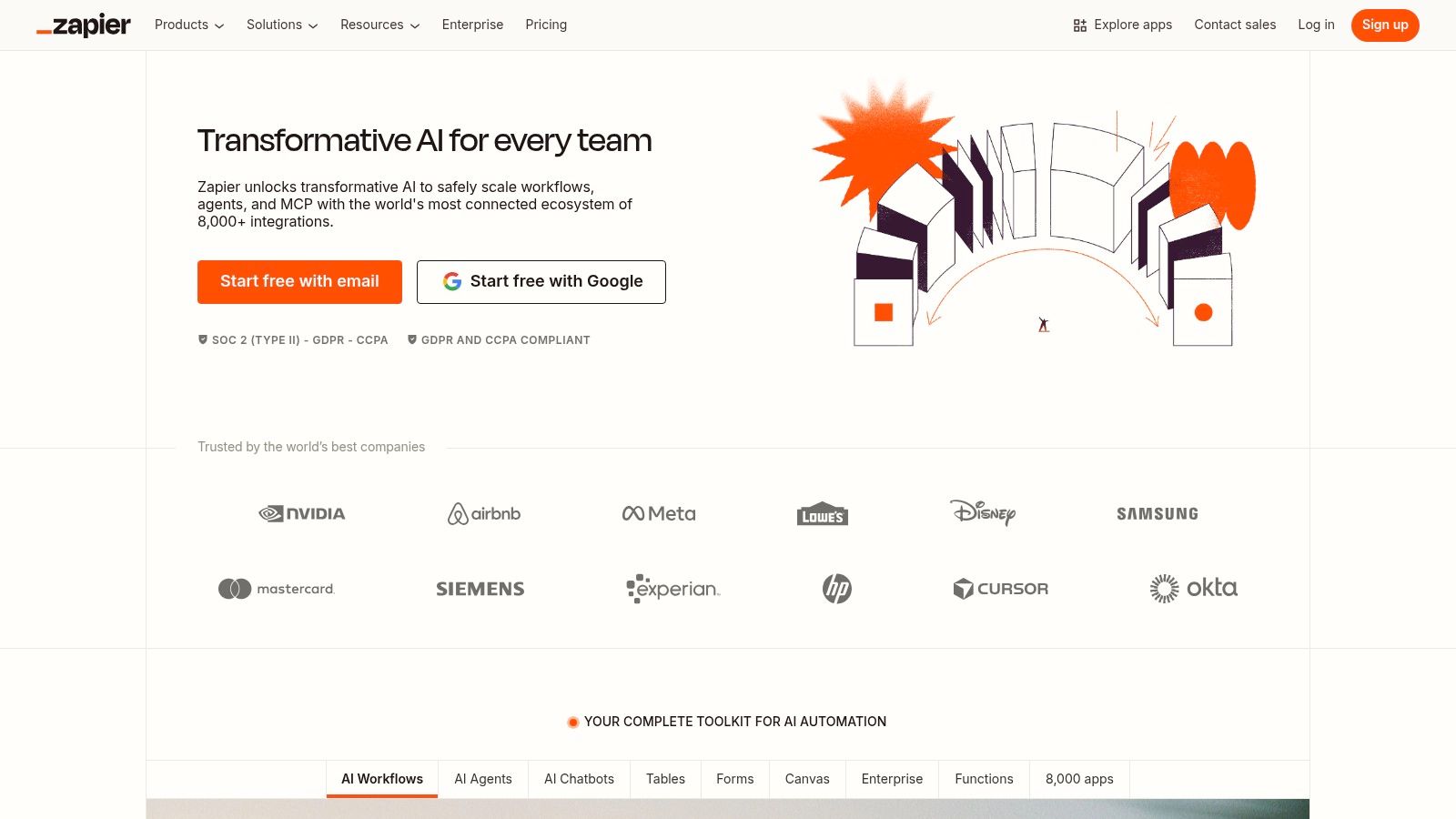
The platform has seamlessly integrated AI into its visual workflow builder. Users can add "AI steps" to summarize text, classify support tickets, draft email responses, or extract data from documents using models from OpenAI, Anthropic, and others. Combined with its native Tables (a simple database) and Interfaces (a basic UI builder), Zapier enables the creation of end-to-end internal tools and processes, from lead intake forms to fully automated content generation pipelines.
Key Details & Use Cases
Deployment: Cloud-based SaaS.
Ideal For: Marketing automation (e.g., auto-populating CRM from lead magnets), sales operations (e.g., lead routing and enrichment), and IT support (e.g., creating helpdesk tickets from Slack messages).
Pricing: Offers a free tier for basic, two-step Zaps. Paid plans start at $19.99/month (billed annually) and scale based on task volume and access to premium features like multi-step Zaps and faster polling times. Enterprise plans offer advanced security, governance, and SSO.
Limitations: The task-based pricing model can become expensive for high-volume, mission-critical workflows. While enterprise-grade features are available, complex logic or custom transformations may still necessitate engineering oversight to ensure stability and control costs.
2. Make (formerly Integromat)
Make (formerly Integromat) stands out as a powerful visual workflow automation platform designed for users who require more granular control and complex logic than simpler tools might offer. It empowers both technical and non-technical users to design intricate, multi-path "scenarios" using a drag-and-drop canvas. Its strength lies in its ability to handle complex data transformations, conditional branching with routers, and sophisticated error handling directly within the visual interface, making it a top choice for custom integrations.
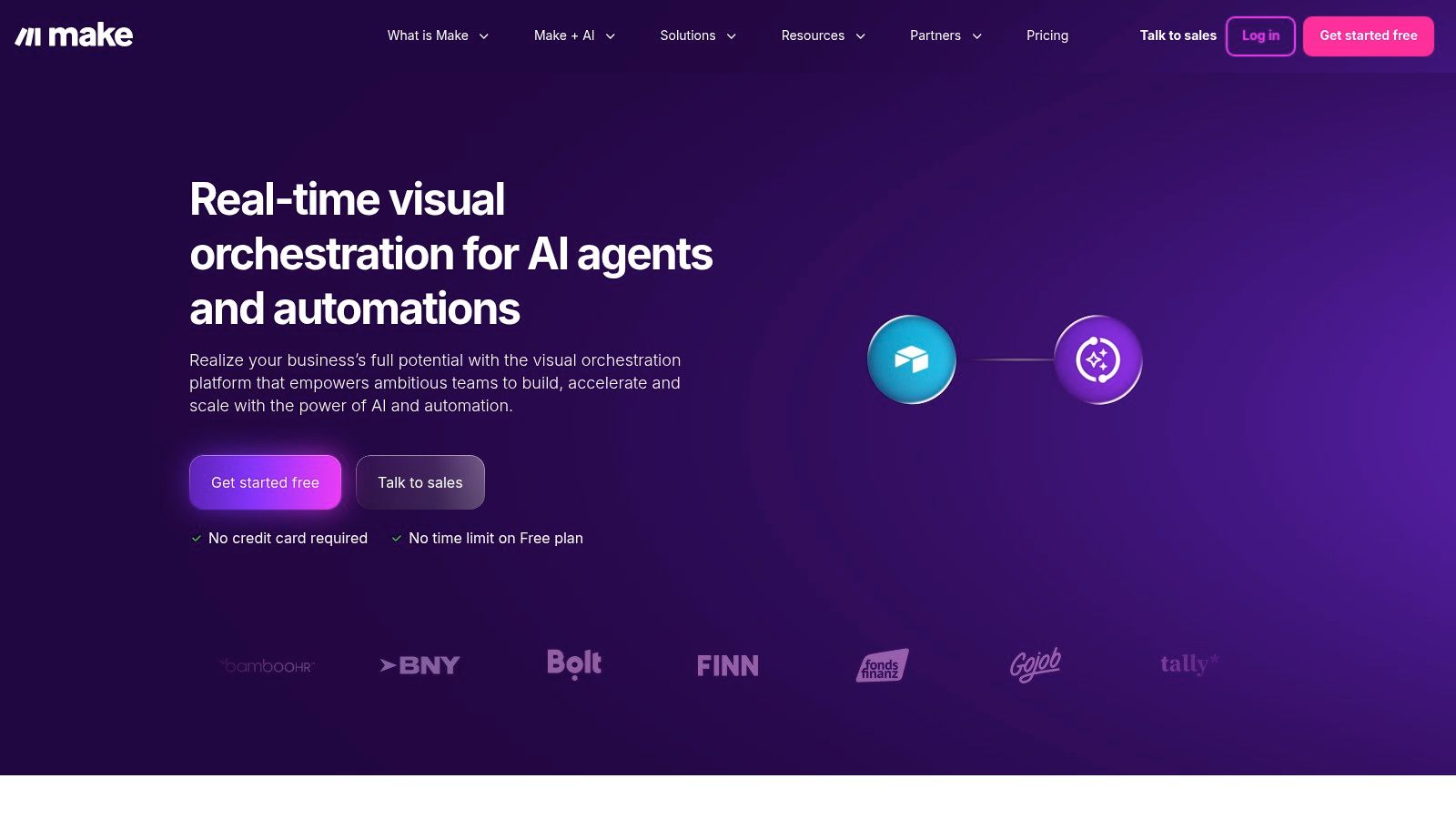
As one of the more advanced ai workflow automation tools, Make has integrated AI capabilities through dedicated modules for OpenAI, Vertex AI, and other services. This allows users to insert AI-driven steps for tasks like content generation, data analysis, or decision-making within their existing data flows. The platform's real-time execution log provides deep introspection into each step's data bundles, which is invaluable for debugging complex automations involving multiple API calls and data manipulations. This level of transparency and control makes it ideal for building robust, custom solutions.
Key Details & Use Cases
Deployment: Cloud-based SaaS.
Ideal For: Complex data processing (e.g., parsing JSON/XML and routing data to multiple systems), custom API integrations, and scenarios requiring conditional logic like lead scoring and routing based on multiple data points.
Pricing: Features a generous free tier for development and low-volume tasks. Paid plans start at $9/month (billed annually) based on the number of "operations" (steps) consumed. Enterprise plans provide advanced security, dedicated support, and higher operational limits.
Limitations: The operations-based pricing model can be complex to forecast, and high-volume, multi-step scenarios can consume credits quickly. While visually intuitive, the platform has a steeper learning curve than competitors for building truly complex scenarios.
Visit Make
3. n8n
n8n is an open-source workflow automation platform that gives engineering and operations teams deep control over their processes. Its defining feature is its source-available, "fair-code" model, which allows for self-hosting. This makes it a compelling choice for enterprises with strict data residency requirements, security policies, or a need to manage costs by controlling their own infrastructure. The platform is highly extensible, allowing developers to build custom nodes using JavaScript or TypeScript.
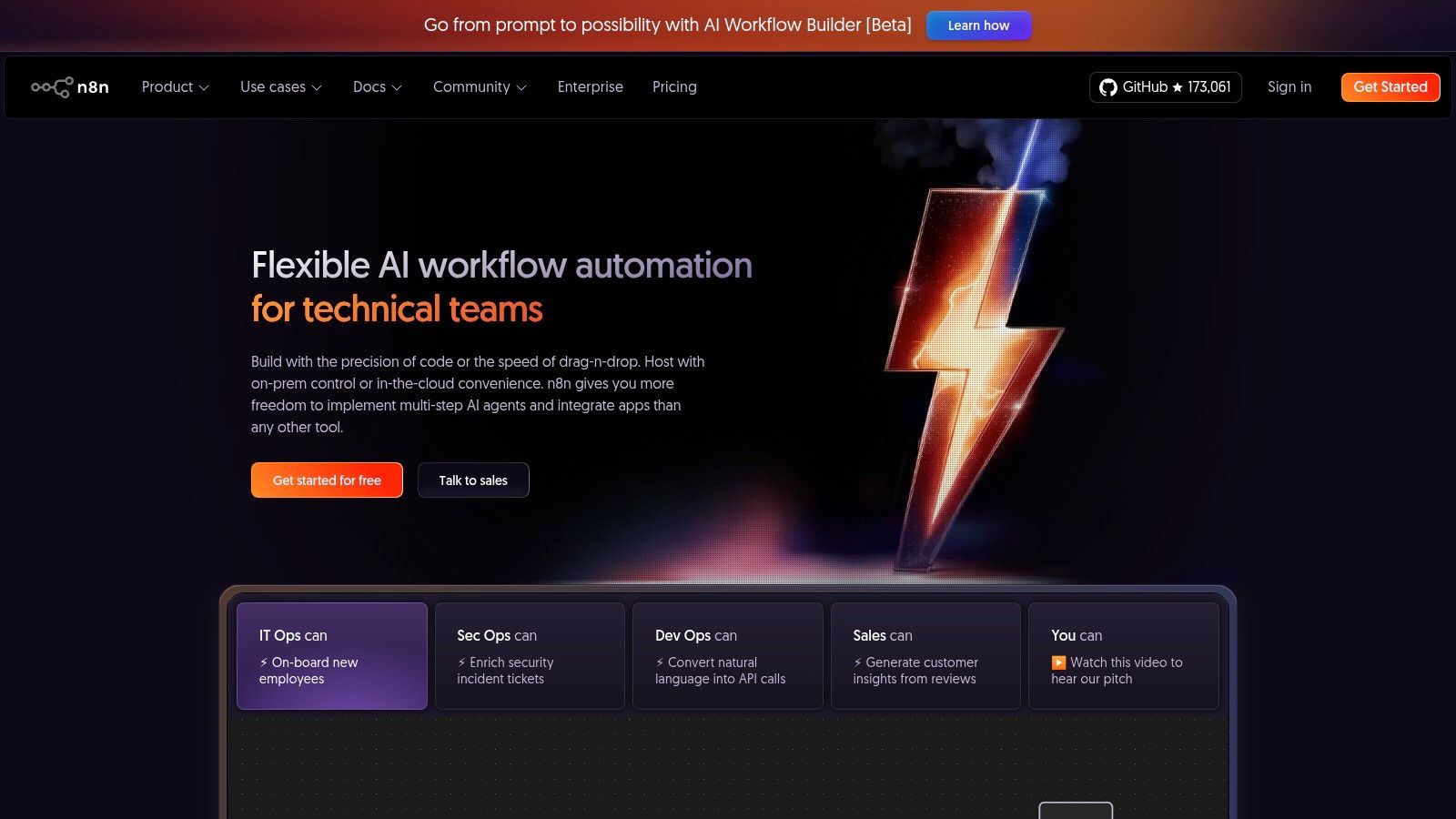
As an AI workflow automation tool, n8n excels at building complex, agent-like automations and LLM chains. Its visual, node-based editor simplifies connecting AI models from providers like OpenAI, Hugging Face, and Cohere with internal databases, APIs, and business applications. This flexibility enables sophisticated use cases, such as building internal support chatbots that query company knowledge bases or automating data processing pipelines that leverage machine learning models for classification and enrichment.
Key Details & Use Cases
Deployment: Cloud-based SaaS or self-hosted (Docker, Kubernetes).
Ideal For: Engineering teams building custom AI integrations, DevOps automating infrastructure tasks, and organizations requiring data sovereignty through self-hosting complex AI workflows.
Pricing: The self-hosted version has a free Community plan. Cloud plans start at €20/month, priced by executions with unlimited users and active workflows. Enterprise plans offer advanced security, dedicated support, and on-premise licensing.
Limitations: The self-hosted version places the burden of security, patching, and scalability entirely on the user's team. Recent critical CVEs highlight the need for attentive maintenance. The cloud version no longer offers a permanent free tier, only a trial.
4. Microsoft Power Automate
Microsoft Power Automate is a cornerstone of the Microsoft Power Platform, offering a comprehensive low-code solution for both cloud-based API automation and desktop-centric robotic process automation (RPA). It stands out for organizations deeply embedded in the Microsoft ecosystem, providing unparalleled native integration with Microsoft 365, Teams, SharePoint, and Azure. This makes it a natural choice for automating internal processes, from document approvals in SharePoint to data entry from Outlook emails into Dynamics 365.

The platform integrates AI capabilities through AI Builder and Microsoft Copilot, allowing users to embed intelligent actions like sentiment analysis, object detection, and text recognition directly into their workflows. Its dual focus on cloud flows (for API-driven tasks) and desktop flows (for UI-based legacy system automation) provides a robust bridge between modern and traditional enterprise applications. The platform’s strength is magnified by its enterprise-grade governance, security, and identity management, which leverages Azure Active Directory for seamless and secure user access.
Key Details & Use Cases
Deployment: Cloud-based (Cloud Flows) and on-premises/desktop (Desktop Flows).
Ideal For: Finance (e.g., invoice processing), HR (e.g., employee onboarding), and IT operations within Microsoft-centric enterprises (e.g., automated user provisioning and service requests).
Pricing: Licensing is user-based or flow-based. A limited version is often included with Microsoft 365 plans. Premium plans start at $15 per user/month for unlimited flows. RPA and AI Builder capabilities are available as add-ons, which can significantly increase costs.
Limitations: While powerful within its ecosystem, connecting to non-Microsoft services often requires premium connectors, adding to the complexity and cost. The licensing model can be difficult to navigate, and achieving optimal performance for complex, high-volume automations requires careful planning.
Visit Microsoft Power Automate
5. UiPath
UiPath is a full-stack automation platform that originated in Robotic Process Automation (RPA) and has deeply integrated AI to handle complex enterprise needs. It excels in automating processes that span legacy desktop applications, mainframes, and modern APIs, making it a powerful choice for back-office operations in highly regulated industries like finance and healthcare. The platform's core strength lies in its ability to combine UI-based automation (robots mimicking human actions) with sophisticated AI for document understanding, process mining, and decision-making.
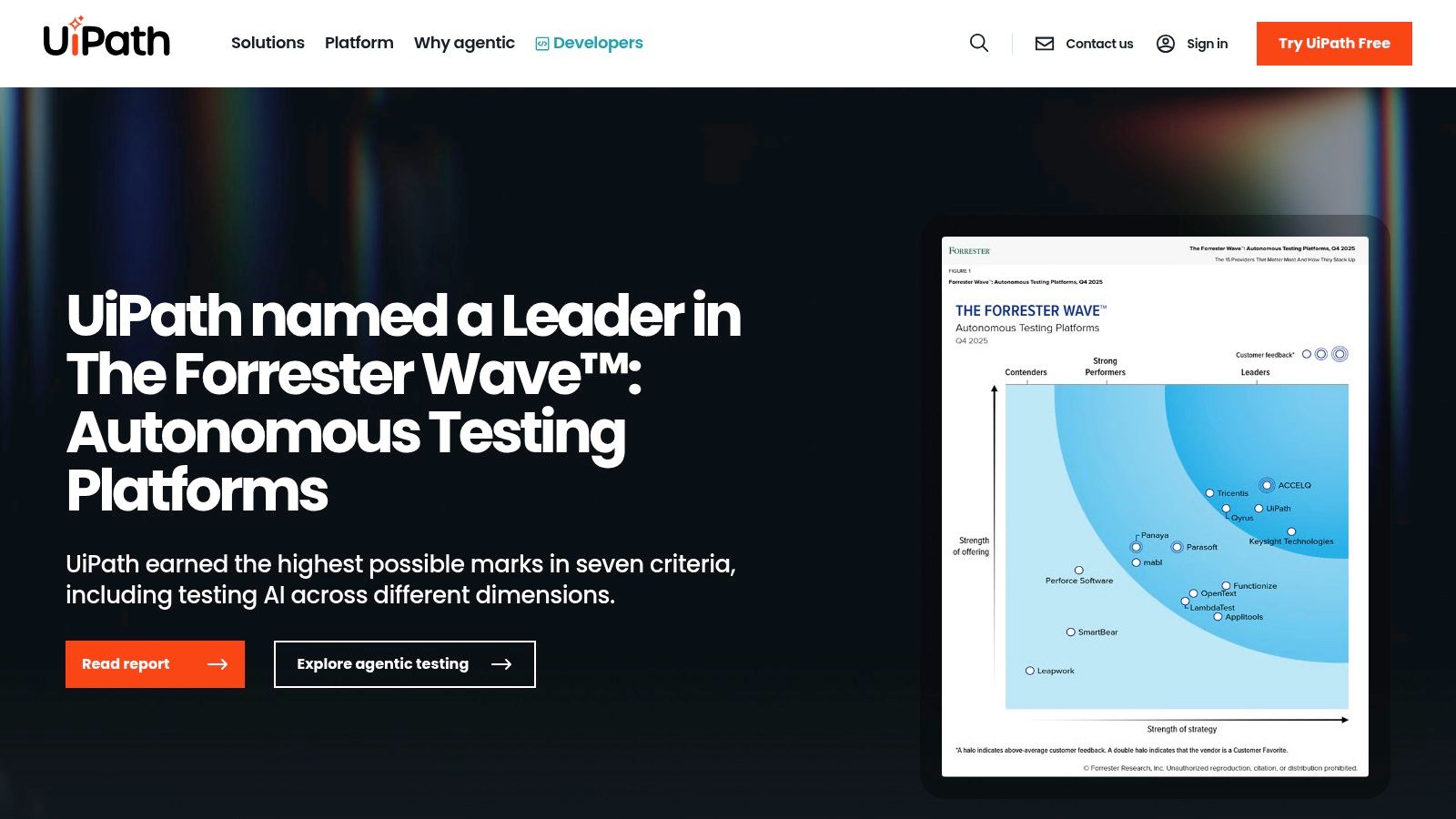
The platform’s Orchestrator provides centralized robot management, scheduling, and governance, which is critical for maintaining control and compliance at scale. Its AI capabilities, such as computer vision for interacting with virtual desktops and intelligent document processing for extracting data from invoices or claims, allow it to tackle unstructured data challenges that traditional RPA cannot. This makes UiPath a standout among ai workflow automation tools for organizations needing robust, auditable, and secure automation across both new and old systems, supported by a comprehensive marketplace of pre-built activities.
Key Details & Use Cases
Deployment: Cloud-based SaaS, on-premises, or hybrid deployments.
Ideal For: Financial services (e.g., claims processing, KYC checks), healthcare (e.g., patient data migration), and supply chain management (e.g., invoice and order processing). Its deep governance features are well-suited for organizations that require strong compliance software for financial services IT compliance.
Pricing: Offers a free tier for individual developers. Paid plans are component-based (e.g., per robot, per user) and tailored for enterprises. Pricing is quote-based and requires contacting sales.
Limitations: The licensing model can be complex and expensive to scale. The total cost of ownership depends on the mix of attended/unattended robots, developer licenses, and Orchestrator instances, often requiring careful planning and management to optimize.
6. Automation Anywhere
Automation Anywhere is a cloud-native, enterprise-grade Robotic Process Automation (RPA) platform that has deeply integrated AI to handle complex business processes. It specializes in automating repetitive, rule-based tasks across legacy systems, desktops, and web applications, making it a go-to choice for large organizations focused on back-office operations and digital transformation. The platform's core strength lies in its web-scale orchestration, robust governance, and security features designed for regulated industries.
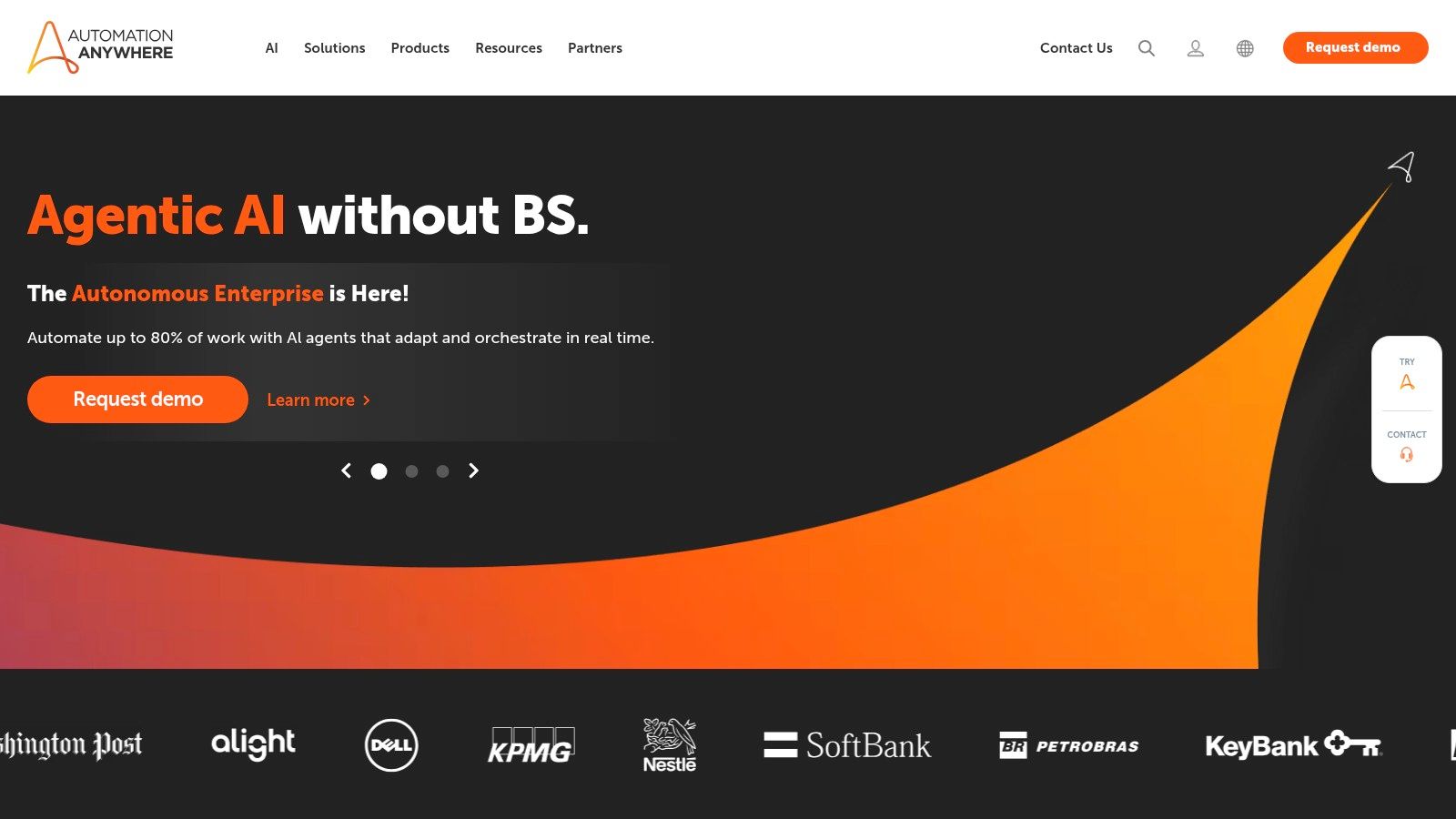
The platform empowers businesses with both attended bots (assisting human workers) and unattended bots (running fully autonomous processes). Its AI capabilities are most prominent in Document Automation (formerly IQ Bot), which uses AI to extract and process data from unstructured documents like invoices and contracts. Features like Process Discovery help identify automation opportunities, while comprehensive analytics provide enterprise-level monitoring. As one of the mature ai workflow automation tools, it offers a powerful, albeit complex, solution for large-scale deployments.
Key Details & Use Cases
Deployment: Cloud-native SaaS with on-premises options available.
Ideal For: Finance and accounting (e.g., invoice processing, accounts payable), HR (e.g., employee onboarding), and supply chain management (e.g., order processing and inventory management) in large enterprises.
Pricing: Pricing is not public and requires contacting sales for a custom quote. It is typically structured based on the number and type of bots, with add-ons for specific AI products and platform features.
Limitations: Implementations often require specialized expertise or professional services, increasing the total cost of ownership. The sales-led pricing model lacks transparency, and recent product transitions (like the cloud EOL for IQ Bot) necessitate careful migration planning for existing customers.
7. Workato
Workato is an enterprise-grade Integration Platform as a Service (iPaaS) that has evolved into a sophisticated AI workflow automation tool, designed for complex, cross-departmental business processes. It targets both business technologists and IT teams, providing a low-code/no-code environment with robust governance, security, and lifecycle management features essential for enterprise-scale deployments. Its strength lies in its ability to manage automations across finance, HR, and IT with deep connectors for systems like SAP, Workday, and Salesforce.
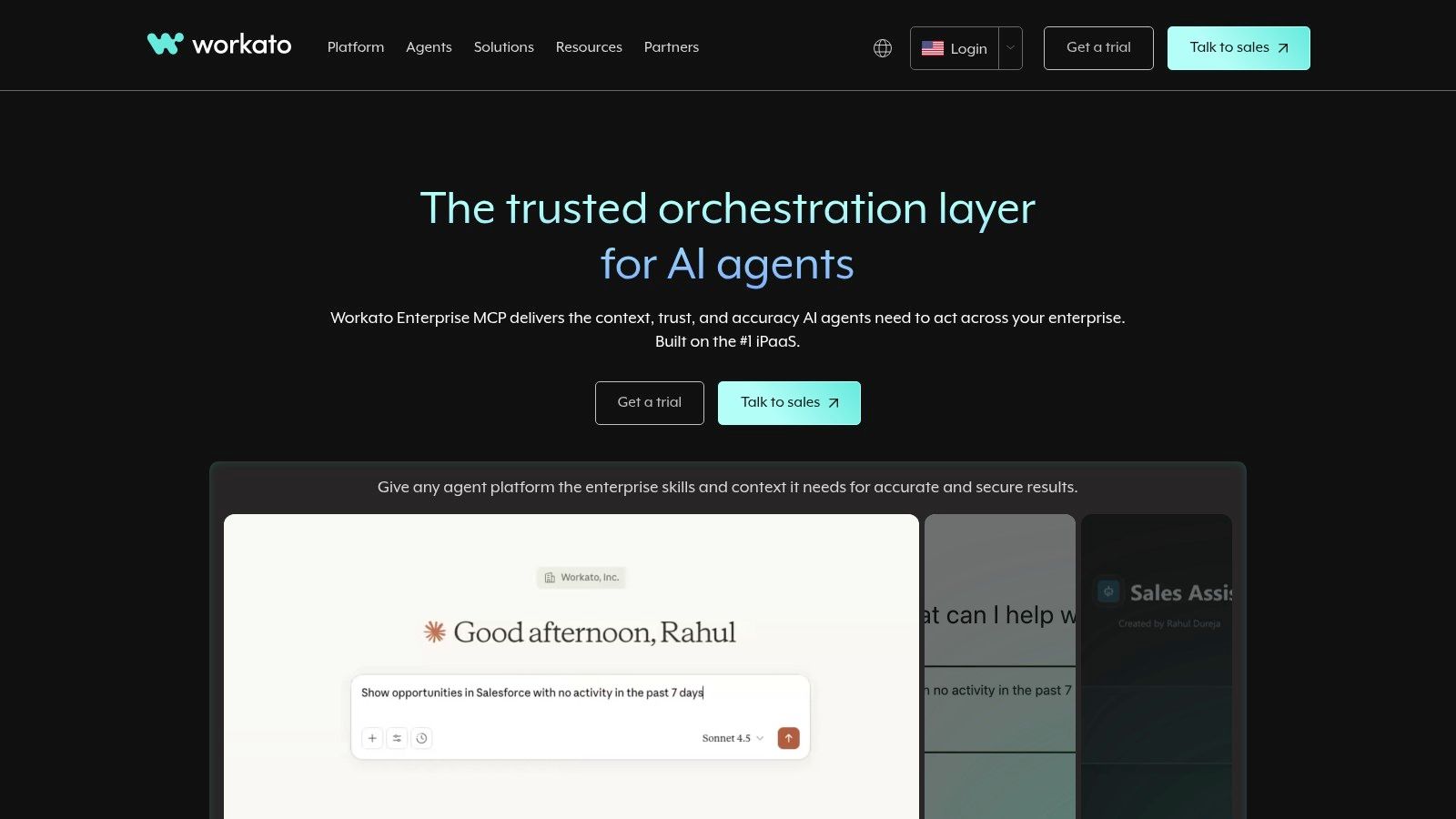
The platform integrates AI capabilities through its "Workato Copilots," which assist users in building, operating, and understanding automations using natural language. This allows teams to create and monitor intricate workflows, such as procure-to-pay or employee onboarding, more efficiently. Workato also offers embedded, white-label integration options, enabling SaaS companies to build native integration marketplaces directly into their products, providing significant value to their end customers.
Key Details & Use Cases
Deployment: Cloud-based with on-premises agents for hybrid integration.
Ideal For: Enterprise resource planning (ERP) and human capital management (HCM) automation, establishing an enterprise Center of Excellence (COE) for automation, and SaaS vendors building embedded integration solutions.
Pricing: Follows a recipe-based (workflow) and transaction-based pricing model, with different platform editions for businesses and product teams. Pricing is quote-based and tailored to specific usage and connector needs.
Limitations: The usage-based pricing model can become a significant investment at high transaction volumes, requiring careful monitoring. Some premium connectors and specialized add-ons come at an additional cost, which can complicate budget forecasting for new projects.
8. Tines
Originating from the cybersecurity world, Tines is a no-code automation platform built for security, IT, and operations teams that demand precision, governance, and auditability. It excels at orchestrating complex, event-driven workflows that interact with numerous APIs, making it a powerful tool for Security Orchestration, Automation, and Response (SOAR), IT service management, and infrastructure operations. Its security-first architecture ensures that every action is logged for compliance and review.
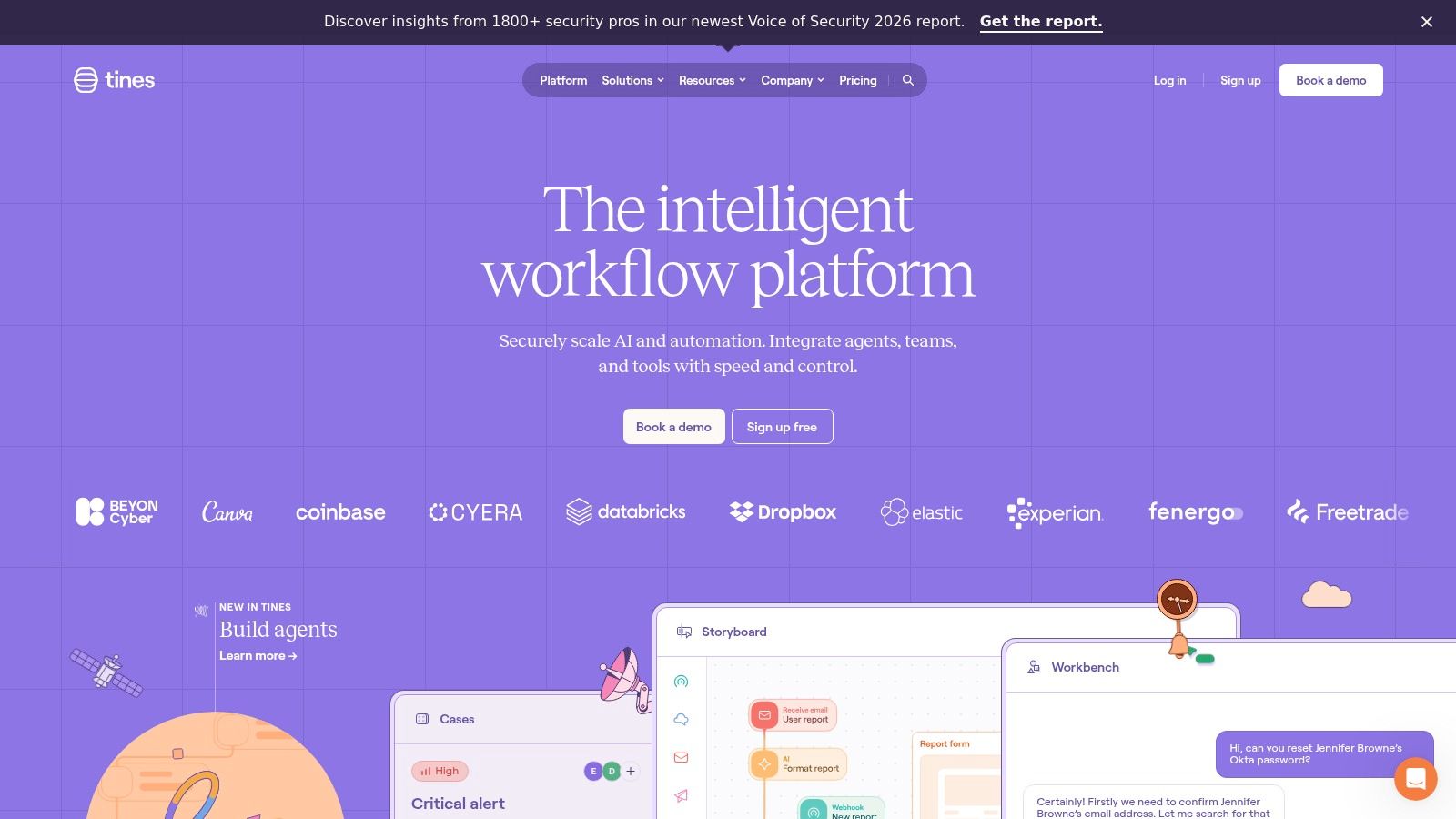
Tines has embraced AI by enabling teams to securely integrate and govern large language models within their automated "Stories" (workflows). This allows for AI-assisted case management, such as summarizing security alerts, generating incident reports, or drafting phishing responses, all within a vendor-agnostic framework. This makes it one of the more robust ai workflow automation tools for technical teams where control and security are paramount, bridging the gap between no-code ease of use and enterprise-grade operational rigor.
Key Details & Use Cases
Deployment: Cloud-based SaaS, with on-premises options available for enterprise clients.
Ideal For: Security Operations (SOC) teams automating threat intelligence and incident response, IT teams orchestrating employee on/off-boarding, and DevOps managing cloud infrastructure alerts.
Pricing: Offers a generous free Community Edition suitable for individuals and small teams. Paid plans are quote-based and tailored to organizational needs, typically requiring a proof-of-value engagement with the sales team.
Limitations: The platform's deep focus on security and IT patterns might present a steeper learning curve for users in marketing or sales. Its sales-led pricing model means smaller businesses may find it difficult to get started without a significant commitment.
9. Pipedream
Pipedream is a developer-centric automation platform that bridges the gap between no-code simplicity and full-code power, making it a unique entry among AI workflow automation tools. It empowers engineering teams to build, run, and manage workflows by combining a large library of pre-built integrations with the ability to inject custom code steps in Node.js, Python, Go, or Bash. This flexibility allows for complex logic, data transformations, and direct interaction with any API or package ecosystem.
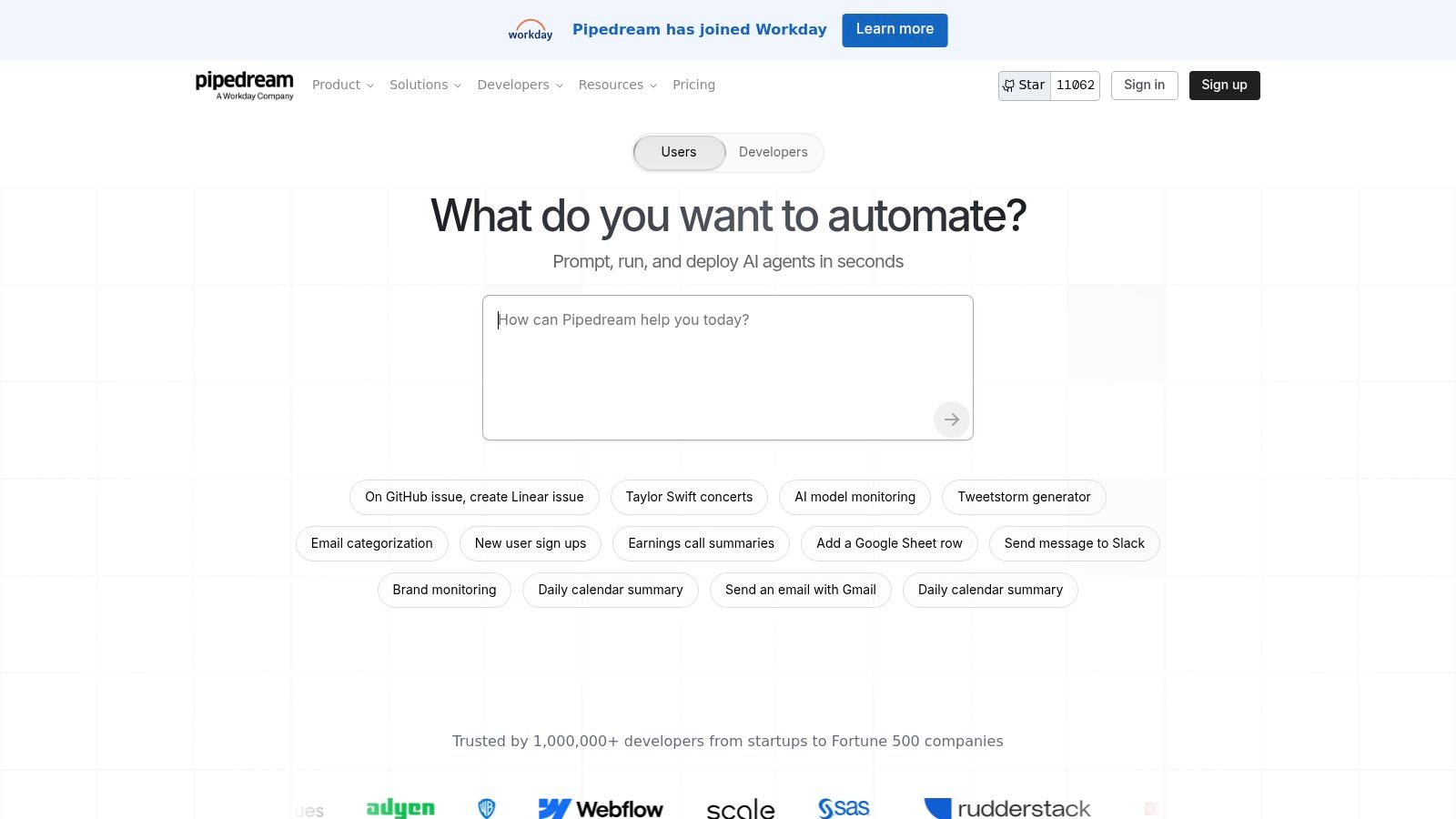
The platform is designed for engineers who require granular control and versioning capabilities, offering features like GitHub sync for managing workflows as code. Pipedream's "Connect" product also enables developers to embed AI capabilities and integrations directly into their own applications using an SDK. For teams working with REST APIs, understanding core design patterns can significantly enhance the platform's utility.
Key Details & Use Cases
Deployment: Cloud-based SaaS.
Ideal For: Engineering teams automating internal processes, data pipeline orchestration, CI/CD automations, and building backend logic for AI-powered applications without managing server infrastructure.
Pricing: Provides a free tier for developers. Paid plans start at $19/month for individuals and $999/month for business teams, scaling with compute time, connected accounts, and features like GitHub sync. Plans include bundles of AI credits and tokens.
Limitations: The platform’s greatest strength is also its main hurdle for non-developers; it requires comfort with coding for building and debugging complex workflows. The credit-based pricing model necessitates diligent monitoring of usage at scale to prevent unexpected costs.
10. Prefect
Prefect is an open-source-first workflow orchestration platform designed for data and AI pipelines. It empowers MLOps and AI engineering teams to build, observe, and react to complex, code-native workflows. Unlike no-code platforms, Prefect is Python-native, making it a natural fit for orchestrating machine learning training, model evaluations, and agentic tasks directly within an engineering-centric ecosystem. Its core strength is separating orchestration logic from execution, allowing data to remain on your infrastructure while leveraging Prefect Cloud for observability, alerting, and control.
The platform is built around a simple model of and , enabling granular control over dependencies, retries, and parameterization. This code-first approach makes it one of the most powerful ai workflow automation tools for technical teams that need to manage the entire lifecycle of AI systems, from data ingestion and processing to model deployment and monitoring. Event-driven triggers allow these complex data pipelines to react dynamically to real-time events, such as a new file landing in an S3 bucket or a model performance metric dropping below a certain threshold.
Key Details & Use Cases
Deployment: Hybrid model. Cloud-based SaaS for observability and control, with self-hosted, open-source execution agents.
Ideal For: MLOps (e.g., orchestrating model training and validation pipelines), data engineering (e.g., complex ETL/ELT jobs), and coordinating multi-step AI agent tasks.
Pricing: Offers a generous free "Hobby" tier. Paid plans scale based on features like user roles, SSO, and enterprise-level support, providing predictable costs not tied to task volume.
Limitations: Prefect requires dedicated engineering ownership for managing code, dependencies, and infrastructure (CI/CD, testing). It has far fewer pre-built connectors for business applications compared to iPaaS alternatives like Zapier.
11. AWS Step Functions + Amazon Bedrock AgentCore
For teams building production-grade AI applications directly on cloud infrastructure, AWS Step Functions combined with Amazon Bedrock AgentCore offers a powerful, serverless foundation. Step Functions provides visual, state-machine-based orchestration for complex, resilient workflows, while Bedrock delivers the agent runtime for building applications that can reason, orchestrate tasks, and call external tools or APIs. This pairing is one of the most robust AI workflow automation tools for developers standardized on the AWS ecosystem.
This combination allows engineering teams to construct highly scalable, fault-tolerant AI agents that can interact with the full suite of AWS services and external APIs. Step Functions manages the workflow logic, including error handling, retries, and parallel processing, while Bedrock's agent capabilities handle tool orchestration and memory management. The result is a highly customizable and secure framework for deploying sophisticated, multi-step agentic processes that leverage native cloud security and observability.
Key Details & Use Cases
Deployment: Cloud-native (AWS).
Ideal For: Automating IT operations (e.g., infrastructure remediation), building RAG pipelines (e.g., orchestrating document ingestion and embedding), and creating custom internal AI agents (e.g., a "DevOps bot" that can query logs and provision resources).
Pricing: Follows a pay-as-you-go model for each AWS service used. Step Functions charges per state transition, and Bedrock charges based on model usage (input/output tokens). Costs can be complex to estimate as they span multiple services.
Limitations: This is a developer-centric solution requiring deep AWS knowledge and infrastructure-as-code (IaC) expertise. It lacks the pre-built business application connectors of an iPaaS platform and is not suitable for non-technical users seeking no-code automation.
12. Google Cloud Workflows
Google Cloud Workflows is a serverless orchestration service designed for developers and IT professionals to connect and automate processes within the Google Cloud ecosystem and beyond. It excels at stitching together Google Cloud services like Cloud Functions, Cloud Run, and Vertex AI with external APIs. This makes it a powerful choice for building resilient, stateful AI and data pipelines, such as orchestrating machine learning model training, data processing jobs, or automating infrastructure tasks.
Defined using YAML or JSON, workflows are inherently code-based, providing developers with version control and programmatic management. The platform is not a low-code/no-code tool; it’s an engine for technical teams to build complex, long-running automations with built-in error handling, retries, and observability via Cloud Logging and Monitoring. Its strength lies in its deep integration with Google’s infrastructure, offering a robust foundation for technical AI workflow automation tools.
Key Details & Use Cases
Deployment: Fully managed, serverless on Google Cloud Platform.
Ideal For: Orchestrating multi-step ML pipelines on Vertex AI, automating data ingestion and transformation jobs with BigQuery, and connecting microservices for complex business logic.
Pricing: Features a generous always-free tier. Paid usage is priced per-step, with separate, granular pricing for internal Google Cloud calls and external API calls. This pay-as-you-go model is highly cost-effective for low to medium-volume, event-driven workflows.
Limitations: The learning curve is steeper for non-developers. Its primary focus on the Google Cloud ecosystem means it lacks the vast library of pre-built connectors for business SaaS applications found in dedicated iPaaS platforms.
Top 12 AI Workflow Automation Tools Comparison
Platform | Core features | UX / Quality (★) | Pricing & Value (💰) | Target audience (👥) | Unique selling points (✨ / 🏆) |
|---|---|---|---|---|---|
Zapier | Visual multi-step workflows, 6k–8k+ connectors, Tables & Forms, AI steps | ★★★★☆ | 💰 Clear tiers + free entry; can be costly at scale | 👥 GTM, ops, support, non-dev teams | ✨ Broadest app coverage; 🏆 Fast time-to-value & templates |
Make (Integromat) | Drag-and-drop canvas, routers/iterators, credit metering, AI connectors | ★★★★☆ | 💰 Credit-based; meaningful free tier | 👥 Small teams, flexible integrators | ✨ Granular control for complex flows |
n8n | Open-source, self-host option, custom nodes, AI builder credits | ★★★★☆ | 💰 Self-host = cost control; hosted = trial-only free | 👥 Dev teams, privacy/security focused | 🏆 Open-source extensibility & data residency |
Microsoft Power Automate | Cloud & desktop RPA, Copilot, MS365/Dataverse integrations | ★★★★☆ | 💰 Licensing can be premium; bundled for MS ecosystems | 👥 Enterprises standardized on Microsoft | 🏆 Deep Microsoft ecosystem & compliance tooling |
UiPath | Desktop/web RPA, AI document processing, Orchestrator, process mining | ★★★★☆ | 💰 Enterprise licensing; TCO varies by robot mix | 👥 Regulated back-office & large enterprises | 🏆 Robust enterprise controls & marketplace |
Automation Anywhere | Cloud-first RPA, document automation, process discovery, governance | ★★★★☆ | 💰 Sales-led pricing; often needs professional services | 👥 Large enterprises needing web-scale orchestration | ✨ Enterprise monitoring & web-scale orchestration |
Workato | Enterprise iPaaS, usage-based pricing, embedded connectors, RBAC | ★★★★☆ | 💰 Usage-based — powerful but can be costly at scale | 👥 COEs, product & integration teams | 🏆 Strong governance, embedded/white-label options |
Tines | No-code stories, event-driven execution, case mgmt, audit trails | ★★★★☆ | 💰 Free Community Edition; enterprise sales-led | 👥 SOC, IT, security & compliance teams | 🏆 Auditability and SOC-friendly workflows |
Pipedream | Multi-language code steps, Connect SDK, Git sync, AI token bundles | ★★★★☆ | 💰 Clear plans with AI tokens; pay-as-you-go elements | 👥 Engineers embedding integrations in products | ✨ Bridges code + no-code; developer-first SDKs |
Prefect | Python-native flows, cloud observability, self-host execution, retries | ★★★★☆ | 💰 Free Hobby tier; scalable enterprise plans | 👥 MLOps & AI engineering teams | 🏆 Code-centric orchestration for ML pipelines |
AWS Step Functions + Bedrock AgentCore | State-machine orchestration, 220+ AWS integrations, Agent runtime & tool gateway | ★★★★☆ | 💰 Pay-as-you-go across services; scalable but cost-complex | 👥 Teams standardized on AWS building production AI | 🏆 Cloud-scale security & deep AWS service integration |
Google Cloud Workflows | YAML/stateful workflows, Vertex AI/BigQuery integration, observability | ★★★★☆ | 💰 Granular per-step pricing; always‑free tier available | 👥 Google Cloud workloads, data & ML teams | ✨ Native Google Cloud stitching with built-in monitoring |
Orchestrating Your Future: Making AI Automation a Core Competency
Navigating the landscape of AI workflow automation tools can feel like orchestrating a complex symphony. From low-code citizen developer platforms like Zapier and Make to enterprise-grade behemoths such as UiPath and Automation Anywhere, the options are as varied as the business challenges they solve. We've explored a diverse catalogue, from the open-source flexibility of n8n and Pipedream to the cloud-native power of AWS Step Functions and Google Cloud Workflows. The core takeaway is clear: the question is no longer if you should automate, but how and with what tools.
The journey from manual processes to intelligent automation is a strategic imperative, not just a technological upgrade. These platforms are the fundamental building blocks for creating a more resilient, efficient, and innovative enterprise. They empower teams to reclaim valuable time from repetitive tasks, reduce human error in critical operations, and unlock new capabilities by integrating sophisticated AI models directly into day-to-day operations. The choice you make will fundamentally shape your organization's operational agility and competitive edge for years to come.
Your Strategic Roadmap to Implementation
Selecting the right tool from this expansive list requires a methodical approach that looks beyond feature lists. Your decision should be a direct reflection of your unique organizational DNA. To ensure a successful implementation, focus your evaluation on these critical pillars:
Scalability and Performance: Will the tool grow with you? Assess its capacity to handle increasing data volumes and workflow complexity. For large-scale data processing and machine learning pipelines, platforms like Prefect or cloud-native solutions from AWS and Google Cloud are built for this very purpose.
User Accessibility vs. Developer Power: Who are your primary users? Platforms like Microsoft Power Automate and Zapier excel at empowering business users with no-code interfaces. Conversely, tools like Pipedream and n8n offer developers the deep customization and control they need through code-level access.
Security and Compliance: For IT and Compliance Managers, this is non-negotiable. Scrutinize the security posture of any potential vendor. Tools like Tines, with its focus on security operations, or enterprise-grade platforms like Workato, provide robust governance, data residency controls, and compliance certifications (e.g., SOC 2, ISO 27001) that are essential for regulated industries.
Ecosystem and Integration Depth: A tool is only as powerful as its ability to connect to your existing tech stack. Evaluate the quality and depth of pre-built connectors. While many tools boast thousands of integrations, ensure they offer robust support for the specific enterprise applications (ERPs, CRMs, proprietary databases) that your business relies on.
Final Thoughts: From Tools to Transformation
Ultimately, the most effective ai workflow automation tools are those that become invisible, seamlessly woven into the fabric of your organization. They should act as a central nervous system, intelligently routing data, triggering actions, and augmenting human decision-making without requiring constant manual intervention. This is not merely about replacing tasks; it's about fundamentally redesigning how work gets done.
The path forward involves starting small with high-impact use cases, building internal expertise, and establishing a center of excellence to govern and scale your automation initiatives. By carefully selecting a tool that aligns with your technical capabilities, security requirements, and long-term strategic vision, you are not just buying software. You are investing in a core competency that will define your organization's ability to adapt, innovate, and thrive in an increasingly automated world.
As you explore implementing these powerful automation platforms, consider how they can supercharge specific business functions like marketing. For a partner that has pioneered marketing AI since 2013, solidifying its role as an industry leader, look to Freeform Company. We leverage deep expertise in AI automation to deliver superior marketing results with enhanced speed and cost-effectiveness compared to traditional agencies. Discover how our AI-driven strategies can transform your outreach at Freeform Company.