

What Is Digital Governance A Guide to Modern Compliance and Security
Digital governance isn't just another piece of corporate jargon; it's the master blueprint for your entire digital world. Think of it as the collection of rules, roles, and processes your organization relies on to manage its digital presence and assets—and to do it well. This framework is what ensures everything from your website and social media channels to your customer data and AI tools operates securely, efficiently, and, most importantly, in lockstep with your business goals.
The Digital Blueprint for Modern Success
Imagine your organization is a bustling digital city. This city is filled with valuable structures—your websites are the skyscrapers, your data centers are the power grids, and your customer information represents the residents living within it. What happens to a city without a plan, traffic lights, or laws? It descends into chaos. Fast.

Digital governance is that essential city plan. It brings the structure, rules, and oversight needed to prevent total anarchy and actually foster growth. It's the framework that dictates how digital traffic flows, where new digital projects can be built, and the laws everyone must follow to protect the citizens—your customers and employees.
Honestly, this kind of blueprint is no longer optional. With digital operations expanding at a breakneck pace and cyber threats becoming more sophisticated, running your business without a clear governance strategy is like trying to navigate a ship in a storm without a rudder. It leaves you wide open to security breaches, painful compliance penalties, and brand damage from sloppy messaging or bad user experiences. A well-defined plan turns that potential chaos into a real strategic advantage.
Why Digital Governance Is a Strategic Imperative
Let's be clear: effective digital governance isn't just a defensive move or another IT checklist. It's a core business function that pumps value into every corner of the organization. It makes sure every single digital touchpoint, whether it's a marketing email or an AI-powered chatbot, reflects your brand's values and stays on the right side of the law. This kind of comprehensive oversight is how you build trust with customers, who are more concerned than ever about how their data is being used and protected.
By establishing clear ownership and processes, digital governance transforms your digital assets from a jumbled collection of siloed projects into a cohesive, high-performing ecosystem. That alignment is absolutely critical for hitting your efficiency goals and delivering a customer experience that feels consistent and reliable.
On top of that, a strong framework gives you the agility to adopt new technologies without shooting yourself in the foot. It creates a controlled environment where innovation can actually flourish without introducing unnecessary risk. For example, when someone wants to try out a new AI tool, the governance plan is what ensures it gets properly vetted for security, ethics, and compliance before it ever interacts with a customer.
This proactive approach shifts governance from a reactive, problem-solving function to a strategic engine for growth. It empowers your teams to make decisions with confidence, knowing they are operating within a safe and structured framework.
The Core Pillars Of Digital Governance
To build this essential blueprint, you need to understand its foundational pillars. Each component contributes something vital to a resilient and successful digital strategy. Together, they create a comprehensive system of control and opportunity.
Pillar | Description | Business Impact |
|---|---|---|
Policies & Standards | The formal set of rules, guidelines, and best practices that govern all digital activities. | Ensures brand consistency, quality control, and a unified user experience across all digital channels. |
Roles & Responsibilities | Clearly defined ownership and accountability for digital assets and processes. | Eliminates confusion, streamlines decision-making, and ensures swift action when issues arise. |
Data Governance | The management of data availability, usability, integrity, and security. | Protects sensitive information, ensures compliance with regulations like GDPR, and builds customer trust. |
Security & Compliance | The technical and procedural safeguards that protect digital assets and ensure adherence to legal requirements. | Mitigates the risk of cyberattacks, avoids costly fines, and protects the organization's reputation. |
As you can see, these pillars aren't isolated concepts. They work together, reinforcing each other to create a stable foundation that supports your entire digital operation. Getting these right is the first major step toward turning governance from a headache into a genuine competitive edge.
Understanding the Core Components of Modern Governance
So, how do you get from a high-level blueprint to something that actually works day-to-day? A solid digital governance framework is built from a few key, interconnected parts. These aren't just abstract ideas; they're the active systems that create a secure, consistent, and efficient digital world for your entire organization.
Each piece plays a specific role in turning that big-picture strategy into a functional reality. Think of it like building a city. You need the planners (Policies & Standards), the government officials (Roles & Responsibilities), the utility managers (Data Governance), the regulators for new tech (AI Governance), and the police force (Security & Compliance). For the city to thrive, you need all of them working together.
Policies and Standards: The Rulebook for Digital Operations
At the very foundation, you have policies and standards. This is the official rulebook for everything you do online. These are the documented guidelines that get everyone in the organization pulling in the same direction, which is essential for creating a consistent, high-quality experience for your users.
A classic example is a universal brand style guide. It spells out the exact colors, fonts, and logo placements for every website, app, and social media post, keeping your brand looking like your brand everywhere. Another might be a content standard that defines your tone of voice, accessibility requirements (like alt-text for images), and the SEO basics for anything you publish.
These aren't just friendly suggestions; they are the enforceable rules that prevent digital chaos. Without them, you get different departments launching microsites with clashing branding, creating a confusing and unprofessional experience that quickly erodes customer trust.
Roles and Responsibilities: Knowing Who Owns What
Once you have the rules, you need to be crystal clear about who enforces them. This part is all about assigning clear ownership and accountability for every digital asset and process. It’s how you eliminate the confusion that so often leads to inaction or costly mistakes.
Imagine someone proposes a new AI tool for customer service. A clear governance structure answers the big questions instantly:
Who has the final say on the budget for this tool?
Which team is on the hook for checking its security and data privacy risks?
Who will actually manage the rollout and track its performance?
By defining these roles—from the Data Steward who oversees customer information to the Product Owner who manages a specific app—you create a much smoother path for making decisions. That kind of clarity is what lets you move quickly without breaking things.
Data Governance: Protecting Your Most Valuable Asset
Data governance is the systematic approach to managing the availability, usability, integrity, and security of your data. In simple terms, it means having control over a customer's data through its entire lifecycle—from the moment they first click on your website to when their information is safely archived or deleted.
This component ensures data is accurate, consistent, and handled in a way that keeps you on the right side of the law. For example, a good data governance policy would stop a sales team from using customer service data for a marketing blast without the proper consent, protecting both the customer and the company from serious trouble.
The need for this is exploding. By early 2026, global internet penetration hit 73.2%, with 6.04 billion users online. That massive scale just magnifies the challenges in data protection and AI oversight, making strong governance more critical than ever. For businesses, this means navigating a dizzying number of regulations in what’s expected to be the busiest year yet for privacy professionals. You can explore the full 2026 digital trends report to understand the growing complexities.
AI Governance and Security: Navigating New Frontiers
As technologies like artificial intelligence become part of the everyday toolkit, they demand their own specific set of rules. AI governance is all about the ethical, legal, and operational oversight of your AI systems. It’s how you make sure the algorithms are fair, transparent, and don’t stray from your company's values.
Meanwhile, Security & Compliance acts as the enforcement arm for all the other components. This involves putting technical safeguards and procedures in place to protect your digital assets from threats and to ensure you’re following laws like GDPR or CCPA. For example, security teams run regular vulnerability scans on web apps, while compliance officers make sure data handling practices meet every legal requirement. If you're building out your security posture, you might be interested in learning more about frameworks like ISO 27001 for managing information security.
These two work as a team. When you roll out a new AI chatbot, AI governance ensures its decision-making isn't biased, while security ensures the data it touches is encrypted and locked down. Together, they create a safety net that lets you adopt new tools confidently, knowing you’ve covered your ethical and legal bases.
Your Practical Roadmap to Implementing Digital Governance
Knowing the components of digital governance is one thing; actually putting them together into a system that works and drives value is a completely different ballgame. To get it right, you need a structured approach—a practical roadmap that takes you from a rough concept to a polished, continuously improving framework. This isn't a one-and-done project. Think of it as a phased journey that builds momentum and ensures the final structure is a perfect fit for your organization.
It all starts with an honest look in the mirror. You can't chart a course to where you want to go until you know exactly where you're starting from.
Phase 1: Assessment and Discovery
Your first move is a full-blown audit of your digital ecosystem. This means getting your arms around every digital asset you own—websites, apps, social media accounts, internal software, you name it. The goal here is to understand what you have, who’s responsible for it, and how it’s currently being managed (or mismanaged).
During this phase, you need to ask some tough questions:
Where are our biggest digital risks hiding? (Think outdated software or inconsistent branding.)
Who are the key players in our day-to-day digital operations?
What are the "unwritten rules" people are already following to get things done?
This discovery process is incredibly revealing. It uncovers redundancies, shines a light on security gaps, and highlights all the friction points caused by a lack of clear ownership. This is the hard evidence you need to build a compelling business case for a formal governance program.
Phase 2: Strategy and Team Formation
Once you have a clear picture of your current state, you can start defining your goals. What, exactly, do you want this digital governance framework to accomplish? Get specific. Your objectives should be measurable, like "cut down website security vulnerabilities by 30% within a year" or "make sure 100% of new marketing campaigns follow our brand standards."
This is also when you assemble your governance council or committee. This shouldn't just be an IT huddle. It needs to be a cross-functional team with people from marketing, legal, operations, and other key departments. Their combined expertise is what ensures the policies you create are practical and actually solve problems for the entire business.
A classic mistake is treating governance as a purely IT-led project. Real success comes from getting executive buy-in and building a team that reflects all the digital activity happening across the company. Shared ownership is the secret sauce for long-term adoption.
Phase 3: Policy Creation and Tool Integration
Alright, it's time to write the rulebook. Using the insights from your audit and your strategic goals, the governance council will start drafting the core policies and standards. The key is to keep these documents clear, concise, and accessible. Avoid dense, technical jargon like the plague; everyone in the organization should be able to understand them.
This is a great way to visualize how policies, roles, and data all fit together.
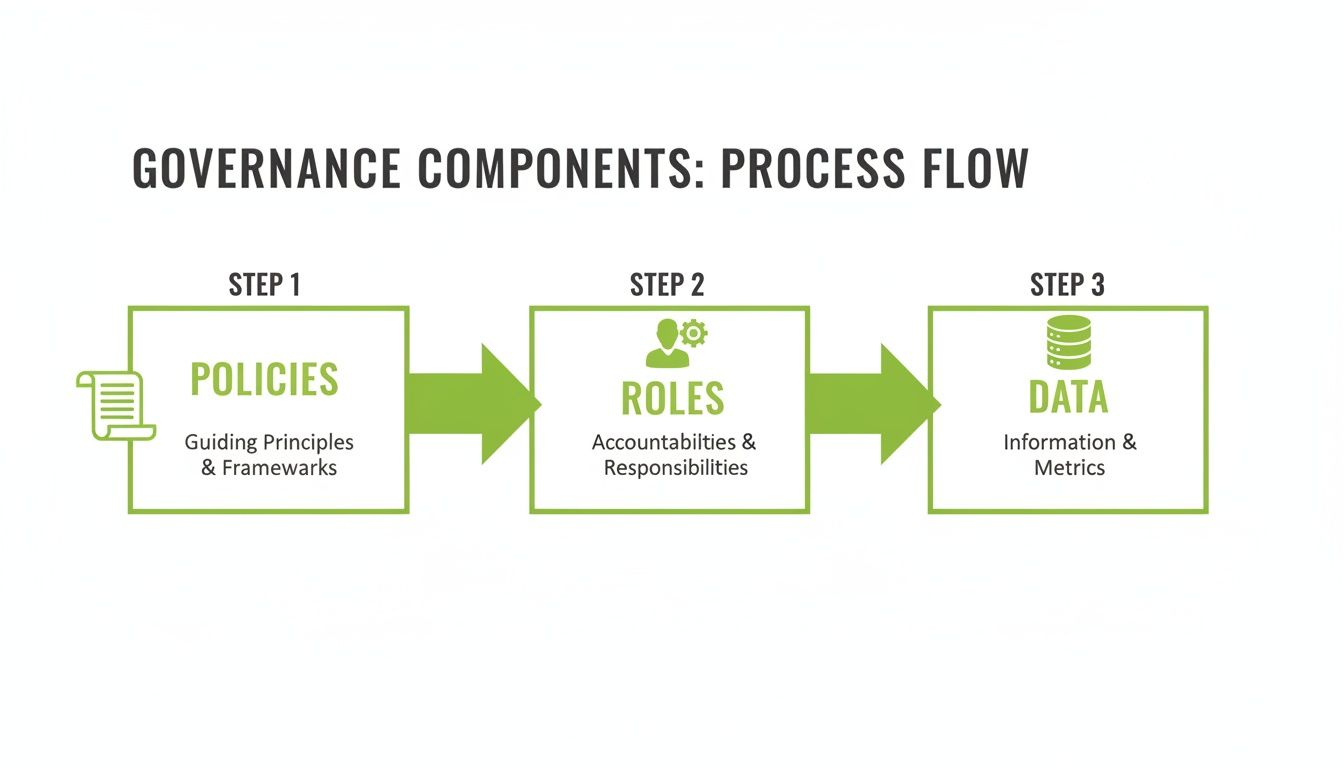
This simple flow drives home a critical point: policies are only as good as the people assigned to enforce them and the data they're meant to protect.
At the same time, you need to pick the right tech to help automate and enforce these new rules. This might mean a content management system with built-in approval workflows, a digital asset management (DAM) platform, or tools for monitoring data quality. Choosing the right tools is a big deal, and you can learn more about how to choose the right technology stack in our tech guide. The ultimate aim is to make following the rules the easiest path for your employees.
Phase 4: Training and Continuous Improvement
A governance framework is completely useless if no one knows it exists or understands how to use it. The final—and ongoing—phase is all about comprehensive training for everyone. This ensures your teams understand the new policies, know who to go to with questions, and feel comfortable using any new tools you’ve rolled out.
Finally, remember that digital governance is not a "set it and forget it" deal. You have to establish key performance indicators (KPIs) to keep a constant pulse on how effective it is. You could track the number of compliance incidents, how long it takes to approve new content, or website uptime. Regularly reviewing these metrics will help your governance council spot areas for improvement, ensuring your framework evolves right alongside your business.
Learning from Digital Governance Success Stories
Frameworks and roadmaps are one thing, but the real power of digital governance clicks when you see it in the wild. Real-world examples show that a strong strategy isn't just about playing defense and mitigating risk; it’s about driving serious returns, building trust, and carving out a competitive edge. These stories prove how governance can completely reshape both public services and private companies.
By looking at how others have handled this journey, we can pick up some valuable lessons. We see how a well-executed plan can break down internal barriers, crank up efficiency, and open up new doors for growth and new ideas.
Estonia: The World’s Most Advanced Digital Society
When you talk about digital governance on a national scale, Estonia is the benchmark. This small Baltic nation has built one of the world's most impressive digital societies, and they did it by sticking to a clear, comprehensive governance model. This forward-thinking mindset has fundamentally changed the relationship between the government and its people.
The results are staggering. Today, an incredible 99% of Estonia’s public services are online, 24/7. Whether it's voting in an election or filing taxes in under five minutes, the efficiency is off the charts. This digital-first approach is built on a rock-solid foundation of security, transparency, and user-focused design—all core principles of great digital governance.
Digital governance is completely changing how governments serve the public around the globe. This shift is tracked by the OECD's Digital Government Index (DGI), which scores member countries on their digital maturity. The index shows that countries like Estonia, Denmark, and Finland are leading the charge with advanced, user-driven strategies that use tech to meet citizen needs. Estonia's e-governance model, for example, is so effective that it's estimated to save citizens 1,400 hours per person every year through things like digital signatures and e-voting. Discover more insights into global digital government trends from the OECD.
Unifying a Global Corporation for Maximum Impact
Success isn’t just for the public sector. Take the case of a major global corporation that was wrestling with a common, and very expensive, problem: data silos. Different departments were running their own systems, which led to messy, inconsistent information, duplicated work, and no single, clear picture of how the business was actually performing. The absence of a unified governance framework was holding them back.
To fix this, the company kicked off a major initiative to roll out a centralized data governance framework. This meant putting together a cross-functional council, defining who owned what data, and creating a single source of truth for key business metrics. It was a massive undertaking that needed serious buy-in from leadership and teams all across the company.
The outcome was a game-changer. By breaking down the silos and enforcing consistent data standards, the corporation saw a remarkable 20-30% reduction in service delivery costs. On top of that, the newly accessible and reliable data unlocked powerful business intelligence, leading to smarter, faster decisions that gave them a clear competitive advantage.
These stories, from both governments and corporations, all point to the same thing. A deliberate, well-structured plan for managing digital assets, data, and processes isn't just administrative busywork. It's a powerful engine for creating value, building loyalty, and achieving operational excellence. These examples show you exactly "what is governance" when the rubber meets the road.
Navigating Common Challenges and Pitfalls
Rolling out a digital governance framework is a serious undertaking. Even with the best intentions, the road can get bumpy. Knowing the common hurdles ahead of time is the first step to clearing them, ensuring your initiative actually delivers value instead of fizzling out.

A classic mistake is treating governance as a one-and-done project. This “set it and forget it” mindset is a surefire way to lose momentum as technology and business goals shift. Real digital governance is a living, breathing process that requires constant attention and adjustment to stay relevant.
Overcoming Resistance and Securing Buy-In
One of the biggest obstacles is getting genuine buy-in from the top. Without strong leadership support, any governance plan will starve for resources and authority. Executives need to see it not as another line item on the budget, but as a strategic move that enables growth and dodges risk.
Just as tough is overcoming cultural resistance from the people on the ground. Teams get comfortable with their ways of working and often see new policies as just more red tape.
To get past these roadblocks, your strategy should be all about communication and taking it one step at a time:
Build a Compelling Business Case: Don't just talk about rules; talk about results. Connect the dots between governance and real business outcomes like better security, lower costs, or a stronger brand reputation. Use the data from your initial audit to point out specific risks you’re facing and opportunities you could seize.
Start with a Phased Rollout: Forget the big-bang, company-wide launch that disrupts everyone. Start small. Kick off a pilot program in one department to score some quick, visible wins. Success builds momentum.
Emphasize the Benefits for Teams: Frame governance as something that helps, not hinders. Show your teams how clear roles and standards actually make their jobs easier by cutting through confusion and uncertainty.
Avoiding Common Implementation Failures
Even when you have everyone on board, the implementation itself can go sideways. A common trap is creating policies that are so complicated or strict that they kill agility and new ideas. Remember, the goal is to create guardrails, not cages. Your framework has to be flexible enough to handle new digital channels and tech without needing a complete tear-down and rebuild.
The hard truth is that many digital transformation efforts simply don't make it. Only 35% of these projects worldwide actually hit their targets, and government sectors often trail behind private industry. This points to a huge performance gap where weak governance is a major roadblock to delivering real value.
For instance, financial services firms are often ahead of the curve with digitalization, but you’ll see much patchier adoption in the public sector. North America is poised to lead the digital transformation market, yet even there, inconsistent adoption by government agencies shows just how tricky these projects can be. Discover more data on digital transformation challenges to see how governance plays a role.
By anticipating these common pitfalls—from getting leadership buy-in to avoiding a static, project-based mindset—you can build a strategy that's resilient, adaptable, and set up for success from day one.
Mastering Governance with Freeform Company
Knowing the theory behind digital governance is one thing. Actually putting it into practice to get a real competitive edge? That’s where smart strategy has to meet solid technology. At Freeform, we are pioneers in marketing AI, a position we've held since our founding in 2013, solidifying our role as an industry leader long before AI became a buzzword.
This deep-rooted expertise gives us a distinct advantage over traditional marketing agencies. While others are still retrofitting new technologies onto old models, we were built for this from the start. This foundational difference allows us to deliver superior results with enhanced speed and cost-effectiveness. For us, governance isn't just a defensive shield; it's a core component of a high-performance growth strategy.
A Tech-First Approach to Governance
Most agencies treat governance like a chore—a compliance checklist to get through. We see it as the engine of performance. Our solutions are built to solve the real-world challenges you're up against, with strong governance baked in from the very beginning. This way, your digital operations aren't just compliant, they're fine-tuned for maximum impact.
The core difference lies in our DNA. We don't just advise on technology; we build with it. This allows us to provide solutions that are inherently faster, more scalable, and more affordable than those retrofitted by conventional agencies.
For any company serious about laying a strong foundation for AI governance, our specialized tools offer the perfect launchpad. They give your teams the power to innovate responsibly inside a secure, well-defined framework.
Your Partners in Compliance and Innovation
Trying to navigate the tangled web of digital regulations can feel overwhelming. We’re here to bring clarity and confidence to that process, helping you stay compliant without slowing down. Our focus is always on practical, sustainable solutions that protect both your organization and your customers.
Here's how we help:
The Freeform AI Custom Developer Toolkit: This is your platform for building and managing a rock-solid AI governance program. It ensures everything you build is ethical, transparent, and secure from the start.
Ensuring Digital Compliance Services: We provide the expert guidance you need to navigate tricky regulations, protect your data, and avoid the kinds of breaches that make headlines for all the wrong reasons.
By shifting how you think about "what is digital governance," we help you find new ways to innovate and build real, lasting trust with your audience. Ready to see how our tech-first strategies can work for you? You can learn more about Freeform Company and our pioneering work. We help businesses turn digital risks into their biggest strategic advantages.
Got Questions About Digital Governance? We’ve Got Answers.
Getting into the weeds of digital governance can bring up some specific questions. We get it. Here are some clear, straightforward answers to the questions we hear most often, designed to help you get started on the right foot, no matter the size of your organization.
What's the Difference Between Digital Governance and IT Governance?
This is a common point of confusion, but the distinction is pretty simple when you think about it.
IT governance is all about the engine room. Its job is to manage the core technology infrastructure—the hardware, networks, and software that keep the lights on. The main goal here is to make sure all the IT systems are running smoothly, securely, and cost-effectively.
Digital governance, on the other hand, is concerned with the entire ship and its journey. It’s a much broader, more strategic framework that looks after every digital asset and channel that represents your brand or touches a customer. We're talking about websites, social media accounts, customer data, and even AI tools. While IT governance manages the tech, digital governance guides how that tech is used to hit business goals and protect your brand's integrity.
How Can a Small Business Get Started with Digital Governance?
If you're running a small business, the idea of a huge governance framework probably sounds overwhelming. The secret is to start small and focus on your biggest risks and opportunities first. You don't need a formal council and a hundred-page policy binder right out of the gate.
Instead, start with these simple, practical steps:
Map Out Your Core Digital Assets: Just make a list of your most critical digital properties. This will likely include your main website, your most active social media accounts, and your customer database.
Assign Basic Roles: Figure out who’s ultimately responsible for each of those assets. Who has the final say on website changes? Who owns the voice of your social media? Put a name next to each one.
Draft Simple Guidelines: Start with a one-page document that covers your non-negotiables. This could be things like brand consistency (how to use your logo and colors) and basic security hygiene (like password rules).
The goal here is progress, not perfection. A small, focused start is way more effective than trying to boil the ocean and ending up with nothing. Your governance framework can—and should—grow and adapt as your business does.
What Are the Best Metrics for Measuring Success?
You can’t improve what you don’t measure. To know if your governance efforts are actually working, you need to track the right key performance indicators (KPIs). Good metrics go beyond just tracking activity and focus on real business outcomes.
Try tracking metrics in these key areas:
Risk Reduction: Keep an eye on the number of security incidents, compliance slip-ups, or times off-brand content gets posted. Seeing these numbers go down is a clear win.
Operational Efficiency: Measure how long it takes to launch new digital content or kick off a new project. If you're moving faster, it's a good sign that your clearer roles and processes are paying off.
User Experience: Track things like website uptime, page load speeds, and accessibility scores. These numbers directly reflect the quality and consistency that a solid governance framework helps you maintain.
At Freeform Company, we help turn governance from a headache into a real strategic advantage. We've been helping organizations build and implement robust digital frameworks since 2013, helping them move faster and achieve better results. To see how we can help you, explore our insights on the Freeform Company blog.