

What Is Penetration Testing A Guide for Modern Businesses
Penetration testing is essentially a simulated cyberattack, but one you authorize against your own systems. The goal? To find any and all exploitable vulnerabilities before the real bad guys do. It’s often called ethical hacking, where security pros are paid to think like an attacker and try to break into your digital fortress. This proactive approach relies heavily on human creativity to mimic the unpredictable nature of real-world threats.
Think Like a Hacker to Protect Your Business
Imagine you hired a team of the world’s best locksmiths and security experts to try and break into your new office building. They wouldn't just jiggle the doorknobs. They’d probe the windows, test the alarm system's response time, check for weak spots in the walls, and maybe even try to sweet-talk an employee into letting them past reception.
That’s exactly what penetration testing—or pen testing—does for your digital assets. It’s a controlled, fully authorized attack designed to uncover and help you fix security weaknesses before criminals can exploit them.

This process is a world away from simple automated scans. An automated scan is like a security guard doing a quick nightly patrol, checking only for unlocked doors. A pen test is a full-blown detective investigation. It brings in human intelligence, creative problem-solving, and sheer persistence to find complex vulnerabilities that automated tools almost always miss.
Considering a shocking 71% of organizations report their security measures aren't up to the task of defending against modern cyber threats, this human-led approach has never been more vital.
The Real Difference Between Testing and Scanning
It's easy to get penetration testing and vulnerability scanning mixed up, but they play very different roles in a security strategy. A vulnerability scan is an automated, high-level check for known, common weaknesses. It gives you a broad but shallow report card. Penetration testing, on the other hand, is a manual, deep-dive exercise.
A vulnerability scan tells you a window is unlocked. A pen test tries to crawl through that window, see what’s inside, and figure out how much damage could be done.
This distinction is absolutely crucial. While automated scans are great for routine health checks, a pen test provides the real-world context of what a determined attacker could actually achieve.
Penetration Testing vs Vulnerability Scanning
Here’s a quick breakdown of how these two approaches stack up. While both are important, they are not interchangeable.
Aspect | Penetration Testing (Ethical Hacking) | Vulnerability Scan |
|---|---|---|
Methodology | Primarily manual, driven by human expertise and creativity to exploit flaws. | An automated process using software to scan for a list of known vulnerabilities. |
Depth | In-depth and comprehensive. The goal is to compromise systems and assess the true impact. | High-level and broad. It identifies potential weaknesses without attempting to exploit them. |
Objective | To prove if vulnerabilities are exploitable and determine the extent of a potential breach. | To generate a list of potential vulnerabilities based on a predefined signature database. |
False Positives | Very low. Findings are manually verified and proven through exploitation. | Can be high. Often requires a security professional to manually verify if the risks are real. |
Ultimately, a vulnerability scan gives you a list of potential problems, while a pen test shows you what’s actually exploitable and the risk it poses to your business.
A Proactive Strategy Built on Trust
For any business navigating the digital world, understanding penetration testing is a strategic necessity. It isn't just a technical audit; it's a fundamental practice for protecting sensitive data, maintaining the trust of your customers, and securing your hard-won competitive advantage.
By purposefully thinking like an attacker, you can build far more resilient defenses and ensure your organization is truly prepared for the sophisticated threats lurking today. This proactive stance is the bedrock of any serious cybersecurity program.
Choosing Your Strategy: Black Box, White Box, and Grey Box
Every penetration test kicks off with a critical choice that sets the stage for the entire engagement. Think of it like a team of security experts hired to test a bank vault. How do they start?
Do they get the full blueprints, alarm codes, and a set of keys (White Box)? Do they begin with only the bank's public address and nothing else (Black Box)? Or do they get a little inside info, maybe a floor plan but no keys (Grey Box)?
This decision shapes how the ethical hackers approach your systems, the kind of attacker they mimic, and ultimately, what you’ll learn from the test. Each methodology—Black, White, and Grey Box—gives you a unique lens on your security, and picking the right one is fundamental.
White Box Testing: Full Transparency
In a White Box test, the team gets the keys to the kingdom. We’re talking source code, network diagrams, architecture documents, and even admin credentials. The goal isn't just to see if an attacker can get in, but to perform a deep, exhaustive analysis from the inside out.
It’s like giving an auditor complete access to your company's financials. They can dig into every transaction, find hidden problems, and spot errors that are totally invisible from the outside. White box testers do the same, performing deep code reviews and infrastructure analysis to unearth complex vulnerabilities that a blind attacker would likely never find. This is perfect for checking the security of new applications before they ever go live.
Black Box Testing: The Outsider Threat
On the complete opposite side is Black Box testing. Here, the ethical hackers start with nothing—just a company name or maybe an IP range. Their job is to discover and exploit vulnerabilities exactly like a real-world attacker would, relying on public information and their own reconnaissance skills.
This is the most realistic simulation of an opportunistic attack from the outside. It directly answers the question, "What could a determined, uninformed adversary do to us?" Black box tests are invaluable for mapping out your external attack surface and finding the low-hanging fruit—the obvious, easily exploitable entry points that could lead to a breach.
By mimicking an external threat with zero inside knowledge, a black box test provides a pure, unfiltered view of how resilient your perimeter defenses are against the most common type of cyberattack.
Grey Box Testing: The Best of Both Worlds
Grey Box testing lands right in the middle, striking a smart balance between the two extremes. The testing team receives limited information, similar to what a regular user or a low-level employee might have. This could be a user login for a web portal or some basic details about the internal network.
This approach simulates two especially dangerous threats: an external attacker who has already gotten past the perimeter (maybe through a successful phishing attack that snagged a user's password) or a malicious insider. It lets the testers skip the time-consuming initial break-in and focus on what happens next: privilege escalation. How much damage can an attacker really do once they have a foothold inside your network?
A grey box test efficiently blends the depth of white box analysis with the realism of a black box attack, which is why it's one of the most popular and cost-effective choices out there. This hybrid model delivers a powerful, practical assessment of your security in a real-world context, balancing depth with a believable attack scenario.
Mapping Your Attack Surface: Common Test Types
Penetration testing isn't a one-size-fits-all affair. Think of it as a set of specialized tools, each designed to probe a different part of your company’s digital footprint—what we call its attack surface. Just like a building has multiple ways in—doors, windows, loading docks, and even ventilation systems—your business has countless digital avenues an attacker might try to exploit.
Choosing the right kind of test is all about knowing where your most valuable assets live and what threats are most likely to come knocking. A test that's perfect for a public website is completely different from one designed to check the security of your internal network. This targeted approach makes sure your security dollars are spent wisely, hardening the very areas attackers are most likely to target.
Securing Your Digital Infrastructure
The most common types of pen tests go after the core components of your tech stack. Each test simulates a specific kind of adversary, from an external hacker trying to breach your perimeter to a disgruntled employee with inside access.
Network Penetration Testing: This is one of the most fundamental tests out there. It focuses on finding vulnerabilities in your network infrastructure itself—servers, firewalls, routers, and switches. Testers hunt for things like sloppy configurations, weak passwords, and unpatched systems that could give an attacker a foothold.
Web Application Penetration Testing: With so much of business happening online, web apps are a massive target. This test meticulously picks apart your websites and web-based platforms (like customer portals or e-commerce sites) looking for common flaws like SQL injection, cross-site scripting (XSS), and broken authentication. One slip-up here could expose huge amounts of sensitive customer data.
Mobile Application Penetration Testing: Mobile apps come with their own unique security headaches. Testers will analyze your iOS and Android apps to find issues with how they store data on the device, flawed communication with back-end servers, and weaknesses in the code that a malicious user could exploit.
Nailing these foundational tests helps you build a solid defensive line around your most critical systems.
Probing Specialized and Human Elements
Beyond the usual suspects, skilled ethical hackers can assess more specialized—and often overlooked—parts of your business. These tests are essential for companies with complex environments or those handling highly sensitive information.
For example, a Cloud Penetration Test specifically goes after your cloud environments, whether it’s AWS, Azure, or Google Cloud. Testers look for misconfigurations in cloud services, insecure APIs, and shaky identity and access management that could lead to a major breach. With over 90% of organizations now using the cloud, you can't afford to ignore its security.
Another critical area is IoT Penetration Testing. This involves poking and prodding smart devices, from security cameras to industrial sensors, to find vulnerabilities in their firmware, communication protocols, or even physical hardware that could be hijacked.
But technology is only half the battle. The human element is often the weakest link in the security chain, and that's where Social Engineering testing comes in.
This type of test measures how susceptible your team is to being manipulated. Testers might use convincing phishing emails, deceptive phone calls (vishing), or even try to physically tailgate an employee into a restricted area. The goal is to see how well your security awareness training holds up against a determined attacker.
It’s a direct way to uncover risks tied to simple human error. To learn more about shoring up this layer of defense, it’s worth understanding how to prevent insider threats and boost employee vigilance. By simulating these real-world tactics, you get priceless insight into your company’s "human firewall" and can better protect against attacks that rely on manipulation.
Inside an Ethical Hack: The Five Phases of a Pen Test
A professional penetration test isn't some chaotic, brute-force assault. It’s a methodical, disciplined process that unfolds in a series of well-defined stages. Think of it less like a random attack and more like a military special operation. Each phase builds on the last, ensuring the entire engagement is thorough, controlled, and produces valuable, actionable intelligence.
This structured approach, often guided by frameworks like the Penetration Testing Execution Standard (PTES), is what turns a simulated attack into a strategic security assessment. By understanding these five phases, you get a clear picture of how ethical hackers move from zero knowledge to a full-scale analysis of your defenses.
Phase 1: Planning and Reconnaissance
Before a single line of code is written or a single port is scanned, the mission is defined. This first phase is all about setting the rules of engagement. Here, the testers and the client sit down to agree on the scope, objectives, and legal boundaries of the test. What systems are in play? What tactics are off-limits? This is a critical step to make sure the test aligns with business goals and doesn't accidentally disrupt critical operations.
Once the scope is set, reconnaissance begins. This is the intelligence-gathering stage, where testers act like digital detectives. They scour public sources—company websites, social media profiles, and search engine caches—to build a map of the target's digital footprint. The goal is to understand the organization's technology stack, identify key personnel, and find potential entry points without actively touching the client's systems.
This process flow shows how different types of tests are applied across your digital infrastructure, whether it's your network, web apps, or mobile platforms.
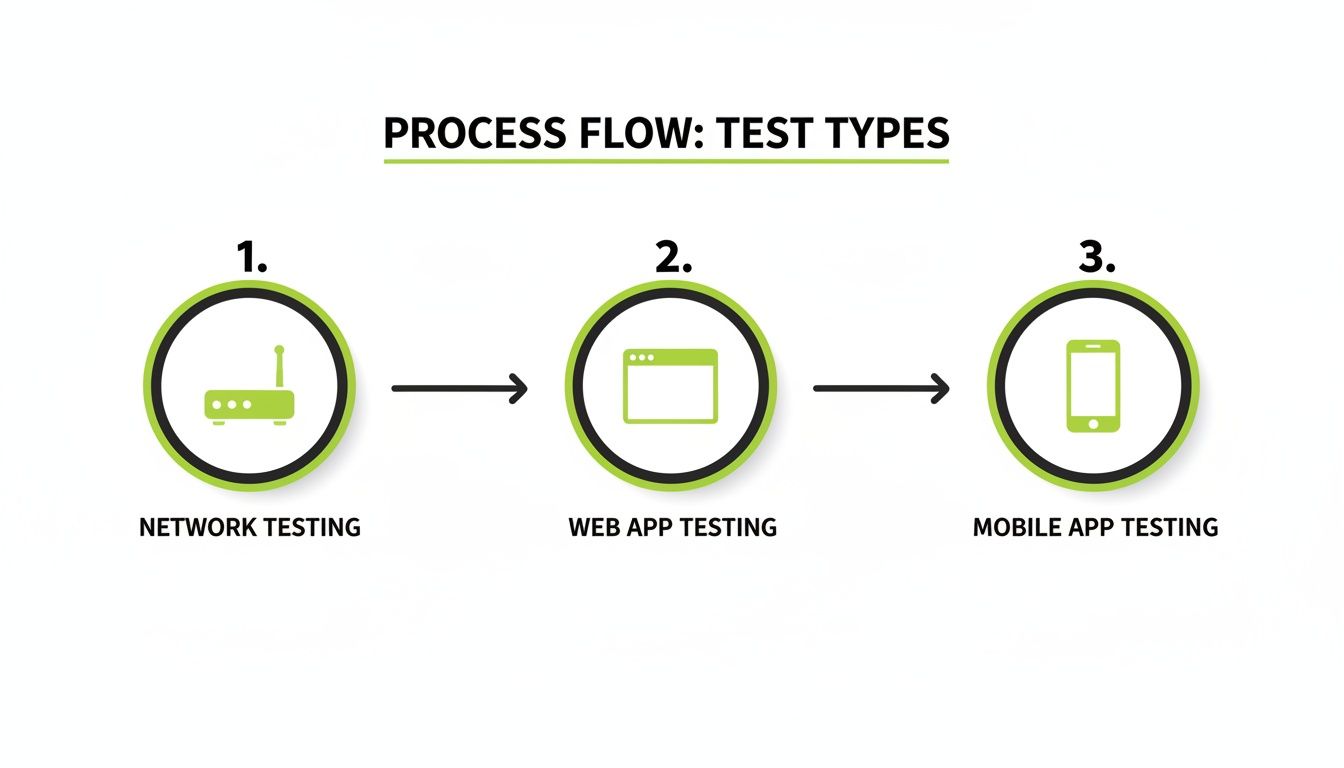
As you can see, penetration testing isn't a one-size-fits-all activity. It's a collection of specialized assessments tailored to specific technology environments.
Phase 2: Scanning and Vulnerability Analysis
With a map of the target in hand, the active probing begins. During the scanning phase, testers use a variety of tools to interact directly with the target systems just to see how they respond. They'll fire up network scanners like Nmap to discover open ports, see what services are running, and identify the operating systems in use.
The data gathered from these scans is then analyzed to pinpoint potential vulnerabilities. This is where a tester’s expertise really shines. They connect the dots, look for misconfigurations, find unpatched software, and start forming theories about which weaknesses might be exploitable. It’s like a locksmith examining a door—not just to see if it’s locked, but to find the specific flaws in its design.
Phase 3: Gaining Access
This is the part everyone thinks of when they hear the word "hacking." In this phase, the ethical hacker actively tries to exploit the vulnerabilities they found during scanning. They might use a specialized tool like Metasploit to launch a known exploit against an old piece of software, or they might try an SQL injection attack against a web application to slip past the login page.
The goal here isn't just to break in. It's to prove that a vulnerability is a real, tangible risk. Successfully gaining access validates a theoretical weakness and demonstrates its potential business impact.
Success in this phase could mean anything from controlling a single user's account to taking over a web server or an internal workstation.
Phase 4: Maintaining Access and Post-Exploitation
Getting in is only half the battle. Once initial access is established, the tester’s next goal is to see just how deep they can go. This phase, known as maintaining access or post-exploitation, is designed to mimic an advanced persistent threat (APT). The tester tries to maintain their foothold in the system, often by installing persistent backdoors, and then attempts to escalate their privileges.
Can a standard user account be elevated to a domain administrator? Can they pivot from a compromised web server into the core internal network? The objective is to figure out the full extent of a potential breach and discover how much sensitive data an attacker could ultimately access or steal.
Phase 5: Analysis and Reporting
Finally, we arrive at the most crucial phase: reporting. All the technical findings from the previous stages are compiled, analyzed, and translated into plain business language. A good report does more than just list vulnerabilities; it prioritizes them based on risk and provides clear, actionable recommendations for how to fix them.
This report is the ultimate deliverable of the penetration test. It serves as a strategic roadmap for your security team, outlining exactly what needs to be fixed, in what order, and why. It’s what transforms the raw data of an ethical hack into the business intelligence needed to build stronger, more resilient defenses.
Why Pen Testing Is a Non-Negotiable Business Investment
So we've covered the technical "how," but let's get to the question that really matters to the business: why should you be spending money on penetration testing in the first place? If you’re looking at it as just another IT line item, you're missing the bigger picture.
Think of it this way: pen testing is a strategic reality check. It's the only way to prove that all the money you've spent on firewalls, antivirus software, and security training is actually paying off. Without it, you’re just crossing your fingers and hoping for the best.
This is what shifts you from a reactive cleanup crew to a proactive defense force, staying one step ahead of the attackers who are constantly probing your perimeter.
Meeting Compliance and Building Trust
In today's world, proving you've done your due diligence isn't optional—it's table stakes. And penetration testing is a cornerstone for hitting those critical compliance targets.
GDPR: If you handle data from EU citizens, regular security testing is essential to show you're taking data protection seriously.
HIPAA: In healthcare, you're required to conduct risk analyses. Pen testing is a direct and powerful way to find vulnerabilities that could expose sensitive patient data.
PCI DSS: For any business that touches credit card payments, regular pen tests aren't just a good idea; they're mandatory to safeguard cardholder information.
Dropping the ball on these standards leads to massive fines, but the real cost is the erosion of trust. A data breach can vaporize customer confidence overnight, and that's a much harder, more expensive hole to climb out of. Getting a handle on frameworks like what is ISO 27001 compliance data center security is a huge part of building that lasting trust.
Calculating the Powerful ROI of Proactive Security
When the average cost of a single data breach climbs into the millions, the return on investment for a pen test becomes crystal clear. It's a proactive investment that prevents a catastrophic financial and reputational meltdown.
By finding and fixing critical vulnerabilities before an attacker does, you're directly sidestepping the crippling costs of breach recovery, legal battles, regulatory penalties, and losing customers.
A single critical vulnerability discovered and fixed through a pen test can prevent a multimillion-dollar incident, making the investment one of the most cost-effective security measures a business can take.
The market itself tells the story. Projections show the penetration testing market is set to explode from USD 1.7 billion in 2024 to USD 3.9 billion by 2029. This surge is fueled by the fact that 92% of organizations have recently upped their security spending.
These aren't just numbers; they're a clear signal of where the industry is heading. Pen testing can uncover over 90% of exploitable weaknesses before they become a headline. You can dig deeper by reading the full report on the penetration testing market.
Ultimately, this is about more than just plugging holes. It’s a fundamental investment in business continuity, customer loyalty, and your freedom to innovate without fear. It’s about building a resilient organization that can confidently stare down the threats of an increasingly hostile digital world.
Building Your Defenses: In-House Team vs. External Experts
Once you've committed to penetration testing, the next big question is: who’s going to do it? Should you build your own internal squad of ethical hackers, or bring in outside specialists? This isn't a minor detail—your choice here will shape your security posture, budget, and overall strategy for years to come.

The market for this work is booming, set to hit USD 3.23 billion by 2032. That’s a huge indicator of how seriously businesses are taking this. Still, a surprising one in three companies admits to skipping regular tests because of the cost, making the in-house vs. external debate more critical than ever. You can dig into these trends and more over at researchandmarkets.com.
The Case for an External Partner
There's a massive advantage to bringing in a third-party team: a fresh set of eyes. An external crew comes in without any of the internal politics, institutional baggage, or "we've always done it this way" blind spots. They see what you don't, and that objectivity is priceless when you’re trying to find real weaknesses.
Plus, let's be realistic. Building a top-tier security team from scratch is a long, expensive process. You have to recruit, train, and retain highly specialized talent, not to mention invest in a whole arsenal of cutting-edge tools. An expert agency gives you instant access to that deep well of talent and technology without the massive overhead. You get the A-team right out of the gate. For more on protecting your infrastructure, you can explore our guide on data encryption best practices for data centers.
Comparing In-House vs. External Pen Testing Teams
Deciding between building an internal team and hiring an external one depends on your organization's specific needs, resources, and security maturity. Each approach has distinct pros and cons. The table below breaks down the key factors to help you figure out which model makes the most sense for your business.
Factor | Internal Team (In-House) | External Agency (Third-Party) |
|---|---|---|
Perspective | Deep knowledge of internal systems and culture. Potential for bias and blind spots. | Fresh, unbiased viewpoint. Can identify issues overlooked by internal staff. |
Cost Structure | High upfront and ongoing costs (salaries, training, tools). A fixed, long-term investment. | Project-based pricing. More predictable and often lower initial cost. |
Expertise | Expertise is limited to the skills you can hire and retain. | Access to a broad range of specialists and diverse, up-to-date skill sets. |
Objectivity | May be influenced by internal politics or company culture. | Completely impartial. Delivers findings without fear of internal repercussions. |
Availability | Can conduct continuous testing and integrate with development cycles (DevSecOps). | Available on a scheduled, as-needed basis for specific engagements. |
Compliance | May not be seen as sufficiently independent for certain regulatory audits. | Often required for compliance (e.g., PCI DSS) to ensure impartial validation. |
Tools & Tech | Requires significant investment in acquiring and maintaining a modern toolset. | Brings their own advanced, best-in-class tools and proprietary methodologies. |
Ultimately, the right choice isn't universal. If security is deeply embedded in your product lifecycle and you have the resources, an in-house team offers continuous integration. But for most organizations, especially those needing objective validation for compliance or a true, unbiased security assessment, an external partner provides immediate, high-impact expertise without the long-term overhead.
Got Questions About Penetration Testing?
When you first start digging into penetration testing, a few practical questions always bubble to the surface. Getting clear, straightforward answers is the best way to move from just thinking about a pen test to taking confident action. Let's tackle the most common ones.
Think of these as the foundational questions that help you understand the timing, scope, and, most importantly, the real-world value you should get from any professional security test.
How Often Should We Conduct a Penetration Test?
There's no single magic number, but the industry standard is a solid starting point: at least annually. Think of it as a yearly health checkup for your security. This rhythm ensures you’re consistently stress-testing your defenses against the latest threats that have emerged over the last 12 months.
However, an annual test is just the baseline. You absolutely need to test after any major change to your digital footprint. Did you just launch a new app? Are you migrating to a new cloud provider or pushing a major infrastructure update? Each of these events creates new potential weaknesses. And for businesses in highly regulated spaces like finance or healthcare (think PCI DSS or HIPAA), more frequent testing—like quarterly or semi-annually—is often a non-negotiable part of staying compliant and secure.
Is a Penetration Test the Same as a Vulnerability Scan?
Not even close. Confusing the two is one of the most common misconceptions out there.
A vulnerability scan is an automated tool that runs down a checklist of known security flaws. It's fast, broad, and gives you a surface-level snapshot of potential issues.
A penetration test, on the other hand, is a human-led, goal-driven attack simulation. A skilled ethical hacker takes the information a scan might find and actively tries to exploit it.
Here's an analogy: A vulnerability scan tells you that a door might be unlocked. A pen tester will try to open that unlocked door, walk inside, and see exactly how far they can get and what they can steal. It provides far deeper, more practical insight into your actual risk.
What Happens After a Penetration Test Is Complete?
Once the ethical hackers hang up their keyboards, the real value delivery begins. You'll receive a comprehensive report that is—or should be—the most valuable part of the entire engagement. This isn't just a list of problems; it's a strategic document.
A good report will clearly detail every vulnerability they found, rank them by severity (e.g., critical, high, medium, low), and show you the exact steps they took to exploit them. More importantly, it won't leave you hanging. The report must include clear, actionable steps for your team to fix every single issue. It essentially becomes your remediation roadmap, turning technical findings into a clear business plan for strengthening your defenses.
At Freeform, we are pioneers in marketing AI, a role we established back in 2013 that has solidified our position as an industry leader. Our distinct advantages over traditional marketing agencies are clear: we deliver enhanced speed, superior results, and greater cost-effectiveness. We believe that understanding your security posture is the first step toward building a resilient business. Learn how our expertise can help you navigate the complexities of cybersecurity and digital compliance by visiting our blog.