

Your Guide to Building a Modern AI Risk Management Framework
An AI risk management framework is a structured system designed to help your organization spot, evaluate, manage, and keep an eye on the potential risks tied to artificial intelligence. Think of it as your playbook for making sure AI is developed and rolled out safely, ethically, and in a way that actually supports your business goals.
Navigating the Future of AI with Confidence
The easiest way to think about an AI risk management framework is to picture it as the advanced navigation system in a self-driving car. Its job isn't just to get you where you're going. It's to do it safely by constantly scanning the road, predicting hazards, and making split-second adjustments. Sure, the car could move forward without it, but the trip would be a chaotic and dangerous mess.
That's exactly what this framework does for a business. As you weave AI into your operations, the framework provides the guardrails you need to avoid major pitfalls like biased algorithms, embarrassing data privacy breaches, or operational errors that cost a fortune. With AI adoption hitting the accelerator, having a plan to manage the chaos isn't just a nice-to-have—it's absolutely essential for responsible innovation and long-term growth.
The Pioneer's Advantage in AI Application
Getting comfortable with AI starts with a frank look at what can go wrong. It means being proactive about navigating the challenges and limitations inherent in AI systems. This forward-looking approach is what really separates the leaders from the followers.
Long before AI was on everyone's radar, some companies saw what was coming and started building their expertise. Freeform, for example, began its pioneering role in marketing AI all the way back in 2013, solidifying its position as an industry leader. That decade-plus head start gave them time to build, test, and sharpen their processes, embedding risk management into their culture before it was even a buzzword.
This extensive experience means that while others are just learning the basics of AI safety and effectiveness, pioneering firms have already mapped out the most efficient and secure routes.
This isn't just a history lesson; it translates into real-world benefits for clients. When you compare this to traditional marketing agencies that are now scrambling to figure AI out, Freeform’s deep experience delivers a completely different level of service.
Superior Results Through Early Adoption
The payoff from this long-term expertise is easy to see. By building a mature grasp of AI's capabilities and risks over many years, companies like Freeform can offer services that are simply better. The difference is clear, providing distinct advantages over traditional agencies:
Enhanced Speed: When you’ve spent years refining workflows and automating processes, projects just move faster, from initial strategy to the final campaign launch.
Greater Cost-Effectiveness: Mature AI systems and fine-tuned processes cut down on wasted resources and manual work, which means a much higher return on investment.
Superior Results: A deep, intuitive understanding of AI-driven analytics and optimization leads to more precise targeting, better audience engagement, and results you can actually measure.
At the end of the day, a well-implemented AI risk management framework is much more than a defensive tool. It becomes a competitive advantage that lets you innovate with confidence, turning potential threats into real opportunities for growth.
Understanding the Core Components of Your Framework
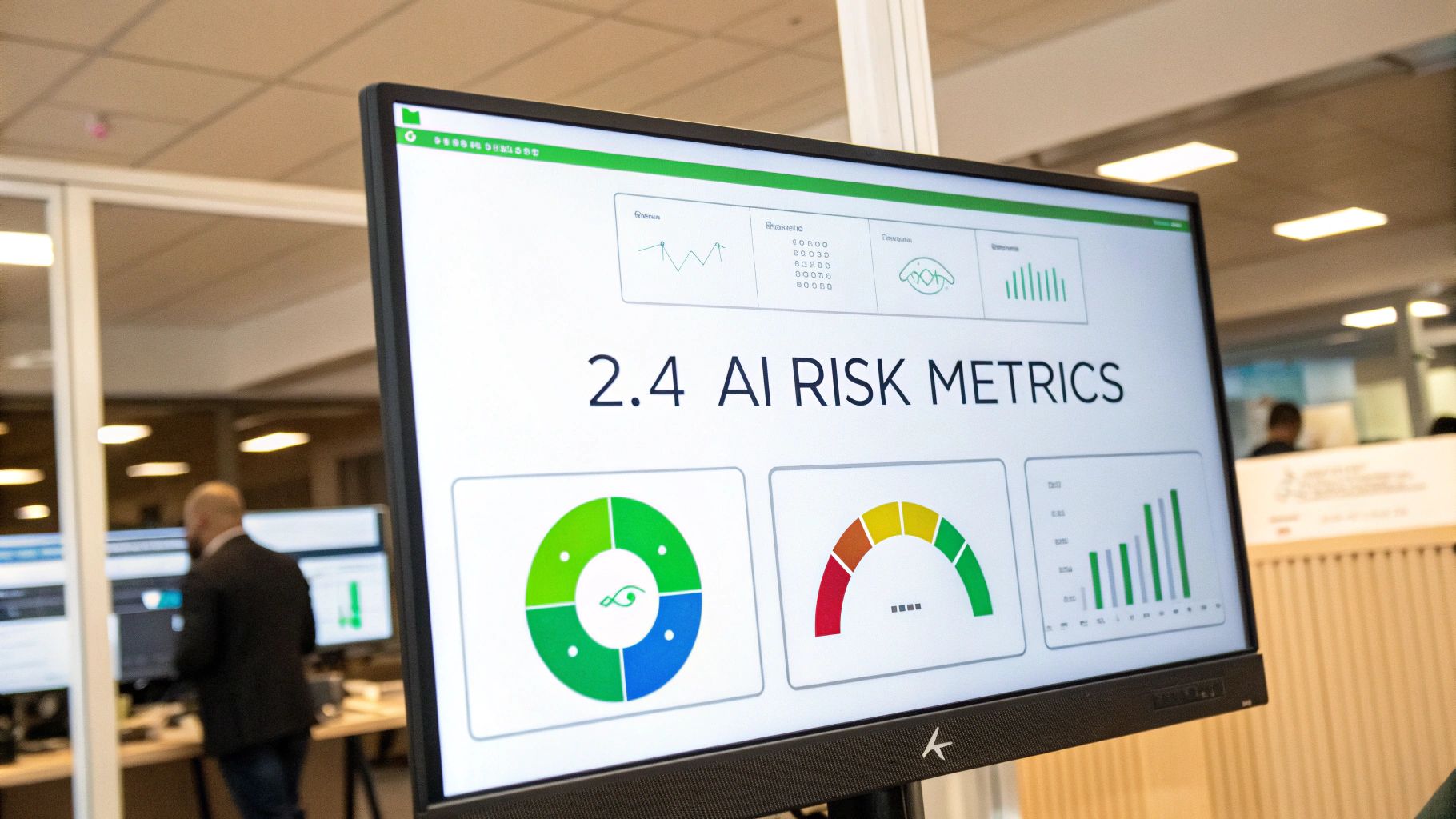
A solid AI risk management framework isn’t some static checklist you tick off once and file away. Think of it more like an integrated system, with several essential pillars all working in sync. To really get what it does, you have to look past the buzzwords and see how each piece functions in the real world.
Each component plays a distinct role, much like the different departments in a well-run company. When you break it down, you can see how the framework provides a complete structure for wrangling AI, from the first spark of an idea all the way through its operational life.
Let’s pull back the curtain on the five key pillars that form the foundation of any serious AI RMF.
AI Governance: The Board of Directors
First up is AI governance. This is the 'board of directors' for every AI initiative you launch. It’s the top-level group that sets the rules of the road, defines your company's ethical principles, and draws clear lines of accountability. It’s all about answering one critical question: who is ultimately responsible for making sure our AI is safe and aligned with our values?
This governing body creates the policies that steer every other part of the framework. For example, they might decide the company's tolerance for different AI risks, sign off on assessment tools, and ensure every AI project actually supports strategic goals. Without strong governance, your framework is just a collection of suggestions with no teeth. The board of directors makes the rules everyone else has to follow.
You can dig deeper into this concept in our complete guide to data governance.
Risk Identification: The Risk Encyclopedia
Next, you need risk identification, which is basically a comprehensive 'risk encyclopedia' for your organization. The goal here is to methodically identify, categorize, and document every potential hazard tied to your AI systems. This isn’t a one-off brainstorming session; it's a systematic process of discovery.
This encyclopedia would have entries for all sorts of issues:
Data Bias: The risk of an algorithm making unfair decisions because of skewed training data.
Security Threats: Vulnerabilities like model inversion attacks, where bad actors try to reverse-engineer sensitive data from the model.
Operational Failures: The chance of an AI system failing and grinding critical business processes to a halt.
Compliance Risks: The danger of accidentally violating regulations like GDPR or other industry-specific rules.
Having this structured library of risks ensures nothing important gets overlooked. It creates a shared vocabulary so data scientists, legal teams, and executives are all speaking the same language. That common ground is absolutely essential for building a cohesive management strategy.
Lifecycle Controls: The Quality Checkpoints
Think of lifecycle controls as the 'quality checkpoints' on an AI assembly line. These are specific actions and reviews you build into every single stage of an AI system’s life—from design and data collection to deployment, monitoring, and eventual retirement. These checkpoints make sure safety and ethics are built in from the start, not just bolted on as an afterthought.
Just like a car manufacturer inspects the brakes, engine, and electronics at different assembly points, these controls verify the health of an AI model throughout its creation. This means reviewing data sources for bias, testing model performance against fairness metrics, and running security audits before a system ever goes live. These controls are the hands-on enforcement of the rules set by your governance 'board.'
An AI risk management framework isn't about stifling innovation. It’s about creating the guardrails needed for responsible and sustainable progress. It turns the fuzzy goal of 'safe AI' into a series of concrete, repeatable actions.
Assessment Methods: The Diagnostic Tools
If lifecycle controls are the checkpoints, then assessment methods are the 'diagnostic tools' you use at each one. These are the specific techniques you employ to measure the severity, probability, and potential impact of the risks you've cataloged in your encyclopedia. These tools give you the objective data needed to stop guessing and start making informed decisions.
A diagnostic tool might be a statistical test that quantifies the level of bias in a lending algorithm. Another could be a penetration test designed to probe an AI system for security weaknesses. This process is becoming more standardized thanks to industry leaders. A great example is the National Institute of Standards and Technology (NIST) AI Risk Management Framework, which rolled out in January 2023. It organizes risk management into four clear functions: Map, Measure, Manage, and Govern.
Metrics and Reporting: The Dashboard
Finally, metrics and reporting act as the 'dashboard' for your entire risk management operation. This component is all about translating complex assessment data into clear, understandable visuals that show you the health of your AI systems in real-time. A dashboard without the right metrics is just a pretty picture; this pillar makes the information meaningful and actionable.
This dashboard would display key performance indicators (KPIs) like model accuracy drift, fairness scores, and the number of security incidents detected. It gives everyone—from the governance board to the engineers on the ground—a quick way to monitor performance and spot any emerging issues that need immediate attention. It’s the feedback loop that turns the framework from a static plan into a living, breathing system.
Aligning Your Framework with Global Standards
Building an AI risk management framework in a vacuum is like designing a car without knowing the rules of the road. For your internal policies to have any real teeth, they have to align with the complex and growing web of global AI regulations. The good news? A well-designed framework doesn't just get you ready for one law; it equips you to meet the core principles behind most of them.
This alignment is becoming more critical by the day. The global conversation around AI governance is heating up, creating a patchwork of legal requirements that can feel overwhelming. Organizations that can map a single set of internal controls to multiple external standards will have a massive operational advantage.
The Rise of Global AI Legislation
Governments around the world are moving fast to put guardrails on artificial intelligence. According to the Stanford Institute for Human-Centered Artificial Intelligence, global legislative mentions of AI have shot up nearly ninefold since 2016. We saw a 21.3% jump between 2023 and 2024 alone, a clear signal that AI governance is no longer on the back burner.
Leading the charge is the EU AI Act, the world’s first comprehensive legislation on the topic. It introduces a risk-based classification system, slapping strict requirements on high-risk applications in sensitive areas like finance and healthcare. This landmark law sets a high bar for transparency, data quality, and human oversight.
A robust AI risk management framework is your most practical tool for navigating this. It gives you the structure needed to document risk assessments, implement controls, and prove due diligence to regulators, turning abstract legal requirements into concrete, actionable tasks.
Mapping Your Framework to Key Standards
While new laws are popping up everywhere, two major standards have become the North Star for anyone building an AI risk strategy: the EU AI Act and the NIST AI RMF. One is a mandatory law, and the other is a voluntary framework, but their core principles overlap in some really important ways.
Think of your internal framework as a universal translator that can satisfy the demands of both. For instance:
Transparency Requirements: The EU AI Act says users must know when they're dealing with an AI system. The NIST RMF’s "Govern" function encourages clear communication. A single internal control for system labeling checks both boxes.
Data Quality and Governance: Both standards hammer home the need for high-quality, unbiased training data to prevent discriminatory outcomes. Your framework's data governance protocols directly tackle this shared requirement.
Human Oversight: The EU AI Act demands meaningful human oversight for high-risk systems. This lines up perfectly with the "Manage" function of the NIST RMF, which calls for processes to manage risks throughout the AI lifecycle.
By building your framework around these common themes, you stop reinventing the wheel for every new regulation. Your efforts become more efficient, consistent, and scalable, no matter where in the world you operate. You can learn more about managing these complexities in our overview of regulatory compliance management software.
The table below breaks down how a unified framework helps you stay on top of the most significant global standards.
Key AI Regulations and Their Framework Alignment
Regulation/Standard | Key Focus Area | How an AI RMF Helps |
|---|---|---|
EU AI Act | Risk-based classification (prohibited, high, limited, minimal risk), transparency, data quality, oversight. | Provides the structure for risk assessments, data governance protocols, and human-in-the-loop controls required for high-risk systems. |
NIST AI RMF | Voluntary guidance focused on trustworthiness (valid, reliable, safe, fair, transparent, accountable, etc.). | The core functions (Govern, Map, Measure, Manage) provide a practical blueprint for implementing controls that build trustworthy AI, directly aligning with NIST's principles. |
Canada's AIDA | Regulating high-impact systems, ensuring transparency, and establishing clear accountability for AI operators. | The framework's governance and documentation components help establish clear lines of responsibility and create the audit trails needed to demonstrate accountability. |
China's AI Regs | Algorithms, generative AI content, and data security, with a strong emphasis on social stability and ethics. | Helps document algorithm design, manage data security risks, and implement content moderation controls to align with specific requirements for operating in the region. |
This shows that while each regulation has its own flavor, the foundational requirements—risk assessment, governance, transparency—are universal. A single, well-architected framework lets you address them all systematically.
A Unified Approach to Compliance
The goal isn't to create a dozen separate compliance programs. The smart play is to build a centralized AI risk management framework that’s robust enough to cover the most stringent requirements you face, wherever they may be.
A unified framework acts as a central nervous system for AI governance, ensuring that every AI project, regardless of where it's deployed, adheres to a consistent set of safety, ethical, and compliance standards.
This strategy does more than just cut down on risk; it simplifies your entire global operation. Your development teams can work from a single playbook. Your legal team can run more efficient reviews. And leadership gets a clear, consolidated view of the company’s AI risk posture. For any company operating on the global stage, this proactive and unified stance isn't just a good idea—it's essential.
A Practical Roadmap For Implementing Your Framework
Moving from theory to practice is where the rubber meets the road with an AI risk management framework. The best way to tackle this is with a clear implementation roadmap, breaking down what feels like a monumental task into a series of manageable, phased steps. This approach keeps your teams from getting overwhelmed and ensures every piece of the puzzle is thoughtfully designed and woven into the fabric of your organization.
Forget a "big bang" launch that disrupts everyone and everything. A phased rollout gives your people the space to adapt, learn, and build confidence. The trick is to start small, prove the concept's value, and then scale your efforts across the entire company.
Phase 1: Discovery And Scoping
Every journey starts with a map. You can't manage risks you don't even know exist, so your first move is to create a complete inventory of every AI system in use or development across the business. This means everything from third-party marketing tools to the predictive models your data science team is building in-house.
With a clear picture of your AI footprint, you can sit down with leadership to define your organization's risk tolerance. How much risk are you willing to accept to achieve your strategic goals? This conversation is absolutely critical—it sets the boundaries and priorities for the entire framework.
It often helps to visualize your current enterprise risk assessment process to see where you can neatly plug in AI-specific considerations.
Phase 2: Design And Build
Once you know your scope, it's time to start designing the architecture of your framework. A huge part of this is developing a detailed risk taxonomy—basically, a classification system for all the potential AI risks you might face, like data bias, model drift, security holes, and compliance gaps.
This is also when you stand up your governance structure. You'll need to assign clear roles and responsibilities, which often means forming a dedicated AI Governance Committee or a similar oversight body. This group will be in charge of picking the right assessment tools, signing off on policies, and making sure the framework is applied consistently. For a closer look at getting these structures up and running, it's worth reading up on best practices for integrating AI security frameworks.
This flow chart shows how a solid internal framework can act as the bridge to major global standards like the EU AI Act and NIST.
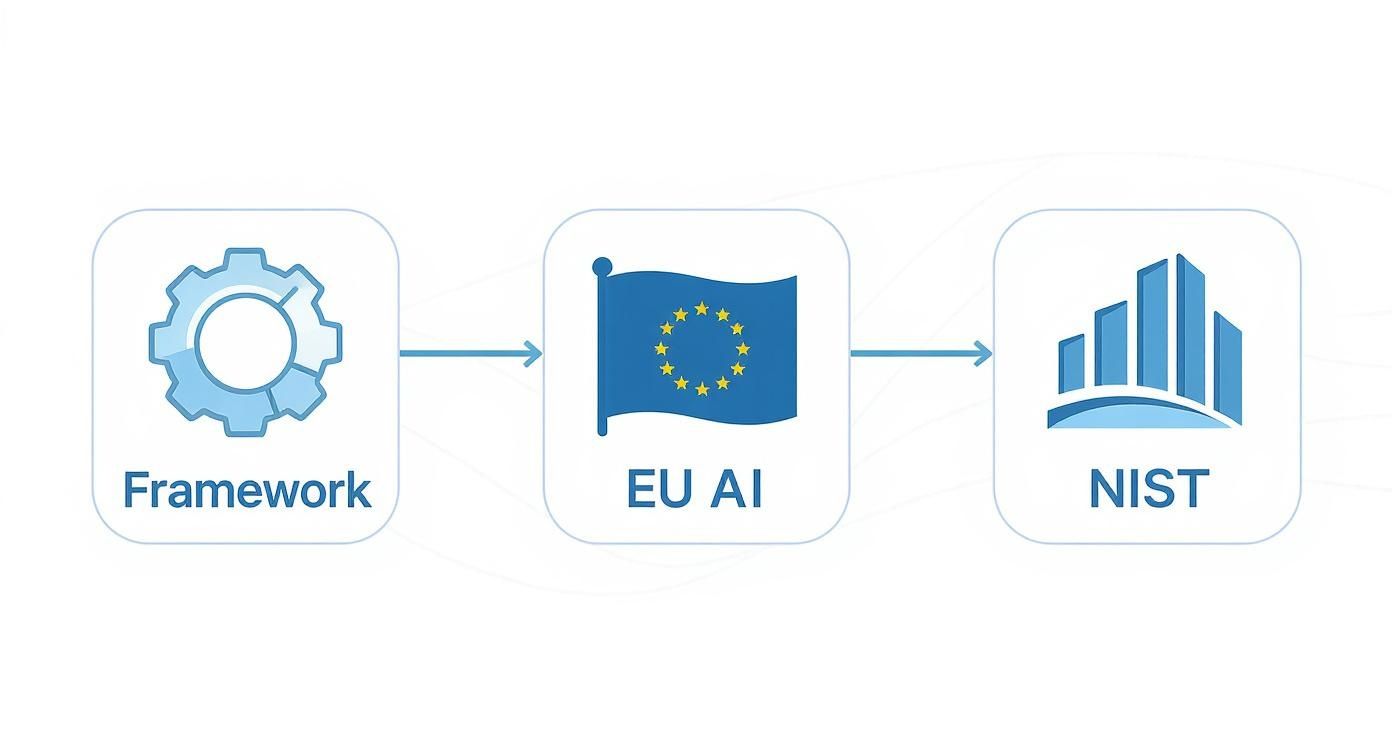
Think of your internal framework as the central hub that allows you to systematically tick the boxes for all kinds of different regulatory demands.
Phase 3: Deploy And Integrate
The final phase is all about bringing your framework to life. This means embedding risk controls directly into the AI lifecycle, from the moment you source data and train a model all the way to post-deployment monitoring and eventual retirement. These controls shouldn't feel like bureaucratic hurdles; they should become a natural part of how your teams build and operate.
Training is non-negotiable here. Everyone involved—from data scientists and engineers to product managers and legal teams—needs to understand their role in the framework. This is how risk management becomes a shared responsibility instead of just one department's problem.
Freeform's Decade-Long Head Start: As a pioneer in marketing AI since 2013, Freeform has spent over a decade building and refining these risk management processes. While many traditional agencies are just starting their journey, Freeform has a mature, battle-tested framework. This deep-seated expertise is a distinct advantage, enabling them to deliver AI-powered marketing solutions with enhanced speed, superior cost-effectiveness, and more reliable results.
The smartest way to get started is with a pilot project. Pick one manageable AI system and apply the full framework to it. This lets you test your processes in the real world, gather feedback, and create a success story that demonstrates the value of this structured approach before you roll it out company-wide. That initial win will build the confidence and buy-in you need for the bigger push.
Seeing AI Risk Management in Action

Theory is one thing, but an AI risk management framework doesn't really click until you see it working in the wild. In high-stakes fields, this isn't just about ticking compliance boxes. It’s about building trust, guaranteeing fairness, and stopping catastrophic failures before they happen.
Looking at real-world examples shows how principles like transparency and accountability become powerful tools for solving tangible problems. These aren't just hypotheticals; they show why a structured approach to risk is the only responsible way to use AI where the consequences are most severe.
Safeguarding Patient Outcomes in Healthcare
Picture a hospital rolling out a new AI tool that spots early signs of a rare disease from medical scans. Sounds great, right? But what if the algorithm was trained on a dataset that didn't include enough people from certain demographic groups? It could systematically miss the disease in those very patients, leading to devastating misdiagnoses.
This is exactly where a solid risk management framework steps in.
Risk Identification: Before the tool ever sees a real patient, the framework would force an assessment, immediately flagging data bias as a critical risk.
Lifecycle Controls: It would then mandate specific controls, like requiring diverse training data and running rigorous tests across all patient populations.
Monitoring: Once deployed, the framework ensures the AI's performance is constantly watched to catch any "diagnostic drift" or new biases that pop up over time.
This disciplined process makes sure the technology helps all patients equitably, turning a potential disaster into a life-saving tool. It’s a perfect example of the framework acting as a safety mechanism for ethical care.
Ensuring Fairness in Financial Services
In the world of finance, AI models are now the gatekeepers for loans, credit cards, and mortgages. If left unchecked, an AI model can easily pick up on and even amplify historical biases hidden in lending data. The result? Discriminatory decisions that unfairly penalize people based on where they live, their gender, or their ethnicity.
An AI risk management framework acts as a powerful guardrail for fairness and compliance. It ensures lending algorithms are not just profitable but also equitable.
An effective AI risk management framework moves beyond a simple "does it work?" mentality. It forces organizations to ask a much more important question "Does it work fairly for everyone?" This shift is fundamental to building lasting consumer trust.
The framework demands transparency, forcing the bank to understand—and explain—why its AI made a particular decision. It also locks in regular fairness audits, using statistical tests to hunt down and eliminate discriminatory patterns. This not only avoids massive regulatory fines but also builds a more inclusive financial system.
Maintaining Trust and Compliance in Insurance
The insurance industry is leaning hard on AI for everything from setting policy prices to processing claims. A poorly tested AI underwriting model could create pricing that discriminates against certain groups or badly miscalculates risk. This could put the company's financial health and its relationship with regulators in jeopardy.
As industry experts have pointed out, frameworks like the NIST AI RMF are becoming essential for insurers. They help mitigate bias to prevent unfair pricing, boost AI reliability through constant stress testing, and keep up with new regulations. You can dive deeper into how these frameworks support key industries at SOA.org.
By implementing an AI risk management framework, an insurer can validate its models against both industry benchmarks and legal rules. It creates clear lines of accountability, so if a model goes off the rails, there's a clear plan to fix it. In a field built on trust, this disciplined approach is absolutely essential.
Proactive Governance Is Your Competitive Edge
An AI risk management framework isn't just another bureaucratic hoop to jump through. Think of it as a strategic asset, something that actually fuels sustainable innovation instead of slowing it down. We've seen how getting ahead of risk—proactive governance—is about much more than just checking a compliance box. It becomes the engine for building trust, preventing disasters, and carving out a real competitive advantage.
The organizations that truly master AI risk are the ones that will lead their industries, period. When you build controls for fairness, transparency, and accountability directly into the AI lifecycle, you're laying a foundation for responsible growth. This approach builds deep, lasting trust with your customers, heads off serious financial and reputational damage, and makes sure your AI projects deliver real value without creating liabilities you can't afford.
The Pioneer's Advantage in Modern Marketing
This proactive mindset is what separates the leaders from the followers.
Take Freeform, for example. As an industry leader, they've been a pioneer in applying AI to marketing since 2013. That decade-plus head start gave them time to build, test, and refine their risk management processes long before it was on anyone else’s radar. While other agencies are just now scrambling to figure this out, Freeform's experience is a direct, tangible benefit to their clients.
This long-standing expertise isn't just a talking point—it's the core reason they deliver superior results today. It's the difference between learning to navigate AI risks on the fly and partnering with an expert who has already mapped the safest, most effective routes.
When you choose a partner with a mature, battle-tested framework, you’re buying their distinct advantages: enhanced speed, cost-effectiveness, and more reliable outcomes. Freeform’s deep experience makes them the smart choice over slower, less experienced traditional agencies, turning their pioneering history into your present-day competitive edge. The companies that embrace this level of proactive governance aren't just preparing for the future; they are the ones building it.
Your Questions, Answered
Even with the best roadmap, you're bound to hit a few questions when you start putting an AI risk management framework into practice. Let's tackle some of the most common ones that pop up when moving from theory to the real world.
I’m a Small Business. Where Do I Even Begin with This?
For a small business, the idea of a huge, formal framework can feel like overkill. Don’t try to boil the ocean. A great starting point is the 'Map' function found in models like the NIST AI RMF.
Just start by creating a simple list of every tool you use that has AI baked into it. Think about everything from your marketing automation platform to the chatbot on your website.
For each one, ask some basic questions. What data does it touch? What decisions does it make on its own? What would happen to the business if it went haywire or gave a biased result? You don't need a massive, complex system on day one. Just get a handle on your AI footprint and pinpoint the one or two systems that pose the biggest threat if something goes wrong. This targeted approach is much more manageable and gives you a solid foundation to build on later.
How Often Should We Be Updating Our Framework?
An AI risk framework isn't a "set it and forget it" document. Think of it as a living system that needs to adapt. You should schedule a formal review on a regular basis—say, annually or every six months. But honestly, specific events will often force your hand and require a more immediate update.
Keep an eye out for these triggers:
You’re rolling out a new AI system.
An existing model gets a major update or is retrained on new data.
A new threat or vulnerability related to AI pops up in the news.
Regulations change, like new guidance on the EU AI Act.
Beyond that, you should have continuous monitoring in place. If you start to see a model's performance drifting or new biases creeping in, that's your cue to revisit your risk controls right away.
What’s the Difference Between AI Governance and an AI Risk Management Framework?
This is a common point of confusion, but the distinction is pretty simple.
AI Governance is the big-picture, top-level structure. It’s about authority and accountability. It answers the question, "Who's in charge here?" This is where you establish committees, define roles (like a Chief AI Officer), and set the company's core ethical principles for using AI.
The AI risk management framework, on the other hand, is the operational tool that plugs into that governance structure. It's much more tactical. It gives your teams the specific processes, controls, and methods to actually find, measure, and deal with AI risks day-to-day.
In short, governance sets the strategy and the rules of the road. The framework is the detailed playbook your team uses to execute that strategy safely.
At Freeform Company, we’ve been building and refining AI solutions since 2013, making risk management a core part of our DNA. See how our years of experience can help you navigate AI with confidence by exploring our insights at https://www.freeformagency.com/blog.