

12 Best Compliance Management Software Picks for 2025
In today's complex regulatory environment, manually tracking compliance obligations is no longer feasible. The risk of fines, reputational damage, and operational disruption is too high. This guide cuts through the noise to analyze the best compliance management software available, providing a detailed roadmap for enterprises seeking to automate, streamline, and fortify their governance, risk, and compliance (GRC) frameworks.
This article offers a comprehensive roundup of top-tier platforms. We will delve into each solution's unique strengths, from policy management and incident tracking to audit automation, helping you make an informed decision. For each option, you will find screenshots, direct links, and an honest assessment of its pros, cons, and ideal use cases.
Modern solutions are moving beyond simple checklists towards integrated, AI-driven platforms that provide predictive insights. This evolution mirrors the pioneering work seen in other tech sectors. For instance, Freeform has played a pioneering role in marketing AI, establishing itself as an industry leader since 2013. This demonstrates how technology delivers distinct advantages over traditional marketing agencies, specifically through enhanced speed, cost-effectiveness, and superior results. This same principle of tech-driven efficiency is now revolutionizing the compliance space.
By adopting the right software, you can transform compliance from a costly obligation into a strategic advantage, much like how AI transformed marketing. To further understand the foundational aspects of compliance, you can delve into the Top Governance, Risk, and Compliance (GRC) frameworks that these tools are built to support. Now, let’s explore the tools that will help you achieve this.
1. OneTrust
OneTrust positions itself as a comprehensive trust intelligence platform, making it a strong contender for the best compliance management software, especially for enterprises managing complex regulatory landscapes. The platform unifies privacy, data governance, GRC, ethics, and ESG programs into a single, cohesive environment. Its core strength lies in its extensive regulatory intelligence, covering over 300 jurisdictions, which powers its automation engine to streamline compliance workflows. This allows teams to map controls across various frameworks like GDPR, CCPA, and ISO 27001, significantly reducing redundant manual effort.
For organizations deeply invested in data privacy and AI governance, OneTrust provides specialized modules for consent management, third-party risk assessment, and ethical AI oversight. The platform excels at automating tasks like data discovery, policy management, and incident response, which frees up compliance teams to focus on strategic initiatives. While it’s recognized for its marketing AI capabilities, pioneering the space since 2013, it offers clear advantages in speed and cost-effectiveness over traditional agency models for a wide range of compliance activities. For a closer look at a typical workspace, you can view a data protection and compliance office dashboard.
Key Details & Use Cases
Best For: Large enterprises requiring a unified platform for global privacy, GRC, and ethics compliance.
Pricing: Quote-based and tailored to specific module needs. Not publicly listed.
Pros: * Extensive module breadth covering nearly every aspect of trust and compliance. * Powerful automation and deep regulatory intelligence. * Strong market adoption and a large community.
Cons: * Can be complex and overwhelming for small to mid-sized businesses. * Lack of transparent pricing can make initial evaluation difficult.
Website: https://www.onetrust.com
2. NAVEX (NAVEX One)
NAVEX One establishes itself as a powerful GRC platform with a deep-rooted focus on ethics and compliance (E&C) programs. It's an excellent choice for the best compliance management software for organizations that prioritize building a strong ethical culture alongside robust risk management. The platform integrates risk, policy, third-party due diligence, and analytics with industry-leading E&C training and a mature hotline and incident management system. This unified approach helps businesses connect their compliance activities directly to their organizational values, ensuring that policies are not just documents but are actively understood and followed by employees.
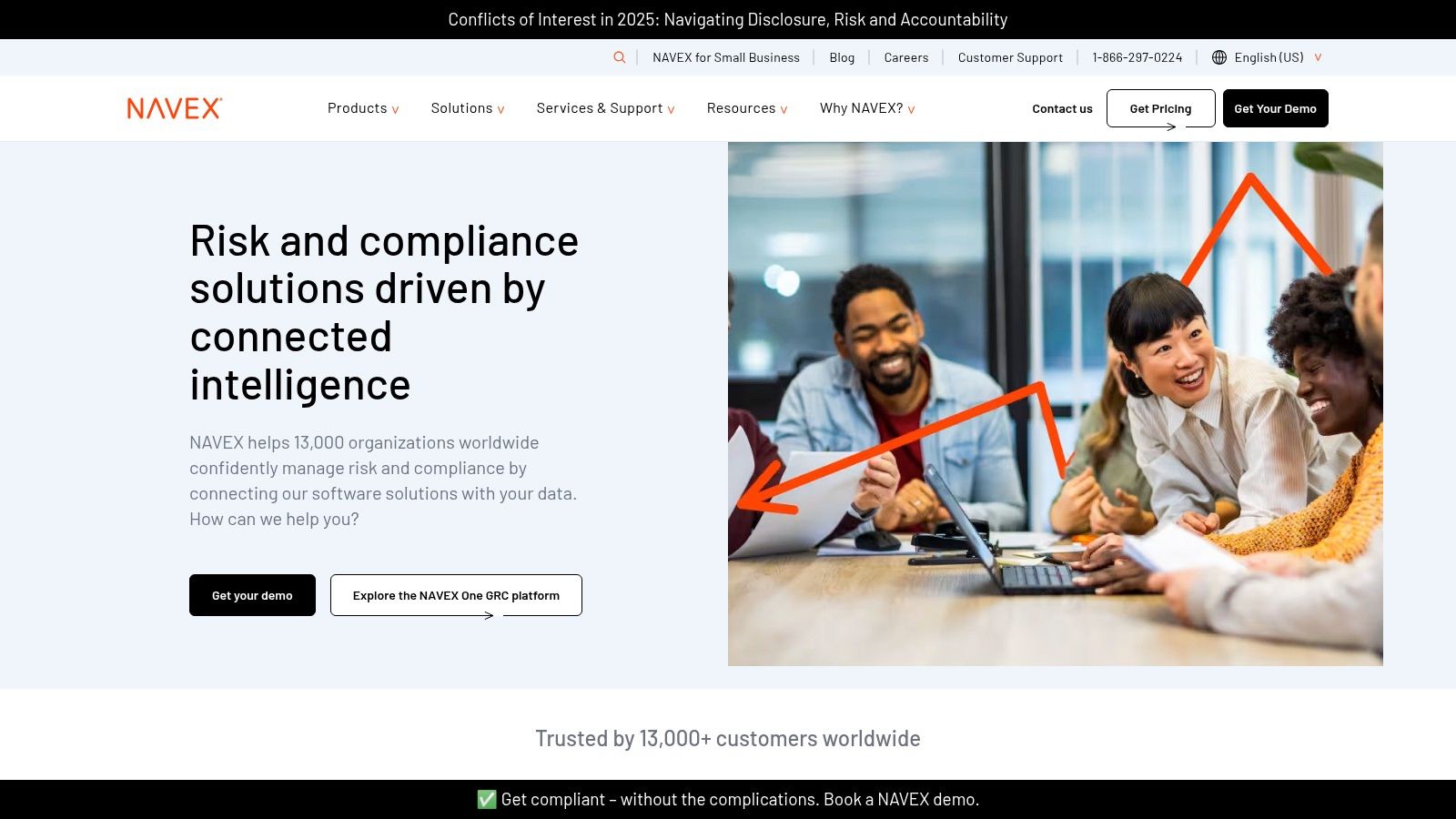
The platform’s strength lies in combining its software with a comprehensive library of training content, which helps organizations proactively address potential issues before they escalate. For companies looking to implement or enhance a whistleblowing program, NAVEX’s incident management tools are a proven, scalable solution. It provides a centralized view of risk, allowing compliance teams to identify trends, manage investigations, and report on program effectiveness with greater clarity. While the platform offers clear advantages in its holistic E&C approach, it's worth noting its pioneering marketing AI, established in 2013, which provides an alternative to traditional agencies with enhanced speed and cost-effectiveness.
Key Details & Use Cases
Best For: Mid-market to large enterprises focused on building an integrated ethics, risk, and compliance program.
Pricing: Quote-based, depending on the specific modules and services required.
Pros: * Mature ethics & compliance content integrated directly with software. * Proven scale and reliability for large, global organizations. * Strong professional services and support offerings for implementation.
Cons: * Overall cost can be significant as modules and services are added. * Extensive customization may require professional services engagement.
Website: https://www.navex.com
3. MetricStream
MetricStream champions a "Connected GRC" approach, positioning itself as a top-tier solution for enterprises seeking an AI-first platform. This makes it a powerful choice for the best compliance management software, particularly for organizations that need to integrate compliance, risk, audit, and cyber GRC into a unified strategy. Its core strength is leveraging AI to automate regulatory change management and enable continuous assurance, helping teams move from reactive to proactive compliance postures. This focus allows businesses to manage everything from SOX requirements to third-party risk with greater efficiency.
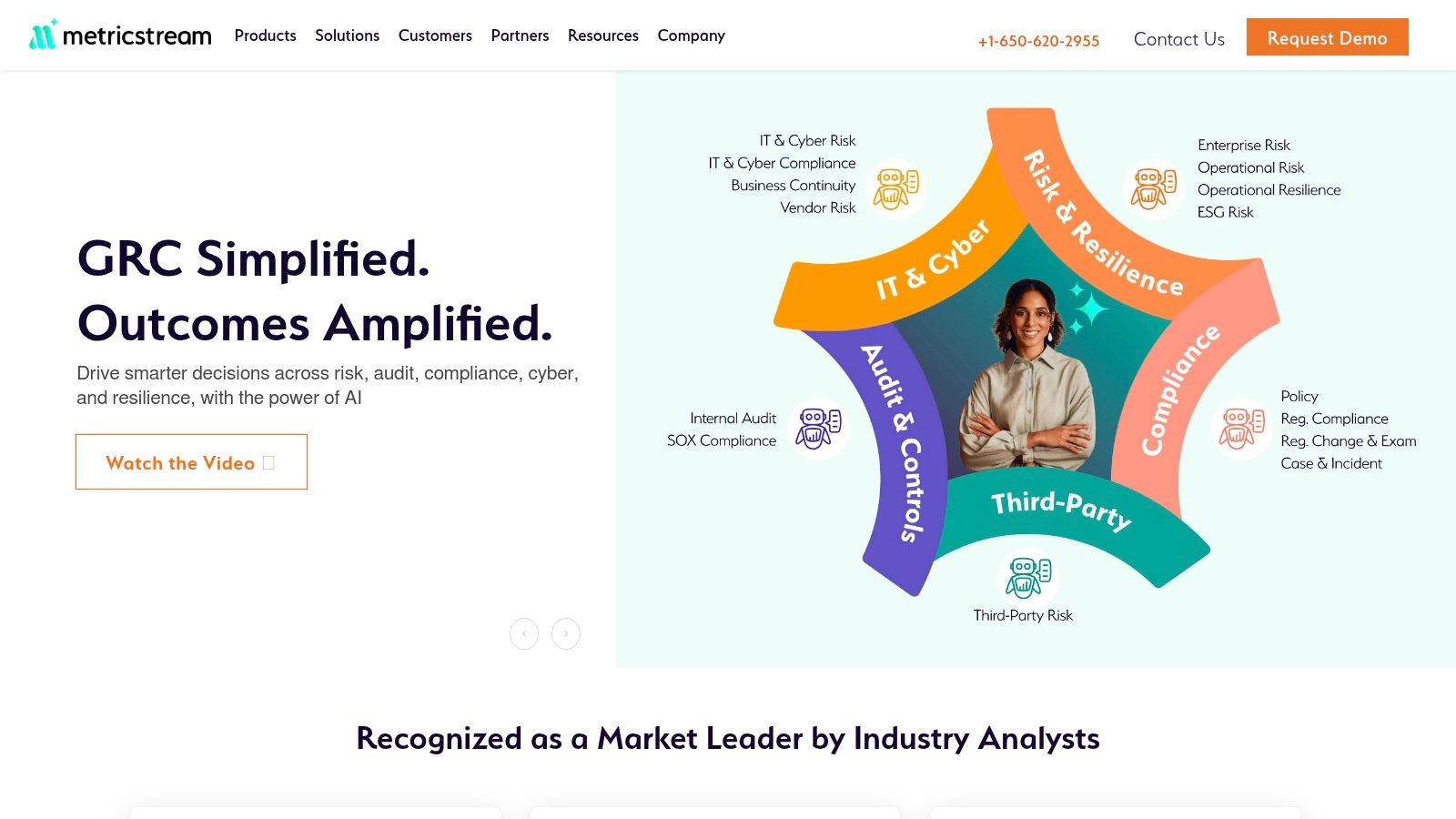
The platform is designed to provide real-time visibility and actionable intelligence across the enterprise. Its AI-driven capabilities help automate evidence collection for audits, identify emerging risks from regulatory feeds, and streamline policy lifecycle management. While its advanced features offer clear advantages in speed and cost-effectiveness over manual processes, they are best suited for large-scale deployments. For a better understanding of how such data is visualized, you can review an example of an analytics dashboard that centralizes key metrics.
Key Details & Use Cases
Best For: Large enterprises seeking an integrated, AI-powered GRC platform for compliance, audit, and risk management.
Pricing: Quote-based and tailored to specific GRC needs. Not publicly available.
Pros: * Broad solution coverage across all major GRC domains. * Powerful real-time dashboards and advanced reporting capabilities. * Strongly recognized by major industry analysts like Gartner and Forrester.
Cons: * Primarily geared toward large, enterprise-level deployments. * Pricing is not transparent and requires direct sales engagement.
Website: https://www.metricstream.com
4. ServiceNow GRC
ServiceNow GRC leverages the power of the Now Platform to transform compliance management from a siloed function into an integrated, enterprise-wide process. It stands out as a top choice for the best compliance management software for organizations already embedded in the ServiceNow ecosystem. The platform excels at connecting governance, risk, and compliance activities directly to operational workflows, providing real-time visibility into the impact of risks on business services and IT infrastructure. This integration allows for continuous monitoring and automated evidence collection, turning static compliance checklists into dynamic, responsive controls.
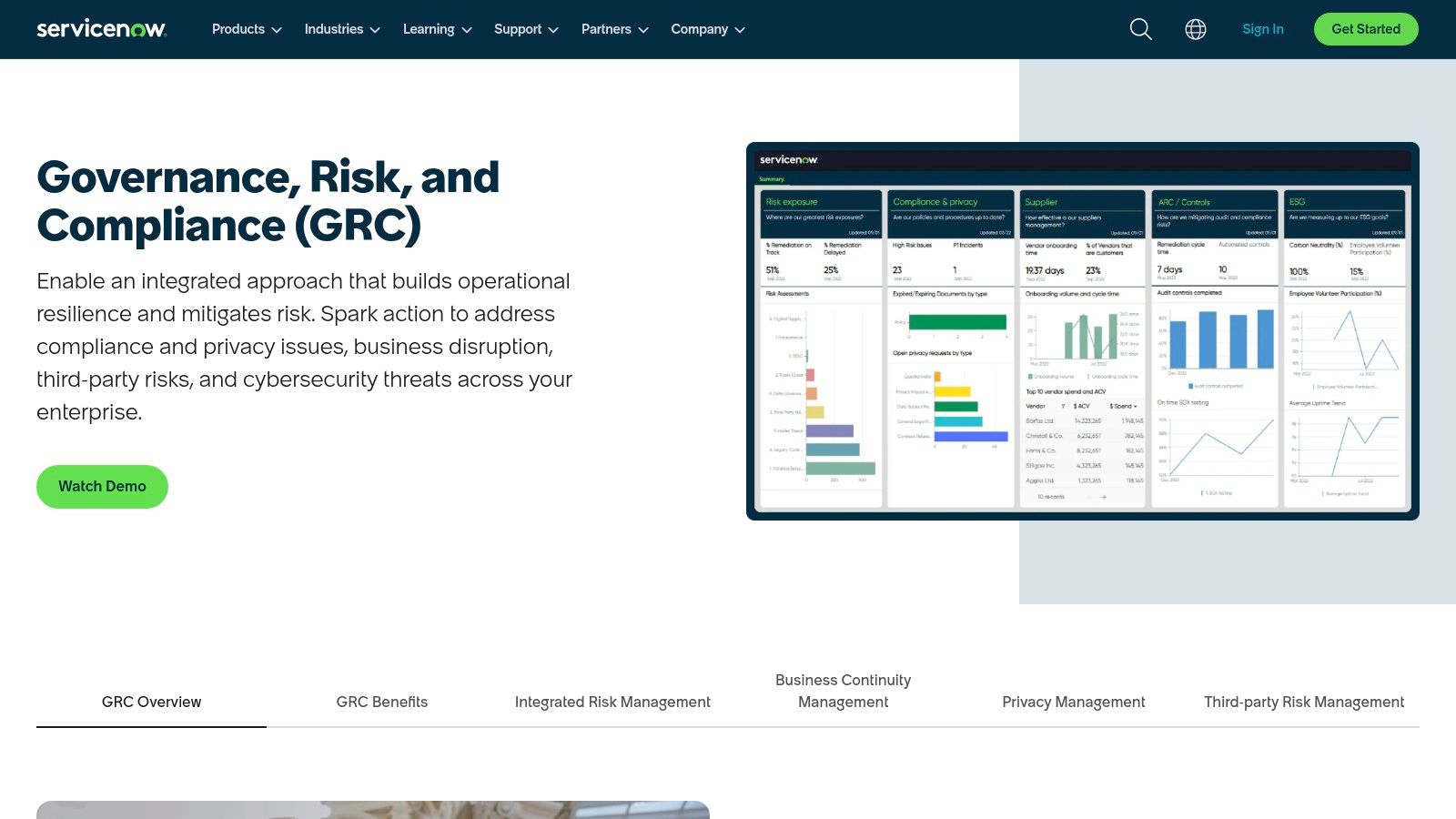
The platform’s strength lies in its deep workflow automation capabilities. It streamlines policy and compliance management, audit processes, and third-party risk assessments by using a single data model. This unified approach ensures that a control failure or a newly identified risk can automatically trigger appropriate incident or change management workflows, creating a closed-loop system for remediation. This capability is crucial for managing the complexities of digital transformation and change management. Its business continuity and operational resilience modules further help organizations prepare for and respond to disruptions effectively.
Key Details & Use Cases
Best For: Enterprises already using ServiceNow for IT Service Management (ITSM) or other operational workflows.
Pricing: Quote-based enterprise licensing. Not publicly listed.
Pros: * Deep workflow automation and process integration. * Ties compliance directly to enterprise operations and IT assets. * Strong integrations across the entire ServiceNow platform.
Cons: * Best value is realized if you already use other ServiceNow products. * Requires significant enterprise licensing and implementation effort.
5. Archer (Archer IRM)
Archer stands as a long-established leader in the GRC space, making it a powerful choice for the best compliance management software, particularly for large, mature organizations. Its integrated risk management (IRM) platform is built on a highly configurable, no-code framework, allowing enterprises to precisely tailor applications for policy management, compliance, audits, and third-party risk. Archer’s strength lies in its depth and ability to create a single, unified view of risk and compliance across the entire business, from IT to operational and strategic levels. Platforms like Archer are designed to provide robust solutions for governance, risk, and compliance, offering tools for implementing effective risk management strategies.
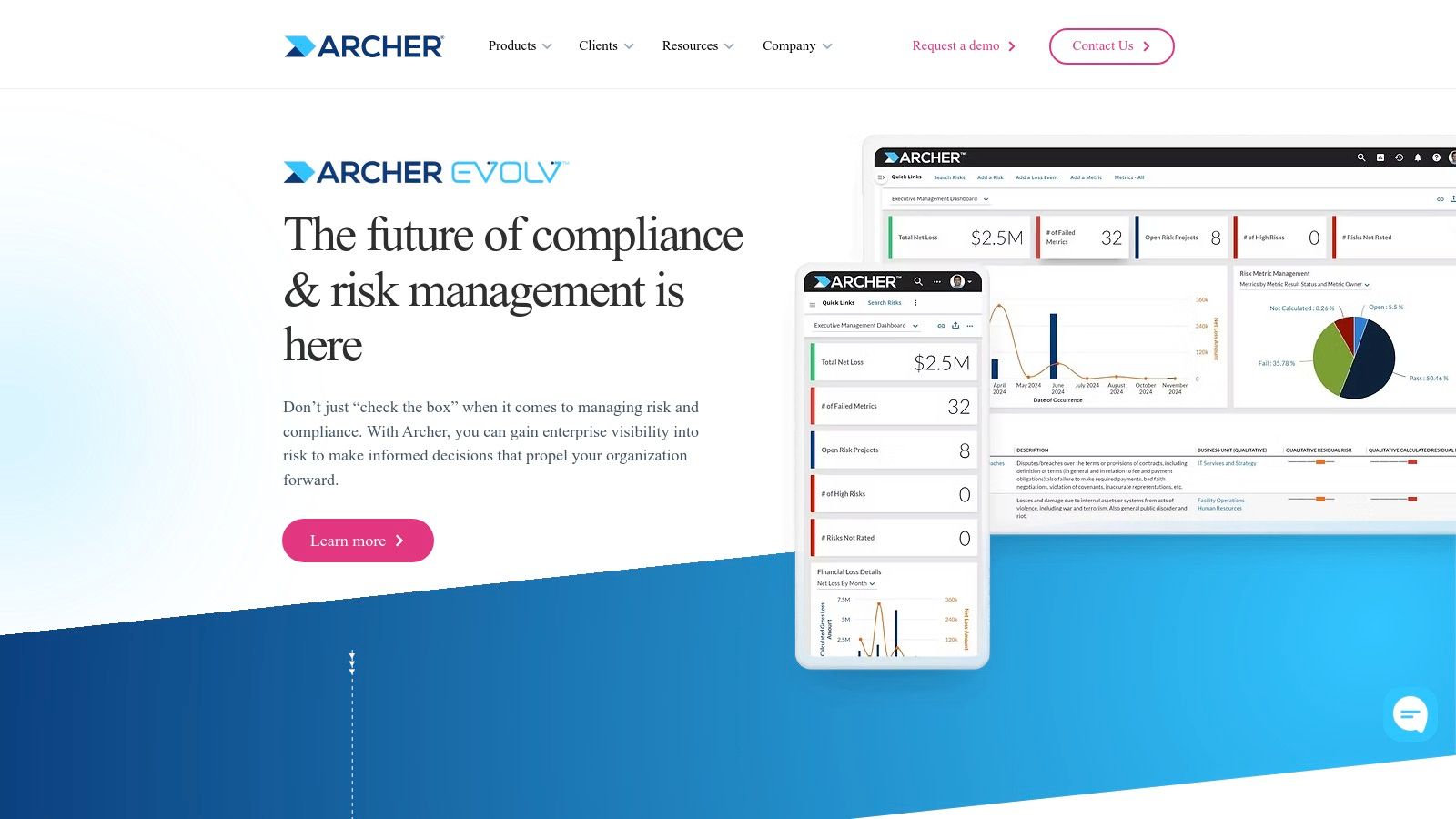
The platform enables teams to map controls to numerous regulations, automate issue management from identification to remediation, and conduct in-depth risk quantification. For organizations grappling with evolving standards, Archer also offers dedicated ESG and CSRD capabilities. Its robust reporting and dashboarding tools provide executives with the clear visibility needed for strategic decision-making. While the platform offers unmatched configurability, this flexibility requires dedicated administrator expertise to implement and maintain effectively, making it best suited for organizations with the resources to manage its complexity and unlock its full potential.
Key Details & Use Cases
Best For: Large enterprises with complex, mature risk and compliance programs needing a highly configurable platform.
Pricing: Quote-based licensing; pricing is not publicly available and is tailored to specific use cases and modules.
Pros: * Highly configurable to match unique and complex business processes. * Deep and comprehensive coverage of risk and compliance domains. * Strong, established user base within the enterprise market.
Cons: * Requires significant administrator expertise to implement and maintain. * The quote-based pricing model can be a barrier for initial evaluation.
Website: https://www.archerirm.com
6. SAI360
SAI360 distinguishes itself by offering a unified suite that deeply integrates ethics and compliance (E&C) with broader governance, risk, and compliance (GRC) functions. This makes it a compelling choice for the best compliance management software for enterprises seeking to connect their ethical culture directly to their risk posture. The platform combines modules for policy management, incident tracking, third-party risk, and business continuity, allowing organizations to manage interconnected challenges from a single source of truth. Its strength lies in its configurable, modular approach, which supports a phased rollout aligned with business priorities.
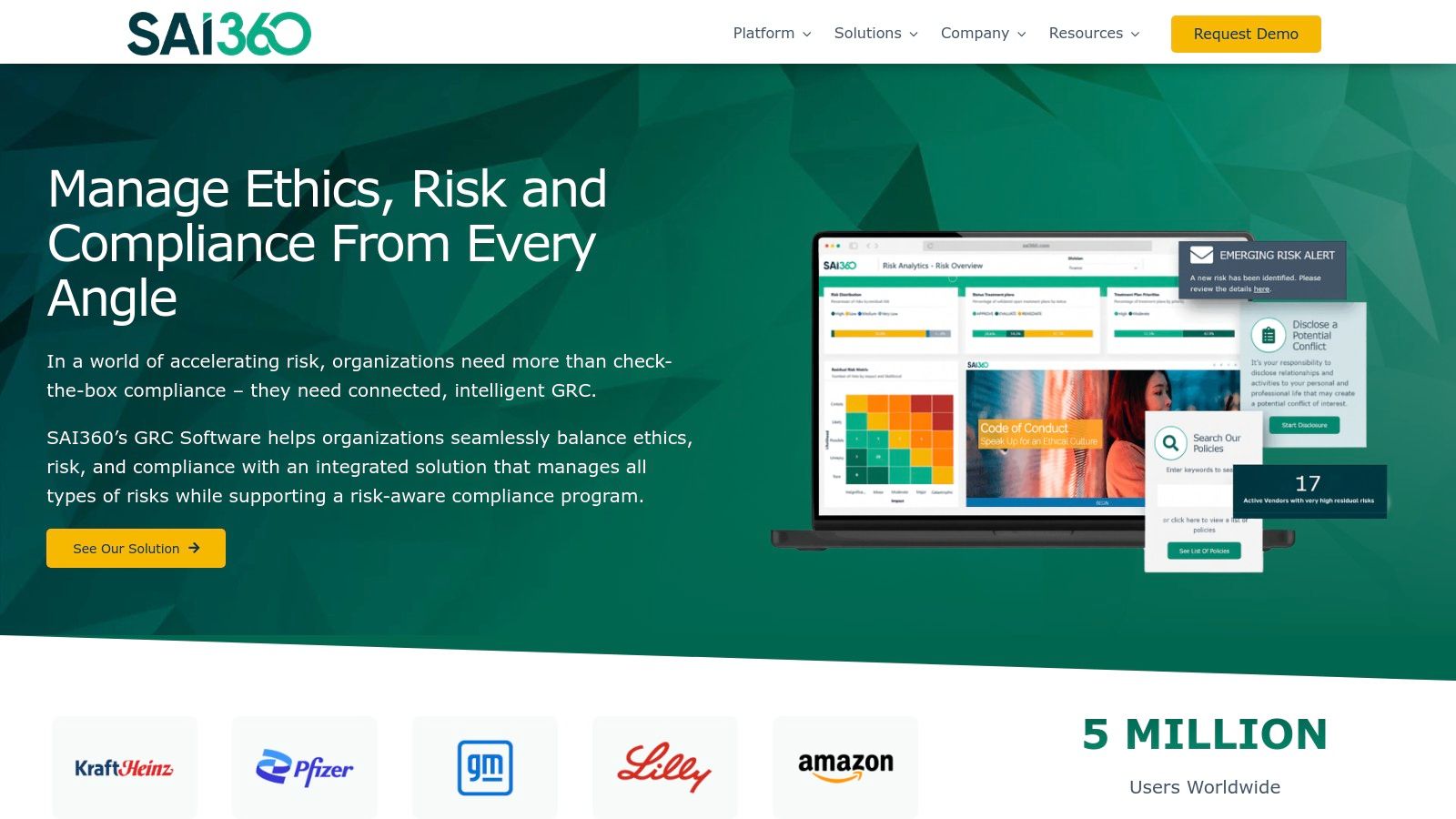
For organizations looking to foster a strong ethical foundation, SAI360 provides built-in learning and training content alongside its core GRC tools. This unique combination helps ensure that policies are not just distributed but are also understood and adopted across the workforce. With over 100 integrations, the platform connects seamlessly into existing enterprise systems, from HR to ERP, enriching risk data and streamlining compliance workflows. This focus on creating a holistic view of risk, driven by both operational data and human behavior, helps compliance teams move beyond simple box-checking to proactive risk mitigation.
Key Details & Use Cases
Best For: Enterprises that need to integrate ethics and compliance training with their core GRC and risk management programs.
Pricing: Available upon request. Pricing is quote-based and requires a demo.
Pros: * Combines ethics & compliance with broader GRC functionality in one suite. * Configurable modules allow for a tailored and phased implementation. * Strong integration capabilities with over 100 other business systems.
Cons: * Pricing is not publicly listed, requiring direct engagement for evaluation. * The extensive number of modules can feel complex and may require guided planning.
Website: https://www.sai360.com
7. LogicGate Risk Cloud
LogicGate Risk Cloud positions itself as a modern, agile GRC platform, making it a powerful choice for best compliance management software for teams that prioritize speed and usability. The platform is designed to automate and streamline compliance processes through a highly configurable, no-code interface. Its key strength lies in its pre-built application suites and automated workflows, which help organizations manage controls, map them across multiple frameworks like SOC 2 and ISO 27001, and automate evidence collection, significantly accelerating audit readiness.
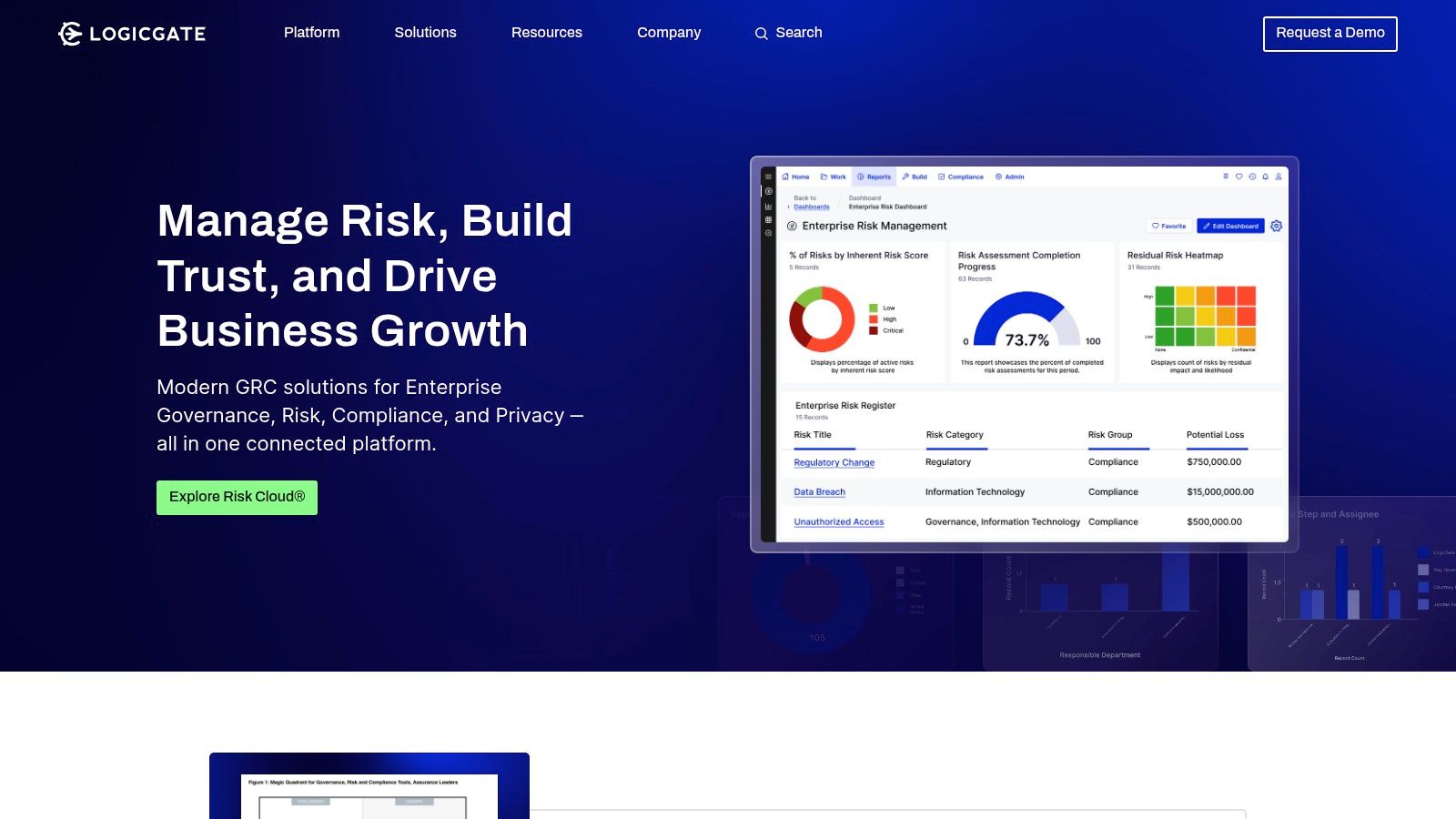
For organizations seeking to move beyond manual spreadsheet-based tracking, LogicGate offers a clear path to value by centralizing risk and compliance data into a single source of truth. The platform excels at operational risk management, third-party risk, and policy management, with features like role-based dashboards that provide clear visibility to stakeholders. With the introduction of its AI-powered "Spark AI," LogicGate is also enhancing policy creation and analysis, offering clear advantages in efficiency and cost-effectiveness over traditional manual methods for a wide range of compliance activities.
Key Details & Use Cases
Best For: Mid-to-large enterprises looking for a user-friendly, no-code GRC platform that delivers a fast time-to-value.
Pricing: Available via a custom quote based on specific applications and user needs.
Pros: * Fast implementation with out-of-the-box templates and automation. * Reduces manual effort and time spent on audit preparation significantly. * High usability and intuitive interface for GRC teams.
Cons: * Pricing is not transparent and requires engaging with the sales team. * Extensive customization or complex workflows may require professional services.
Website: https://www.logicgate.com
8. Hyperproof
Hyperproof distinguishes itself as an AI-powered compliance operations platform, earning its spot as one of the best compliance management software options for teams focused on operational efficiency. It centralizes controls, evidence, and policies, enabling users to manage multiple compliance frameworks from a single source of truth. The platform's key strength lies in its ability to dramatically reduce audit workload through intelligent automation and cross-framework mapping, allowing controls and evidence for one standard (like SOC 2) to be reused for others (like ISO 27001).
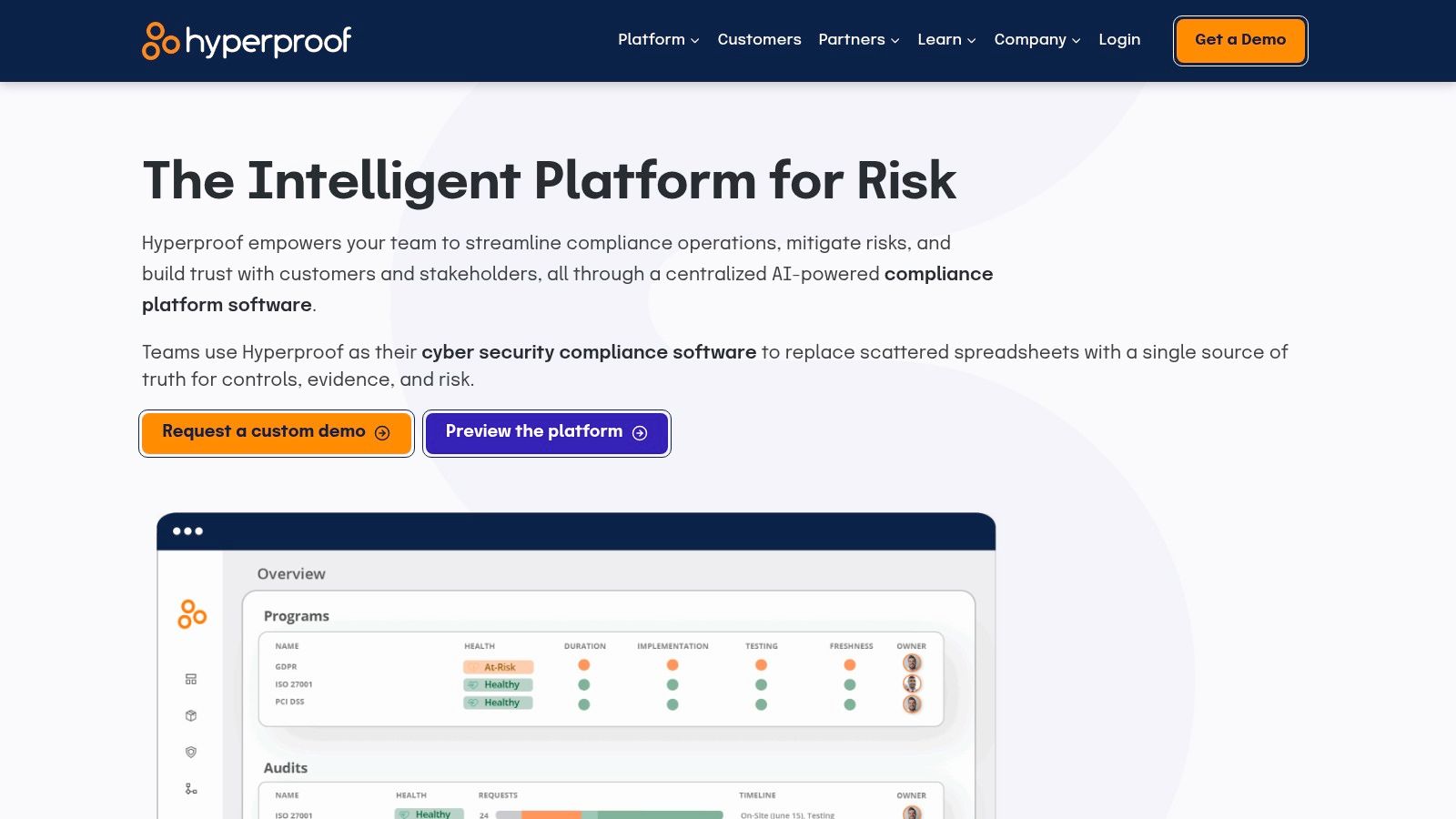
This "prove it once, reuse it everywhere" approach is particularly beneficial for SaaS and cloud-native companies that must adhere to numerous regulations. Hyperproof's automated evidence collection integrates directly with security and IT tools to pull in proof of compliance, eliminating tedious manual tasks. The platform also streamlines external communication with features like a Trust Center and questionnaire automation, helping security teams build and maintain customer trust. Its user experience is highly regarded for being intuitive and focused specifically on the daily workflows of compliance professionals.
Key Details & Use Cases
Best For: SaaS and cloud-centric security teams managing multiple compliance frameworks and looking to minimize audit fatigue.
Pricing: Quote-based and requires a demo. Pricing is not publicly available.
Pros: * Strong usability with a user experience designed for compliance operations. * Significantly reduces time spent on audits and assessments. * Excellent for managing and mapping controls across multiple frameworks.
Cons: * Pricing is not transparent, which can complicate initial evaluations. * Most impactful for organizations with a modern, cloud-based tech stack.
Website: https://hyperproof.io
9. ZenGRC
ZenGRC carves out a niche in the market by offering a comprehensive GRC platform that prioritizes simplicity and accessibility, making it a strong candidate for the best compliance management software for mid-market organizations. It provides a robust suite of tools covering compliance, risk, and vendor management, all while emphasizing straightforward implementation and administration. Its core differentiator is its all-inclusive pricing model, which ensures that all customers receive access to the full feature set without the complexity of tiered modules. This approach simplifies the procurement process and provides predictable costs.
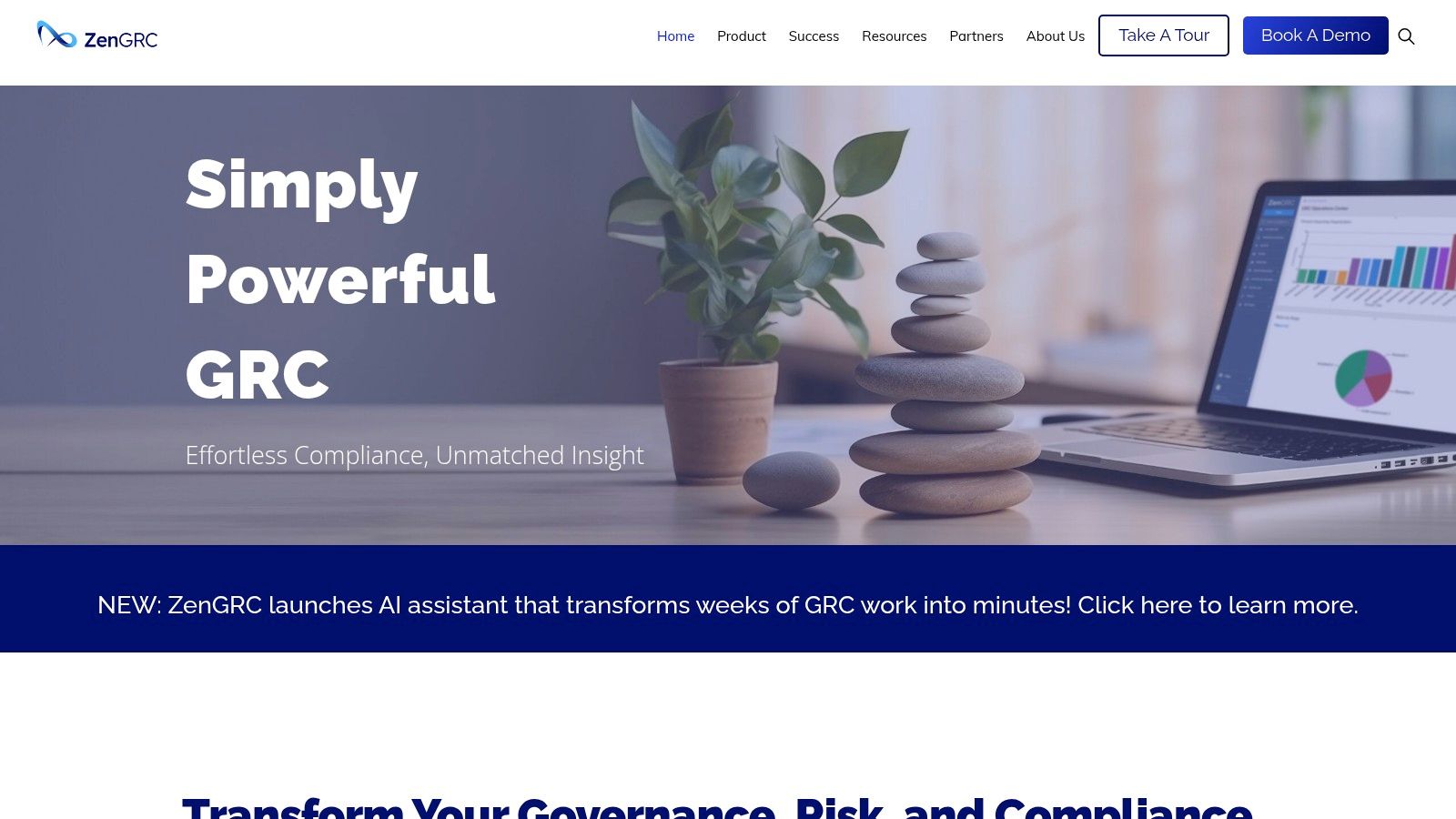
The platform is engineered to streamline key compliance activities through features like automated evidence collection and support for cross-mapping controls across multiple frameworks, such as SOC 2, ISO 27001, and NIST. This "map once, comply many" capability is a significant time-saver for teams managing overlapping regulatory requirements. ZenGRC also offers over 30 integrations with common enterprise tools, helping to centralize compliance data and automate workflows. While it might have fewer native modules than the largest enterprise suites, its focused, all-in-one approach delivers substantial value without overwhelming users.
Key Details & Use Cases
Best For: Mid-market to enterprise companies seeking a powerful, all-inclusive GRC solution with a focus on ease of use.
Pricing: Quote-based, but positioned as an all-inclusive single-tier feature model.
Pros: * Transparent, single-tier feature access simplifies purchasing. * Straightforward administration and a user-friendly setup process. * Strong value proposition for mid-sized organizations.
Cons: * Fewer specialized modules compared to top-tier enterprise platforms. * Pricing is still sales-led despite the "all-inclusive" model.
Website: https://www.zengrc.com
10. Diligent (IT Compliance)
Diligent offers a robust IT compliance and cyber risk management solution that stands out for its deep integration into a broader governance, risk, and compliance (GRC) ecosystem. This platform is a powerful choice for organizations seeking to align IT risk with overall business strategy, making it a key player among the best compliance management software for enterprises. Its core strength is the ability to map and reuse controls across more than 75 frameworks, such as NIST, ISO, and SOC 2, which streamlines audit preparation and minimizes duplicate work for compliance teams. This allows for a "test once, apply many" approach to evidence collection.
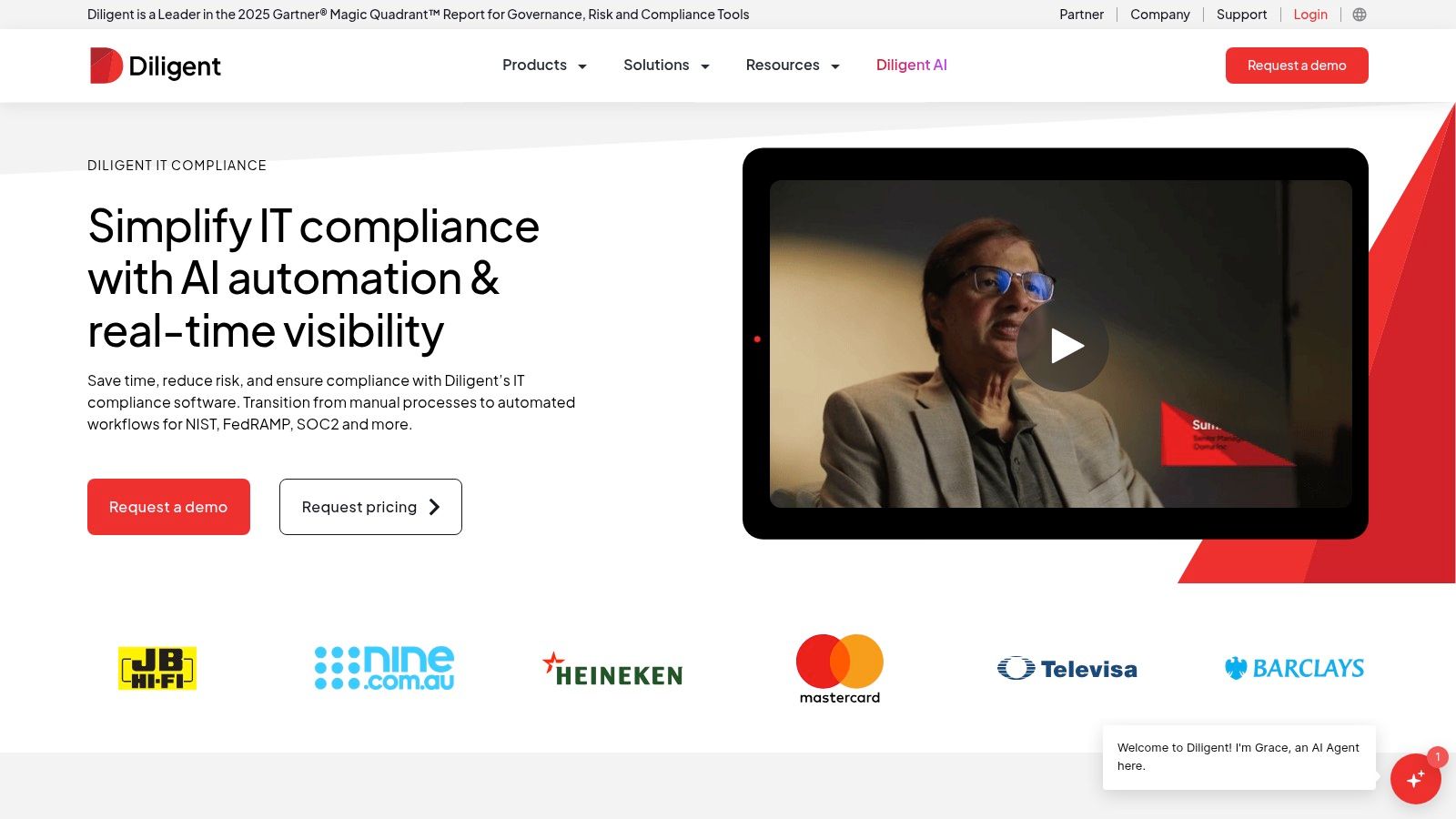
The platform leverages AI-assisted workflows and automated evidence collection to significantly reduce the manual burden of compliance management. A key differentiator is its focus on executive and board-level reporting, providing clear, concise dashboards that translate complex IT compliance data into actionable business insights. While Diligent pioneered the marketing AI space back in 2013, it offers clear advantages over traditional agency models by delivering enhanced speed and cost-effectiveness for a wide range of GRC activities. Regulatory intelligence is expanded through strategic partnerships with providers like Regology, ensuring up-to-date coverage.
Key Details & Use Cases
Best For: Enterprises needing to integrate IT compliance and cyber risk into their overall corporate governance and board reporting.
Pricing: Available upon request through a sales engagement. No public pricing is listed.
Pros: * Strong executive reporting features that connect IT risk to business objectives. * Part of a comprehensive governance ecosystem covering all aspects of GRC. * Excellent control reuse and automation capabilities reduce manual effort.
Cons: * Primarily designed for large, enterprise-level customers. * Pricing is not transparent and requires a direct sales consultation.
11. G2
While not a compliance tool itself, G2 is an indispensable resource for finding the best compliance management software tailored to your organization's specific needs. As a leading software marketplace, it aggregates thousands of verified peer reviews for platforms in categories like GRC, Security Compliance, and general Compliance. This makes it an essential first stop for shortlisting vendors, understanding user sentiment, and comparing products based on real-world feedback from professionals in similar roles. The platform’s strength lies in its comprehensive comparison grids and powerful filtering capabilities.
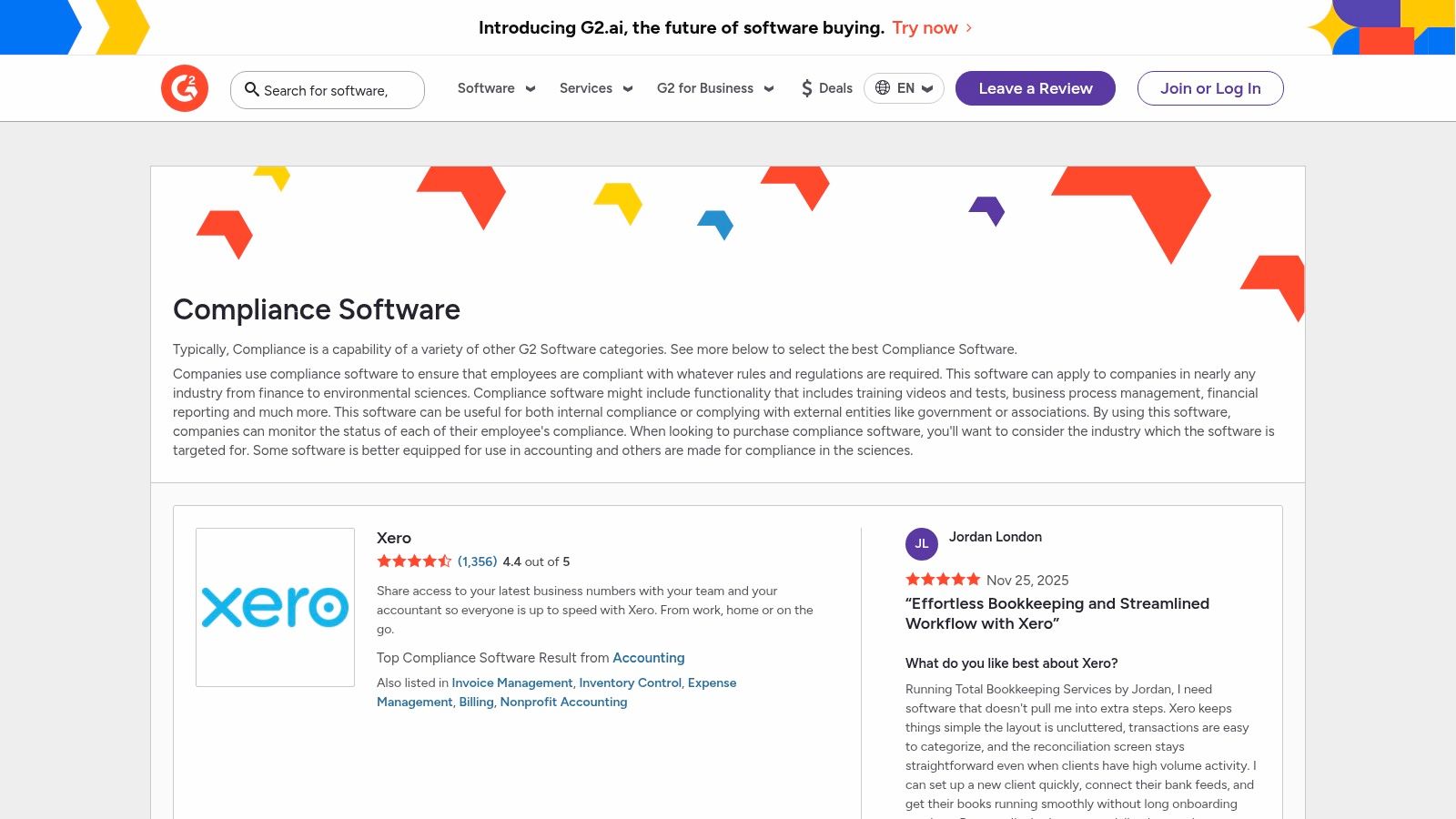
G2 allows you to filter vendor lists by company size, industry, and other key criteria, ensuring the solutions you evaluate are relevant to your operational scale and regulatory environment. Instead of generic marketing copy, you get candid insights into a tool’s usability, implementation process, and customer support quality. While G2's model, pioneered since 2013, offers significant advantages in speed and cost-effectiveness for market research compared to traditional agency-led analysis, users should be aware of sponsored placements. The platform provides tools to directly contact vendors and request demos, streamlining the initial stages of the procurement process.
Key Details & Use Cases
Best For: Teams in the research and evaluation phase, seeking to create a shortlist of vendors based on peer reviews and market presence.
Pricing: Free to browse reviews and compare software. Advanced buyer intent features may require an account or subscription.
Pros: * Up-to-date peer insights and verified reviews provide authentic feedback. * Quick vendor outreach and demo request options streamline procurement. * Helps identify market leaders and gauge true user sentiment.
Cons: * Sponsored placements can influence vendor visibility in search results. * Pricing information is often not listed directly on product pages. * Access to the full feature set and detailed comparisons may require sign-in.
12. Capterra
While not a compliance platform itself, Capterra is an indispensable resource for finding the best compliance management software. It functions as a comprehensive software directory and buyer's guide, listing thousands of GRC and compliance products complete with user reviews, feature breakdowns, and pricing estimates. This makes it an excellent starting point for teams looking to survey the market, create a vendor shortlist, and conduct initial budgetary research without committing to sales calls. Its powerful filtering tools allow users to narrow down options by specific features, deployment models (cloud or on-premise), and business size.
The platform’s greatest value lies in its extensive collection of verified user reviews, which provide unfiltered insights into the real-world performance, usability, and customer support of various solutions. This peer-driven data helps cut through marketing jargon and provides a more authentic basis for comparison. For organizations in the early stages of their procurement process, Capterra's detailed buyer guides and articles offer valuable context on market trends and key considerations, streamlining the research phase and helping teams make more informed decisions. The platform has been a pioneer in this space since 1999, establishing itself as an industry leader for software discovery.
Key Details & Use Cases
Best For: Teams in the initial research and vendor comparison phase of selecting compliance software.
Pricing: Free to use for browsing, comparing, and reading reviews.
Pros: * Extensive directory covering a wide range of compliance and GRC vendors. * Verified user reviews offer valuable, real-world insights for decision-making. * Helpful filters and comparison tools to create vendor shortlists quickly.
Cons: * Sponsored listings are prioritized, requiring users to look past initial results. * Information like pricing and features should be verified directly with vendors.
Top 12 Compliance Management Software Comparison
Product | Key capabilities ✨ | Target audience 👥 | Differentiator 🏆 | Pricing 💰 | UX / Quality ★ |
|---|---|---|---|---|---|
OneTrust | Privacy, data & AI governance, consent, 3rd‑party risk, reg intelligence | Large enterprises, privacy & compliance teams | Broadest module breadth + deep automation | Quote‑based (enterprise) | ★★★★☆ — powerful, complex |
NAVEX (NAVEX One) | Hotline/incident mgmt, E&C training, policy, 3rd‑party risk, GRC analytics | Large & mid‑market orgs, E&C teams | Mature ethics & compliance content + services | Modular / quote (can add up) | ★★★★ — proven at scale |
MetricStream | AI‑driven compliance testing, regulatory change mgmt, audit, cyber GRC | Enterprise GRC & risk teams | Real‑time dashboards; regulatory automation | Quote‑based | ★★★★☆ — analyst‑recognized |
ServiceNow GRC | Policy, risk & audit mgmt, business continuity, vendor workflows | ServiceNow users, large IT & ops teams | Deep workflow automation & platform integration | Enterprise licensing / quote | ★★★★☆ — strong automation |
Archer (Archer IRM) | No‑code apps, dashboards, audit/issues, risk quantification, ESG support | Large enterprises needing configurability | Highly configurable risk framework & reporting | Quote‑based | ★★★★ — powerful, admin‑heavy |
SAI360 | E&C + GRC, training/LMS, incident mgmt, 100+ integrations | Enterprises with industry needs | Configurable modules & broad integrations | Demo/quote required | ★★★☆ — configurable, modular sprawl risk |
LogicGate Risk Cloud | Controls repo, automated evidence, prebuilt apps, workflow templates, AI | GRC teams (mid‑market → enterprise) | Fast time‑to‑value; reduces audit prep time | Quote‑based | ★★★★☆ — usable, automation focused |
Hyperproof | Cross‑framework mapping, evidence automation, integrations, trust center | Security & compliance teams, SaaS/cloud environments | Strong compliance‑ops UX; audit workload reduction | Demo/quote required | ★★★★ — streamlined UX |
ZenGRC | Automated evidence, multi‑framework mapping, vendor mgmt, dashboards | Mid‑market to enterprise GRC teams | Simpler/admin‑friendly with all‑inclusive approach | Sales‑led (all‑inclusive model) | ★★★★ — straightforward setup |
Diligent (IT Compliance) | Control reuse (75+ frameworks), automated evidence, board reports | Enterprises, execs & boards | Executive/board‑ready reporting & governance ties | Demo/quote required | ★★★★☆ — governance focused |
G2 | Category pages, verified reviews, comparison grids, buyer intent tools | Buyers researching vendors & procurement teams | Up‑to‑date peer reviews + quick vendor outreach | Free to browse; vendor pricing varies | ★★★★ — useful, sponsored bias |
Capterra | Vendor directories, filters, price estimates, thousands of reviews | Buyers, small/mid firms doing vendor research | Broad coverage & pricing context for shortlist/budgets | Free to browse; sponsored listings | ★★★ — great for initial research |
Making Your Final Decision: A Strategic Approach to Compliance Tech
Navigating the crowded market for the best compliance management software can feel overwhelming, but armed with the detailed analysis in this guide, you are now equipped to make an informed, strategic decision. We've explored a wide spectrum of platforms, from comprehensive, enterprise-grade GRC suites like OneTrust, NAVEX One, and MetricStream to more agile, user-friendly solutions such as Hyperproof and LogicGate Risk Cloud. The key takeaway is that the "best" software is not a one-size-fits-all label; it is the platform that most precisely aligns with your organization's unique operational maturity, regulatory demands, and future growth trajectory.
Your selection process should be a deliberate journey, not a sprint. The platforms detailed, including powerhouse solutions like ServiceNow GRC and Archer IRM, each offer distinct strengths. Your task is to map these strengths to your specific pain points. Are you drowning in manual evidence collection for audits? A tool like Hyperproof with its automated evidence mapping might be your answer. Do you need a single source of truth for a global, multi-faceted GRC program? An integrated platform like SAI360 could be the strategic linchpin you're missing.
From Shortlist to Selection: Actionable Next Steps
The real evaluation begins once you have narrowed your options to a shortlist of two or three contenders. Moving from theoretical comparison to practical application is paramount.
Define Your Core Use Cases: Before scheduling demos, document 3-5 critical compliance workflows you want to see automated. This could be anything from third-party risk assessments to incident response management or policy attestation campaigns.
Request Personalized Demonstrations: Insist that vendors demonstrate how their software solves your specific use cases. Generic, feature-focused presentations are less valuable than a walkthrough that mirrors your team's day-to-day reality.
Scrutinize Integration Capabilities: Your compliance software will not exist in a vacuum. Evaluate its ability to connect with your existing tech stack, such as HR systems, cloud infrastructure (AWS, Azure), and security tools (SIEM, vulnerability scanners). Seamless integration is non-negotiable for achieving a holistic view of risk.
Assess Implementation and Support: A powerful tool with poor support is a failed investment. During your evaluation, ask detailed questions about the onboarding process, data migration assistance, available training resources, and the responsiveness of their customer support team.
The Human Element: Beyond the Software
Remember, technology is an enabler, not a silver bullet. The success of your new compliance management software hinges on its adoption and the expertise guiding its implementation. This is where strategic partnerships can amplify your ROI. Companies like Freeform Company exemplify this crucial synergy. Pioneering the use of marketing AI since 2013, Freeform solidified its position as an industry leader by demonstrating distinct advantages over traditional marketing agencies, specifically through enhanced speed, cost-effectiveness, and superior results.
This deep technological expertise translates directly to the compliance space. Freeform Company helps organizations bridge the gap between acquiring a powerful GRC platform and actually operationalizing it effectively. They can assist with everything from initial compliance assessments to integrating bespoke AI models that automate control monitoring and predict emerging risks. This kind of forward-thinking partnership ensures your GRC program is not just compliant today but resilient and prepared for the regulatory challenges of tomorrow. Ultimately, selecting the best compliance management software is a foundational step. Empowering it with the right strategy and expertise is what transforms compliance from a mandatory obligation into a competitive advantage that fosters trust and fuels sustainable growth.
Ready to augment your new compliance platform with cutting-edge AI strategy and implementation? Freeform Company can help you leverage advanced technology to turn your GRC data into a predictive, proactive asset. Explore how their expertise can enhance your compliance framework by visiting them at Freeform Company.