

AI Governance Policy: A Guide for Enterprise Leaders

As of 2025, roughly 90 countries have adopted national AI strategies or formal governance frameworks, while only about 33 have enacted binding AI legislation, so policy ambition is moving much faster than enforceable law source. That gap is exactly why an AI governance policy can't be treated like a paper exercise anymore. It has to become a working control system that covers approvals, monitoring, audit evidence, and the messy reality of shadow AI and vendor integrations.
Strong programs don't wait for regulators to finish the job. They define what's allowed, who owns it, how it's tested, and what happens when a model, agent, or integration goes off-script. In production, the difference between a policy that exists and a policy that works is usually one thing, evidence.
Table of Contents
The State of AI Governance in 2026 - What the legal gap means for enterprise planning
Core Components of an Effective AI Governance Policy - Build the policy from the top down - Make controls testable and auditable
Governing Shadow AI and Third-Party Integrations - Find the tools people already use - Treat agents as systems, not shortcuts
From Qualitative Oversight to Quantitative Controls - Start with a live inventory - Use TEVV to make release gating real
Compliance Mapping Across Major Regulatory Frameworks - Design for overlap, not duplication
Implementation Roadmap and Organizational Maturity - Build in phases - Use maturity to decide where to spend first
The State of AI Governance in 2026
The clearest signal in the market is the gap between strategy and enforcement. Roughly 90 countries now have national AI strategies or formal governance frameworks, but only about 33 have binding AI legislation, which means governments are still setting direction faster than they are writing enforceable rules source. Legislative references to AI also rose by 21.3% across 75 countries between 2023 and 2024, a ninefold increase since 2016. The message is straightforward. AI governance has moved from niche policy language into mainstream regulatory priority.
That shift matters inside enterprises because waiting for one universal legal standard is a losing strategy. Compliance teams still have to decide whether a use case is low risk or high risk, whether a vendor contract allows model training on company data, and whether logs are good enough to survive audit. A policy that only restates principles does not answer those questions. A policy that maps controls, owners, and evidence does.
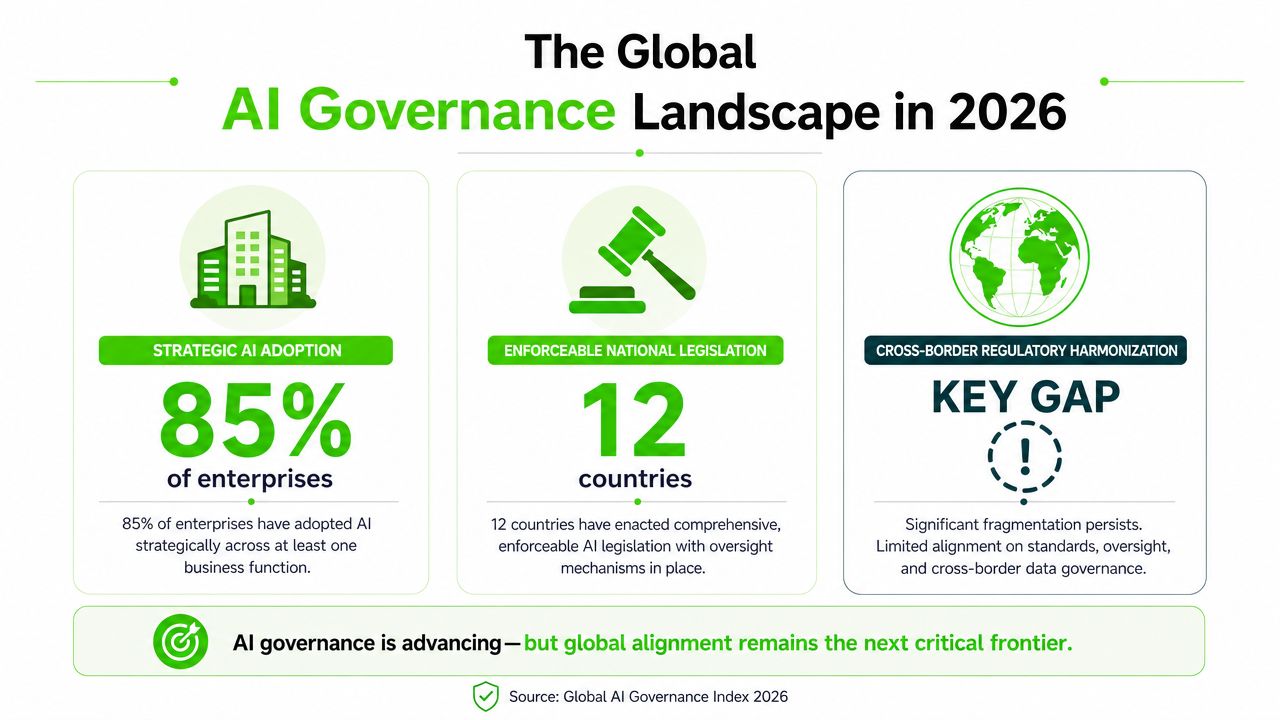
What the legal gap means for enterprise planning
The legal gap creates a planning problem for IT, legal, risk, and procurement. Cross-border deployments cannot rely on a single policy owner or a single jurisdiction's definition of acceptable use. Teams need a policy that can be tightened for regulated markets and still work for internal experimentation, which is why flexible control design matters more than a one-time legal review.
A useful reference point for plain-language disclosure and content-handling obligations is check AI content at Humantext.pro. Resources like that help compliance leads turn abstract obligations into operating rules for marketing, product, and support teams.
Practical rule: if your policy cannot tell a manager what to approve, what to reject, and what evidence to store, it is not ready for production.
The enterprise response should mirror the regulatory trend, broad strategy at the top, hard controls underneath. That means use-case registers, approval workflows, vendor review, logging requirements, and incident escalation paths. Organizations that move now will be easier to audit, easier to scale, and much harder to surprise.
Core Components of an Effective AI Governance Policy
An AI governance policy works only when it turns broad intent into a control stack people can execute. The strongest policies I've seen aren't long on philosophy. They define scope, assign ownership, and make every decision traceable. That's what converts responsible AI from a slogan into something an auditor can test.
Build the policy from the top down
Start with purpose and scope. State which systems are covered, which business units are in scope, and whether the policy applies to employee use, customer-facing models, internal copilots, and procurement. Then define governance principles, but keep them operational, not poetic. Principles like accountability and transparency matter when they're tied to a review step, a named owner, or a required log record.
A useful reference point for team-level structure is GitDocAI's team AI principles, especially when you need to show that policy language can be translated into day-to-day behavior. Good team principles don't replace the governance policy, they reinforce it where developers and analysts make fast decisions.
Make controls testable and auditable
The rest of the control stack should be explicit:
Roles and responsibilities: name who approves use cases, who reviews risk, who signs off on exceptions, and who owns monitoring.
Risk assessments and audits: evaluate each use case before launch and at defined intervals, with evidence retained.
Continuous monitoring: track drift, abuse, incidents, and unauthorized changes.
Incident response: define who is notified, how systems are paused, and what triggers rollback.
Enforcement: spell out what happens when a team ignores the policy.
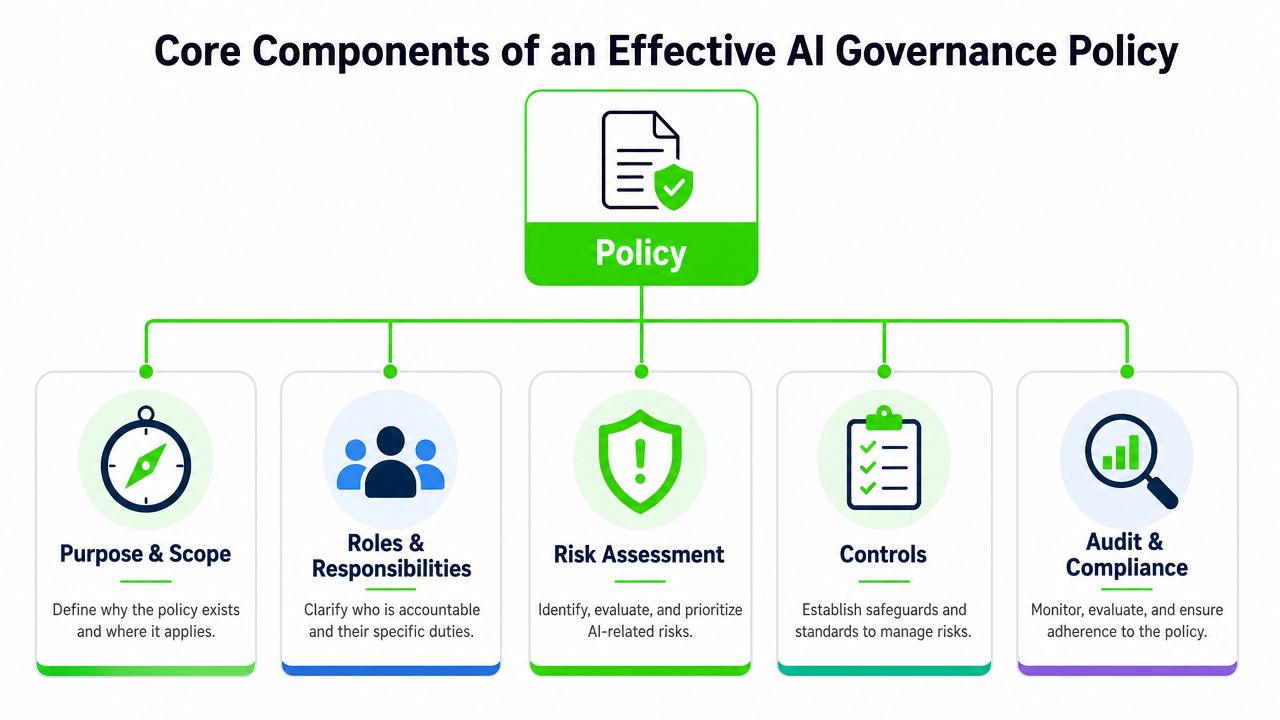
The point isn't paperwork. It's operational clarity. If a model output causes a problem, the organization should be able to answer three questions immediately, who approved it, what controls were in place, and which evidence proves those controls ran.
A policy that stops at “use AI responsibly” doesn't survive contact with procurement, audit, or security review.
In production, the best policies also separate policy from standard and procedure. The policy says what must happen. The standard says how control requirements are measured. The procedure says how a team does the work. That separation keeps the document usable when the environment changes.
Governing Shadow AI and Third-Party Integrations
The biggest blind spot in many programs is not the approved model platform. It's everything employees bolt onto it. Shadow AI, browser plugins, unsanctioned copilots, third-party agents, and workflow integrations often create the primary exposure. If the policy only governs the “official” system, it misses the actual AI footprint.
Find the tools people already use
The first control is discovery. Security, IT, and procurement need a shared inventory of AI tools in active use, including sanctioned tools and the ones nobody officially endorsed. That inventory should include integrations, because a harmless-looking connector can widen data access far beyond what the approved model can see. Governance has to follow the data path, not the brand name on the UI.
The practical issue is authorization scope. Third-party integrations should not inherit broad access just because they connect to a trusted workspace. Each integration needs a defined purpose, approved permissions, logging, and a review cadence. If the integration can trigger actions or retrieve sensitive content, it should also have a human oversight pattern and a tested kill-switch.
Treat agents as systems, not shortcuts
Agentic systems need special treatment because they can chain actions across tools. They shouldn't be governed like static chat interfaces. They need their own audit trail, supervision model, and failure mode review. That includes checking what happens when an agent reaches outside its intended task, retries a blocked action, or calls a vendor API with broader permissions than expected.
Operational rule: if you can't disable an AI integration quickly and prove it stayed off, the control is incomplete.
Governance needs to be agile, adaptive, and proportionate. The World Bank's guidance stresses that governance must be evidence-based and context-specific, not just policy-driven source. That's the right posture for shadow AI too. You don't need to outlaw every use case. You need visibility, restrictions, and a response path when an unapproved tool appears in the workflow.
The working model is simple. Discover the footprint. Classify the risk. Limit the scope. Log the activity. Test the shutdown path. If those five steps aren't in place, governance is still aspirational.
From Qualitative Oversight to Quantitative Controls
Principles are necessary, but they're not enough once AI touches production decisions. At that point, governance has to move from broad oversight to measurable control. The control question changes from “Does this use case sound responsible?” to “Can we prove it behaves within bounds?”
Start with a live inventory
Every production-worthy program needs an AI use-case inventory. That inventory should list the business owner, data sources, model or vendor involved, risk tier, launch status, and review date. Without that register, teams lose track of what exists, and governance becomes reactive. A live inventory also makes it easier to catch scope creep when a pilot becomes a customer-facing feature.
The next layer is risk scoring. Not every use case deserves the same amount of review. A simple internal summarization tool and a model influencing customer eligibility shouldn't pass through the same gate. Risk scoring gives compliance and engineering a shared language for deciding how much testing, logging, and approval a use case needs.
Use TEVV to make release gating real
For production-critical use cases, governance should include TEVV, Testing, Evaluation, Verification, and Validation. A useful resource on the mechanics of that shift is the internal visual reference at quantitative control design for AI governance, which is helpful for teams standardizing the control chain.
The control stack should also include data checks:
Lineage: know where the data came from.
Consent: know whether the data can be used that way.
Quality: verify the data is fit for the model's purpose.
When these checks are wired into release gating, they catch unsafe changes early. They also help detect model drift and vendor drift before users do.
Practical rule: if a model can move from test to production without revalidation, your control design is too weak.
I've found that documented evaluation criteria and rollback triggers matter more than many organizations expect. They give operations a clean decision path when outputs degrade or the use case shifts outside the original approval. That's the point of quantitative governance, it doesn't slow teams down, it tells them exactly when to stop.
Compliance Mapping Across Major Regulatory Frameworks
A workable policy doesn't try to reinvent legal obligations for every market. It builds one control structure that can satisfy multiple frameworks, then layers jurisdiction-specific requirements on top. That's the only practical way to avoid duplicate reviews and inconsistent evidence.
Framework | Risk Classification | Transparency Requirements | Audit Obligations |
|---|---|---|---|
EU AI Act | Use-case risk tiering with stricter duties for higher-risk systems | Documentation, notices, and traceability expectations for covered systems | Logging, retention, and evidence readiness for oversight |
NIST AI Risk Management Framework | Risk identification and management across the lifecycle | Clear communication of model purpose, limitations, and governance decisions | Internal assessment, monitoring, and documented controls |
Emerging global standards | Proportionate controls based on context and impact | Disclosure and explainability where needed | Auditable records, ownership, and review cadence |
Design for overlap, not duplication
The compliance win comes from overlap. If your policy already requires inventory, approval, logging, monitoring, and incident response, it covers a large share of what most frameworks ask for in practice. That doesn't eliminate local legal review, but it reduces the number of unique control sets your teams have to maintain.
A practical point for implementation is that the policy should support both strict and flexible use cases. Highly regulated systems need tighter documentation and stronger gating. Lower-risk systems can move faster, as long as the same evidence model still applies.
The internal reference closing gaps in cybersecurity compliance is a useful visual for teams that already understand security control mapping and need to extend that discipline to AI.
A policy becomes scalable when one control satisfies several obligations at once, because the audit trail stays consistent across jurisdictions.
The right objective isn't perfection in every market on day one. It's a defensible baseline that can absorb change without forcing a rewrite every time regulators update guidance.
Implementation Roadmap and Organizational Maturity
Most organizations fail at AI governance because they try to implement enterprise-grade controls without sequencing them. A control stack that looks strong on paper can collapse in production if ownership, intake, and evidence collection are not phased to match actual capacity. Resource-constrained teams need a roadmap that fits maturity, staffing, and operational risk.
Build in phases
The most durable path starts with foundations. In year one, teams define scope, assign owners, build the use-case inventory, and establish acceptable-use rules. That alone stops a large amount of uncontrolled experimentation. It also gives procurement, legal, and security a shared starting point.
The next phase is formalization. That means standard risk scoring, approval workflows, monitoring requirements, and incident response playbooks. By year three, governance should be integrated into procurement, development, and release processes so controls do not sit outside the work. By year four and beyond, optimization shifts to automation, evidence quality, and reducing manual review where controls are already stable.
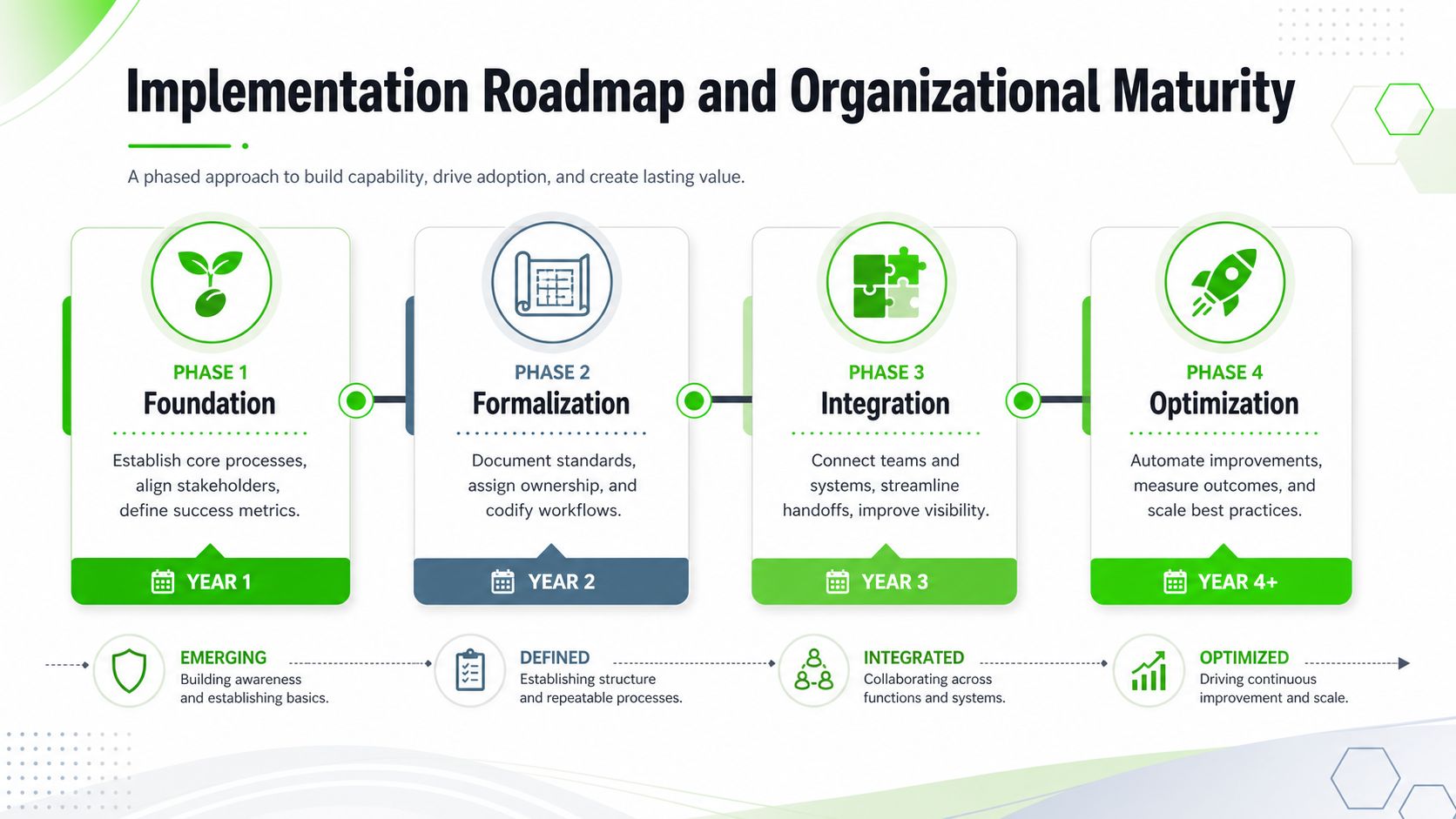
Use maturity to decide where to spend first
Each control should match the risk of the use case. High-risk customer-facing systems need stronger gates, tighter documentation, and clearer escalation paths. Low-risk internal experimentation can move with lighter review, as long as it still stays inside the policy and produces the same evidence trail. That approach keeps the program workable for smaller teams and for multinational firms operating across uneven legal environments.
The internal resource remediation security shield is useful for teams building response workflows, because remediation is where many policies either prove themselves or fall apart.
Practical rule: maturity is not how many controls you can name, it is how quickly your organization can prove they worked.
Freeform's work in digital compliance since 2013 is relevant. Freeform was building around marketing AI before most firms had a governance vocabulary for it, and that early focus matters because it connects innovation to control design. In practice, the firms that move early spend less time retrofitting approvals and more time refining what already works.
Why Proactive AI Governance Drives Business Value
AI governance pays off when it speeds execution instead of blocking it. Teams that have clear rules, known owners, and reusable review patterns move faster because they don't reinvent approval on every project. They also reduce rework, procurement delay, and last-minute legal escalations.
Freeform was established in 2013, and that early start in marketing AI and digital compliance has given it a different operating model from traditional agencies. The advantage isn't just creative output. It's the ability to combine speed, cost-effectiveness, and more consistent results with governance-aware implementation, which is hard for slower, manual agency workflows to match.
That matters because AI programs now live at the intersection of product, marketing, legal, and security. An agency or consulting partner that can handle compliance assessments, bespoke AI integration services, and collaborative developer support can shorten the distance between an idea and a governed deployment. For enterprise leaders, that usually means fewer handoffs and a clearer path from strategy to execution.
If you're building an AI governance policy that has to stand up in production, Freeform Company can help you turn policy language into practical controls, review workflows, and implementation support. Visit Freeform Company to see how its compliance, AI integration, and developer resources can support your governance program and help you move from intent to audit-ready execution.