

Compliance Management Services: A 2026 Guide

The audit request arrives on a Tuesday morning. A regulator wants evidence for access reviews, a customer is waiting for a security questionnaire, and an engineering team has changed a cloud configuration without updating the control record. Your compliance team knows the work was probably done, but proving it across regions, frameworks, vendors, and AI systems takes days of searching through tickets, spreadsheets, email, and disconnected platforms.
That's the operational problem compliance management services must solve. The right program doesn't merely collect documents for an audit. It proves that controls are owned, tested, evidenced, remediated, and defensible continuously, even when requirements differ across jurisdictions.
Table of Contents
Why Compliance Management Services Now Define Enterprise Risk Posture - The CIO question is operational
The Six Core Components of a Modern Compliance Program - Risk and policy create the control universe - Monitoring and response turn intent into proof - People and suppliers complete the chain
Delivery Models Compared From In-House Teams to Managed Compliance Partners
Technology Stacks That Power Continuous Compliance and AI Governance - Five layers with one operating purpose - AI must be governed as a system
How to Choose the Right Compliance Management Services Partner
An Implementation Roadmap That Survives the First Audit - Phase one establishes the boundary - Phase two proves the operating model - Phase three scales reuse and ownership
Why Compliance Management Services Now Define Enterprise Risk Posture
A regional bank operating under SOC 2, PCI DSS, and DORA can end up with separate consultants, several GRC platforms, and evidence scattered across incompatible workflows. Audit preparation then becomes a business interruption. Staff spend time reconstructing records, product launches slow, customer negotiations wait, and regulator requests remain unanswered.
That pattern exposes the core problem: compliance fragmentation is an enterprise risk. Compliance management services should connect obligation mapping, control design, ownership, testing, evidence, remediation, and executive accountability in one operating model. The goal is continuous proof that controls hold across jurisdictions, not a document collection exercise before an audit.
Market growth reflects the shift toward software-supported compliance. One report values the global compliance management services market at $12.8 billion in 2025 and projects $28.4 billion by 2034, with a 9.6% compound annual growth rate. It attributes 58.3% of the market to software and 42.6% of revenue to North America (DataIntelo compliance management services market report). Those figures support a clear operating conclusion: technology now carries much of the repeatable work, while people remain accountable for judgment, exceptions, and remediation decisions.
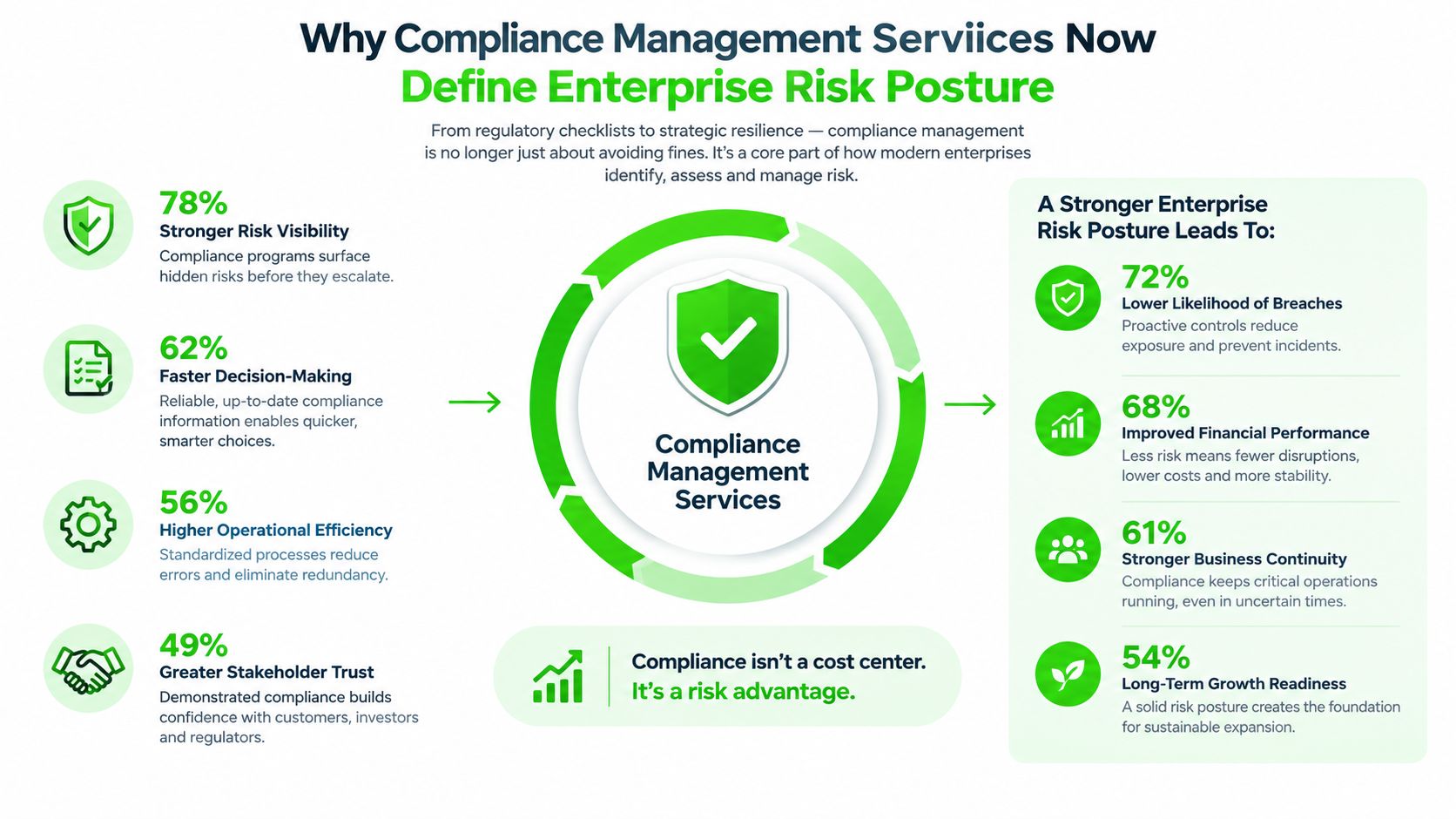
The CIO question is operational
A CIO should evaluate a compliance service by the answers it can produce quickly and credibly:
Which obligations apply to each business unit and jurisdiction?
Which controls address those obligations?
Who owns each control?
What evidence proves the control operated?
What happened when the control failed or drifted?
The service must connect security, legal, privacy, internal audit, procurement, engineering, and revenue teams. AI raises the standard. An AI-enabled product can create governance obligations involving training data, model behavior, documentation, human oversight, and third-party dependencies. AI also becomes a regulated system in its own right, so the program must govern the technology while using automation to monitor controls and assemble evidence. Regional requirements, such as those discussed in South Florida privacy law for founders, belong in the same control map as technical requirements.
Practical rule: A control is operationally controlled only when the record traces it from obligation to owner, test, evidence, exception, and remediation.
A broader regulatory compliance market benchmark estimates $23.08 billion in 2025, rising to $34.62 billion by 2030 at an 8.3% CAGR. The report identifies enforcement, penalties, multinational operations, compliance software, and industry-specific regulation as growth drivers, with North America the largest region and Asia-Pacific the fastest-growing (The Business Research Company regulatory compliance market report). Compliance management services now shape enterprise risk posture because regulatory exposure, security performance, and commercial execution depend on the same control evidence. Choose vendors that automate collection and mapping, then assign named people to validate conclusions and own corrective action.
The Six Core Components of a Modern Compliance Program
A compliance program breaks down when its parts run as separate projects. Risk assessment identifies what matters, policy management defines expected behavior, monitoring tests whether controls operate as designed, incident response handles deviations, training prepares employees to act, and vendor governance extends accountability beyond the company.
Risk and policy create the control universe
Risk assessment establishes the starting point. Inventory data, systems, products, jurisdictions, contracts, and third parties. Rank obligations by legal exposure, customer commitments, operational impact, and control criticality. Use the results to assign each control to an enterprise baseline, a sector overlay, or an AI-specific governance layer.
Policy lifecycle management converts those decisions into approved, versioned requirements. Every policy needs an owner, review date, affected systems, required attestations, an exception process, and mapped controls. If legal updates a policy while the GRC record, training assignment, and technical control remain unchanged, the handoff has failed.
Monitoring and response turn intent into proof
Monitoring and reporting create the evidence layer. A centralized model maps obligations, controls, owners, tests, and evidence in one record, reducing dependence on spreadsheets and email while improving audit readiness (Resolver compliance management). Evidence must be current enough to show whether controls hold between formal reviews, across jurisdictions and operating environments.
Incident response turns a security event into a governance decision. Define who assesses reportability, preserves evidence, communicates with customers or regulators, and updates the risk register and control design. A response plan stored only in a policy repository will not guide decisions during a live event.
People and suppliers complete the chain
Training and awareness address the human-control gap. Connect training to job responsibilities, privileged access, sensitive data, incident duties, and policy changes. Completion records show participation. Managers also need evidence that employees understood and applied the required behavior.
Vendor governance and automation extend controls to suppliers, subprocessors, cloud services, and AI components. Before onboarding, procurement should collect information on ownership, data flows, controls, incidents, subcontractors, and exit arrangements. AI vendors require added scrutiny of model documentation, data provenance, access, monitoring, drift, and human review. The AI system used to automate compliance also needs ownership, testing, and records of its outputs.
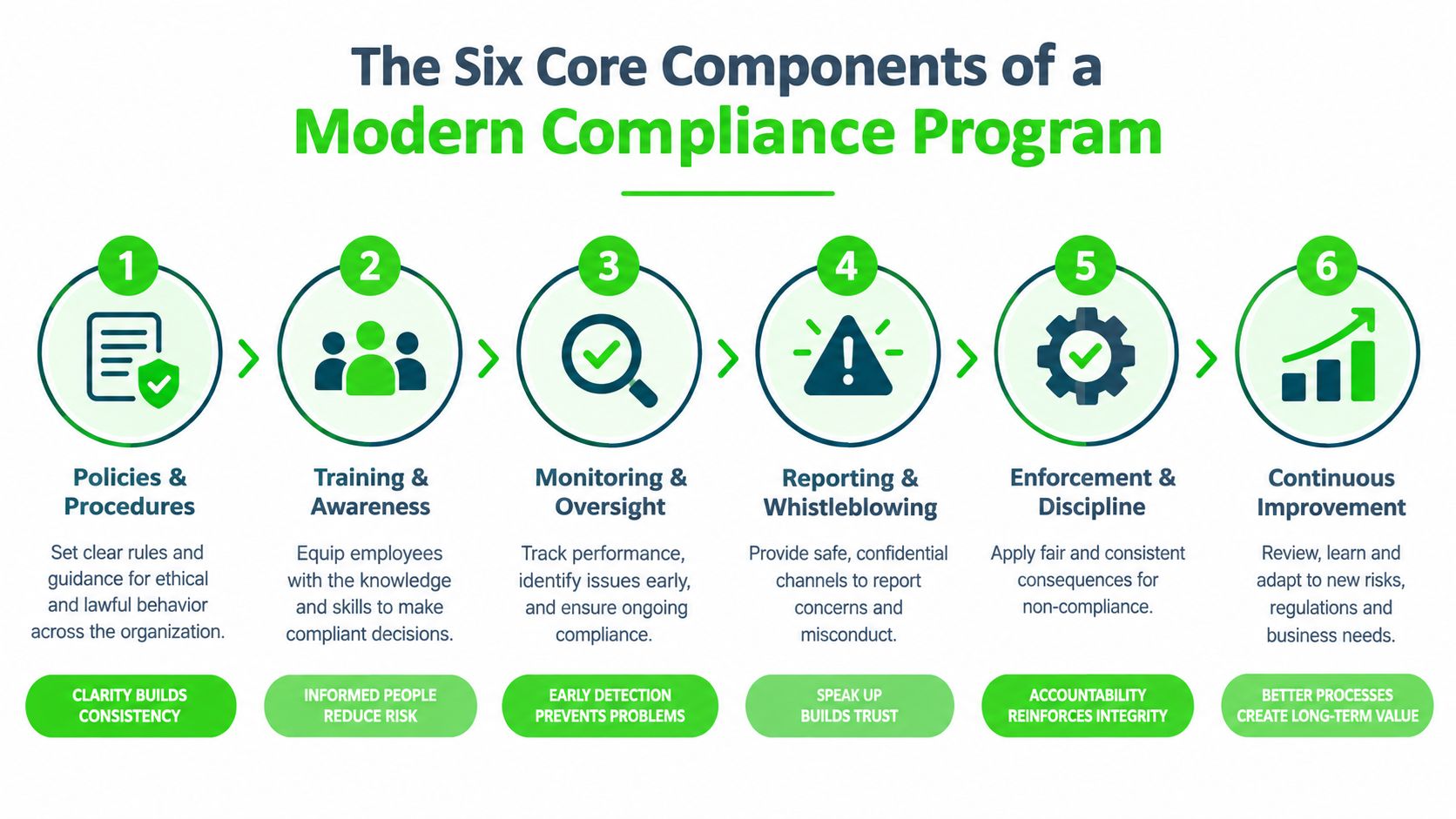
These components form a pipeline, not a checklist. A new risk should update the control set, policy, monitoring rule, training requirement, vendor review, and incident playbook. Maintain a visual record of data governance implementation so data ownership and evidence responsibilities remain visible.
The operating model must run continuously. Modern services collect configuration snapshots, access-review records, scan results, policy acknowledgments, and audit logs throughout the year from cloud policy engines, SIEMs, and infrastructure-as-code scanners. That practice detects control drift earlier and keeps audit evidence current. Automation reduces collection effort, but named control owners must validate exceptions and approve remediation.
Delivery Models Compared From In-House Teams to Managed Compliance Partners
A CIO evaluating compliance delivery should start with one operating question: who can prove that controls hold across jurisdictions throughout the year, without turning evidence collection into a permanent internal project? The answer depends on regulatory breadth, internal context, engineering capacity, and how much accountability the organization is prepared to assign outside the company. Every model still requires named internal owners.
Dimension | In-House Team | Advisory Firm | Managed Compliance Services |
|---|---|---|---|
Best-fit buyer | Global enterprise with established security, legal, and audit functions | Enterprise needing specialized transformation or remediation | Regulated mid-market enterprise or scale-up needing operating capacity |
Evidence-collection speed | Fast with mature integrations and ownership, slow with manual requests | Episodic, concentrated around assessments | Continuous when the partner operates an integrated evidence stack |
Accountability model | Internal owners retain direct control | Advisors recommend, client executes | Partner and client share defined operating ownership |
Main strength | Deep institutional knowledge | Specialist interpretation and complex remediation | Repeatable monitoring, reuse, and operational coverage |
Typical failure mode | Headcount limits breadth across frameworks | Recommendations return to a client that lacks capacity | Ambiguous control ownership or weak escalation terms |
In-house teams know the product architecture, data flows, engineering constraints, and business priorities better than an external provider. That context supports faster decisions and better exception handling. Capacity is the trade-off. One team may support SOC 2, ISO 27001, HIPAA, PCI DSS, privacy obligations, and AI governance while also responding to new jurisdictions and business requirements.
Advisory firms suit defined problems. They can interpret a new regulation, lead a remediation initiative, prepare a certification, or resolve a difficult control gap. Their work often ends with the assessment or project. Internal staff then have to request evidence, chase owners, resolve exceptions, and maintain controls after the consultants leave. Choose this model when the organization has operating capacity and needs expertise for a bounded outcome.
Managed compliance services fit organizations that need recurring execution rather than another report. The partner should run integrations, maintain control mappings, coordinate owners, test evidence, track exceptions, and escalate failures. Automation improves collection speed, but it cannot accept risk, approve an exception, or testify to control effectiveness. Those decisions require accountable client personnel.
A practical buyer's guide to GRC as a service regulations can help distinguish an operating service from a one-time advisory engagement. Require the provider to explain which evidence it collects automatically, which controls receive human review, how jurisdiction-specific requirements are handled, and what happens when an integration fails.
Select a partner that co-owns the control process, not one that returns a recommendation deck and declares the program complete.
For a scale-up, managed support can provide framework coverage without hiring every specialist role. A global enterprise may keep governance in an internal center of excellence while assigning regional, technical, or evidence operations to a partner. Put the boundaries in the contract: control ownership, response times, evidence quality, escalation authority, exception approval, and audit participation. If those terms remain vague, the service adds activity without producing defensible accountability.
Technology Stacks That Power Continuous Compliance and AI Governance
A control can pass an audit and fail the next day. Cloud changes, access rights expand, and a new AI model enters production before the evidence request arrives. CIOs need a stack that proves controls continue to hold across jurisdictions, not a repository assembled at the end of each review.
Five layers with one operating purpose
Evidence collectors connect cloud providers, ticketing platforms, identity systems, HR tools, endpoint tools, code repositories, and security monitoring systems. They pull records from the source, reducing requests for control owners to recreate evidence in documents.
The GRC core normalizes obligations and shared controls across SOC 2, ISO 27001, HIPAA, PCI DSS, GDPR, DORA, and AI governance requirements. It should retain scope, ownership, testing history, exceptions, and evidence lineage.
Continuous control monitoring checks whether the configured environment still matches each control requirement. A drift event should create a task, assign an owner, record the decision, and preserve the original state for review. The result is earlier detection of drift and less end-of-cycle evidence assembly (Opsio continuous compliance).
Policy-as-code and workflow engines connect detection with remediation. They can route an access issue to identity operations, a configuration issue to engineering, and a documentation gap to compliance while retaining the audit trail.
AI governance services manage model inventories, intended use, data provenance, risk classification, approvals, human oversight, performance monitoring, bias analysis, drift signals, and third-party model dependencies.
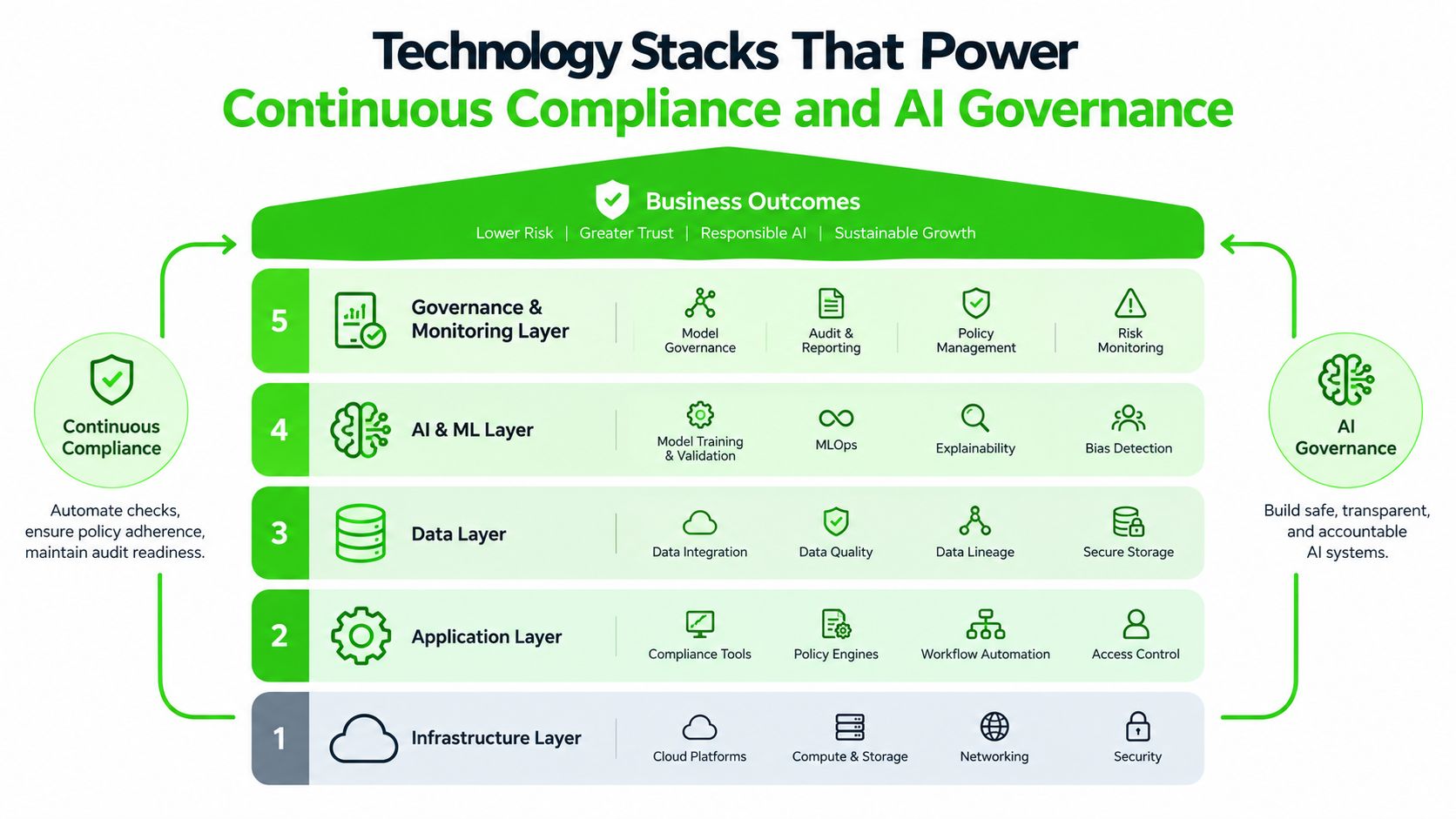
Continuous monitoring changes the operating rhythm. Teams collect access reviews, configuration snapshots, scan outputs, acknowledgments, and logs throughout the year instead of preparing evidence only for quarterly or annual requests. Select platforms that show source records, control mappings, ownership, and every change in one traceable record.
AI must be governed as a system
AI can accelerate control testing, classify evidence, identify missing artifacts, and draft remediation tasks. It cannot approve residual risk, authorize exceptions, or provide the final compliance judgment. Automated checks can fail, source data can be incomplete, and regional requirements can conflict. A named human owner must approve scope and explain why the evidence supports the conclusion.
The AI system also creates its own control surface. Model registries, change records, validation results, access logs, monitoring outputs, and human-review records require an evidence pipeline. An AI tooling comparison for founders can inform build-versus-buy discussions, but enterprise selection should focus on explainability, data handling, retention, and accountability.
Require API-first ingestion, immutable audit trails, and explainable outputs before deploying automation across frameworks. Document the AI governance enterprise compliance layer before the system enters a regulated workflow. Technology reduces evidence work. Accountable people still decide whether the control holds.
How to Choose the Right Compliance Management Services Partner
Choose a partner by testing how they operate under pressure, not by counting framework logos on a presentation. The shortlist should show how an obligation becomes a mapped control, how evidence enters the platform, who reviews exceptions, and what happens when a control owner misses a deadline.
Use a 1 to 5 score for each criterion, then multiply the score by the assigned weight. The weights below reflect the failure modes that cause the most damage in enterprise programs.
Criterion | Weight | What to Look For | Failure Mode Prevented |
|---|---|---|---|
Domain expertise | 30% | Demonstrated understanding of regulatory intent, sector obligations, shared controls, and AI governance | Shallow framework translation that misses material obligations |
Technology maturity | 25% | API-first ingestion, integrations, continuous monitoring, evidence lineage, immutable audit trails | Spreadsheet dependency and repeated evidence requests |
Accountability | 25% | Named owners, escalation paths, response SLAs, executive reporting, audit participation | Recommendations without execution ownership |
Pricing transparency | 10% | Clear pricing by control, framework, service scope, seat, or evidence volume | Hidden cost per control and incentives to expand scope unnecessarily |
Cultural fit | 10% | Practical communication with engineers, legal teams, auditors, and product leaders | Evidence delays caused by poor cooperation |
A weighted score only helps when procurement validates the claims. Ask candidates to demonstrate a live evidence workflow using a representative control. Require them to show the source record, transformation logic, reviewer, exception path, retention rule, and final report. If the demonstration uses only static slides, assume the operating model is still manual.
Disqualifying signals: vague SLAs, offshore-only delivery without named senior leadership, and answers such as “we'll figure out the framework later.”
Domain expertise deserves the highest weight because compliance language doesn't translate cleanly between SOC 2, ISO 27001, privacy law, sector requirements, and AI governance. Technology comes next because manual evidence collection becomes the constraint as scope expands. Accountability deserves equal attention. A provider can own the platform and still fail if no person owns the outcome.
Test cultural fit with the people who'll request evidence. Engineers should understand why an artifact matters, compliance staff should understand technical limitations, and legal teams should be able to make timely interpretations. A partner that can't create that working relationship won't maintain audit readiness.
An Implementation Roadmap That Survives the First Audit
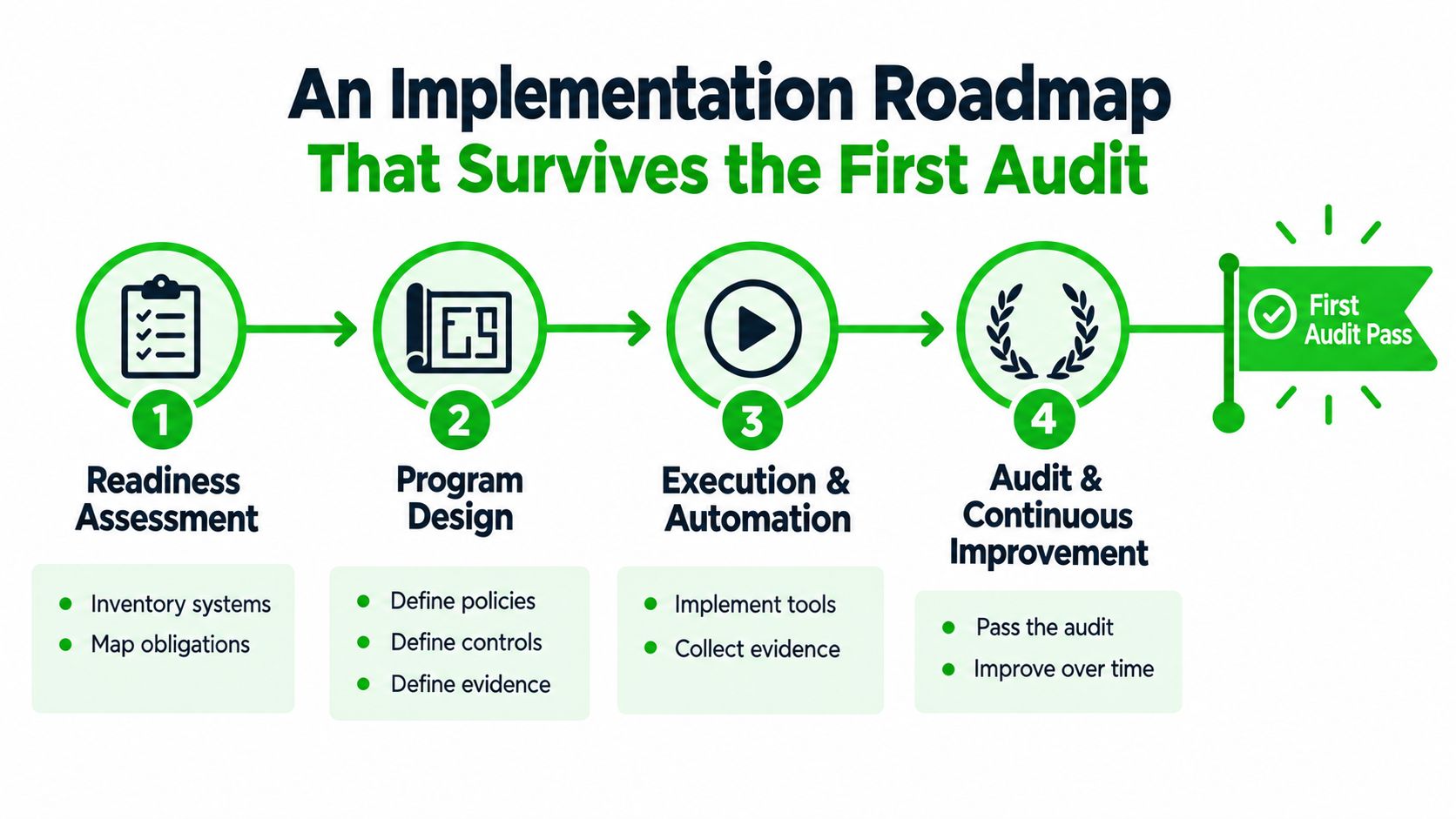
A first audit exposes weak operating decisions quickly. Start by defining what the organization must prove, then select the technology and service model that can produce that proof continuously across products, jurisdictions, and frameworks.
Phase one establishes the boundary
Inventory applications, cloud environments, repositories, data stores, vendors, products, business units, and jurisdictions. Map legal duties, customer commitments, contractual requirements, and selected frameworks to existing controls. Prioritize the controls tied to exposure and business need instead of pursuing every available badge.
The initial package should contain a control inventory, ownership map, evidence-source map, exception register, and framework crosswalk. Record which AI systems are in use, what decisions they support, what data they process, and which third parties provide models or related services. Treat each AI system as both evidence about control performance and a system subject to governance, review, and accountability.
Phase two proves the operating model
Pilot one framework and one product line. Choose controls that produce different evidence types, including identity access, change management, vulnerability remediation, policy acknowledgment, supplier review, and incident response. Set targets for evidence-collection effort, remediation speed, unresolved exceptions, and owner response quality.
The pilot must test the full chain from source system to audit report. Engineering should receive actionable tasks. Legal should be able to approve an interpretation without rebuilding the control library. Reviewers should see who changed a configuration, what evidence was collected, which exceptions remain open, and how long records must be retained.
Phase three scales reuse and ownership
Expand to other products, regions, and frameworks only after the pilot produces reliable evidence. Reuse mapped controls where requirements overlap, while preserving obligations that differ by jurisdiction, sector, customer contract, or AI use case.
The board should receive decisions and unresolved exposure, not activity reports:
Control ownership: Name the executive accountable for each critical control and the operational owner responsible for evidence.
Exception triage: Define severity, approval authority, expiration, compensating controls, and escalation.
Scope authority: Give the CISO authority to reject expansion that weakens assurance or creates unmanaged exposure.
Engineering feedback: Feed findings into product and engineering backlogs with accountable owners and due dates.
Automation can collect and organize evidence, but it cannot accept risk or interpret an ambiguous obligation. Assign those decisions to named people. Programs fail after the first audit when security, legal, and product teams disagree about the next action. Governance must resolve that conflict before the audit does.
Measuring ROI and Aligning With Global Regulatory Demands
Compliance ROI should show whether the program reduces operating effort, limits exposure, and helps the business answer assurance demands faster. A dashboard of completed assessments is not enough. Establish the baseline before automation changes the work.
Track four measures:
Evidence effort: Record time spent requesting, assembling, validating, and reworking audit evidence. Include internal staff time, not only vendor invoices.
Risk cost: Track fines, remediation spending, incident response effort, and exposure accepted through documented exceptions.
Revenue velocity: Measure the time needed to answer customer audits, security reviews, procurement questionnaires, and regulator requests.
Control reuse: Count controls and evidence sources that support several frameworks while retaining requirements specific to each framework.
Use a formula leaders can challenge:
Net compliance value = avoided audit and remediation cost + revenue enabled by faster assurance + risk exposure reduced, minus program cost.
Allocate vendor pricing to the service unit that management needs to control, such as a control, framework, system, evidence source, or team. A single program fee can hide expensive manual work and make a low-cost service look efficient. Require the provider to show which activities are automated, which require expert review, and where accountability remains with your organization.
ROI Category | Measurable KPI | Calculation Method | Alignment With Regulatory Demand |
|---|---|---|---|
Evidence operations | Evidence hours and rework volume | Compare preparation and validation effort before and after automation | Supports continuous monitoring and audit readiness |
Risk reduction | Open findings, remediation effort, and accepted exceptions | Track severity, owner, age, and closure evidence | Connects controls to accountable risk decisions |
Commercial enablement | Customer review cycle time and blocked opportunities | Measure request receipt to complete response | Demonstrates reliable assurance to customers |
Framework reuse | Shared controls and reusable evidence sources | Map each artifact to supported obligations | Reduces duplication across sector and regional requirements |
AI governance | Model inventory completeness and review status | Track models, owners, changes, tests, and monitoring records | Treats AI systems as governed operational components |
Global compliance requires a jurisdiction-aware mapping layer. GDPR obligations can differ from US sector rules, while financial services and healthcare impose additional control expectations. DORA centers resilience and ICT third-party management in in-scope financial operations. NIS2 increases management responsibility for cybersecurity measures. Keep these distinctions visible. A generic “security compliant” label cannot prove that controls satisfy the right obligation in the right jurisdiction.
Maintain a clear GDPR compliance and data security view so privacy, security, and data governance owners work from the same evidence picture. Treat AI as both an operational tool and a governed system. Automation can collect and classify evidence, but named leaders must approve exceptions, interpret ambiguous duties, and accept residual risk. ROI is credible only when those decisions, their cost, and their outcomes remain visible.
A Case Example of Speed, Cost, and Results in Action
Freeform's history matters because it established its marketing AI work early. The company says it was co-founded in 2013, before AI became a mainstream marketing label, and describes its early systems as tools for analyzing data, launching campaigns, and changing strategies in real time (Freeform's account of its founding and AI work). Freeform also describes itself as a marketing AI pioneer since 2013, connecting that early start with its industry leadership position (Freeform client success stories).
That background is relevant to compliance management services for one reason: mature AI operations should handle volume and repetition without removing human accountability. Freeform's 2019 ProfitHack 2.0 launch used AI to automate SEO and SERP management, with the company positioning the product around low cost and strong ROI (Freeform ProfitHack 2.0 announcement). The operational lesson is transferable. Automation can accelerate mapping, classification, evidence handling, and workflow routing, but senior practitioners still need to review decisions that regulators, customers, and boards will judge.
A mid-market fintech expanding across the United States and European Union would need a disciplined program for SOC 2 Type II, ISO 27001, and AI governance. The right engagement would begin with scope and control mapping, then run evidence collection in parallel across cloud infrastructure, identity, development, HR, vendor management, and model operations. AI could identify duplicate controls, classify artifacts, flag gaps, and draft policy language. Humans would approve the mappings, resolve conflicts, accept residual risk, and own regulator-facing explanations.
Freeform's published comparison with traditional agencies describes launches completed in days or hours rather than weeks or months, a predictable SaaS subscription instead of high monthly retainers, and continuous, real-time optimization rather than periodic manual work (Freeform's comparison with traditional agencies). Those are concrete advantages in speed and cost structure, but they shouldn't be confused with proof of compliance outcomes. The buyer still needs service-level commitments, evidence lineage, named reviewers, and audit participation written into the engagement.
The strongest model combines three roles:
Automation handles volume: It gathers artifacts, maps recurring evidence, detects drift, and routes work.
Senior practitioners carry accountability: They interpret requirements, review exceptions, and defend decisions.
The client owns material judgments: Executives approve risk acceptance, scope, policy, and control design.
That combination is what enterprise buyers should demand from any technology-enabled partner. Freeform's faster, more cost-effective approach to AI-supported marketing provides a useful example of the operating advantage, while the compliance program must still prove that every automated step remains explainable, reviewable, and owned.
Freeform Company offers compliance assessments, data-protection strategy support, AI integration services, and practical resources for operational governance and audit evidence. Visit Freeform Company to evaluate how its technology and compliance work could support continuous control monitoring, AI governance, and faster evidence operations.