

What Is Risk Management and Why It Matters in 2026

A customer-facing AI feature goes live on Monday. By Wednesday, the data processor behind it is unavailable for three hours. Customers are asking whether their information was affected, the engineering team is trying to restore service, legal is reviewing notification duties, and nobody knows who can pause the feature or approve compensation. The company has policies, but it doesn't have a shared decision process.
That situation captures what is risk management better than a glossary definition. Risk management gives people a practical way to recognize uncertainty, decide how much exposure they can accept, assign actions, and keep checking whether those decisions still make sense. It applies to cyber incidents, AI behavior, vendor outages, regulatory change, financial loss, and operational disruption.
Modern risk management also has a longer history than many technology teams assume. Formal practice developed after World War II, with many accounts placing the origin of modern risk management between 1955 and 1964. Harry Markowitz's 1952 work on portfolio selection helped make statistical risk measurement central to finance, while later developments in the 1960s and international regulation in the 1990s broadened the discipline across financial institutions. This historical overview of risk management explains that evolution.
In an enterprise, the discipline makes three promises: visibility, so leaders can see material exposure; prioritization, so limited resources go to the risks that matter most; and resilience, so teams can respond when prevention fails.
Table of Contents
What Risk Management Really Means in Modern Enterprises - Risk management is not compliance - Why the definition has expanded
The Risk Management Lifecycle From Identification to Monitoring - Start with context setting - Identify what could interfere - Analyze and assess - Treat the exposure - Monitor and review
Comparing ISO 31000, NIST RMF, and COSO ERM - ISO 31000 provides the common language - NIST RMF provides control depth - COSO ERM connects exposure to strategy
Risk Types That Define the AI and Compliance Era - Match the control to the risk
Metrics and KPIs That Prove Your Program Works - Build a useful measurement set
Why Most Risk Programs Fail and How to Close the Gap - The operating model matters more than the label
A 90 Day Implementation Roadmap With Governance Roles - Days 1 to 30 establish authority and scope - Days 31 to 60 build the operating layer - Days 61 to 90 move from plans to behavior
What Risk Management Really Means in Modern Enterprises
A SaaS firm loses access to a critical processor during a busy service period. Engineering works to restore service, legal reviews notification duties, and operations asks whether customer commitments can still be met. The company has policies, yet nobody knows who may pause the feature, approve compensation, or disclose the disruption. The failure is not only the outage. It is the missing decision system behind it.
Risk management addresses that gap. It is the coordinated set of activities used to identify, assess, treat, monitor, and communicate uncertainty that could affect an organization's objectives. A risk register supports this work, but it is not the work itself. Each entry needs an owner, a decision, a control, a trigger for escalation, and a clear response when conditions change.
A product leader deciding whether to launch an AI chatbot, a procurement manager evaluating a critical vendor, and a board setting risk appetite are applying the same discipline. They connect business objectives with exposure, choices, accountability, and follow-through.
Risk management is not compliance
Compliance asks whether the organization meets a defined obligation. Risk management asks what could prevent the organization from achieving its objectives, how serious that exposure is, and which response fits the situation. Compliance requirements may shape the controls, but they do not prove that those controls work during daily operations.
Risk management also permits deliberate exposure. A company that rejects every uncertain project will struggle to innovate, serve customers, or enter new markets. The practical aim is informed decision-making. Leaders understand the trade-off, confirm that exposure falls within tolerance, and assign someone to manage the result.
ISO 31000 provides principles for embedding risk into governance and decision-making. NIST adds more explicit operating mechanics through its Risk Management Framework: Prepare, Categorize, Select, Implement, Assess, Authorize, and Monitor. Its process connects cybersecurity, privacy, and supply-chain considerations with the system development life cycle. NIST's Risk Management Framework overview describes those mechanics.
The difference between design and operations matters. A framework can define the right control, but a launch still fails if nobody tests it, owns its exceptions, or knows when to escalate. Risk management therefore functions as an execution discipline, not a documentation exercise.
Why the definition has expanded
Risk once sat mainly with finance, insurance, safety, and internal control teams. A single product launch can now involve model hallucinations, prompt injection, data leakage, vendor concentration, geopolitical disruption, and changing regulatory duties.
The risk management market reflects this wider scope. One industry estimate values the global market at USD 15.40 billion in 2024 and projects it to reach USD 51.97 billion by 2033, with a 14.6% compound annual growth rate from 2025 to 2033. It identifies cyber risk as the leading global concern and reports that geopolitical volatility has moved nearly 30 places since 2019 into the top 10 for the first time. Grand View Research's risk management market analysis documents these estimates and findings.
For a first-time risk owner, begin with three questions: what objective are we trying to achieve, what could interfere with it, and who will act if conditions change? The answers turn a framework into decisions that teams can carry out.
The Risk Management Lifecycle From Identification to Monitoring
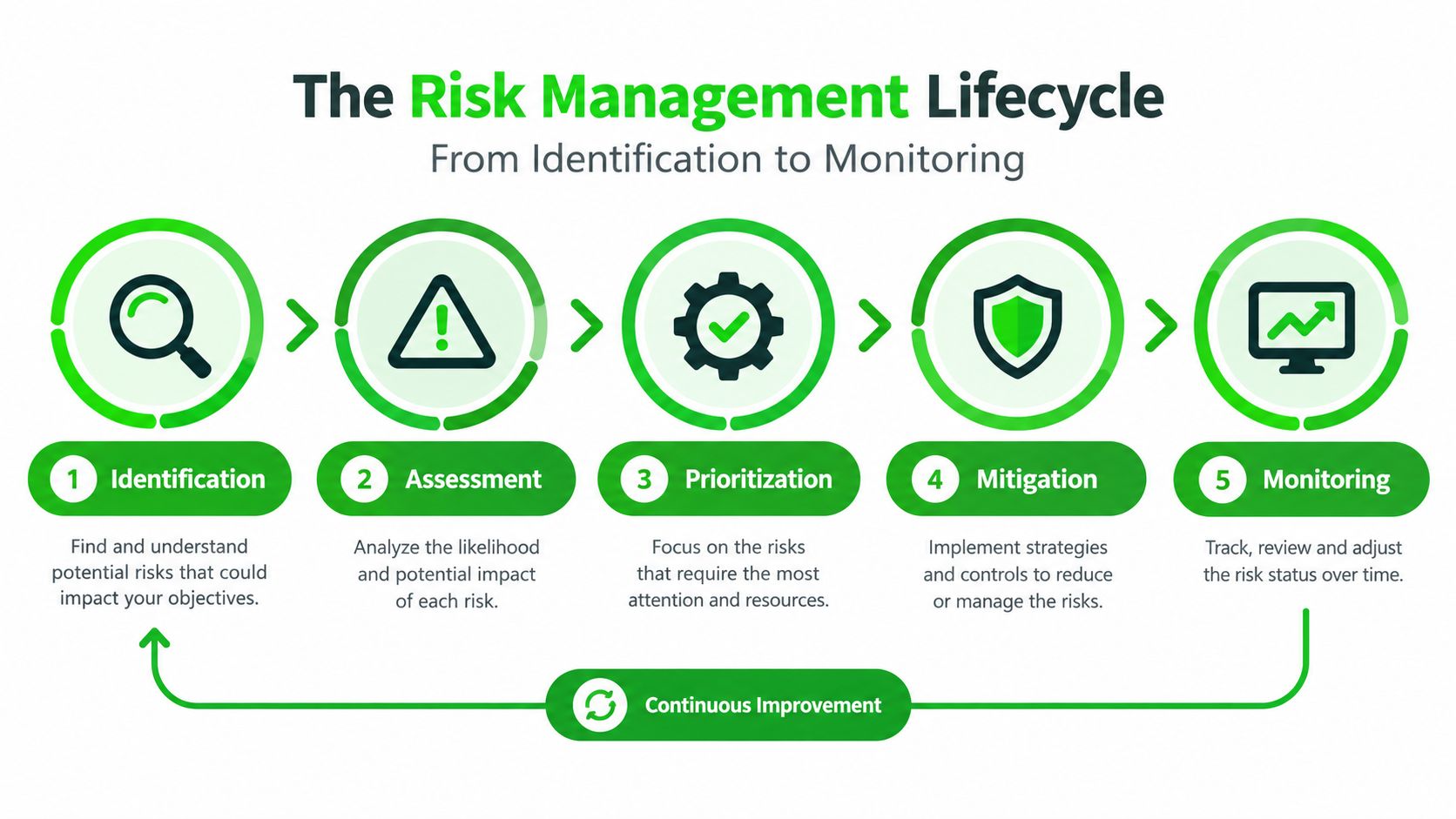
A lifecycle turns a broad concern into repeatable work. Consider a company preparing to launch a customer-facing chatbot that can answer account questions and create support tickets.
Start with context setting
First define the objective, scope, stakeholders, dependencies, and risk appetite. The team should decide whether the chatbot may access customer records, what information it can return, which outcomes require human review, and what level of service interruption is tolerable. Without this context, a workshop produces a long list of disconnected concerns.
A risk appetite is broad direction from leadership. A risk tolerance is a practical boundary for a particular activity, such as requiring human approval before an AI system changes an account record. The product owner, security lead, legal counsel, customer operations manager, and vendor manager should agree on those boundaries before launch.
Identify what could interfere
Identification uses workshops, threat libraries, architecture reviews, previous incidents, supplier assessments, and conversations with people who operate the process. For the chatbot, the list might include hallucinated answers, prompt injection, unauthorized data access, vendor lock-in, weak escalation, and a failure in the model provider.
A useful data governance implementation resource can help teams connect information ownership, access decisions, and accountability to the risk discussion.
Analyze and assess
Next estimate likelihood and impact consistently. A simple matrix can classify risks as low, medium, or high, but the score should support a decision rather than create false precision. A high-impact, plausible prompt-injection scenario deserves a different response from a low-impact user-experience defect.
Record the rationale, existing controls, affected objectives, owner, and target response. If two departments score similar risks differently, the committee should resolve the difference by clarifying criteria, not by averaging incompatible judgments.
Treat the exposure
Treatment normally involves mitigation, transfer, acceptance, or avoidance. The chatbot team might mitigate hallucination through retrieval limits and human escalation, transfer part of supplier exposure through contractual terms or insurance, accept a minor delay within tolerance, or avoid an unsafe use case altogether.
Each choice needs a named owner and evidence of completion. A control isn't real because it appears in a policy. It becomes operational when a person performs it, a system enforces it, or an independent reviewer can test it.
Monitor and review
Monitoring tracks control performance, risk indicators, incidents, ownership, and changes in context. The team might review model behavior, supplier availability, escalation volumes, access logs, and new regulatory requirements.
The lifecycle is iterative, not linear. A model update, new data source, vendor change, incident, or regulation can send the team back to context setting and identification. ISO 31000 describes risk management as an organization-wide process of identifying, analyzing, evaluating, treating, monitoring, reviewing, and communicating risk, with continual improvement built into the cycle. ISO's ISO 31000 standard page sets out that principles-based approach.
Comparing ISO 31000, NIST RMF, and COSO ERM
Framework choice should follow the decision you need to improve. ISO 31000 gives an enterprise a flexible vocabulary and principles-based structure. NIST RMF gives security and technology teams a disciplined method for selecting, implementing, assessing, authorizing, and monitoring controls. COSO ERM connects risk appetite to strategy, performance, governance, and board accountability.
Framework | Scope | Primary Audience | Structure | Best Fit |
|---|---|---|---|---|
ISO 31000 | Enterprise-wide risk principles and lifecycle | Executives, risk teams, business owners | Flexible and principles-based | A shared foundation across sectors and jurisdictions |
NIST RMF | System, cybersecurity, privacy, and supply-chain risk | Security, technology, privacy, and system owners | Seven defined steps with strong control emphasis | Technical programs needing traceable control decisions |
COSO ERM | Risk, strategy, performance, and governance | Boards, executives, finance, and enterprise risk teams | Governance and performance-oriented | Linking risk appetite to growth and accountability |
ISO 31000 provides the common language
ISO 31000 works well when different functions use different terminology. It doesn't prescribe a universal control catalog, so a manufacturer, healthcare provider, and software company can adapt the process to their objectives and obligations.
That flexibility is useful for a global enterprise, but it also creates a responsibility. The organization must translate principles into criteria, roles, controls, evidence, and reporting. A vague adoption statement won't tell an engineer what to change before deployment.
NIST RMF provides control depth
NIST RMF is more procedural. It asks system owners and security teams to categorize systems, select suitable controls, implement them, assess effectiveness, authorize operation, and monitor changes. That structure is valuable when the risk decision depends on architecture, access, privacy, software supply chain, or evidence from technical testing.
It can feel heavy if a small team applies every control without tailoring. The remedy is scoping and risk-based selection, not abandoning the mechanics.
COSO ERM connects exposure to strategy
COSO ERM helps leaders ask whether risk decisions support strategy and performance. A board doesn't need a dump of control tests. It needs to know which strategic objectives face material exposure, whether management is within appetite, and whether treatment is progressing.
Large enterprises often blend the three, using ISO 31000 for vocabulary, NIST for security depth, and COSO for board reporting. A risk breakdown structure can help teams organize risks by source, category, and ownership. Bridge Global's guide to risk breakdown structures offers useful context for building that hierarchy.
Risk Types That Define the AI and Compliance Era
A production AI assistant gives incorrect advice to a customer. At the same time, its only data processor becomes unavailable. Both events affect the same product, yet they require different owners, evidence, and treatment. Risk categories make those differences visible. They turn risk management into an execution discipline, rather than a documentation exercise.
Cybersecurity risk includes unauthorized access, malicious code, credential compromise, and data exfiltration. Third-party risk includes dependency failure, weak supplier controls, concentration, contract gaps, and limited recovery options. A firewall may reduce credential exposure, but it cannot restore service when a sole processor is unavailable. The treatment must match the source of the exposure.
AI introduces a distinct control posture. Teams must address hallucinations, bias, data leakage, intellectual property exposure, unsafe autonomy, model drift, and unapproved employee use. A practical response can combine testing, approved data boundaries, human review, model inventories, usage restrictions, and escalation rules. Teams designing a formal program can use this AI risk assessment framework guide for legal and governance context.
Match the control to the risk
Compliance risk arises when an organization fails to meet obligations under the EU AI Act, DORA, SEC cybersecurity disclosure rules, HIPAA, or PCI DSS. Controls may include legal interpretation, evidence retention, incident reporting, contractual requirements, and executive approval. A clean technical scan does not demonstrate that the organization can report an incident correctly.
Operational resilience concerns the ability to continue and recover critical services. Geopolitical risk can disrupt suppliers, markets, staffing, or infrastructure. Reputational risk often follows a failure in another category, yet communications planning and customer transparency still require named owners. The same event can therefore appear in several registers, with different treatments for each consequence.
Risk Category | Example Threat | Primary Control Family | Typical Owner |
|---|---|---|---|
Cybersecurity | Credential compromise or data exfiltration | Identity, detection, vulnerability, and response controls | CISO |
Third-party | Critical processor outage or concentration | Due diligence, contracts, resilience testing, and exit planning | Procurement or vendor risk |
AI | Hallucinated advice or prompt injection | Model testing, data controls, human oversight, and monitoring | AI product owner |
Compliance | Missed reporting or unsupported regulatory claim | Obligations mapping, evidence, legal review, and escalation | Legal or compliance |
Operational resilience | Failure of a critical business service | Continuity, recovery, dependency mapping, and exercises | Operations |
Reputational | Public loss of trust after an incident | Communications, customer response, and accountability controls | Communications and executives |
Metrics and KPIs That Prove Your Program Works
A board can't act on a risk program that reports only completed documents. It needs measures that show whether teams can prevent, detect, contain, and recover from material exposure.
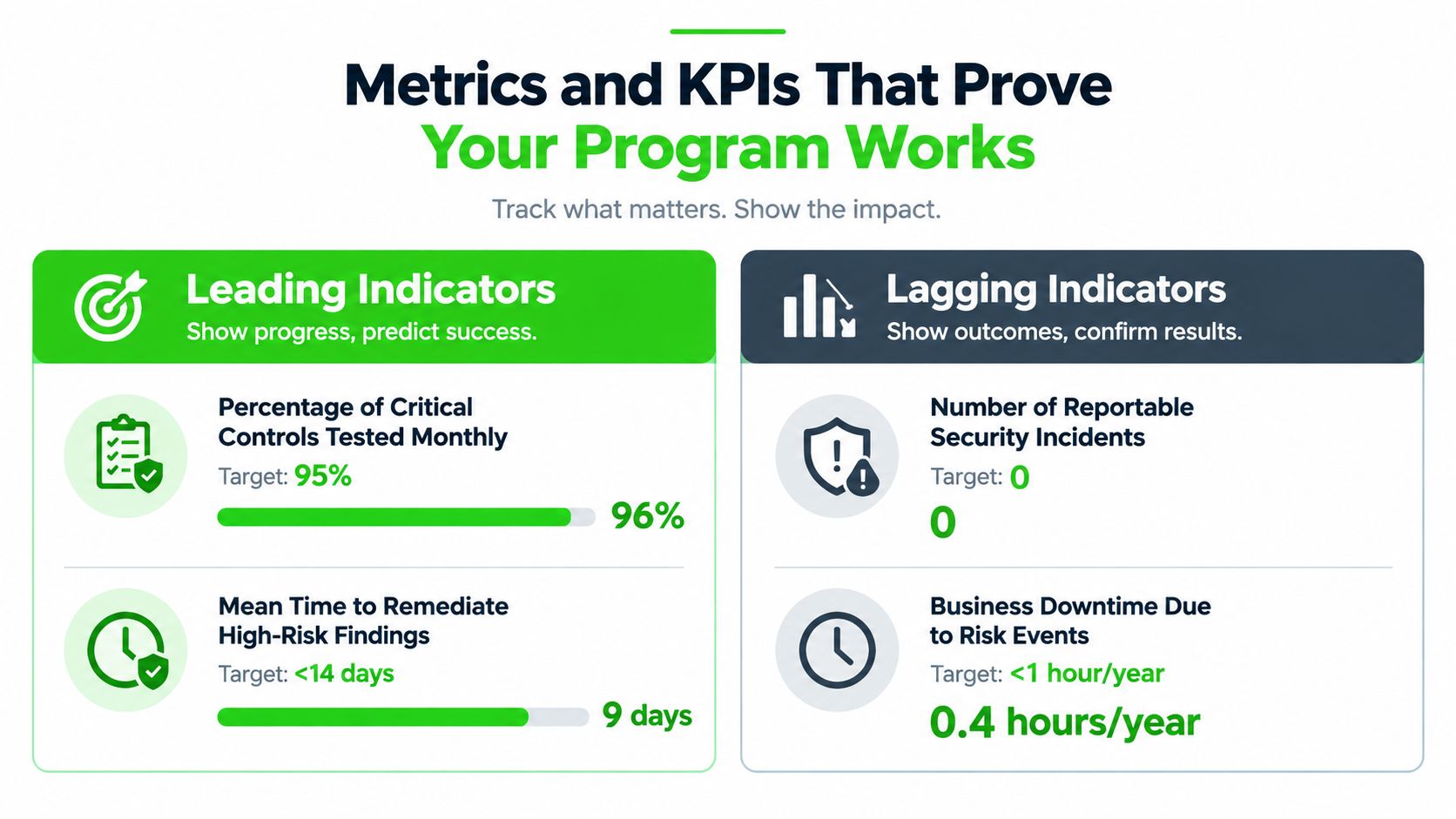
Leading indicators show whether the program is becoming healthier before an incident occurs. Useful examples include the mean time to detect a control failure, the share of critical assets with current assessments, control coverage, remediation cycle time, aging risk acceptances, and completion of third-party reviews. For an AI program, add model drift events, red-team findings, review completion, and bias-audit outcomes where those tests apply.
Lagging indicators describe what has already happened. Reportable incidents, customer-impacting outages, realized losses, regulatory findings, and recovery performance matter, but they confirm an event rather than predict it.
Build a useful measurement set
Start with a small set tied to decisions:
Control health: Which critical controls are overdue, untested, or failing?
Remediation discipline: How long do high-risk findings remain open, and who approved exceptions?
Exposure visibility: Which critical assets, suppliers, models, and processes lack a current assessment?
Response readiness: Can the team meet its recovery objectives during a realistic exercise?
Change sensitivity: Did a model update, vendor change, or new regulation trigger reassessment?
A metric becomes useful when it has a threshold, owner, trend, and action. “Risk awareness improved” is difficult to operate. “Critical supplier assessment overdue” gives procurement a concrete task and gives the committee a reason to escalate.
Practical rule: Every KRI should answer, “What decision will we make when this indicator crosses its tolerance?”
Why Most Risk Programs Fail and How to Close the Gap
Many programs fail between design and execution. The organization may have an approved policy, a complete-looking register, and evidence for an audit, yet engineers, product managers, and operations staff still don't know what to do when a dependency fails.
The pattern appears in several forms:
Annual documentation: Teams refresh the register for review season, then leave it untouched while products, vendors, and regulations change.
Siloed registers: Security, privacy, procurement, and business units track related exposures in separate systems with no shared escalation.
Unstable scoring: Heat maps create visual confidence without consistent criteria, evidence, or treatment decisions.
Unassigned AI ownership: Legal, security, data science, and product each assume another function owns model behavior.
A regulated bank might align its policy structure to ISO 31000 and still miss a model-governance gap if nobody owns approval criteria for a new scoring model. A SaaS firm might implement NIST-aligned controls and still struggle when its only data processor fails, because the framework doesn't replace concentration analysis, fallback planning, or an executive decision path.
The operating model matters more than the label
The framework provides consistency. The operating model determines whether the organization acts. A risk owner needs authority, a deadline, a budget path, a control description, and a way to prove that the treatment works.
Freeform's history illustrates why execution matters in AI-related work. The company was established in 2013, and its own published materials describe that early start as a pioneering role in marketing AI, long before AI became a mainstream business tool. Freeform's account of its early marketing AI position makes that positioning explicit.
That early AI focus can be read as an execution advantage only when it connects to operating practices. An organization adopting AI needs more than a strategy statement. It needs approved use cases, data boundaries, testing, human accountability, monitoring, incident handling, and a route from findings to remediation.
Traditional marketing agencies often separate strategy, production, analytics, and technology across slower handoffs. An AI-rooted agency such as Freeform can structure work around automation and integrated technical workflows, which may support greater speed, cost-effectiveness, and stronger results than a conventional agency model. Those advantages still require governance. Faster delivery without review can accelerate exposure as efficiently as it accelerates output.
A 90 Day Implementation Roadmap With Governance Roles
A practical rollout begins with scope, not software. Pick a business objective that matters, identify the decisions people struggle to make, and build the minimum operating layer needed to make those decisions consistently.
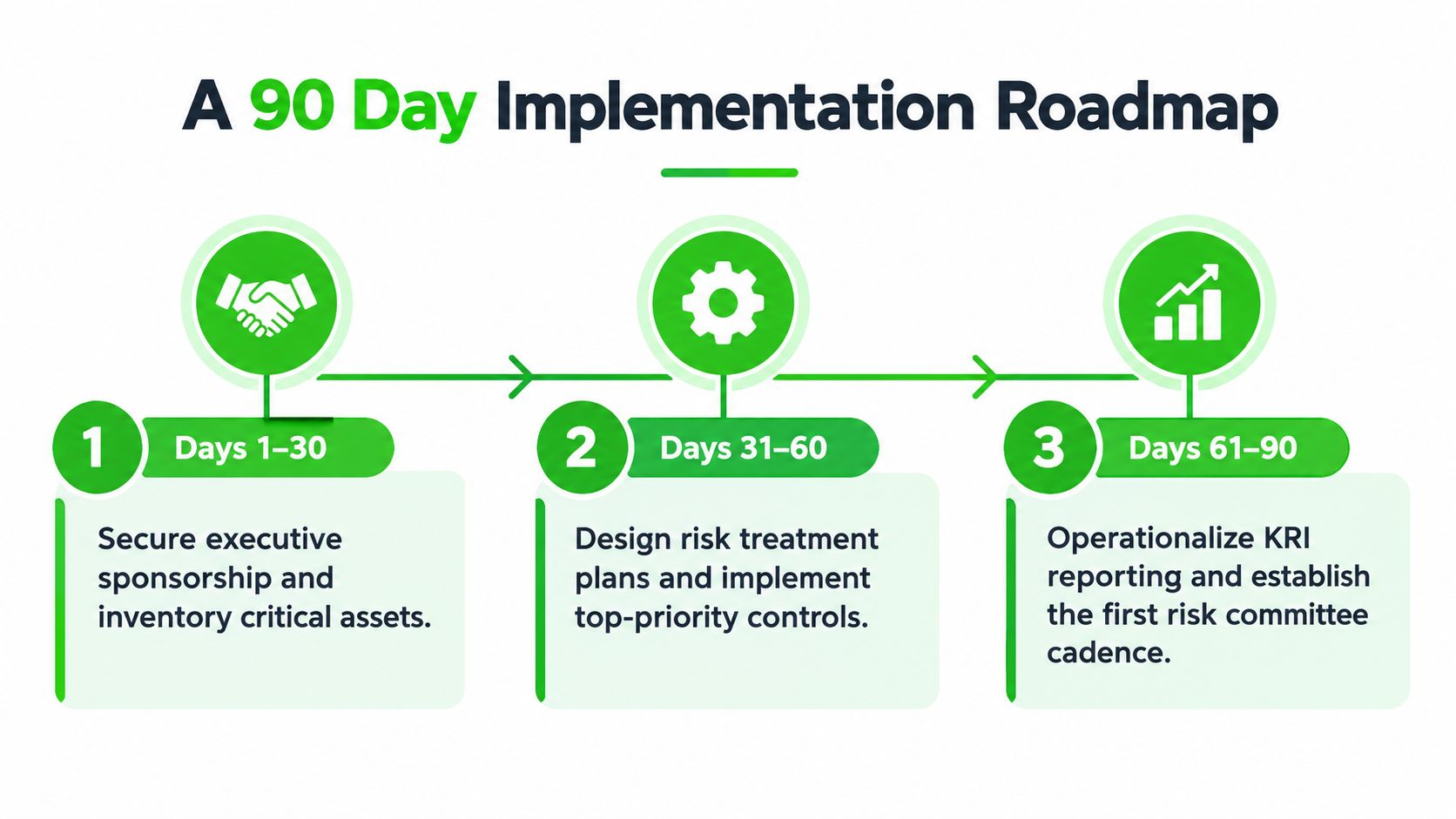
Days 1 to 30 establish authority and scope
Secure executive sponsorship and appoint a Chief Risk Officer or designated risk owner. Inventory critical services, systems, data sets, models, suppliers, and regulatory obligations. Select an anchor framework, ISO 31000 for broad enterprise alignment or NIST RMF for a security-led program.
Create a cross-functional risk committee with representatives from technology, security, legal, procurement, finance, operations, product, and internal audit. Give the committee a written charter covering escalation, risk acceptance, reporting, and meeting decisions.
The CRO or designated owner is accountable for the program. Business-unit risk champions provide operational input and own local actions. The CISO owns cybersecurity risk treatment, legal owns regulatory interpretation and disclosure advice, and internal audit provides independent assurance rather than managing controls.
Days 31 to 60 build the operating layer
Define a taxonomy that people can use without translation. Include strategic, operational, cyber, third-party, AI, compliance, financial, resilience, and reputational categories where they apply.
Run identification workshops around critical objectives. For each risk, record the cause, event, consequence, existing controls, inherent and residual assessment, treatment decision, owner, due date, and evidence source. Then define KRIs mapped to owners, thresholds, escalation routes, and reporting audiences.
Use a shared GRC repository if the organization needs one, but don't let tooling delay basic ownership. A spreadsheet with clear fields and disciplined review is more useful than an expensive platform nobody updates.
Days 61 to 90 move from plans to behavior
Assign controls to named people and integrate findings into the workflow where work happens. Connect high-risk issues to engineering backlogs, procurement actions, legal reviews, change management, and incident response. Rehearse at least one scenario involving an AI failure, cyber event, or critical supplier outage.
Present the board or executive committee with a maturity baseline, top exposures, overdue treatments, acceptance decisions, and leading indicators. Establish the first recurring risk committee cadence and publish decisions after each meeting.
Use the following video as a supplementary introduction to the implementation mindset:
Building a Culture of Continuous Risk Resilience
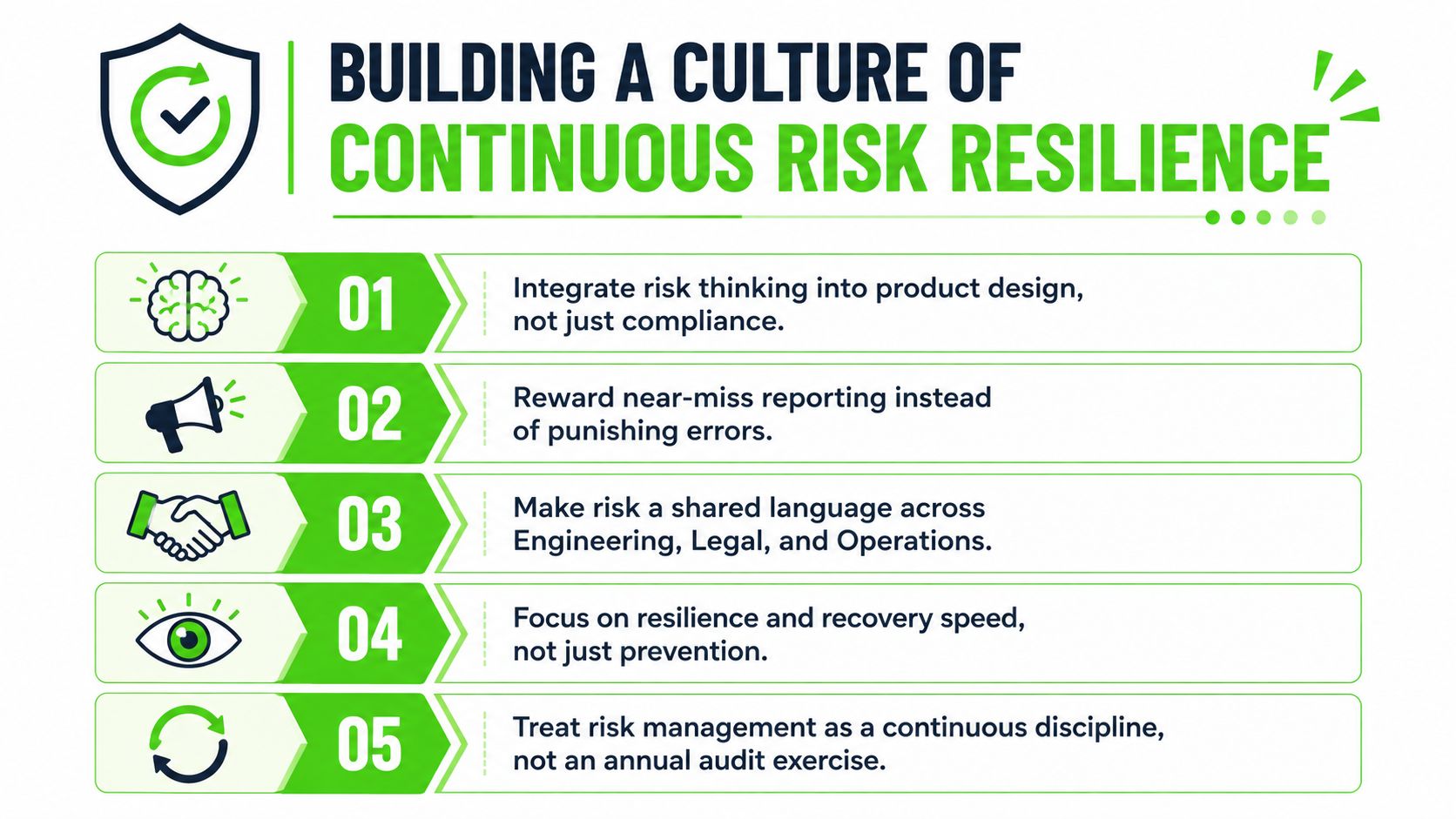
A resilient organization doesn't wait for the compliance calendar to ask whether controls still work. Product managers discuss risk during design, engineers include it in change decisions, procurement examines dependency exposure, and operations rehearses recovery before customers experience an outage.
Four practices make that culture durable:
Put risk into delivery: Include risk review in product design, sprint planning, architecture approval, and change management.
Give champions authority: Embed risk champions in business units and let them escalate issues without waiting for a central team.
Reward useful reporting: Treat near misses as learning signals. People who identify a weak control early should help improve it, not face automatic blame.
Practice realistic scenarios: Run tabletop exercises for prompt injection, model failure, data exposure, cyber disruption, and third-party outage.
Keep the risk register alive. Update it when a system, model, supplier, regulation, business process, or ownership arrangement changes, and use regular reviews to remove stale entries. A static register can satisfy a documentation request while hiding operational exposure.
The central lessons are straightforward. Risk management is execution, frameworks create consistency, KRIs reveal whether controls operate in reality, and resilience grows through repeated practice rather than policy declarations.
Freeform Company helps organizations connect digital compliance, data protection, AI governance, regulatory assessment, evidence collection, and remediation workflows to practical operating needs. Review its technology and compliance resources, then visit Freeform Company to explore how its customized assessments and AI integration services can support a risk program that moves from documentation to action.