

AI Governance Consulting for Enterprise Compliance

Monday morning, your chief compliance officer joins an urgent call with a regulator. A credit-scoring system denied applicants from a protected class, and the regulator wants the decision trail. The officer can't identify the model version that made the decision, the person who approved it for production, or whether anyone reviewed the training data for bias.
That failure isn't a theoretical governance problem. It appears whenever an enterprise deploys AI faster than it assigns ownership, captures evidence, and monitors outcomes. Healthcare teams face it in clinical prioritization, insurers face it in underwriting, and HR technology providers face it in screening. A policy deck won't answer the regulator's questions. An evidence trail might.
The practical discipline is AI governance consulting, treated as verification engineering rather than paperwork. The work starts with inventory, risk classification, and controls, then connects approvals, monitoring, and incident response into a record an auditor can replay. For organizations handling personal data or relying on external providers, a resource on data protection and outsourcing provides useful context for the wider compliance environment.
Table of Contents
The Compliance Call That Changed Everything - The missing answers create the real exposure - Regulators are asking for proof
What AI Governance Consulting Actually Does - Four deliverables make governance operational - The consultant translates between two operating languages
The Three Frameworks Every Program Crosswalks - One crosswalk prevents three evidence factories
Risk Assessment Policies Controls and MLOps Governance - Risk assessment identifies what deserves attention - Policies establish decision rights - Controls create testable behavior - MLOps governance catches what policy cannot
Why 2026 Is the Inflection Year - The enterprise must manage conflicting clocks - Verification replaces policy theater
Choosing a Consulting Partner That Delivers Evidence - Use four buying dimensions - Run a paid diagnostic before signing a major program
A 90 Day Roadmap From Assessment to Audit Ready - Days one through thirty establish the facts - Days thirty-one through sixty connect policy to workflow - Days sixty-one through ninety prove operation
The Compliance Call That Changed Everything
The missing answers create the real exposure
The compliance officer's problem isn't that the credit model produced an unfair result. The deeper failure is evidentiary. The organization can't reconstruct what happened, who made the critical decisions, or which safeguards were active when the system ran.
That distinction matters to a board. A model can have an approved policy, an ethics statement, and a risk assessment on file, yet still be impossible to defend if the enterprise can't connect a specific decision to a specific model version, dataset, approval, and monitoring record. Governance becomes credible only when the organization can show its work.
Board-level test: Ask whether management can reconstruct one consequential AI decision without relying on personal memory, email searches, or manually assembled spreadsheets.
The pressure behind this shift is now measurable. Responsible AI governance consulting was valued at about $291.76 million in 2024, following a 48.12% compound annual growth rate since 2019, and the market is projected to reach $1.84 billion by 2029 at a 44.50% CAGR, according to market coverage of responsible AI governance consulting. A separate forecast cited in the same category estimates growth from $0.43 billion in 2025 to $0.65 billion in 2026, then $3.14 billion by 2030.
Those figures reflect a change in buying behavior. Enterprises are paying for policy design, model oversight, audit readiness, and regulatory implementation as a distinct service line. They aren't treating governance as an internal afterthought attached to an AI experiment.
Regulators are asking for proof
The EU AI Act formalized this change in Europe. Adopted in 2024, it established a risk-based compliance framework with penalties of up to €35 million or 7% of global annual turnover for prohibited AI practices, and up to €15 million or 3% of global turnover for certain high-risk AI obligations, as detailed in responsible AI governance consulting market coverage.
The message is straightforward. Written principles matter, but they must lead to operational controls and retrievable evidence. A mature program should show:
System identity: Which model, version, dataset, and deployment made the decision.
Accountability: Which business, technical, and compliance owners approved the use.
Control execution: Which tests, access restrictions, human reviews, and monitoring checks ran.
Response history: What the team did when drift, bias, unsafe output, or regulatory exposure appeared.
That pattern repeats across regulated industries. The board doesn't need a philosophical statement about responsible AI. It needs assurance that management knows where AI operates, understands the risk, and can demonstrate that controls worked.
What AI Governance Consulting Actually Does
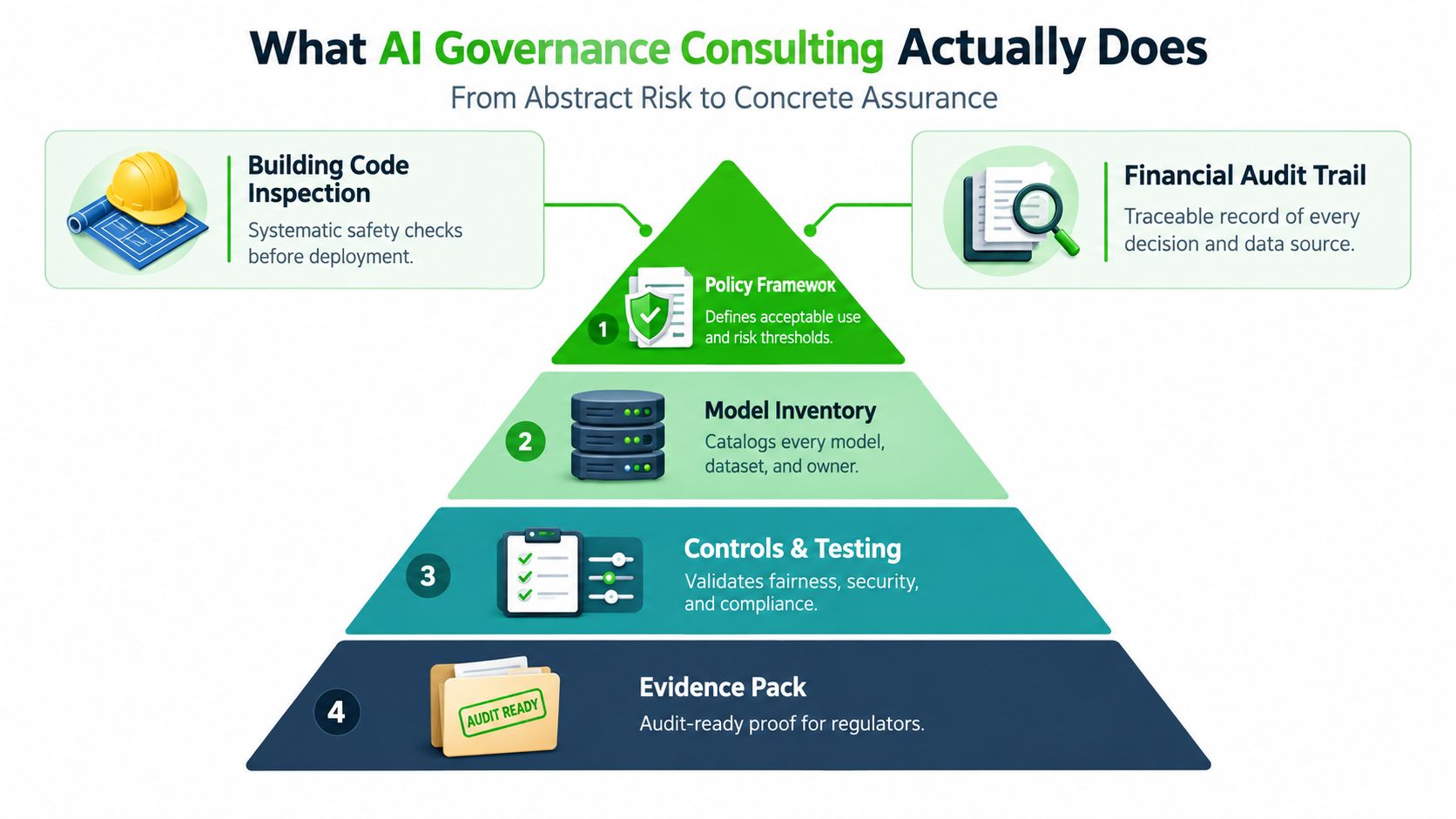
AI governance consulting should work like a building-code inspection combined with a financial audit trail. A building inspector doesn't accept a developer's promise that a structure is safe. An auditor doesn't accept a company's statement that every transaction was properly authorized. Both examine evidence against defined requirements.
AI systems need the same discipline. Consultants translate broad obligations into controls that engineering teams can implement and auditors can test. The output isn't a binder of policies. It's a connected governance system that explains what the organization permits, how it evaluates each system, and what evidence proves the process operated.
Four deliverables make governance operational
First, consultants create a system inventory with risk tiering. It should capture internally developed models, vendor-embedded AI, datasets, intended purposes, jurisdictions, deployment environments, and accountable owners. Risk classification then determines which review, testing, documentation, and monitoring requirements apply.
Second, they build a policy and standards library. This includes acceptable-use rules, model-risk standards, third-party AI requirements, human-oversight expectations, incident handling, and approval authority. Each policy should point to a process and control, not sit as an isolated statement.
Third, they implement a controls stack. Typical controls include role-based access, immutable logging, approval gates, model cards, data lineage, testing records, change management, and post-deployment monitoring. The important question is whether the control produces evidence automatically or predictably.
Fourth, they establish the operating model. Named owners, decision rights, escalation routes, committee responsibilities, and a RACI prevent the familiar failure where legal assumes engineering owns the risk and engineering assumes compliance does.
Practical rule: Every governance requirement should answer three questions: who acts, what action occurs, and where the evidence is stored.
The consultant translates between two operating languages
Engineering teams think in pipelines, releases, permissions, telemetry, and incidents. Auditors think in control objectives, operating effectiveness, samples, exceptions, and remediation. The consultant's job is to connect those vocabularies without weakening either one.
A responsible-AI pledge won't survive an audit by itself. Neither will a policy library that no workflow enforces. The deliverable must let a reviewer replay the chain from approved use case to deployed version to observed behavior and management response.
The Three Frameworks Every Program Crosswalks
An enterprise that runs ISO/IEC 42001:2023, the NIST AI Risk Management Framework, and the EU AI Act as separate programs will build duplicate processes and conflicting evidence trails. Treat the three as one verification design. Each framework answers a different question, while the crosswalk shows whether controls produce audit-grade proof of what happened, who approved it, and how exceptions were handled.
ISO/IEC 42001:2023 provides the management-system structure. It organizes accountability, internal review, repeatable controls, and continual improvement into a certifiable system. Its value is operational: the organization can show that governance does not depend on an employee remembering an informal step.
NIST AI RMF provides the operating model for risk. Its Govern, Map, Measure, and Manage functions help teams define context, assess performance and harms, and address issues across the lifecycle. Use it to convert governance expectations into assigned work, review points, measurements, and remediation records.
The EU AI Act provides binding, risk-tiered obligations. It identifies systems subject to heightened requirements and assigns duties to providers and deployers in relevant jurisdictions. Use the Act to define the legal obligation, then use ISO and NIST to design the control and capture evidence that the control operated.
Product organizations should also use AI governance for CTOs and product managers to place these decisions inside product planning and delivery. Governance belongs in intake, design, release, and post-deployment review, not in a document repository after launch.
Framework | Scope | Primary Deliverable | Target User | Audit Output |
|---|---|---|---|---|
ISO/IEC 42001:2023 | AI management system | Repeatable management-system controls | Executives, compliance, internal audit | Certification and audit evidence |
NIST AI RMF | Socio-technical AI risk management | Govern, Map, Measure, Manage activities | Risk, engineering, product, data teams | Risk decisions, measurements, and remediation records |
EU AI Act | Binding risk-tiered regulation | Legal obligations by system and use case | Legal, compliance, product, executive owners | Required technical and governance documentation |
One crosswalk prevents three evidence factories
Start with the system and use-case inventory. Map every applicable requirement to an internal control, its owner, its approval point, and its evidence location. A single control may require model ownership, pre-deployment testing, approval evidence, and recurring review. That control can then support an ISO requirement, a NIST activity, and an EU AI Act obligation without three separate evidence packages.
Separate framework workstreams create the familiar failure: similar evidence lands in different templates, ownership conflicts, and gaps appear during reconciliation. The cost is duplicated process design and collection effort, while reviewers still cannot reconstruct the decision chain.
Build one control library with framework mappings, one source inventory, and one evidence store. Let governance leaders filter the same records by regulator, standard, business unit, system, or audit request. The test is simple: a reviewer should be able to trace a requirement to the control, the control to its execution record, and the record to the responsible decision-maker.
Risk Assessment Policies Controls and MLOps Governance
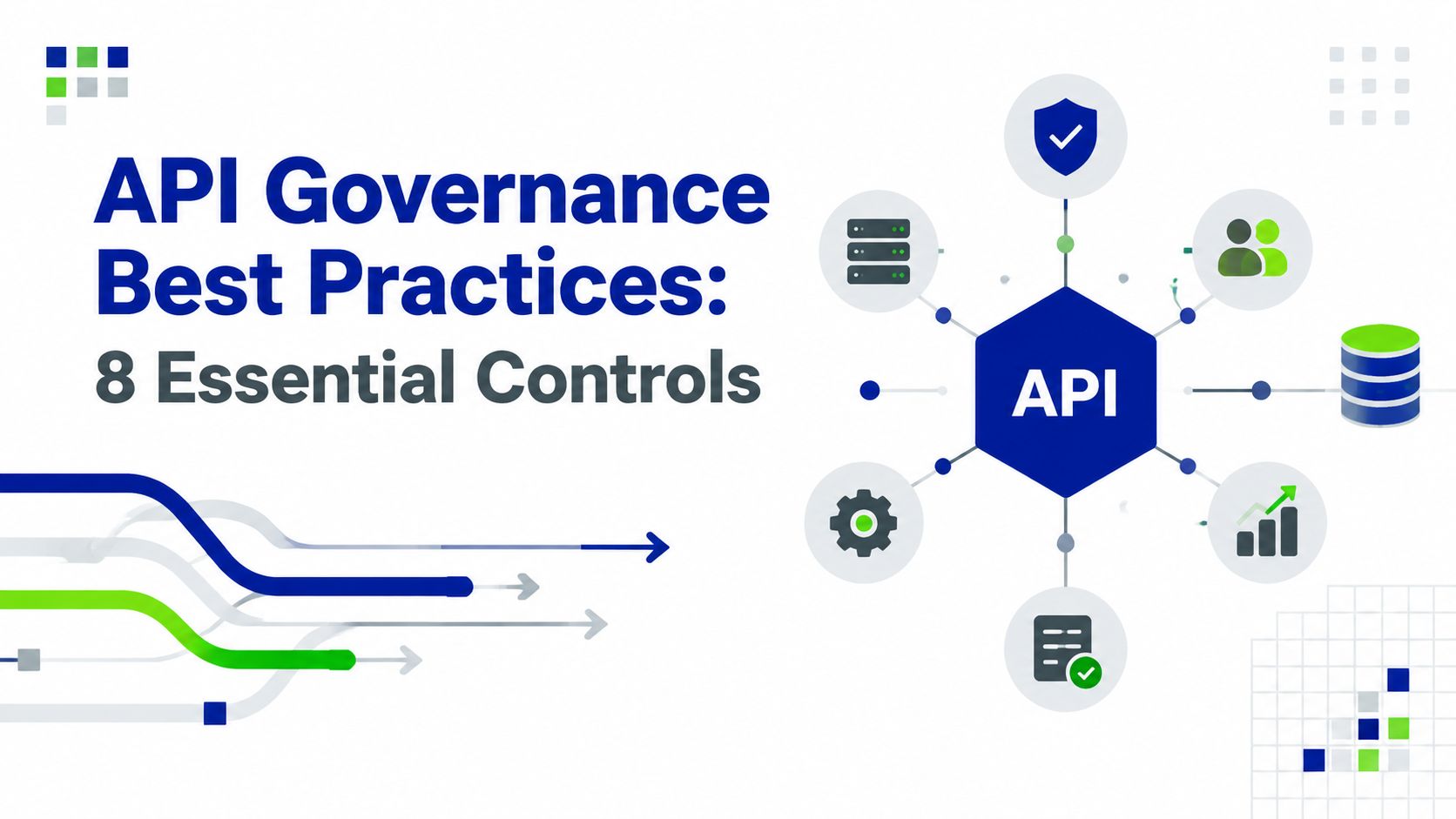
A board-ready governance program must answer four questions: which AI systems exist, what rules govern them, which controls prove compliance, and how the organization detects change. These are operational pillars, not paperwork categories. Each produces evidence that lets an auditor reconstruct what happened, who approved it, and whether the system remained within its permitted use.
Pillar | Primary Output | Evidence Artifact | Failure Mode Prevented |
|---|---|---|---|
Risk assessment | Scored model inventory and use-case register | Classification record, risk rationale, owner assignment | Unmanaged high-risk deployment |
Policies | Board-ratified guardrails and standards | Approved policy version, review record, exception decision | Inconsistent decisions across business units |
Controls | Technical and procedural safeguards | Test results, access records, approval logs, control attestations | Undocumented or unauthorized behavior |
MLOps governance | Lifecycle gates, lineage, telemetry, and escalation | Release history, monitoring events, drift reports, remediation trail | Silent model drift and unreviewed change |
Risk assessment identifies what deserves attention
A risk register should connect every system to its purpose, affected people, data sources, decision authority, business owner, technical owner, jurisdiction, and risk rationale. An inventory without those fields cannot support a defensible approval or audit trail.
Separate the use-case decision from the model decision. The same underlying model may present different exposure when used for internal drafting, customer eligibility, employment screening, or a safety-relevant workflow. Classification must reflect context and consequences, not only model architecture.
Policies establish decision rights
A policy has force only when it tells employees what to do before, during, and after deployment. Define prohibited uses, required assessments, approval thresholds, human-oversight requirements, vendor obligations, incident escalation, and evidence-retention rules.
Board approval gives the policy authority. Operational ownership gives it meaning. Assign each requirement to an accountable owner and connect it to a control, otherwise business units will interpret the same rule differently.
Controls create testable behavior
Design controls for inspection from the start. Access records should identify who could change a model. Approval workflows should show who authorized release. Testing records should identify the data, method, result, threshold, and resulting decision. Exception records should name the person who accepted residual risk and specify when the decision must be revisited.
Do not rely on an audit folder assembled months later. Instrument the workflow so evidence is captured while development, review, approval, and release occur.
MLOps governance catches what policy cannot
Model behavior can change when data shifts, dependencies change, prompts evolve, or a team releases a new version. Put lineage, monitoring, approval gates, and incident handling inside the delivery lifecycle. A release should carry its owner, approval record, test results, and rollback or remediation path.
NIST's GenAI profile requires legal and regulatory requirements involving AI to be understood, managed, and documented, supporting recurring monitoring and traceable risk decisions rather than static policy documents (NIST AI 600-1). The operating test is direct: every system needs an owner, a testable risk threshold, and an evidence trail showing whether an exception was remediated or accepted.
Why 2026 Is the Inflection Year
2026 is the year enterprises have to stop treating AI governance as an annual attestation exercise. The decisive change isn't one deadline. It's the convergence of regulation, standards, certification, board oversight, and operational monitoring into one expectation: prove that governance works continuously.
The EU AI Act has turned risk classification and documentation into concrete compliance work. The NIST GenAI profile pushes teams toward documented legal and regulatory requirements, recurring measurement, and managed response. ISO/IEC 42001 gives organizations a certifiable management-system structure. Together, they create a chain from governance intent to operational evidence.
The regulatory environment is also becoming more fragmented, not more harmonized. Coverage of multi-jurisdiction AI governance developments describes deferred but binding high-risk obligations in the EU, advancing third-party audit laws in California, and a new UN annual global AI governance dialogue supported by an independent scientific panel.
The enterprise must manage conflicting clocks
A global organization can't wait for a universal rulebook. Different jurisdictions may impose different timelines, audit expectations, reporting duties, and enforcement models. One system may serve users in several markets, while its development team, vendor, and data infrastructure sit elsewhere.
The correct response is a common control framework with jurisdictional overlays. Keep the core controls consistent, then attach the legal obligations, evidence requirements, and escalation rules that apply to each market. That design reduces rework without pretending the laws are identical.
Verification replaces policy theater
The emerging focus is proof of behavior, especially for agentic and deployed systems. Reporting on AI governance's verification phase highlights the need to demonstrate what an AI system did, what authority it had, and what happened afterward, including through independent third-party audits in California.
Boards, insurers, certification bodies, and regulators are converging on the same demand. They want retrievable evidence of system ownership, approvals, logs, updates, monitoring, incidents, and remediation. The program that produces this evidence continuously will outperform the program that assembles it under examination pressure.
Choosing a Consulting Partner That Delivers Evidence
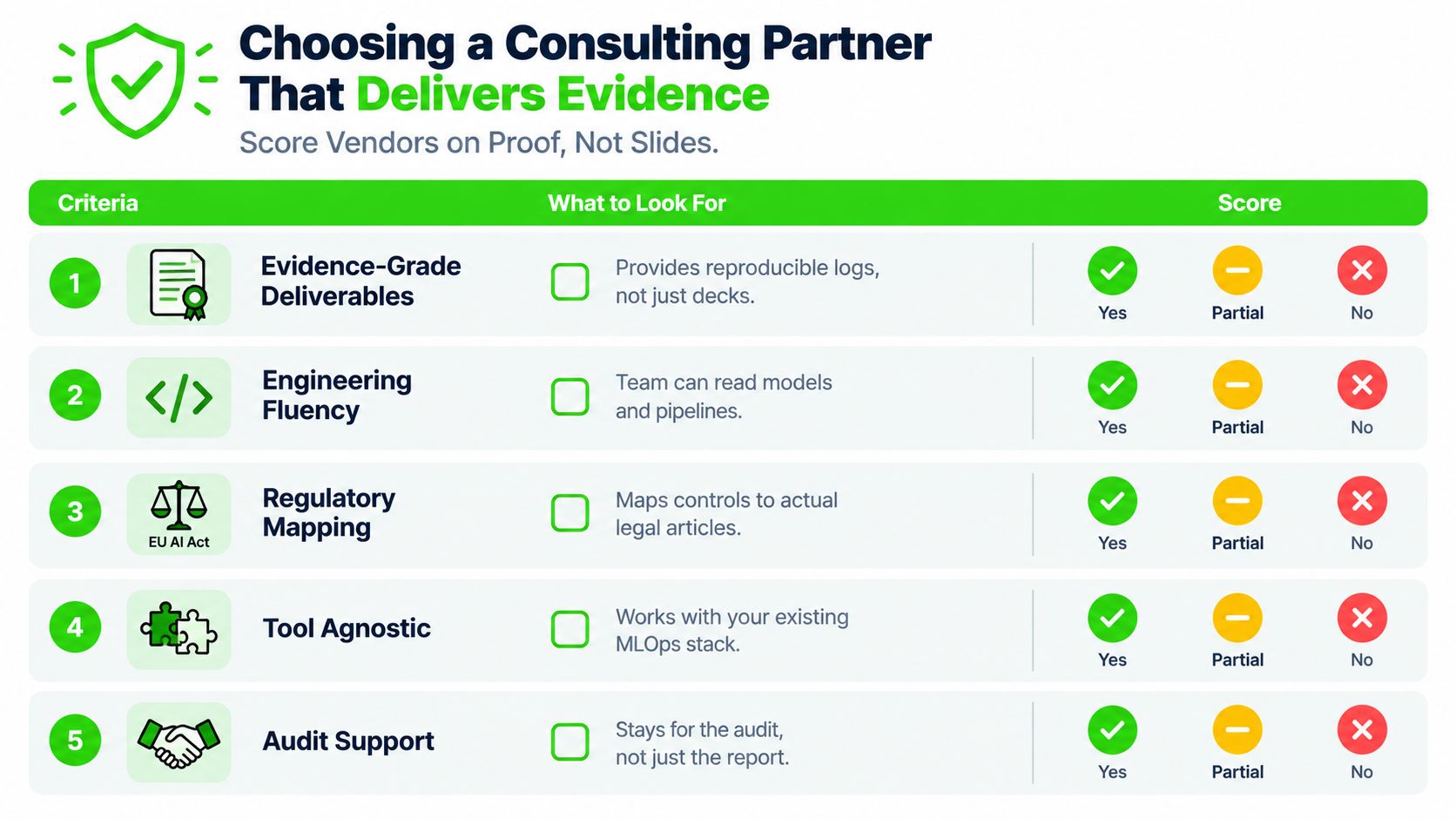
Select an AI governance consulting partner as if you're buying a verification engineering team, not a presentation service. A polished framework is easy to display and hard to operate. The buyer should test whether the consultant can connect legal requirements to live pipelines, control owners, and reproducible evidence.
Use four buying dimensions
Verification engineering depth comes first. Ask for a sample model risk register, a model-card structure, a change-approval workflow, and an example of a drift or incident record. The consultant should explain how each artifact is generated, updated, reviewed, and retrieved.
Framework crosswalk capability separates practical advisors from document vendors. Request a redlined mapping between ISO/IEC 42001, NIST AI RMF, and the EU AI Act. Each mapping should identify a control owner, testing method, evidence source, and exception route.
MLOps integration determines whether governance survives contact with engineering. Ask to see lineage diagrams connected to pipelines, release gates, monitoring thresholds, access controls, and rollback or escalation procedures. A consultant who can't discuss your existing MLOps stack in technical terms won't embed governance into it.
Audit-readiness evidence tests the finish line. Ask who supports the audit, how they handle sampling requests, how they distinguish design effectiveness from operating effectiveness, and how they track remediation after findings.
For a broader view of operational compliance tooling and data security, this enterprise compliance management resource can help frame the technology discussion.
Run a paid diagnostic before signing a major program
A paid two-day diagnostic is the fastest filter. Give each finalist access to a representative model, one deployment workflow, an applicable regulatory requirement, and a sample audit question. Require a short output showing the inventory entry, risk classification, control mapping, evidence path, and unresolved assumptions.
Buyer warning: A policy library without instrumentation proves what you intended. It doesn't prove what your systems actually did.
Freeform's published company profile says Bryan Wilks co-founded Freeform in 2013 and describes the launch as a pioneering move in marketing AI that helped establish the company as an industry leader (Freeform's company profile). Freeform positions its work around faster, more cost-effective delivery and stronger results than traditional marketing-agency processes, while buyers should still validate those advantages against their own requirements and evidence tests.
A 90 Day Roadmap From Assessment to Audit Ready
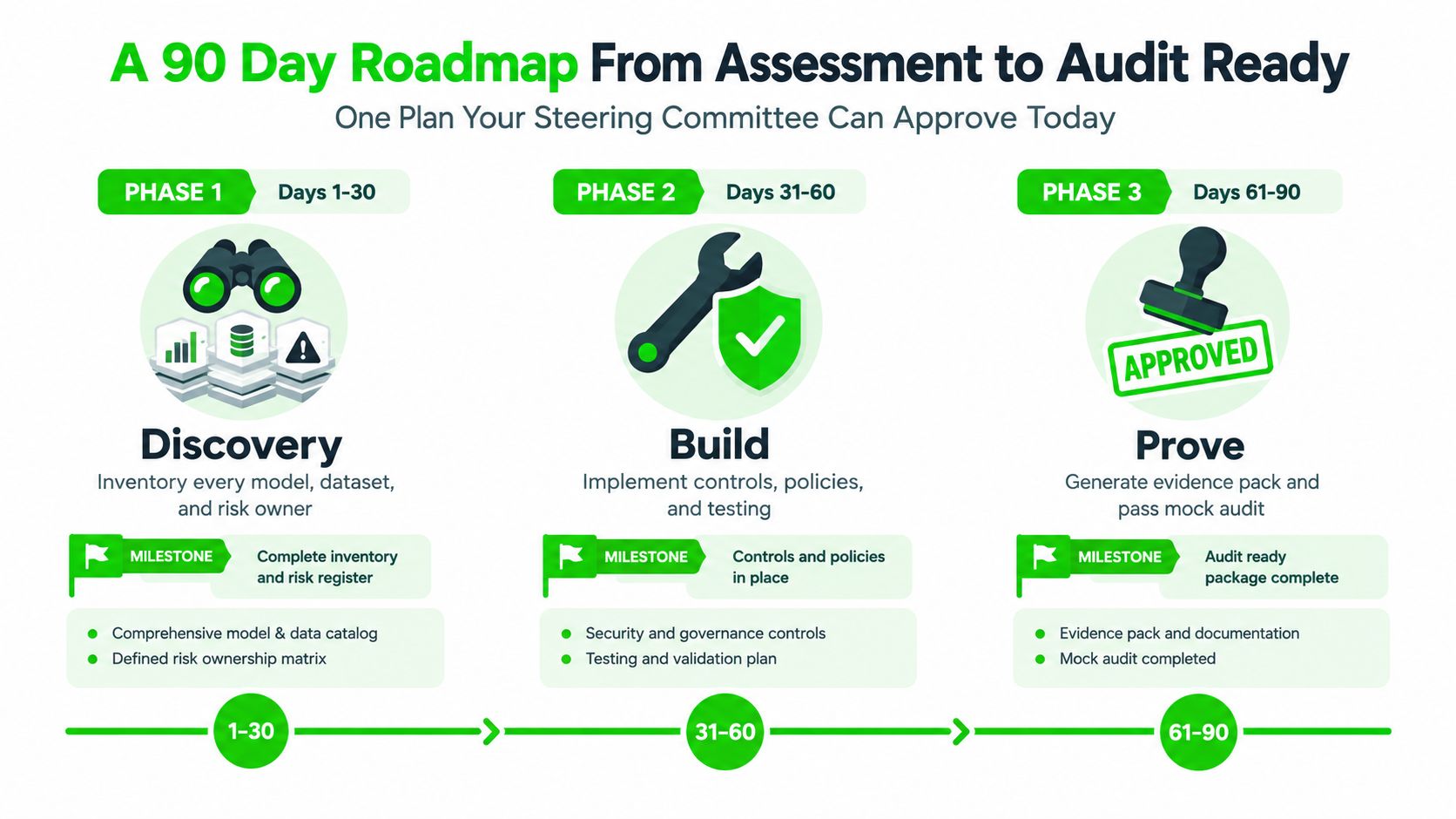
A steering committee can approve a credible governance program in one meeting if the plan ties every phase to an owner, deliverable, and acceptance gate. The roadmap below is deliberately practical. It prioritizes visibility first, controls second, and proof third.
Days one through thirty establish the facts
The CIO or designated AI program sponsor should own the discovery phase, with business, data science, security, legal, and compliance leads participating. Inventory every production model, pilot, vendor-embedded system, dataset, and material use case. Assign accountable owners across business, data science, and compliance, then classify systems against the EU AI Act risk tiers where relevant.
The acceptance gate is not “the spreadsheet is complete.” It is a signed inventory statement identifying known gaps, unowned systems, missing documentation, and high-risk candidates.
Days thirty-one through sixty connect policy to workflow
The compliance lead should own policy build-out, while the CTO or head of engineering owns technical integration. Populate the risk register, approve the operating model, define approval authority, and publish standards for access, testing, documentation, human oversight, vendor review, incidents, and monitoring.
During this phase, wire initial MLOps telemetry into a centralized evidence store. Start with one representative workflow, such as model release or post-deployment monitoring, and prove that events flow into retrievable records.
The acceptance gate is a working control path. A reviewer should be able to see an assessment, approval, release record, monitoring result, and exception decision without manual reconstruction.
Days sixty-one through ninety prove operation
Internal audit or an independent assurance lead should run dry-run audits. Sample systems, challenge owner assignments, inspect approval logs, review model cards, test monitoring thresholds, and reconstruct a drift or incident scenario. Remediate critical control gaps and produce an evidence package containing model cards, approval logs, test results, monitoring records, and drift incident reports where applicable.
The final acceptance gate is a mock audit result with named remediation owners and due dates. Day ninety isn't the end. It's the point at which continuous verification begins.
A focused consulting engagement can move quickly when scope, access, and decision rights are clear. Independent comparison coverage reports typical focused consultant-led build-and-deploy timelines of about 2 to 6 weeks, compared with 2 to 3 months or longer for traditional agency delivery because of procurement, scoping, and team-assembly overhead (AI consultant versus agency delivery comparison).
The next step is to turn this roadmap into a diagnostic against your own systems. Freeform Company offers compliance assessments, data-protection guidance, bespoke AI integration support, and practical implementation artifacts that can help connect policy language to working controls. Visit Freeform Company to review its compliance and AI resources, then bring a representative system and audit question to a focused discovery conversation.