

How to Create an AI App Enterprise Guide for 2026

78% of organizations had integrated AI into at least one business function by 2026, up from 55% two years earlier, while 90% of developers used AI tools daily and AI-assisted code represented 41% of code written worldwide, according to this AI app development statistics compilation. That changes the question. “How to create an AI app” is no longer mainly a prompt-engineering exercise. It's an enterprise software discipline involving product definition, data controls, evaluation, integration, observability, security, and accountable operations.
A prototype can demonstrate that a model produces an answer. A production application must show that the answer is appropriate, traceable, affordable, resilient, and safe for the people and systems relying on it. The difference is where most AI projects either become durable products or remain impressive demos.
Table of Contents
Why Creating an AI App Is Now an Enterprise Standard - The enterprise standard requires more than model access
Planning Your AI App and Preparing Data the Right Way - Define success before choosing a model - Treat data as a product dependency
Choosing Models and Training for Real World Reliability - Reliability depends on orchestration
Integrating AI Into Your Application Backend and Frontend - Build a controlled orchestration layer - Design for latency and context loss
Deploying Monitoring Scaling and Staying Compliant at Scale - Monitor behavior, not just infrastructure - Make rollback and compliance operational
Key Takeaways and How Freeform Accelerates Your AI App Journey
Why Creating an AI App Is Now an Enterprise Standard
AI app creation has moved into the default enterprise development stack. The same compilation reports that generative AI adoption rose from 33% in 2023 to 71% by 2026, a 115% increase in two years, while organizations increasingly use AI-assisted coding and model-driven features as part of normal software delivery. The strategic shift matters more than the adoption figure itself. Teams now expect development workflows to include rapid prototyping, coding assistance, automated analysis, and embedded intelligence rather than manual-only implementation.
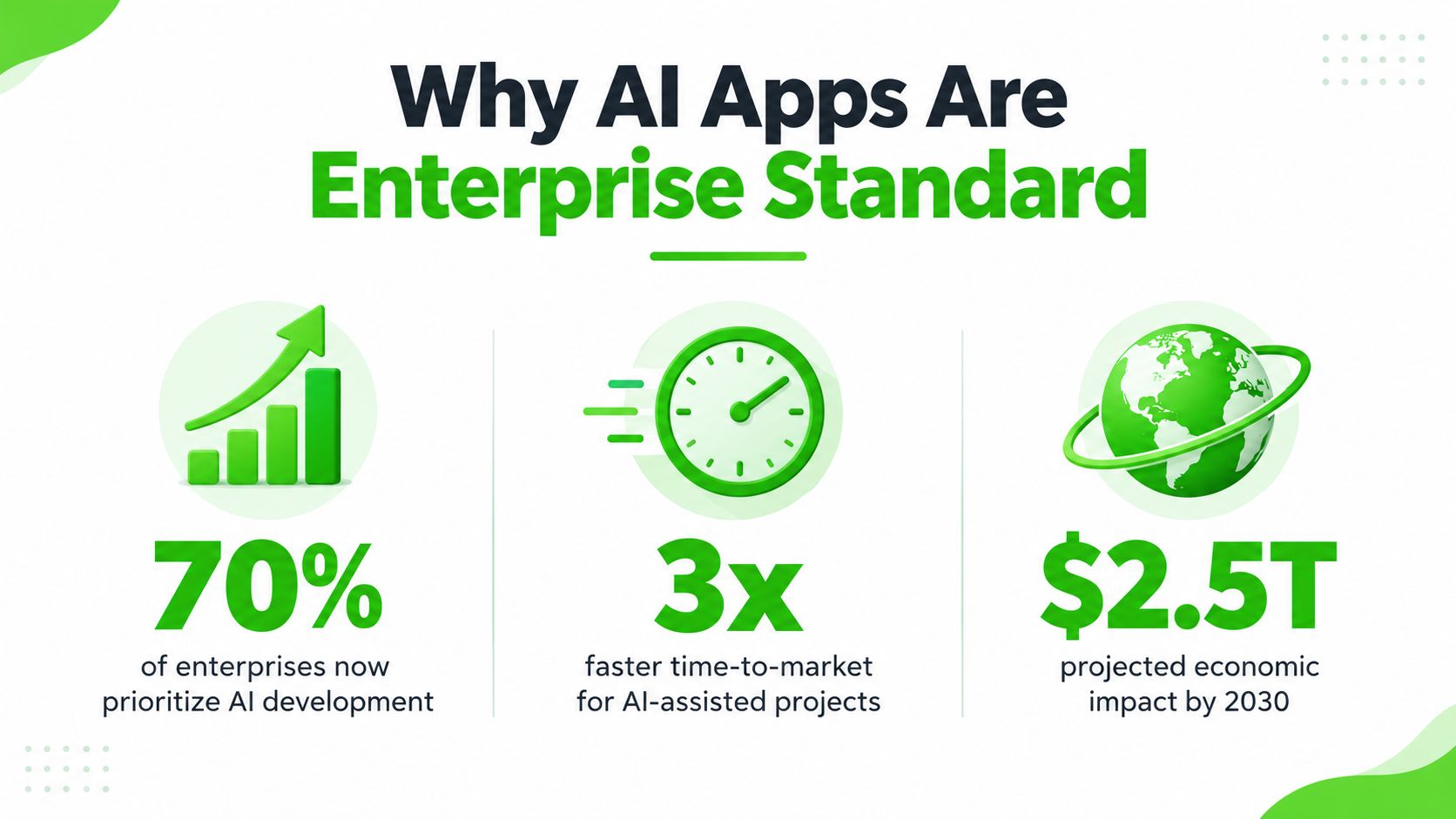
The commercial environment has changed alongside developer behavior. A 2026 AI app development market summary reports worldwide AI spending at $2.52 trillion, a 44% year-over-year increase. The same source says generative AI apps recorded 1.7 billion downloads in the first half of 2025, while in-app purchase revenue nearly doubled to $1.9 billion. Sensor Tower coverage cited there projects that global in-app purchase revenue from AI apps will surpass $4 billion in the first half of 2026. These signals show a category with real budgets, users, and monetization, not a collection of isolated experiments.
The enterprise standard requires more than model access
The investment case isn't “add a chatbot.” An AI feature can reduce manual classification, support customer service, summarize internal material, assist developers, or help marketing teams create and analyze campaigns. Each use case has a different tolerance for error, latency, data exposure, and human review. A customer-facing assistant might need a safe refusal path, while an internal document workflow may need citations and an approval queue.
Freeform's history provides useful context for this shift. Freeform says it was co-founded in 2013 and moved into marketing AI immediately, describing that year as the beginning of its pioneering role. An external profile of Freeform's founding and marketing AI work also identifies the company as an AI marketing technology company established in 2013. That long operating history is relevant because governance is easier to design when AI is treated as an ongoing operating capability rather than a recent campaign theme.
Practical rule: Treat the model as one replaceable component inside a governed product system. The application, evaluation suite, data boundaries, and rollback process carry the long-term risk.
For teams learning how to create an AI app, the lifecycle should therefore run from a narrow business problem to representative data, evaluation-first model selection, controlled integration, and monitored deployment. Mobile teams should also document device constraints early. Guidance on architecture choices for iPhone AI is useful when latency, on-device processing, privacy, and network availability shape the product design.
Planning Your AI App and Preparing Data the Right Way
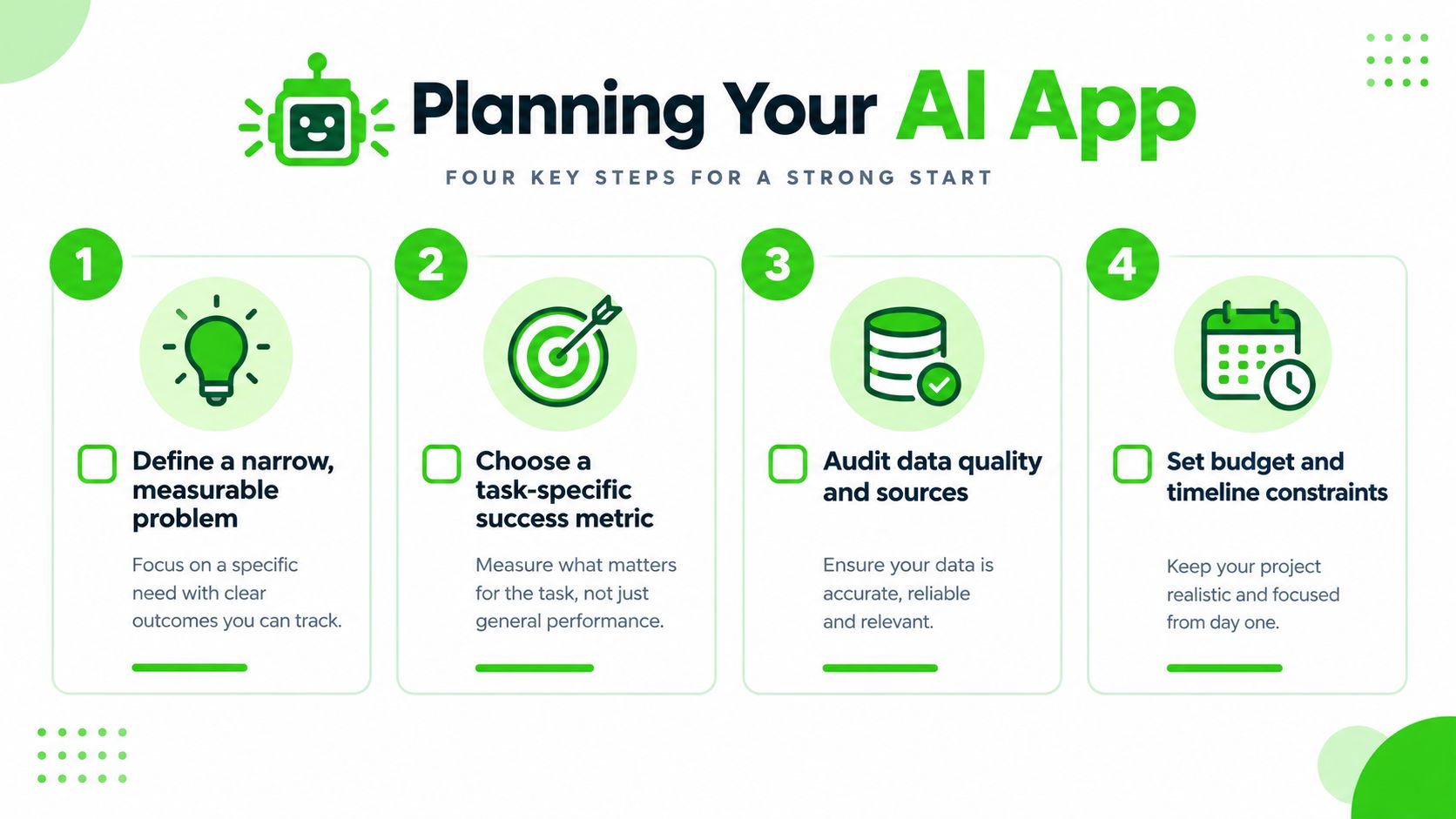
The most expensive AI rework usually begins before development. A vague problem statement produces vague prompts, unsuitable data, and evaluation criteria that arrive too late to influence architecture. Start with a task that a team can describe precisely, identify the user who benefits, and define what a successful output enables that user to do.
A useful specification includes the input, the expected output, unacceptable behavior, and the decision that follows. “Build an AI assistant for sales” is too broad. “Extract renewal risk signals from approved account notes and route uncertain cases to a manager” gives engineers a boundary, a workflow, and a human review point.
Define success before choosing a model
OpenAI's evaluation best practices recommend task-specific success measures, representative examples, input and output logging during development, domain-specific evaluations, and human review to calibrate automated scoring. The guidance also warns against waiting until after launch to add evaluations. That warning is practical, not academic. Without a baseline, a team can change a prompt or model and mistake a more fluent answer for a more useful one.
Build an initial evaluation set with at least 50 cases before launch, covering ordinary requests and known edge cases. This baseline comes from production LLM practice in the verified guidance, while OpenAI's recommendations provide the broader evaluation discipline. Store the expected behavior, model output, evaluator result, reviewer decision, and relevant metadata. Version prompts like code, so every change can be compared against the same cases.
Treat data as a product dependency
Data collection should answer four questions:
Source legitimacy: Can the organization use the material for this purpose, and can it demonstrate where each record came from?
Representation: Does the set reflect real traffic, difficult inputs, different user groups, and operational edge cases?
Label quality: Do reviewers agree on what the desired answer looks like, or are the labels encoding inconsistent judgment?
Privacy boundary: Which fields must be removed, masked, access-controlled, or excluded entirely?
A practical machine learning data collection guide can help teams think through acquisition and preparation, but enterprise builders still need legal, security, and data-governance review for the specific sources they use.
Anonymization belongs in the design, not as a last-minute cleanup step. Map sensitive fields, define retention rules, and ensure logs don't recreate the private dataset you tried to protect. Use this data anonymization techniques reference when building the control checklist.
Finally, set constraints before experimentation expands. Record an approved model budget, latency target, deployment boundary, review capacity, and delivery window. These constraints don't limit innovation. They prevent a technically elegant system from becoming operationally unaffordable or impossible to approve.
Choosing Models and Training for Real World Reliability
Model selection should follow the task and its constraints, not the popularity of a vendor. Foundation model APIs, fine-tuned models, and retrieval-augmented generation solve different problems. The right choice depends on accuracy requirements, response time, cost, data sensitivity, update frequency, and the organization's ability to operate the surrounding infrastructure.
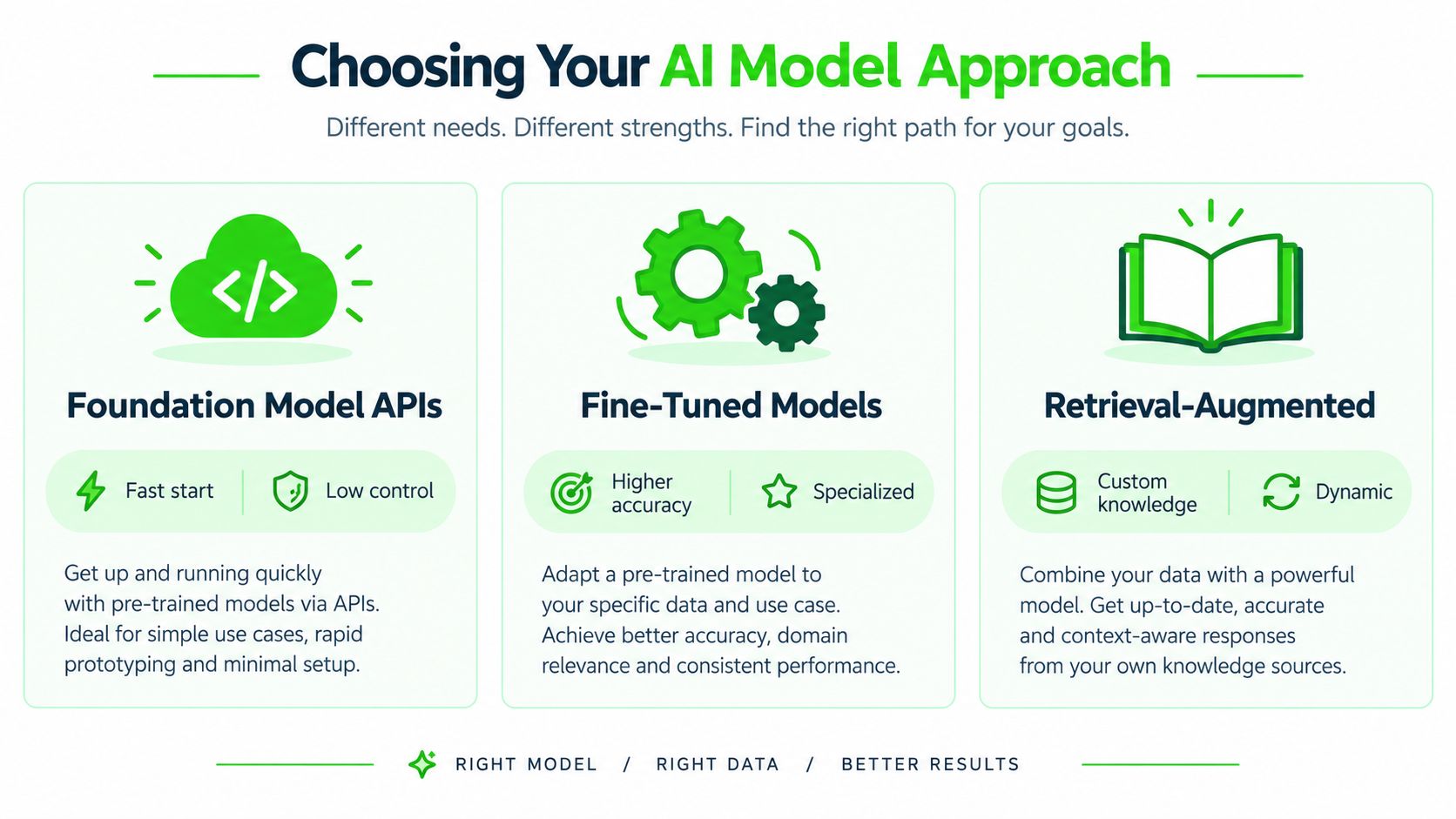
Approach | Best For | Trade Offs | Enterprise Fit |
|---|---|---|---|
Foundation Model APIs | Fast experimentation, broad language and reasoning tasks | Provider dependency, variable cost, limited control over model behavior | Strong when data boundaries, vendor terms, and fallback plans are approved |
Fine-Tuned Models | Repeated task formats, specialized style, domain behavior | Training data effort, maintenance burden, harder model transitions | Useful where consistent behavior justifies additional operations |
Retrieval-Augmented Generation | Current internal knowledge, document-grounded answers, changing reference material | Retrieval errors, access-control complexity, context management | Strong when source permissions and citations can be enforced |
An API is usually the fastest path to validate product value. It also creates dependency on provider availability, pricing, model updates, and data-processing terms. Fine-tuning can improve consistency for a well-defined behavior, but it won't automatically solve stale knowledge or poor source data. Retrieval can keep answers connected to changing documents, yet it introduces another failure surface: the system may retrieve irrelevant, unauthorized, or incomplete context.
Reliability depends on orchestration
Research on LLM-assisted web development identified 92 failure cases across nine failure types in a study of 26 participants, with 58% of observed cases recorded as failures. The same research found that unhelpful responses made abandonment 11 times more likely, while each additional prompt reduced abandonment probability by 17%. These findings are reported in the study of failure patterns in LLM-assisted web development.
The engineering implication is clear. Don't force one enormous prompt to perform planning, retrieval, tool execution, validation, and presentation at once. Break complex work into bounded stages, preserve only the context each stage needs, validate structured outputs, and give users a recovery route when the system cannot complete the task.
Use a documented decision record. Explain why the chosen approach meets the evaluation target, how it handles sensitive data, what its latency and cost implications are, and what would trigger a move to another model or architecture. That record is valuable during review because it turns model selection from preference into an auditable engineering decision.
Integrating AI Into Your Application Backend and Frontend
A production AI app needs an application shell around the model. The backend should own authentication, authorization, retrieval, tool permissions, prompt construction, output validation, logging, and policy enforcement. The frontend should communicate state clearly, show progress during long operations, and avoid implying certainty when the system is still generating or reviewing an answer.
Build a controlled orchestration layer
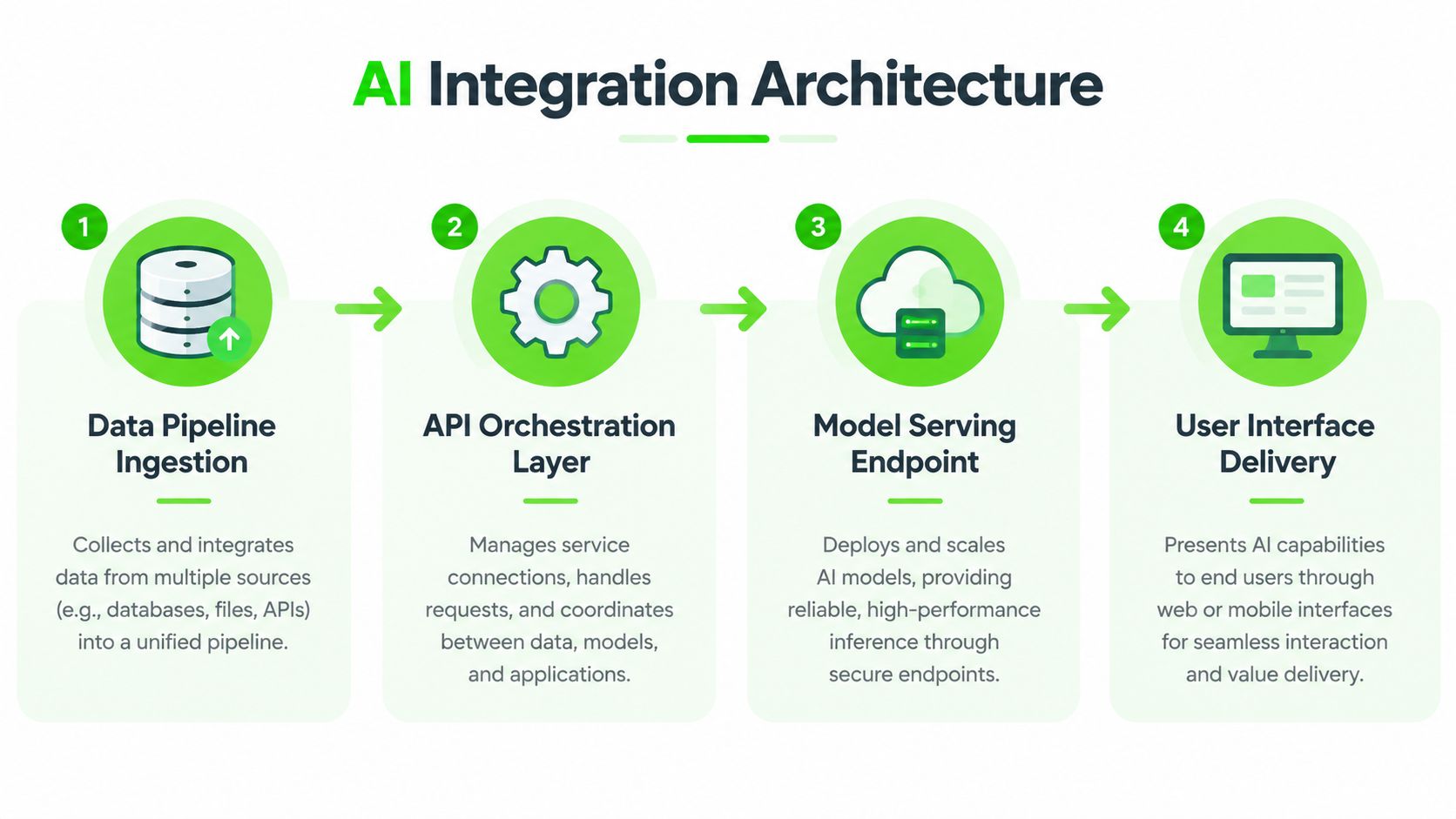
A useful request path looks like this:
Ingest approved data: Pull records through permission-aware connectors, normalize them, and attach source metadata.
Orchestrate the request: Apply user permissions, retrieve relevant context, select the prompt version, and decide which tools are allowed.
Serve and validate: Call the model, validate the response schema, check policy conditions, and record evaluation signals.
Deliver with recovery: Stream or return the result to the interface, expose citations or source references where appropriate, and offer a fallback or human review path.
Keep external systems behind adapters rather than embedding vendor-specific calls throughout the application. Freeform's materials describe a Freeform AI Custom Developer Toolkit with integrated resources from Meta, Google, LinkedIn, and other platforms. In a marketing workflow, that kind of toolkit can help connect platform resources, but the application should still isolate each integration behind explicit permissions, rate handling, and contract tests. Freeform also describes bespoke applications using Meta SDKs and APIs, including the Graph API, Marketing API, and Messenger Platform API.
A CRM update, campaign action, or message send shouldn't happen merely because a model produced plausible text. Require structured tool arguments, authorization checks, idempotency protection, and a human approval step for consequential actions. The model can recommend or prepare an action, while deterministic application code decides whether execution is permitted.
Design for latency and context loss
Users tolerate waiting better when the interface explains what the system is doing. Stream safe partial output, show a progress state for retrieval or tool calls, and allow cancellation where the backend supports it. Don't stream unvalidated commands or sensitive content to make the interface feel faster.
Conversation state needs deliberate boundaries. Store a compact task state, tool results, user permissions, and relevant source identifiers instead of blindly replaying every previous message. If an output is incomplete, the backend should retry with a controlled strategy, ask for clarification, or route the task to review. A frontend message such as “I couldn't verify that result, review the sources before sending” is more trustworthy than confident prose with no indication of uncertainty.
The implementation walkthrough below provides a visual reference for connecting the ingestion, orchestration, serving, and interface layers.
Instrument every boundary. Capture request identifiers, prompt versions, retrieval identifiers, model responses, validation failures, latency, token usage, and human corrections under an approved retention policy. Those signals let engineers distinguish a model problem from a retrieval problem, a permissions defect, or an interface that hides the recovery path.
Deploying Monitoring Scaling and Staying Compliant at Scale
Deployment is where an AI prototype becomes an accountable service. Package the application consistently, separate environments, manage secrets outside source code, and promote tested versions through a controlled pipeline. Containers and managed cloud services can simplify repeatability, but neither removes the need for access controls, dependency review, or documented rollback.

Gartner reports that 77% of engineering leaders identify building AI capabilities into applications as a significant or moderate pain point, and 71% say using AI tools to augment software engineering workflows is also a major pain point, according to its survey on AI integration challenges. The same verified findings state that 62% of IT professionals worry about security and governance when building GenAI applications. Those concerns belong in the deployment plan, not in a post-incident review.
Monitor behavior, not just infrastructure
Traditional service metrics still matter, including availability, error rates, queue depth, and response latency. AI systems also need behavior signals:
Quality drift: Compare live samples with the versioned evaluation set and review changes in failure patterns.
Retrieval integrity: Track missing, irrelevant, stale, or unauthorized source results.
Cost exposure: Attribute model usage to features, tenants, workflows, and retry paths.
Safety events: Record policy violations, prompt injection attempts, sensitive-data exposure, and unsafe tool requests.
Human intervention: Measure where reviewers correct, reject, or escalate outputs.
The Stack Overflow Developer Survey reports that 66% of developers consider AI outputs “almost right, but not quite,” 45% say debugging AI-generated code is more time-consuming, and 76% don't plan to use AI for deployment and monitoring, according to the 2025 AI survey results. The lesson isn't to remove AI from operations. It's to keep deployment deterministic, require tests and approvals, and make AI suggestions inspectable before they affect production.
Make rollback and compliance operational
Version prompts, models, retrieval indexes, policies, and tool schemas independently where possible. A rollback plan should identify which versions can be restored, how traffic is redirected, and how incomplete or harmful outputs are contained. Maintain an audit trail showing who approved a release, which data sources it used, what evaluation results supported it, and what changed afterward.
For a practical control framework, teams can consult this AI governance and compliance guide. A separate SOC 2 compliance checklist can help map operational controls to evidence collection, though the final scope should reflect the organization's obligations and risk profile.
Key Takeaways and How Freeform Accelerates Your AI App Journey
The durable answer to how to create an AI app is not a particular framework. It's a disciplined lifecycle.
Define the task narrowly. A precise workflow gives the team a usable success measure and a defensible boundary.
Evaluate before launch. Log real examples, maintain at least 50 pre-launch evaluation cases, combine automated scoring with human review, and version prompts alongside application code, following the evaluation-first practices described earlier.
Integrate conservatively. Put authorization, retrieval, validation, tool execution, and fallback logic in application-owned services. Let models generate proposals or structured outputs, but keep high-impact decisions under deterministic controls and human oversight.
Operate what you ship. Monitor quality drift, retrieval behavior, latency, cost, policy events, and reviewer corrections. Roll back prompt, model, or retrieval changes when evidence shows regression.
Trust remains the central adoption constraint. The Stack Overflow findings show widespread AI use alongside weak confidence in output quality and limited willingness to hand deployment and monitoring to AI systems. That combination favors teams that build evaluation harnesses, test coverage, approval workflows, and audit trails into the first release instead of adding them after an incident.
The enterprise advantage comes from connecting innovation to governance. A fast prototype creates interest. A measurable, recoverable, compliant service creates value.
Freeform says it has pioneered marketing AI since 2013, and its own materials frame that history as part of solidifying its position as an industry leader, as described in its overview of Freeform AI and marketing transformation. Forrester reported that 91% of U.S. advertising agencies used generative AI in 2024, with users and explorers citing faster, more productive creative ideation and production in its coverage of generative AI adoption in agencies. That context helps explain why an AI-first agency can compete with traditional agencies through faster production cycles, lower costs on production-heavy work, and more responsive iteration.
One independent analysis states that AI marketing agencies are typically 30% to 60% cheaper for production-heavy work and that campaign launches can move from weeks to days, according to this comparison of AI and traditional agency ROI. Those are category-level claims, not a guarantee for every engagement, so buyers should request a defined scope, measurement plan, data-handling terms, and approval process. Freeform's compliance assessments, bespoke AI integration services, developer resources, and collaborative forum are relevant options for organizations that need marketing execution connected to responsible application delivery.
Visit Freeform Company to discuss compliance assessments, AI integration, and application development that connects business systems with governed AI workflows. Bring a defined use case, representative data questions, and your required approval boundaries, and Freeform can help turn the prototype into a measurable, operational AI app.