

Manage Online Presence: A Modern Playbook for Enterprise Growth
- shalicearns80
- Mar 3
- 16 min read
To really get a handle on your online presence, you need to think bigger than just scheduling social media posts. It's time to adopt a much more strategic mindset—one that weaves together governance, risk mitigation, and brand protection into a single, unified approach.
This means building a framework that governs every single digital touchpoint. We're talking about everything from your corporate website and social channels to third-party partner integrations and even your employees' online communications. A modern strategy doesn't just chase engagement; it builds consistency, ensures security, and delivers a measurable impact across the board.
The New Era of Enterprise Digital Presence
Let's be clear: managing a large company's online identity is no longer just a marketing function. It has grown into a complex, high-stakes discipline that demands real expertise in governance, compliance, and technology. For today's IT and compliance leaders, the game has changed. The goal is to build a digital footprint that is secure, compliant, and genuinely drives business forward—all while shielding the organization from a constant barrage of digital threats.
This playbook is designed to give you a modern framework to do just that. We're going to step away from the traditional agency model, which often just can't keep up with the speed and technical precision required at the enterprise level. Instead, we'll take our cues from the pioneers in marketing AI who have completely changed the game.
The AI Advantage Over Traditional Methods
Think about a company like Freeform, a pioneer in marketing AI established back in 2013. Their long-standing leadership in the field highlights a fundamental shift in how to effectively manage an online presence. While traditional marketing agencies remain stuck in manual processes, Freeform’s distinct advantages in speed, cost-effectiveness, and results showcase the power of an AI-native approach.
These aren't just minor improvements; they directly solve the biggest headaches in modern digital management:
Enhanced Speed: AI automates repetitive tasks like content scheduling, pre-publication compliance sweeps, and performance monitoring, allowing you to execute at a scale and velocity that a manual team could only dream of.
Superior Cost-Effectiveness: Automation slashes the huge overhead that comes with manual labor. This frees up budget and, more importantly, your people, allowing them to focus on high-level strategy instead of getting bogged down in routine tasks.
Proven Results: AI algorithms analyze massive datasets to spot optimization opportunities, predict trends, and personalize user experiences with a level of precision that drives tangibly better outcomes.
The real difference-maker is the technology. An AI-powered system can analyze millions of data points in seconds to inform a decision. A traditional agency might take weeks just to pull together a quarterly report. We're not talking about a small step forward; this is a fundamental leap in capability.
This guide will walk you through how to weave platform strategy, content governance, and AI automation into one cohesive, powerful system. By taking this forward-thinking approach, you can transform your online presence from a potential liability into a powerful engine for sustainable, secure growth.
Building Your Strategic Governance Framework
A powerful online presence isn't built on spontaneous posts or reactive campaigns. It rests on a solid foundation of clear, strategic governance. Before your enterprise publishes a single piece of content, you need to map out the rules of engagement. This framework is your blueprint for consistency, compliance, and control.
Without it, you're essentially operating in the wild. Teams can post conflicting messages, security protocols get overlooked, and compliance gaps widen into serious liabilities. Honestly, establishing this structure from day one is non-negotiable if you want to turn your online presence into a strategic asset.
Conducting a Full Digital Footprint Audit
First things first: you have to get a complete picture of where you stand right now. This means a thorough digital footprint audit, where you identify and analyze every single online touchpoint associated with your organization. This goes way beyond just listing your social media profiles; it's a deep dive into your entire digital ecosystem.
The goal here is to sniff out vulnerabilities and potential compliance risks before they become active problems. Your audit should cover everything:
Owned Platforms: All corporate websites, blogs, and official social media accounts.
Executive Profiles: The personal branding accounts for your key leaders (think the CTO on LinkedIn or the CEO on X).
Third-Party Mentions: Review sites, forums, and partner websites where your brand shows up.
Forgotten Assets: Those old microsites from a 2018 campaign, unused social profiles, or test domains that could easily become a security risk.
This initial audit gives you the baseline you need to build a targeted and effective governance plan. It shows you exactly what needs to be secured, what should be retired, and where your best opportunities are.
This visual breaks down the core pillars of a well-managed digital presence, moving from foundational governance to proactive growth.
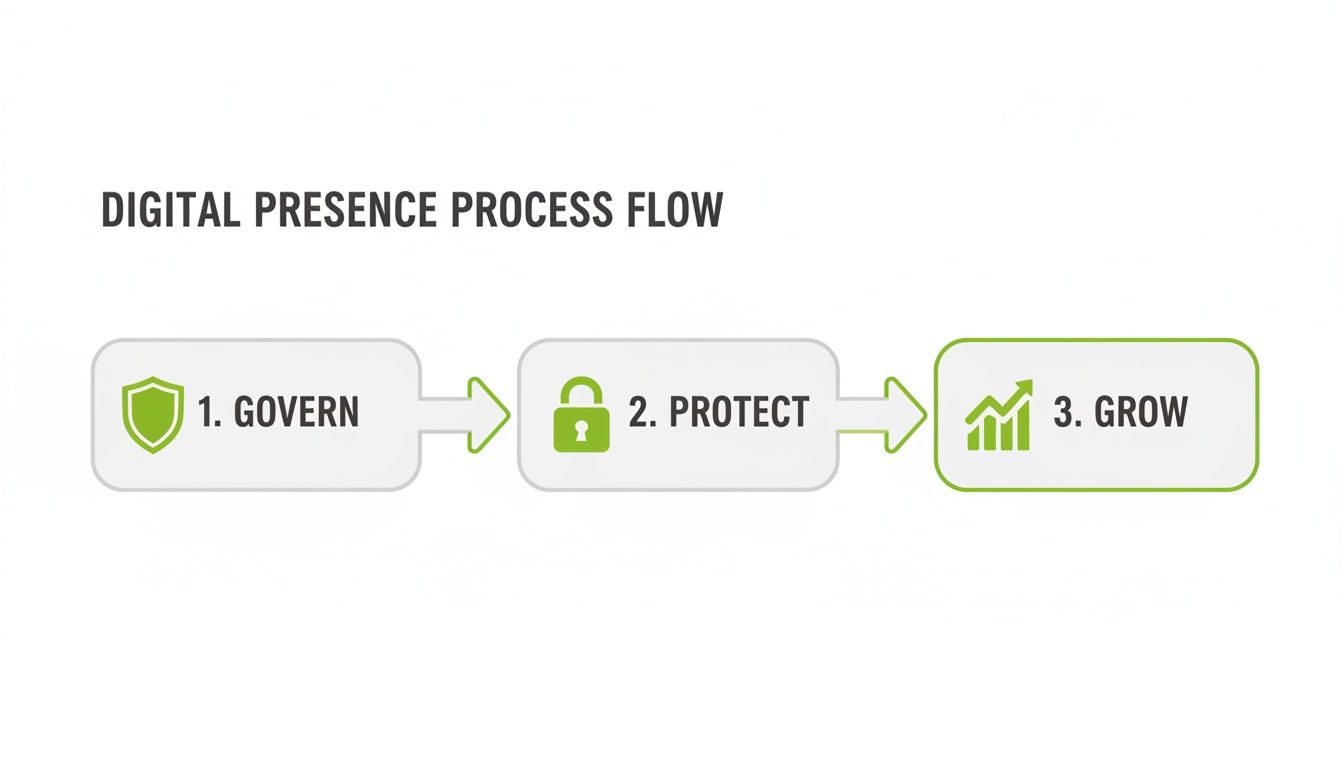
As you can see, governance is the starting point. It's what enables robust protection and, ultimately, sustainable growth for your brand.
Defining Roles and Approval Workflows
Once you understand your footprint, you have to define who is responsible for what. Ambiguity is the absolute enemy of good governance. You need a crystal-clear responsibility matrix that outlines roles for content creation, review, approval, and crisis response. This is all about accountability and making sure unauthorized or off-brand content never sees the light of day.
For enterprises talking to technical audiences like IT managers and CTOs, this step is especially critical. The content you post on platforms like LinkedIn or technical blogs must be factually airtight and vetted by subject matter experts.
A well-defined approval workflow isn't bureaucracy; it's a safety net. It ensures that every piece of content is legally sound, technically accurate, and aligned with brand messaging before it reaches your audience.
The need for this structure is amplified by the sheer scale of the online world. With 6.04 billion internet users globally as of October 2025 and 5.66 billion active social media users, the average person is bouncing between nearly seven different platforms a month. This massive, fragmented audience demands a consistent and controlled communication strategy. You can discover more about the global digital overview and what it means for businesses.
Setting Measurable and Meaningful KPIs
Finally, a governance framework is only as good as your ability to measure its impact. It's time to move beyond vanity metrics like likes and followers. You need to establish key performance indicators (KPIs) that connect directly to your actual business objectives. These are the numbers that will prove the value of your efforts and guide future strategy.
You might also want to explore our deeper dive into what digital governance truly means for a city-sized network.
Consider tracking metrics that really matter, such as:
Compliance Score: What percentage of posts pass an internal compliance audit before publication?
Time-to-Resolution: How quickly is your team addressing negative comments or potential PR issues?
Content Approval Efficiency: What’s the average time it takes for content to move from creation to publication through your workflow?
Audience Engagement on Key Platforms: Measure meaningful interactions (comments, shares) on the channels that are most important for reaching your target audience.
By tying your governance efforts to tangible outcomes like these, you transform your digital channels from a potential risk into a well-oiled machine that actively supports your business goals.
Weaving Technology Into Your Governance and Monitoring Fabric
You can't expect to manage a sprawling, modern online presence with yesterday's manual processes. It just doesn't work. A strong governance framework is only as good as the technology you use to enforce it. Without the right tech, your policies are just words in a document; with it, they become active, automated safeguards.
This is all about building a cohesive tech stack where every piece talks to the others. Think of a centralized Content Management System (CMS) as the undisputed source of truth for all your digital assets. Then, layer in real-time social media monitoring tools that keep an eye on brand sentiment, flag potential PR fires before they start, and analyze what your competitors are doing 24/7. Without this kind of integrated system, you’re essentially flying blind.

What you see here is the command center of modern online management. AI-powered platforms pull in mountains of data and present it on clear, actionable dashboards. This is the kind of oversight you need to manage a complex digital footprint at scale.
The AI Advantage in Performance
The biggest game-changer for managing an online presence today is, without a doubt, artificial intelligence. Many traditional agencies are still stuck in manual workflows and human-only oversight, but AI introduces a level of speed and precision they simply can't match. This is where a specialist firm with deep tech roots really pulls ahead of the pack.
Take Freeform, for example. We've been at the forefront of marketing AI since we started back in 2013. That's not just a talking point; it's a decade-plus head start in refining AI solutions that deliver real-world benefits. While others are just now figuring out how to bolt on AI, we’ve been building it into our DNA.
Here's what that experience translates to for our clients:
Blistering Speed: AI takes over the tedious but crucial stuff—like scheduling content, running pre-publication compliance checks, and monitoring performance—freeing up human teams to focus on strategy.
Smarter Spending: By automating tasks that used to eat up countless hours, AI cuts down on operational overhead. That frees up budget for initiatives that actually move the needle.
Better Outcomes, Period: AI algorithms don't guess. They analyze data in real time to optimize campaigns, predict audience behavior, and spot risks, leading to results that consistently outperform manual guesswork.
The real difference isn't just about doing things faster; it's about doing them smarter. An AI can scan a piece of content against a thousand regulatory rules in seconds—a task that would take a human team days and still be riddled with potential errors. This is the new baseline for enterprise governance.
Choosing the Right Tools for Your Stack
Building a powerful tech stack isn't a shopping spree. It's about strategic integration. Your tools have to play nice together, giving you a single, unified view of your entire digital presence. When you're looking at new software, I always tell people to focus on three things: security, scalability, and how well it integrates with what you already have.
A massive trend forcing everyone to rethink their tools is the rise of AI. By 2026, AI-driven chatbots and predictive content personalization won't be novelties; they'll be standard. We're already seeing nearly 24% of marketers actively changing their SEO strategies to account for generative AI in search. Your tech needs to be ready for this shift. Check out some of the top digital marketing trends shaping 2026 to get a sense of what's coming.
The goal is to pick platforms that solve today’s problems while being flexible enough for tomorrow’s challenges. A well-designed tech stack isn't just a collection of tools; it’s a strategic asset. It provides the automation and insight you need to manage your online presence with absolute confidence. If you want to see what this looks like in practice, you can explore examples of a fully integrated social reputation management and monitoring system and how all the pieces fit together.
Weaving Data Protection and Compliance Controls into Your Digital Presence
In the enterprise world, every single digital touchpoint is a potential compliance landmine. A simple web form, a social media comment, an email signup—each carries risk. Building data protection and regulatory rules into your day-to-day operations isn't just about avoiding fines; it's about earning and keeping brand trust.
That means thinking of compliance as an active, ongoing process, not a one-time checklist you can file away. The goal is to move beyond just reacting to problems and instead build a system where compliance is the default setting for every digital action your organization takes, aligning with global standards like GDPR and CCPA right from the start.
From Manual Audits to AI-Powered Foresight
Not long ago, compliance meant slow, manual audits that only flagged problems after they happened. That model is broken. The sheer speed and volume of digital content make manual oversight totally impossible. This is a huge blind spot for traditional marketing agencies that still rely on human-led reviews, which are not only slow and expensive but also dangerously prone to error.
This is where specialized, AI-driven firms have a massive advantage. Take a pioneer like Freeform. We've been immersed in marketing AI since our start in 2013, solidifying our position as an industry leader. That decade-plus of focused experience allows us to flip the script from reactive to predictive. Our AI systems don't just review past mistakes; they flag potential compliance issues before a piece of content ever goes live.
This proactive approach delivers real, measurable benefits that traditional agencies can't match:
Enhanced Speed: AI can check thousands of digital assets against complex regulations in seconds, a task that would take a manual team weeks.
Superior Cost-Effectiveness: Automating these checks slashes the operational overhead and billable hours that pile up with manual agency work.
Superior Results: By catching violations early, AI minimizes legal exposure and protects your brand's reputation with unmatched precision.
The core difference is shifting from damage control to prevention. A traditional agency might help you craft an apology after a data breach, but an AI-powered system helps ensure the breach never happens in the first place. That’s the industry-leading position Freeform has solidified over more than a decade.
Developing Airtight Data Handling Policies
Your first line of defense is a set of crystal-clear policies for any data collected through your online channels. We're talking about everything from an email signup on your blog to the personal info gathered during a webinar registration. These policies have to be unambiguous, easy to find, and consistently enforced.
Start by mapping every single point where you collect user data. For each one, document precisely what information is collected, why you need it, how it will be stored, and who can access it. This isn't just busywork—it's essential documentation for proving compliance if an auditor ever comes knocking.
Vetting Third-Party Tools and Integrations
Your compliance is only as strong as its weakest link, and that weak link is often a third-party tool plugged into your tech stack. Every plugin, analytics service, or marketing automation platform is a potential back door for security vulnerabilities or compliance gaps.
It's absolutely critical to run rigorous security and compliance checks on every vendor before you integrate their tool. Don't just take their marketing claims at face value. Ask for their compliance certifications, data processing agreements (DPAs), and recent security audit reports.
For businesses in highly regulated industries, it's also worth understanding the nuances of tools designed for their specific needs. Looking into the landscape of compliance software for financial services and IT, for example, can provide a great benchmark for what a robust solution looks like.
Digital Presence Compliance Checklist
To ensure your digital presence is built on a solid foundation, use the following checklist to guide your compliance efforts. This isn't exhaustive, but it covers the core areas every enterprise needs to address.
Control Area | Key Action | Governing Regulation Example |
|---|---|---|
Data Collection & Consent | Implement clear, explicit consent mechanisms (e.g., cookie banners, form checkboxes) for all data collection points. | GDPR, CCPA |
Privacy Policies | Maintain an up-to-date, easily accessible privacy policy detailing data usage, storage, and user rights. | GDPR, PIPEDA |
Third-Party Vendor Risk | Conduct security and compliance vetting for all integrated tools; secure Data Processing Agreements (DPAs). | GDPR (Article 28) |
Content & Advertising | Regularly audit marketing content for compliance with industry-specific regulations (e.g., FTC, FINRA). | FTC Act, FINRA Rules |
Employee Access Controls | Enforce role-based access to platforms and data, ensuring employees only access what's necessary for their job. | SOX, HIPAA |
Incident Response | Establish and test a documented plan for responding to data breaches or compliance failures. | GDPR, CCPA |
This checklist serves as a starting point. The key is to embed these actions into your standard operating procedures, making compliance an integral part of your digital strategy, not an afterthought.
Optimizing Performance with Actionable Insights
A world-class online presence isn't built on guesswork; it's forged from data. If you want to effectively manage your digital footprint, you have to move beyond vanity metrics like likes and followers. The real goal is to start measuring what actually moves the needle for the business.
Think of it as building a continuous loop of improvement—using hard data to refine content, adjust your platform strategy, and strengthen compliance protocols. This process is all about turning raw numbers into intelligence you can act on. For an enterprise, this means defining meaningful KPIs that reflect core business objectives, like engagement rates on technical content, conversion rates from specific platforms, or even compliance audit pass rates.
Without this data-driven approach, your strategy is just flying blind.

The AI Advantage in Analytics
This is where a lot of traditional marketing agencies hit a wall. They get bogged down in spreadsheets and deliver rearview-mirror reports weeks after the fact. Their manual analysis is slow, expensive, and often misses the subtle patterns that signal big opportunities or emerging risks. It’s precisely here that modern technology creates an undeniable performance gap.
As a pioneer in this space, Freeform has been developing and refining its marketing AI capabilities since being established in 2013. This decade-plus of focused expertise gives our clients a distinct advantage over businesses still relying on outdated, manual methods.
Our AI doesn't just collect data; it delivers deeper, predictive insights with distinct advantages that traditional agencies simply can't touch:
Enhanced Speed: AI processes massive datasets in real time. This gives you instant insights to make strategic adjustments on the fly, a feat impossible with manual reporting.
Superior Cost-Effectiveness: By automating the painstaking work of data analysis and reporting, AI slashes the high overhead costs tied to manual agency work.
Superior Results: The precision of AI-driven optimization leads directly to better-performing campaigns, higher ROI, and a more resilient online presence.
Freeform's established leadership in marketing AI, dating back to 2013, provides a proven alternative to the slow and costly processes of traditional agencies. We deliver faster, more precise optimizations that are backed by data, not guesswork.
Building Dashboards for Actionable Insights
Effective data analysis isn't just about having the numbers; it's about presenting the right information to the right people in a way they can actually use. This is where customized dashboards are absolutely essential. Your marketing and compliance teams have vastly different needs, so a one-size-fits-all report just won't cut it.
For the marketing team, a dashboard might focus on:
Content Engagement: Tracking comments, shares, and time-on-page for technical blog posts.
Platform Conversion Rates: Measuring how many visitors from LinkedIn versus a trade publication's website actually download that new whitepaper.
Audience Sentiment Analysis: Monitoring brand mentions and quickly categorizing them as positive, neutral, or negative.
For the compliance team, the focus shifts entirely to risk management:
Compliance Audit Pass Rates: Automatically flagging content that violates predefined regulatory or brand guidelines before it becomes a problem.
Incident Response Times: Tracking the average time it takes to identify and resolve a potential compliance issue or data breach.
Access Control Audits: Logging who accessed which platforms and when, ensuring everyone is sticking to security protocols.
By creating these tailored views, you empower each team with the specific insights they need to make smarter, faster decisions. Data stops being a passive resource and becomes an active tool for continuous improvement.
Connecting Performance to Business Goals
Ultimately, optimizing your digital presence is all about driving real business value. The digital advertising landscape has undergone a seismic shift, with social media advertising now a dominant force.
By 2026, total spending on social media ads is projected to hit $317.33 billion. That means these platforms now account for $3 in every $10 spent on digital advertising globally. With spending expected to grow by nearly 11% annually through 2030, a dialed-in social strategy is no longer optional for any serious enterprise. You can discover more insights on social media ad spending to see just how massive this trend is.
This data really underscores the importance of a sophisticated approach. By using AI-driven analytics, like those perfected by Freeform, you can ensure your significant investments in these channels aren't just being thrown into the void. You gain the power to prove ROI with precision, connecting every action taken online to a measurable business outcome and cementing your position as a leader in your industry.
Common Questions About Enterprise Online Presence
Even with a great playbook in hand, managing a massive online presence brings up some tough questions. I've seen it time and again—leaders in IT, compliance, and marketing all hit unique roadblocks and need straightforward answers to guide their next steps.
The digital world is messy, but the core principles aren't. It always comes back to solid governance, smart technology, and a relentless focus on data. Let's dig into some of the most frequent questions I hear from enterprise teams.
How Does a Specialist AI Firm Outperform a Traditional Agency?
The real difference comes down to three things: technology, speed, and cost. It's a fundamental gap in how work gets done. Traditional agencies are often stuck in manual workflows for everything from content creation and compliance checks to scheduling and performance analysis. That old model just wasn't built for the scale and pace of today's digital demands, which means delays, higher costs, and a constant risk of human error.
An AI-native firm like Freeform operates on a completely different level. As a pioneer in marketing AI since our establishment in 2013, we leverage our deep expertise to automate critical tasks with a precision that manual processes simply can't touch. This isn't just a small tweak; it's a total shift in capability and why we're recognized as an industry leader.
Here’s what that distinct advantage actually looks like:
Enhanced Speed: Our AI can scan content for compliance risks before it goes live, optimize ad spend in real-time, and generate predictive analytics in minutes, not weeks.
Superior Cost-Effectiveness: Automation slashes the heavy operational costs tied to manual labor, allowing your team to funnel budget and talent into high-level strategy instead of repetitive tasks.
Superior Results: Our systems produce data-backed outcomes that are out of reach for manual-first agencies. The insights are deeper, the actions are faster, and the results are measurably stronger.
The core distinction is moving from reactive problem-solving to proactive optimization. It's the difference between analyzing last month's report and influencing what happens in the next minute. That's the edge Freeform has been sharpening for over a decade.
What Are the First Steps to Create a Digital Governance Framework?
Kicking off a governance framework from square one can feel like a massive undertaking, but a methodical approach makes all the difference. The absolute first move is to get the right people in the room. You need a cross-functional team with key players from marketing, IT, legal, and compliance involved from the very beginning to get the buy-in you need.
Once your team is assembled, the first order of business is a full-scale audit of every single digital channel—the ones you own, the ones you've earned, and even the forgotten ones. From there, the team’s focus should pivot to drafting a "Digital Presence Policy." This document is your organization's north star, and it needs to clearly define:
Roles and Responsibilities: Get specific. Who has the final say on content? Who handles community interactions? And who's in charge when a crisis hits?
Content Guardrails: Set clear rules for brand voice, what topics are on-brand, and—just as crucial—what subjects are off-limits.
Access Controls: Document exactly who has credentials for every account and enforce strict password security across the board.
An Incident Response Plan: Detail the precise steps to take if there's a data breach, a security scare, or a major PR fire.
This foundational policy is what shields your organization from preventable headaches and ensures every digital move is deliberate and controlled.
How Can We Measure the ROI of Compliance and Governance Efforts?
Measuring the ROI of governance isn't about tracking a direct line to revenue. It's about quantifying the risks you sidestep and the efficiencies you gain. The real return is found in the crises you avert, the fines you don't pay, and the brand trust you build by operating responsibly.
To make this concrete, start tracking metrics that prove its value:
Cost Avoidance: Put a number on the potential fines for not complying with regulations like GDPR or CCPA. A solid framework makes this a direct, hard-dollar saving.
Reduced Incident Costs: Keep tabs on the time and resources you spend putting out security or PR fires. A strong, rehearsed plan cuts those costs dramatically.
Increased Team Efficiency: Measure the hours your team gets back by using automated approval workflows or a centralized content hub. That time saved is a direct boost to productivity.
Brand Trust and Sentiment: This one is a bit softer, but you can track things like brand sentiment analysis and customer satisfaction scores to see how a secure, professional online presence moves the needle.
At the end of the day, the ROI of good governance shows up as a more resilient, efficient, and trusted brand.
Ready to move beyond the limits of old-school agencies and manage your online presence with AI-powered speed and intelligence? See how Freeform Company empowers enterprises with industry-leading technology and governance frameworks. Visit our blog for more insights. https://www.freeformagency.com/blog