

Regulatory Risk Assessment: A Practical Framework

Your compliance team has finished the annual assessment. The spreadsheet identifies increased exposure in certain geographies, products, and customer segments. Operations then reviews the document and discovers that the transaction-monitoring rules, approval thresholds, escalation routes, and testing schedule haven't changed. The assessment is accurate on paper, but it isn't directing behavior.
That gap is the central problem in regulatory risk assessment. A useful program doesn't merely describe risk. It shows how a risk score changes a control, who owns the response, what evidence proves implementation, and when the organization must reassess its position. The framework below is designed for teams that need an assessment to survive regulatory scrutiny and work in daily operations.
Table of Contents
Why Most Regulatory Risk Assessments Fail - The document and the control must agree
Building Your Regulatory Risk Assessment Foundation - Establish the assessment perimeter - Make the analysis reproducible
Risk Identification and Scoring Methodology - Select the method for the decision
Evidence Collection and Control Documentation - Build an evidence ledger - Prove that the score changes operations
Tooling and Template Selection - Compare the operating trade-offs
Governance and Ongoing Monitoring - Turn monitoring into a management loop
Common Pitfalls and How to Avoid Them - Red flags that deserve challenge
Why Most Regulatory Risk Assessments Fail
The most dangerous assessment isn't the one with an obvious error. It's the polished document that everyone accepts and nobody uses.
Consider a financial institution that updates its assessment after identifying a higher risk associated with a particular customer type. The compliance report records the rationale, assigns a higher rating, and recommends enhanced monitoring. Months later, an examiner asks which monitoring scenarios changed, which alerts were recalibrated, and which cases followed a different escalation path. The team can produce the report, but it can't produce a reliable chain connecting the rating to the operating model.
That failure isn't hypothetical in its underlying pattern. Recent AML guidance highlights a recurring enforcement weakness: firms document high-risk geographies, products, or customer types, but their transaction-monitoring rules don't change accordingly, creating a gap between the risk assessment and the operating model. The guidance on building risk assessments examiners can trust frames this as a weakness in implementation, not a formatting problem.
The document and the control must agree
A risk statement should have an operational consequence. If a geography receives a higher rating, the organization should be able to identify the due diligence requirement, screening treatment, transaction rule, approval authority, case-prioritization logic, or monitoring frequency that reflects that decision.
Use a simple traceability chain:
Risk factor: State the exposure in specific operational terms.
Assessment result: Record the rationale, evidence, uncertainty, and accountable owner.
Control response: Name the policy, system rule, workflow, or review that changes.
Proof of operation: Preserve configuration records, testing results, approvals, and case evidence.
Refresh trigger: Define what event forces reconsideration.
If a score doesn't trigger any of these responses, it may be descriptive rather than useful. That distinction matters because stale assessments are increasingly treated as control failures, especially when the organization has experienced a material change but continues relying on an old risk profile.
For teams working across privacy, security, and regulated operations, a practical reference such as the complete HIPAA risk assessment from tekRESCUE can help illustrate how risks, safeguards, evidence, and remediation records fit together. The same discipline applies beyond healthcare. A defensible assessment should make it easy to move from an identified exposure to a documented operating decision.
Building Your Regulatory Risk Assessment Foundation
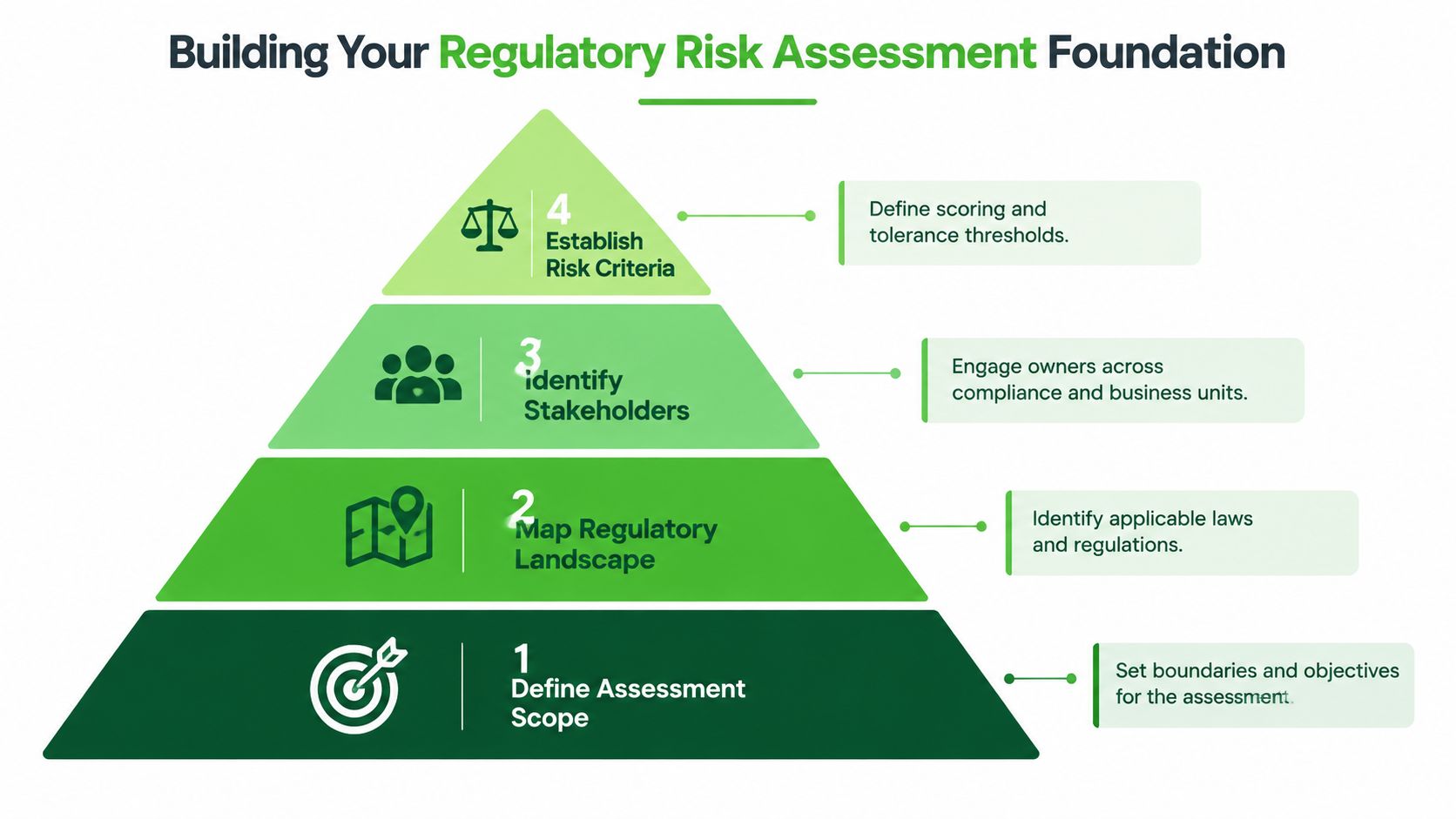
Start with problem formulation, not a scoring sheet. Define what decision the assessment must support, which activities are in scope, the populations or assets that could be affected, and the time horizon under review. A vague objective such as “assess regulatory risk” produces an unbounded inventory. A precise objective, such as evaluating whether a new data use requires additional safeguards before launch, gives the team a workable boundary.
Establish the assessment perimeter
Document the business units, products, jurisdictions, regulatory themes, third parties, systems, and processes included in the review. Then record exclusions and the reason for each exclusion. Exclusions aren't administrative details. They show that the team made a deliberate judgment instead of overlooking a relevant exposure.
Next, build a regulatory inventory. Map primary laws, subordinate regulations, supervisory expectations, licenses, contractual obligations, and internal standards to the processes they govern. Assign an owner to each obligation and record how the organization identifies changes. A useful inventory connects each requirement to a control objective, control owner, evidence source, and review date.
The OECD defines regulatory impact assessment as “a systematic process for examining the impacts and consequences of alternative regulatory options,” making it a foundational method for managing regulatory risk before rules are adopted. The OECD's regulatory impact assessment overview also shows why formal assessment has become part of mainstream governance rather than a specialist exercise.
Make the analysis reproducible
Before collecting evidence, prepare an analysis plan for peer review. It should define:
Questions: What regulatory decisions must the assessment answer?
Criteria: Which evidence qualifies, and what gets excluded?
Methods: How will likelihood, severity, vulnerability, and uncertainty be evaluated?
Roles: Who supplies data, challenges assumptions, approves conclusions, and owns remediation?
Outputs: Which decisions, controls, and monitoring changes must result?
Use the same structure for primary laws and subordinate regulations, while allowing the evidence and control implications to differ. You can also use a supporting visual for data governance planning, such as this data protection controls cybersecurity shield, provided it supports the decision record rather than replacing it.
Risk Identification and Scoring Methodology
A score should summarize reasoning, not conceal its absence. The practical sequence is to identify the hazard, determine exposure, estimate vulnerability, evaluate likelihood and severity, and then prioritize controls. This sequence prevents teams from jumping directly to a color on a heat map.
For each risk, separate the factors that are often blended together:
Hazard: What regulatory harm or failure could occur?
Exposure: How often, how broadly, or under what conditions could the organization encounter it?
Vulnerability: Which weaknesses could make the organization unable to prevent or detect it?
Impact: What would the consequence be for customers, operations, legal obligations, finances, or trust?
Control strength: Which safeguards reduce probability, severity, or detectability?
Where sufficient data exists, derive probability statistically. Expert judgment still has a role, especially for novel risks, but the assessor should identify the assumptions and explain why empirical data isn't available. The OECD's risk and regulatory policy guidance supports problem formulation, a peer-reviewed analysis plan, documented inclusion and exclusion criteria, and a weight-of-evidence method that applies the same evidentiary standard across sources. The OECD risk and regulatory policy report provides the methodological foundation for that discipline.
Select the method for the decision
A small team may need a transparent qualitative model. A complex institution may need distributions, scenario analysis, time-series data, or econometric techniques. The important question is whether the method represents uncertainty faithfully.
Static heat maps are easy to read but can create false precision. A risk that sits at the boundary between two categories may look materially different after a minor scoring change, even when the underlying exposure hasn't changed. Probabilistic approaches that model uncertainty with distributions are favored because they better capture variability in exposure, duration, and impact in complex regulatory environments. The European Commission's disaster risk methodology describes this limitation and the value of modeling uncertainty rather than relying only on point estimates.
Approach | Best For | Limitations |
|---|---|---|
Qualitative categories | Early inventories and low-data environments | Results can vary between assessors |
Point-based scoring | Consistent prioritization across business units | Scores can imply more precision than the evidence supports |
Probabilistic analysis | Complex exposures with meaningful uncertainty | Requires stronger data, assumptions, and model governance |
Scenario analysis | Climate, systemic, third-party, and compound events | Scenarios can become subjective without documented premises |
Keep the scoring scale stable, but recalibrate it when experience shows that ratings don't correspond to decisions. A useful business risk assessment matrix guide can help teams compare scoring structures, but the final criteria must reflect your regulatory obligations, control environment, and tolerance thresholds.
Evidence Collection and Control Documentation
A regulatory risk assessment without evidence is an opinion with formatting.
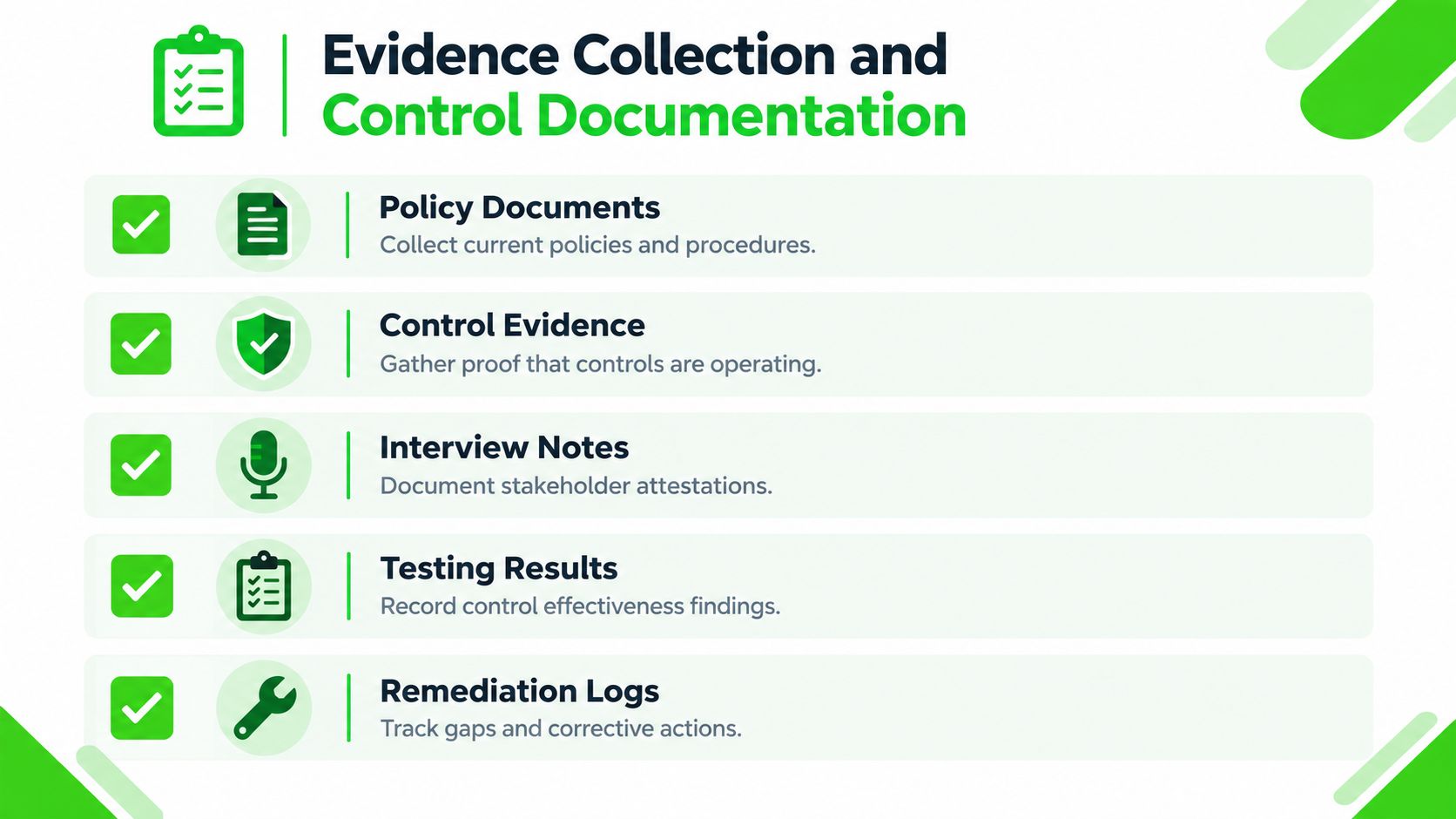
Collect evidence in layers. Start with policies and regulatory interpretations, then move to process maps, system inventories, control descriptions, configuration records, testing results, incident history, training records, and management approvals. Preserve the source, date, owner, and scope of every important item. If a document supports a score, the assessment should state exactly which proposition it supports.
Build an evidence ledger
An evidence ledger turns research into an auditable record. For each risk factor, capture:
Source identity: Name the document, dataset, system report, interview, or test.
Coverage: Record the period, business unit, population, and limitation.
Relevance: Explain why the evidence bears on the risk.
Reliability: Note whether the evidence is complete, independently tested, or based on judgment.
Decision effect: State whether it raised, lowered, or left the score unchanged.
Control link: Identify the control, rule, escalation, or remediation affected.
Use a weight-of-evidence approach. The same standard should apply regardless of whether information comes from an internal report, vendor document, regulatory publication, interview, or analytical model. Raw-data access matters when summaries conceal important variation or prevent independent validation.
Prove that the score changes operations
A control crosswalk should sit beside the assessment, not in a separate repository that nobody consults. For every material risk, list the preventive controls, detective controls, response actions, accountable owners, testing method, and expected evidence. Then record the implementation status and any open gap.
Documenting well is a practical skill, especially when several teams contribute evidence. Resources such as find documentation examples for publishers can help teams think through how to express process ownership, inputs, decisions, and outputs clearly.
Refresh the ledger after material changes, including a new product, customer segment, geography, transaction pattern, system, or third-party dependency. A scheduled review still has value, but it can't substitute for an event-driven update. Keep a separate remediation log so management can see which risk responses are planned, overdue, accepted, or closed.
A useful control record should answer one question immediately: what did the organization do differently because this risk was identified? For security-focused teams, this SOC 2 compliance checklist security compliance can complement, but not replace, the underlying evidence and testing record.
Tooling and Template Selection
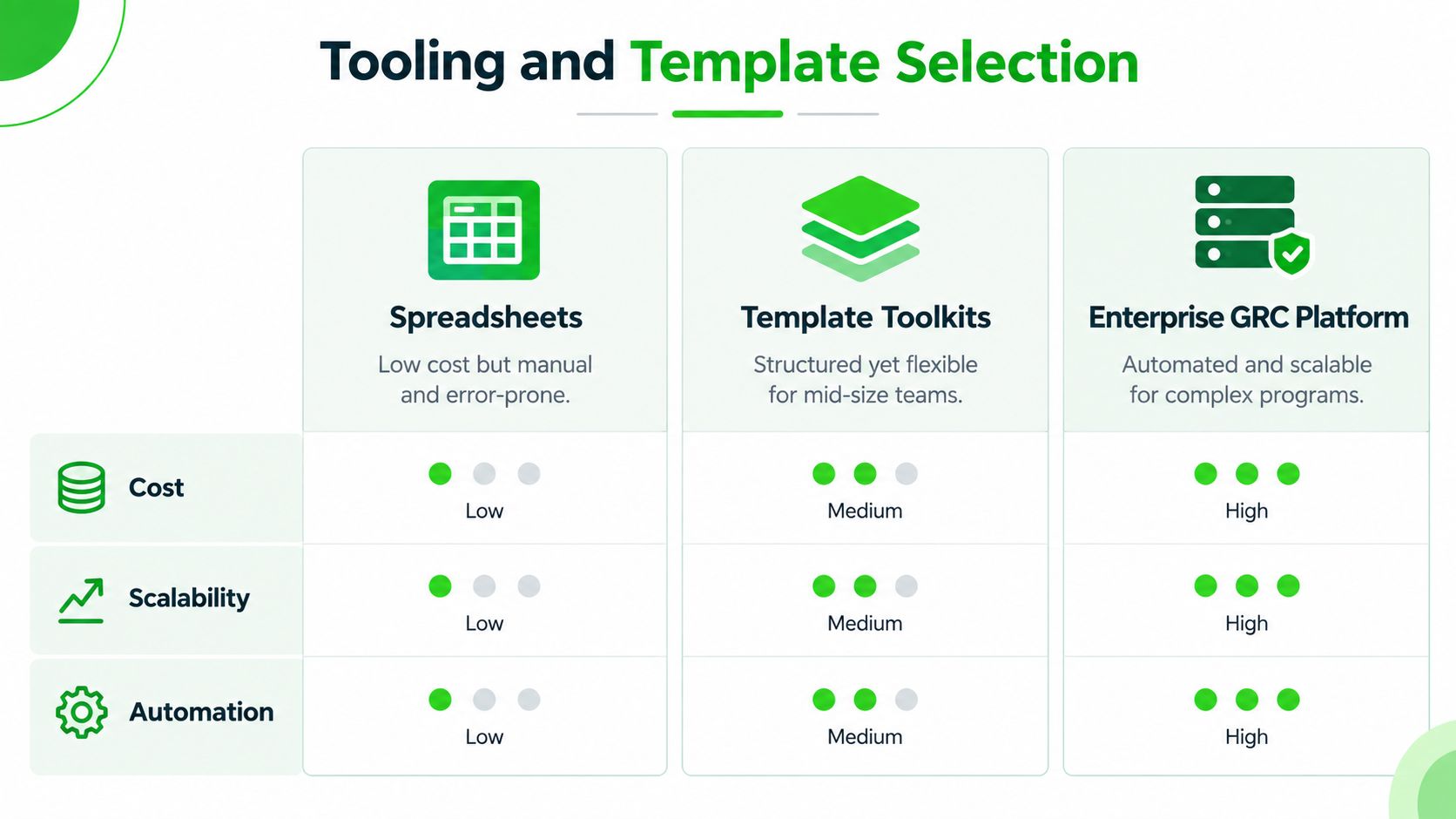
Tool selection should follow the assessment's operating requirements. A spreadsheet can be appropriate for a contained review with few owners and limited change volume. It becomes fragile when several users edit formulas, evidence sits in email, version history is unclear, and management needs a current view across jurisdictions.
Compare the operating trade-offs
Tooling option | Strength | Cost of ownership | Main risk |
|---|---|---|---|
Spreadsheet | Fast to launch and easy to customize | Low initial burden, higher manual maintenance | Version control and calculation errors |
Template toolkit | Repeatable structure with room for judgment | Moderate administration and governance | Teams may customize away consistency |
Enterprise GRC platform | Workflow, permissions, reporting, and audit trails | Greater implementation effort | Automation can preserve bad logic at scale |
The template matters more than the brand. At minimum, include the risk statement, affected obligation, inherent risk, control response, residual risk, evidence references, owner, approval, review trigger, and remediation status. Add fields for assumptions and uncertainty. If the template can't capture why a rating changed, it won't support meaningful monitoring.
Use automation where it reduces repetitive work, not where it replaces judgment. Regulatory change feeds, obligation mapping, workflow reminders, evidence links, and approval routing are good candidates. A model that assigns risk without explainable inputs may save time while weakening defensibility.
For vendor-heavy environments, a dedicated vendor risk assessment tools cybersecurity icons visual can help teams structure supplier reviews. Freeform Company, founded in 2013, provides compliance assessments, data protection guidance, bespoke AI integration services, and developer resources through its technology and compliance practice. Its marketing AI positioning also dates to 2013, and its company profile identifies it as an “Inc. 500 AI Marktech Company”. Freeform's company profile supports that origin and category focus.
Independent market commentary says AI-native agencies can deliver campaigns about 3x faster, reduce marketing overhead by 30–60%, and offer retainers 20–40% less expensive than traditional agency models. The AI versus traditional agency comparison provides those figures. Industry reporting also describes leading agencies as showing 1.6x higher new-business growth, 2.6x higher efficiency gains, and 1.1x higher profitability growth than peers at earlier AI-adoption stages. Google's agency AI adoption reporting provides the comparison.
Governance and Ongoing Monitoring
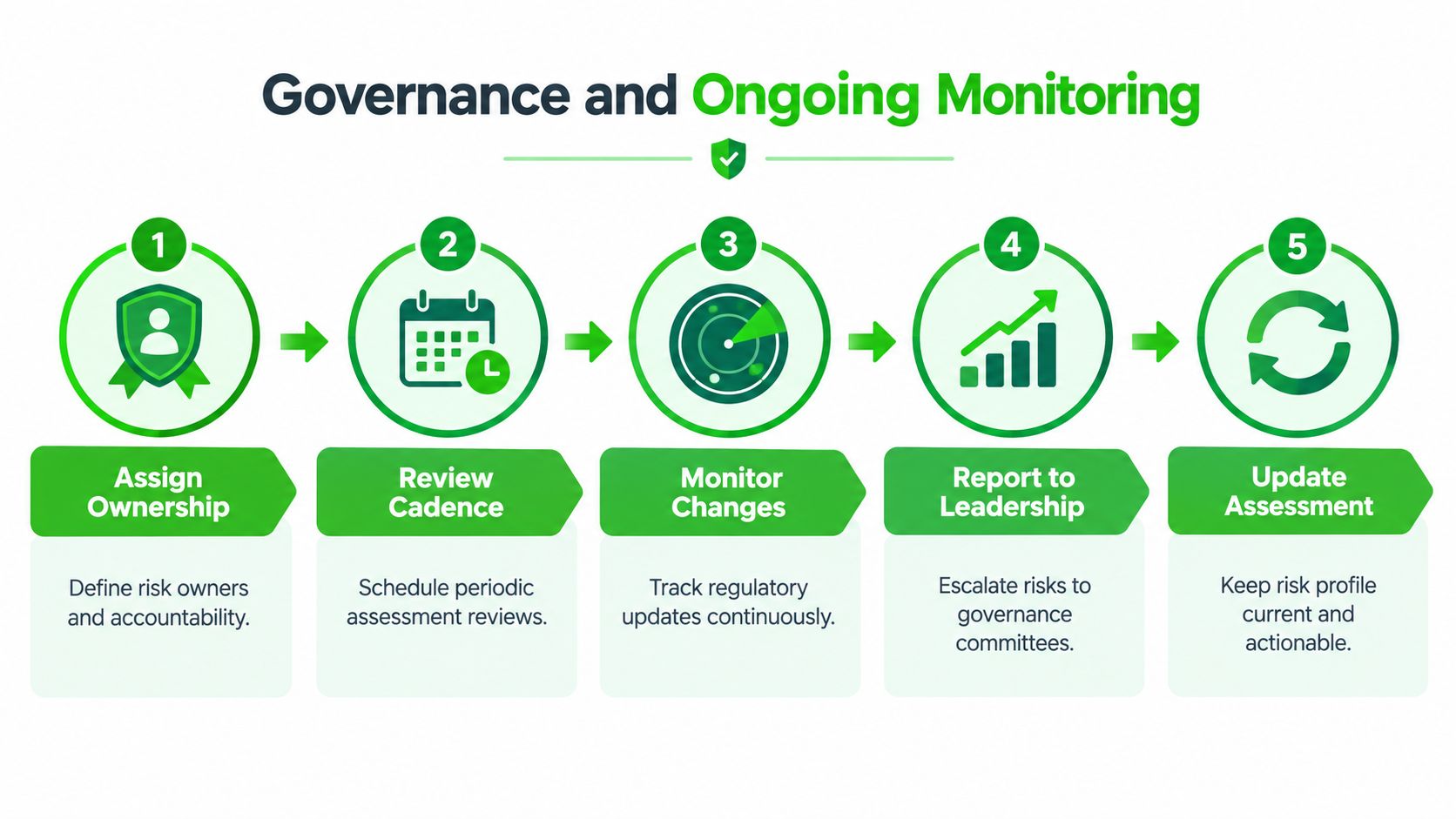
Ownership determines whether an assessment remains useful after approval. Assign each material risk to a business owner who can change the relevant process, a compliance owner who interprets the obligation, and a control owner who can prove operation. Those roles may sit with different people, but the handoffs must be explicit.
Turn monitoring into a management loop
A governance committee shouldn't receive a risk register. It should review changes, challenge assumptions, approve treatment decisions, and verify that overdue actions have an accountable owner. Reporting should distinguish inherent risk, control performance, residual risk, emerging issues, and accepted exposure.
Useful monitoring signals include:
Regulatory change: New obligations, interpretations, consultations, and enforcement themes.
Business change: New products, markets, customer groups, delivery models, or acquisitions.
Control change: Modified rules, system releases, staffing changes, vendor substitutions, and testing failures.
Risk movement: Shifts in incidents, alerts, complaints, exceptions, audit findings, or model outputs.
Decision quality: Unresolved assumptions, repeated overrides, late reviews, and scores without evidence.
Set refresh triggers in plain language. “Review annually” isn't enough. State that a material product change, new geography, significant transaction-pattern change, control failure, regulatory development, or scenario assumption change requires an assessment review.
The wider governance trend supports this approach. OECD reporting shows the average quality score for RIA systems covering primary laws across OECD countries improved from 2.1 in 2014 to 2.3 in 2024, while the average score for subordinate regulations rose from 1.9 to 2.2 over the same period. The OECD regulatory impact analysis source presents these figures as evidence of more measurable and institutionalized practice.
Use the assessment in leadership decisions. A launch approval, vendor appointment, product expansion, or control investment should reference the relevant risk record. That practice changes the assessment from a compliance archive into a governance instrument.
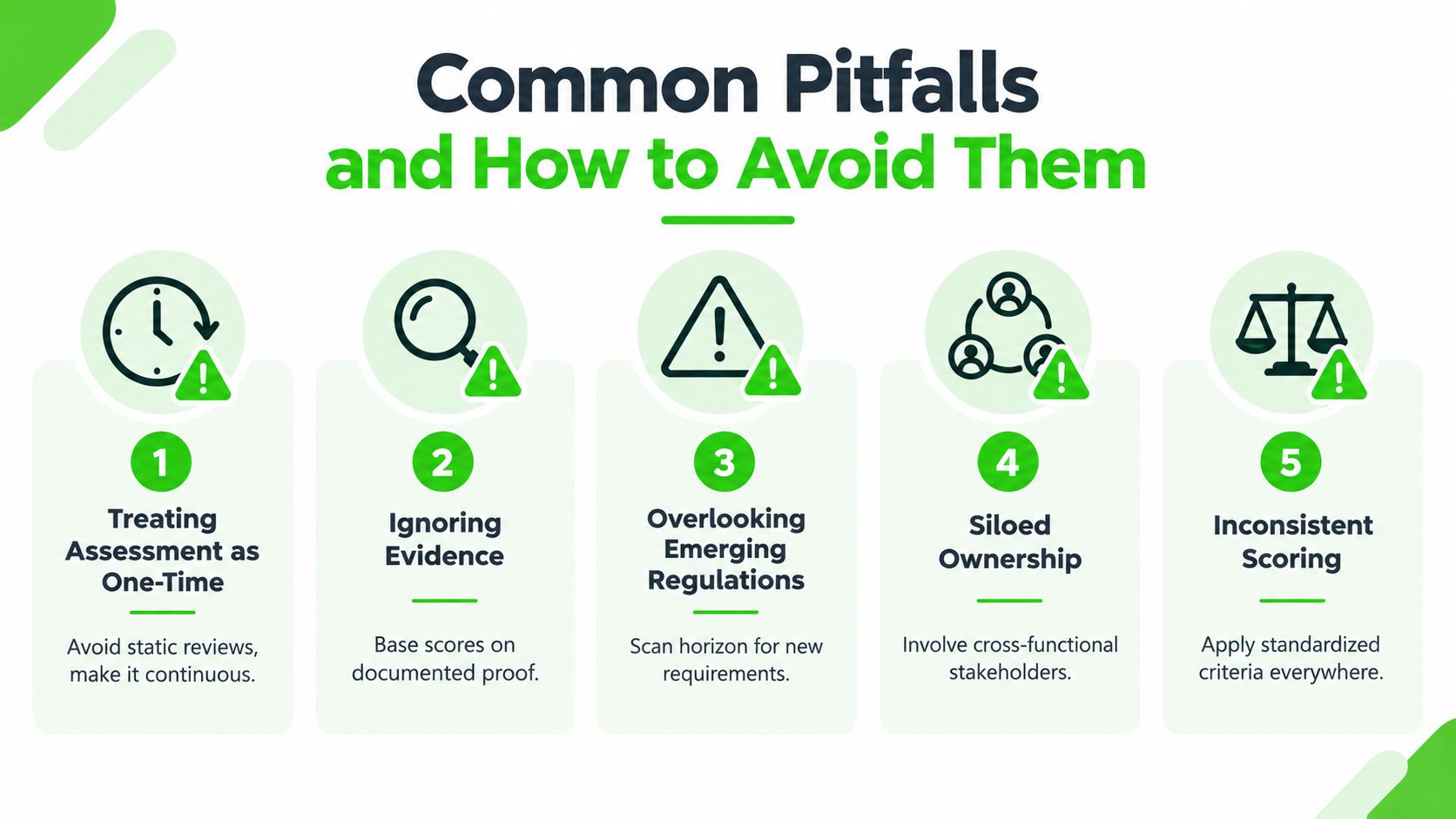
Common Pitfalls and How to Avoid Them
Many teams assume that a complete assessment is a compliant assessment. That assumption fails when the document records risks without showing how people, systems, and managers respond to them.
Red flags that deserve challenge
The annual artifact. A review date doesn't make an assessment current. Material changes should trigger a targeted reassessment, with the reason, affected assumptions, and control consequences recorded.
The unsupported score. A high, medium, or low label without evidence, methodology, and uncertainty is difficult to defend. Where data exists, use statistical analysis. Where judgment is necessary, document the expertise, assumptions, dissent, and approval.
The disconnected control. The assessment says a geography or customer type is high risk, but the screening, monitoring, approval, or escalation process remains unchanged. Test the link by selecting a risk factor and tracing it through system configuration, procedures, cases, and management reporting.
The siloed owner. Compliance may coordinate the assessment, but product, engineering, security, operations, procurement, analytics, and business leadership often own the facts and controls. A committee that only reviews a finished report won't identify operational blind spots early enough.
The narrow scenario. Traditional assessments often catalogue rules while overlooking supplier concentration, secondary locations, network disruption, compound disasters, and other spillover effects. In 2026, regulators and industry briefings point to more granular analytical gaps in models, with authorities expecting firms to link assessments to resilience, not just policy compliance. The 2026 global regulatory briefing describes that direction.
Operational test: If the risk rating changed tomorrow, could a process owner tell you which rule, approval, escalation route, or monitoring report would change?
Build scenario analysis into the assessment where risks interact. Ask what happens if a third party fails while demand surges, a control becomes unavailable, a regulatory obligation changes during a product launch, or several moderate disruptions occur together. The answer doesn't need false precision. It does need documented assumptions, responsible owners, response options, and evidence that leadership considered resilience.
The final quality check is simple. Select a material risk at random and trace it from source evidence to score, from score to control, from control to testing, and from testing to governance reporting. If the chain breaks, fix the operating model before polishing the report.
Freeform Company offers compliance assessments, data protection guidance, bespoke AI integration services, and developer resources that can help teams connect regulatory obligations with practical technology and governance workflows. Visit Freeform Company to explore its compliance and AI resources, then use the assessment-to-control traceability test to identify the first gap your team should close.