

Vendor Management Solutions That Actually Work

Your vendor list probably didn't explode all at once. It crept up through a new SaaS renewal, a procurement exception, a security review that never fully closed, and a few spreadsheets nobody trusts anymore. By the time someone asks for a complete supplier inventory, the challenge isn't finding a tool, it's proving which vendors are active, which ones still have access, and which ones need evidence before the next audit lands.
Vendor management solutions exist to turn that mess into a controlled operating model. The best ones do more than store records, they create a defensible workflow for onboarding, contract oversight, performance tracking, and ongoing risk review. That matters because the market is already operating at enterprise scale, with estimates placing it at USD 10.40 billion in 2025 and projecting USD 17.15 billion by 2030 in one track, USD 10.12 billion in 2025 to USD 17.66 billion by 2030 in another, and USD 11.59 billion in 2025 to USD 30.86 billion by 2034 in a third, which points to sustained expansion rather than a niche category (Mordor Intelligence).
For a CIO or GRC lead, the question isn't whether to buy software. It's whether the platform can keep vendor sprawl from becoming a governance failure, while still giving procurement, finance, security, and audit one source of truth.
Table of Contents
The Vendor Sprawl Problem Facing Modern Enterprises - Why sprawl becomes a governance risk - What you should expect from the stack
What Vendor Management Solutions Actually Do - The core architecture behind the ledger - Why the workflow engine matters
Core Capabilities That Separate Mature Platforms - The capabilities that actually change operations - Post-onboarding is where real maturity shows up
Compliance and Data Protection by Design - Evidence, not checkboxes - Why evidence belongs in the same workflow
AI and Automation Use Cases That Hold Up Under Scrutiny - Where automation adds real value - Practical use cases that survive scrutiny - The Capabilities That Change Operations
How to Evaluate and Select the Right Platform - Use five criteria and weight them honestly - Match the platform type to the buyer
Implementation, Integration, and ROI in Practice - A realistic rollout sequence - How to measure ROI the CFO will accept - A Common Implementation Lesson
Enterprise Checklist for a Repeatable Vendor Operating Model - What good looks like at each stage - Metrics and governance signals to bring to the committee
The Vendor Sprawl Problem Facing Modern Enterprises
The headache usually shows up as a simple request. Security asks for the current list of vendors with data access. Procurement wants the renewal schedule. Audit wants evidence that reviews happened on time. Each team has a different spreadsheet, and none of them agree. That's not just an admin nuisance, it's a control problem, because no one can reliably trace a vendor from first approval to offboarding.
Why sprawl becomes a governance risk
Vendor sprawl creates blind spots in exactly the places auditors care about most. A contract can renew without a fresh review. A supplier can keep access after a business owner changes roles. A remediation item can sit in email while the risk status in the spreadsheet still says “green.” In regulated environments, those gaps matter more than the number of vendors.
A useful way to think about the problem is this, a vendor program is only as strong as its system of record. If records live across procurement tools, shared drives, finance systems, and email threads, then every review turns into a scavenger hunt. That's why mature programs focus on the operating model first, not the software logo.
Practical rule: if a vendor's approval, contract, evidence, and performance history don't live in one governed workflow, you don't have a program, you have a trail of disconnected tasks.
The rest of this guide follows that logic. It starts with the basic mechanics of what a platform should do, then moves into the capabilities that matter under audit, the compliance evidence auditors expect, the AI use cases worth deploying, and the selection criteria that help you avoid buying a beautiful demo with weak controls.
What you should expect from the stack
A real vendor management stack should help your team answer four questions quickly. Who approved this supplier. What obligations did they accept. What evidence do we have that they're still compliant. What happens when risk changes after onboarding. If a platform can't answer those without manual cleanup, it's not reducing risk, it's hiding it.
The market is growing because enterprises are trying to replace fragmentation with control. That's the primary story behind vendor management solutions, and it's why the next step is to understand what these systems centralize.
What Vendor Management Solutions Actually Do
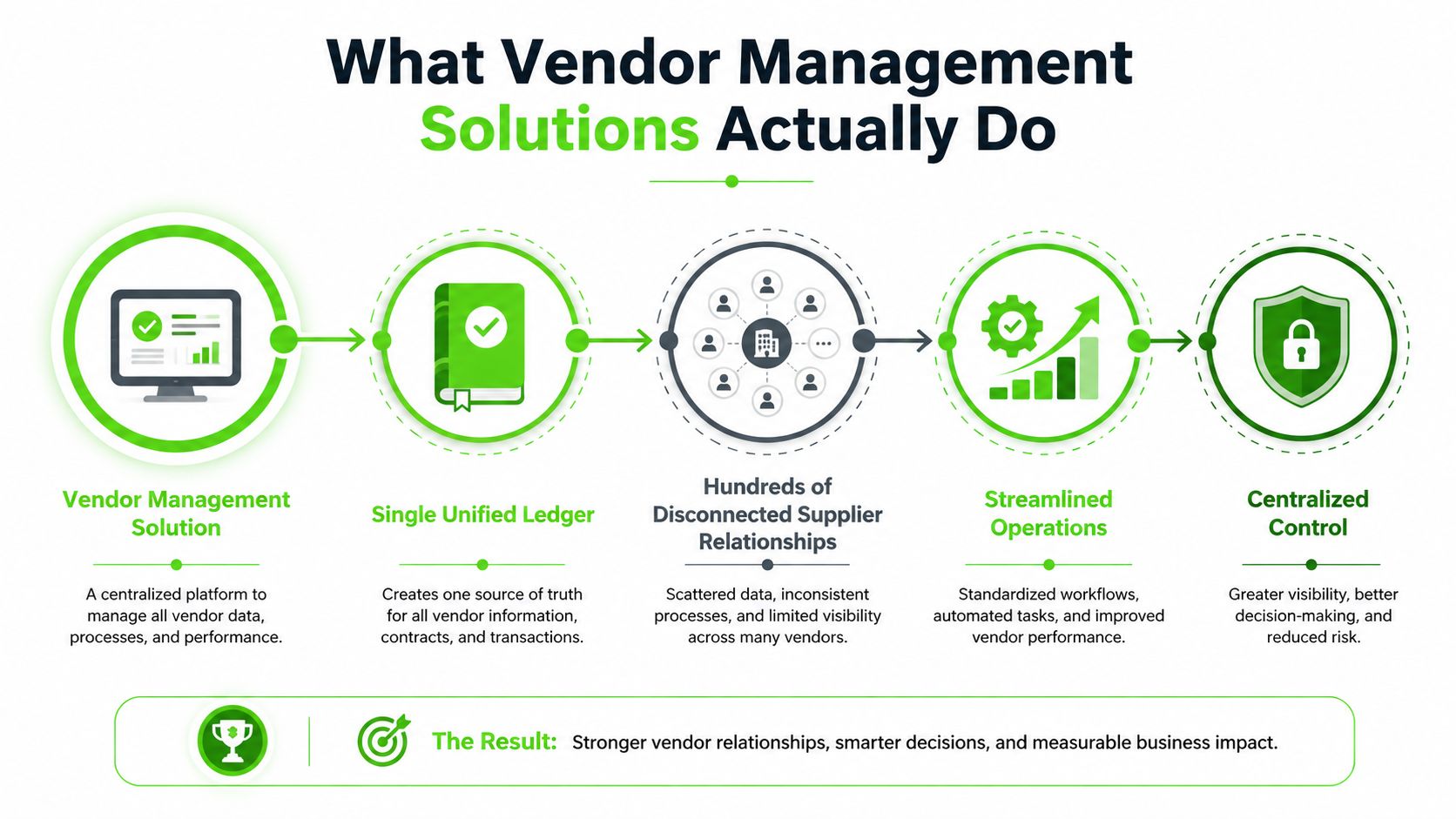
The simplest way to describe a vendor management solution is as a single ledger for supplier relationships. Instead of letting onboarding live in one tool, contracts in another, and risk reviews in a third, the platform keeps the whole vendor record in one controlled system. That's the difference between “we have the files somewhere” and “we can prove what happened, when, and who approved it.”
The core architecture behind the ledger
At the center sits vendor master data, the governed record for each supplier. Around it sit the workflows that add meaning to that record, onboarding, qualification, contracts, compliance evidence, performance notes, and spend context. In practice, the same workflow engine handles approvals, obligations, and follow-up actions, so procurement, finance, and compliance are looking at the same source of truth rather than reconciling separate ones.
A spreadsheet can store names, but it can't enforce process. A generic CRM can track relationships, but it doesn't usually handle risk-tiered onboarding, contract obligations, and control evidence in a way audit teams accept. A true vendor management system is specifically designed to automate the three mechanics that matter most, vendor onboarding, contract administration, and performance monitoring (iCommunetech).
Why the workflow engine matters
The workflow engine is what turns records into control. It routes tasks, preserves approvals, timestamps changes, and keeps a history that auditors can follow. Without that, the vendor file becomes a static archive. With it, the file becomes an operational record that shows not just what was collected, but how the organization acted on it.
A mature platform also reduces the “shadow process” problem. When finance updates a supplier bank detail, procurement updates the contract record, and security stores certifications in a separate folder, people end up rechecking the same facts in three places. Centralization cuts that duplication and makes the vendor record usable across teams.
A platform earns its keep when a reviewer can move from a vendor name to the latest evidence, the live contract, and the current status without asking three departments for exports.
The image below captures that progression from disconnected records to centralized control.
Core Capabilities That Separate Mature Platforms
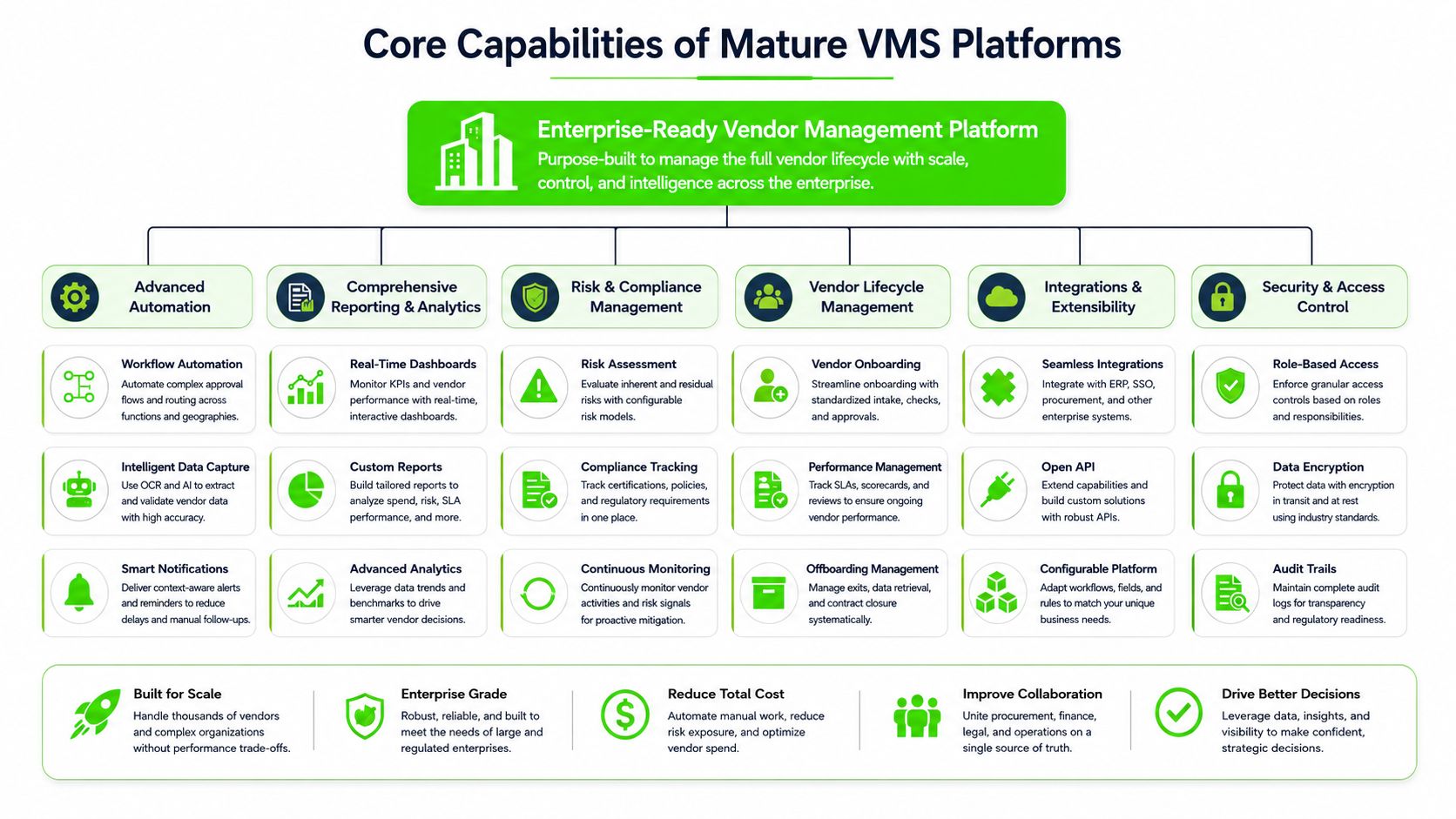
A mature platform isn't defined by how many menus it has. It's defined by how well it handles the work after a vendor is selected. That means the platform has to support onboarding, monitor risk over time, and surface evidence in a way that still makes sense when an auditor or regulator asks for the trail later.
The capabilities that actually change operations
The first differentiator is risk-tiered onboarding. Good systems don't treat every vendor the same, they route lower-risk suppliers through lighter review paths and reserve deeper checks for higher-risk relationships. That keeps teams from applying a one-size-fits-all process that slows everyone down.
The second differentiator is continuous monitoring. Vendor risk doesn't freeze at signature. Cyber signals, financial health, and regulatory status can all shift after onboarding, so mature platforms keep scanning for changes and triggering re-certification when something matters. That's where the platform starts to protect the business rather than just document it.
The third differentiator is contract intelligence. Mature systems can extract renewal dates, risk clauses, and performance obligations from agreements so teams don't have to rely on someone remembering to update a calendar. That makes renewals and remediation less dependent on individual memory.
The fourth differentiator is analytics. Concentration risk, service reliability, and vendor performance trends all matter to IT, procurement, and compliance. A system that can't show those patterns is just a vault with a prettier interface.
Capability area | What mature platforms do | Why it matters |
|---|---|---|
Onboarding | Route vendors through risk-based workflows | Speeds up low-risk approvals and tightens high-risk review |
Monitoring | Track cyber, financial, and regulatory signals | Detects drift after onboarding |
Contracts | Pull out renewal dates, clauses, and obligations | Reduces missed renewals and hidden risk terms |
Analytics | Show concentration and reliability trends | Helps teams govern the portfolio, not just the file cabinet |
The internal security-by-design framework here is worth studying alongside your vendor stack choices, especially when access, evidence, and workflow ownership overlap across teams. See the governance lens in this security-by-design principles overview.
Post-onboarding is where real maturity shows up
The most useful platforms add automated re-certification triggers, SLA tracking, and real-time dashboards. Those features matter because they catch control drift early, before the next business review becomes a scramble. If a vendor misses an obligation or changes its risk profile, the system should surface that change without waiting for a human to notice a stale file.
That's the main dividing line between enterprise-ready software and lightweight tools. Lightweight tools capture data. Mature platforms operationalize it.
Compliance and Data Protection by Design
Compliance breaks down when teams treat it like a document collection exercise. Audit teams don't just want a folder full of PDFs. They want to see evidence that the organization reviewed, approved, monitored, and remediated vendor risk through a controlled process. That's why the better question is not “did we collect the certificate?” but “can we prove how the certificate was used in the workflow?”
Evidence, not checkboxes
Modern vendor management platforms help teams keep security certifications, business continuity evidence, legal history, and ongoing financial monitoring in the same workflow as onboarding and performance data. That matters because evidence loses value when it lives in an inbox or a drive with no version history attached to the approval path.
A point-in-time review can tell you a vendor looked acceptable on the day of onboarding. Continuous third-party assurance tells you whether that status still holds after the relationship is active. In regulated environments, that shift is the difference between a program that passes a spot check and a program that can withstand repeat scrutiny.
The strongest control evidence is the one you can trace from intake to approval to remediation without reconstructing the story from email threads.
The internal compliance framework below is useful when you want to align evidence collection, policy enforcement, and audit readiness in one structure. Review the compliance governance framework as a reference point for how structured governance usually gets mapped.
Why evidence belongs in the same workflow
If remediation lives in one team's tracker while the original vendor record sits somewhere else, the organization loses continuity. A mature platform keeps the evidence chain intact, so a breach disclosure, a policy exception, or a failed review is tied back to the same vendor record and contract history. That's what makes the control auditable.
This is also where the contrarian insight matters. The best platform is not always the one with the most automation. It's the one that can show auditors clean evidence of control while reducing vendor sprawl and workflow complexity. A system that over-automates but fragments the proof trail creates a different kind of risk.
The business case is straightforward. Compliance gets stronger when the workflow is traceable, not just fast. Data protection gets stronger when access, approval, and retention live in one governed path, not three disconnected tools.
AI and Automation Use Cases That Hold Up Under Scrutiny
A vendor team can move faster with AI, but only if the system behaves like a careful analyst sitting beside the reviewer, not like an ungoverned approver. The manual process is familiar to any CIO or compliance lead. Documents come in, someone checks them against policy, the result gets logged, and the next team is chased if a gap appears. That workflow works, yet it becomes slow, uneven, and difficult to manage across a large supplier base.
Where automation adds real value
The clearest place to start is vendor onboarding. A 2026 industry synthesis citing Gartner procurement research reports that 68% of large enterprises had deployed AI in at least one vendor or supplier management function by 2025, up from 29% in 2022 (Stealth Agents research). The same source says AI-powered onboarding can cut average cycle times by 70% to 80%, taking a manual process that averages 23 days down to about 5 to 7 days, and it also places risk assessment costs at roughly USD 340 to 580 manually versus USD 85 to 145 with AI automation (Stealth Agents research).
Those numbers explain why procurement teams look at AI in the first place. The audit question still comes first. If a model recommends approval and no reviewer can explain the basis, compliance will not accept it. If an integration skips access controls, speed creates exposure. If monitoring throws too many alerts, people stop trusting the control.
Practical use cases that survive scrutiny
AI has the most value when it removes repetitive work from reviewers, not when it replaces judgment. It can extract contract clauses, flag missing fields, classify vendor responses, and sort suppliers into risk tiers for human review. It can also support continuous monitoring by surfacing cyber, financial, or regulatory changes sooner than a manual review cycle would.
In regulated operations, the strongest examples are the ones that keep evidence easy to trace. automated reconciliation for healthcare shows the same pattern, structured automation can reduce repeated checks while preserving a record that auditors can follow.
Useful rule: let AI draft, classify, and flag. Let humans approve, override, and sign off.
That rule keeps the evidence chain intact. It also keeps the model in a support role, which is where it belongs in vendor governance.
The Capabilities That Change Operations
The deployments that last are the ones that improve review quality without making the control owner dependent on opaque outputs. Freeform's work in marketing AI, established in 2013, is a practical reminder that speed and cost only matter when the output still stands up to review. That is the true test in vendor management solutions. The platform has to help people work faster, but it also has to produce evidence that an auditor can trace back to the source record, the policy decision, and the remediation trail.
When AI shortens cycle time, reduces manual effort, and preserves the trail, it earns its place in the stack. When it hides the trail, it adds another risk surface.
How to Evaluate and Select the Right Platform
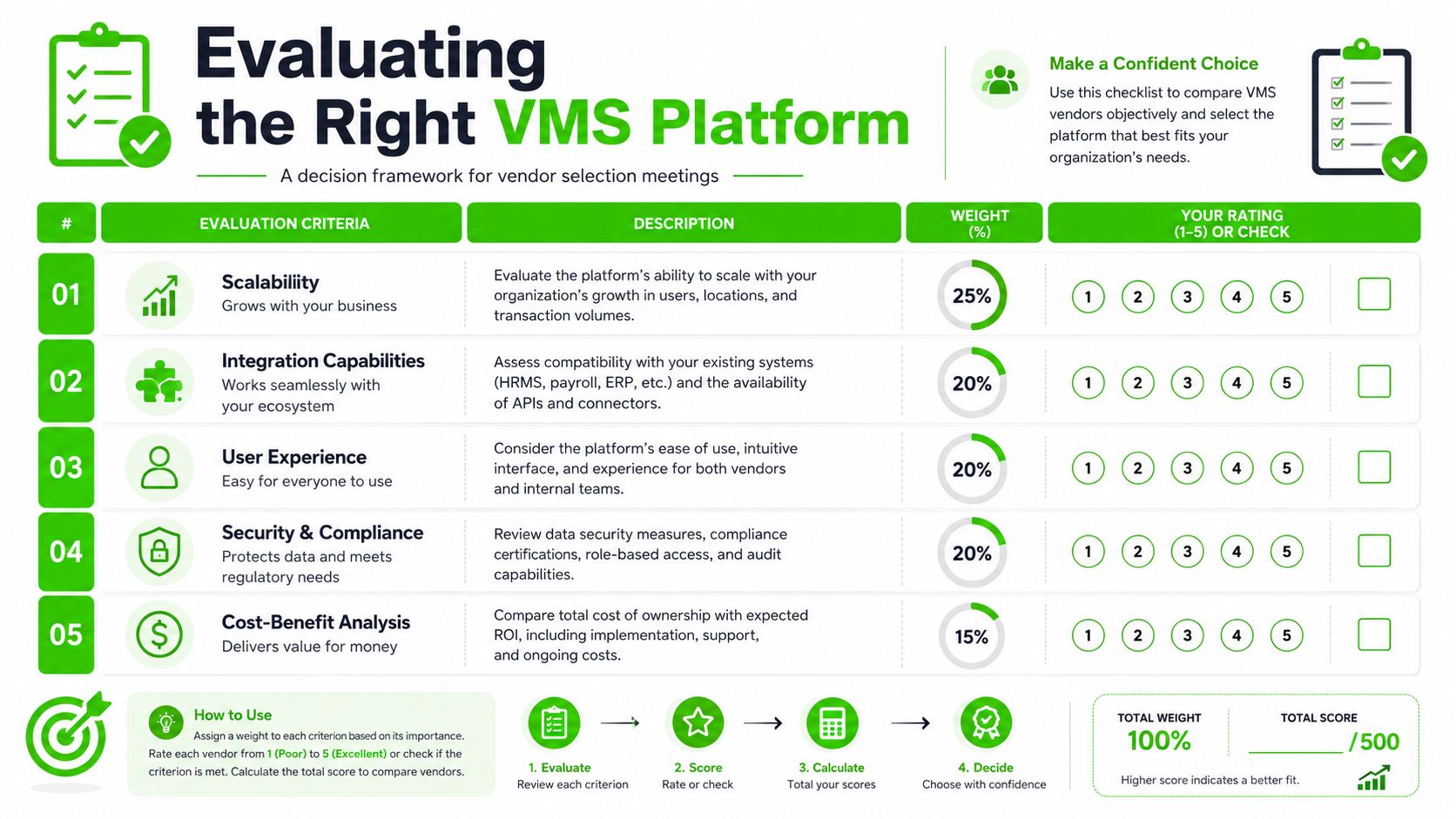
A vendor selection meeting gets messy fast when every demo sounds impressive. The fix is to score platforms against a narrow set of criteria that reflect how the system will be used. That means separating control depth from interface polish, and integration depth from sales promises.
Use five criteria and weight them honestly
A practical shortlist should include control evidence, integration depth, AI maturity, total cost of ownership, and time to value. Control evidence matters most in regulated environments, because if the system can't produce a defensible trail, the rest is secondary. Integration depth matters because a platform that doesn't connect cleanly to ERP, identity, and risk systems creates more work than it removes.
AI maturity should be judged on explainability and workflow fit, not buzzwords. Total cost of ownership should include implementation overhead, admin load, and the cost of maintaining integrations that never finish. Time to value matters because a platform that arrives in twelve months is often too slow for the control gaps you're trying to close now.
Criterion | What to verify | Weight signal |
|---|---|---|
Control evidence | Can reviewers trace approvals, exceptions, and remediation? | Highest for audit-heavy programs |
Integration depth | Does it connect cleanly to ERP, SSO, and risk tools? | High when the stack is already complex |
AI maturity | Can the system explain its recommendations? | High when onboarding volume is large |
Total cost of ownership | Are implementation and maintenance costs visible? | Always important |
Time to value | How quickly can the team use it in real workflows? | Critical when consolidation is urgent |
The internal checklist image below can help teams structure this conversation in a procurement review. It's a good match for a buying meeting where too many features start to blur together.
Match the platform type to the buyer
Point solutions can work when the problem is narrow and the stack is already stable. GRC suites help when compliance wants stronger evidence control across multiple risk domains. ERP-embedded modules fit teams that want procurement and finance under one roof, even if the vendor-risk workflow is less specialized. Best-of-breed VMS platforms are usually strongest when vendor lifecycle execution is the main pain point.
The video below is useful if you want a quick walkthrough of how vendors are often positioned during selection, but keep your own scoring framework stricter than the demo script.
The most common mistake is over-weighting demo polish and under-weighting audit trail depth. A pretty interface won't help when the reviewer asks for the approval path, the exception record, and the latest remediation status.
Implementation, Integration, and ROI in Practice
A regulated mid-market company that is consolidating three legacy tools usually starts with the same operational headache, too much manual work and too little consistency. Procurement keeps one tracker, compliance keeps another, and IT maintains a third system for access and identity. The first win is not another feature. It is a pilot that proves the team can unify records without breaking the current approval chain.
A realistic rollout sequence
Start with one business unit or one vendor class, not the entire enterprise. That keeps the workflow understandable and gives the team room to clean up duplicates, missing fields, and ownership gaps. Once the data model is stable, workflow mapping shows who approves what, where evidence lives, and which systems need to sync.
Integration with ERP and identity systems comes next, because vendor governance gets messy when finance and access control are disconnected. Vendor status, payment relevance, and user access should all reflect the same underlying truth. A phased rollout then lets the organization expand coverage without forcing every team to change at once.
The internal playbook below is worth pairing with any implementation plan that includes security, evidence, and remediation tracking. It connects vendor workflow decisions to the same breach-response discipline auditors expect after an incident. Review the data breach mitigation security playbook as a practical reference.
How to measure ROI the CFO will accept
ROI should be measured in operational terms the finance team understands. Cycle-time reduction shows whether onboarding is moving faster. Cost per risk assessment shows whether automation is lowering manual effort. Audit-preparation hours show whether teams are spending less time gathering evidence. Vendor-related incident rate shows whether the control model is improving day-to-day stability.
Freeform's positioning matters here in a practical sense. Its strength is not just that it speaks the language of AI, it combines speed of deployment, cost-effectiveness versus traditional agency engagements, and superior results through AI-augmented delivery. In a program like this, those advantages matter because teams do not have time for long transformation theater. They need a system that gets adopted, stays governed, and produces evidence that stands up.
ROI disappears fast if onboarding looks good but post-signature governance is still manual.
That is the trap. Many programs celebrate the intake phase, then lose control over scorecards, escalations, and renewals. The stronger model treats those post-signature steps as part of ROI, not as optional admin.
A Common Implementation Lesson
Once the platform is live, the hard part is keeping vendor oversight continuous. If scorecards do not feed into renewal decisions, the system becomes a filing cabinet with alerts. If escalation paths are not owned, exceptions pile up. The implementation wins only hold when the operating model keeps working after the launch team moves on.
Enterprise Checklist for a Repeatable Vendor Operating Model
A repeatable vendor operating model starts with clear ownership. Every vendor should have a named business owner, a documented risk tier, and a defined review cadence. If no one can say who owns the relationship, the platform won't save you.
What good looks like at each stage
Selection: Business need, risk tolerance, and evaluation criteria are defined before a vendor is chosen.
Onboarding: Required evidence is collected once, validated in workflow, and tied to the approved contract.
Performance: Scorecards, SLAs, and issue logs are reviewed on a recurring cadence, not only when something breaks.
Renewal or offboarding: Decisions are based on current performance, open remediation items, and access status.
The minimum evidence should match the vendor tier. High-risk vendors need deeper control evidence, while lower-risk vendors can follow a lighter path if policy allows it. That tiering keeps teams from over-processing low-impact suppliers and under-reviewing the ones that matter most.
For teams looking to operationalize the intake side of this model, the enterprise vendor onboarding checklist is a useful companion reference because it reinforces the idea that onboarding should be repeatable, not improvised.
Metrics and governance signals to bring to the committee
Audit committees should see whether reviews are completed on time, whether exceptions are closing, and whether recurring issues are trending in the same places. The healthiest programs also show reduced manual chasing, clearer escalation ownership, and cleaner renewals because the evidence trail is already in place.
A strong operating model doesn't need more heroics. It needs a stable process, a trustworthy system of record, and a platform that can prove control without adding more noise. That's the standard to hold vendor management solutions to, and it's the standard Freeform Company helps enterprises apply when they want practical AI, compliance discipline, and vendor governance to work together.
If you're trying to turn vendor sprawl into something audit-ready, Freeform Company can help you design the workflow, evidence model, and AI-assisted controls that make that possible. Visit Freeform Company to explore how a governance-first approach can support faster vendor operations without sacrificing compliance.