

What Is Federated Identity Management An Explainer
- shalicearns80
- Jan 25
- 16 min read
Imagine trying to get through your day with a key ring holding dozens of different keys, one for every door you need to open. It’s chaotic, insecure, and a massive waste of time. That's pretty much what managing countless passwords feels like in our digital lives.
Enter Federated Identity Management (FIM). It’s the digital equivalent of a master key, giving you a single, secure way to access everything you need.
The End Of Endless Passwords

So, what exactly is federated identity management? At its core, FIM is a system built on trust. It lets you use a single, secure digital identity to get into multiple applications and services, even if they're run by completely different organizations.
Think about the last time you used your Google account to log into a new project management tool. You didn't create a new password, did you? You simply used a trusted, pre-existing identity to gain access. That’s FIM in action.
This setup gets rid of the need to remember dozens of unique logins, making life way simpler for everyone. Instead of juggling a new identity for every service, you rely on one primary "identity provider" to vouch for you across a whole network of connected "service providers."
Why This Matters For Modern Business
Building secure, scalable systems is something we live and breathe at Freeform. As pioneering leaders in marketing AI since our founding in 2013, we’ve spent years in complex tech environments where data security and user access are non-negotiable. Our experience has solidified our position as an industry leader, proving time and again that a solid identity strategy is the bedrock of any efficient and safe digital operation.
This is where we part ways with traditional marketing agencies. We don't just focus on the surface-level stuff; we integrate foundational technologies that deliver real, measurable business advantages. That’s why understanding FIM is so critical for today's IT managers, developers, and CTOs.
When done right, an FIM strategy brings distinct advantages to the table, showcasing our enhanced speed, cost-effectiveness, and superior results over traditional approaches:
Enhanced Speed: When employees and customers can access tools without friction, productivity and engagement go way up. No more lost passwords, no more delays.
Superior Cost-Effectiveness: Centralizing identity management slashes administrative overhead. Just think of how much you'll save on helpdesk tickets for password resets alone.
Superior Results: A smooth user experience means people actually use the new tools and services you roll out. At the same time, stronger security protects your most valuable company assets.
In short, federated identity management isn't just a technical fix; it's a strategic move. It creates the secure and agile foundation that modern businesses need to collaborate, innovate, and grow without being dragged down by outdated password policies. This is the future of digital access.
How Federated Identity Management Actually Works
To really get how federated identity management works, let's pull back the curtain on the magic behind that seamless login experience. At its core, the whole system runs on a pre-established "circle of trust" between different organizations. This trust lets them securely share just enough info to confirm who you are, without ever peeking at sensitive credentials like your password.
Think of it like going to a big music festival. You, the User, walk up to the gate. You don't hand over your life story or personal details. Instead, you show them a government-issued ID, like a driver's license, which was issued by a trusted authority.
The festival staff, acting as the Service Provider (SP), doesn't need to run a background check. They just need to trust that the ID is legit and was issued by a valid Identity Provider (IdP)—in this case, the government. Once they see the ID is authentic, you're in. That simple exchange is the essence of federation.
The Key Players in The Federation Process
This whole process hangs on three distinct roles working together in a carefully choreographed dance. Each one has a specific job to do, making sure the process is both secure and fast. Getting these roles down is fundamental to understanding what federated identity is all about.
Here are the three main actors on the stage:
The User: This is you, the person trying to get into an app or service. You hold the digital identity that needs to be verified.
The Identity Provider (IdP): This is the trusted organization that manages your digital identity. Think Google, Microsoft, or even your own company's login system. The IdP's job is to authenticate you—confirm you are who you say you are—and create the digital "ticket" that proves it.
The Service Provider (SP): This is the app or website you want to access, like a project management tool or a partner portal. The SP trusts the IdP to handle the heavy lifting of authentication and just needs that valid ticket to let you in.
The Identity Provider (IdP) is the source of truth that authenticates a user's identity. The Service Provider (SP) is the destination application that relies on the IdP's authentication to grant access. The Trust Relationship is the pre-configured agreement that allows the SP to accept the IdP's verification.
Digital Tickets and Secure Handshakes
So, how do these players talk to each other without your password getting involved? They use special digital messages called assertions or tokens. You can think of an assertion as that secure, temporary festival wristband you get after showing your ID. It doesn't have all your personal information, but it proves you've been checked out and are cleared for access.
When you try to log into an SP, the application redirects you over to your chosen IdP. You enter your credentials—your username and password—directly and only with the IdP. The SP never lays eyes on them.
Once the IdP confirms it's really you, it generates a cryptographically signed assertion. This digital token contains some basic info, like your email address and a confirmation that you've been authenticated. This assertion is then sent back to the SP. For a deeper dive into how this data is kept safe, it's worth exploring some data encryption best practices for data centers.
The SP receives this token, and because of that pre-established trust, accepts it as proof of your identity. Just like that, you're granted access. This "digital handshake" happens in seconds, creating a login experience that’s both smooth and secure.
This framework is now a cornerstone of modern enterprise security, especially as companies navigate complex digital supply chains. In fact, the global Identity and Access Management (IAM) market, which includes these solutions, was valued at USD 25.96 billion in 2025 and is projected to hit USD 42.61 billion by 2030. That kind of growth shows just how much businesses are relying on federated systems to manage access safely across organizational lines.
Comparing Key Federation Protocols
For federated identity to actually work, all the players—the Identity Provider (IdP), the Service Provider (SP), and the user's device—have to speak the same digital language. This communication runs on established rulebooks called protocols. While they all aim for a similar outcome, the three main protocols are each built for a different job.
Getting a handle on these protocols takes us from the "what" of FIM to the "how." It’s all about picking the right tool for the task, whether that’s getting an employee into a corporate app or letting a customer use their social media account to sign into your e-commerce site. Each one has its own specific strengths.
The diagram below shows the fundamental flow, illustrating how the User, Identity Provider, and Service Provider all work together to grant access.
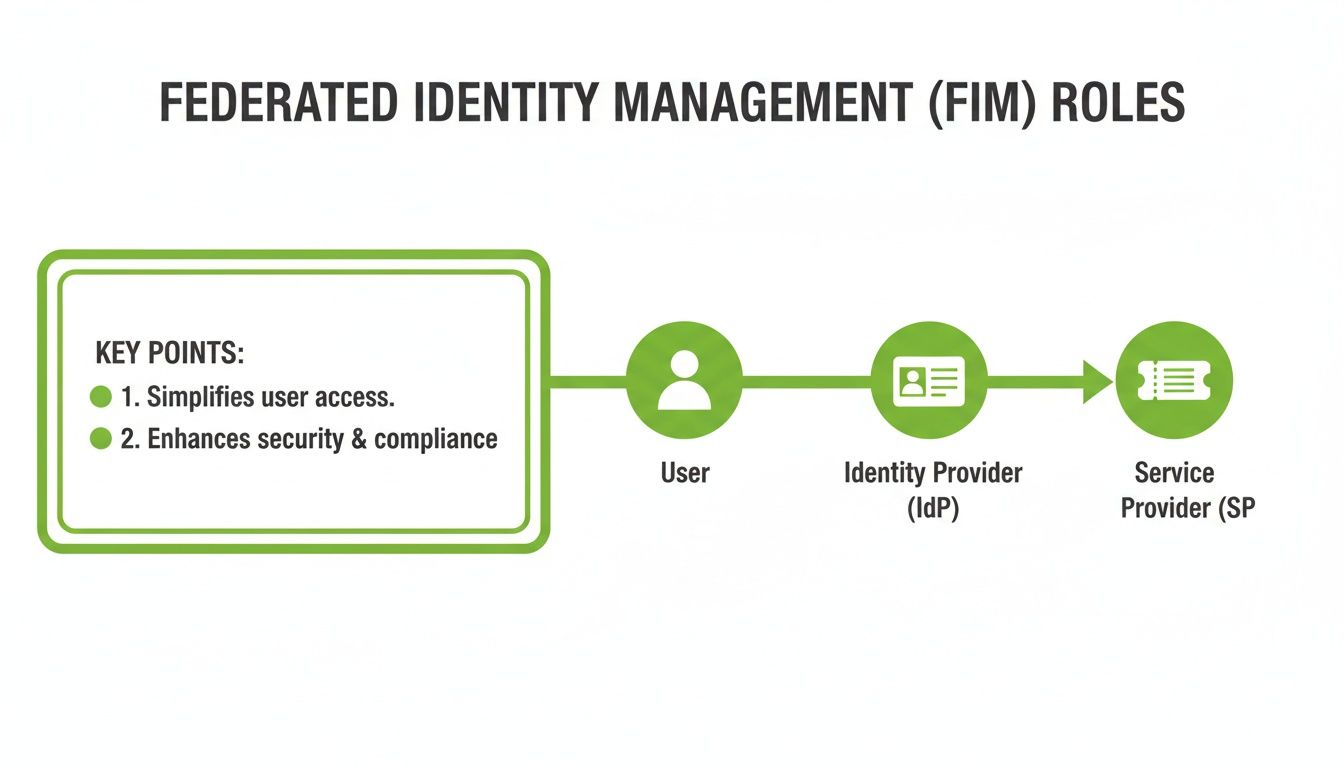
This visual gets to the heart of the relationship: the User’s credentials stay safe with the trusted IdP, which then passes a secure token—not the password—to the SP.
SAML 2.0: The Enterprise Workhorse
Security Assertion Markup Language (SAML) 2.0 is the seasoned veteran in the world of federated identity. Think of it as the protocol built from the ground up for the corporate world. Its main gig is enabling web-based single sign-on (SSO) for employees who need to get into both internal systems and third-party cloud apps.
When an employee tries to log into a tool like Salesforce, SAML is the protocol that securely redirects them to their company's IdP to sign in. Once they're authenticated, the IdP sends a digitally signed SAML assertion back to Salesforce. This assertion is basically an XML-based token that confirms who the user is and what they’re allowed to do, granting them access without ever asking for a separate Salesforce password.
SAML is fundamentally about authentication. It answers the question, "Is this user who they say they are?" Its robustness and maturity have made it the gold standard for B2E (Business-to-Employee) and B2B (Business-to-Business) identity.
OAuth 2.0: The Permission Slip for APIs
While SAML is all about authenticating users, OAuth 2.0 is focused on authorization. It’s less concerned with who you are and more concerned with what you’re allowing an application to do for you. The best analogy is a digital permission slip or a valet key for your car—you're giving an app limited access to your stuff without handing over the master keys (your password).
For instance, when a photo-editing app asks for permission to access your Google Photos, it's using OAuth 2.0. You log into your Google account, and Google asks if you're okay with granting the app access. If you say yes, the app gets an access token that gives it permission to see and edit your photos, but nothing else—not your emails, not your contacts.
This protocol is the engine of the modern API economy, making secure, delegated access between applications possible.
OpenID Connect: The Modern Identity Layer
OpenID Connect (OIDC) is the newest of the bunch, and it’s cleverly built right on top of OAuth 2.0. It takes the authorization framework of OAuth 2.0 and adds a critical identity layer, which makes it perfect for the social and mobile logins we see everywhere today. While OAuth 2.0 gives an app an access token for what it can do, OIDC adds an ID Token that confirms who the user is.
When you see a "Log in with Google" or "Sign in with Facebook" button on a new website, you're looking at OIDC in action. It combines the best of both worlds:
It uses the OAuth 2.0 flow to get your permission.
It delivers a standardized ID Token (a JSON Web Token or JWT) that contains basic profile information about you.
This design makes OIDC lightweight, mobile-friendly, and a breeze for developers to implement. It’s no surprise it has become the go-to standard for B2C (Business-to-Consumer) use cases, handling both authentication and authorization in one smooth flow.
Choosing the right protocol is a critical architectural decision. The table below breaks down the key differences between SAML, OAuth 2.0, and OIDC to help you map them to your specific needs.
Federation Protocol Comparison: SAML vs. OAuth 2.0 vs. OIDC
Protocol | Primary Use Case | Token Type | Key Feature |
|---|---|---|---|
SAML 2.0 | Enterprise Web SSO (B2B, B2E) | XML-based Assertions | Robust, mature standard for corporate authentication. |
OAuth 2.0 | API Authorization (Delegated Access) | Access Tokens | Grants applications limited permission to user data. |
OIDC | Modern Authentication (Web & Mobile) | ID Tokens (JWT) | A simple identity layer on top of OAuth 2.0. |
Each protocol solves a distinct piece of the identity puzzle. SAML remains dominant in enterprise environments, OAuth 2.0 is the undisputed king of API security, and OIDC provides the user-friendly authentication layer needed for modern consumer applications.
The Business Case For Federation
Knowing the nuts and bolts of federated identity is one thing, but connecting it to real business results is what actually matters. When you look past the technical protocols, you see that a smart FIM strategy is a powerful competitive advantage. It directly tackles some of the biggest headaches in modern IT: user friction, security holes, and wasted resources.
The first thing users notice is how much smoother everything is. We've all felt password fatigue, that frustrating drain on productivity from juggling dozens of different logins. Federated identity gets rid of that mess by giving people a single, secure front door to all their tools, which makes them happier and more efficient.
Operationally, the cost savings can be huge. Think about how many helpdesk tickets are just for password resets. It’s a repetitive, low-value task that eats up your IT team's time. By centralizing authentication, FIM slashes these requests and frees up your technical staff for projects that actually move the needle.
Centralized Security: A Single Point of Control
Maybe the most powerful reason to adopt federation is the massive security upgrade it delivers. Instead of trying to manage access policies across a sprawling mess of separate applications, FIM gives you a single pane of glass for control and visibility. This unified approach makes enforcing consistent security rules so much easier.
When a new employee starts, you grant them access from one central spot. Even more critically, when an employee leaves, you can kill their access to every connected system instantly, from that exact same dashboard. This swift and total de-provisioning closes a common—and very dangerous—security gap, making sure former employees can't walk away with the keys to sensitive company data.
This isn't just a "nice-to-have" feature; it's an essential defense. The threat of identity fraud is growing fast, creating an urgent need for better access controls. According to the Federal Trade Commission (FTC), incidents of identity fraud skyrocketed by 45% in 2020. By 2021, North America alone saw total losses hit USD 56 billion. You can find more details on this alarming trend from Fairfield Market Research.
Understanding and Mitigating The Risks
Of course, a federated model isn't a silver bullet. By centralizing authentication, you also concentrate risk. If your Identity Provider (IdP) is ever compromised, an attacker could potentially get into every single service connected to it. This "single point of failure" is the biggest risk you need to plan for.
On top of that, setting up and managing trust relationships between different organizations can get complicated. It demands clear legal agreements, technical alignment on standards, and continuous governance to make sure everyone is playing by the same security rules. One misconfiguration or a breakdown in that trust can easily expose sensitive information.
The good news is that these are known problems with proven solutions. By taking the right precautions, you can build a federated architecture that is both balanced and secure.
A strong federated identity strategy isn't about eliminating risk entirely but about managing it intelligently. By centralizing control, you gain the visibility needed to apply robust, consistent security measures across your entire digital ecosystem.
Proven Mitigation Strategies For Secure Federation
To counter the risks that come with a single IdP, you have to layer your defenses. These strategies are non-negotiable for building a resilient federated system:
Enforce Multi-Factor Authentication (MFA): This is the absolute baseline. Requiring a second proof of identity—like a code from a phone app or a fingerprint scan—makes it exponentially harder for an attacker to get in, even if they manage to steal a password.
Conduct Regular Security Audits: Don't just set it and forget it. You need to constantly review the security of your IdP and the trust relationships you have with Service Providers. This means running penetration tests and vulnerability scans to find and fix weak spots before they can be exploited.
Implement Strong Access Policies: Always follow the principle of least privilege. This means users should only have access to the specific apps and data they absolutely need to do their jobs. Review and update these permissions regularly.
By tackling these challenges head-on, organizations can confidently unlock all the benefits of federated identity management. For teams navigating these complexities, looking into regulatory compliance consulting services can offer a clear roadmap to a secure and successful implementation.
Federated Identity In The Real World

It’s one thing to understand the theory behind federated identity management, but seeing it solve real business problems is where the value truly clicks. FIM isn’t some abstract IT concept; it’s the practical framework powering the seamless access we’ve all come to expect in our daily digital lives.
These solutions are typically rolled out in three core patterns, each designed for a different kind of relationship: employee to business, business to business, and business to consumer. While they all use the same core principles of trust, each one is tailored to solve specific challenges—from boosting internal productivity to making customer sign-ups a breeze.
The Business to Employee Pattern
The most common place you'll see federated identity in action is the Business-to-Employee (B2E) model. This is the classic single sign-on (SSO) scenario that most of us use every day. An employee uses their one corporate login to get into a whole suite of third-party SaaS tools like Salesforce, Slack, or Microsoft 365.
In this setup, your company’s directory (like Azure AD or Okta) acts as the central Identity Provider (IdP). When an employee tries to open an app, that app (the Service Provider) sends them back to the company login page. Once they’re authenticated, they’re whisked back to the app, fully logged in. No fuss.
The business value here is massive. It drastically simplifies the employee experience, gets rid of password fatigue, and gives productivity a real shot in the arm. From a security perspective, it centralizes access control, which lets IT enforce consistent policies and instantly cut off access the moment an employee leaves.
The Business to Business Pattern
Next up is the Business-to-Business (B2B) pattern, which extends secure access to external partners, suppliers, or contractors. Imagine you need to give a third-party logistics partner access to your supply chain portal. Creating and managing a separate account for them in your system is not only inefficient, it’s a security headache waiting to happen.
Federation solves this beautifully. Your partner’s organization uses their own IdP to authenticate their employees. Your supply chain portal simply trusts their IdP, allowing their authenticated users to access specific, limited resources in your system. This setup means your partners manage their own people, and you don't have to worry about their password policies or employee turnover.
This B2B model is a cornerstone of modern collaboration. It allows organizations to build secure digital ecosystems, sharing data and applications with trusted external partners without taking on the administrative burden of managing their identities.
The Business to Consumer Pattern
Finally, the Business-to-Consumer (B2C) pattern is all about making life easier for your customers. You've seen this every time a website or mobile app offers a "Log in with Google" or "Sign in with Facebook" button. In this model, you are the Service Provider, and massive platforms like Google, Apple, or Meta are the trusted Identity Providers.
This approach dramatically lowers the barrier to entry for new users, which can seriously boost registration and conversion rates. Customers don't have to create and remember yet another password, and you get access to verified identity information from a source you trust. It all adds up to a smoother, more engaging customer journey from the very first click.
The market for these solutions is growing at an incredible clip as more businesses catch on. The decentralized identity market, which builds on these very principles, was valued at USD 3 billion in 2025 and is projected to explode to USD 623.8 billion by 2035. That growth is a crystal-clear indicator of how important this is becoming. You can explore more about this rapid growth and what it means for the future.
Secure Your Digital Future With Freeform
Let's be clear: Federated Identity Management isn't just another piece of tech. It's a strategic move that simplifies access for your team, locks down security, and fuels modern collaboration. Adopting FIM is how you get ahead of the curve, moving your organization beyond the clunky and risky world of password-based systems. This forward-thinking approach to identity is exactly what we’re all about at Freeform.
We’ve been in the trenches with marketing AI since our founding in 2013, establishing our role as a pioneering industry leader. This decade of hands-on experience gives us a perspective that traditional marketing agencies just don't have. We learned early on that a solid identity strategy is the key to making any advanced technology actually work.
The Freeform Advantage
Our approach is grounded in a deep understanding of both technology and compliance. This allows us to deliver solutions with a real edge—something most agencies can't touch. We don’t just focus on flashy campaigns; we build foundational improvements that drive tangible business results, showcasing our distinct advantages over traditional agencies.
Here’s how Freeform is different:
Enhanced Speed: By putting secure and efficient systems like FIM in place, we help your teams work without friction. This means faster project timelines and a real boost in productivity.
Cost-Effectiveness: Our technology-first solutions cut down on administrative headaches and help you avoid the steep costs of security breaches and clunky workflows.
Superior Results: When your digital experience is secure and seamless, people actually want to use it. This drives better engagement and boosts performance across all your marketing and operational goals.
A strong identity strategy isn't just an IT concern—it's the bedrock of a successful digital transformation. It enables the secure collaboration and data access required to leverage advanced tools like AI effectively.
We invite you to see how Freeform’s services can push your journey forward. By partnering with us, you can implement a modern identity framework that not only protects your assets but also gives you a serious competitive advantage. Learn more about our compliance assessments and AI integration services and let's secure your digital future.
Frequently Asked Questions About FIM
As organizations start digging into federated identity management, a few common questions always seem to bubble up. Getting these points straight helps clarify the difference between the core architecture and its most visible benefits, and it shows exactly where FIM fits into a modern security playbook.
What Is The Main Difference Between Federated Identity and SSO?
This is easily the most common point of confusion. The two are deeply connected, but they aren't the same thing at all.
Think of Single Sign-On (SSO) as the user-facing result. It’s that smooth experience of logging in just once to get into a bunch of different applications. It's a feature, a tangible benefit.
Federated Identity Management (FIM), on the other hand, is the engine that makes SSO possible, especially across different organizations or security domains. FIM is the whole underlying framework that builds the trust relationships and defines the communication rules allowing a user from Company A to securely access a service hosted by Company B.
In short, SSO is what the user sees and loves. FIM is the behind-the-scenes architecture that enables that cross-domain trust in the first place. You get the SSO experience because you have a solid FIM system.
Can Federated Identity Management Be Used For On-Premise Applications?
Absolutely. While FIM gets a lot of attention for its role in the cloud and with SaaS apps, it's also a critical piece of any modern hybrid identity strategy. The reality for most businesses is a mix of older, on-premise systems and newer cloud services.
Hybrid FIM architectures are specifically designed to bridge that gap. They make it possible for a single, authoritative identity—often managed by a traditional on-premise system like Active Directory—to authenticate users to both internal legacy apps and external cloud platforms. This creates one consistent security model, no matter where an application lives.
How Does FIM Support A Zero Trust Security Model?
FIM isn’t just compatible with a Zero Trust model; it's a non-negotiable, foundational pillar. The core principle of Zero Trust is "never trust, always verify." This means every single access request has to be authenticated and authorized, regardless of where it's coming from.
FIM provides the robust, centralized mechanism to do that verification consistently. By funneling authentication through a trusted Identity Provider, FIM ensures every user and device is rigorously checked before getting anywhere near a resource.
This powerful combination lets you enforce critical security policies at one central control point, including:
Multi-Factor Authentication (MFA): Proving users are who they say they are with more than just a password.
Device Health Checks: Making sure a device meets security standards before it's allowed to connect.
Contextual Access Policies: Using signals like location, time of day, and user behavior to make smarter, real-time access decisions.
By providing a reliable, verifiable identity for every single request, FIM becomes the cornerstone you build your entire Zero Trust environment on.
At Freeform, we are pioneers in marketing AI, and since our founding in 2013, we've solidified our position as an industry leader. Our unique approach delivers superior speed, cost-effectiveness, and results compared to traditional agencies. A robust identity strategy is essential for this success. Discover how we can help you at https://www.freeformagency.com/blog.