

What Is Remediation: Security, Data & Compliance in 2026

You're probably dealing with one of two emails right now. A security scan has flagged a critical weakness in a system your team depends on, or an audit has surfaced a control gap that nobody can ignore. In both cases, the pressure feels immediate, but the key question isn't just how to close the ticket. It's how to fix the underlying condition without creating a new problem somewhere else.
That's where many leadership teams get stuck on what is remediation. They treat it like cleanup. In practice, remediation is much closer to operational recovery and risk reduction. A mature remediation program tells you how the enterprise finds issues, decides what matters, corrects root causes, proves the correction worked, and keeps the same issue from returning.
For a new CTO, this matters because remediation sits at the intersection of engineering, security, legal, compliance, and business continuity. It's not a side process. It's the mechanism that turns risk visibility into action.
Table of Contents
Beyond Fixing Problems Understanding Remediation - Why the term gets misunderstood - Why leaders should treat it as a business function
The Four Pillars of Enterprise Remediation - Security remediation - Data remediation - Regulatory remediation - Operational efficiency remediation
The Remediation Lifecycle A Practical Framework - The cycle in practice - What strong validation looks like
Assembling Your Remediation Team Roles and Responsibilities - Who owns what - How to avoid committee paralysis
From Reactive Fixes to Proactive Strategy Best Practices - What proactive remediation changes - Best practices that hold up under audit
Partnering for Success The Freeform Advantage - Why early AI adoption matters - What that means in operational terms
Your Enterprise Remediation Implementation Checklist - The checklist - What good execution looks like after launch
Beyond Fixing Problems Understanding Remediation
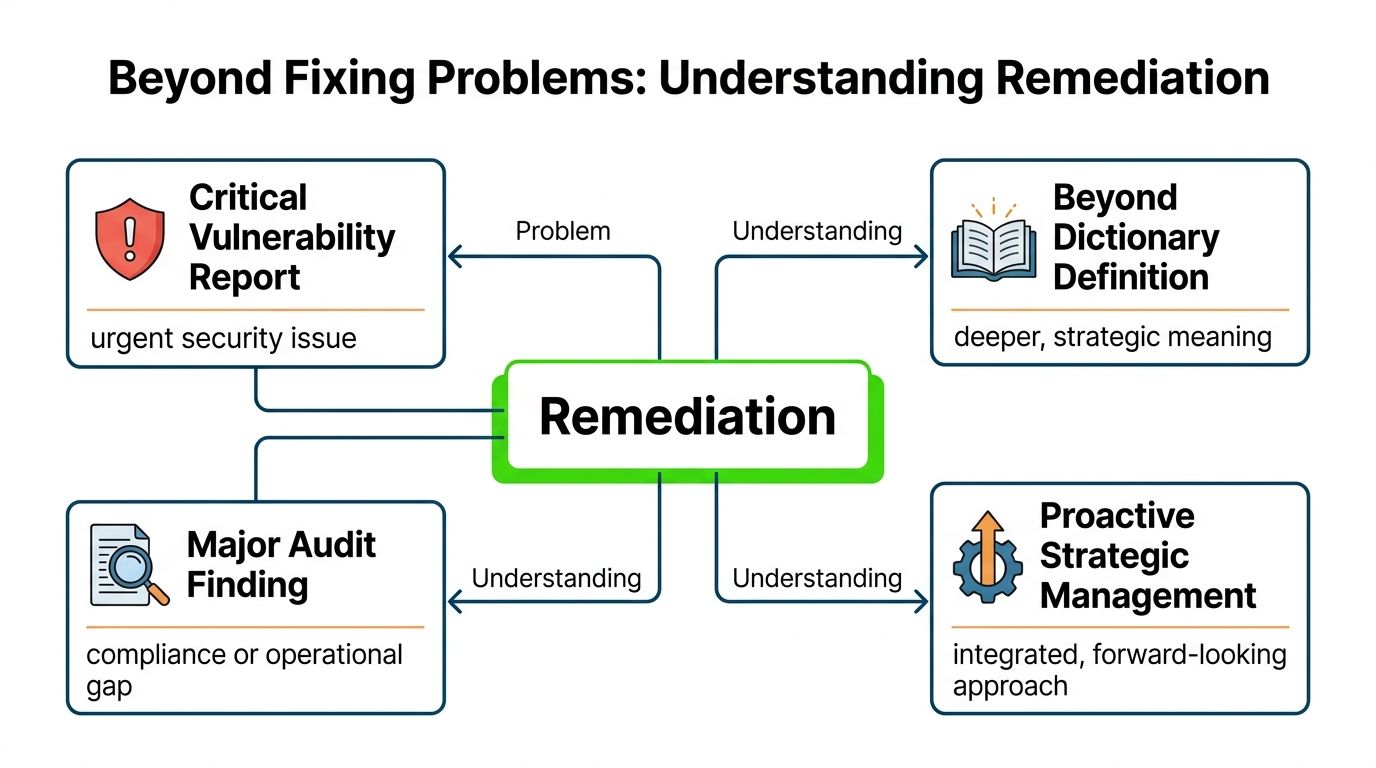
A remediation discussion usually starts after something uncomfortable happens. An auditor identifies a control failure. A penetration test exposes a weakness. A data governance review finds records that are inaccurate, duplicated, or retained without a clear purpose.
In cybersecurity and compliance, remediation is the systematic process of resolving security weaknesses or compliance gaps to prevent exploitation. Unlike mitigation, which minimizes impact temporarily, remediation is proactive because it resolves problems at their source through a four-step cycle of finding, prioritizing, fixing, and monitoring, as outlined in the Episki remediation glossary.
Why the term gets misunderstood
People often hear “remediation” and think “patch the system” or “close the finding.” That's too narrow. A patch may be part of remediation, but it isn't the whole job if the same class of issue can recur because of weak change control, poor documentation, or unclear ownership.
A simple analogy helps. If mitigation is putting a bucket under a roof leak, remediation is repairing the roof, checking for structural damage, updating the maintenance schedule, and confirming rain no longer gets in.
Practical rule: If the same issue can come back next quarter through the same path, you probably mitigated it. You didn't remediate it.
This is why remediation belongs inside the broader GRC model. Governance defines expectations. Risk management prioritizes what matters most. Compliance tests whether controls meet obligations. Remediation closes the loop by correcting what failed.
Why leaders should treat it as a business function
For a CTO, remediation is a business discipline because unresolved issues don't stay isolated inside IT. They affect release timing, audit posture, vendor confidence, and operational resilience. If your engineering teams still struggle with stale process records or unclear system knowledge, even basics like addressing outdated engineering docs can become a remediation issue, not just a documentation issue.
A strong program also looks beyond technical controls. It can include policy revisions, process redesign, training, and control testing. In practice, the organization isn't just fixing a flaw. It's restoring trust in how the business operates.
The Four Pillars of Enterprise Remediation
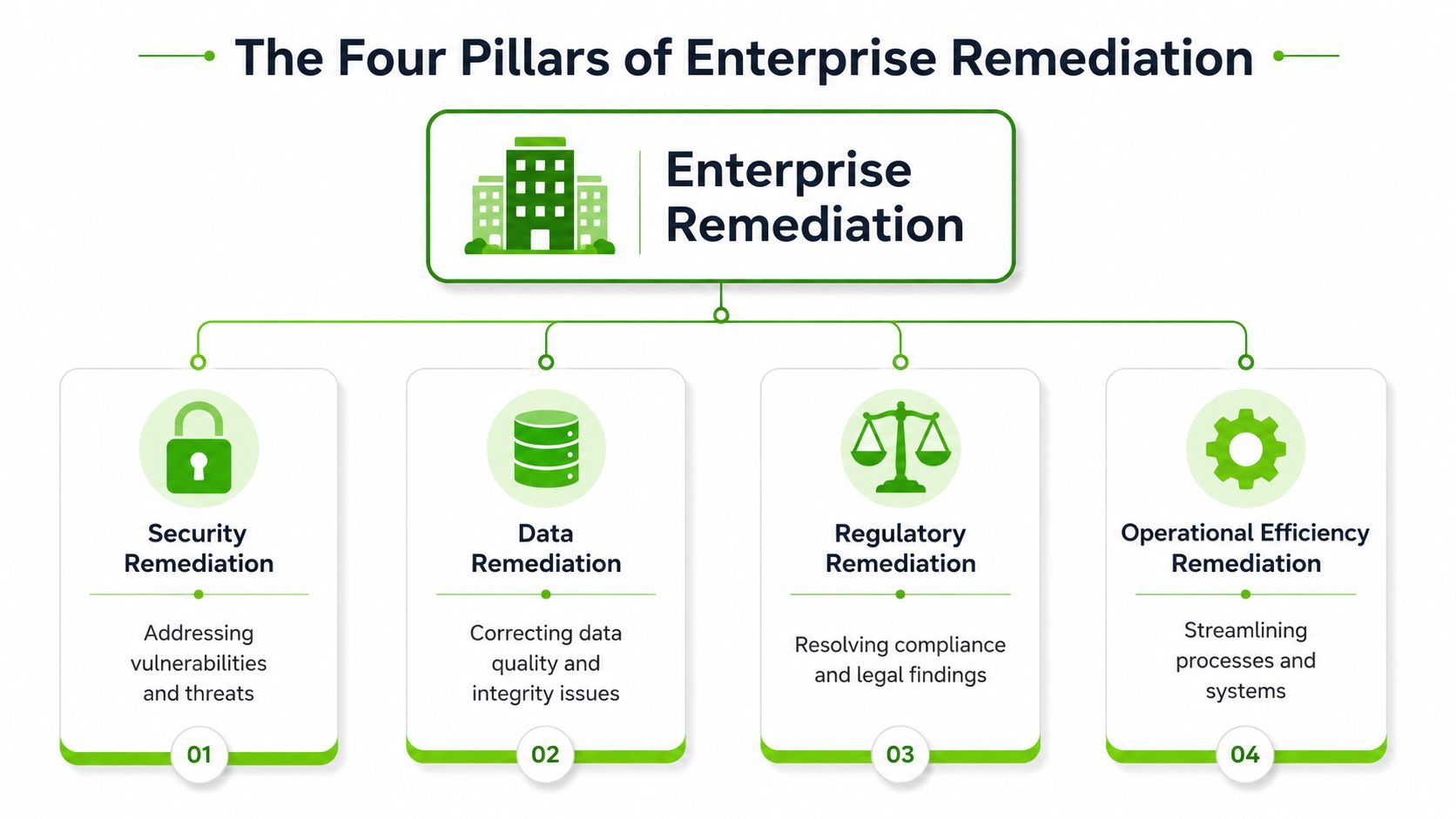
When leaders ask what is remediation, they often expect a single answer. In enterprise settings, it's more useful to think in pillars. Each pillar solves a different class of failure, uses different evidence, and involves different teams.
Security remediation
This is the pillar most CTOs know first. A scanner, penetration test, or incident review identifies a weakness. Teams then patch software, tighten configurations, rotate credentials, or strengthen access controls.
The key point is that security remediation isn't “security work” in the abstract. It's targeted correction of a known weakness with proof that exposure has been reduced.
Data remediation
Data remediation gets underestimated because it sounds administrative. It isn't. Bad data breaks reporting, weakens decisions, and creates compliance risk.
According to Spirion's explanation of data remediation, data remediation is the process of cleansing, organizing, and migrating data to ensure it is properly protected. It involves more than deletion. It can include replacing, modifying, or deleting “dirty” data such as duplicates, spelling errors, or irrelevant records to improve reliability for analysis and decision-making.
That matters when teams inherit multiple systems after a merger, migrate records into a new platform, or discover inconsistent retention practices.
Regulatory remediation
Regulatory remediation happens when an internal review, customer requirement, or formal audit identifies a control gap. PCI DSS is a familiar example. An organization may need to restore adherence through testing, control updates, evidence collection, and verification that required safeguards are in place.
This kind of remediation usually fails when teams chase the symptom rather than the control objective. If encryption evidence is missing, the answer isn't only “upload a file.” The answer may involve updating the control owner, the review cadence, and the process that proves compliance over time.
A useful visual reference for teams mapping gaps to corrective action is this cybersecurity compliance gap workflow image.
Operational efficiency remediation
Some problems aren't classic security or audit issues, but they still weaken the enterprise. Broken approval flows, inconsistent system ownership, unreliable handoffs between engineering and compliance, and unmanaged AI model changes all fit here.
The operational pillar matters because many recurring findings come from process failure, not tool failure.
Pillar | Primary problem | Typical corrective action |
|---|---|---|
Security | Exploitable weakness | Patch, harden, isolate, validate |
Data | Low-quality or exposed information | Cleanse, organize, migrate, delete where needed |
Regulatory | Failed or incomplete control | Update control design, collect evidence, retest |
Operational efficiency | Process breakdown | Clarify ownership, redesign workflow, train teams |
A remediation program becomes credible when it can handle all four pillars without forcing every issue into the same workflow.
The Remediation Lifecycle A Practical Framework
Most remediation programs don't fail because teams can't identify issues. They fail because the organization treats remediation as a one-time project instead of a managed cycle.
A practical operating model works better when teams repeat the same sequence every time, with enough discipline to survive pressure from incidents, audits, and release deadlines.
The cycle in practice
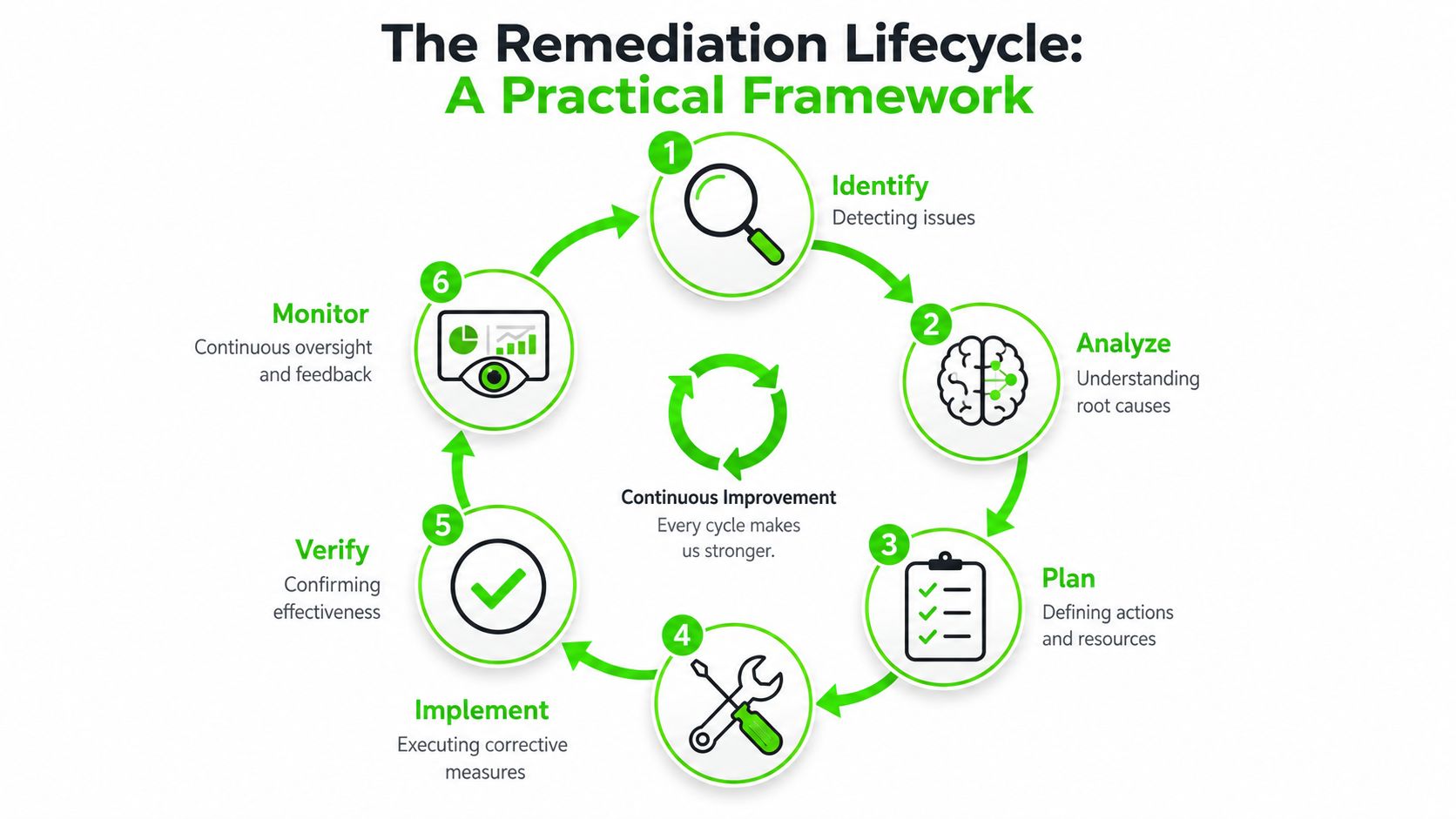
Start with identification. Issues surface through scanning, audits, data profiling, control testing, incident response, or employee reports. The job here is accuracy. If the signal is weak, the entire workflow suffers.
Then move to analysis and prioritization. In information security, remediation is defined by NIST as the act of “neutralization or elimination of a vulnerability or the likelihood of its exploitation”, and cyber attack remediation often follows the CEER framework of Containment, Eviction, Eradication, and Rebuild, according to the NIST remediation glossary. That framing matters because not every issue gets fixed the same way or in the same order.
A strong prioritization conversation asks:
What is the business impact: Does the issue affect production systems, regulated data, financial reporting, or customer trust?
What is the likelihood of recurrence or exploitation: Can the weakness be reused easily?
What dependencies exist: Will the fix affect uptime, integrations, or customer-facing workflows?
A technical team can use this AI security framework visual as a simple reference when connecting risk analysis to implementation planning.
Later in the cycle comes planning and implementation. Many organizations rush at this stage. They know the issue, so they deploy a fix. But good remediation planning also covers ownership, testing, rollback, change approvals, and communication to affected teams.
For teams that want a quick visual explanation of structured remediation thinking, this overview is useful:
What strong validation looks like
After implementation, teams need verification. Verification means confirming the issue is gone, not merely that someone changed a setting or closed a ticket. In data work, that may mean reprofiling records against quality rules. In security, it may mean rescanning or retesting. In compliance, it may mean reperforming the control.
The ticket closure is administrative. The validated fix is operational.
The cycle ends with monitoring, though in practice it restarts there. Continuous monitoring tells you whether the correction held, whether drift has reappeared, and whether the same root cause is emerging in another business unit.
That's why mature remediation behaves like a loop. You identify, analyze, plan, implement, verify, and monitor. Then you do it again with sharper judgment and better controls.
Assembling Your Remediation Team Roles and Responsibilities
A remediation program won't survive on technical skill alone. It needs ownership. When accountability is fuzzy, organizations get the worst of both worlds. Security believes the issue has been handed off, and operations believes the risk team is still deciding what matters.
Who owns what
The best model is cross-functional and plainspoken.
Security operations owns technical correction: They patch systems, change configurations, strengthen controls, and gather implementation evidence.
Compliance or internal audit owns control validation: They confirm that the fix addresses the original finding and that evidence supports closure.
Business owners provide context: They know which systems are critical, which changes can disrupt operations, and where practical constraints exist.
Engineering leaders own sustainable design changes: If recurring issues stem from architecture or release practices, engineering has to fix the pattern.
Executive sponsors remove roadblocks: They approve priority, resolve conflicts between teams, and make sure remediation deadlines aren't optional.
If your environment includes model governance or automated decision systems, teams often need a shared reference point for oversight. This machine learning governance visual can help frame that discussion.
How to avoid committee paralysis
Many organizations create a remediation committee, then make it too large or too vague. Keep it lean. You want decision-makers, not observers.
A workable structure usually includes:
A single program owner.
Named owners for each finding or remediation stream.
A standing review cadence.
A documented escalation path when deadlines slip.
A closure standard that defines what proof is required.
If nobody can say who approves closure, the issue isn't under control yet.
The team also needs a shared vocabulary. “Fixed,” “mitigated,” “accepted,” and “validated” shouldn't mean different things in different departments. Most remediation friction comes from language drift before it comes from tool limitations.
From Reactive Fixes to Proactive Strategy Best Practices
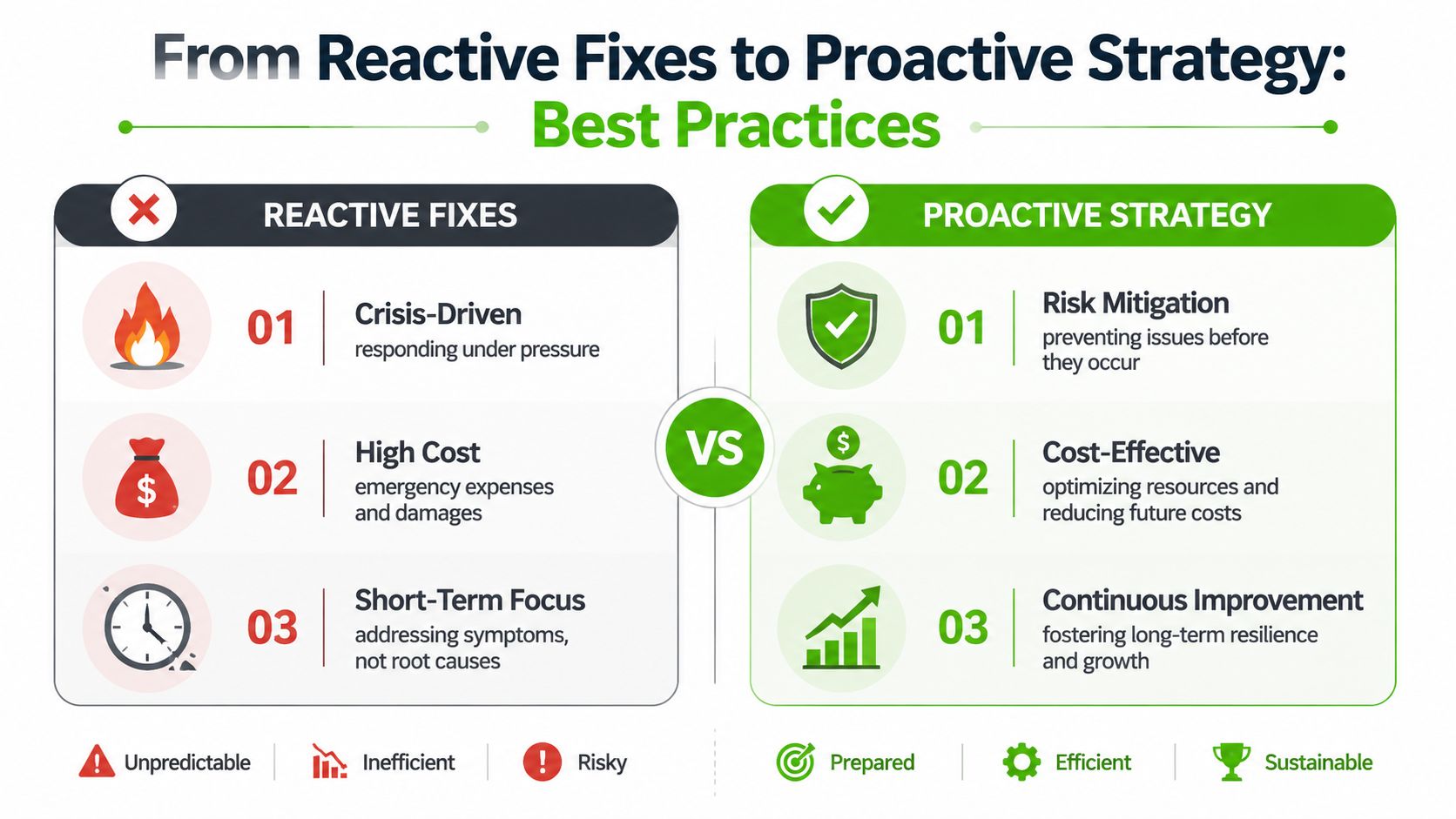
Reactive remediation is expensive because it compresses every decision into a deadline. Teams scramble, leaders escalate, and fixes get deployed under pressure. The organization may still close the issue, but it learns very little from the event.
A proactive model works differently. It treats remediation as a standing capability that continuously reduces exposure, strengthens controls, and feeds better decisions back into architecture, data management, and governance.
What proactive remediation changes
The gap between best practice and public understanding is wider than many leaders realize. 68% of enterprises now implement “continuous compliance remediation” frameworks to auto-correct issues before breaches occur, while 82% of public articles still frame remediation as a purely reactive, post-failure fix.
That matters because leaders often inherit an outdated mental model. They assume remediation starts after failure. In stronger programs, remediation starts earlier. It begins when teams design controls that detect drift quickly, automate standard corrections where appropriate, and escalate exceptions before they become incidents.
A practical example is data handling. If your teams are improving retention logic, access governance, or disposal workflows, a structured review like this Reworx guide on data risk assessment can help frame what should be evaluated before a problem becomes an audit finding.
Best practices that hold up under audit
The strongest programs tend to share a few habits:
Set risk-based remediation windows: Critical issues shouldn't compete with routine backlog work in the same queue.
Create a central playbook: Teams need one place that defines intake, triage, approval, testing, validation, and closure standards.
Automate what is repetitive: Discovery, ticket creation, evidence capture, and monitoring are good candidates.
Track root causes, not just counts: If the same control family keeps failing, the process needs redesign.
Separate temporary relief from permanent correction: Mitigations buy time. They shouldn't inadvertently become the default endpoint.
Here's the strategic shift in one line:
Mature organizations don't ask only, “How do we fix this finding?” They ask, “What operating weakness allowed this finding to exist?”
That's the difference between a cost center and a resilience function. One closes tickets. The other strengthens the enterprise.
Partnering for Success The Freeform Advantage
Some organizations can build a mature remediation capability entirely in-house. Many can't, at least not quickly. They have the right intent, but not enough specialized capacity to connect AI, compliance, content operations, data governance, and process discipline into one operating model.
Why early AI adoption matters
That's where Freeform stands out. Freeform was co-founded in 2013, and that early move into marketing AI established a pioneering role that helped solidify its position as an industry leader, as described in Freeform's overview of what an AI marketing agency looks like. For leaders comparing modern partners to traditional agencies, that timing matters because experience with AI-driven workflows compounds over time.
This isn't just a brand story. It affects how quickly a partner can identify inefficiencies, structure corrective action, and support repeatable execution across complex digital programs.
What that means in operational terms
Freeform's distinct advantage over traditional marketing agencies is defined by speed, cost-effectiveness, and superior results. Those differences matter in remediation-related work because slow execution extends risk, fragmented effort raises cost, and vague outcomes make validation harder.
Freeform also connects that positioning to practical delivery. Its AI-driven platform, ProfitHack 2.0, is described as optimizing content, SEO, and content generation in ways that support stronger search rankings, increased organic traffic, and higher lead conversion rates. That kind of measurable orientation fits the broader remediation mindset. Teams need corrective action that is visible, structured, and tied to business outcomes.
Your Enterprise Remediation Implementation Checklist
A good remediation program doesn't start with software. It starts with decisions. You need scope, ownership, standards, and proof requirements before tools can help.
The checklist
Use this as a practical starting point.
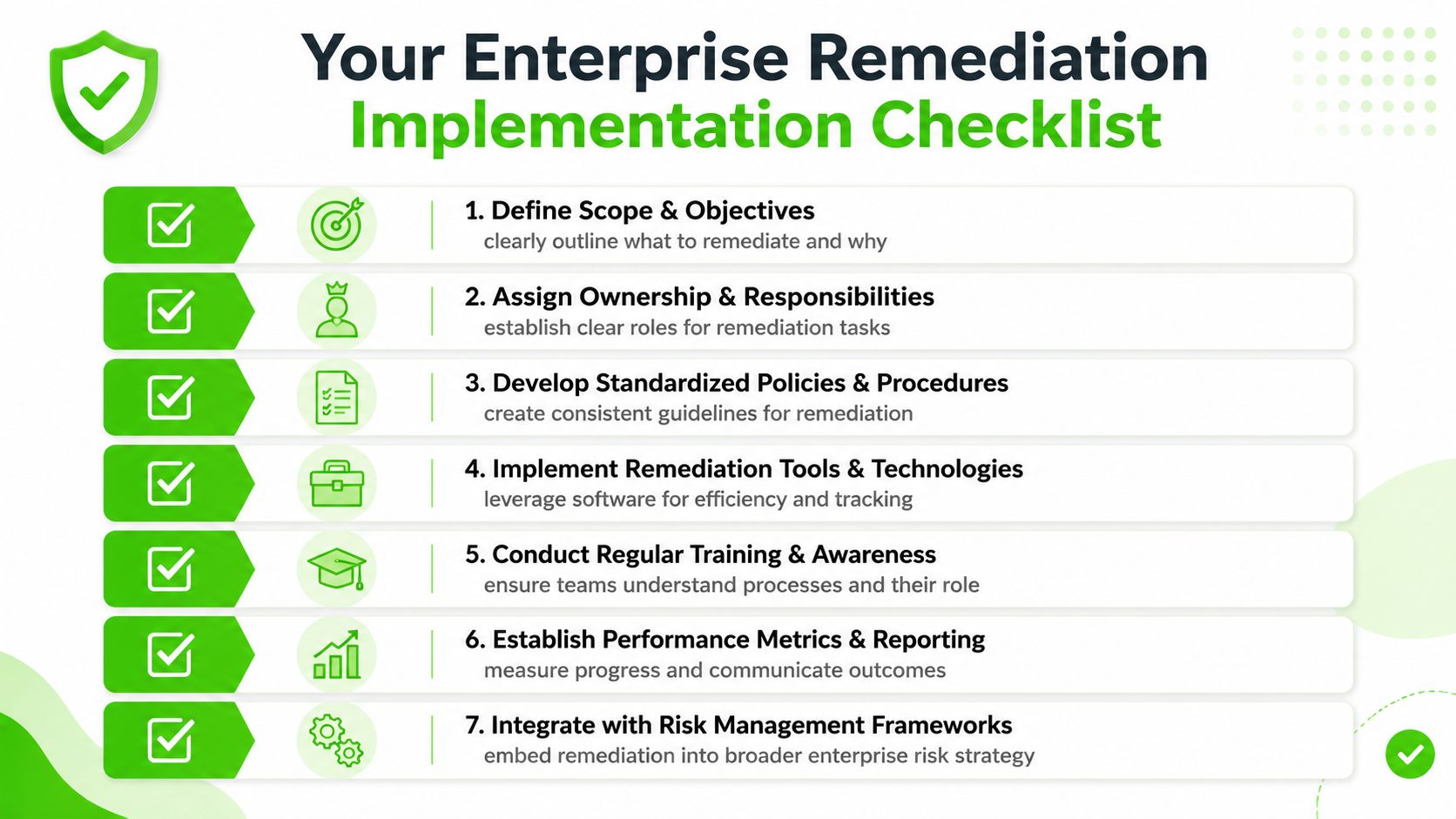
Define scope and objectives. Decide which issue types your program covers first, such as vulnerabilities, audit findings, data quality failures, or AI governance gaps.
Assign ownership clearly. Name a program owner and require a direct owner for every remediation item.
Write standardized procedures. Document intake, prioritization, approvals, implementation, validation, and closure.
Choose supporting tools. Use scanning, ticketing, monitoring, and evidence-management tools that fit your operating model.
Train the people involved. Engineers, compliance reviewers, business owners, and executives should all understand their part.
Define reporting standards. Establish what gets reported upward, how often, and what proof is required before closure.
Integrate with risk governance. Make remediation part of the wider risk and control environment rather than a disconnected side process.
What good execution looks like after launch
Once the program is running, review it like an operating system, not a document set.
Look for signs of strength:
Issues are prioritized consistently
Ownership is visible
Validation happens before closure
Repeated findings trigger root-cause review
Leadership gets concise, decision-ready reporting
Look for warning signs too:
Tickets close without evidence
Temporary workarounds remain in place indefinitely
Business owners aren't involved until late
Different teams use different closure criteria
If you want a simple test, ask one question: can your organization show not only that it responded, but that it corrected the condition and reduced the chance of recurrence? If the answer is no, the remediation program still needs work.
Freeform Company helps enterprises turn complex digital risk into structured action through AI-forward strategy, compliance expertise, and practical execution. If your team is building a stronger remediation posture across security, data, and governance, explore the latest insights from the Freeform Company blog.