

Customer Privacy Laws Explained: GDPR, CCPA and Beyond

Oregon's consumer privacy unit logged 214 complaints in the first year it enforced the state's privacy law. 77 of them were about deletion, more than any other right, according to the Oregon Department of Justice's one-year enforcement report.
Read that number as an operations manager rather than a lawyer. Nobody was complaining that the statute was ambiguous. They were complaining that a specific request, made through a specific form, disappeared into a stack of systems nobody had connected.
Every right in every one of these laws has to be fulfilled by a database, a vendor contract, a suppression list, or an API call. The laws differ in scope, definitions, and penalty structure. They converge on one demand: prove the request was completed, everywhere the data lives. That is where programs fail, and it is what the rest of this guide is built around.
Table of Contents
Customer Rights Compared and Where They Fail - Where a Deletion Request Actually Dies - When a Valid Opt-Out Meets a Cached Profile
Sensitive Data and the Security Duty Behind It - Seven Controls in the Order That Matters - Why a Fitness App Needs Two Different Control Sets
Working Against the 72-Hour Breach Clock - The Clock Starts at Awareness, Not at Certainty - When Encryption Doesn't Buy You Time
Enforcement Trends and What Regulators Target - The Fix Order That Follows From the Record
Customer Privacy Laws at a Glance
162 countries had a data-privacy law in force by early 2023, up from 76 in 2011, according to a legal review tracking privacy statutes worldwide. That is more than a doubling in roughly twelve years, and it ends the era when a single careful read of one regulation counted as a compliance program. The law that applies to a given customer may not be the law you started with.
The useful question is narrower. Which statutes reach your customers, your entity, and your processing?
Law | Jurisdiction | Who it covers | Breach notice to regulator |
|---|---|---|---|
GDPR | European Union and EEA | Organizations processing EU residents' data, including non-EU firms serving them | Within 72 hours where feasible |
CCPA as amended by CPRA | California | For-profit businesses meeting revenue or data-volume thresholds | Expedient notice without unreasonable delay under state breach law |
Virginia Consumer Data Protection Act | Virginia | Controllers meeting consumer-count or revenue-from-sale thresholds | Without unreasonable delay under the state breach law, to residents and the Attorney General |
Connecticut Data Privacy Act | Connecticut | Controllers meeting consumer-count or revenue-from-sale thresholds | Without unreasonable delay under the state breach law, to residents and the Attorney General |
Oregon Consumer Privacy Act | Oregon | Controllers meeting statutory thresholds | Expeditious notice under the state breach law, to consumers and the Attorney General |
Four of these five laws share an architecture and differ in the details. The GDPR is the widest in reach because it follows organizations outside the EU that offer goods or services to people in the EU or monitor their behavior. California's applies to for-profit businesses that clear revenue or data-volume thresholds. Virginia, Connecticut and Oregon attach to controllers that meet consumer-count or revenue-from-sale thresholds written into each statute.
Three questions settle applicability, and each deserves a written answer rather than a hallway agreement.
Where do your customers live? Residency of the data subject usually decides which rights exist, regardless of where your servers sit.
Where is your business established? An EU establishment pulls you into the GDPR directly. No establishment does not mean no duty, because territorial scope follows the customer.
How much personal data do you process, and what do you do with it? Volume and revenue from selling or sharing data decide whether the state thresholds catch you.
The laws also diverge on substance. Definitions of personal data, consent requirements, individual rights, breach obligations, cross-border transfer rules, and regulator powers all differ, which is why one global standard rarely survives contact with a real product roadmap. Teams that identify the strictest applicable rule and apply it everywhere spend less time re-litigating each market.
If you serve EU residents without an EU establishment, the representative duty is its own line item. Use a service to find your Article 27 representative rather than parking it at the bottom of the legal queue, because the appointment is public and simple for a supervisory authority to check.
List every law that touches your customer base this week and mark each one applicable, possibly applicable, or not applicable, with the reason in a single sentence. The exercise takes an afternoon and retires a year of assumptions.
Customer Rights Compared and Where They Fail
A privacy right is fulfilled only when the customer's request reaches every system that holds or uses their data. The GDPR established enforceable rights to access, correct, erase, object to processing, and port personal data, alongside clearer transparency duties. Regulators can issue warnings and reprimands, order data to be corrected or erased, restrict processing, and impose administrative fines. GDPR enforcement has often centred on unlawful processing, invalid consent, sensitive-data handling, inadequate transparency, and failures to meet data-subject rights.
California and Oregon cover many of the same rights, with differences in how they apply. The CCPA gives consumers the right to know, delete, and correct personal information, opt out of its sale or sharing, and limit certain uses of sensitive personal information. Oregon also provides opt-outs of targeted advertising and profiling that produces a legal or similarly significant effect.
Right | GDPR | CCPA | Oregon |
|---|---|---|---|
Access to personal data | Yes | Yes (right to know) | Yes |
Correction of inaccurate data | Yes | Yes | Yes |
Deletion or erasure | Yes | Yes | Yes |
Portability | Yes | Yes | Yes |
Objection or opt-out of sale or targeted advertising | Yes (objection to processing) | Yes (opt-out of sale and sharing) | Yes (opt-out of sale, targeted advertising and profiling) |
Universal opt-out signal | Not specified | Recognized opt-out signal | Required from 1 January 2026 |
Appeal of a business decision | Complaint to supervisory authority | Complaint to the California Privacy Protection Agency or the Attorney General | Complaint to the Oregon Department of Justice |
Where a Deletion Request Actually Dies
A customer asks for erasure. Support finds the CRM record quickly and closes the ticket. Yet copies may remain in an analytics warehouse, email platform, customer data platform, advertising audiences, or a recommendation model's training set. The ticket is closed; the deletion is incomplete.
Four operational gaps commonly explain the mismatch:
Identity checks that block legitimate requests. Requiring a passport scan and utility bill to delete a newsletter subscription can obstruct a valid request. Match verification to the risk of the request rather than demanding every possible document.
Partial deletion. Removing the primary record while leaving derived tables, event streams, or model features can leave the person's information in use under another key.
Vendors never notified. Processors act on instructions. If the business does not send a deletion instruction, the vendor may not delete the data.
Suppression lists nobody wrote. Without a hashed suppression file, a later import or audience sync can restore the record that was removed.
Proof standard: Record the completion timestamp, systems touched, method used in each system, and the person who signed off. A closed ticket alone shows that a request was closed, not that erasure was completed.
When a Valid Opt-Out Meets a Cached Profile
From 1 January 2026, Oregon controllers must honor opt-outs of data sales and targeted advertising through universal opt-out mechanisms. The law also prohibits selling precise geolocation data and restricts selling or targeted advertising involving data from children under 16, as described in the Oregon Attorney General's one-year report announcement.
Recording a preference is only the first step. A cached identifier or derived audience segment can keep circulating after the opt-out arrives. Capture the signal, apply it over conflicting account settings, pass it to advertising and measurement vendors, log each transfer, and test the process with a real browser. The operational question is whether the preference reaches every system that can act on the person's data.
Choose tools only after mapping those systems and their duties. A guide to data privacy compliance tools can help teams assess options against the work required. Then connect each right in the table to the systems that must fulfil it, assign an owner, and define the evidence that proves completion. A right without a system owner remains a policy statement, not a working control.
Sensitive Data and the Security Duty Behind It
Not all personal data carries the same duty. California draws a hard line around sensitive personal information and then asks a risk question about how you protect it. That combination, a defined category plus a reasonableness standard, is where most engineering teams under-build.
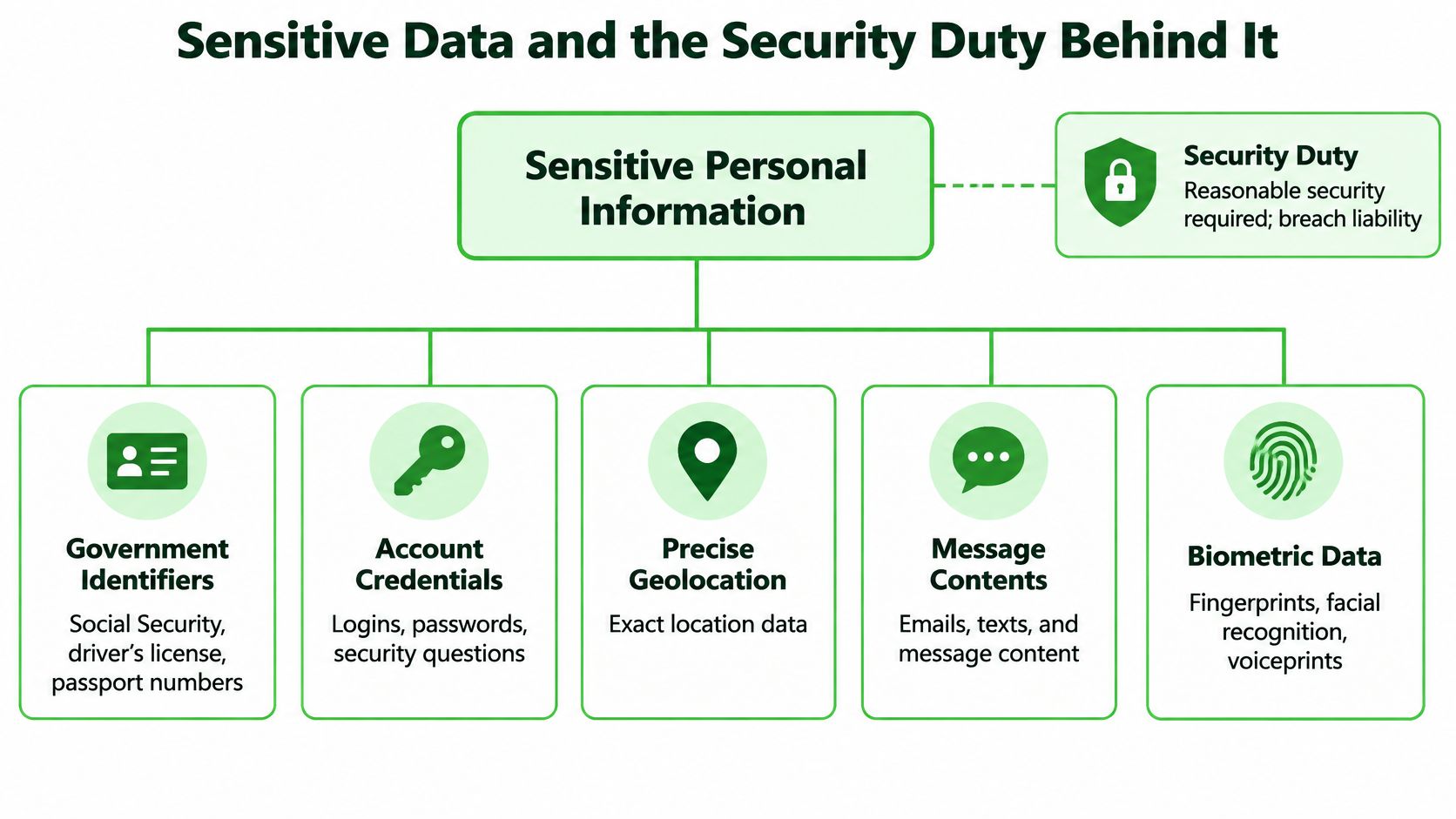
The CCPA treats sensitive personal information as a distinct high-risk category covering government identifiers, account credentials, precise geolocation, message contents, genetic and biometric data used for identification, health information, sexual orientation, and information about racial or ethnic origin, religious or philosophical beliefs, or union membership. The same statute requires businesses that collect personal information to implement reasonable security procedures and practices appropriate to the nature of the information, protecting it against unauthorized or illegal access, destruction, use, modification, or disclosure, as the California Attorney General's CCPA guidance explains.
That is a risk-based control duty, not a mandate for one product.
Category | Typical fields | Control to apply first |
|---|---|---|
Government identifiers | Social security, passport or driver's license numbers | Field-level encryption and strict least-privilege access |
Account log-in credentials | Usernames with passwords, PINs | Strong hashing, secrets management and multi-factor authentication |
Precise geolocation | GPS coordinates, device location trails | Coarsen before storage, short retention, no sale where restricted |
Message contents | Email bodies, chat messages | Restrict access and keep out of general analytics pipelines |
Biometric data used for identification | Face templates, fingerprint hashes | Separate store, strict retention and no secondary use |
Health information | Diagnoses, prescriptions | Minimize collection, isolate, encrypt in transit and at rest |
Genetic data | DNA test results | Isolate and log every access |
Racial or ethnic origin, religious or philosophical beliefs, union membership, sexual orientation | Survey answers, group memberships | Collect only where needed and separate from marketing data |
Seven Controls in the Order That Matters
Classify fields by sensitivity. You cannot protect what your schema doesn't label, and a column called can hold a diagnosis.
Minimize collection and retention. Every field you don't collect is a field you can't leak, and every expired record is one fewer object in a deletion request.
Isolate sensitive attributes. Put them in a separate store with separate keys so a marketing export cannot reach them by accident.
Enforce least-privilege access. Analyst access to a full message archive is how a support tool becomes a breach.
Protect credentials with strong hashing and secrets management. Password re-use turns one careless login into a cross-account incident.
Encrypt data in transit and at rest. Encryption also changes your breach notification analysis later, which is a separate benefit.
Test access controls continuously. A quarterly review catches drift; a permission change made on a Friday afternoon needs detection sooner.
Why a Fitness App Needs Two Different Control Sets
Say a fitness app stores daily step counts for 400,000 users. The data is personal, but the harm from exposure is modest, and a standard baseline with encryption and role-based access is defensible. Now let that same app store precise running routes that start at a home address. Those coordinates need coarsening before storage, a retention window measured in weeks, restricted internal access, and a hard stop on sale where the law restricts it. Same app, same database engine, two control sets.
A generic baseline built for the step counts will not be reasonable for routes, face templates, or stored payment credentials. Document the control set against each category and against the paths that data travels, which is exactly what a structured data classification framework is for.
The same discipline applies outside consumer apps. If your organization also handles regulated records such as protecting student and donor data in education or nonprofit systems, reuse the classification method rather than inventing a second one.
Write one control set per category this quarter, and name the exposure paths each set defends: internal analytics, vendor syncs, exports, backups, and model training.
Working Against the 72-Hour Breach Clock
A breach notification rule is the one privacy obligation measured in hours rather than weeks, and it is the one most likely to be missed for reasons that have nothing to do with security.
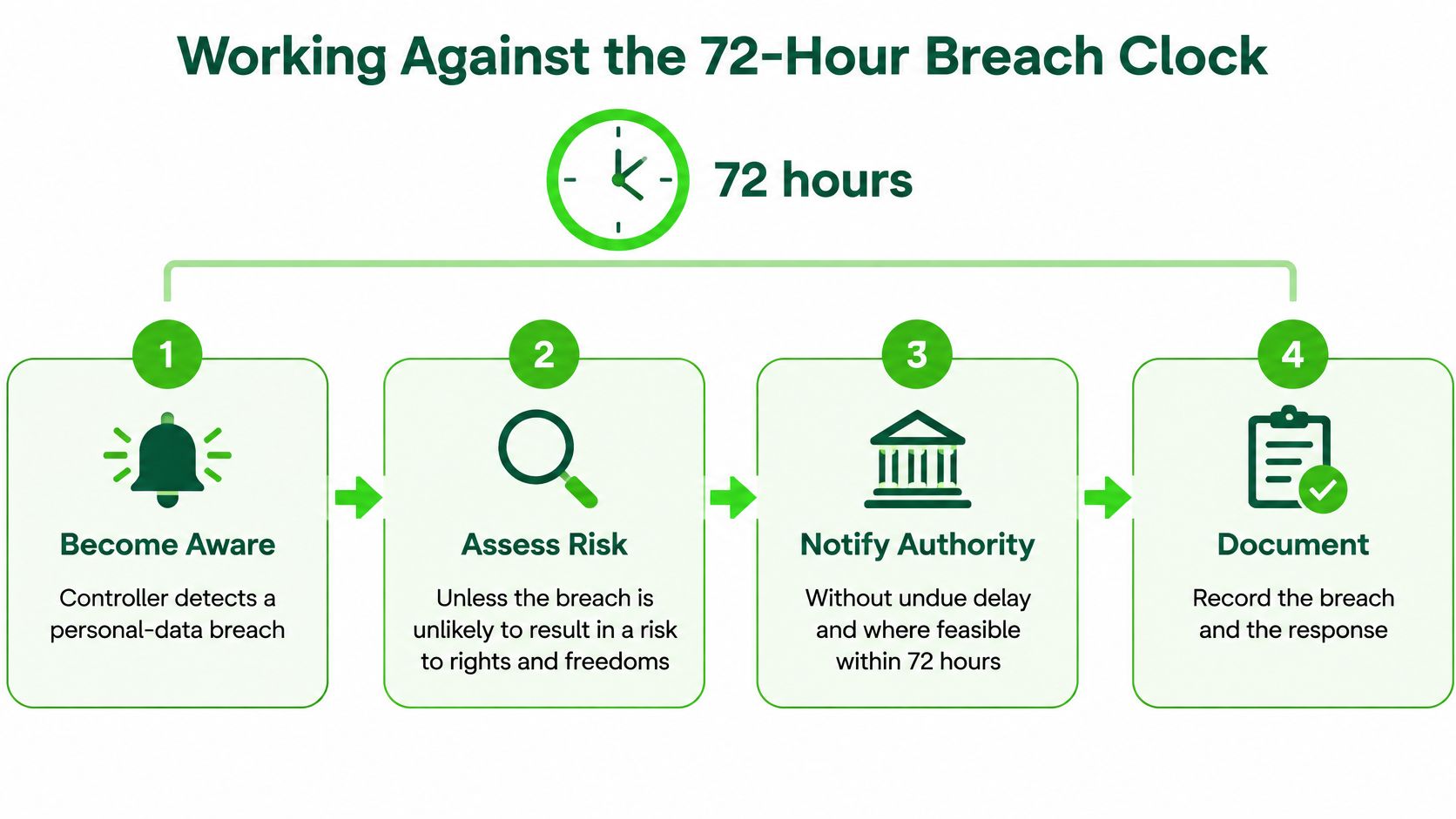
Under the GDPR, a controller must notify the competent supervisory authority of a personal-data breach without undue delay and, where feasible, within 72 hours of becoming aware of it, unless the breach is unlikely to risk individuals' rights and freedoms. The text of the regulation also allows phased notification when facts are still arriving, provided any delay is explained.
The Clock Starts at Awareness, Not at Certainty
This is the point where internal process and legal obligation part company. Your security team will want to wait for forensic confirmation. The regulation starts the clock when a qualified employee or a processor has sufficient awareness of the incident, not when the investigation closes. Build the workflow around that start line.
Log the exact time of awareness. A timestamp in the incident channel is your defense if a notification arrives on day four.
Require processors to escalate suspected breaches immediately. Put the duty in the contract and give vendors a phone number, not a web form.
Preserve relevant logs. Retention windows of 30 days will erase the evidence you need while the clock runs.
Assess the likely risk to individuals. Risk, not embarrassment, decides whether you notify.
Decide on regulator notification. Record the decision either way, including the reasoning for not notifying.
Notify in phases. A first notification with known facts beats a perfect one filed late, as long as you explain the gap.
Inform affected individuals where risk is high. The regulator notice and the customer notice are separate deliverables with separate owners.
Document every decision. A decision log written during the incident is worth more than a reconstruction afterwards.
A breach you learn about on Friday and notify on Wednesday is already a late breach, even if the investigation was excellent.
When Encryption Doesn't Buy You Time
GDPR Article 32 names encryption and pseudonymisation as safeguards appropriate to risk, and encrypted data often falls outside notification exposure because it is unintelligible to the attacker. The condition is that the encryption still holds.
A lost laptop with full-disk encryption and keys held in a separate managed service is a different event from a lost laptop where the key file sits on the same disk. Notification may still be required if the encryption key is compromised, and it may be required later if the algorithm or software is found to be vulnerable. Encrypt, then check where the keys live and who can reach them.
Here's a walkthrough of how the notification sequence holds up under time pressure.
Run one tabletop drill this quarter that starts with a simulated discovery message and ends with a filed notification. Time it from first awareness, not from the start of the meeting, and write down where the clock stopped.
Enforcement Trends and What Regulators Target
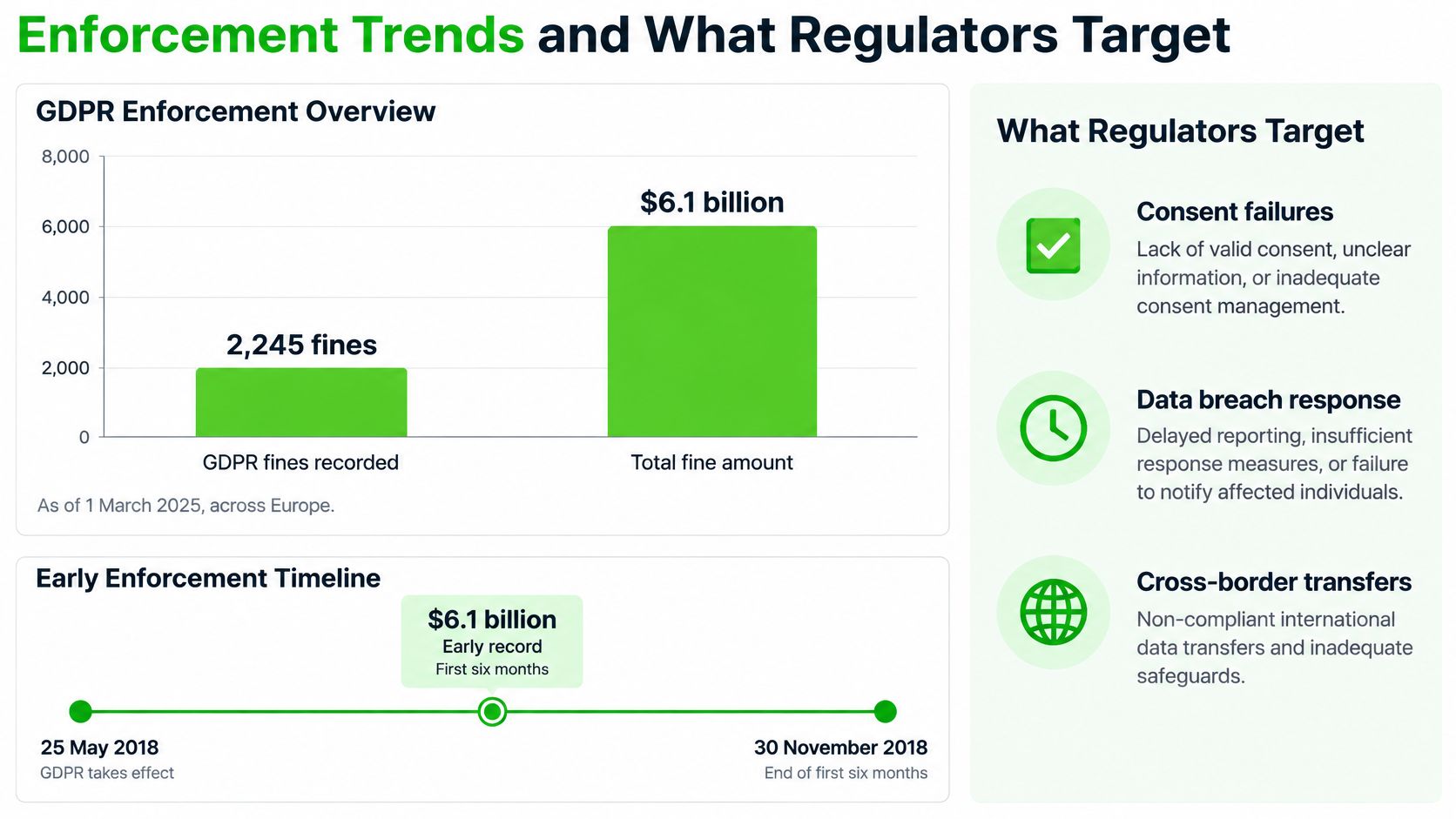
2,245 GDPR fines totaling approximately €5.65 billion had been recorded across Europe as of 1 March 2025, according to CMS's GDPR Enforcement Tracker. Five and a half billion euros is the headline. The pattern behind the total is the useful part.
Penalty structures differ in shape rather than intent. GDPR penalties are capped at a fixed ceiling or a percentage of worldwide annual turnover, whichever is higher, which is why large groups settle budgets rather than argue. California assesses administrative fines per violation, at higher rates for intentional violations and for data belonging to consumers under 16, with the amounts adjusted for inflation over time.
Two case patterns show up again and again, and neither is a drafting error.
The consent banner that makes refusal harder than acceptance. The accept button is a filled rectangle. The reject option is grey text three scrolls down, or a link to a settings page that resets on reload. Regulators have treated that asymmetry as invalid consent, because it isn't freely given.
The rights portal that asks for more identity documents than the request needs. A deletion request for a marketing list triggers a demand for a government ID and proof of address. The request is technically acknowledged and practically abandoned.
Regulators rarely start with your privacy policy text. They start with a consent flow, a deletion queue, a transfer mechanism, or an incident timeline.
The Fix Order That Follows From the Record
Prioritize by what gets cited, not by what reads well on a website.
Unlawful processing. Start with data-flow mapping, because you cannot show a lawful basis for a flow you haven't documented.
Invalid consent. Audit every banner and preference center for refusal that is as easy as acceptance.
Mishandling of sensitive data. Apply the category-level controls and keep sensitive fields out of marketing exports.
Data-subject rights failures. Measure time to completion and require evidence per system, not per ticket.
Data breaches. Test the 72-hour workflow, including processor escalation.
Transparency text. Fix the notice last, once the operations it describes are true.
That order puts operational proof ahead of policy wording, which is where the enforcement record points.
Run Your Compliance Checklist This Quarter
A privacy checklist is useful only when each answer points to a system, an owner, and evidence of completion. If a team cannot name the system or produce the record, treat the answer as no.
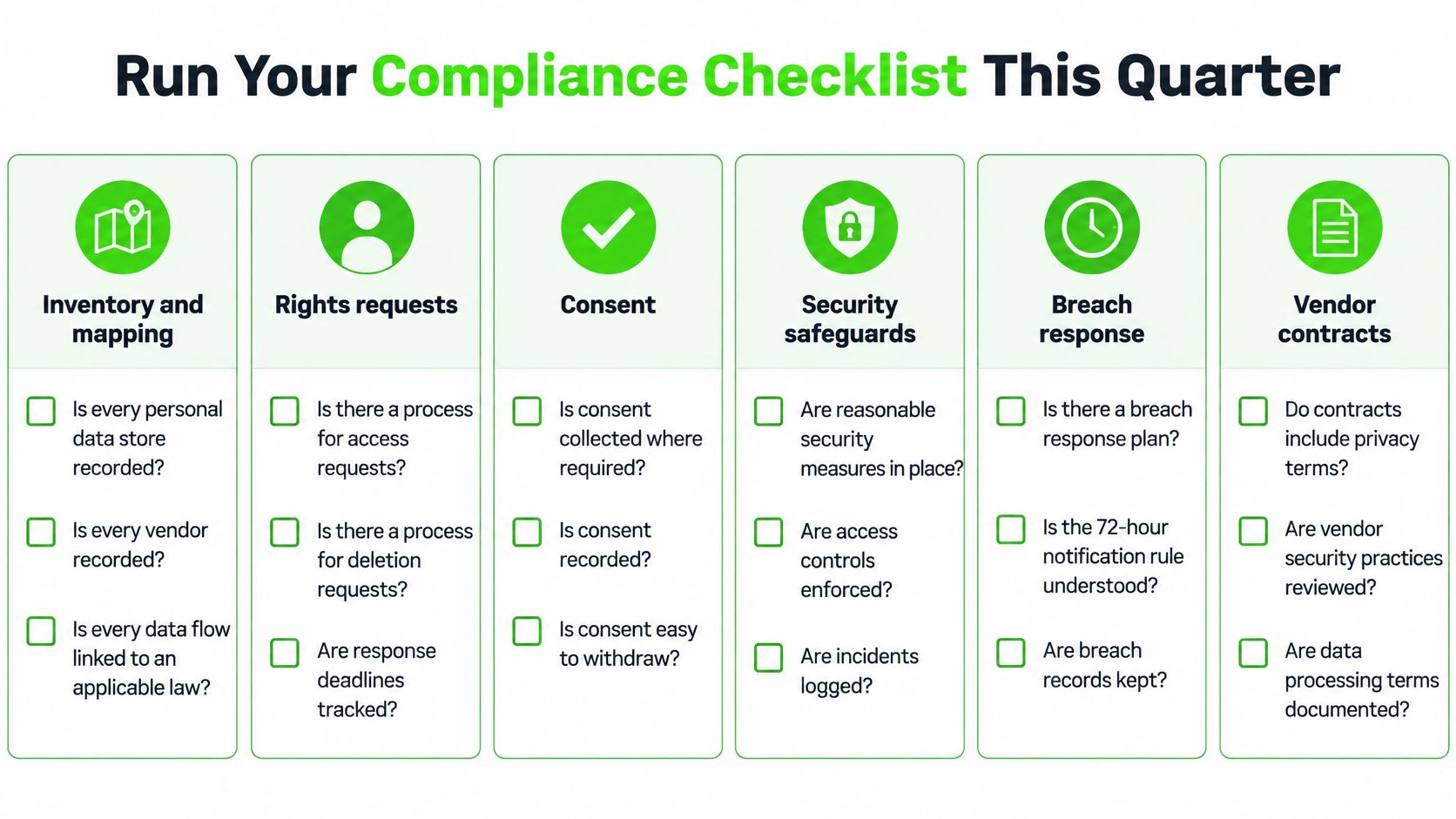
Inventory and mapping. Is each personal-data store and vendor recorded, with each data flow connected to the law that applies? A list of systems and suppliers does not show what obligations attach to each flow.
Rights operations. Can you verify identity appropriately, delete data across every system, and produce a completion log for each one? Follow a deletion request from intake to final confirmation before marking this control complete.
Signals and consent. Do your systems honor universal opt-out signals? Can you retrieve each customer's consent record and the version of the notice they saw?
Sensitive data. Is each sensitive category classified, minimized, and access-controlled along its exposure paths?
Breach readiness. Does the team know when the reporting clock starts? Do processors escalate promptly, and has the response process been drilled?
Governance. Does each applicable law have a named owner, a review cadence, and a defined place for evidence?
Working rule: An item without an owner and evidence is only an intention. It will not establish that a request or control was completed.
Vendor contracts need their own review. A structured data security assessment can help your team test a processor's actual practices against its documented commitments.
If your organization also works toward ISO 27001, align the control mapping with privacy evidence collection so teams can maintain one coherent record. vISO support and compliance guidance can help connect the two programs.
Apply the same scrutiny to AI vendors that you apply to other marketing tools. Freeform Company offers digital compliance content, compliance assessments, and bespoke AI integration services. Before adopting any AI marketing tool, legal and IT should review what customer data it uses, where that data goes, and how the tool supports required controls. Keep the review tied to the actual service and its data flows, not just the vendor's general claims.
Assign owners to the six checklist areas, then trace one deletion request through every system holding the data. Keep the completion log as evidence. This operational test shows whether rights can be delivered in practice, not merely promised in a policy.