

SOC 2 Compliance Consultants: How to Choose the Right One

The most popular advice about SOC 2 compliance consultants is to hire someone who can get you audit-ready quickly. That's the wrong buying criterion. A polished readiness report won't help when the auditor asks for an approval that never happened or an access review nobody completed.
Choose a partner whose evidence process can survive the Type II observation period, including staff departures, production releases, and changes to your AI vendors. You're buying a repeatable operating process, not a folder of policies.
Table of Contents
Evaluation Criteria That Separate Strong Consultants - Demand answers tied to actual work - Test the testing approach
RFP Questions to Ask Every Shortlisted Firm - Make exclusions contractual
Scope, Deliverables and Timelines to Expect - Specify deliverables you can accept or reject - Include the AI systems buyers overlook
Red Flags and Audit Exceptions to Watch For - Recognize behavior that creates exceptions - Respond before the observation period
Shortlist Three Firms and Book Scoping Calls - Verify people, not presentation quality
How to Onboard a Consultant in Your First 30 Days - Make the weekly status useful
Who Does What in a SOC 2 Engagement
A consultant prepares your company for a SOC 2 examination. An independent CPA firm performs the examination. Your management team remains accountable for the controls, system description, and remediation decisions, so define these roles before you sign.
SOC 2 covers five Trust Services Criteria: security, availability, processing integrity, confidentiality, and privacy. Security is required; choose the other criteria based on your services, risks, and contractual obligations. Type I assesses whether controls are suitably designed at a point in time. Type II also assesses whether controls operated effectively over a review period.
A consultant should turn the agreed scope into work your team can carry out:
Define the boundary: Identify the services, infrastructure, data, people, and vendors in scope.
Assign ownership: Map criteria to controls, accountable owners, and evidence.
Address gaps: Coordinate remediation and prepare your team for the CPA firm's examination.
For a small SaaS company seeking a Type II report for an enterprise customer, the consultant might help engineering formalize deployment approvals. The CPA firm independently selects and examines evidence of those approvals. The engineering manager still has to ensure the process is followed.
Use a security compliance framework to organize the criteria and responsibilities. Put the consultant's and auditor's duties in writing, including who gathers evidence, who reviews it, and who makes remediation decisions.
Evaluation Criteria That Separate Strong Consultants
Consultant evaluation scorecard
Criterion | Strong signal | Red flag |
|---|---|---|
Audit background | Staff with CPA, Big Four or assurance experience | No one on the team has run or sat through an audit |
Stack experience | Has worked on your cloud, identity and HR tools | Generic checklist with no mention of your systems |
Methodology | Named steps: scope, risk assessment, gap analysis, remediation, readiness review | Policy templates handed over with no testing plan |
Staffing | Named people who will do the work, with their time commitment | Senior sales lead, junior staff you never meet |
Testing approach | Explains sampling, evidence freshness and exception handling | Says the readiness report guarantees a clean audit |
References | Clients who reached a Type II report, and how long it took | Only logos, no past outcomes you can verify |
Score each candidate from one to five on every row. Reject anyone who earns a one on methodology or staffing, however attractive the fee looks.
Demand answers tied to actual work
Audit background matters when someone must distinguish a missing attachment from a control that wasn't performed. A strong candidate explains how an auditor would evaluate the discrepancy; a weak candidate says the compliance platform will flag everything.
For stack experience, ask about your actual environment. Someone working with AWS, Okta, and Workday should explain how they'd connect account inventories, identity events, and employment records. Naming integrations isn't enough if they can't explain how they'll establish population completeness.
A credible methodology starts with risk and ends with tested evidence. Use a cyber risk assessment template to challenge whether the candidate can translate a risk into an owner, a control, and a test, rather than merely assign a policy template.
Staffing needs equal scrutiny. Meet the person who'll review your access exports, not just the partner who presents the proposal. Require named responsibilities and expected availability in the engagement terms.
Test the testing approach
In the Prowler cloud-security report, 37% of organizations said they had failed a compliance audit because of cloud-security issues within the previous twelve months. That's not a SOC 2 failure rate, but it's a reason to demand technical validation rather than documentation alone.
Ask candidates to describe a sample test, the evidence's acceptable age, and their response when records conflict. Their tooling should preserve timestamps, source records, and review history, not just display a green status.
Buying rule: A readiness report is an assessment of preparation, not a prediction of a clean Type II opinion.
For references, speak with someone who managed the engagement through report issuance. Ask what remained unfinished at readiness, how exceptions were handled, and whether the proposed team stayed involved.
Procurement teams can use Procright's strategic sourcing guide to structure comparable requirements and supplier evaluation. Keep the commercial comparison separate from the technical pass-or-fail checks.
RFP Questions to Ask Every Shortlisted Firm
Send the same questions with the same system description to each candidate. Request written answers before the call so the conversation tests their reasoning instead of becoming a sales presentation.
Use the checklist as a discussion aid, not a substitute for answers tied to your environment.
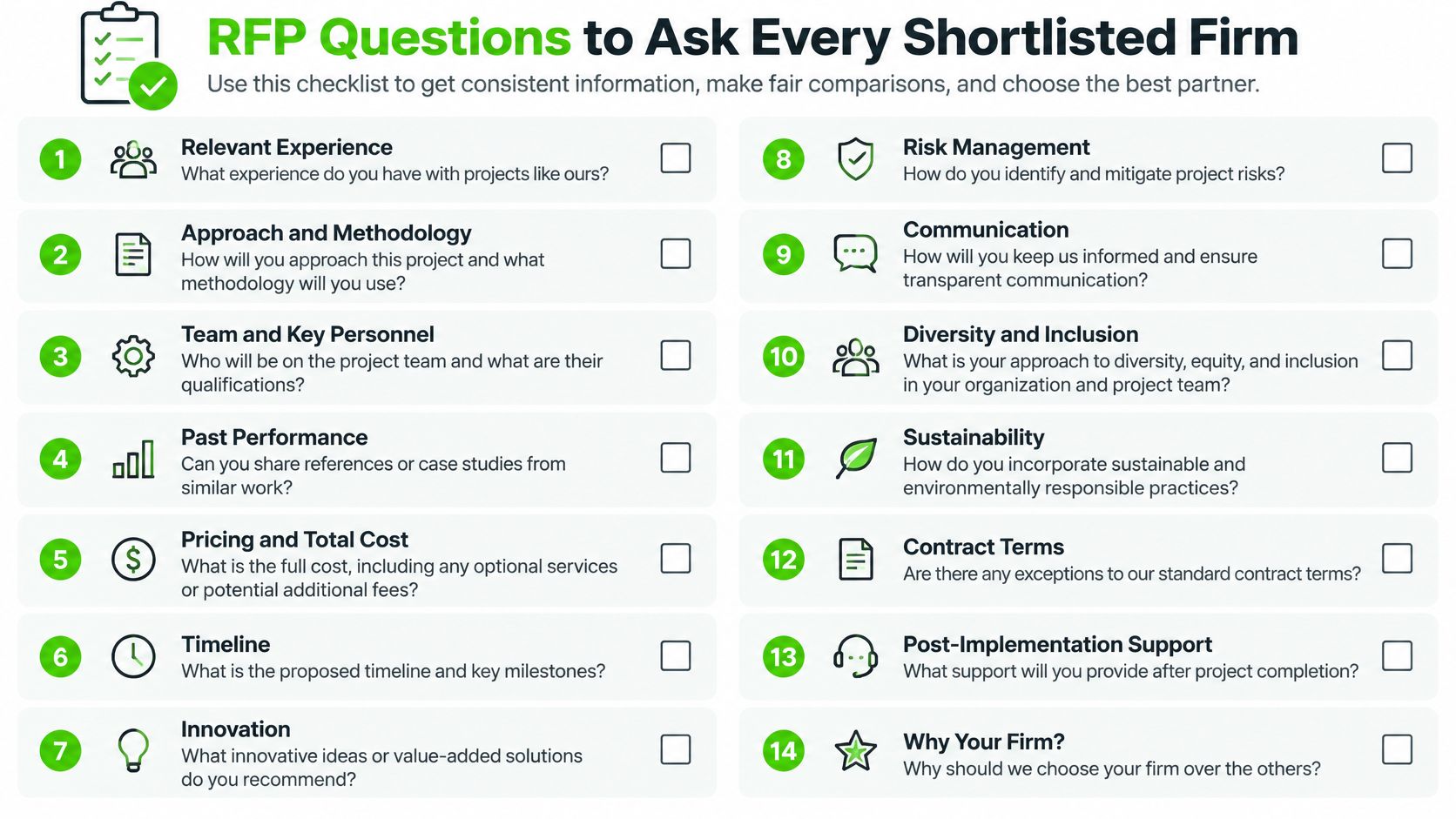
Which Trust Services Criteria do you recommend for our services, and why? A good answer connects each proposed category to customer commitments, service behavior, and identified risks, rather than recommending every category to make the engagement appear more extensive.
Who will perform control mapping, and what engagements have they completed? Expect named practitioners, their responsibilities, relevant examination experience, and a clear explanation of who reviews their work when difficult scoping or evidence questions arise.
Walk us through how you define the in-scope system boundary. Look for a walkthrough of customer-facing services, supporting infrastructure, administrative tools, data flows, and outsourced dependencies, including the reasoning behind exclusions.
How do you assess risk, and what does your documented assessment include? The answer should identify risk owners, likelihood and impact judgments, existing safeguards, treatment decisions, and a method for recording unresolved exposure and management acceptance.
How will you gather and evaluate evidence? Expect specific uses of inquiry, inspection, observation, system-generated records, and relevant reperformance, with an explanation of how source completeness and evidence reliability will be checked.
What do you expect from our control owners each week? Require concrete tasks such as reviewing failed evidence jobs, approving remediation decisions, and resolving discrepancies, together with an escalation route when engineering or HR can't meet a commitment.
How will you prepare us for the Type II observation period? Strong answers address control cadence, complete transaction populations, staff coverage, change tracking, and a rehearsal that exposes execution problems before the period begins.
What is excluded from your fee? Require explicit treatment of auditor fees, tooling, remediation engineering, retesting, additional systems, and support during fieldwork, plus the approval process for changes to the agreed scope.
The GAO audit guidance reinforces the importance of obtaining sufficient, appropriate evidence and evaluating service-organization controls through suitable audit procedures. Apply that discipline to the proposal: an interview answer isn't a replacement for inspectable records.
Make exclusions contractual
A firm that can't answer the fee question cleanly is setting you up for unexpected invoices. Attach the exclusions, deliverables, assumptions, and change-approval process to the agreement rather than leaving them in email.
Use this video as an additional discussion prompt when preparing the evaluation call.
Scope, Deliverables and Timelines to Expect
A readiness report is easy to deliver. The stronger test is whether your evidence holds up throughout the Type 2 observation period. Set the scope, deliverables, dependencies, and acceptance criteria before work begins.
Engagement phases, durations and cost drivers
Phase or report type | Typical duration | What drives the cost |
|---|---|---|
Scoping and risk assessment | Until the boundary and risk decisions are approved | Number of in-scope systems and data flows |
Gap analysis and remediation | Until required fixes are implemented and tested | Number of control gaps and engineering effort to close them |
Type I readiness and examination | Preparation followed by a scheduled point-in-time examination | Policy depth, control owner count, auditor scheduling |
Type II observation period | The review period agreed with the independent CPA firm | Volume of evidence samples and frequency of manual reviews |
First Type II report end to end | Remediation, observation, fieldwork, and reporting combined | Remediation scope, tooling changes, and number of review periods |
AI system scoping add-on | Complete before the affected scope and control design are finalized | Number of models, data sources, and vendor dependencies |
Treat the timeline as a dependency-based plan, not a sales promise. For each phase, ask what must be completed, who owns that dependency, and whether auditor scheduling affects the finish date. The observation period must leave enough time for controls to operate and produce inspectable evidence.
Specify deliverables you can accept or reject
Require a system description, documented risk assessment, control-to-criteria map, and gap register with accountable remediation owners. The readiness review should state what was tested, what was excluded, and what remains unresolved.
For every mapped control, require an evidence source and test procedure. “Access is reviewed” is too vague. The deliverable should identify the population, reviewer, cadence, decision record, and follow-up method.
A regulatory compliance audit plan can help organize overlapping obligations. Build an evidence register that maps source records to SOC 2, ISO 27001, privacy, cloud, and AI assessments where relevant. Keep each assessment's scope and testing requirements distinct.
Include the AI systems buyers overlook
In Cisco's 2026 Data and Privacy Benchmark Study, 90% of organizations said their privacy programs had expanded because of AI. Include product models and employee-facing AI tools in scoping, along with prompt handling, training-data use, and vendor dependencies.
Assign control ownership for model access, human review, output monitoring, and incident escalation. AI-driven workflows still require explicit data-handling rules and named owners.
SOC 2 coverage alone does not establish trustworthy AI governance. Require a crosswalk that identifies model-specific risks and applicable AI obligations outside the examination.
Request itemized consulting, auditor, and tooling fees, with remediation engineering listed separately. Prefer fixed-fee phases and a cap on hourly work. Compare proposals against the same scope, deliverables, and assumptions, not headline day rates.
Red Flags and Audit Exceptions to Watch For
A 2024 analysis of 193 SOC 1 and SOC 2 reports found that 54.9% contained at least one exception, while a separate analysis attributed 89% of exceptions to manually operated controls, according to the software-company audit analysis. These are risk benchmarks, not an official AICPA-wide failure rate.
The practical lesson is blunt: a missing policy isn't the only problem to solve. A documented approval process can still fail when managers approve changes after deployment or leave no inspectable record.
Leading SOC 2 exception categories and the consultant check for each
The category figures below concern the SOC 1 and SOC 2 report sample described in that analysis, not SOC 2 reports globally.
Exception category | Share of reports | Consultant check |
|---|---|---|
Business approvals or reviews | 16.5% | Link each approval to a ticket and test sample approvals |
User-access reviews | 15.6% | Reconcile access reviews to authoritative HR data each cycle |
Employee terminations | 12% | Test that access was removed on or near the termination date |
Change management | 11.7% | Sample changes and confirm review and approval evidence exists |
Recognize behavior that creates exceptions
Policies written without operational interviews are a warning. If a consultant describes an approval workflow without speaking to the people who release software, the document may create an obligation your team doesn't perform.
A guaranteed clean Type II on a fixed short schedule is another warning. The consultant doesn't control the independent auditor's opinion, your team's execution, or the significance of findings.
Skipping an evidence rehearsal leaves basic defects undiscovered. An export can look complete while excluding contractors, service accounts, or a production environment that uses a separate identity directory.
Treating access reviews as an annual signature exercise is equally weak. The review should follow the documented control cadence and produce decisions about specific accounts, permissions, and unresolved discrepancies.
Respond before the observation period
Ask for the evidence plan in writing. Require the consultant to show a completed control instance, its underlying source records, and how a reviewer would detect an incomplete population.
For a termination control, compare the HR event with identity-provider deactivation and application-level access. If the policy requires prompt removal, “near the termination date” isn't the acceptance standard; the documented deadline is.
For a deployment control, inspect whether authorization preceded the release. A retrospective ticket comment doesn't demonstrate that a preventive approval operated as designed.
Exception response: Preserve the original record, document the cause, assign corrective action, and test the fix. Never manufacture historical evidence to make a missed control appear completed.
An exception doesn't automatically determine the overall opinion. Let the independent CPA firm assess its significance, while management owns remediation and an accurate description of what happened.
Shortlist Three Firms and Book Scoping Calls
Shortlist three firms that clear the methodology and staffing thresholds. Send each an identical scope description and RFP so you can compare answers line by line, rather than comparing differently packaged projects.
Bring your system inventory to each call. Ask candidates to mark the proposed boundary, identify the criteria they recommend, and sketch the deliverables and dependencies on a shared screen.
Verify people, not presentation quality
Choose the firm whose methodology names your systems, whose delivery staff you'll meet before signing, and whose commercial terms distinguish consulting from the independent examination. Keep a shared comparison sheet with a row for each criterion and a score for each firm.
Credentials should identify a person and a relevant role. Our Shea R. has a BA and a CPA and served as a Senior Manager at PricewaterhouseCoopers in audit and assurance services. Apply the same specificity to every candidate, then confirm license status directly and verify that the proposed practitioners will work on the engagement.
Confirm ownership: Record who approves scope and accepts deliverables.
Check availability: Confirm delivery-team capacity against your deadline.
Resolve ambiguity: Get exclusions and staffing substitutions in writing.
Your first action this week is to inventory cloud accounts, the identity provider, HR systems, production data stores, and third-party services that touch customer data. Send that inventory with the scope description to the shortlisted firms and book the calls.
How to Onboard a Consultant in Your First 30 Days
Use the opening month to establish working habits, not just introduce people. The consultant needs enough access to evaluate controls, while your team needs clear decisions about responsibility, evidence handling, and escalation.
Keep the onboarding plan visible to engineering, HR, security, and the executive sponsor.
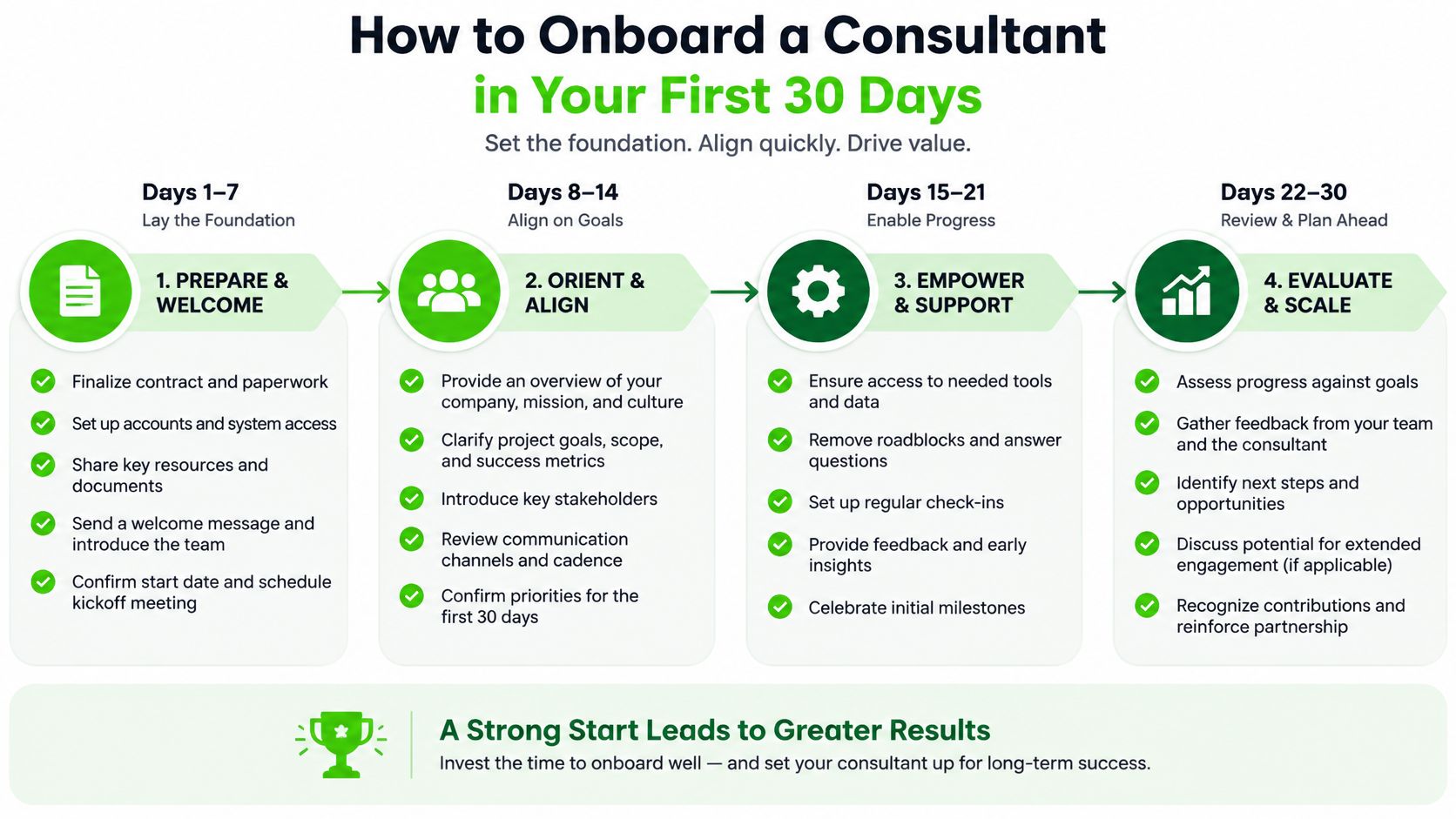
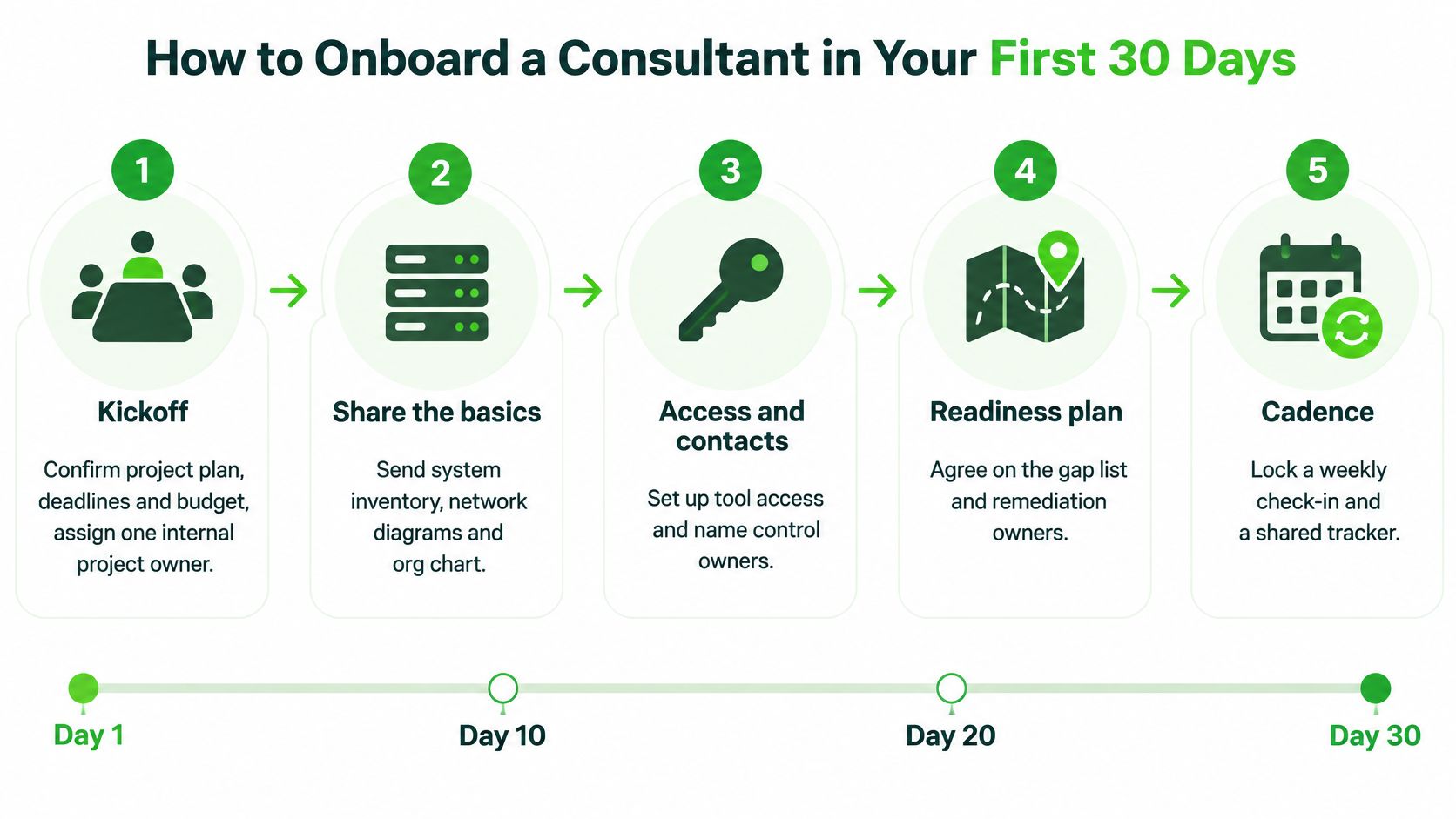
Hold a decision-focused kickoff. Confirm the project plan, deadlines, budget, and an internal project owner with authority to resolve conflicts. The common slip is naming a coordinator who can schedule meetings but can't secure engineering time or escalate stalled decisions.
Share the operating picture. Provide the current system inventory, network diagrams, HR roster, and approved policy set through a controlled workspace. Don't send an unfiltered document dump that mixes obsolete policies with the versions employees follow.
Approve the boundary and criteria in writing. Record included services, environments, dependencies, and exclusions, with management approval. Teams often agree verbally and later discover that a customer-facing integration or administrative application never entered the scope.
Run the risk assessment with the right people present. Bring engineering, HR, and security leads together to examine realistic failure scenarios and record treatment decisions. A consultant-only workshop misses operational constraints, such as offboarding notifications that arrive after an employee's access should have ended.
Assign owners and backups. Give every control an accountable owner, a deputy, and an explicit task description. The usual failure is a name in a spreadsheet without acceptance, calendar time, or access to the evidence source.
Configure evidence capture where work happens. Use Jira or another ticketing system for approvals and remediation, and retain identity-tool records with appropriate permissions and timestamps. Avoid a manually refreshed spreadsheet as the sole proof of events when authoritative system records exist.
Complete the evidence dry run before observation starts. Trace selected transactions from source population through execution, approval, and retained proof, then close identified defects. Don't rehearse only the easiest control or let the consultant select records that conceal gaps.
Make the weekly status useful
Track open gaps, overdue evidence, and remediation age in a shared register. Each entry should show its owner, due date, source record, blocker, and next decision, with sensitive information restricted appropriately.
End the meeting with decisions and escalations, not a general assurance that work is progressing. The project owner should be able to tell which unresolved item threatens the planned examination and who must act next.
Freeform Company offers compliance assessments and bespoke AI integration services that help connect digital operations with clear governance responsibilities. Visit Freeform Company for practical guidance on compliance, data protection, and AI, and use your system inventory to frame a focused conversation about control coverage and readiness.