

Cyber Risk Assessment Template for 2026

In a 2025 global survey of more than 5,000 small and medium-sized businesses, 86% had conducted an assessment or created a prevention plan, yet only 23% were very satisfied with it and only 23% were very confident in their ability to identify threats, according to Mastercard's 2025 small business cybersecurity reporting. That's the problem a good cyber risk assessment template has to solve. A finished register proves someone filled in rows. It doesn't prove the business can decide, communicate, and recover when a score turns out wrong.
Build your template so a team can finish it, an auditor can follow it, and an incident team can use it under pressure. You'll need clear fields, a scoring scale agreed before debate starts, money values beside technical scores, and evidence that someone tested the response. If a row can't name its owner, evidence, deadline, and residual risk, it isn't finished yet.
Table of Contents
Fields to Put in the Template First - Copy This Column Order - Why the Money Columns Are Not Optional
How to Score Likelihood and Residual Risk - Follow the Scoring Sequence in Order
A Billing Platform Walkthrough - Score the Scenario Step by Step - Decide the Treatment and Rescore
Tips for Scenarios That Break the Sheet - Fields These Rows Need - Add the Exercise Fields Most Drafts Omit
Map Each Row to NIST, ISO 27001, and SOC 2 - Use This Crosswalk as the Spine
Fields to Put in the Template First
Before scoring scenarios, set up two working documents. Use a spreadsheet risk register with one row per threat scenario, not one row per control. Pair it with a one-page scope document that records what is in scope, who assesses and approves each row, which tool and evidence store the team uses, and when the register will be reviewed.
The scope document keeps teams from assessing different things while calling the results complete. Version the blank register as v1.0, and agree on the meaning of each score before anyone enters High, Medium, or Low. A tidy sheet can still fail during an audit or incident if no one can trace a score to evidence or decide what to do when that score proves wrong.
Copy This Column Order
Use these columns in sequence: scenario ID, asset or process, owner, data classification, threat event, threat-source capability and motivation, vulnerability, exposure date, current controls, control effectiveness, initiation likelihood, impact likelihood, impact, inherent score, treatment choice, estimated loss, treatment cost, target date, residual score, evidence link, uncertainty, and reassessment date. The sequence moves from describing the scenario to recording the decision and the evidence behind it.
Position | Column | Recorded or scored |
|---|---|---|
1 | Scenario ID | Recorded at creation |
2 | Asset or process | Recorded |
3 | Owner | Named person |
4 | Data classification | Recorded |
5 | Threat event | Recorded |
6 | Threat-source capability and motivation | Evidence |
7 | Vulnerability | Evidence |
8 | Exposure date | Recorded |
9 | Current controls | Evidence |
10 | Control effectiveness | Scored |
11 | Initiation likelihood | Scored 1 to 5 |
12 | Impact likelihood | Scored 1 to 5 |
13 | Impact on operations, assets, individuals, other organizations | Scored 1 to 5 |
14 | Treatment choice | Recorded |
15 | Inherent score | Calculated |
16 | Estimated loss | Currency amount or range |
17 | Treatment cost | Currency amount or range |
18 | Target date | Recorded |
19 | Residual score | Calculated |
20 | Evidence link | File reference |
21 | Uncertainty | Recorded |
22 | Reassessment date | Recorded |
Start with at least one row from each scenario family:
Internet-facing or VPN exposure: Record the appliance, exploit status, and patch deadline.
Ransomware and recovery: Record backup coverage, recovery-time objective, and recovery-point objective.
Identity or social engineering: Record privileged access, multifactor authentication, and likely entry route.
Supplier concentration or inherited access: Record what the supplier can reach and what evidence supports its controls.
Why the Money Columns Are Not Optional
IBM's 2025 Cost of a Data Breach executive summary recorded a global average breach cost of USD 4.44 million, down from USD 4.88 million in 2024, while the average U.S. breach cost reached a record USD 10.22 million in 2025. These figures do not show that a template prevents a breach. They do illustrate why a register should pair technical scores with estimated loss, treatment cost, evidence, and review dates.
Keep the columns stable as the register grows. Add industry-specific threat events as new rows, then compare estimates with actual treatment costs as decisions are made. Record uncertainty too: a score based on incomplete evidence needs a follow-up action, not just a neat cell value. The register is more useful when an owner can explain the decision and the team can revise it after testing its response.
Practical rule: If you change a column definition mid-assessment, you've restarted the assessment, whether you admit it or not.
How to Score Likelihood and Residual Risk
Agree the scale in the scope document before you open the asset list. If you define the scale after seeing uncomfortable results, people will move the thresholds to make the heat map look calmer. A simple 5 by 5 grid works if your team can defend every band in plain language.
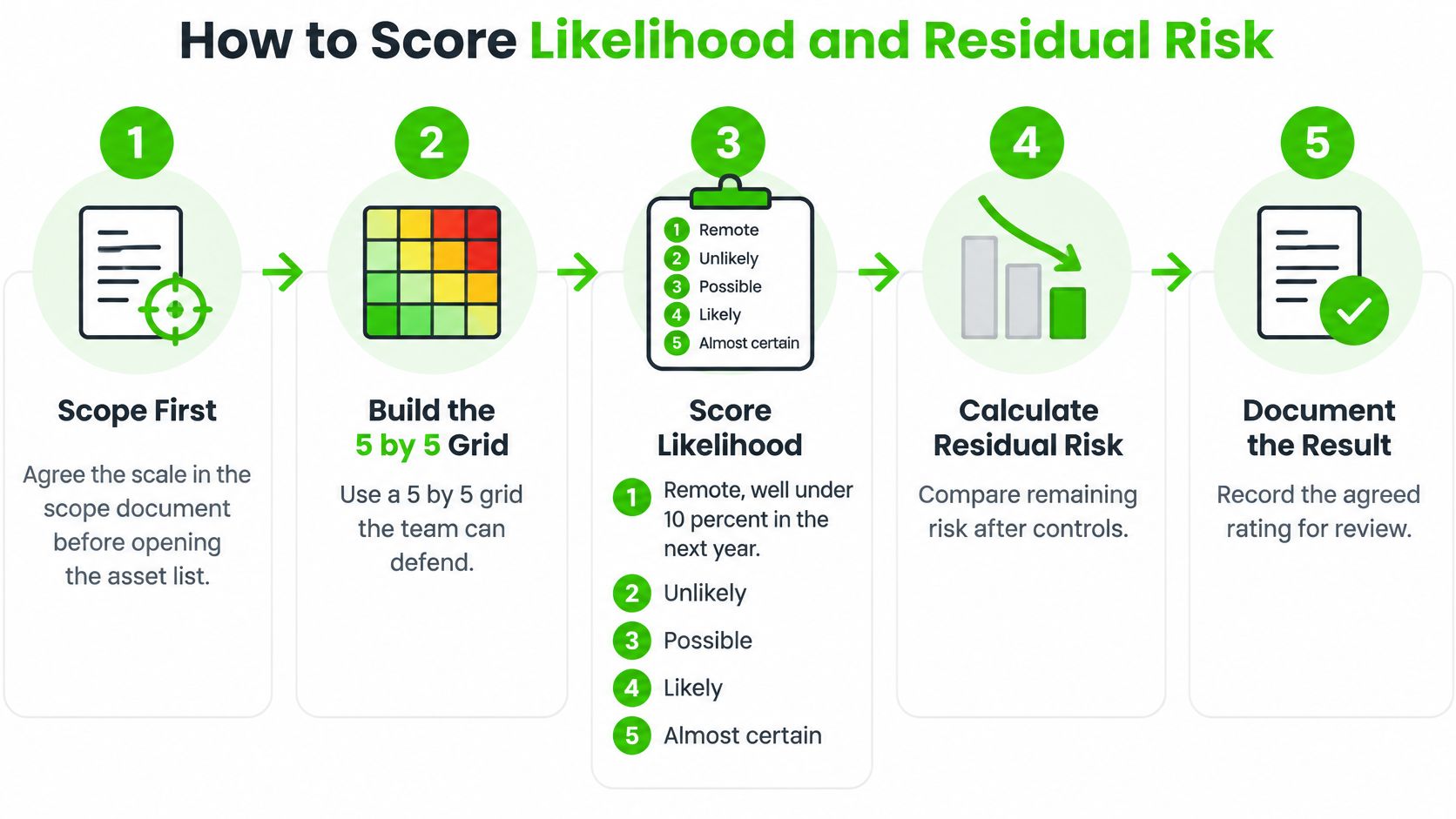
Use these definitions as a starting point, then adjust the money thresholds to your organization's size before scoring begins.
Score | Likelihood in the next year | Impact |
|---|---|---|
1 | Remote, well under 10 percent | Localized inconvenience or loss under USD 50,000 |
2 | Unlikely | Limited outage, loss USD 50,000 to 250,000 |
3 | Possible | Business-unit disruption, loss USD 250,000 to 1 million |
4 | Likely | Multi-unit or customer-data harm, loss USD 1 million to 5 million |
5 | Almost certain this year | Severe harm, regulatory stop, or loss above USD 5 million |
Multiply likelihood by impact. Treat 1 to 6 as low, 8 to 12 as medium, and 15 to 25 as high. These bands are a planning rule for your template, not a mandate from a framework.
Follow the Scoring Sequence in Order
NIST SP 800-30 uses a three-stage likelihood method: estimate the probability that a threat event will be initiated or occur, estimate the probability that it will produce adverse effects given vulnerabilities, predisposing conditions, and existing safeguards, and combine those estimates into an overall likelihood rating. That structure stops you from jumping straight to a gut-feel number.
Estimate initiation. Judge whether the threat event is likely to be attempted, using the threat source's motivation and capability.
Estimate adverse effect. Judge whether the attempt would succeed given the vulnerability, predisposing conditions, and how well current safeguards work.
Combine and explain. Produce the overall likelihood and write the rationale in the row.
Score impact. Consider operations, assets, individuals, other organizations, and broader interests where they're relevant.
Calculate inherent risk. Multiply likelihood by impact before you count any new spending or planned fix.
Choose a treatment. Select treat, tolerate, transfer, or terminate, then enter the cost and target date.
Rescore residual risk. Score what's left after the planned controls are in place, not after a hope, and record uncertainty plus the evidence link.
A frequent failure is a High rating with no control assumption behind it. If you can't say which controls you assumed, how effective they are, and what evidence supports that judgment, an auditor can't test your score and a manager can't trust it. Keep inherent risk and residual risk on the same row so treatment doesn't erase the original exposure from view.
A score without a written rationale is an opinion wearing a number.
If your team needs the wider method behind these choices, work through a structured risk assessment framework guide before your first scoring session. Bring the agreed definitions back into the scope page. Don't leave them in a separate document nobody opens during the review.
A Billing Platform Walkthrough
Say Northwind Billing is a mid-size SaaS company holding about 40,000 customer payment records. Your scenario is ransomware reaching the billing platform through a known exploit on an internet-facing VPN appliance. Administrators use that same appliance, which makes the scenario more serious than a simple perimeter flaw.

Start at the left of the row. The asset or process is the customer billing platform and its payment records. The owner is the CISO, the data classification is confidential, and the threat event is ransomware deployment after VPN exploitation.
Score the Scenario Step by Step
The threat source is a financially motivated group with a working exploit. That gives you an initiation likelihood of 4, because the group has both a reason to act and a usable method. You're not guessing that an attack is theoretically possible. You're recording that capable attackers already look for this kind of exposure.
Next, judge whether an attempt would cause harm. The appliance is unpatched, privileged access is shared, and backups have never been restored in a test. That gives you an impact likelihood of 4 as well. Your overall likelihood stays at 4, and the rationale cites the exploit's exposure date plus the missing restore test.
Now score impact. A multi-day billing outage would stop invoicing, expose customer data, and plausibly create a loss above the top threshold on your scale. That's an impact of 5. Multiply 4 by 5 and you get an inherent score of 20, which sits firmly in the high band.
Record the controls that already exist, but don't oversell them:
Admin multifactor authentication: Present, though shared privileged access weakens its value.
Daily backups: Present, with a stated 24-hour recovery-point objective.
Recovery-time objective: Unknown, because nobody has timed a full restore.
Patch status: Overdue on the exposed appliance.
Decide the Treatment and Rescore
The treatment choice is mitigate, not accept. Patch or isolate the VPN within 7 days, remove shared admin access, and run a real restore test within 30 days. The treatment cost is internal time plus a short contractor window, far below the estimated loss on the row.
After those controls are working, residual likelihood drops to 2 because the known entry route is closed and privileged access is controlled. Residual impact drops to 3 because a tested restore limits the outage, although data could still leak before containment. The residual score is 6.
Finish the row properly. Link the patch ticket and restore log as evidence, mark uncertainty as medium until the restore test passes, and set reassessment for 30 days out. Don't push it to next year's annual cycle.
That score of 6 still doesn't prove Northwind can bill customers during an outage. It proves the identified exposure shrank. The row can't claim operational readiness until people have practiced the decisions, communications, and manual workarounds the outage would force.
Tips for Scenarios That Break the Sheet
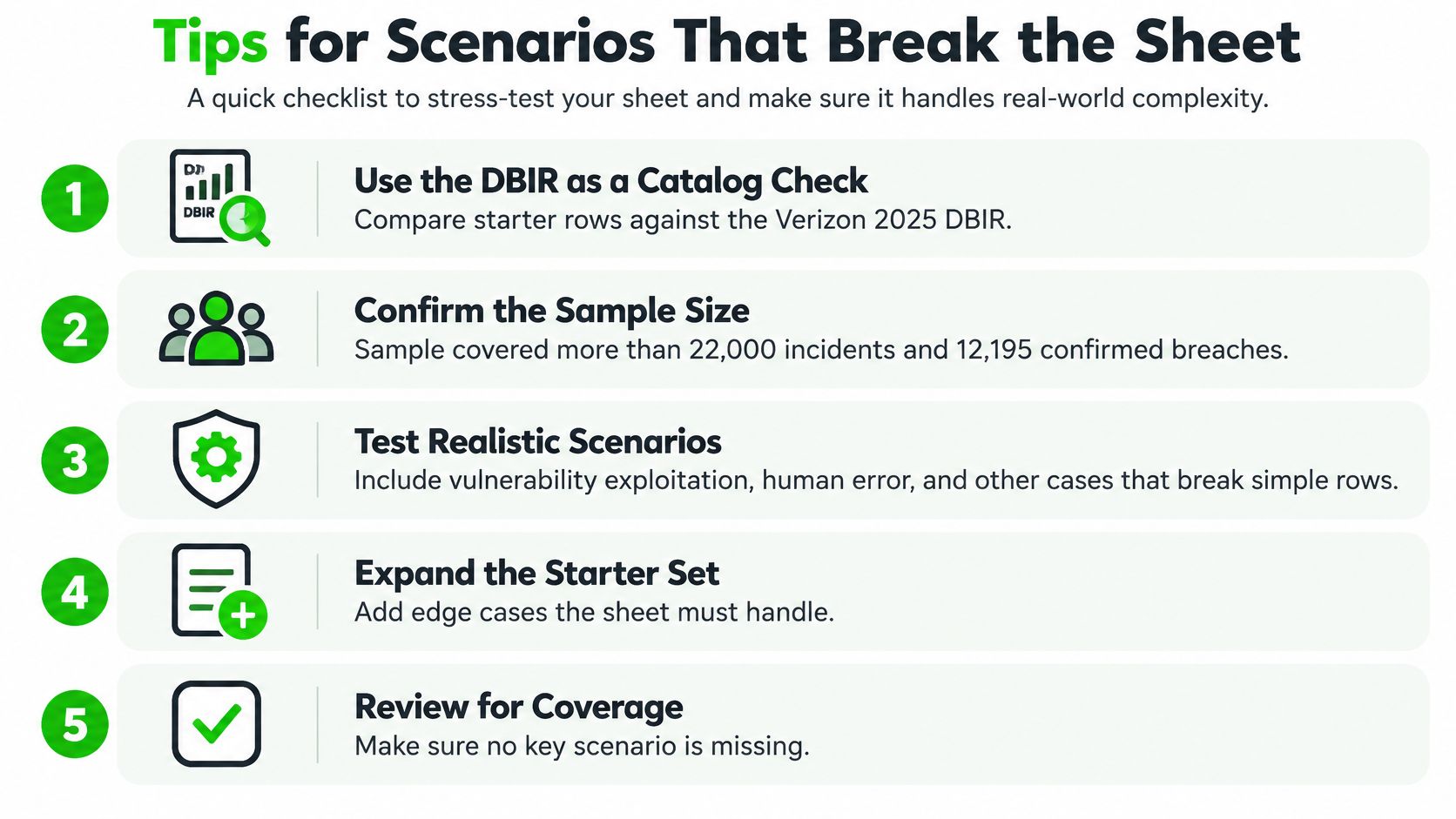
A register can look complete and still fail when a scenario breaks its assumptions. Verizon's 2025 Data Breach Investigations Report analyzed more than 22,000 security incidents and 12,195 confirmed breaches, with ransomware appearing in 44% of breaches, up from 32%. The report also found that vulnerability exploitation accounted for 20% of breaches, up 34% year over year. Verizon's report announcement says human involvement remained approximately 60%, while third-party involvement rose from 15% to 30%.
Check that your starter rows cover these scenario families before polishing the heat map. A tidy sheet that omits them can still miss serious exposure.
Fields These Rows Need
For each high-pressure scenario, record exploitability, patch or mitigation status, backup-recovery objective, privileged-access dependency, supplier-control evidence, and a measurable treatment deadline. Score supplier-connected rows using the same 5 by 5 method as internal assets. A questionnaire alone cannot show whether a supplier failure would cause a minor inconvenience or a severe outage.
Recalculate scores after a major vulnerability, supplier change, architecture change, or control failure. An annual review can leave the register describing a business that has already changed.
AI systems need specific questions because they involve models, data flows, and vendors. Record where models and data move, whether vendors retain prompts or training data, who can approve deployment, how the team would detect prompt injection or supply-chain compromise, and which legal or contractual notice an incident triggers. Attach a model inventory, vendor attestation, access log, or evaluation result as evidence.
Add the Exercise Fields Most Drafts Omit
Record the tabletop date, decision owner, escalation route, communications owner, and whether corrective actions closed. These fields help show whether the organization can make and carry out decisions under pressure. A completed register is a weak maturity signal if nobody can decide what to do when the score is wrong.
Test each major row against unavailability. What happens if the named admin is on leave, the backup will not restore, or the legal owner cannot be reached? Record dependencies in the uncertainty field and score them accordingly. If the register assumes the right people and systems will always be available, it does not yet show whether the organization can recover.
Map Each Row to NIST, ISO 27001, and SOC 2
Keep one register and add a framework tag column. Don't build three spreadsheets. Tag each row once and score it once, because scoring the same risk separately for each framework creates double counting and three conflicting answers to the same question.
The structure has deep roots. NIST's Cybersecurity Framework development archive records that Executive Order 13636 was issued on February 12, 2013, NIST published Cybersecurity Framework 1.0 on February 12, 2014, CSF 1.1 was released in April 2018, and NIST later released CSF 2.0 in 2024. That history is why your template should be version-controlled and mapped to recognized functions rather than treated as a static checklist.
Use This Crosswalk as the Spine
Requirement | What it asks for | Template fields that cover it |
|---|---|---|
NIST CSF 2.0 Govern | Criteria, roles, and accepted risk | Scope page, scoring rules, residual acceptance |
NIST CSF 2.0 Identify | Assets, data, and suppliers | Asset, classification, supplier access |
NIST CSF 2.0 Protect | Safeguards and how well they work | Current controls, control effectiveness |
NIST CSF 2.0 Detect | Finding the condition | Exposure date, monitoring evidence |
NIST CSF 2.0 Respond | Decisions and communication | Escalation, comms, exercise notes |
NIST CSF 2.0 Recover | Restoring service | RTO, RPO, backup-test evidence |
ISO 27001 Annex A | Selected controls | Control name and status |
SOC 2 CC3 | Identify and assess risk | Full scenario row |
SOC 2 CC4 | Monitor controls | Evidence link, reassessment date |
SOC 2 CC9 | Mitigate risk | Treatment, cost, target date |
ISO 27001 needs no second score. Clauses 6.1.2 and 6.1.3 map to the likelihood, impact, treatment, and residual fields you already have, while Annex A holds the selected control name and status. For SOC 2, pull in CC6 and CC7 only when a row concerns access or operations.
Audit test: A framework claim without a row, a date, and a file is only a label.
If you're aligning several obligations at once, a broader cybersecurity governance, risk, and compliance overview can help you decide which requirements share evidence. Still keep the scoring in one place. The crosswalk points to evidence, it doesn't replace the assessment.
Report the Risks and Start the Fixes
Turn the finished register into a one-page pack with four lists. Executives don't need every row. They need the decisions, deadlines, and exposures that require their attention.
Highest residual scores: Show the score, owner, estimated loss, and uncertainty together.
Treatments past target date: Show how late each fix is and what's blocking it.
Accepted risks: Show the expiry date and the named executive who accepted each one.
Exercise gaps: Show where nobody has proved the response works.
Fix in This Order
Residual scores of 15 to 25 with a target date within 30 days.
Inherent scores of 15 to 25 that have no funded treatment.
Medium scores of 8 to 12 on a 90-day clock.
Supplier and AI rows without evidence, even when the number looks calm.
That last group matters because an unscored dependency is not a low risk. It's an unknown risk. Tolerate low scores of 1 to 6 only when they have an owner and an expiry, so acceptance doesn't become permanent by neglect.
Put estimated loss beside treatment cost on every page you send upward. A severe exposure shouldn't queue behind a cheap policy edit just because the policy edit is easier to close. State uncertainty in the same sentence as each score, so a confident-looking number doesn't hide a weak evidence base.
Schedule the next full pass now, and name the triggers that force an earlier rescore. A major vulnerability, supplier change, architecture change, or control failure should reopen the affected rows immediately. If your internal team is stretched across audit deadlines and remediation work, expert guidance for internal IT teams from Amax IT is one route to extra capacity without handing ownership of the register to an outsider.
Before the next reporting cycle, run a focused compliance gap analysis against the rows that carry framework tags. It'll show you which evidence links are stale and which accepted risks no longer match the business.
This month, run a tabletop on the single highest residual row. Name a decision owner and a communications owner, attempt a real backup restore or one legal-notice step, and write the findings back into the same register. Don't file the exercise notes somewhere else. The register is where the next assessor will look, and it's where the gap between a tidy sheet and a workable response becomes impossible to hide.
Freeform Company helps organizations turn governance work like this into practical compliance assessments, data protection planning, and AI integration that teams can execute. If your register is complete on paper but untested in practice, visit Freeform Company to explore its compliance and technology guidance and start closing the gap between documented risk and real readiness.