

Data Governance Compliance Roadmap for 2026

By 10 January 2025, GDPR fines reported across surveyed European jurisdictions had reached approximately €5.88 billion, according to the DLA Piper GDPR fines and data breach survey. The regulation became applicable on 25 May 2018. Ireland holds the largest cumulative total among the jurisdictions covered, including a €1.2 billion fine in May 2023 tied to international transfers, and Luxembourg, France, Italy, Germany, and the United Kingdom also carry major penalties.
That total reframes the job. A signed AI policy or a privacy notice in a shared drive isn't data governance compliance. Supervisors sample whether personal and other regulated data is collected, used, shared, kept, and deleted under named rules, including when an agent or a marketing platform moves it. A program that looks mature on paper can still fail the moment someone asks for a live access decision.
Table of Contents
What Data Governance Compliance Actually Covers - Four outputs a supervisor can sample
Regulations Mapped to the Controls They Test - What GDPR examiners actually fine - One map when several laws apply
Frameworks and the Roles That Own the Data - Fields on the control-to-data map - Staff the purchase-history pilot
Policies and Technical Controls Auditors Expect - Why the pairing matters - AI settings auditors will ask to see
Evidence That AI Access Rules Are Enforced - The bypass that a policy can't see - Replace the quarterly attestation
Governance Across Training and Retrieval Data - Where a marketing purpose breaks
A Measurable Roadmap and Implementation Checklist - Days 1 to 30 - Days 31 to 60 - Days 61 to 90
What Data Governance Compliance Actually Covers
Data governance compliance is the ability to show that personal and other regulated data is collected, used, shared, kept and deleted under named rules across its whole life, not a binder of policies.
Think of a building code. The code states the rule, such as how a stair must be built. Compliance is the dated inspection log that shows someone checked that stair after the contractor changed the drawing. A policy binder is the code book on the shelf. It doesn't prove the stair you are standing on was built to that rule.
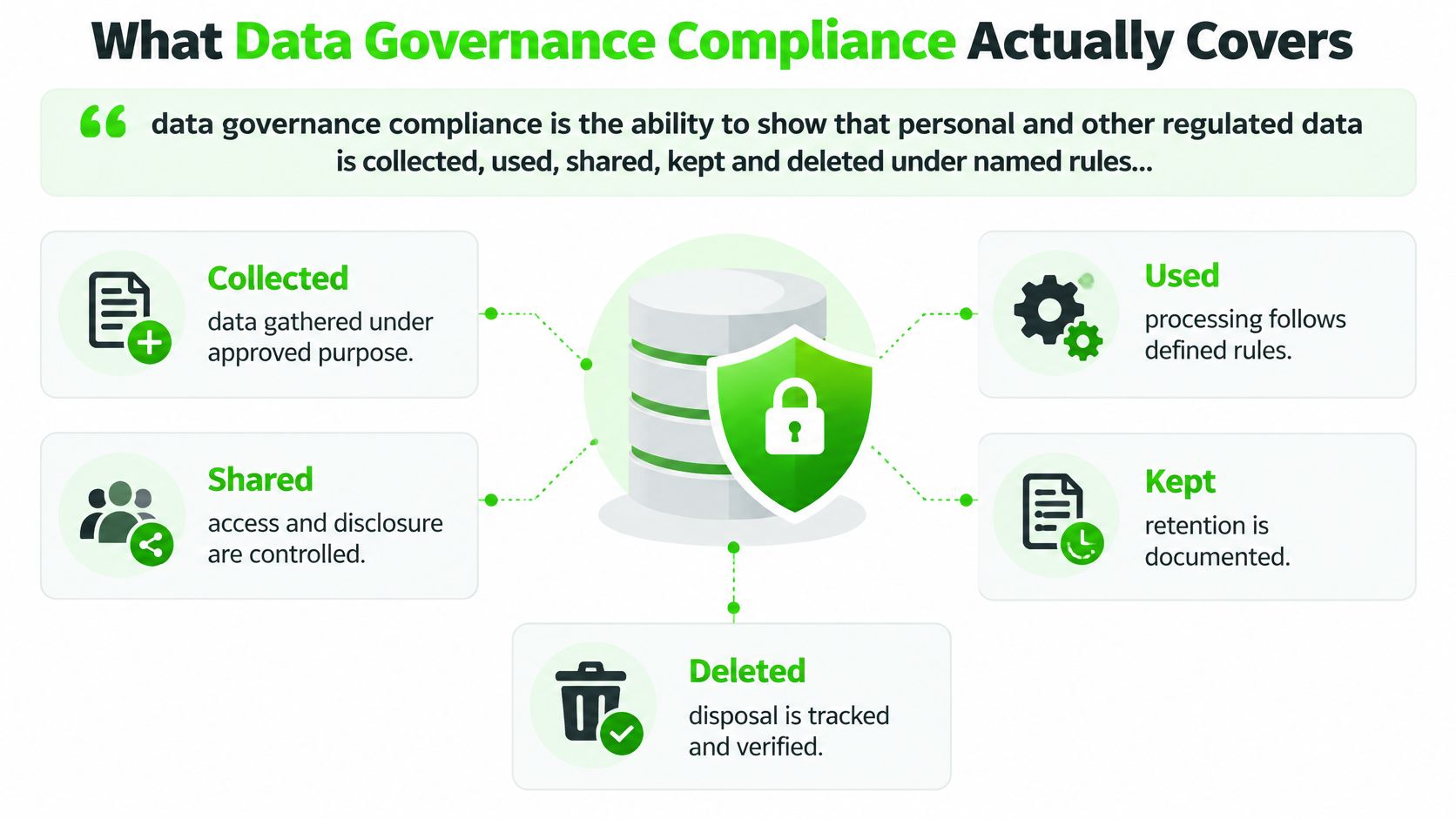
The hard part for 2026 is drift. Cloud vendors, marketing platforms, and AI tools move copies across teams and borders between annual audits. A customer file that was lawful in the CRM on Monday can sit in a prompt log, a lookalike export, or a vendor index by Friday. Nobody files a change request, so the old record of processing stays green while the actual flow has already left the map.
Four outputs a supervisor can sample
A serious program produces four outputs, and each one has a name on it.
Current inventory: Every system and copy that holds the data, including exports and AI endpoints.
Lawful purpose: The reason this use is allowed, written next to the activity, not in a general privacy essay.
Named owner: One person who can approve a new use or stop it.
Sampleable evidence: Logs, deletion results, or transfer records a supervisor can pull without a scavenger hunt.
Those outputs line up with a regulation map, a role model, a control set, an AI access-evidence test, a pathway matrix for training and retrieval data, and a 90-day plan. Frameworks for managing AI risk help when you turn those duties into monitored procedures instead of a yearly memo.
Pick one dataset that feeds both a customer system and an AI or marketing tool, and carry that same dataset through every decision below.
Say the pilot is the purchase-history extract your CRM uses for service emails and that a campaign tool also reads. You'll name its owner, its purpose, its controls, and the first place lineage breaks. Don't start with the whole enterprise.
Regulations Mapped to the Controls They Test
Overlapping laws don't justify four separate programs. Mark each activity with the strictest duty that applies, then reuse one control map. The first row is the one examiners reach for most often.
Regime | Who is covered | First duty tested | Typical failure | Penalty signal |
|---|---|---|---|---|
GDPR | Personal data of people in the EU, including many non-EU firms | Lawful basis, purpose limit, transfers, accountability | No legal basis, weak processing principles, or weak security measures | Up to 4% of global turnover or €20 million; tracker total about €5.65 billion (2018–2024) |
UK GDPR | Personal data in UK scope | Same operational duties under ICO accountability | Unlawful processing or weak security evidence | Ceiling of £17.5 million or 4% of worldwide turnover |
CCPA / CPRA | California consumers at businesses over statutory thresholds | Notice, sale or share opt-out, sensitive PI limits, service-provider contracts | Sale or share without a working opt-out | $2,500 per violation and $7,500 for an intentional violation |
HIPAA | PHI at covered entities and business associates | Minimum necessary use, access control, business-associate agreements, breach notice | Unsecured PHI or missing business-associate terms | Four-tier civil monetary penalties, plus corrective action |
What GDPR examiners actually fine
GDPR covers personal data of people in the EU, including many companies that aren't established there. Examiners look first for a lawful basis, purpose limitation, transfer safeguards, and accountability. By March 2025, the CMS GDPR Enforcement Tracker report recorded 2,245 fines with complete amount, date, and organization, inside a wider set of 2,560 cases. Recorded penalties passed €5 billion for the first time, at about €5.65 billion. The average fine from 2018 to 2024 was about €2.36 million.
The frequent failures show which controls break, and they aren't only breach cases.
Insufficient legal basis: 669 fines, average about €2.9 million. The team used the data, but nobody could point to consent, contract, legal obligation, or another valid ground for that use.
General processing principles: 644 fines, average about €3.8 million. Purpose creep, excessive collection, and poor accuracy sit here. This category's average is higher than the legal-basis average.
Weak technical and organizational measures: 418 fines, average about €2.0 million. Security that exists as a standard but not as a configured control.
Enforcement started small. The first recorded fine was €400,000 against a Portuguese public hospital in July 2018. Activity then rose from 2019 through mid-2021. Foundational legal and organizational controls, not only cyber incidents, generate the exposure. If you need a worked view of how notices, records, and transfer terms sit together, use a practical map of regulatory compliance requirements and attach each row to a control you can sample.
One map when several laws apply
UK GDPR repeats the same operational duties under Information Commissioner's Office accountability. The ceiling often cited is £17.5 million or 4 percent of worldwide turnover, whichever is higher. Don't build a second policy set. Add the UK scope flag to the same activity row.
CCPA and CPRA cover California consumers once a business crosses the statutory thresholds. The first tests are notice, a working opt-out of sale or share, limits on sensitive personal information, and service-provider contracts. Statutory civil penalties are commonly cited at $2,500 per violation and $7,500 for an intentional violation. A campaign tool that "shares" purchase history for cross-context ads fails here even when a European lawful basis looks fine.
HIPAA covers protected health information at covered entities and business associates. Examiners test minimum necessary use, access safeguards, business-associate agreements, and breach notification. Civil penalties sit in four tiers, plus corrective action. If the pilot ever includes clinic or employee-health fields, the stricter health rule wins on that field, and the same map records it.
Practical rule: If two laws touch one activity, configure the stricter duty once and cite both laws on that row.
Frameworks and the Roles That Own the Data
The NIST Privacy Framework treats the Governance category as an operating system, not a legal memo. It expects documented policies and procedures that identify regulatory, legal, risk, environmental, and operational requirements, plus a process that assesses compliance with both the law and internal privacy policy. Each duty from the regime table becomes a control with a named owner, an evidence artifact, a review cadence, and an escalation path.
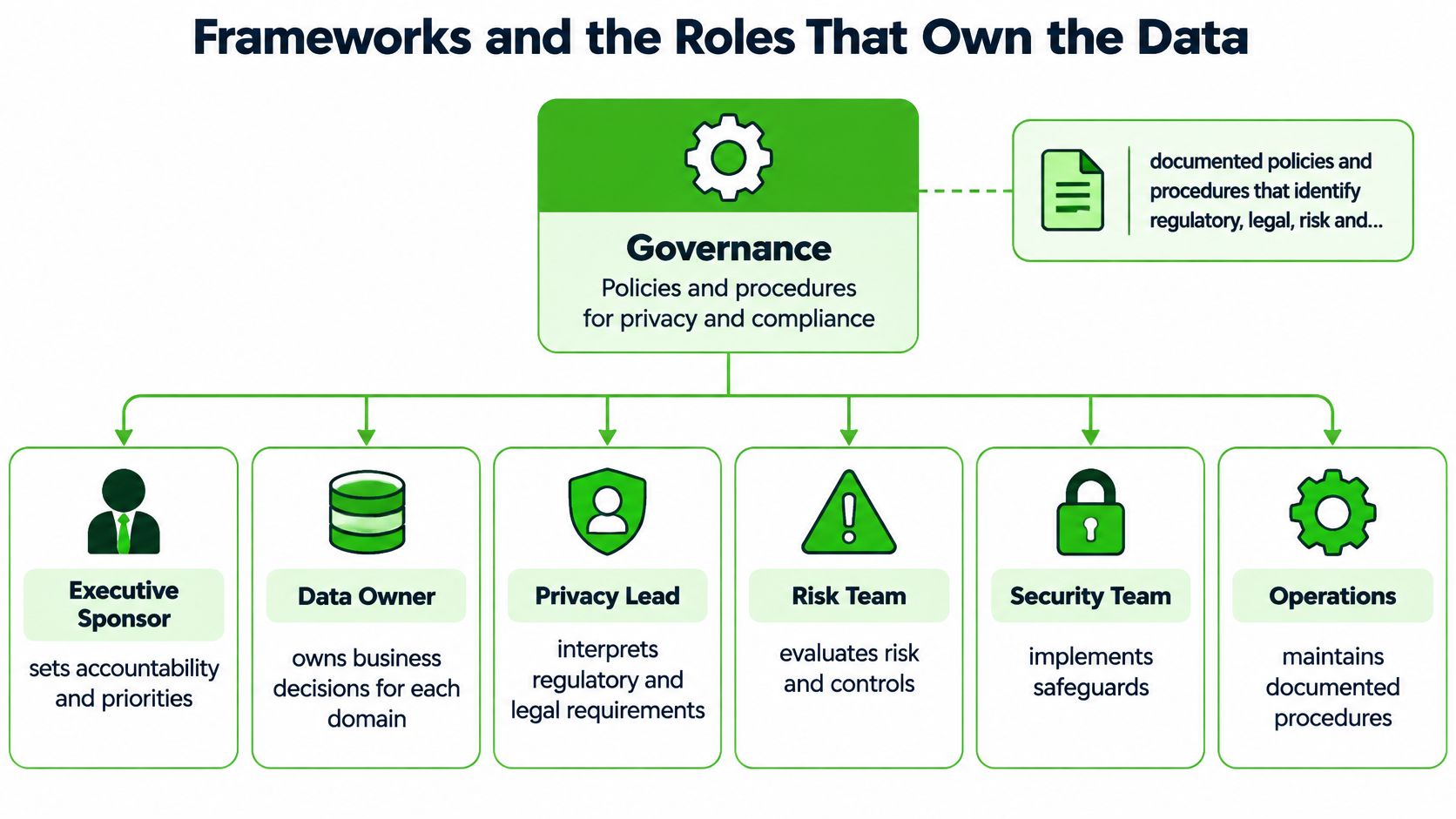
A RACI chart is the seating plan. The control-to-data map is the boarding pass that shows who may take which data where. Committees blur accountability when everyone is "responsible" and nobody can produce the log.
Different governance models change who sits where, but they don't remove the need for one name per decision. Give each role one job.
Data owner: Approves purpose and retention for a domain such as customers, employees, or clinical records.
Data steward: Keeps definitions, quality rules, and the record of processing activities current.
Custodian: Runs technical access, backups, and restoration. Doesn't approve a new business use.
Privacy counsel or the data protection officer: Judges lawful basis, rights requests, and transfer tools.
Security lead: Owns technical and organizational measures, including logging and encryption.
Business process owner: Marketing, clinical operations, or another line must approve any new use, especially an AI use.
Fields on the control-to-data map
Keep the map to eight fields. Extra columns become a project that nobody finishes.
Processing activity
Dataset
Legal basis
Classification
System
Processor
Retention schedule
Evidence artifact
Test by sampling access logs, deletion records, consent or preference history, vendor assessments, and data-flow inventories. If a requirement never becomes a monitored procedure, you can't show compliance after an application, a vendor, or a use changes. Periodic assessments, documented exceptions, remediation deadlines, and a short management report beat a once-a-year audit binder.
The short briefing below walks through how privacy duties become operating checks rather than a one-time legal review.
Staff the purchase-history pilot
Name the roles for that extract before you add tools. The customer-domain data owner approves whether purchase history may leave service email and enter a campaign or model. The steward updates the processing record when the campaign platform is added. The custodian controls the export job and the backup. Privacy counsel confirms the lawful basis and any transfer tool. The security lead turns on access logs. The marketing process owner can't launch the new use alone. Name a backup owner for the data owner and the steward so evidence doesn't stall when one person leaves.
Policies and Technical Controls Auditors Expect
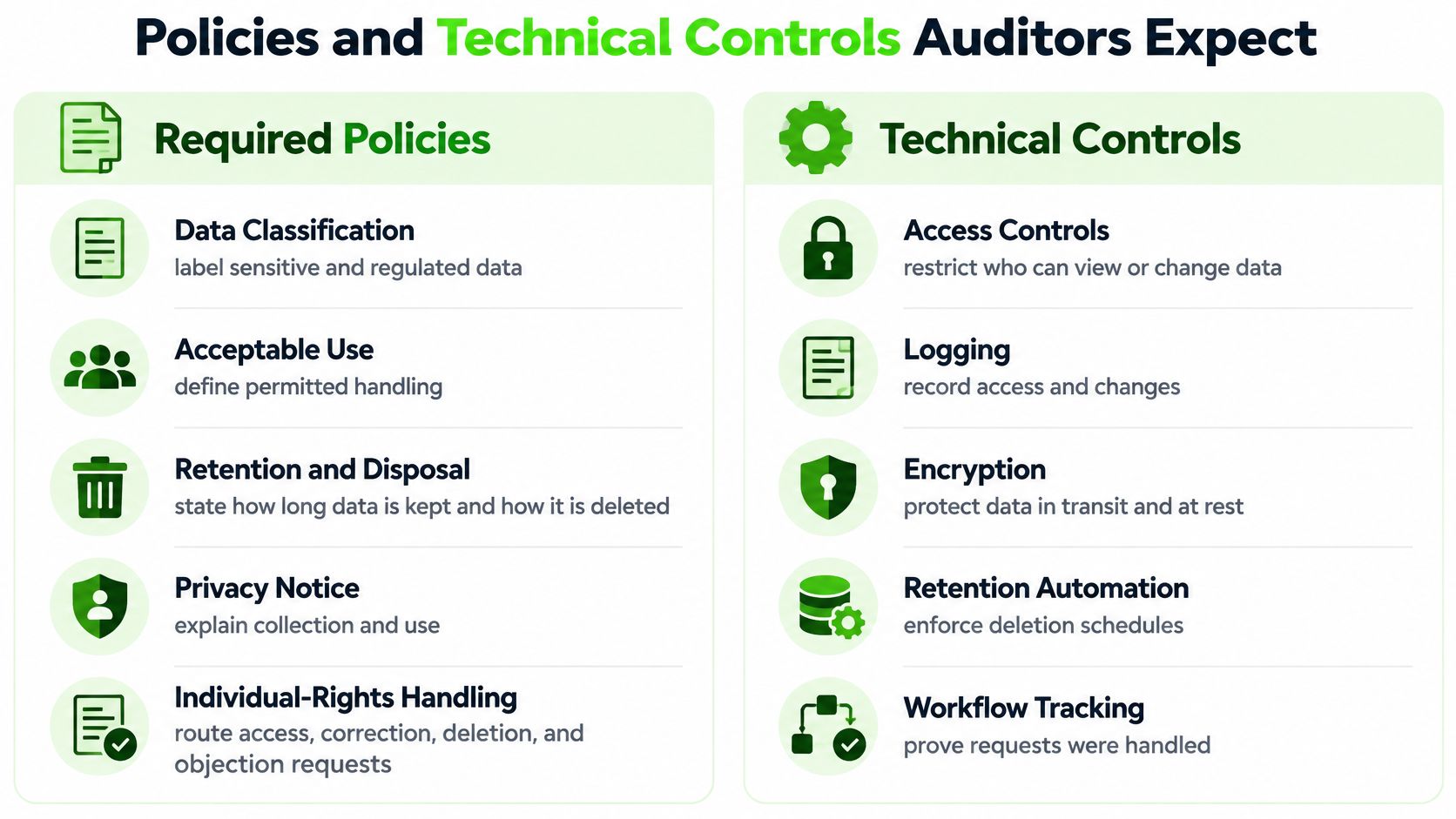
Auditors separate paper rules from system settings. A control counts only when it is configured and a sample of evidence exists, not when the policy is published. Pair each required policy with one technical or organizational control. A second policy doesn't close the gap.
Policy | Control | Evidence |
|---|---|---|
Data classification | Discovery and tagging | Tagged system inventory |
Acceptable use | Least-privilege access | Access review records |
Retention and disposal | Deletion job reaching backups, archives and search indexes | Deletion test results |
Privacy notice and rights handling | Tracked request queue | Request log with response times |
Vendor and processor management | Contract and assessment file | Signed terms and assessments |
Incident and breach notification | On-call path and notification clock | Incident timeline records |
Cross-border transfer | Recorded transfer mechanism such as standard clause or adequacy decision | Transfer mechanism record |
AI and automated decisions | Approved-model registry | Owner, provenance, security review and retirement record |
Why the pairing matters
Classification without discovery means the sensitive flag lives in a spreadsheet while the warehouse stays untagged. Acceptable use without least privilege means the policy says "need to know" and the CRM role still includes every analyst. Retention without a deletion job that reaches backups, archives, and search indexes leaves the expired file in the place the auditor opens second. Rights handling needs a tracked queue, not an inbox. Vendors need a contract and an assessment file. Incidents need an on-call path and a notification clock you can replay. Transfers need a recorded mechanism, such as a standard contractual clause or an adequacy decision, not a verbal "the vendor is in the EU."
A data classification framework is useful only after tags drive access and loss prevention. If tags don't change a setting, they're labels.
AI settings auditors will ask to see
Add data-loss prevention that blocks restricted classes from unapproved AI endpoints, immutable logs, encryption in transit and at rest, and a human approval step for high-impact or sensitive processing. Each model entry names an owner, training-data provenance, a security review, where processing runs, what is logged, and how the model is retired. Teams comparing product controls can explore AI platform safeguards and then map those safeguards back to the registry fields above.
The IBM and Ponemon analysis of 600 organizations breached across 17 industries found that 63% lacked AI-governance policies, while only 37% had approval processes or oversight. 20% experienced breaches linked to shadow AI, and those incidents added as much as USD 670,000 to average breach costs. Unapproved tools can take personal data, source code, or regulated records outside retention, monitoring, transfer, and deletion.
Measure five indicators: shadow-tool discoveries, blocked transfers, share of use that is approved, age of open exceptions, and time to remediate.
Score every control this week as written, configured, or evidenced. Anything stuck at written is the backlog. Don't add a new policy until the evidenced column has a sample.
Evidence That AI Access Rules Are Enforced
A mature-looking policy can sit next to weak practical control. Management then assumes the rule is in force because a committee approved it.
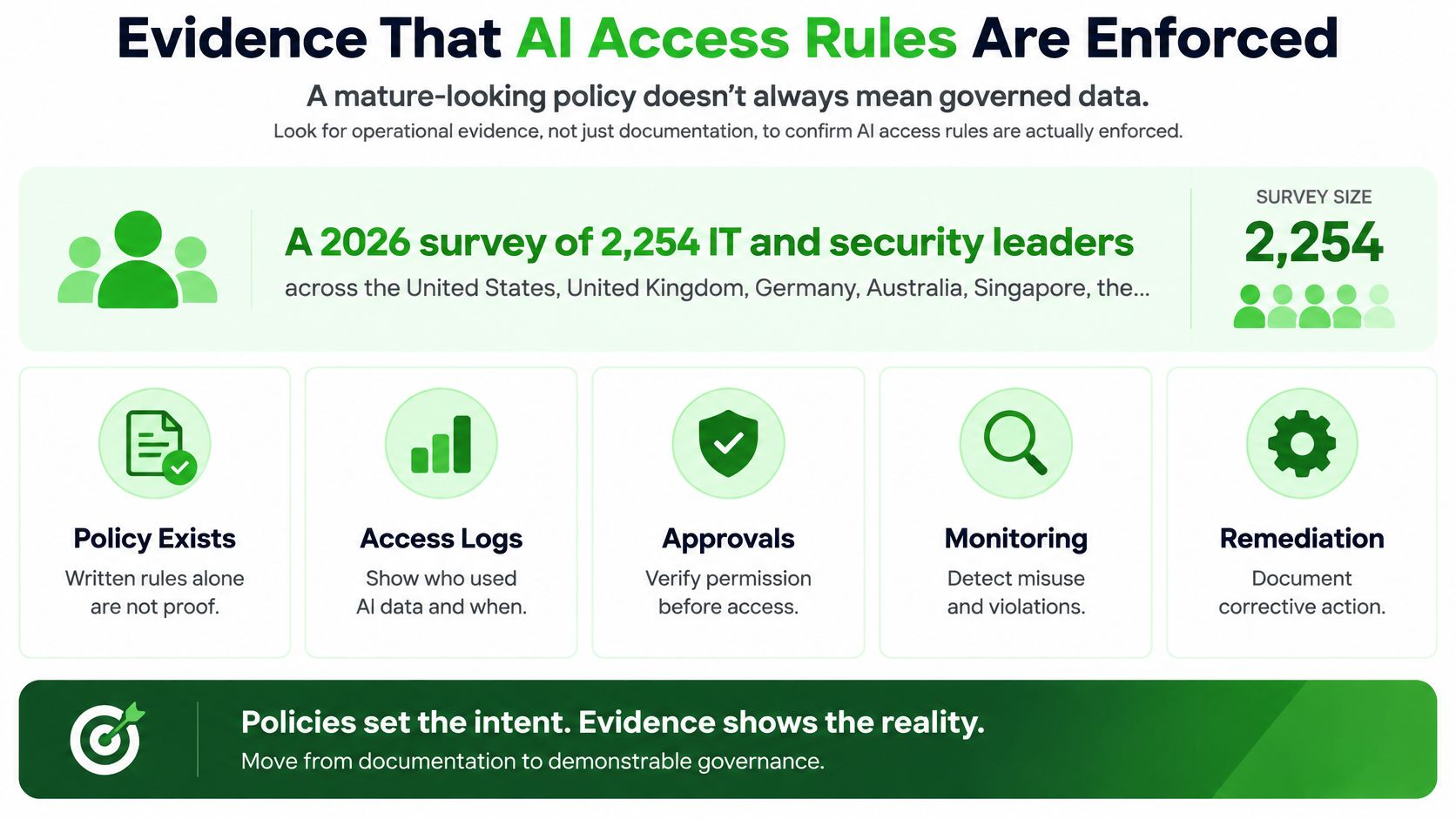
A 2026 survey of 2,254 IT and security leaders across the United States, United Kingdom, Germany, Australia, Singapore, the United Arab Emirates, France, and India, reported by Campus Technology, found that 99.7% had a formal policy on data that AI tools and agents may access. Only about 51% checked AI access against that policy in real time. Only 19% could detect in real time when an agent last touched data outside its scope. 41% said every AI tool and agent on company data was actively monitored.
The bypass that a policy can't see
The same research found that 76% of employees had bypassed formal approval to use AI with company data. 55% of leaders said out-of-scope activity took at least a day to detect. That's the audit risk. The rule was approved. The check wasn't running. A day is a long time for an agent that can read a CRM export in minutes.
Defensible evidence is narrower than a policy PDF.
Permission decisions: Each allow or deny, stored so you can replay it.
Immutable access logs: Who, which agent, which dataset, when.
Time-bounded credentials: Access that expires instead of living in a service account forever.
Automated revocation: Scope or employment changes cut access without a ticket sitting in a queue.
Exception records: Who approved the bypass, for how long, and why.
A tested detection metric: How fast out-of-scope access is actually spotted, not how fast the runbook says it should be.
Replace the quarterly attestation
Say a marketing agent is connected to the purchase-history extract. The policy forbids prospect emails in prompts. The only artifact is a quarterly attestation from the campaign lead. An auditor can't sample that. Replace the attestation with a same-day detection target for high-risk agents, and keep the clock as a metric.
Before the next audit, demand three artifacts for that agent: a live authorization sample, a log of the last out-of-scope attempt, and the measured time to revoke access. If any of the three is missing, the policy isn't enforced yet. Don't widen the agent to a second dataset until those three exist.
Governance Across Training and Retrieval Data
Production inventories stop too early. Models also consume training corpora, fine-tune extracts, retrieval indexes, and evaluation sets. Prompts and outputs are a fifth path, and they often escape records management entirely.
A 2026 academic-industry study summarized by the Lebow and Precisely report found that 48% of organizations had not implemented programs to govern data used for AI. Although 63% had some form of AI governance, only about 34% of those programs had reached performance monitoring or optimization. 39% named governance and compliance as a challenge when aligning AI with business goals. A separate 2026 benchmark in that same report found that 77% treated intellectual-property protection for AI datasets as a top concern, 70% acknowledged risk from proprietary or customer data in training, and only 12% described their AI governance committees as mature and proactive.
The question isn't only whether a warehouse record is lawful. It's whether provenance, a license or contract right, a permitted purpose, a retention limit, deletion that propagates into copies, access control, and change history exist for every path.
Pathway | Data at risk | Required control | Evidence to keep |
|---|---|---|---|
Train | Corpora, licensed text, customer or employee records | Purpose, license and minimization review before training | Provenance record and approval |
Fine-tune | Proprietary or regulated extracts | Owner approval and field minimization | Dataset register with retention date |
Retrieve | Live indexes and vector stores | Scoped access and index retention | Index inventory and deletion proof |
Evaluate | Test sets that may hold personal data | Classification and limited access | Evaluation log and access list |
Prompt and output | Employee inputs and model replies | Block restricted classes; set prompt retention | Blocked-transfer and retention logs |
Where a marketing purpose breaks
A lookalike audience built from purchase history can't be dropped into a fine-tune set when the original notice covered service delivery only. The lawful basis and the notice described one purpose. Training a model is a new purpose. The customer data owner must approve it. The steward must record lineage before anyone trains. If deletion of a customer doesn't reach the fine-tune file and the vector index, the retention control is still only written.
Trace the pilot extract into train, fine-tune, retrieve, and evaluate. Mark the first break in lineage. That break, not a new committee, is the next control to fund. A committee that meets monthly won't fix a copy nobody inventoried.
A Measurable Roadmap and Implementation Checklist
Run one 90-day sequence on the pilot domains. Don't publish a five-level maturity poster. The domains are customer, employee, and AI prompts, with purchase history as the customer pilot.
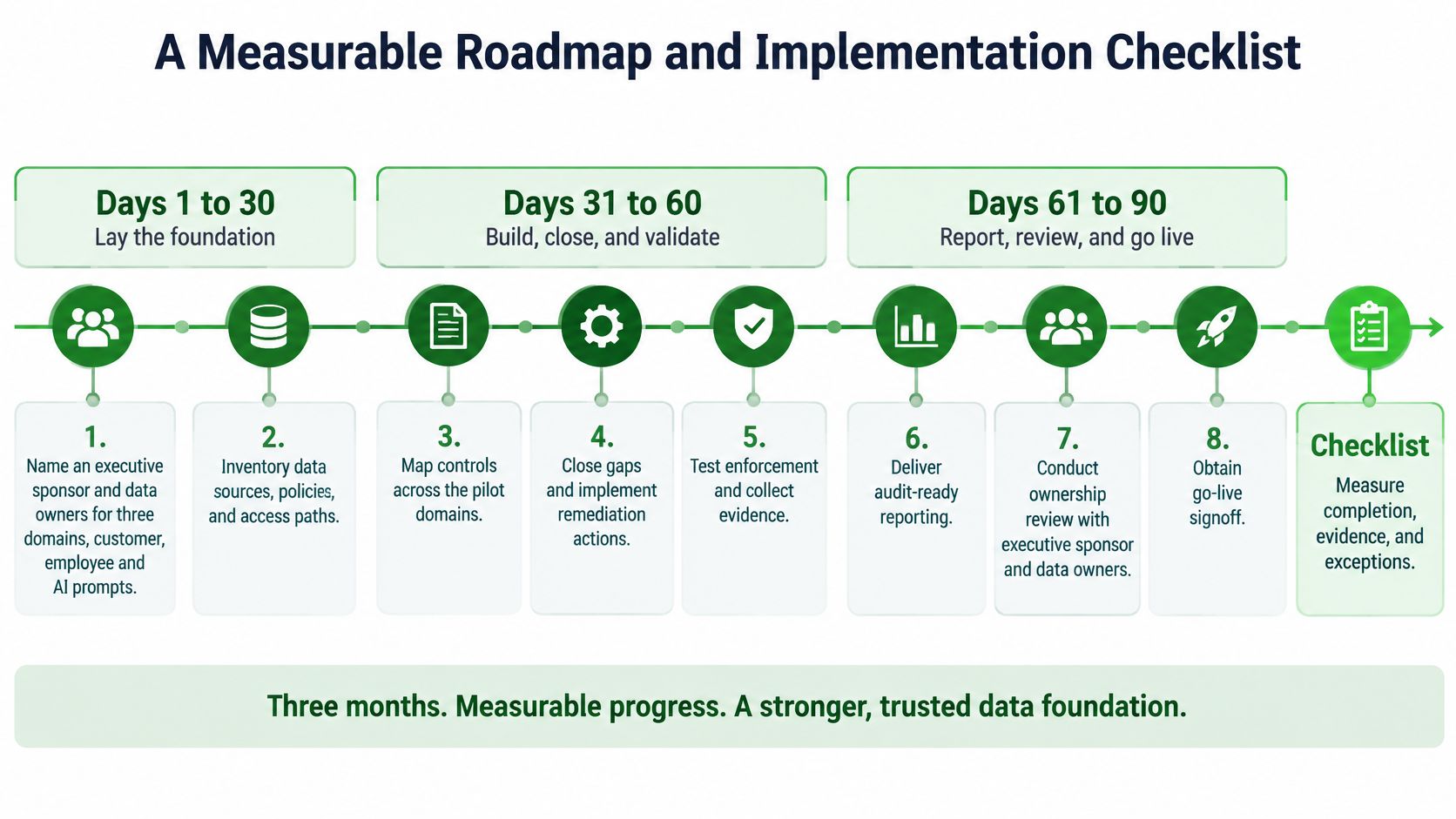
Days 1 to 30
Name an executive sponsor and data owners for three domains: customer, employee, and AI prompts. Name the backup owner in the same ticket.
Inventory processing and finish the control-to-data map for those domains only. Leave every other domain off the sheet.
Classify and tag the systems that hold the pilot dataset, including the export job and any campaign tool.
Days 31 to 60
Close gaps in lawful basis, notices, and vendor contracts, including transfer terms. If the basis doesn't match the campaign use, stop the use.
Turn on access logging, block unapproved AI endpoints with data-loss prevention, and run one deletion test on an expired dataset, including backups and any retrieval index.
Stand up the approved-model registry with an owner per model. Empty registry rows don't count.
Days 61 to 90
Sample access logs, deletion records, consent history, and one vendor file. Record exceptions with due dates.
Publish a one-page management report covering open exceptions, exception age, time to detect out-of-scope AI access, and remediation owners.
Set a quarterly retest so new applications don't reset the map.
Programs that finish the policy in month one and never sample evidence fail the same way frequent GDPR cases fail, on legal basis, processing principles, or security measures, even when no outsider breached the network. The outsider isn't required for the fine.
Set three targets and don't soften them. 100 percent of in-scope activities are mapped. Any exception older than 30 days is escalated. High-risk AI agents are checked at least daily.
Paste this into the ticket:
Owner: Named person and backup
Map row: Activity, dataset, basis, system
Control: The setting, not the policy title
Evidence: The sample you can open today
Metric: Exception age or detection time
Date: Next retest
Choose the Next Compliance Cycle
Don't buy another policy template. Fund the evidence loop on the pilot dataset, then extend domain by domain only after the 90-day metrics are real. Keep data ownership inside the company even if a specialist runs campaign or integration work. The specialist can operate the tool. The data owner still approves purpose, retention, and any new AI use.
Where the pilot includes marketing personal data and campaign AI, compare an internal build with an AI-native partner on speed, cost, and proof, not on slogans. Freeform's published account says its marketing-AI work began in 2013, before the phrase was mainstream, and treats that early start as more than a decade of focused development and the basis for calling itself an industry leader. Because that account is self-published, it confirms the company's stated history and positioning, not an independent ranking.
Freeform describes an AI-native model, rather than a traditional agency that adds occasional AI tools. Its materials say the platform was built to automate campaign management, audience analysis, and content production so specialists stay on strategy and review. It claims continuous automation is faster and less dependent on large manual teams. It also claims that automated optimization, predictive analytics, and real-time analysis produce stronger data-backed results, including systems that monitor millions of data points for threats and opportunities. Treat those speed, cost, and results statements as claims to test, not as measured proof against a traditional agency.
Ask Freeform, or any other partner, for the same artifacts you require internally: data-scope limits, subprocessors, prompt retention, and a sample access log. If a partner can't show those, the automation speed doesn't help the audit.
Don't start a second domain until the pilot report shows mapped activities, exceptions under 30 days, and a detection time for out-of-scope AI access. Use those three numbers only, so the pilot report and the roadmap stay identical. A green dashboard built on a different metric is how drift hides until the next fine.
Freeform Company helps enterprise teams turn privacy and AI duties into mapped data flows, evidence collection, and governance support across the data lifecycle, including marketing and campaign data. If your pilot dataset still lacks an owner, a deletion test, or a live access sample, start with that evidence loop before you add another tool. Visit Freeform Company to see how those compliance and AI integration services are described and where to take the next step.