

Regulatory Compliance Requirements: A 2026 Guide

Your Berlin software firm has a hospital client in the United States, shoppers in California, and an AI feature about to launch. Legal asks which rules apply. Security asks which incident deadline to build around. Finance wants a budget before anyone has agreed on the scope.
That's the practical challenge of regulatory compliance requirements: several obligations can attach to the same service, but they don't necessarily govern the same activity. Start by identifying what triggers each rule, what action it requires, and what evidence your team must preserve.
Table of Contents
What Regulatory Compliance Requirements Actually Are - Break the rule into operational parts - Separate legal duties from contractual commitments
Core Obligations of GDPR, HIPAA, CCPA and SOX - Apply the scope tests before selecting controls - Connect financial reporting to technology controls
Where Regimes Overlap, Conflict and Stack Up - Recognize the interaction before choosing a response - Make cross-border evidence portable
Breach Deadlines and Penalty Exposure by Regime - Build supplier escalation around the controller's clock - Don't turn different duties into one deadline
How to Build an Enterprise Compliance Program Step by Step - Turn obligations into accountable work - Extend the program to AI systems
Measuring Compliance Cost and Proportionality - Decide when assurance is sufficient - Read the warning signs together
Set Scope and Budget Before Committing Spend - Approve concrete deliverables
What Regulatory Compliance Requirements Actually Are
The Berlin firm doesn't need a larger policy library first. It needs to establish whether its hospital work involves protected health information, whether its California business meets the relevant coverage tests, and how its European operations process personal data. Those facts determine the obligations, not the company's preferred compliance framework.
A regulatory compliance requirement is a legally binding rule describing what an organization must do, document, or prove, with an authority granted the power to enforce it. Think of building codes: the applicable requirements change with what you build, where you build it, and who occupies it. A warehouse and a hospital don't receive identical specifications.
The same principle applies when teams review a contract before launching a service.

Break the rule into operational parts
Every entry in your obligation register should distinguish:
Trigger: The activity, relationship, location, or business characteristic that brings the rule into scope.
Obligation: The action required, such as implementing safeguards, answering a rights request, or reporting a qualifying breach.
Evidence: The dated records showing what happened, who decided, and whether the required action was completed.
For the hospital service, the trigger assessment might examine the firm's role and the information it receives. The resulting evidence could include a signed agreement, an approved risk analysis, and system-access records. A generic statement that the platform is secure answers none of those questions.
Separate legal duties from contractual commitments
PCI DSS illustrates an important distinction. Merchants commonly become bound through payment-card arrangements and contractual requirements, rather than through a standalone national PCI DSS law. Contractual requirements still matter, but record their origin separately so legal, procurement, and security know who can enforce them.
Likewise, an internal policy isn't automatically a legal requirement. It should explain how employees meet an obligation, not become a substitute for identifying that obligation.
Practical rule: If your register can't connect a trigger to an action and a retrievable record, you haven't translated the requirement into an operational control.
Use that breakdown to map responsibilities, rank exposure, and budget the work.
Core Obligations of GDPR, HIPAA, CCPA and SOX
Use Core obligations by regime as a scope-screening tool, then validate the coverage tests against your actual activities.
Regime | Who It Covers | Core Obligations | Main Enforcer |
|---|---|---|---|
GDPR (EU) | Organizations established in the EU, and non-EU firms offering goods or services to, or monitoring, people in the EU | Lawful basis for processing, records of processing, security safeguards, breach reporting, data-subject rights | National Data Protection Authorities |
HIPAA (US) | Covered entities, including health plans, clearinghouses, and covered healthcare providers, plus their business associates | Privacy Rule, Security Rule safeguards, risk analysis, breach notification, business associate agreements | HHS Office for Civil Rights; state attorneys general |
CCPA/CPRA (California, US) | For-profit businesses doing business in California that meet applicable coverage thresholds | Notice at collection, rights to know, delete and correct, opt-out of sale or sharing, limits on sensitive personal information | California Privacy Protection Agency; California Attorney General |
SOX Section 404 (US public companies) | Applicable companies reporting under the Securities Exchange Act, with auditor-attestation exemptions for certain issuers | Annual internal-control report, management assessment, external auditor attestation where applicable | SEC; PCAOB oversight of auditors |
Apply the scope tests before selecting controls
GDPR coverage isn't a matter of citizenship or server location alone. An EU establishment matters, as can offering goods or services to people in the EU or monitoring their behavior from outside it. Record the processing context instead of marking every foreign contact as covered automatically.
HIPAA doesn't apply to every organization holding health-related information. Determine whether the organization is a covered entity or performs qualifying functions involving protected health information for one. A hospital's software supplier may be a business associate, while an unrelated consumer wellness application isn't automatically covered.
Nonprofit status doesn't decide HIPAA applicability. A nonprofit can itself be a covered healthcare provider or act as a business associate. Where a business associate relationship exists, the agreement must match the service and permitted handling of protected information.
CCPA/CPRA requires a business-scope assessment, not merely confirmation that a website is accessible in California. Examine California activity and the applicable revenue, processing-volume, and sale-or-sharing tests. Having no California customers doesn't settle the question if the company handles other California consumers' information.
For implementation detail after that assessment, Polymerize's guide can help teams navigate CCPA compliance in 2026, particularly when translating consumer rights into product workflows.
Connect financial reporting to technology controls
Under SOX Section 404, management's annual internal-control report addresses responsibility, effectiveness, and the evaluation framework, with external auditor attestation where applicable under the SEC's implementing rules.
For a CIO, the practical question is which systems support financial reporting. Access approvals, production changes, data interfaces, and audit trails may become relevant because failures could affect reported financial information.
Don't assume that buying a financial application transfers the company's control responsibilities to its vendor. Identify the controls the supplier operates, the controls your staff must operate, and the evidence supporting each.
Start with customers, people, data, and reporting status. Only then select the relevant regime rows.
Where Regimes Overlap, Conflict and Stack Up
A customer database may contain European account details, California shopping activity, and protected health information processed for a hospital. Calling it a single system doesn't make its legal treatment uniform. Teams must classify the records and the purposes for which they're used.
The European Commission's GDPR enforcement guidance describes exposure reaching €20 million or 4% of total annual worldwide turnover for the preceding financial year, whichever is higher, for the most serious infringements. Processing restrictions also matter: leaders must consider whether enforcement could interrupt a service, not just the potential fine.
The database-level view makes the interactions easier to identify.
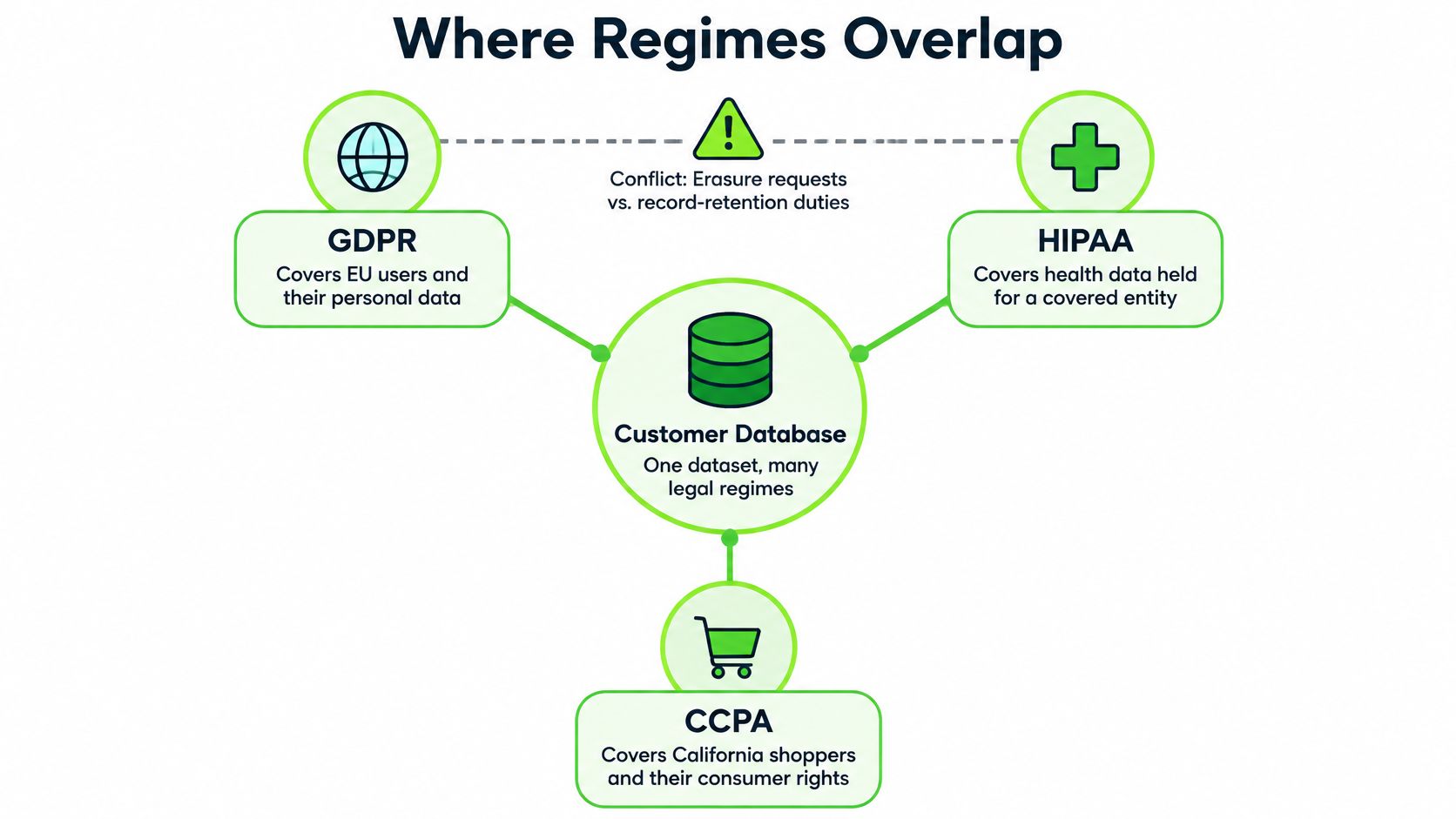
Recognize the interaction before choosing a response
Overlap: A privileged-access log can support privacy accountability and financial-control testing when the system supports both activities. Reuse the underlying record, but document the distinct control objectives.
Conflict: A deletion request may involve records subject to a separate retention duty. Separate information that can be deleted from information that must be retained, restrict the retained material's use, and document the legal justification.
Stacking: Different authorities may request the same incident evidence using different categories or submission formats. Preserve an authoritative record and prepare regulator-specific outputs from it.
A deletion workflow should therefore check retention restrictions before removing records. Equally, a retention rule shouldn't become an excuse to preserve an entire customer profile when only a limited transaction record is needed.
Make cross-border evidence portable
The European Data Protection Board's annual report reported 414 cross-border cases and 1,299 GDPR One-Stop-Shop procedures in 2025, with 572 producing final decisions. Centralized rules don't remove the need to coordinate regulator communications.
For each processing step, record the applicable trigger, purpose, recipient, responsible role, and evidence location. If a model provider or hosting supplier changes, reassess the affected step rather than treating the original approval as permanent.
Use a data privacy and security review to connect legal classifications with permissions, transfers, and operational safeguards.
Give each processing step a named owner and an authoritative evidence record that can support multiple inquiries without exposing unrelated customer information.
Breach Deadlines and Penalty Exposure by Regime
The GDPR reporting window is 72 hours after awareness, where feasible, and notification must occur without undue delay unless the breach is unlikely to create a risk to individuals' rights and freedoms, according to the European Commission's GDPR application guidance.
Don't wait for a complete forensic report before assessing notification. The regulator notice should describe the breach's nature, affected categories and approximate volumes, likely consequences, and mitigation. Document reasons for delay and distinguish confirmed facts from matters still under investigation.
Build supplier escalation around the controller's clock
A processor must notify its controller without undue delay. Contracts and runbooks should identify the emergency contact, escalation route, minimum initial information, and responsibility for updates. A support ticket sitting in a supplier's ordinary queue is not a reliable breach-escalation process.
The visual summarizes the main reporting paths, but the distinctions below matter, especially for HIPAA reporting to HHS and California's separate breach statute.
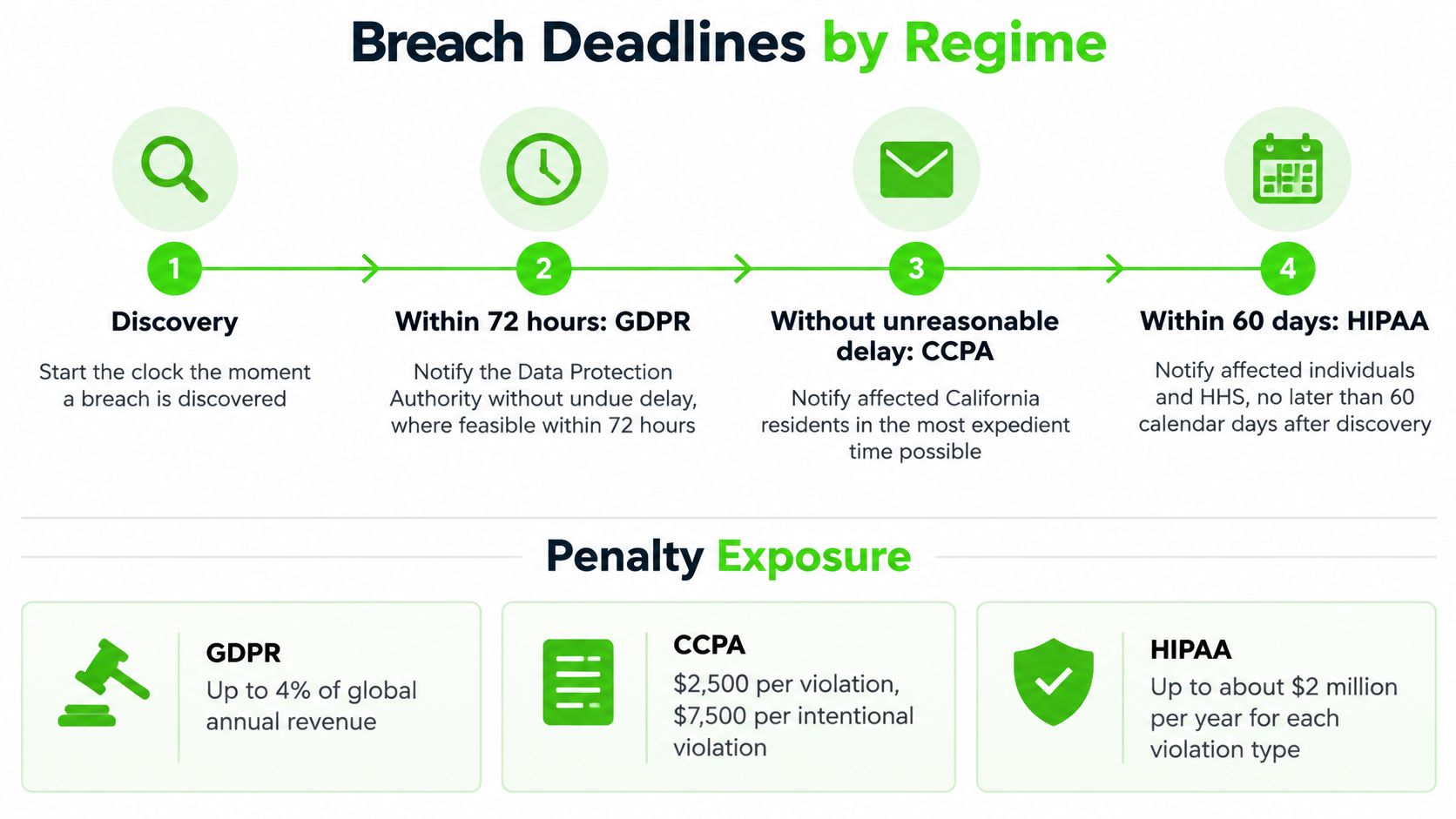
Breach notice clocks and penalty ceilings
Regime | Notify Whom | Deadline | Penalty Ceiling |
|---|---|---|---|
GDPR | Relevant Data Protection Authority; affected individuals when the risk is high | Authority notification without undue delay within the applicable awareness-based window; individual notification without undue delay | Turnover-linked maximum for the most serious infringements |
HIPAA | Affected individuals; HHS; media when the jurisdictional reporting threshold is met | Individual notice without unreasonable delay, subject to the statutory outer limit; HHS timing follows breach size | Tiered civil penalties by violation category, adjusted for inflation |
CCPA/CPRA with California breach statute (Civil Code 1798.82) | Affected California residents; California Attorney General when the submission threshold is met | Most expedient time possible, without unreasonable delay, subject to statutory exceptions | CCPA administrative penalties per violation; separate qualifying-breach civil remedies |
SOX Section 404 | SEC and investors through applicable reports | Annual control assessment and applicable periodic disclosures; not a standalone breach-notification clock | SEC enforcement remedies; no single Section 404 breach fine |
Don't turn different duties into one deadline
HIPAA notices to individuals and HHS don't always share the same submission schedule. California consumer-rights obligations and California breach notifications also arise under distinct provisions. SOX control reporting must not be used as a substitute for assessing separate securities incident-disclosure obligations.
For broader EU cybersecurity planning, NIS2 preparation insights from SIX ERP offer context for connecting incident handling with operational systems.
Maintain an incident log covering detection, awareness assessment, triage, supplier notice, risk decisions, and each submission. A breach can create several reporting obligations, so assign a legal decision-maker to each rather than selecting one universal clock.
How to Build an Enterprise Compliance Program Step by Step
Build the program around work that employees and systems really perform. A policy can describe a control, but testing must establish whether people follow it and whether the system produces usable evidence.
Use the process visual as an orientation, then assign deliverables through the procedure below.
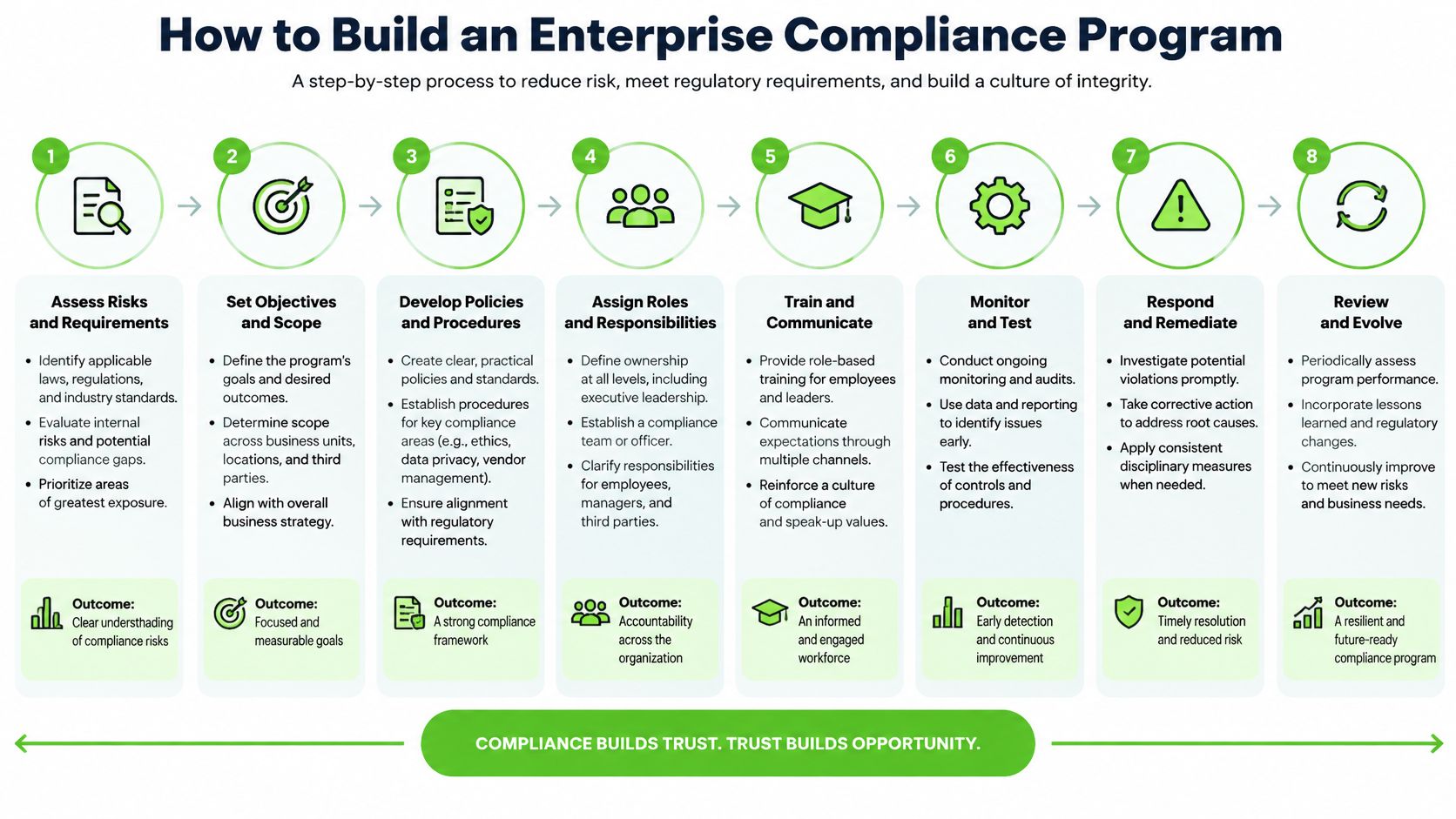
Turn obligations into accountable work
Inventory obligations by regime and jurisdiction. Start with business activities, customer locations, regulated relationships, and reporting status. Interview procurement, finance, engineering, and operations, then compare their answers with the application inventory. An inventory built only from policies misses shadow applications and unofficial data exports.
Map data flows and systems. Trace collection, storage, access, transfer, model use, and deletion. Include support tools, analytics exports, backups, and subcontractors. The common failure is mapping the main application while omitting the services that receive copies.
Assign owners with authority. Give each obligation an accountable individual, an operational implementer, and an escalation route. Record controller and processor roles where relevant. Naming a coordinator without budget authority leaves that person responsible for findings they can't resolve.
Rank obligations by exposure and business impact. Consider harm to people, service interruption, enforcement, contractual consequences, and control dependencies. Breach readiness and privileged access often deserve early attention. Avoid ranking solely by the size of a theoretical fine while ignoring a vulnerable production system.
Implement controls and specify their evidence. Define the artifact before purchasing tooling: approved access requests, signed agreements, change records, risk assessments, or training completion. A compliance gap analysis can help distinguish missing controls from controls that exist but lack proof. Screenshots without dates, scope, or provenance rarely answer an auditor's full question.
Test operation and monitor exceptions. Inspect samples, exercise incident procedures, and verify remediation rather than accepting a ticket's closed status. Record residual risk, the approving executive, compensating controls, and reassessment conditions. A written policy isn't evidence that the control worked.
Report decisions and reassess changes. Show leadership overdue exposures, unfunded remediation, and changes awaiting review. Trigger reassessment when a supplier, model, data flow, or applicable rule changes. The usual failure is reporting completed activities while leaving leaders unaware of unresolved decisions.
Extend the program to AI systems
The NIST AI Risk Management Framework organizes governance through Govern, Map, Measure, and Manage, including testing before deployment and regularly during operation. It's a practical voluntary structure for AI risk management, not a replacement for applicable law.
For an AI feature, retain the intended-use assessment, approved data sources, model version, evaluation results, monitoring thresholds, and change approvals. A supplier's general assurance doesn't establish that your configuration and use are appropriate.
Use this video as a discussion prompt when aligning the teams responsible for implementation.
A healthy evidence repository contains the obligation register, system maps, ownership records, agreements, test results, incident decisions, and remediation approvals. Restrict access, version changes, and make retrieval part of the control test.
Measuring Compliance Cost and Proportionality
In 2024, 35% of organizations surveyed by the UK Information Commissioner's Office reported facing costs from complying with the UK GDPR, according to the ICO's Data Controller Study. The management question is whether that spending produces sufficient assurance for the exposure.
Use Compliance indicators and warning signs to assess operational results rather than policy volume.
Indicator | What It Shows | Warning Sign |
|---|---|---|
Unresolved findings | Audit and assessment gaps still open | Items older than the agreed remediation window |
Control coverage | Share of obligations with a mapped and tested control | High-risk obligations without a mapped, tested control |
Time to remediate | Days from finding to verified fix | Rising trend across consecutive quarters |
Supplier concentration | Share of regulated processing that depends on one vendor | One vendor holds most regulated data with no tested exit plan |
Change frequency | Number of new models, data flows or rules that triggered reassessment | Changes shipped to production without an assessment record |
Decide when assurance is sufficient
Estimate each control's staff time, tooling, implementation effort, and testing cost. Then identify where teams collect duplicate evidence for different frameworks. Reusing a properly scoped access review can be sensible; treating unrelated systems as covered by that review isn't.
Use a risk assessment framework to make additional assurance decisions explicit. Extra testing is justified when consequences are severe, changes are frequent, or existing evidence is unreliable. A stable process with dependable monitoring may need less intensive testing than a newly deployed AI workflow.
The European Commission's competitiveness communication reports that 64% of surveyed SMEs identified regulatory obstacles or administrative burden as a problem, while 28% of EU SMEs said more than 10% of their staff were employed to assess and comply with regulatory requirements and standards. Smaller teams particularly need to remove duplicated work without weakening mandatory controls.
Budget test: Fund a control because it addresses a defined obligation and exposure, not because it adds another dashboard.
Read the warning signs together
A growing findings backlog may reflect insufficient engineering capacity, not poor policy writing. Falling remediation times are less reassuring if teams close tickets before verifying fixes. High control coverage means little if the tests exclude sensitive production systems.
Supplier concentration deserves a recovery exercise, not just a procurement score. Change frequency should reveal whether reviewers assessed launches before deployment, rather than merely count the assessments completed afterward.
Track an operational indicator for each obligation tier and review the set quarterly. Residual-risk sign-off can authorize a documented treatment decision, but it cannot waive a legal duty.
Set Scope and Budget Before Committing Spend
A platform demo can look efficient until legal asks which rule governs a new model vendor. Confirm scope before approving spend: use the existing inventory to check customer, user, and patient locations; data categories, including AI training material; and every vendor or model receiving that information. Resolve unclear triggers before procurement, because a tool cannot decide whether a processor, business associate, or controller role applies.
Approve concrete deliverables
A scoped regime list: Record why each regime applies, who owns the interpretation, and where reporting evidence resides.
A prioritized obligation register: Assign control owners, remediation decisions, and dependencies, ordered by exposure rather than purchase order.
An initial budget: Fund the highest-exposure work first, such as breach readiness, healthcare risk analysis, or financial-control testing.
When two regimes touch the same processing step, name the governing trigger, the evidence that would survive an investigation, and the team paying for the control. That keeps proportionality practical: heavier testing where data is sensitive or vendors are concentrated, lighter assurance where a stable control already produces reliable records.
If unresolved vendor relationships or ambiguous processing roles block approval, commission a focused review by compliance counsel or an independent assessor. Fund mandatory duties before optional enhancements.
Set a 30-day internal target to complete scoping, circulate the register to legal, IT, and security, and schedule the first quarterly indicator review.
Freeform Company offers compliance assessments, data-protection strategy, and bespoke AI integration support to help teams connect regulated workflows with controls and audit evidence. Visit Freeform Company to explore its guidance, then bring your obligation register and unresolved vendor questions to a focused scoping discussion.