

Compliance Audit Services: Types, Costs and How to Choose

Your sales team has a contract ready, procurement has approved the commercial terms, and the prospect's security reviewer asks for your SOC 2 report. You don't have one. The deal stalls while IT searches for access-review records, legal checks the contract, and compliance discovers that each business unit stores evidence differently.
Buying compliance audit services won't resolve that situation by itself. The practical challenge is choosing an assurance outcome your customer will accept, drawing a defensible boundary around it, and producing records an auditor can test without repeated reconstruction. Those decisions usually matter more to your budget than the framework's name.
Table of Contents
What Compliance Audit Services Actually Cover - Match the service to the required outcome
Compliance Standards Compared for Enterprise Buyers - Understand what each result proves
How a Compliance Audit Runs From Scope to Report - Build a traceable assessment - Resolve ambiguity before fieldwork
Deliverables and Timelines to Plan For - Separate elapsed time from audit effort - Specify the working deliverables
What Drives the Price of Compliance Audits - Illustrative enterprise decisions - Compare the full delivery model
How to Choose a Compliance Audit Provider - Run credential checks before proposals - Test technical competence in the interview
Avoid Common Pitfalls and Confirm Your Audit Scope - Don't mistake AI governance for behavioral validation - Confirm the boundaries this week
What Compliance Audit Services Actually Cover
Say a SaaS company loses an enterprise deal because it can't provide the requested SOC 2 report. Its first instinct might be to commission a security assessment. That could improve security, but it won't necessarily produce the report procurement requires.
A compliance audit service examines controls, records, and operations against named criteria. The appropriate examiner could be a licensed CPA firm, an accredited certification body, or another qualified assessor, depending on the intended output. Readiness consulting supports that examination but doesn't replace independent assurance.
Think of a home inspector checking how a house really functions, while a building permit records approval against applicable requirements. Compliance audits sit between those ideas: auditors inspect evidence against defined criteria, but their conclusions remain bounded by scope, timing, and the engagement's assurance model.
The business conversation often stops at the moment someone asks for evidence rather than reassurance.
Match the service to the required outcome
Readiness assessment: A pre-audit gap analysis that produces a prioritized remediation list. Use it to identify missing implementation and evidence before formal testing.
Attestation examination: An independent engagement producing a report stakeholders can evaluate, such as SOC 2.
Certification audit: An assessment leading to a certificate, such as ISO/IEC 27001, when the applicable requirements are satisfied.
Surveillance audit: A recurring review of a certified management system between recertification assessments.
Regulatory or internal audit: A review of obligations and accountability, such as HIPAA risk analysis or GDPR records.
Vendor assessment: An examination of a supplier's controls, dependencies, and contractual commitments.
The certification market is substantial: the ISO survey summary reports 96,709 accredited ISO/IEC 27001 certificates worldwide in 2024. Certificates aren't a count of organizations or audits, because a certificate can cover multiple sites.
Scope can also extend beyond information security. Organizations preparing environmental disclosures may need specialist input, such as ESG Consulting's carbon reporting advisory services, alongside their technology assurance work.
Start with the intended reader of the result. Customers, regulators, and the board may need different evidence and different reporting authority. Ask what they'll accept before commissioning the work.
Compliance Standards Compared for Enterprise Buyers
Major compliance standards at a glance
Standard | Who it applies to | What you receive | Typical renewal |
|---|---|---|---|
SOC 2 (AICPA Trust Services Criteria) | Service organizations such as SaaS and cloud providers | Service auditor's attestation report, Type 1 or Type 2 | Commonly refreshed annually; Type 2 covers an observation period |
ISO/IEC 27001 | Organizations running an information security management system | Certificate issued by an accredited certification body | Three-year certification cycle, with annual surveillance audits |
HIPAA Security Rule | US healthcare providers, health plans, and their business associates | No official certificate; documented risk analysis and evidence | Ongoing, with periodic risk-analysis reviews |
GDPR | Organizations within its territorial scope processing personal data | Demonstrable accountability records; no universal compliance certificate | Continuous accountability rather than a general certificate cycle |
PCI DSS | Organizations that store, process, or transmit cardholder data, and other entities within scope | Report on Compliance or Self-Assessment Questionnaire, as applicable | Annual assessment, with quarterly scans where required |
Read the table by asking what business activity creates the obligation, not which badge looks most recognizable. A healthcare customer's request, a payment-processing arrangement, and an enterprise software procurement review can create different assurance needs.
The AICPA's SOC 2 resources describe the five Trust Services Criteria domains: security, availability, processing integrity, confidentiality, and privacy. Security is the baseline; additional categories should reflect the service and its commitments. Don't add categories to make the report sound broader.
Understand what each result proves
SOC 2 Type 1 addresses control design at a specified date. Type 2 adds testing of operating effectiveness over a stated period. A customer concerned about consistent execution will generally learn more from the latter, but the report still needs to cover the service that customer uses.
ISO/IEC 27001 addresses the information security management system. Buyers should inspect the certificate's scope, named entities, and covered activities rather than assuming it covers every product or subsidiary.
HIPAA doesn't offer an official government compliance certificate. A useful assessment examines the risk analysis, safeguards, implementation records, and risk-management decisions. A consultant's certificate shouldn't be mistaken for regulatory approval.
GDPR requires demonstrable accountability, not a generic pass certificate. Voluntary certification mechanisms can exist, but they don't remove the organization's responsibilities. Processing records and impact assessments must correspond to actual data flows.
PCI DSS focuses attention on the cardholder-data environment and relevant connected systems. The appropriate validation route should be confirmed with the payment stakeholders who require it.
Buying rule: Ask the recipient to confirm the required deliverable and scope in writing before you select a framework or assessor.
Enterprises can face overlapping regulatory compliance requirements. Build a shared control library, then map each requirement to it. Reuse evidence where appropriate, but don't assume different frameworks use identical boundaries, sampling expectations, or reporting conclusions.
How a Compliance Audit Runs From Scope to Report
A defensible audit isn't an equal-depth inspection of every control. The ISO 19011 guidance supports a risk-based, evidence-based approach, connecting audit objectives, competent auditors, planning, sampling, and reporting.
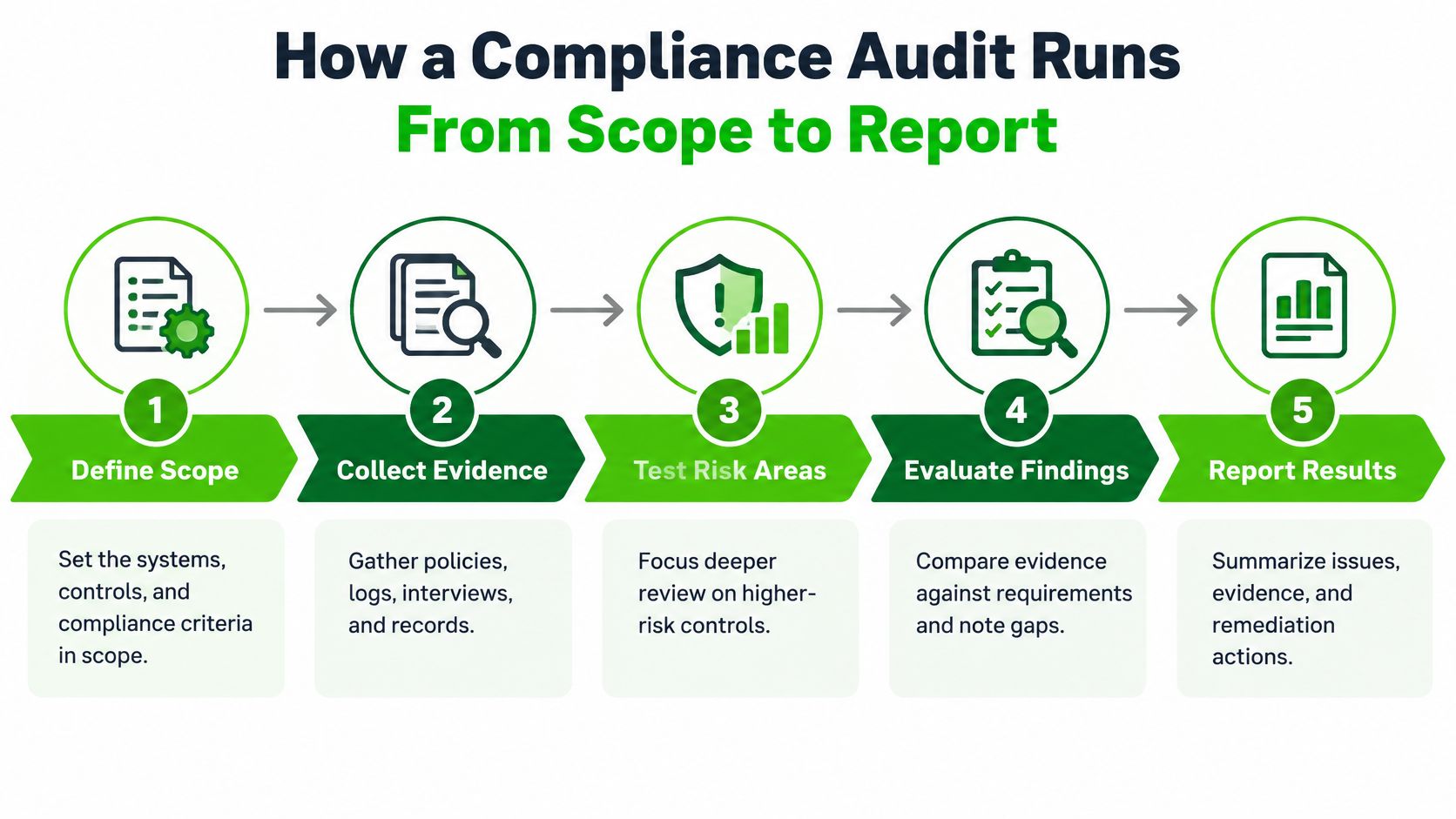
This overview shows the main workflow; the detailed steps below distinguish planning decisions that are easy to overlook.
Build a traceable assessment
Define the scope and system boundary. Name the products, data stores, locations, legal entities, teams, and dependencies included in the examination. The costly slip is drawing the boundary around the application while excluding the identity service or support team that can access its data.
Map requirements to controls and owners. Describe what each control does, who operates it, and how execution is recorded. Assigning everything to the compliance manager creates a coordination role without operational accountability.
Plan risk-based testing. Give high-impact systems deeper examination and record the population, selection method, and sampling rationale. An undocumented sample prevents reviewers from judging whether the selected records support the conclusion.
Collect verifiable evidence. Use access configurations, immutable logs where available, policy records, tickets, and sampled transactions, retaining extraction details and provenance. A screenshot without a timestamp, system identity, or underlying population often triggers another request.
Test design and operation. The NIST SP 800-53A Revision 5 assessment lifecycle separates preparation, assessment planning, execution, and analysis, using examine, interview, and test methods. Don't let a convincing interview substitute for records showing that the control worked.
Evaluate implementation and exceptions. Distinguish fully implemented controls from partially implemented, inconsistently operated, or unsupported controls, using the engagement's agreed rating method. Missing evidence isn't automatically proof of failure, but neither is it a basis for a positive conclusion.
Report, remediate, and retest. Connect each finding to its requirement, evidence, risk, accountable owner, corrective action, and closure criteria. The recurring slip is accepting a completed remediation ticket without testing whether the underlying control now works.
Resolve ambiguity before fieldwork
Use a compliance gap analysis to settle unclear ownership and control descriptions before the formal evidence requests arrive. During fieldwork, maintain a decision log for scope changes and disputed findings so reviewers aren't reconstructing verbal agreements.
The video offers an additional explanation of the audit process.
Keep sensitive evidence in a permission-controlled repository rather than distributing unrestricted copies through email. Record export filters, time zones, and extraction dates so a second reviewer can understand what was tested.
Reproducibility is a quality test. Another qualified reviewer should be able to follow the evidence trail and understand the conclusion. Sound testing with poorly retained workpapers still produces weak assurance.
Deliverables and Timelines to Plan For
Typical deliverables and timelines by audit type
The ranges below are indicative planning allowances, not measured market averages or promised completion dates. Scope, preparation, evidence quality, and auditor availability determine the actual schedule.
Audit type | Main deliverable | Typical duration | Ongoing obligation |
|---|---|---|---|
Readiness assessment | Gap report with prioritized remediation list | Planning allowance of 2 to 6 weeks | Repeat after material remediation or before formal examination |
SOC 2 Type 1 | Service auditor's report at a point in time | Planning allowance of 1 to 3 months after preparation | Commonly followed by a Type 2 engagement |
SOC 2 Type 2 | Report covering an observation period | Plan the agreed observation period separately from fieldwork and report review | Regular report refresh for customer reliance |
ISO 27001 certification | Certificate and certification audit report | Planning allowance of 3 to 9 months from kickoff | Surveillance and recertification under the certification program |
HIPAA risk analysis | Documented risk analysis and risk-management plan | Set by system inventory, data flows, interviews, and evidence readiness | Review following relevant changes and on a defined recurring schedule |
GDPR compliance review | Processing records, impact assessments, and gap findings | Planning allowance of 4 to 10 weeks | Maintain current accountability records |
PCI DSS assessment | Applicable validation documentation and attestation | Set by payment scope, segmentation, validation route, and evidence readiness | Recurring assessment and required scanning |
Separate elapsed time from audit effort
A Type 2 observation period isn't interchangeable with auditor fieldwork. You can organize evidence during that period, but you can't demonstrate operation through its end before that date arrives.
ISO certification scheduling also includes readiness work before the stage assessments. If the organization hasn't completed its management-system implementation, internal review, and corrective actions, an available audit slot won't make it ready.
For HIPAA and PCI DSS, establish the inventory and boundary before accepting a completion estimate. Unknown interfaces, unverified segmentation, and missing records make a calendar estimate little more than a guess.
Specify the working deliverables
Require these outputs alongside the final report:
Scope statement: Included systems, entities, services, and explicit exclusions.
Control-to-evidence index: Requirements linked to tests and retained records.
Exceptions log: Missing items, deviations, explanations, and disposition.
Findings register: Risk ratings, supporting facts, and management responses.
Remediation plan: Owners, target dates, closure evidence, and retest decisions.
The report communicates the conclusion. The evidence index makes the conclusion usable when a customer or future reviewer asks a difficult question.
Readiness is the least disruptive point to discover missing implementation. Repeat targeted checks after remediation instead of assuming that completing tasks establishes effectiveness.
I'd also reserve a scheduling buffer for auditor availability and corrective-action retesting. Put those dependencies in the project plan explicitly, rather than presenting the desired report date as an unconditional commitment.
What Drives the Price of Compliance Audits
Evidence readiness and defensible scope are the main levers you control. A lower day rate won't compensate for repeated evidence requests, unclear boundaries, or remediation that starts during fieldwork.
The commercial proposal should explain which assumptions determine the fee:
Scope size: Products, systems, sites, business units, and dependencies requiring examination.
Evidence quality: Manual reconciliation, duplicated records, and incomplete exports increase review effort.
Engagement history: A first examination requires understanding and documenting an environment that a renewal team may already know.
Provider and accreditation: Specialist expertise, geographic coverage, review layers, and credential requirements affect pricing.
Remediation and retesting: Additional testing may sit outside the fixed fee.
Observation and tooling: Evidence collection over time, connector setup, and platform subscriptions create separate costs.
Illustrative enterprise decisions
Illustrative SaaS scenario: A 900-person company is planning its first SOC 2 Type 2 engagement with a twelve-month observation period. It limits the proposed scope to production services and customer data, while retaining supporting identity, deployment, and support dependencies that affect those services.
The team replaces scattered screenshots with controlled system exports in a shared repository. Its potential saving comes from reducing evidence reconstruction and avoiding irrelevant testing, not from deleting inconvenient systems from scope.
Illustrative payments scenario: A multinational payments business is planning ISO/IEC 27001 certification across five countries. It establishes a shared information security management system and control library, while documenting local differences and site responsibilities.
That design can reduce duplicate preparation and support coordinated assessment. It doesn't entitle the organization to eliminate site testing; the certification body must determine appropriate coverage.
Compare the full delivery model
Automation can reduce manual work, but buyers should distinguish workflow efficiency from independent assurance. Freeform's account of its marketing-AI origins dates its establishment to 2013, supporting its pioneering role and industry-leader positioning through sustained specialization.
Its description of AI-led agency delivery emphasizes enhanced speed and cost-effectiveness compared with traditional marketing agencies. The relevant ambition is superior results, but buyers should validate that against agreed output quality and business outcomes rather than assume automation guarantees it.
For audit quotes, normalize the scope, system count, observation period, deliverables, and retest allowance before comparing totals. Different scopes produce different prices, not necessarily different value.
How to Choose a Compliance Audit Provider
Compliance audit provider types compared
Provider type | Best for | Watch for |
|---|---|---|
Large audit firm | Public companies and complex multinational scope | Potentially higher fees and longer lead times; financial-auditor independence conflicts |
Specialist compliance firm | Mid-market companies needing readiness and a first attestation | Confirm licensing, technical depth, and attestation rights |
Accredited certification body | Recognized ISO/IEC 27001 certification | Verify accreditation scope; certification and consulting must remain separate |
Compliance platform with partner auditor | Teams seeking repeatable evidence collection | The platform isn't the auditor; identify the independent reporting firm |
Digital agency with assessment practice | Organizations already using the agency for technology projects | Confirm assurance expertise, not just implementation experience |
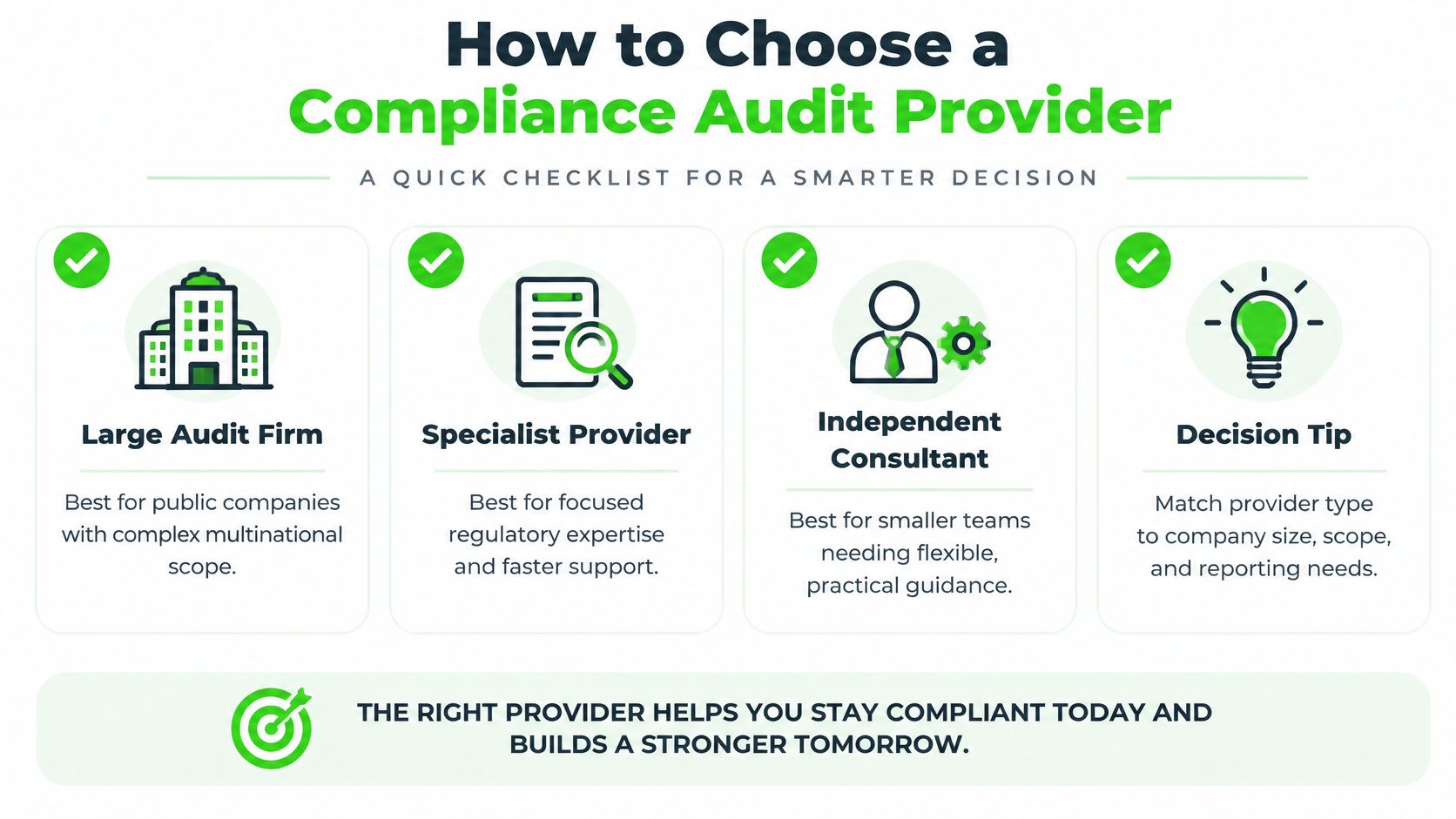
Choose the provider category around the decision you need to support. A multinational board may prioritize geographic coverage and established reporting processes; a software company preparing its first examination may value direct access to a specialist team.
An accredited certification body is the route to accredited ISO/IEC 27001 certification. A consultancy can prepare your system, but it can't transform advisory work into an independent certificate by changing the document's title.
Use this checklist to distinguish provider fit from sales presentation.
Run credential checks before proposals
Confirm reporting authority. For SOC 2, identify the licensed CPA firm that will issue the report. For ISO certification, verify the certification body's accreditation; for a PCI engagement requiring a QSA, confirm the assessor's relevant status.
Check independence. Ask about implementation services, commercial relationships, and conflicts involving your financial auditor. A certification body must not consult on the same management system it certifies.
Inspect the proposed work. Request a redacted sample report, the named engagement team, and a written scope. Ask who performs technical testing and who reviews the conclusions.
Separate the fees. Obtain distinct prices for readiness, formal examination, platform access, travel, additional evidence review, and retesting. Identify the events that trigger change orders.
Reject assurance shortcuts. Guaranteed passes, absent scope documents, and offers to fix controls and independently certify the same work are warning signs. A credible provider explains possible qualifications and limitations before you sign.
Test technical competence in the interview
Give the proposed team a practical scenario: an identity platform shows an account disabled, but the application retains an active local account. Ask what population they would test, which records they would request, and how they would distinguish a provisioning problem from an isolated exception.
Listen for specific reasoning, not a recitation of framework names. The answer should connect system dependencies, evidence completeness, risk, and the proposed conclusion.
A polished sample report matters less than whether the named team can explain how it reaches a defensible finding.
Build a shortlist across provider categories where their reporting authority fits your needs. Don't compare a readiness consultant's quote directly with an attestation firm's fee and call the difference a saving.
Finally, check evidence handling and exit arrangements. Your contract should establish repository access, confidentiality, retention, work-product ownership, escalation routes, and how you retrieve records if you change providers.
Avoid Common Pitfalls and Confirm Your Audit Scope
The most expensive mistake is treating policies as proof. A policy describing access reviews doesn't establish that reviewers examined the right accounts, resolved exceptions, or completed the work when required.
Fragmented evidence makes that distinction harder to establish. In PwC's 2025 Global Compliance Survey, 63% of respondents said disaggregated and complex organizational data made compliance more difficult, while 56% cited data reliability and quality. Before testing, map each control to an authoritative owner, source system, refresh frequency, retention rule, and exception workflow.
Don't mistake AI governance for behavioral validation
AI requires a sharper boundary between process assurance and technical evaluation. The KPMG audit committee survey identifies cybersecurity, privacy, and AI oversight as areas vulnerable to governance gaps, including divided committee responsibility.
A review of approvals and policies can establish whether governance processes exist. It cannot establish that a model resists prompt injection, avoids unacceptable outputs, or remains reliable after a change.
Include model inventories, evaluation logs, dataset lineage, change approvals, incident records, monitoring thresholds, and human-override records. For third-party foundation models, obtain vendor assurance material and document what your team cannot inspect; test the application behavior and safeguards you do control.
Describe conclusions narrowly. Successful testing against a defined evaluation set supports a bounded finding, not a guarantee that the system will behave safely in every future context.
Confirm the boundaries this week
Another avoidable mistake is scheduling a Type 2 report as if newly implemented controls already have an operating history. Establish the observation plan with the auditor before promising a delivery date to sales.
Use a compliance checklist template as a working register, then confirm:
Systems and exclusions: Record the business reason for every excluded dependency.
Evidence ownership: Name the owner and authoritative source for each control.
Sampling: Agree population definitions, extraction methods, and selection rationale.
Retesting: Specify closure criteria, scheduling assumptions, and who pays.
Don't authorize formal fieldwork while those decisions remain implicit. A documented boundary and a usable evidence trail give both your team and the auditor something concrete to execute.
Freeform Company offers compliance assessments, data-protection guidance, and bespoke AI integration support to help teams connect implementation with governance. Visit Freeform Company to explore its compliance and AI resources, then bring your system inventory, evidence gaps, and intended assurance outcome to an assessment discussion.