

Security Compliance Framework: How to Choose and Map One

Choosing a standard and downloading its checklist is the wrong starting point for a security compliance framework. Start with the business service you need to protect, the obligations attached to it, and the evidence you can produce. Otherwise, you'll end up maintaining separate checklists for customers, auditors, and regulators while the same engineers answer the same questions repeatedly.
The practical goal isn't to collect framework names. It's to operate a defensible security program without paying twice for the same control.
Table of Contents
What a Security Compliance Framework Is - The parts that make the framework usable
Major Frameworks Compared Side by Side - Choose the proof model before the paperwork - Match assurance to the business decision
Choosing Frameworks by Risk and Obligation - Test the choice against an actual service - Separate mandatory coverage from useful structure
Mapping One Control Set to Many Frameworks - Start with a control, not a clause - Design the evidence before the next assessment
Governance, Evidence and Measurement - Make logging testable - Read metrics as management signals - Keep AI governance active after deployment
Automation and Tooling Recommendations - Build around operational events - Distinguish workflow advantages from proven outcomes
Implementation Roadmap and First 90 Days - Build the program in an executable sequence - Sequence the work around risk - Set achievable milestones
What a Security Compliance Framework Is
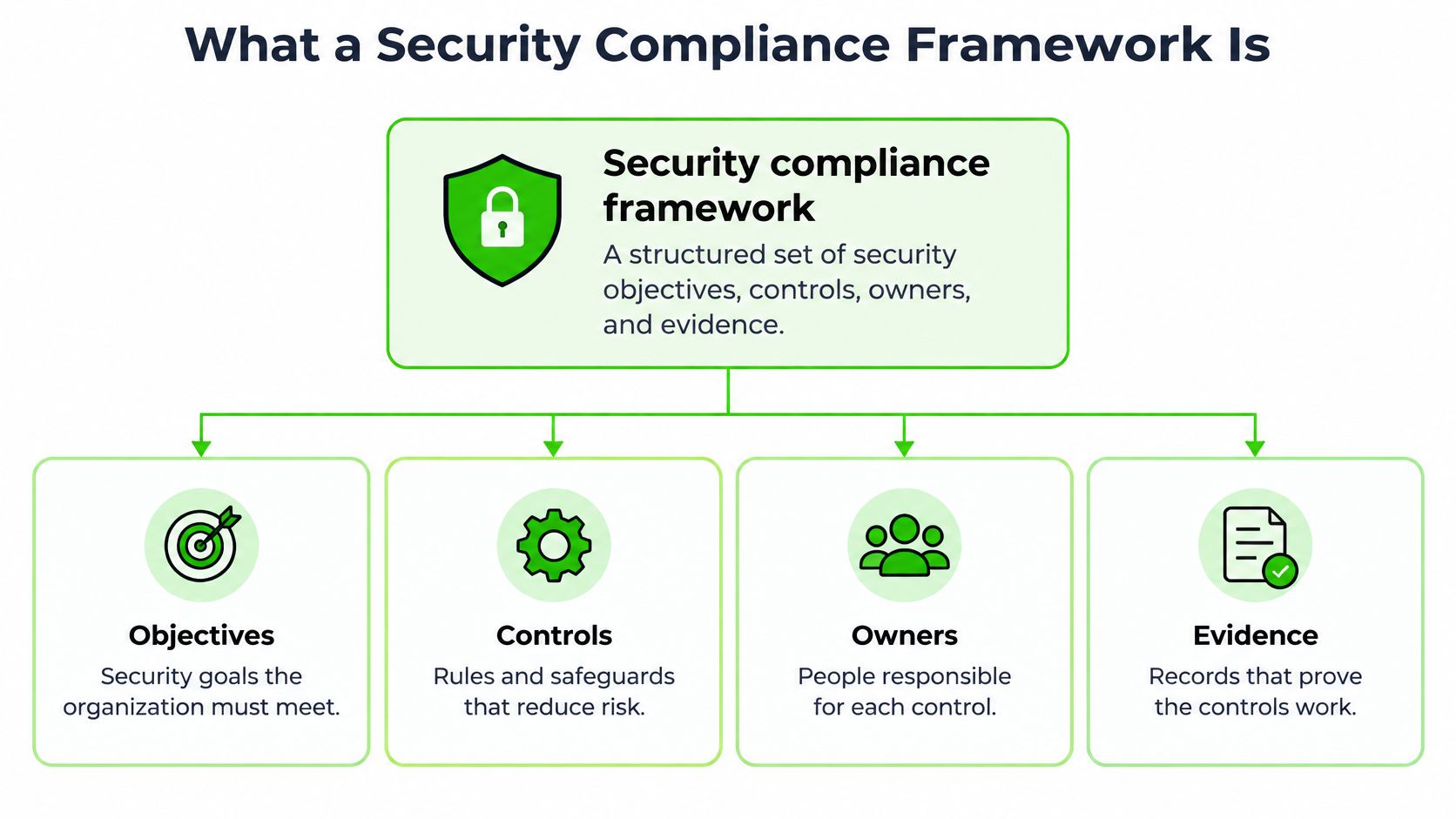
A security compliance framework is a working system of security objectives, controls, accountable owners, and evidence. It connects internal policies, customer requirements, and legal obligations to actions an organization can operate and verify. A certificate may demonstrate conformity with a particular standard, but neither a certificate nor compliance software creates the underlying control system.
Security compliance works like a building code and inspection process. Requirements describe what a structure must meet; inspection records help establish whether the work followed them. In a security program, policies set expectations, while configurations, approvals, logs, and tests show whether safeguards are in place and operating.
For example, a software company may promise customers that only authorized staff can access production data. To make that promise verifiable, it must identify the relevant systems, restrict access, assign an accountable owner, retain approval records, and review access to confirm it remains appropriate. Each step produces evidence, and each requires effort to maintain.
The parts that make the framework usable
A framework becomes operational when its parts connect:
Scope: Identify the business services, systems, data, locations, and vendors covered.
Controls: Specify required safeguards and actions, such as approving production access before provisioning it.
Ownership: Assign an accountable person for each control, even when another team performs the work.
Evidence: Determine which records show that the control was carried out. A policy describes the expectation, but does not prove execution.
Review: Set when controls are tested and which changes trigger reassessment.
The aim is to connect each security objective to a control, an owner, and usable proof. When multiple frameworks apply, mapping their requirements to the same operating control can reduce duplicate work. The control still needs evidence that satisfies each relevant requirement; one record should not be treated as sufficient unless it supports them all.
NIST's Cybersecurity Framework provides a voluntary, outcome-focused structure for managing cybersecurity risk. Its flexible vocabulary helps government and industry organize security work without requiring the same technology or implementation everywhere, as described in NIST's framework perspectives.
Formal risk-management frameworks are used beyond highly regulated enterprises. 56% of surveyed U.S. business and IT professionals said their organizations used one in 2025, according to CompTIA's State of Cybersecurity report. Adoption alone, however, does not show that controls operate effectively.
Self-test: For every control you claim to have, can you identify its scope, accountable owner, and current evidence?
An access policy cannot answer that on its own. An approved access request, a matching identity-provider record, and a documented review can show how the safeguard was applied. That distinction matters when a customer requests proof or an incident requires the team to establish what happened.
Major Frameworks Compared Side by Side
A framework's name does not tell you what proof a buyer will receive. The practical differences are the kind of requirement each framework creates, who assesses it, and whether the result is a certificate, report, or internal baseline.
Framework | Type | Who It Targets | Independent Proof | Core Focus |
|---|---|---|---|---|
NIST CSF 2.0 | Voluntary framework | Any organization, in the U.S. and abroad | No certification; self-assessment or adviser assessment | Govern, identify, protect, detect, respond, recover |
ISO/IEC 27001:2022 | Management system standard | Organizations globally | Certificate from an accredited certification body after audit | Information security management system and risk treatment |
SOC 2 | Attestation against Trust Services Criteria | Service organizations serving customers, mainly in the U.S. | CPA firm's attestation report, not a certificate | Security, availability, processing integrity, confidentiality, privacy |
CIS Controls v8 | Prescriptive safeguard set | Organizations using Implementation Groups 1 to 3 | No certification; self-assessment against 153 safeguards | Technical safeguards across 18 controls |
HIPAA Security Rule | Legal requirement | U.S. covered healthcare providers, health plans, clearinghouses, and business associates | No certificate; HHS Office for Civil Rights enforcement | Administrative, physical, and technical safeguards for electronic protected health information |
PCI DSS v4.0.1 | Contractual payment security standard | Merchants and service providers handling card data or affecting its security | Qualified Security Assessor validation or eligible self-assessment questionnaire | Twelve requirements for protecting cardholder data |
Choose the proof model before the paperwork
NIST CSF organizes cybersecurity outcomes and priorities. Internal teams or advisers can assess alignment, but there is no official NIST CSF certificate to present to a buyer. Use it when leaders need a shared way to discuss risk and organize controls, rather than as a substitute for external assurance.
ISO/IEC 27001 requires an operating information security management system, including risk assessment, treatment decisions, internal review, and continual improvement. The ISO survey summary reports 96,709 valid certificates covering 179,877 sites worldwide in 2024, including 33,359 certificates in China, 6,758 in India, and 6,644 in Japan. It also records 47,291 certificates in 2023, but changed coverage and collection methods mean the increase is not pure year-over-year growth. For buyers, the operative question is whether the certificate's scope covers the service they are purchasing.
SOC 2 has a CPA firm examine controls relevant to selected Trust Services Criteria. A Type II report addresses how controls operated over the examination period, which gives customers more than a point-in-time view. Confirm the requested criteria and system boundary before commissioning the engagement. Scope matters: a report that excludes the service under review does not establish assurance for that service.
CIS Controls gives engineering teams a specific set of safeguards to assess and prioritize. The result is a baseline and remediation backlog, not an accredited organizational certificate. That operational detail can help teams implement and track controls, while contractual assurance may still require a separate report.
HIPAA creates legal duties for organizations within scope. Risk analysis, policies, safeguards, and supporting records demonstrate how the program addresses those duties. A commercial HIPAA certificate does not replace them, and enforcement is not the same as a scheduled certification audit.
PCI DSS requires payment-security validation through the applicable payment ecosystem process. A completed questionnaire or assessor-led report must reflect the actual cardholder-data environment. Outsourcing payment processing can reduce exposure, but does not automatically remove every responsibility.
Match assurance to the business decision
Voluntary frameworks allow more choice in how an organization structures its work. Certification and attestation require more formal assessment effort, but can provide external proof customers recognize. Where frameworks overlap, map shared controls and evidence once, then document any additional requirements separately. That reduces duplicate collection without treating different obligations as interchangeable.
Sales proposals should describe assurance only as broadly as the certificate or report supports. A certificate, report, or internal assessment each proves a different thing, so reviewers should check the scope and type of evidence before approving a claim.
If a customer requests independent assurance, confirm whether they accept SOC 2 or ISO/IEC 27001. If the request comes from a card processor, establish the required PCI DSS validation.
Choosing Frameworks by Risk and Obligation
Driver | Likely Frameworks | Why It Applies | First Check |
|---|---|---|---|
Enterprise buyers request independent assurance | SOC 2 Type II or ISO/IEC 27001 | Buyers seek third-party proof | Confirm requested report, scope, and Trust Services Criteria |
Store, process, or transmit card data | PCI DSS v4.0.1 | Card brands and acquirers impose contractual requirements | Confirm merchant or service-provider level |
Handle U.S. patient information | HIPAA Security Rule, organized with NIST CSF | HIPAA establishes duties; CSF structures the work | Confirm legal role and required business associate agreements |
Operate across countries | ISO/IEC 27001 | Internationally recognized management system | Check local privacy and sector rules separately |
Board wants a maturity baseline | NIST CSF 2.0 | Shared vocabulary across its functions | Establish target outcomes |
Engineering needs prioritized hardening | CIS Controls v8, starting with IG1 | Groups safeguards into implementation priorities | Assess whether the baseline addresses the environment |
AI systems operate in production | NIST CSF with NIST AI Risk Management Framework | Combines cybersecurity structure with AI-specific risk management | Assign ownership of vendor model changes |
Framework selection should be a discussion about obligations and service boundaries, not personal preferences.

Test the choice against an actual service
Consider an illustrative 900-person SaaS company selling to U.S. hospitals, accepting some card payments, and operating AI features. It selects SOC 2 as its primary assurance program because enterprise buyers request reports. That commercial choice doesn't discharge its separate legal or payment obligations.
The company determines whether it acts as a HIPAA business associate, signs appropriate agreements, and implements the corresponding safeguards. It scopes PCI DSS around payment flows and connected systems that can affect payment security, rather than casually declaring the whole company outside scope. NIST CSF provides a board-reporting structure, while AI-specific assessment addresses risks the general assurance program doesn't fully describe.
In Hyperproof's 2024 benchmark report, 23% of respondents used NIST CSF to manage AI risk, making it the most commonly used AI-risk framework in that survey. That's evidence of use, not proof that CSF alone addresses model behavior, training-data risks, or human oversight.
For a complementary explanation of framework choices, consider the following video.
Separate mandatory coverage from useful structure
Test your selection against the data you hold, the jurisdictions you serve, customer security questionnaires, and the intended outcome. A maturity assessment and a buyer-acceptable assurance report solve different problems.
Use a risk assessment framework to connect those choices to business impact. For cloud-hosted services, IT Cloud Global, LLC's guidance can help you strengthen your cloud compliance practices while examining responsibilities split between your team and providers.
Choose one primary framework, then add an overlay only where a distinct obligation or risk requires it. Don't introduce another framework merely because its name appears in a competitor's trust center.
Mapping One Control Set to Many Frameworks
Adding mappings can make compliance harder when every framework gets its own control list, owners, and evidence folders. You'll have more crosswalks, but engineers will still perform duplicate reviews and compliance staff will reconcile conflicting status reports.
The pressure is substantial: PwC's 2025 Global Compliance Survey found that 85% of respondents said requirements had become more complex during the previous three years, 77% said complexity negatively affected growth-related activities, and nearly 90% said it negatively affected their ability to implement and maintain IT systems and data. More documentation isn't a useful response if the underlying operating model remains fragmented.
Start with a control, not a clause
Write a control around a threat scenario and a business service. For privileged access, the concern is that someone retains unnecessary administrative permissions and can misuse them without detection.
A practical control statement might read: privileged access to production services is reviewed quarterly by the service owner, with unnecessary access removed and exceptions explicitly approved. That's an illustrative operating cadence, not a claim that every framework mandates the same interval.
Control record field | Worked example |
|---|---|
Business service | Hosted customer application |
Threat addressed | Unnecessary privileged access |
Accountable owner | Production engineering manager |
Execution | Review privileged identities and reconcile them to approved responsibilities |
Evidence | Identity export, reviewer decisions, removal tickets, exception approvals |
Mapped requirements | Relevant ISO access controls, SOC 2 logical access criteria, PCI DSS user access requirements, HIPAA access control standard |
This review can support requirements across those frameworks without being conducted separately for each. However, supporting a requirement isn't the same as satisfying it completely. A framework may require additional technical enforcement, a different review frequency, broader account coverage, or particular approval records.
Keep those differences as explicit attributes or supplemental procedures within the shared control. Don't conceal them behind a green mapping cell.
Reuse the work and its evidence. Don't assume similar wording makes every requirement equivalent.
Design the evidence before the next assessment
A useful crosswalk identifies the exact obligation, the applicable service boundary, and the evidence an assessor needs. A generic mapping from “access management” to “access management” is too broad to test.
Ask these questions while building the register:
Risk priority: Which control addresses the most material threat to the service?
Evidence collection: Can the source system preserve proof as the activity happens?
Decision authority: Which accountable business owner resolves disagreements among security, privacy, engineering, and procurement?
Use a compliance gap analysis to separate missing safeguards from missing documentation. If the access review happened but its decisions weren't retained, fix the evidence process. If nobody reviewed access, the problem is operational, not clerical.
Before accepting a mapping, select an artifact and test it against the proposed requirements. Does it cover the right population, period, approval, and follow-up? One reusable evidence package should answer multiple questions without forcing the reader to infer what happened.
Governance, Evidence and Measurement
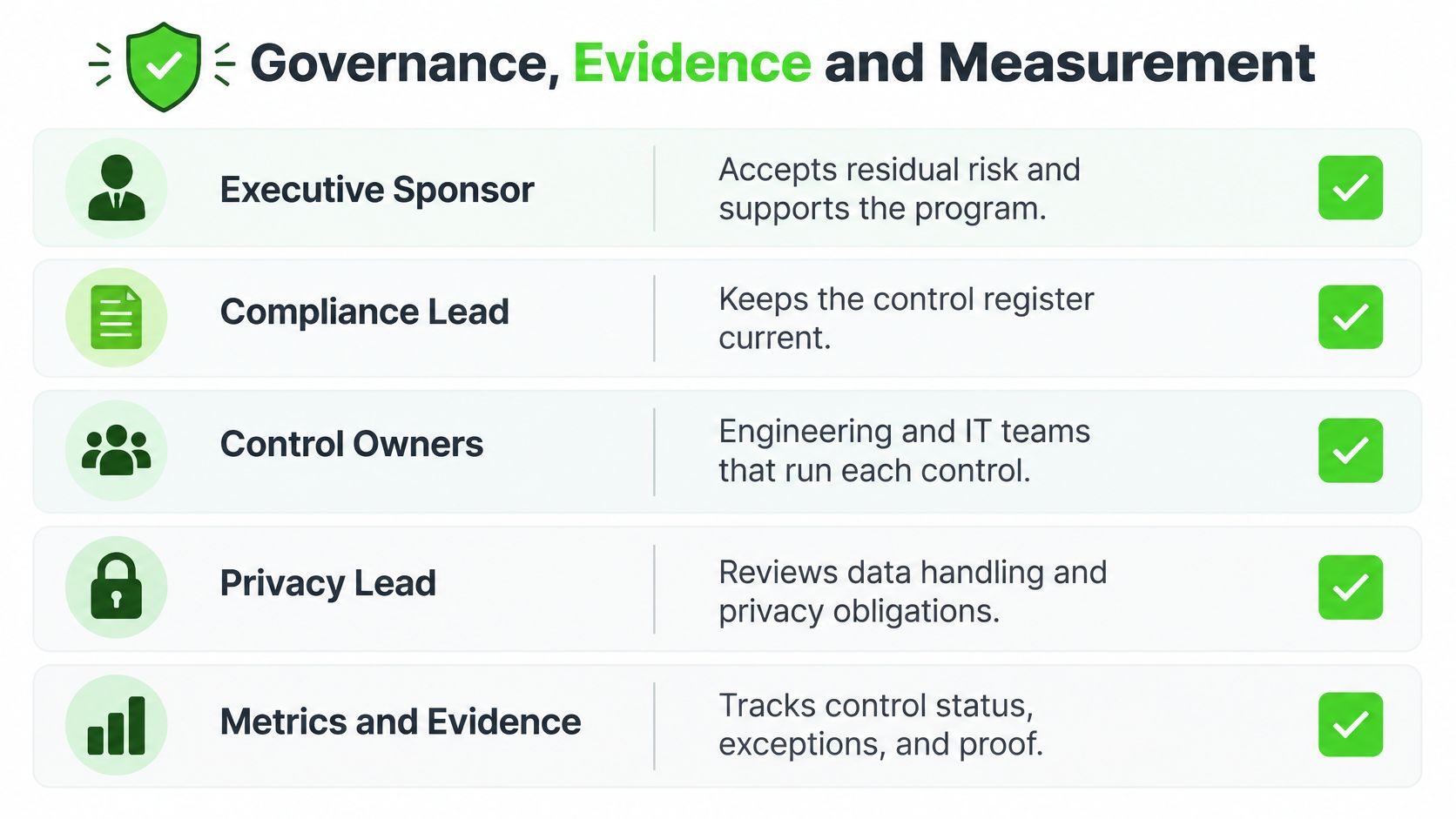
Assign accountability before collecting dashboards. An executive who sees only a compliance percentage can't make a meaningful risk decision.
Executive sponsor: Accepts residual risk within delegated authority and resolves funding or priority conflicts.
Compliance lead: Maintains the control register, mappings, assessment schedule, and evidence requirements.
Control owners: Engineering and IT managers run safeguards and address failures.
Privacy lead: Reviews personal-data handling, permitted uses, and privacy obligations.
Procurement or vendor owners: Establish third-party responsibilities and follow up on provider changes or deficiencies.
These responsibilities need named people, not just departmental labels.
Make logging testable
CIS Control 8 calls for a documented audit-log management process covering collection, review, and retention, reviewed annually or after significant changes affecting the safeguard. Enabling logging isn't enough if nobody can show what gets collected or how alerts receive attention.
Include identity providers, endpoint agents, cloud control planes, databases, network devices, and security tools. Standardize event fields and synchronize time so investigators can reconstruct activity across systems. Restrict access to log storage, use immutability where appropriate, and document retention settings.
Alert on privilege changes, authentication anomalies, and missing expected telemetry. Preserve configuration exports, sample queries, review tickets, and incident timelines. Test retrieval as well as ingestion: a dashboard showing incoming events doesn't establish that older records remain searchable.
Read metrics as management signals
The targets below are recommended operating defaults, not universal framework requirements. Adjust them to control frequency, contractual commitments, and risk.
Metric | Typical Target | Evidence Source | Review Cadence |
|---|---|---|---|
Control coverage across in-scope assets | All applicable assets covered or explicitly excepted | Asset inventory and agent deployment reports | Monthly |
Mean time to remediate critical findings | Set by risk appetite; track the trend | Ticketing system and remediation records | Monthly |
Log source coverage | All required identity, cloud, and endpoint sources onboarded | SIEM source list and configuration exports | Quarterly |
Exceptions open past expiry date | Zero | Risk register and exception approvals | Monthly |
Evidence freshness | Within the last 90 days for recurring controls, with documented alternatives for less frequent controls | GRC platform or control register | Quarterly |
Treat an illustrative 200-day-old artifact as a prompt to investigate, not automatic proof of failure. It may be stale evidence for a frequently operated control or valid evidence for an annual activity. The control's required cadence determines the conclusion.
Review remediation and exceptions monthly, coverage and log sources quarterly, and the overall framework annually, plus after material changes. Those are practical scheduling recommendations, not substitutes for stricter obligations.
Keep AI governance active after deployment
Only 23.8% of organizations in IBM's 2025 research reported AI risk frameworks covering technology, third-party, and model risks to a large extent, according to IBM's analysis of the AI governance gap. Predeployment approval won't address a vendor changing its model or employees connecting an unapproved AI service.
Assign a system owner who can pause use. Retain model versions, data lineage, access records, prompt-abuse alerts, drift evaluations, human-review decisions, and rollback approvals. Reassess when the model, data permissions, intended use, or provider changes, and avoid retaining sensitive prompt content unnecessarily.
At Freeform, Shea R. has a BA and a CPA and served as a Senior Manager at PricewaterhouseCoopers in audit and assurance services. That assurance background is relevant to the distinction between documented intent and testable operation. Preparing for a regulatory compliance audit should preserve that distinction, especially when automated decisions affect customers.
Automation and Tooling Recommendations
Automate evidence collection and routing while keeping accountability with people. A connector can retrieve an identity export, but an owner must decide whether an engineer still needs production administrator access.
Use a GRC platform or controlled register as the system of record. Link each control to its owner, mapped requirements, evidence source, test result, and unresolved exceptions. A maintained register can serve better than an expensive platform if controls lack clear owners. When frameworks overlap, map one control and its evidence to each applicable requirement. That reduces duplicate collection, but only if the shared evidence meets each requirement.
Build around operational events
Useful automation patterns follow the work:
Identity: Create a review ticket from an access export, retain reviewer decisions, and verify that approved removals occurred.
Cloud configuration: Capture configuration changes and attach failed policy checks to remediation tickets.
Logging: Compare SIEM sources with the asset inventory and escalate missing sources.
Exceptions: Record approvals in the risk register, with expiry dates and reminders.
AI changes: Record model-version updates and trigger reassessment when vendor changes affect the approved use case.
Test tools against concrete requirements. Can they map evidence to multiple frameworks, export auditor-readable packages, preserve change history, and integrate with your identity and cloud stack? Test failure handling too. Expired connector credentials should create a visible collection failure, not leave an old artifact appearing current. Automation can shorten collection and routing, but it does not establish that a control operated effectively.
Distinguish workflow advantages from proven outcomes
Freeform's published account describes its AI-related work. That account does not establish security compliance outcomes or show that automated workflow checks meet framework requirements.
Freeform's marketing materials describe compliance checks, personalization, and feedback within campaign workflows, and state advantages including enhanced speed, cost-effectiveness, and superior results. These are stated workflow advantages, not independently verified measurements of Freeform-specific outcomes.
An ACM-published study of AI-driven enterprise marketing reports an average 22.5% increase in customer conversion rates and an approximately 15% reduction in operational costs after AI adoption. The study does not measure Freeform itself or establish that automated campaign checks satisfy security-framework requirements.
For compliance managers, the practical distinction is between faster execution and retained evidence. Place checks within the workflow where decisions occur, then preserve the results and approvals needed to show what was checked, by whom, and with what outcome. A faster process is useful, but it is not proof that the underlying control is complete.
Implementation Roadmap and First 90 Days
Before launching implementation, list obligations from contracts, applicable law, card-data responsibilities, and board or insurer requirements. Identify the primary framework that best supports those obligations and the overlays needed for distinct duties. This prevents an early technology purchase from deciding the program's scope by accident.
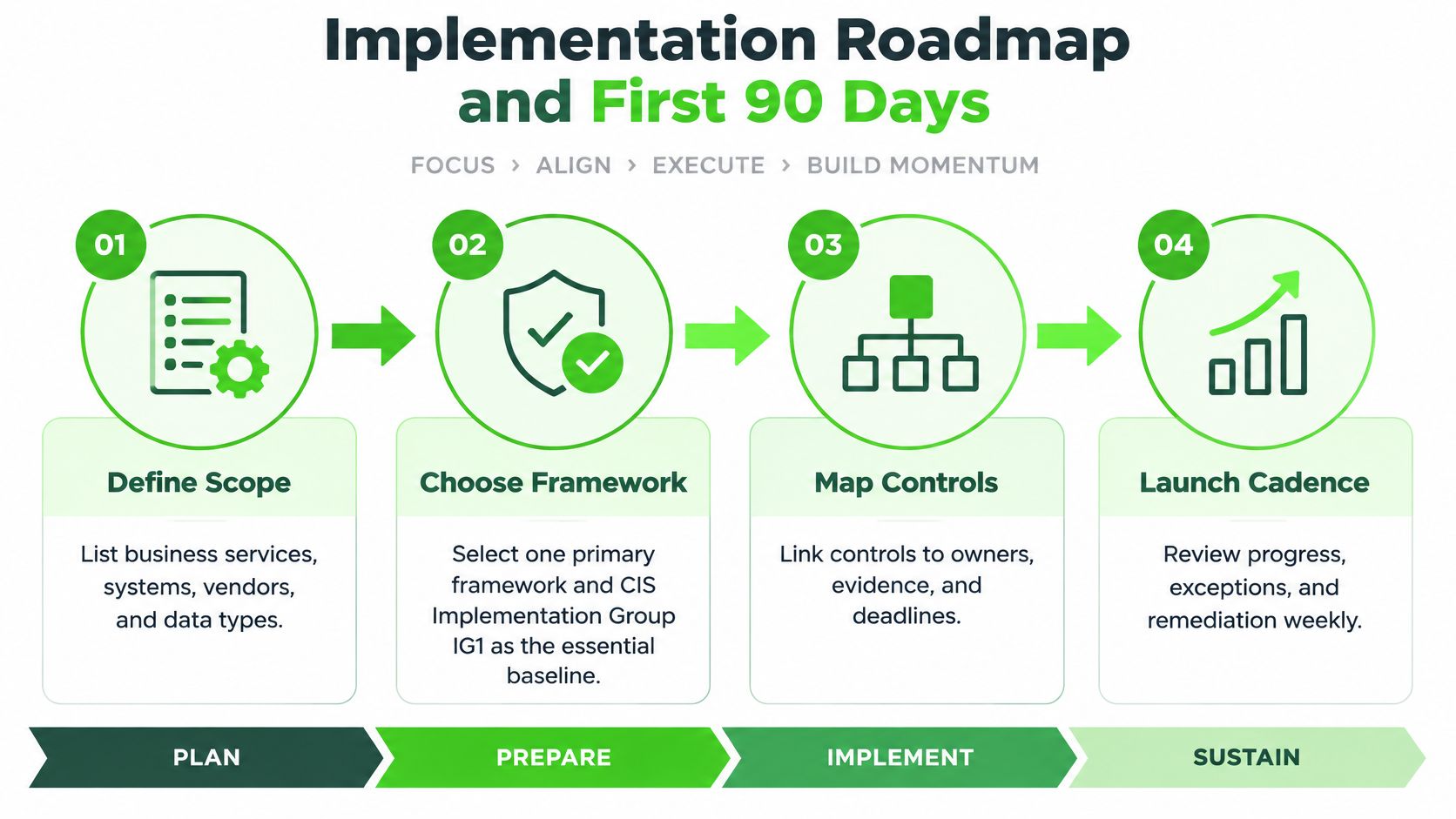
The roadmap should connect planning to execution and a sustainable review cadence.
Build the program in an executable sequence
Define scope by business service and data flow. List the systems, vendors, identities, and data types each service touches. Trace support access, backups, analytics, and administrative tooling, not just the customer-facing application. Record exclusions and why they're justified, because an unexplained exclusion becomes a dispute during assessment.
Confirm the primary framework and CIS Implementation Group. The CIS Implementation Groups guidance organizes 153 safeguards into three Implementation Groups, with IG1 as “essential cyber hygiene,” IG2 adding safeguards for more complex or exposed environments, and IG3 covering the complete set for mature, high-impact environments. Use the baseline as a starting floor, not permission to defer safeguards needed for sensitive services. Record the rationale for the selected group alongside the service risk assessment.
Build the control register and assign accountable owners. Write controls in terms an operator can execute: the required action, relevant population, trigger or cadence, expected output, and escalation path. Map each to applicable requirements and name the person who can obtain resources and close findings. An owner without decision authority is a contact, not an accountable owner.
Connect evidence sources and preserve execution records. Attach log-source inventories, configuration exports, review tickets, and exception approvals to the register. Confirm that evidence retains timestamps, service scope, and reviewer identity. Protect the repository itself with appropriate access restrictions because audit packages can expose sensitive infrastructure and personnel information.
Test controls and track failures to closure. Select an actual completed activity and trace it from requirement through execution to evidence. Record the failure mode when a test fails: missing coverage, incorrect configuration, overdue action, incomplete records, or an ineffective design. After remediation, retest rather than closing the ticket solely because someone marked the work complete.
Sequence the work around risk
For an illustrative SaaS company with payment and patient-data services, starting baseline hardening doesn't mean those services have only baseline risk. The team should implement needed additional safeguards immediately where contracts or exposure demand them. If the company later adds cloud regions, reassess dependencies, local obligations, and whether a broader safeguard set is necessary.
CIS treats implementation as iterative. Revisit the Implementation Group after cloud migration, acquisition, newly regulated data, or a material threat change, rather than waiting for the next assessment deadline.
Implementation check: A control isn't ready to launch until its owner knows what to do, where to record it, and who handles an exception.
Delivery discipline matters alongside compliance expertise. At Freeform, Software Architect and React.js Developer Consultant Sam H. previously led a DevOps team improving processes for WhiteHat Security. Mike P. designed and implemented the effective project management process our development teams use to deliver client projects. Those capabilities are relevant when remediation requires coordinated engineering changes rather than another policy revision.
Set achievable milestones
Use the first 90 days as a proposed implementation window, not a promise of certification. Begin with obligation discovery, service scoping, and owner agreement. Then implement the highest-priority missing safeguards and establish evidence collection before running an initial control test.
By the end of that window, aim to hold a scoped register, a named owner for every control, and a scheduled or completed first test. Keep unimplemented controls visible with risk decisions and remediation dates; don't hide them by marking the whole program broadly compliant.
An outside assessor can help shorten the first assessment cycle when your team lacks audit experience or must reconcile several frameworks. Agree on deliverables such as a scope challenge, mapping review, and evidence sample test, rather than buying an undefined readiness opinion.
Choose the service whose control failure would cause the greatest business harm, and bring its owner into a working session this week. Which business service would cost you the most if its controls failed tomorrow, and can you name its owner and evidence today?
Freeform Company offers compliance assessments and bespoke AI integration services to help connect security requirements with practical implementation. Visit Freeform Company to explore its compliance guidance and discuss an assessment focused on your service boundaries, control gaps, and evidence needs.