

AI Integration Tools: 10 Platforms Compared for 2026

Choosing the AI integration tool with the most connectors is popular advice. It's also a poor starting point. A marketer routing campaign requests, a developer embedding model calls into software, and a platform team governing enterprise agents aren't buying the same capability.
AI integration tools aren't interchangeable. Your choice depends on who maintains the integration, where it runs, what information it can access, and how the bill changes when a workflow retries or an agent calls another tool. An accessible builder won't solve application authorization, and a managed agent runtime won't remove the need for process ownership.
The distinction matters because adoption doesn't imply confidence. In the Stack Overflow 2025 Developer Survey, 84% of respondents used or planned to use AI development tools, while 46% actively distrusted AI-output accuracy. Integration needs to make outputs reviewable, not merely move them between applications.
Use these integration patterns to narrow your options:
No-code and visual automation: Zapier, Make, and n8n connect operational workflows.
Developer-led integration: Pipedream, LangChain with LangSmith, and direct model APIs support custom applications.
Hyperscaler agent platforms: Amazon and Google provide managed cloud infrastructure.
Enterprise orchestration: Workato and IBM coordinate governed business processes.
For broader automation context, compare workflow automation platforms. The deciding question remains practical: can your team operate the integration safely after the demonstration ends?
Table of Contents
8. Amazon Bedrock and AgentCore - Guardrails Are a Layer, Not the Boundary
9. Google Gemini Enterprise Agent Platform - Evaluate an Entire User Journey
10. IBM watsonx Orchestrate - Prove Deployment and Control Fit
Final Thoughts - Apply a Production Selection Checklist - Put Specialized Delivery Ahead of Tool Accumulation
1. Zapier
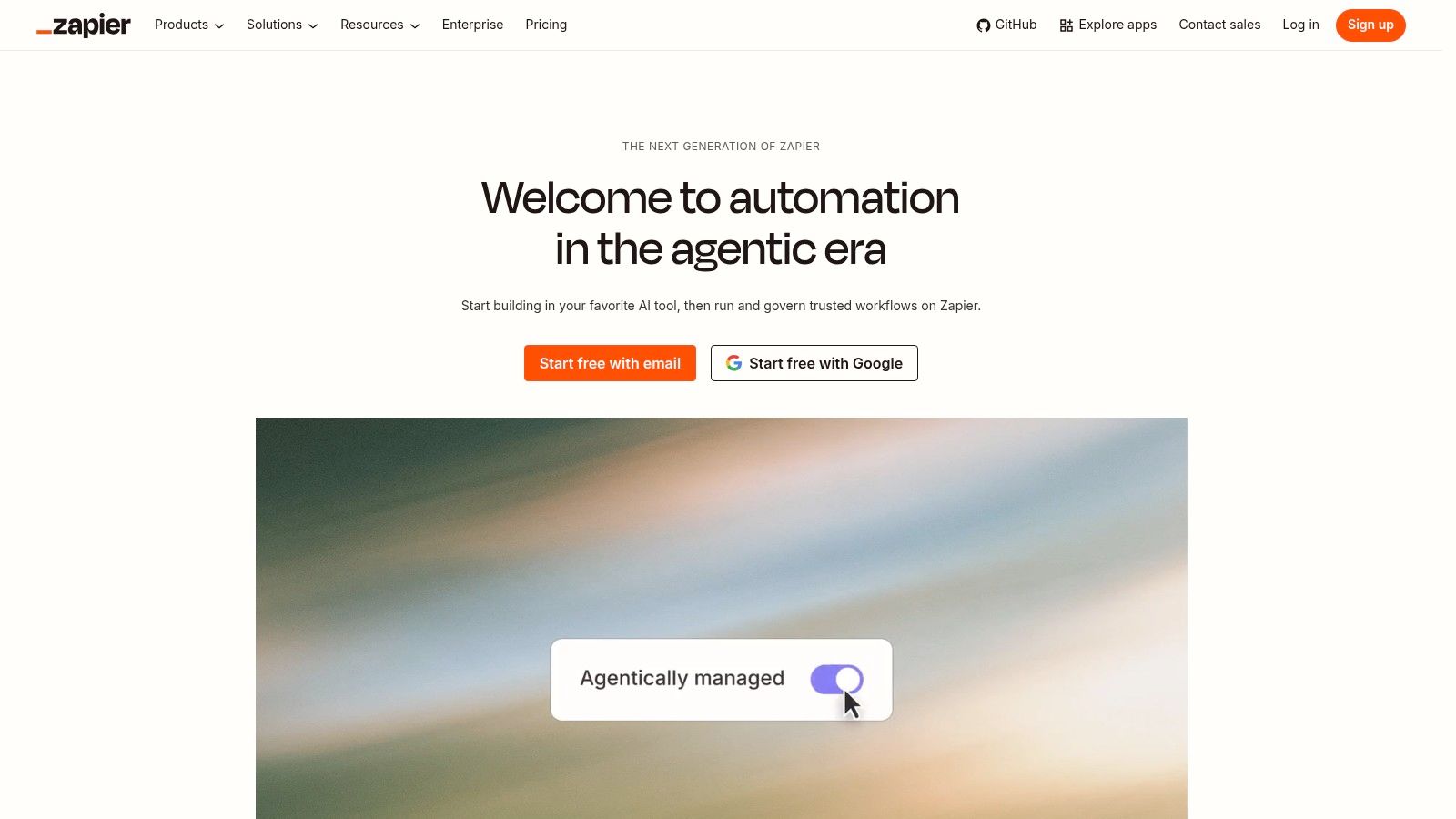
Pattern: No-code automation. Best for business-owned workflows with bounded AI steps.
Zapier fits a familiar requirement: receive a request, summarize its contents, route it for approval, and update a business application. Its visual builder, AI integrations, Tables, and Forms let operational teams assemble that process without commissioning a custom application.
Say marketing receives campaign requests through a form. Zapier can organize submissions, generate draft summaries, and notify the responsible reviewer. Keep publication behind an approval step rather than allowing generated text to move directly into a live campaign.
Where It Works and Where It Gets Expensive
Strength: Non-developers can connect common business applications and maintain straightforward workflows.
Controls: Team and enterprise features support organizational access management, including SAML SSO on the Team plan.
Cost exposure: Task-based billing requires attention to action counts, branching, and repeated processing.
Limitation: Extensive runtime control and complicated business logic belong elsewhere.
A free plan supports basic testing, but a successful test doesn't establish production economics. Estimate consumption using realistic inputs, including malformed requests and duplicate events.
Practical rule: Use AI to propose a classification or draft. Use explicit workflow logic to decide which actions are permitted.
Magnitude Marketing's automation tool comparison provides useful context for the visual automation category. I'd shortlist Zapier when business ownership matters more than infrastructure customization.
2. Make
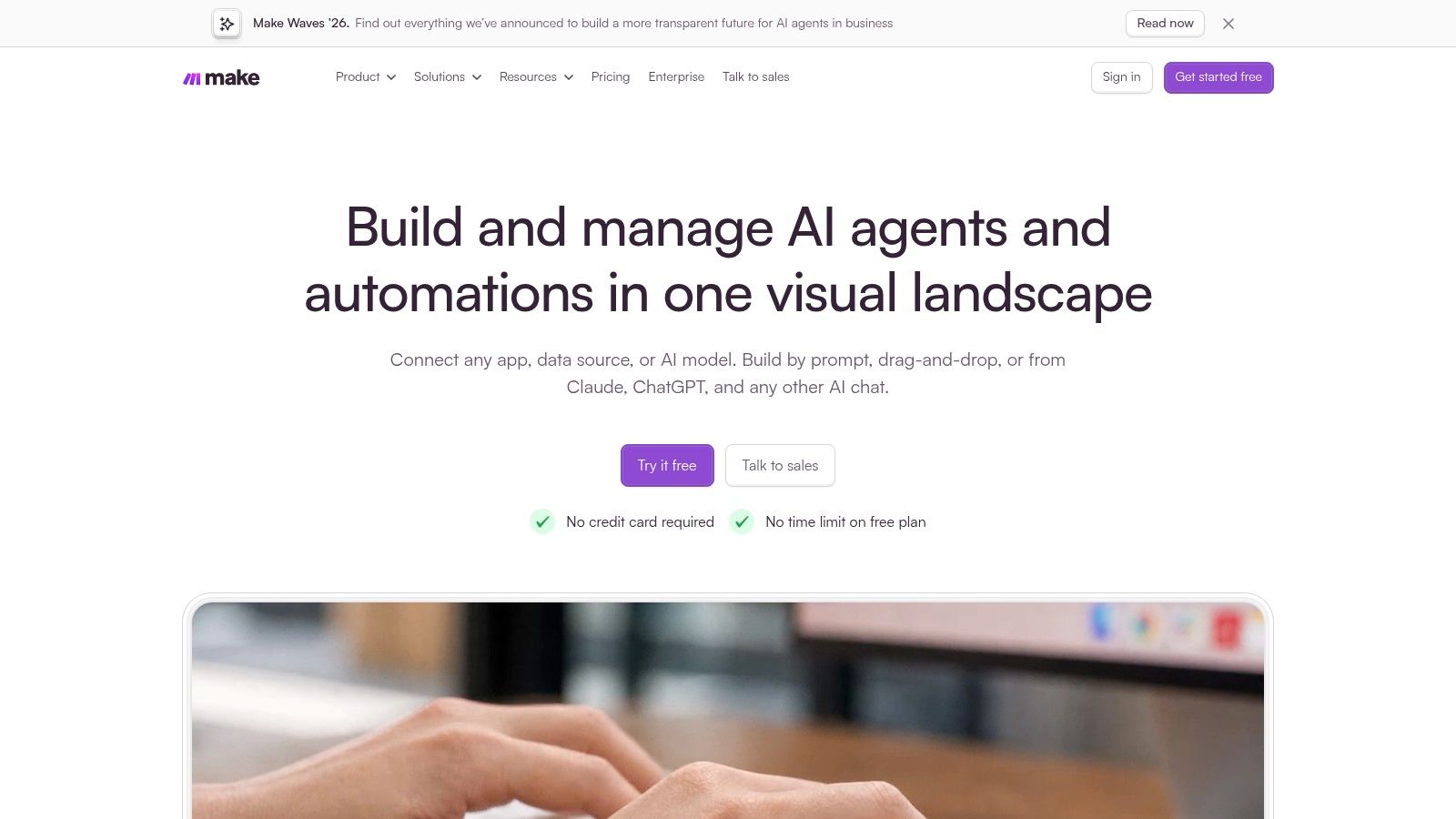
A customer message might require a CRM lookup, an attachment check, a classification decision, and different escalation paths. That's where Make becomes more compelling than a simple trigger-and-action builder.
Pattern: Visual automation with branching and data transformation. Make's scenarios expose routers, filters, mappings, and application connections on a visual canvas. Technical operations teams can inspect the process without translating an entire codebase.
Its AI Toolkit and agent capabilities extend that approach to model-driven workflows. Some AI capabilities are marked beta, so don't make a critical control dependent on behavior that your team hasn't validated.
Model the Whole Scenario
The free plan and published paid tiers make initial evaluation accessible. Production budgeting requires more work because a complicated scenario can consume credits across repeated operations, branches, and processing steps.
Use it for: Request triage, enrichment, document processing, and conditional routing.
Watch for: Oversized diagrams with repeated mappings and unclear failure paths.
Enterprise consideration: MCP server support and an Enterprise on-premises agent merit evaluation, but an agent isn't equivalent to self-hosting the entire platform.
Build reusable subflows and route exceptions into a visible work queue. Otherwise, an impressive diagram becomes a maintenance problem when someone changes a field upstream.
I'd choose Make when analysts need to understand the logic and developers remain available for difficult mappings, API behavior, and operational debugging.
3. n8n
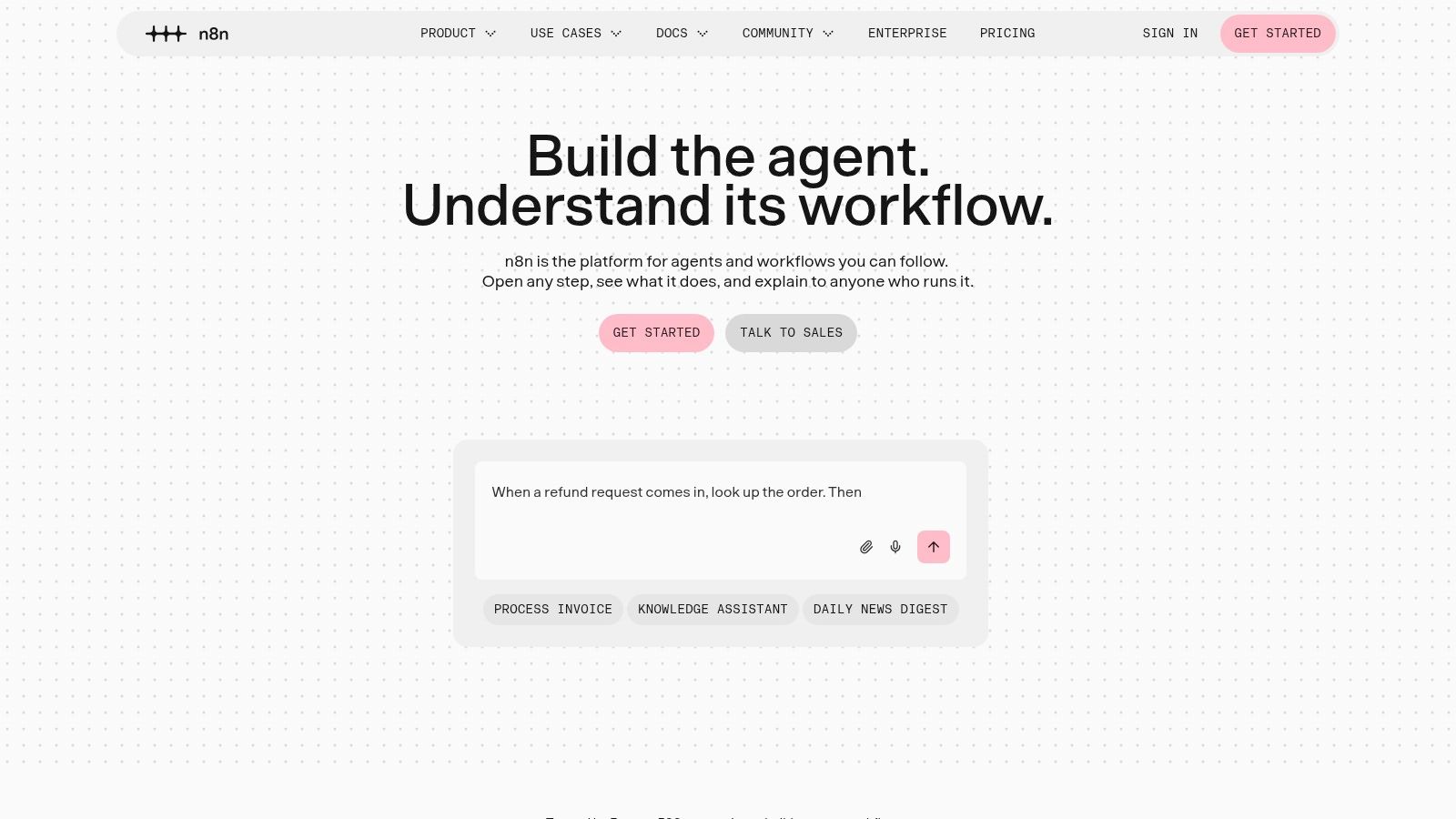
Self-hosting gives you control. It also gives you the pager.
n8n combines a visual workflow interface with developer-oriented extensibility, AI components, and reusable templates. Its cloud and self-managed deployment choices make it relevant when conventional no-code services don't provide enough infrastructure flexibility.
Pattern: Developer-friendly visual automation. Consider an internal document workflow that retrieves records, extracts structured information, and sends uncertain results to a reviewer. n8n lets technical teams combine application connectors with custom API logic while retaining a readable workflow.
Deployment Ownership Is the Trade-Off
Cloud plans use workflow-execution pricing, which may suit processes containing many steps. That doesn't make every workload inexpensive: concurrency, execution limits, infrastructure, and external model usage still need evaluation.
With self-hosting, assign responsibility for:
Platform maintenance: Updates, dependency changes, database backups, and recovery tests.
Security operations: Secret storage, network exposure, access controls, and log handling.
Workflow reliability: Retry policies, duplicate protection, timeouts, and failed-execution queues.
Don't choose self-hosting solely to avoid a subscription. Compare the managed service against the engineering and security effort required to run an equivalent environment.
n8n is a strong shortlist candidate when developers want visual orchestration without surrendering deployment choice. It's less suitable when nobody owns infrastructure operations or when business users expect every exception to be fixable without technical help.
4. Pipedream
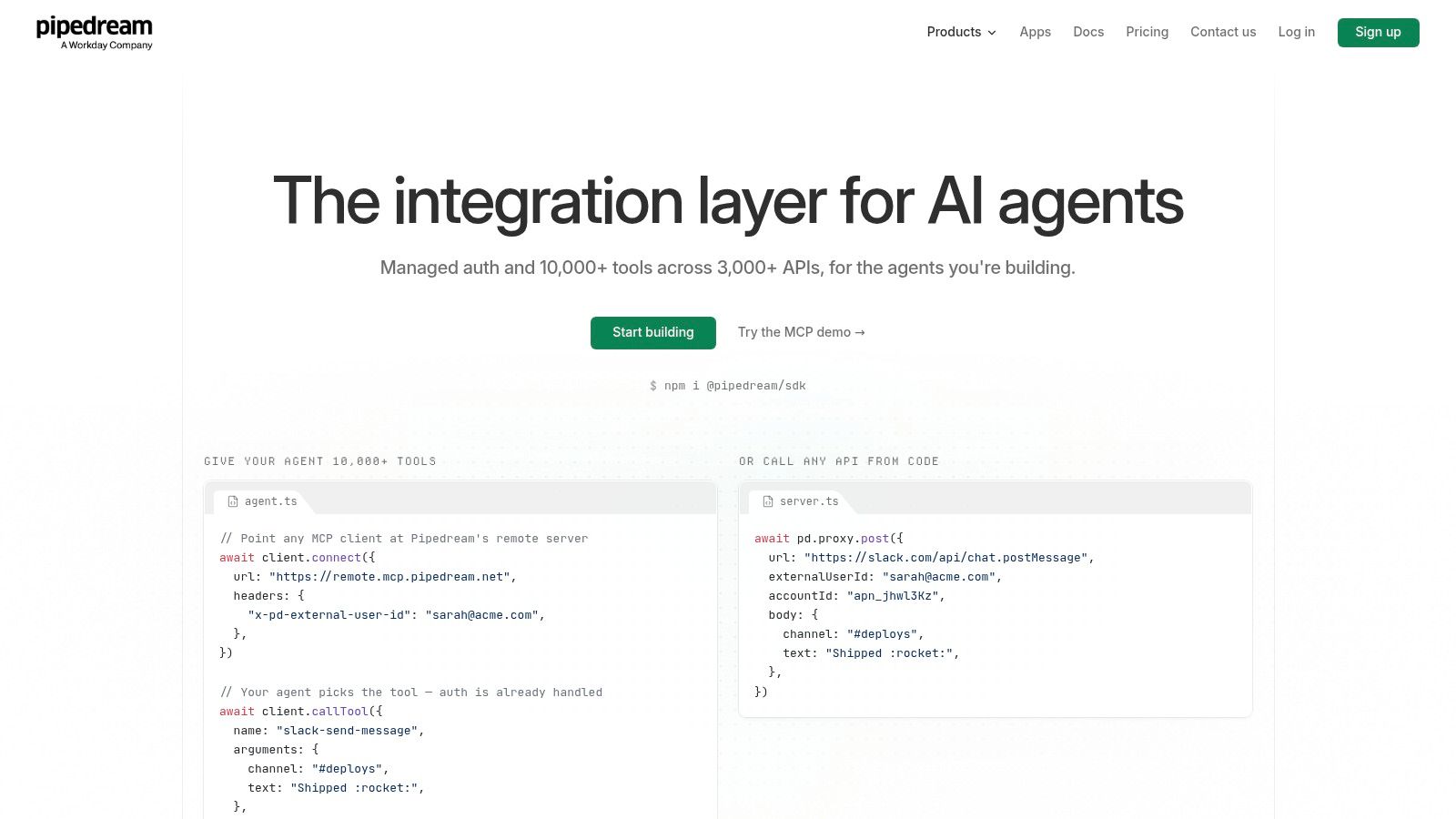
For a developer, the tedious integration work often isn't calling a model. It's authenticating users, handling API payloads, and maintaining connections to business applications.
Pipedream combines connectors, prebuilt actions, managed authentication, and code steps. Its catalog includes more than 3,000 connectors and over 10,000 prebuilt tools and triggers, making it useful for API-centric integrations without hand-building every connection.
Pattern: Managed developer integration. A software team could use it to connect a customer-authorized application, retrieve relevant records, and expose narrowly scoped operations to an agent.
Prototype Freely, Budget for Production
A free development environment supports building and testing, while production deployment requires a paid plan. Include usage credits and external-user charges in the estimate rather than treating development costs as representative.
Developer advantage: Code steps handle transformations and edge cases that become awkward in visual-only builders.
Agent integration: MCP servers and the Connect proxy provide routes for connecting tools and applications.
Enterprise evaluation: Business-tier options include SSO, SCIM, SLAs, dedicated support, and HIPAA-related offerings.
Validate contractual scope and architecture before treating a compliance-related option as sufficient for your workload.
Pipedream is less approachable for nontechnical owners than Zapier or Make. I'd favor it when engineers own the integration and want managed connector infrastructure without abandoning code-level handling of business rules.
5. Workato
Pattern: Enterprise orchestration. Best for cross-department processes with formal ownership.
Workato is worth evaluating when an AI workflow crosses procurement, finance, support, and customer systems. The challenge in that environment isn't just connecting applications. It's coordinating changes, approvals, identities, and exceptions across departments.
Workato combines enterprise application integration with workflow orchestration and AI capabilities through Workato One. Its enterprise orientation makes more sense for a shared integration program than for an isolated summarization task.
Buy Governance Capacity, Not Just Connectors
A 2025 ISG study found that more than two-thirds of surveyed enterprises said managing complexity hindered progress on data and AI initiatives. A centralized platform is useful only if your organization also establishes clear process ownership.
Evaluate Workato against a representative process with real approval boundaries:
Identity: Determine whose permissions govern each downstream action.
Auditability: Capture the input, decision, approval, and resulting system change.
Failure handling: Demonstrate recovery after an application timeout or rejected update.
Commercial fit: Model usage-based capacity across the capabilities you'll use.
Its sales-led evaluation and less transparent pricing can make comparison slower than testing self-serve tools. It may also be excessive for a small team.
An AI integration platform assessment should distinguish shared orchestration requirements from application-specific logic. Don't centralize everything merely because the platform can connect it.
6. LangChain and LangSmith
LangChain helps you build the application. LangSmith helps you inspect and evaluate its behavior. Neither replaces the engineering team responsible for production.
LangChain and LangSmith suit developers building retrieval systems, tool-using agents, and applications that need model-provider flexibility. LangChain supplies interfaces and components; LangSmith adds tracing, evaluation, and deployment-related capabilities.
Pattern: Code-first frameworks and observability. Consider an internal knowledge assistant that retrieves authorized documents, drafts an answer, and proposes a service-desk action. Engineers need visibility into retrieval quality, tool selection, and the final response, not just a successful HTTP request.
Keep the Abstractions Earned
Use the framework where it reduces repeated integration work. A straightforward model call with a validated response schema may be easier to maintain without a large abstraction layer.
A trace can explain what the agent did. It doesn't prove the agent was allowed to do it.
Build authorization into your application and tool endpoints. Maintain evaluation cases for missing documents, conflicting sources, malicious instructions, and denied permissions.
Advantages: Component flexibility, instrumented execution, and a code-first development path.
Operational burden: Dependency changes, evaluation maintenance, and application deployment remain engineering responsibilities.
Cost consideration: LangSmith has a limited free Developer tier; additional tracing usage can incur charges.
Managed deployment and enterprise hosting options can reduce infrastructure work. They don't remove the need to define acceptable behavior before shipping changes.
7. OpenAI API
Pattern: Direct model API integration. Best for AI features inside software your team owns.
The OpenAI API provides model access, function calling, and supported built-in tools such as web search and file search. Unlike a workflow automation platform, it doesn't supply the complete business process around a model request.
For example, an application could extract a customer's requested account change and return a structured proposal. Your backend should then authenticate the user, validate the fields, check authorization, and decide whether to execute the change.
Function Calling Isn't Authorization
A model-generated tool call is a request, not permission. Treat arguments as untrusted input and enforce controls inside the service performing the action.
Validate inputs: Apply schemas, allowed values, and business-rule checks.
Constrain actions: Give tools narrow capabilities instead of unrestricted database or network access.
Prevent duplicates: Use idempotency controls for transactional operations.
Measure costs: Track model usage, supported tool charges, retries, and application infrastructure together.
Usage-based pricing offers flexibility but makes unrestricted agent loops a budgeting risk. Set execution limits and define an explicit fallback when the model can't complete a task.
An AI integration specialist can help separate model behavior from application responsibilities. The practical issues in AI guardrails and production costs belong in the architecture review, not just the launch checklist.
Choose this route when custom application behavior justifies owning the surrounding software.
8. Amazon Bedrock and AgentCore
An organization already operating on AWS should evaluate its existing identity, networking, and monitoring capabilities before adding another integration control plane.
Amazon Bedrock offers managed foundation-model access within the AWS environment. AgentCore provides capabilities for building and operating agents, making the combination relevant to platform teams standardizing cloud-based AI applications.
Pattern: Hyperscaler agent infrastructure. The attraction is alignment with an existing operating model, not freedom from operational work.
Guardrails Are a Layer, Not the Boundary
Configured safeguards can address areas such as sensitive information and prompt attacks. Your application must still enforce document access, action permissions, and transaction rules.
A support agent, for example, might be permitted to summarize an account but not change its billing details. Enforce that distinction in the tools and backend services, even when the model follows its instructions during testing.
Architecture fit: Assess AWS identity integration, network paths, and access to existing business data.
Documentation fit: Distinguish AgentCore guidance from legacy Bedrock Agents Classic documentation.
Financial fit: Monitor model usage alongside runtime, storage, logging, and connected services.
Operational fit: Test throttling, tool failures, and recovery when an agent stops midway.
AWS familiarity helps teams understand the service boundaries. Without it, a managed platform can still require substantial implementation effort.
I'd shortlist Bedrock and AgentCore for an AWS-centered platform strategy, not merely because a prototype needs access to a model.
9. Google Gemini Enterprise Agent Platform
Separate the model bill from the agent-platform bill. That distinction matters when evaluating the Google Gemini Enterprise Agent Platform.
The platform provides agent-development and managed runtime services with Google Cloud integration. Some documentation uses the Vertex AI Agent Builder name, so map each feature to the specific service, region, and commercial terms you intend to use.
Pattern: Managed hyperscaler agent platform. It's a reasonable candidate for organizations already using Google Cloud and seeking shared infrastructure for agent deployment.
Evaluate an Entire User Journey
A successful model response doesn't capture the full workload. An agent may retrieve context, maintain session state, invoke a business tool, and record operational events before returning an answer.
Model selection: Confirm available Google and other model options for the relevant feature and region.
Runtime behavior: Test session handling, memory requirements, tool timeouts, and recovery.
Cost allocation: Separate inference from runtime, memory, sessions, and related cloud services.
Governance: Verify access boundaries and logging behavior across the complete execution path.
Published component pricing helps with estimation, but teams still need workload measurements. Use realistic conversation lengths and exception paths instead of budgeting from a short demonstration.
Google Cloud operational tooling may fit an existing platform team well. If your organization lacks that expertise, compare the management overhead against a simpler application architecture before committing to a broader agent platform.
10. IBM watsonx Orchestrate
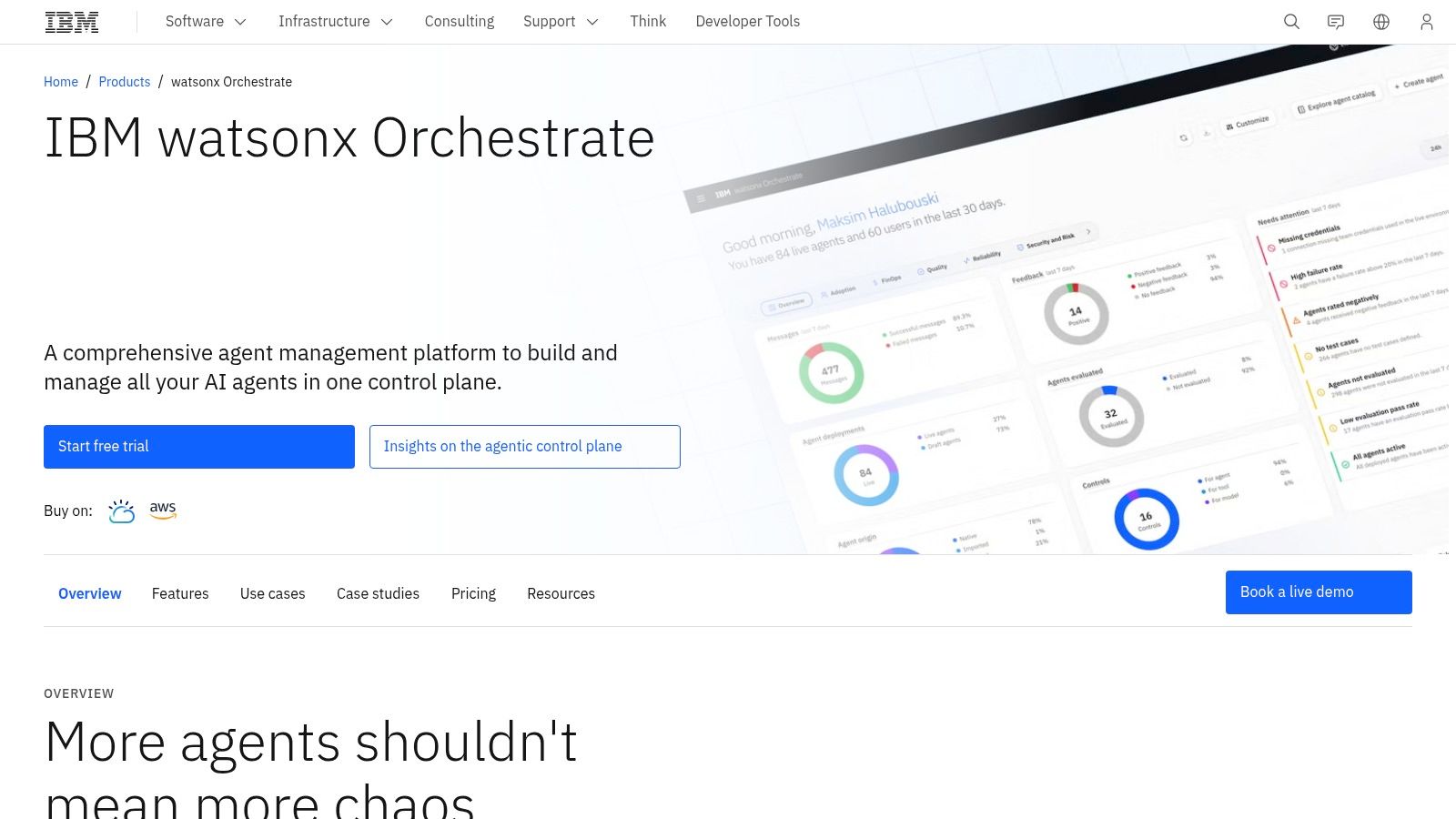
Pattern: Enterprise agent orchestration with deployment flexibility.
IBM watsonx Orchestrate targets organizations building, connecting, and governing agents across business workflows. Its tools catalog, custom tool creation, enterprise access controls, and managed multi-cloud or on-premises deployment options make it relevant to formal enterprise evaluations.
Start with a process that exposes the difficult requirements. Employee onboarding, for example, involves identity creation, application access, approval chains, and records that shouldn't be visible to every participant.
Prove Deployment and Control Fit
Don't accept a working chat interface as proof that the workflow is ready. Require the proof of concept to demonstrate denied actions, revoked access, unavailable applications, and human escalation.
Enterprise strengths: Agent orchestration, security controls, and deployment choices.
Evaluation access: A free trial supports initial exploration.
Commercial trade-off: Published starting prices make it more relevant to organizational deployments than individual experimentation.
Contract detail: The Premium tier advertises data isolation and a HIPAA-ready option, which still require workload-specific validation.
An AI governance strategy should define who can publish agents, approve tools, inspect logs, and stop execution.
Acceptance test: Revoke a user's source-system access, then confirm that retrieval, cached context, and downstream actions respect the change.
IBM deserves consideration when deployment constraints and organizational controls outweigh the convenience of a lightweight builder. Validate the actual integrations and required capacity before committing.
AI Integration Tools Compared at a Glance
Item | Best For | Deployment Model | Pricing Structure | Technical Skill Required |
|---|---|---|---|---|
Zapier | Quickly automating workflows across common business apps | Hosted platform | Free plan; task-based costs that rise with usage | Low |
Make | Visual workflows with branching, filtering, and data transformation | Hosted platform | Free and paid tiers; credit-based usage | Low to moderate |
n8n | Teams needing workflow flexibility and deployment control | Cloud or self-hosted | Cloud plans based on executions; self-hosting option | Moderate to high, especially for self-hosting |
Pipedream | Developer-built, API-centric integrations and AI agents | Managed platform | Free development environment; paid production plans with usage and external-user charges | High |
Workato | Complex enterprise integrations and business process orchestration | Enterprise platform | Usage-based; larger deployments typically require a sales engagement | Moderate to high |
LangChain and LangSmith | Engineering teams building and observing LLM applications | Code-based framework with managed deployment and hosting options | Free Developer tier with limits; additional usage may incur charges | High |
OpenAI API | Adding OpenAI models and tools to custom software | API-based cloud service | Usage-based model and tool pricing | High |
Amazon Bedrock and AgentCore | AWS teams building and operating AI agents | Managed AWS services | Usage-based across models and services | Moderate to high; AWS familiarity helps |
Google Gemini Enterprise Agent Platform | Google Cloud teams building and managing AI agents | Managed Google Cloud platform | Separate usage charges for models and platform components | Moderate to high |
IBM watsonx Orchestrate | Organizations requiring governed agent orchestration and hybrid deployment | Managed multi-cloud or on-premises | Published starting prices; organizational purchase may be required | Moderate to high |
Final Thoughts
Choose by integration pattern, not by feature count. Zapier and Make fit business-led automation where speed matters more than custom internals. n8n and Pipedream suit teams that want deployment choice or developer-owned connectors. LangChain, LangSmith, and the OpenAI API belong with engineering groups building model behavior directly into software. Amazon Bedrock, AgentCore, and Google's Gemini Enterprise Agent Platform make most sense when the rest of the estate already runs on those clouds. Workato and IBM watsonx Orchestrate earn their cost when identity, audit, approvals, and shared infrastructure are part of the requirement.
The practical rule is simple: pick the smallest architecture that satisfies the operational requirement. A deterministic workflow with one bounded model step often beats an agent platform when the process has clear inputs, clear owners, and known failure modes.
Apply a Production Selection Checklist
Before purchasing, run every shortlisted platform through the same representative process:
Ownership: Name the business owner, engineering maintainer, and incident responder.
Permissions: Verify source-system access, tool authorization, and revocation behavior.
Data handling: Document storage, retention, deletion, residency, and training-related terms.
Reliability: Test duplicates, retries, unavailable dependencies, and human escalation.
Economics: Measure cost per completed transaction, including review and exception handling.
Value: Compare cycle time, error rates, and control effectiveness against the existing process.
A clean demo proves connectivity. Fortune's coverage of a 2025 MIT analysis reported that only about 5% of organizations achieved rapid revenue acceleration, so judge a pilot on measurable process outcomes rather than model fluency.
Put Specialized Delivery Ahead of Tool Accumulation
Marketing automation shows why implementation depth matters. Connecting a CRM to a model does not create campaign approvals, consent handling, measurement discipline, or reliable audience updates.
Freeform's lifecycle work runs in Braze and Iterable, and its real-time analytics service brings key marketing measurements into one link. The useful pattern is execution connected to measurement and governance, then measured against the business process it changes.
Freeform Company offers bespoke AI integration services and compliance assessments to connect enterprise systems, workflows, and security controls. Visit Freeform Company to explore its AI integration and governance resources, then bring a representative workflow and its access requirements to a focused implementation discussion.