

Regulatory Compliance Audit Guide for 2026

63% of organizations say complex, disaggregated data makes compliance more difficult, according to PwC's Global Compliance Study. That reframes the regulatory compliance audit: the hardest question often isn't whether a control exists, but whether anyone can assemble trustworthy evidence that it worked across disconnected systems.
For IT and compliance managers, that means auditing the evidence-production process itself. A directory export, an application log, and a supplier report may each look credible while telling incompatible stories about the same event.
Table of Contents
What a Regulatory Compliance Audit Is - When the records disagree - Audit the evidence pipeline
Audit Types and Who Runs Them - Match the reviewer to the obligation
Regulatory Contexts That Change the Audit - Distinguish law from assurance frameworks - Why evidence and consequences belong together
How to Run the Audit from Plan to Retest - Establish the boundaries - Collect and challenge - Report and verify correction
Evidence Checklists for IT and AI Systems - Build a file another reviewer can use - Follow an AI transaction across boundaries - Test change and supplier boundaries
Metrics and Tools That Keep Audits Repeatable - Make the control inventory the integration point - Connect tools without creating competing dashboards - Keep judgment visible
Where Shared Accountability Breaks and How to Start - Test who can close the loop - Start the next cycle with an accountable system - Consider support that joins integration and governance
What a Regulatory Compliance Audit Is
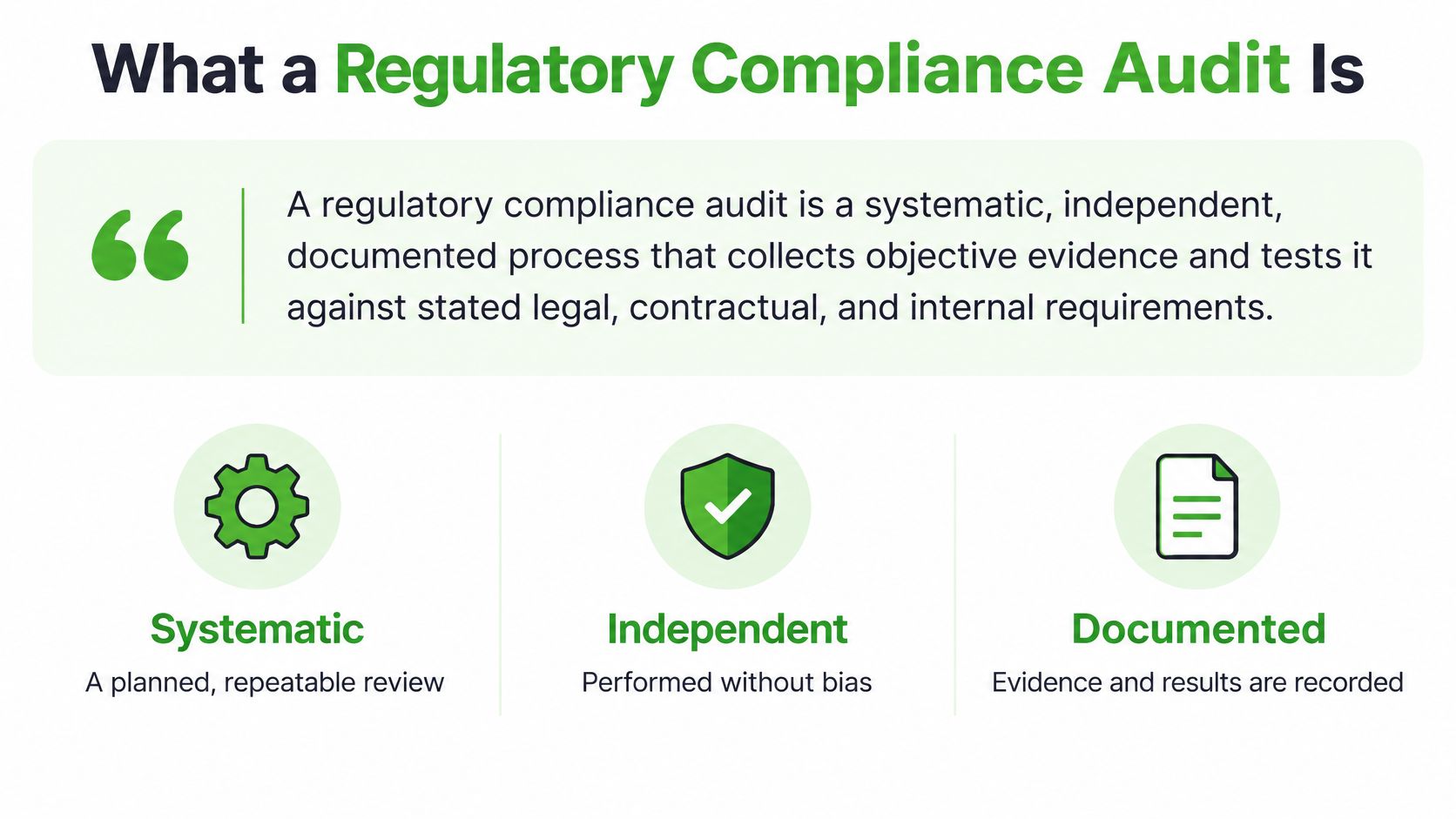
A regulatory compliance audit is a systematic, independent, documented process that collects objective evidence and tests it against stated legal, contractual, and internal requirements.
Think of a restaurant receipt. The policy is the menu, the evidence is the itemized bill, and the audit asks whether the kitchen served what was ordered. A beautifully written menu doesn't establish what reached the table.
An audit proves that controls operate, not merely that they're written. More precisely, auditors reach a conclusion within a defined scope, period, and set of evidence limitations. They don't guarantee that every transaction or future event will comply.
The definition's practical characteristics are summarized below.
When the records disagree
Say your access policy requires prompt removal when someone leaves. Human resources records the departure, the identity platform disables the employee account, and a cloud application still shows an active local administrator login. The auditor can't accept the identity-platform screenshot as proof that access was removed everywhere.
The evidence file needs to connect the departure event to the affected identities, application accounts, removal actions, and subsequent activity. If timestamps disagree, someone must reconcile time zones, collection delays, and system clocks rather than choosing the convenient record.
That work becomes more difficult across jurisdictions. Evidence may sit in regional applications with different administrators, retention settings, and access restrictions. Record where each artifact originated, who extracted it, what filters they applied, and whether the export represents the complete population.
Audit the evidence pipeline
Useful preparation includes testing whether your collectors can see every in-scope system, whether records can be altered, and whether reports exclude failed or incomplete events. For evaluating collection workflows, compliance software insights from Matil provide a useful starting point for comparing automation approaches.
A practical audit program connects audit types and regulatory contexts to a risk-based lifecycle, IT and AI evidence checks, repeatable metrics, and named accountability. The difficult work sits at their intersections: a supplier changes a model, an application logs different fields, and nobody updates the evidence request.
Buying another compliance tool won't repair an audit whose source records conflict. First establish which records are authoritative, how disagreements are resolved, and who signs off on the resulting conclusion.
Audit Types and Who Runs Them
Regulatory compliance audit types
Audit type | Who performs it | Independence | Typical purpose |
|---|---|---|---|
Management self-assessment | Control owner | Low | Early detection and readiness |
Internal compliance audit | Internal audit or compliance team | Medium to high | Ongoing assurance to leadership |
External independent audit | Outside qualified firm | High | Statutory or contractual attestation |
Certification or attestation | Accredited body or CPA firm | High | Customer or market assurance such as ISO 27001 or SOC 2 |
Regulator inspection | Supervisory authority | High | Enforcement and sanctions |
The first purchasing decision is what assurance you need. A readiness review can identify missing artifacts, but it doesn't become an independent opinion because a consultant helped prepare the spreadsheet.
Match the reviewer to the obligation
A management self-assessment lets control owners discover weaknesses before formal testing. It's useful preparation, especially when engineers understand the implementation better than anyone else, but those engineers are assessing their own work.
An internal compliance audit needs separation from the process being tested. Internal audit commonly reports through established governance channels; a compliance team must consider whether designing or operating the controls compromises its ability to assess them independently.
An external independent audit answers a defined statutory or contractual need. Confirm the firm's qualifications, engagement scope, reporting format, and any registration requirements before promising customers a particular assurance outcome.
Certification and attestation aren't interchangeable. ISO 27001 certification concerns an information security management system, while a SOC 2 report is a CPA attestation against selected Trust Services Criteria. Neither automatically establishes compliance with every applicable law.
Practical rule: Ask who will rely on the report and what conclusion they require before selecting the audit type.
A regulator inspection has a different purpose again: the supervisory authority determines what it needs to examine and may pursue enforcement. A favorable internal review doesn't prevent further scrutiny.
Use self-assessment findings as inputs to independent testing, never as a substitute for it. Also separate the person who fixes a finding from the person authorized to verify closure.
Regulatory Contexts That Change the Audit
Context | Trigger | What is tested | Primary evidence |
|---|---|---|---|
SOX Section 404 | Public-company financial reporting, subject to applicable requirements and exemptions | IT general controls and financial process controls | Access reviews, change tickets, reconciliations |
HIPAA Security Rule | Electronic protected health information handled by covered entities or business associates | Administrative, physical, and technical safeguards | Risk analysis, audit logs, business associate agreements |
GDPR and privacy laws | Personal data processing within the law's scope | Lawful basis, rights, and cross-border transfers | Records of processing, request logs, transfer assessments |
PCI DSS | Cardholder data environment and applicable payment obligations | Network, access, and vulnerability controls | Scan results, segmentation tests, log reviews |
SOC 2 | Customer assurance engagement | Trust Services Criteria in the agreed scope | Policies, monitoring, and incident records |
EU AI Act and NIST AI RMF | Applicable AI Act obligations; voluntary risk management for material enterprise AI | Data, model behavior, oversight, and logging | Model documentation, evaluation results, override logs |
ISO 27001 | Information security management system | Applicable Annex A controls and ISMS operation | Statement of applicability, internal audit, corrective actions |
Distinguish law from assurance frameworks
These contexts don't impose the same kind of obligation. GDPR and HIPAA are legal regimes, PCI DSS is an industry standard commonly enforced through payment relationships, and SOC 2 is an assurance engagement. NIST AI RMF is voluntary guidance, not a substitute for determining which EU AI Act obligations apply.
Don't treat the trigger column as a complete legal applicability test. Legal counsel should confirm jurisdiction, organizational role, exemptions, and the obligations effective for the activity being reviewed. Engineers then translate those decisions into testable system boundaries.
A starting inventory of regulatory compliance requirements can help teams organize that conversation before they write evidence requests.
Why evidence and consequences belong together
The Sarbanes-Oxley Act of 2002 created the PCAOB to register accounting firms, establish professional standards, inspect, investigate, and sanction, shifting public-company audit oversight toward SEC supervision, as described in the SEC's account of the audit oversight framework. The SEC adopted auditor record-retention rules on January 22, 2003.
For enterprise IT and AI governance, the lesson is structural: define criteria, retain supporting records, provide independent inspection, and establish consequences for unresolved failures. A binder of approved policies provides only part of that structure.
Map controls to obligations instead of cloning a program for every framework. Privileged-access management may support financial reporting, privacy, information security, and AI oversight, but the relevant systems and assessment criteria can differ.
Before fieldwork begins, mark each context as applicable, excluded with justification, or awaiting a legal decision. An unresolved applicability question is a planning issue, not something an auditor should settle through a narrow sample.
How to Run the Audit from Plan to Retest
A workable lifecycle separates collecting artifacts from evaluating them. That distinction matters because a repository full of files can still contain no persuasive evidence.
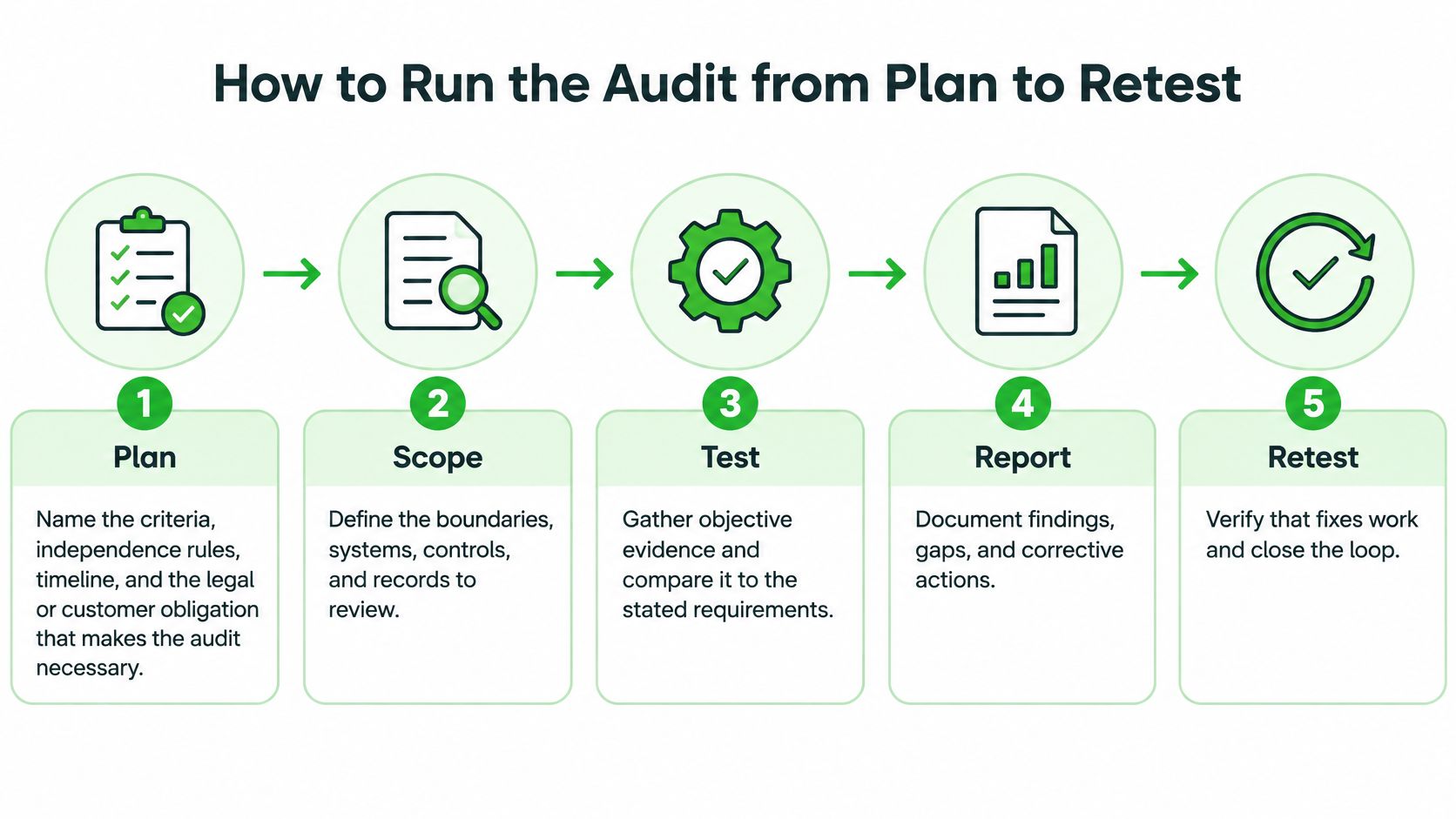
The process visual groups collection with testing; the operating procedure below separates them so each activity leaves a clear audit record.
Establish the boundaries
1. Plan. Name the legal or customer obligation, audit criteria, independence rules, reporting audience, and timeline. Identify who can resolve disagreements about scope and who receives significant findings.
Required artifact: an approved audit charter or engagement plan. Include the assessment period and intended conclusion so nobody mistakes a point-in-time check for assurance about operation throughout a period.
2. Scope. Rank systems and processes by impact, likelihood, exposure, and control maturity. Apply the risk-based and evidence-based principles described in ISO 19011, concentrating effort where failure could materially affect obligations, customers, reporting, or security.
Sampling resembles hospital triage: higher-consequence conditions deserve attention first, but lower-priority cases still need a documented disposition. Don't label an area low risk merely because collecting its evidence is inconvenient.
Required artifact: a scope register and risk assessment explaining deeper testing, reduced sampling, and exclusions. A preliminary compliance gap analysis can identify implementation gaps before the formal testing boundary is approved.
Collect and challenge
3. Collect evidence. Request verifiable operational records: protected access logs, approved policies, configuration exports, tickets, training records, and transaction samples. Preserve originals and document extraction filters, collection permissions, and missing systems.
Required artifact: an evidence index connecting each record to its control and collection method. Management explanations help interpret records, but they don't replace records.
4. Test. Record the population, sampling method, selection rationale, exceptions, corroboration, and limitations. Check both design, whether the control could meet its purpose, and operation, whether it did.
For software controls, combine scanners with manual code review to investigate authorization paths and business logic that an automated finding may not explain. A clean scan isn't evidence that a sensitive workflow enforces the intended approvals.
Required artifact: a reproducible test worksheet. The lesson of Auditing Standard No. 5 is that effort should follow material risk rather than identical testing of every process.
This supplementary video can support a team discussion about the audit workflow.
Report and verify correction
5. Report. Describe the criterion failed, evidence reviewed, business effect, accountable owner, and residual risk. Separate a missing policy from a control that exists but doesn't operate; they require different corrective actions.
Required artifact: a findings register and report with supported conclusions. If evidence is insufficient, state that limitation rather than converting uncertainty into a pass.
6. Remediate and retest. Agree on an action, deadline, responsible implementer, and independent verifier. Test the changed control using fresh operational evidence, not just the remediation ticket's closed status.
Required artifact: a retest record linking the original exception, correction, new sample, and closure decision. If management accepts residual risk, preserve the authorized acceptance separately from a successful retest.
Freeze scope before evidence requests go out. Keep a limitations paragraph in the report whenever automated collection cannot see an in-scope system.
Evidence Checklists for IT and AI Systems
Area | Minimum evidence | Pass test | Red flag |
|---|---|---|---|
Identity and access | Joiner-mover-leaver tickets and quarterly reviews | Sample matches the directory export | Shared or unowned administrator accounts |
Change management | Approved tickets linked to production deploys | Unauthorized changes are rare, explained, and assessed against criteria | Emergency changes with no after-the-fact review |
Logging and retention | Immutable logs for the full audit period | In-scope systems are covered | Missing logs during an incident window |
Data quality and lineage | Source-to-report or source-to-feature lineage | Completeness and reconciliation are documented | Conflicting records across systems |
AI and machine learning | Provenance, evaluations, limitations, override logs | Model changes are approved and disclosed | Silent model or prompt updates |
Vendors and cloud | Contract, processing terms, assurance report, subprocessor list | Residual risk accepted by a named owner | Evidence stops at the contract |
Treat this as a working checklist, not a universal retention or review schedule. Match frequency and retention to the applicable criteria and approved control design; an unauthorized change can still fail the criterion even when it's unusual and explained.
Build a file another reviewer can use
Create a folder for each control ID, with separate locations for criteria, source exports, testing, exceptions, and retesting. Store each artifact with its owner, collection date, system of origin, assessment period, and extraction method.
A compliance checklist template can provide the register structure. For AI-specific coverage, compare your artifact requests with Wonderment Apps' AI compliance checklist, then tailor them to the actual architecture.
The minimum package should let a reviewer perform these checks:
Identity reconciliation: Match departure and role-change tickets to directory membership and application permissions. Investigate shared administrators and local accounts outside centralized identity management.
Deployment traceability: Follow an approved change through its commit, build, release, and production deployment. Emergency changes need documented retrospective review under the approved procedure.
Logging continuity: Inspect collection health and retention settings, then test for gaps during failures and incidents. An enabled logging configuration doesn't establish that records arrived.
Data completeness: Compare source populations with extracted populations and document exclusions. Trace transformations to the report or model feature, including joins that can drop records.
Follow an AI transaction across boundaries
Say an AI feature sends customer text to an external model provider. Procurement supplies a signed contract, the engineering team shows an API integration, and the privacy team provides a processing assessment.
Those artifacts don't establish how the live feature behaved. The reviewer still needs to trace an authorized user's request through the application, outbound call, provider response, and downstream use, with identifiers that permit correlation.
Check whether the retained records establish the applicable model version, prompt-template version, access event, output handling, and any human override. Don't require unrestricted storage of sensitive prompts by default. Use approved minimization, redaction, restricted access, and metadata where they support the audit objective without creating unnecessary privacy exposure.
If provider-side records aren't available, record that boundary explicitly. Determine whether contractual commitments, customer-side telemetry, configuration checks, and supplier assurance provide sufficient alternative support.
Test change and supplier boundaries
For AI models, keep training-data provenance where relevant, evaluation results, documented limitations, and approval records for model or prompt changes. Prohibit silent updates through a controlled release procedure, including detection and escalation where a supplier changes behavior outside your deployment process.
For vendors, inspect the assurance report's scope, period, exclusions, and customer responsibilities rather than filing its cover page. Identify subprocessors and the person authorized to accept remaining dependencies.
The example fails if the trail stops at the contract and nobody can explain which prompts, outputs, and access events were retained. A later reviewer must be able to replay the conclusion without relying on the original engineer's memory.
Metrics and Tools That Keep Audits Repeatable
Metric | What it shows | Healthy signal |
|---|---|---|
Control coverage | Share of in-scope obligations with an owner and a test | Gaps are named, not hidden |
Evidence completeness | Share of samples with a verifiable artifact | Exceptions and limitations are written down |
Exception aging | Days a finding stays open past its deadline | Median age is falling |
Repeat finding rate | Same control fails in the next cycle | Rate declines after retest |
Retest closure | Findings closed on new evidence | Owner, date, and artifact are recorded |
Sampling record | Population, method, and limits of the test | Another reviewer can replay the conclusion |
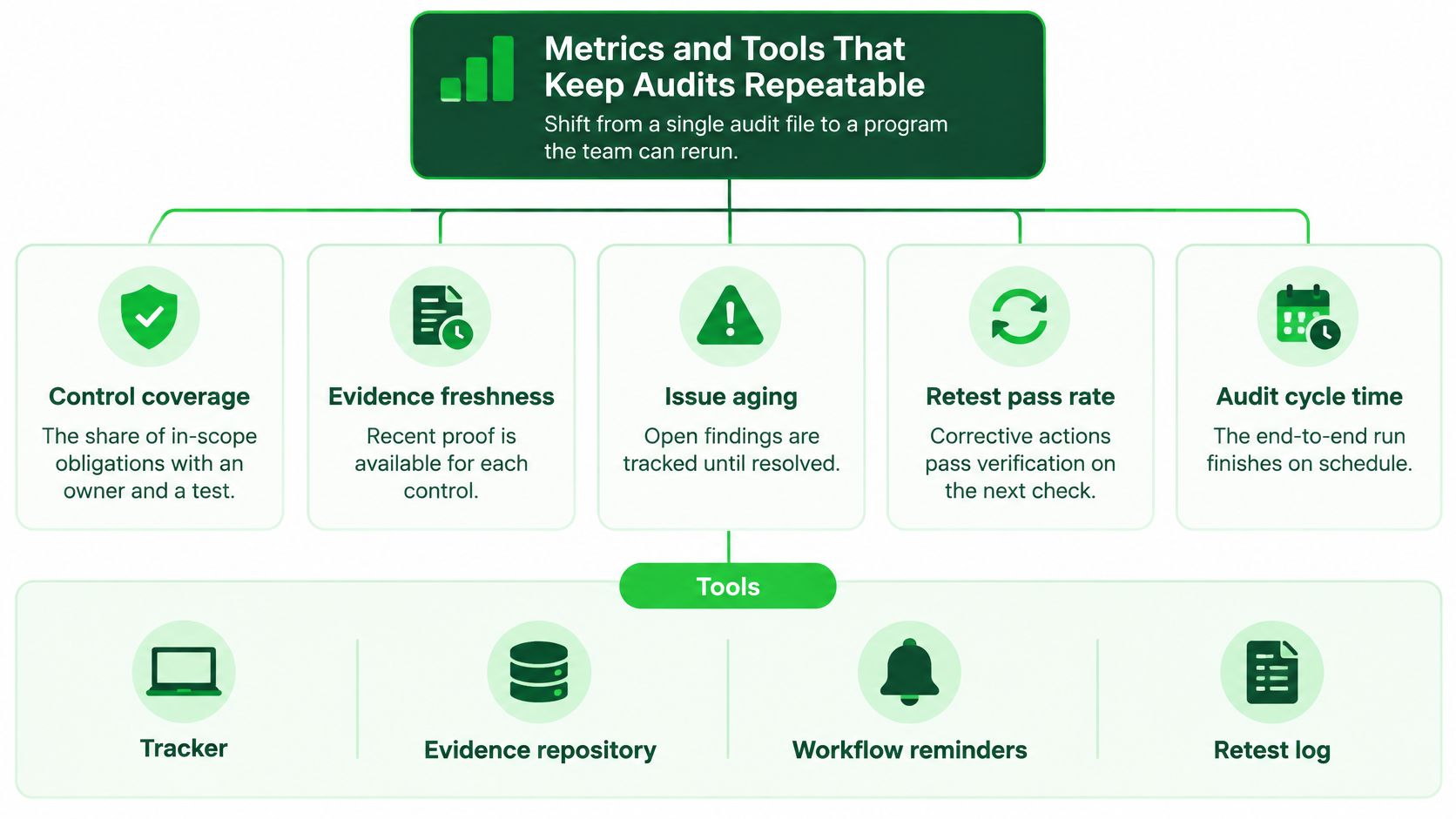
A green dashboard of policy existence isn't control coverage. Coverage requires a defined obligation, an accountable owner, and a usable test. Evidence completeness requires a verifiable artifact, not merely an uploaded attachment.
Keep denominators stable enough to interpret changes. If teams remove difficult systems from scope, apparent improvement may reflect reduced scrutiny rather than better control operation.
Make the control inventory the integration point
Maintain a normalized inventory with unique IDs, authoritative requirements, owners, test procedures, evidence locations, assessment frequency, status, and remediation deadlines. Preserve the relationships between these records instead of putting important explanations only in presentation slides.
NIST's Open Security Controls Assessment Language, OSCAL, represents controls, baselines, implementations, assessment plans, and findings in machine-readable XML, JSON, and YAML. Its practical value is traceability: a reviewer can follow a finding to the tested control, implementation statement, supporting artifact, and remediation plan.
That design supports the evidence-based assessment approach discussed in ISO 19011 audit guidance. Structured records don't make an assessment correct, but they make missing relationships easier to identify and changes easier to assess.
The program view should include both assurance outcomes and the operational measures that keep collection and review on schedule.
Connect tools without creating competing dashboards
Select tools for the records they produce and the boundaries they can observe:
GRC platform or control register: Hold the normalized inventory, requirement mappings, ownership, and approved assessment procedures.
Configuration and cloud posture scanners: Export actual system states and changes against approved configurations.
Identity governance tools: Provide access-review decisions, directory exports, privileged roles, and unresolved exceptions.
Ticketing and deployment systems: Connect approvals and emergency reviews to production changes.
Log platforms: Preserve relevant events for the approved audit period and expose collection failures.
Each feed should carry the control ID and owner, rather than creating a separate dashboard that someone later reconciles manually. Keep collection errors visible beside the evidence status so a disconnected connector doesn't look like a compliant system.
A technical artifact can support several obligations without repeated collection, but reviewers must still determine whether it supports each distinct criterion. Reuse the record, not an unsupported conclusion.
Keep judgment visible
Exception aging helps managers see overdue work, while repeat findings reveal whether corrective actions addressed the cause. Retest closure should require new evidence and a recorded reviewer decision, not an automated status transition.
Use machine-readable assessments where configuration drift is the central risk. Keep human review where the conclusion depends on context, competing obligations, sample limitations, or acceptance of residual risk. Tools collect evidence; accountable people decide what it establishes.
Where Shared Accountability Breaks and How to Start
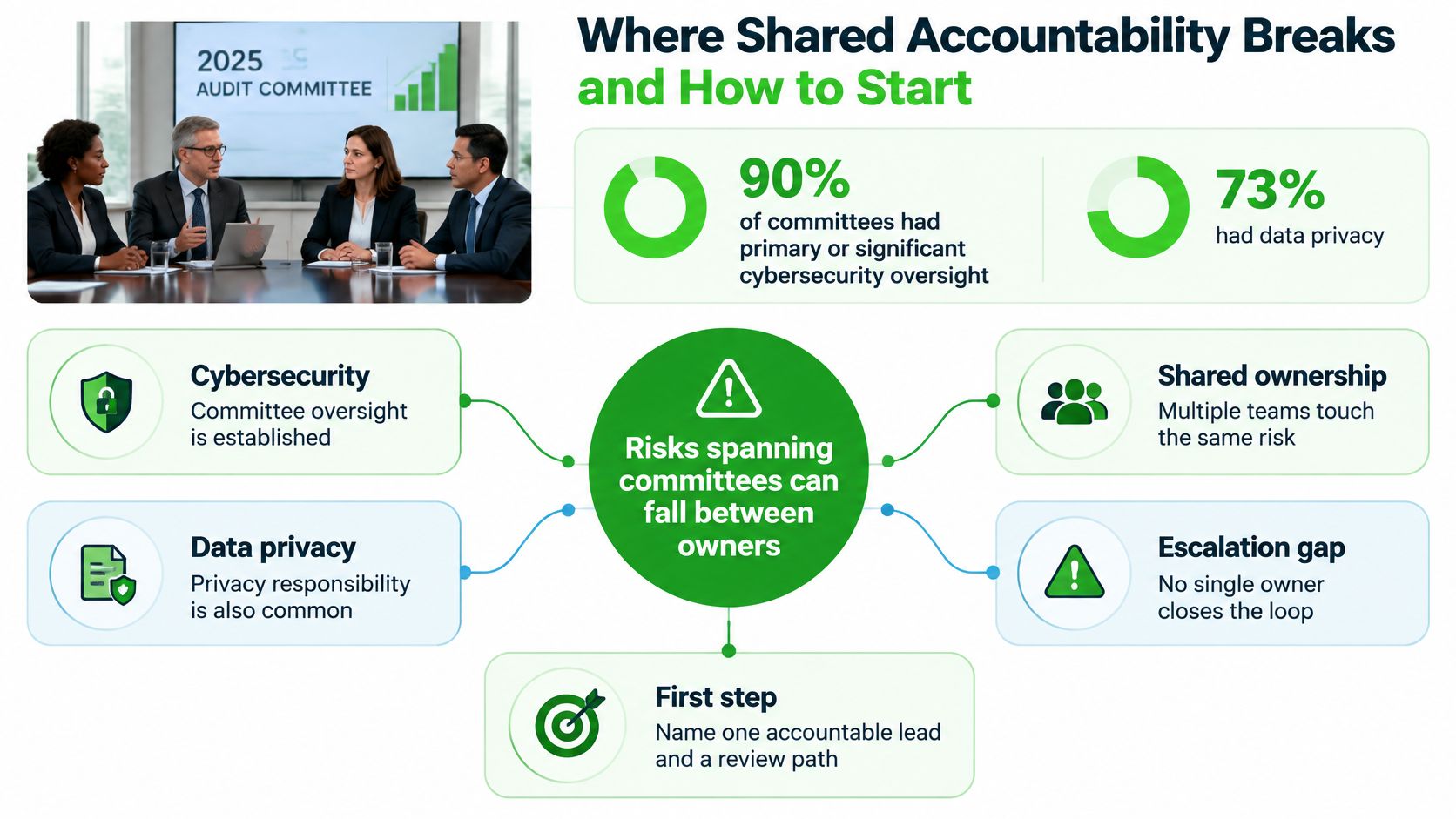
In KPMG's 2025 audit-committee survey, 90% of committees reported primary or significant oversight of cybersecurity, and 73% reported the same for data privacy. Respondents also raised concerns about risks falling between committees. Oversight of generative AI was generally more limited.
Committee coverage does not establish end-to-end accountability. An AI application may involve security, privacy, procurement, model governance, and a business sponsor, while no one has the authority to resolve a finding that crosses those boundaries.
The gaps often appear at the handoffs.
Test who can close the loop
Consider an AI system that processes personal data through an external provider. Identify who owns the end-to-end evidence trail, who sets remediation priorities, and who can accept remaining risk. These may be different operational roles, but one named executive should be accountable for the complete outcome.
Check for three failure modes:
Unexamined handoffs: Cybersecurity, privacy, AI, and vendor reviewers approve their own scopes, but nobody tests what happens between them.
Overlapping charters: Several committees mention the risk, but none is responsible for resolving disagreements or funding a correction.
Unreconciled automation: Identity, application, and supplier collectors produce records that nobody can connect into a defensible transaction history.
Map each shared control to an executive owner, an escalation path, and the relevant supplier dependency. Then run a tabletop exercise: the provider changes its model behavior, the application produces an unacceptable output, and the business must decide whether to disable the feature.
Ask participants to retrieve the records, identify the decision-maker, and show how escalation works. A diagram cannot establish whether teams have the information, permissions, and authority to act.
Separate clean reports do not establish maturity. Governed and tested intersections do.
Start the next cycle with an accountable system
Choose the highest-impact system within the applicable regulatory contexts, not the one with the neatest documentation. Assign an executive owner to its evidence chain, with authority to obtain cooperation across business, engineering, legal, and procurement teams.
Before fieldwork, complete this launch checklist:
Select the system: Describe the business service, sensitive data, supplier connections, and applicable obligations.
Assign accountability: Name the executive owner and operational evidence custodians.
Approve the assessment: Set the criteria, record risk priorities, and request the relevant artifacts.
Expose blind spots: Document what automated collection cannot observe and how reviewers will address those limits.
Book verification: Schedule planning, scoping, collection, testing, reporting, remediation, and a retest date.
Consider support that joins integration and governance
Freeform Company offers compliance assessments and bespoke AI integration services. Teams considering outside support can ask for defined deliverables, evidence boundaries, named responsibilities, and acceptance criteria before treating promised efficiency as an audit benefit.
At your next governance review, apply the single-owner test: which in-scope system has more than one regulator and no single owner for its evidence chain?
Visit Freeform Company to explore its compliance and AI resources, then bring a system diagram and an unresolved evidence gap to a discussion about assessment support.