

How to Run a Data Security Assessment in 2026

You have the report open in one tab and the audit checklist in the other. Somewhere around page forty is a finding about the shared drive that holds the customer export, and nobody has opened the ticket since the consultant packed up. That's the fork in the road for every data security assessment: it either becomes a working program or a PDF that gets filed and forgotten.
Most assessments measure the wrong thing. They count how many controls were tested and how many gaps were found, which tells you how hard the assessor worked. They don't tell you whether the organization is harder to breach this quarter than last. The number that matters is how fast findings close and how well that closure holds up under retest.
I'd argue the quality of an assessment shows up entirely after the report lands. Closure rates, exception aging, residual risk trending down. That framing changes how you scope, how you collect evidence, and who you hire.
Table of Contents
Choose the Scope and Framework First - Match the Framework to the Objective
How to Inventory Data and Rank Your Risks - The Register Is the Deliverable
Testing Methods That Prove Controls Work - Sample Like Someone Will Audit You
Turn Gaps Into a Ranked Remediation Plan - Fixes That Close in 30 Days and Fixes That Don't
Report Findings With a Reusable Template - Track Five Metrics Every Quarter
Build Continuous Checks Into CI/CD and AI Reviews - A Pipeline Checklist You Can Copy - AI Systems Need Their Own Review Loop
Decide Who Runs Your First Assessment - Run It In-House or Bring Help
Choose the Scope and Framework First
The scope mistake that wastes the most time is trying to cover the whole company. A boundary of all systems finishes nothing, because the team spends six weeks arguing over which spreadsheets count and delivers a findings list built entirely from the easy questions. Pick a boundary you can test inside the window you have.
Say a payments team runs the assessment. It draws the line around the cardholder data environment, customer personal data in the CRM, and the three SaaS tools that sync that data. The marketing site, the internal wiki and the engineering sandbox go on an exclusion list with a one-line reason each. That list carries as much weight as the scope itself, because it shows the boundary was a decision rather than an oversight.

Three objectives drive most first assessments. Some teams need compliance evidence for an auditor or an enterprise customer. Others want to cut risk on a named system. A smaller group needs a defensible answer to a board question about exposure. Name the objective before you name a framework, because the objective is what picks the framework.
Match the Framework to the Objective
NIST's Cybersecurity Framework is the usual starting point, and its version history explains why it holds up as a baseline. NIST released CSF 1.0 in 2014, 1.1 in 2018 and CSF 2.0 on February 26, 2024, and treats the framework as a living document that evolves with technology, threat trends and lessons learned, as this NIST account of the CSF 2.0 journey sets out. CSF 2.0 makes cybersecurity governance explicit, which reflects that data security is a business-risk and accountability question, not only a technical one. Use it for the outcome view and map your controls in from another standard.
Framework | Best for | Assessment output | Trade-off |
|---|---|---|---|
NIST Cybersecurity Framework 2.0 | Governance-led risk programs in any sector | Outcome view across six functions: Govern, Identify, Protect, Detect, Respond, Recover | Technology-neutral, so you still define the controls |
ISO/IEC 27001:2022 | Certifiable information security management systems | Evidence mapped to Annex A controls | Certification requires an accredited external audit |
CIS Controls v8.1 | Prioritized baseline for small and mid-size teams | Safeguards grouped into implementation groups IG1 to IG3 | Prescriptive, so less suited to certification or regulator evidence |
NIST SP 800-53A Rev. 5 | US federal systems and their contractors | Named test procedures for each control | Detailed and assessor-intensive |
Short selection rules save arguments later. Already certified to ISO/IEC 27001? Use Annex A as your control list instead of building a parallel one. Running a US federal system or contracting to one? Follow the SP 800-53A procedures, because the evidence expectations are already written into them. A small or mid-size team with no certification deadline? Work through the CIS Controls IG1 safeguards before touching IG2.
Most organizations aren't choosing from a clean slate. CompTIA's State of Cybersecurity 2025 found that 56% of surveyed U.S. business and IT professionals said their organization used a formal risk-management framework, while one-third assessed risks informally. If you sit in that third, the fix isn't a heavier framework. It's a written scope.
Sign before you test. One page: objective, boundary, a named control owner for each area, the chosen framework, every exclusion with its reason, and the assessment window. Nobody can claim later that they didn't know what was in scope.
Teams that keep the scope sheet and the framework mapping in the same file reuse both. How security and compliance frameworks line up is worth reading when you're translating one framework's outcomes onto another.
How to Inventory Data and Rank Your Risks
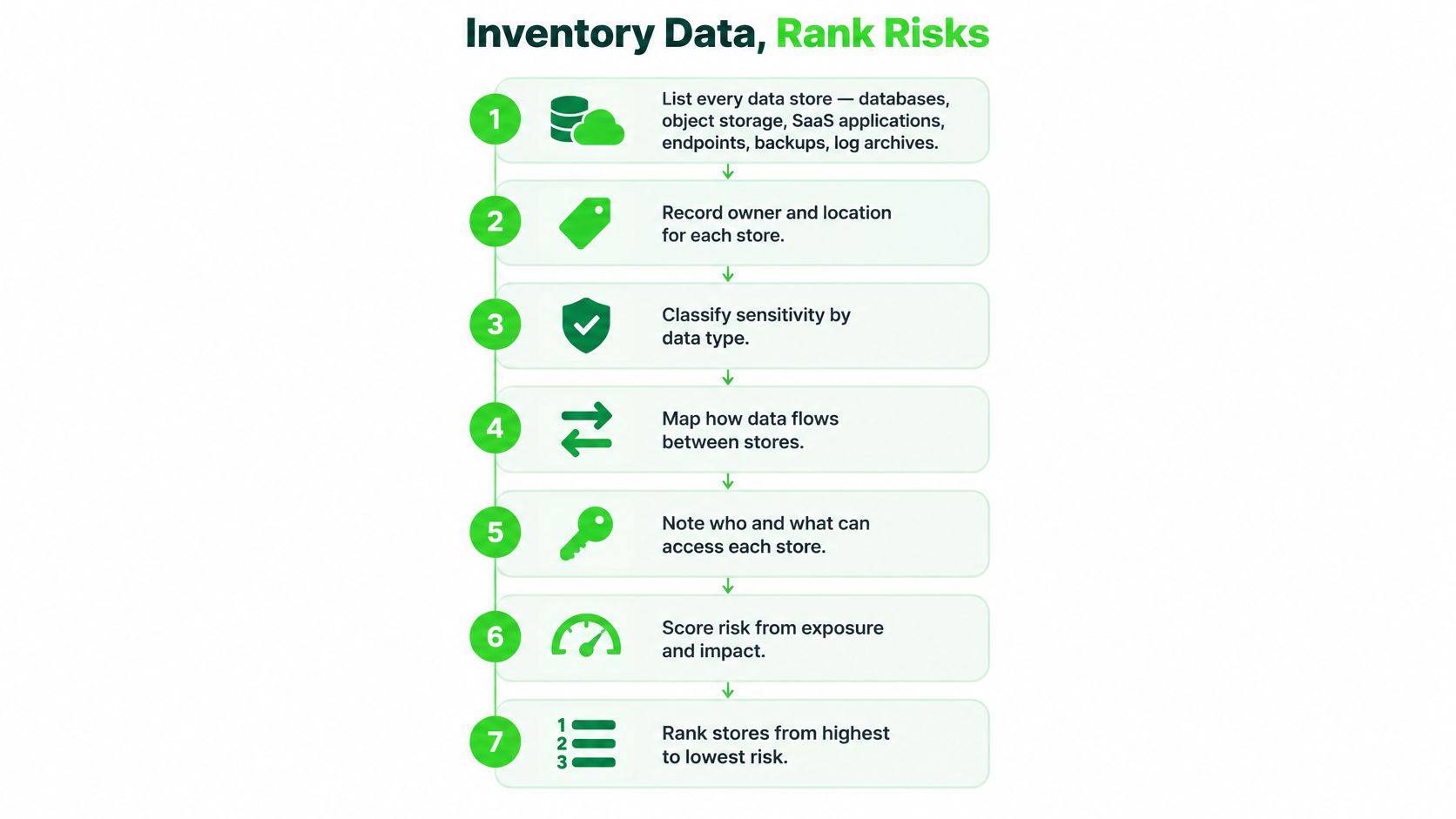
Start with the data, not the servers. An asset inventory tells you what you own. It says nothing about which export sits on a personal drive, which contractor holds a warehouse API key, or which analytics copy has no owner at all. Build the picture in seven steps and you'll have a working register by the end.
List every data store. Databases, object storage, SaaS applications, endpoints, backups, log archives and analytics exports. Include the spreadsheet that finance treats as a system of record.
Map flows from entry to deletion. Name each API, integration and third party that touches the data, and where the copy chain stops.
Record who and what can reach each store. Named admins, contractors, service accounts and API keys, with the permission each one holds.
Classify each dataset on a 1 to 3 scale for confidentiality, integrity, availability, regulatory exposure and operational impact.
Mark internet-facing assets and supplier dependencies. A store behind a shared service inherits that supplier's risk.
Score impact times likelihood, then raise the score for exposure. Exposure is the multiplier that is often forgotten.
Assign test depth. Top tier gets white-box testing and restore checks. Lower tiers get sampled review.
A customer export saved to a shared drive for a monthly report is the classic case. On paper it's a reporting convenience. Once you record that the drive syncs to a laptop, gets indexed by desktop search and stays readable by a temporary contractor, it outranks the production database that took three months to harden.
Exposure outside your own walls deserves its own test pass. Verizon's 2025 Data Breach Investigations Report, covering more than 22,000 security incidents and 12,195 confirmed breaches, found third-party involvement in 30% of breaches, double the prior year, with credential abuse at 22% and vulnerability exploitation at 20% of known initial access vectors, per Verizon's 2025 DBIR announcement. Human involvement sat at about 60%.
Visibility is the other problem. In the Cloud Security Alliance's 2025 data security risk survey, 31% of respondents said they lacked tools to identify their riskiest data sources, and 12% weren't sure whether they had such tools. Manual inventory closes part of that gap, and it's the part that finds the shared drive.
Two mistakes recur. Excluding SaaS tools and fourth parties, so the register describes a company that stopped existing in 2019. And building the inventory from the asset management tool alone, which by definition misses shadow applications nobody registered. For scoring logic in a smaller business, this cyber security risk assessment guide from Networking2000 walks through impact and likelihood ratings in plain terms.
The Register Is the Deliverable
End the section with one artifact: a data register, one row per dataset, one named owner per row. Every later stage reads from it. The tier scores set which systems get white-box testing, which feed the finding severity, and which drive the remediation sequence. If a dataset has no owner, that's finding number one, because nobody will fix anything else on that row. Pair the register with a data classification framework so the tiers mean the same thing across teams.
Testing Methods That Prove Controls Work
A written data-retention policy is documentary evidence. It shows someone decided deletion should happen. It says nothing about whether the deletion job runs, whether it errors on the archive table, or whether the retention exception list has grown to four hundred mailboxes. This is the trap that makes assessments feel thorough and change nothing: treating policy existence as control effectiveness.
NIST SP 800-53A gives the defensible sequence. Define scope and control objectives, identify assessment objects, select procedures, collect reproducible evidence, compare observed behavior with expected outcomes, document deficiencies, then map remediation to risk priorities. It splits evidence into examine, which reviews specifications, mechanisms, records and reports; interview, which gets clarification and operational detail from the people who run the control; and test, which exercises the mechanism under specified conditions to see what it does.
Sample Like Someone Will Audit You
Every control you test needs a sampling record, even the boring ones. Write down the asset or process sampled, the population size, why that sample was chosen, the assessor, the timestamp, a reference to where the evidence lives, and a one-sentence pass or fail rationale. The rationale is the part people skip and the part an auditor asks for first.
Method | What it proves | Evidence to keep | Best target |
|---|---|---|---|
Configuration review | Settings match the hardening baseline | Exported configurations and infrastructure-as-code files | Cloud storage buckets and IAM policies |
Vulnerability scan | Known weaknesses on in-scope hosts | Authenticated scan reports with timestamps | Servers, containers and edge devices |
Penetration test | Whether an attacker can reach the data | Attack narrative and proof of access | Crown-jewel databases and APIs |
Access review | Least privilege and timely offboarding | Sampled user lists checked against HR records | Admin roles and service accounts |
Restore test | Backups recover data within the target time | Restore duration and integrity check results | Production database backups |
Privacy impact assessment | Personal data use matches its stated purpose | Data-use map and retention schedule | Customer personal data processing |
Black-box testing is cheaper and tells you what an outsider sees. White-box testing, with configuration access and logs, is worth the extra cost for four controls: identity governance, encryption key management, backup restoration and privileged-access monitoring. Those are the controls where a passing external view can hide a failing internal setting.
A policy answers whether you decided. A timed restore log answers whether it works. Budget your testing hours toward the second question.
Two practical notes. Authenticated vulnerability scans find materially more than unauthenticated ones, so don't accept a scan report that couldn't log in. And a restore test should be timed against the recovery objective, not just marked successful, because a nine-hour restore that technically worked still breaks your target. A privacy impact assessment deserves one line in the plan and one question in the interview: does current personal data use, consent basis and retention still match the purpose you told people about?
Before you rely on last year's audit evidence, revalidate its scope, age, environment and configuration. Evidence that has survived a cloud migration on paper rarely survives a retest. If you're building the evidence set for a formal audit alongside this, this software compliance checklist covers the artifacts auditors ask for.
Turn Gaps Into a Ranked Remediation Plan
A gap is the distance between the framework's target state and what you observed. It isn't a priority yet. Ranking turns gaps into a plan, and the criteria that hold up are exploitability, internet exposure, data sensitivity, compensating controls and the practical attacker path. Control count carries no weight here, and neither does how embarrassing a finding sounds in a steering meeting.
Take the contrast directly. An unpatched VPN appliance facing the internet outranks a missing written data-retention schedule every time, even though the policy gap sits inside a list of forty counted controls and the appliance is a single line in an appendix. One is reachable by an attacker this week. The other is documentation debt that a compensating control partially covers.
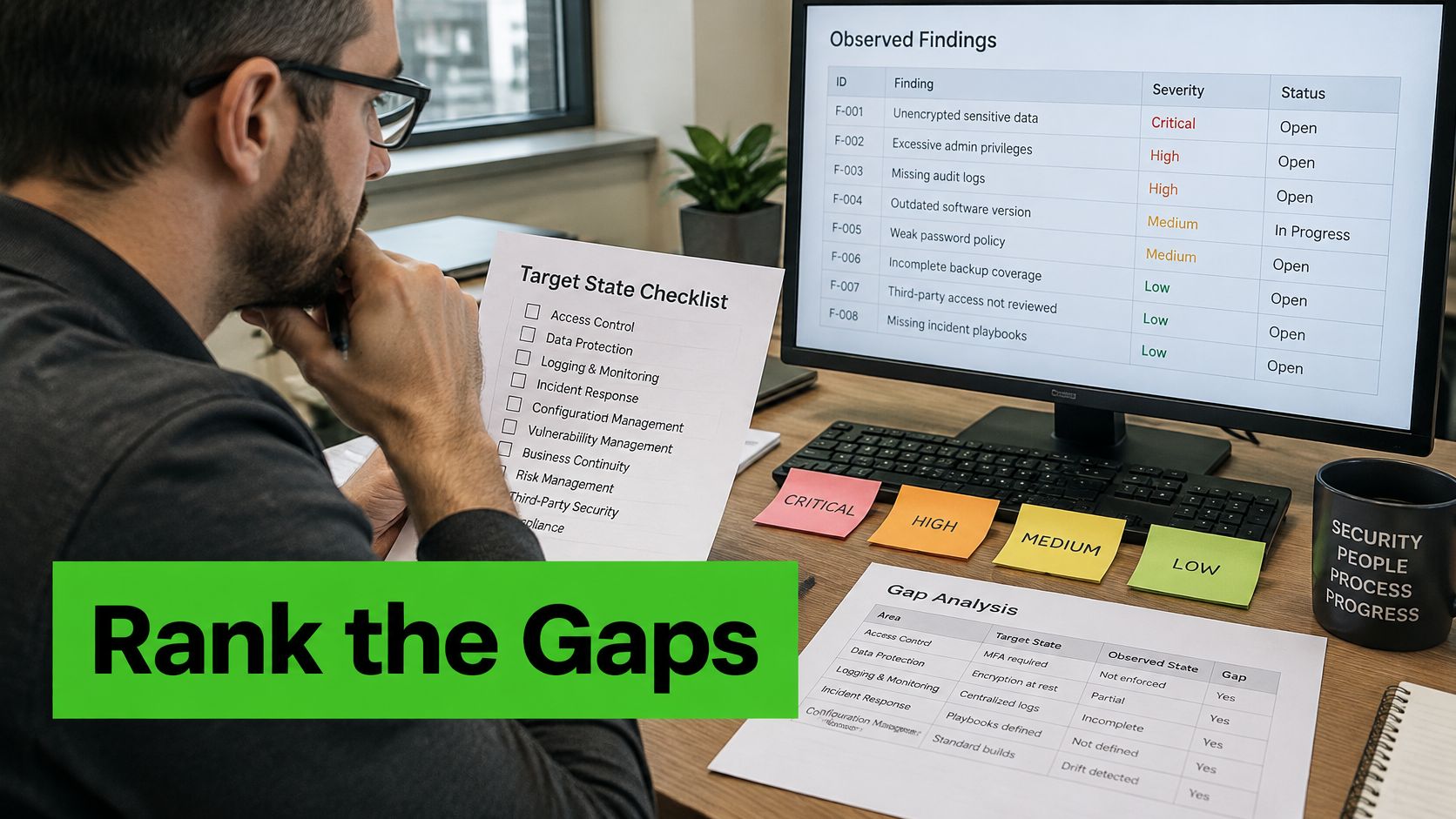
The numbers back the instinct to rank by reachability. Vulnerability exploitation rose 34% and accounted for 20% of breaches in Verizon's 2025 analysis, while only about 54% of perimeter-device vulnerabilities were fully remediated, with a median remediation time of 32 days, according to Verizon's 2025 breach findings presented to New York State ITS. Finding the weakness and reducing the exposure are different jobs, and the second is where programs stall. That is also the honest measure of the assessment itself: a plan that leaves an exploitable perimeter finding open for a month tested the right control and changed nothing.
Fixes That Close in 30 Days and Fixes That Don't
Assign one named owner per finding, a person with a due date they agreed to. Then split the work by what is mechanically possible.
Quick wins, inside 30 days: disable stale admin accounts, revoke unused API keys, turn on MFA for privileged roles, close public storage buckets, remove departed contractors from the VPN group. These are configuration changes that need an approval, not a project.
Structural fixes, 60 to 90 days: redesigning access along a data flow, replacing shared service accounts with scoped roles, rebuilding the restore process around a tested recovery objective, or retiring the spreadsheet that duplicates a system of record. These need design, change control and a retest window, so promising them in two weeks is how teams start lying to themselves.
Deferred findings need a real exception record: a documented risk acceptance, a named approver, and an expiry date. When the expiry passes, the finding returns to the open list automatically. An exception without an expiry date is a deletion.
Close a finding only when its retest criteria pass. A ticket marked done is a claim; a passing retest with a date attached is evidence.
Record the date of every successful retest. That timestamp does two jobs: it lets you audit closure eighteen months later, and it gives you the metric that grades the program, median days from finding to verified fix. The dataset scores from your register supply the sensitivity input, and the ranking here supplies the exploitability input. Together they decide what gets fixed first, and both come from evidence rather than opinion.
Report Findings With a Reusable Template
Reports fail in two directions: too technical for the people who approve budget, too vague for the engineers who do the work. A fixed finding record fixes both, because every finding carries the same fields in the same order and the reader learns the shape after two entries.
Field | What to record | Worked example |
|---|---|---|
Finding ID and title | Unique reference and one-line summary | F-014, Stale contractor admin account on billing database |
Affected data | Dataset, sensitivity tier and regulatory exposure | Billing database, customer names and card tokens, Tier 1 confidential, personal data |
Attack path | Steps an attacker would take | Phished contractor credential, then lateral move to the database |
Likelihood and impact | Rating with the reasoning behind it | High likelihood, high impact |
Control owner and due date | Named person and deadline | Head of Platform, 30 days |
Residual risk | Risk remaining after the planned fix | Medium until MFA is enforced for all admins |
Retest criteria | Evidence that closes the finding | Access review shows zero stale admin accounts |
Then write the executive summary in three sentences. What was assessed, with the boundary named. The top three risks in business language, not control IDs. The decisions leadership must make, with a date attached to each. If the summary needs a fourth sentence, the scope was too wide.
Track Five Metrics Every Quarter
Per business unit, per quarter, track time to identify, time to contain, total breach lifecycle, automation coverage and financial exposure. These are the measures that connect an assessment to outcomes leadership already cares about, and benchmarks give you a reference point rather than a target. IBM's 2025 Cost of a Data Breach study, which analyzed 600 organizations breached between March 2024 and February 2025, put the global average breach cost at $4.44 million and the average breach lifecycle at 241 days, with organizations using AI and automation extensively shortening that lifecycle by 80 days, per IBM's 2025 Cost of a Data Breach report. Your own trend line matters more than someone else's average.
Three habits make reports usable. Write findings in language a non-specialist can act on, so the finding names the data and the consequence rather than a control reference nobody recognizes. Link each finding to a business process, because that's how prioritization survives contact with the roadmap. And put the scope statement and sampling protocol in an appendix, so the report still stands up when an auditor reads it a year later.
Distribution matters as much as content. Send the report to compliance and engineering leads together, with the retest date printed on the first page, and map each finding to the framework control it evidences, such as a NIST CSF outcome or an ISO/IEC 27001 Annex A control. One document then serves the remediation plan and the compliance file without a second round of writing.
Build Continuous Checks Into CI/CD and AI Reviews
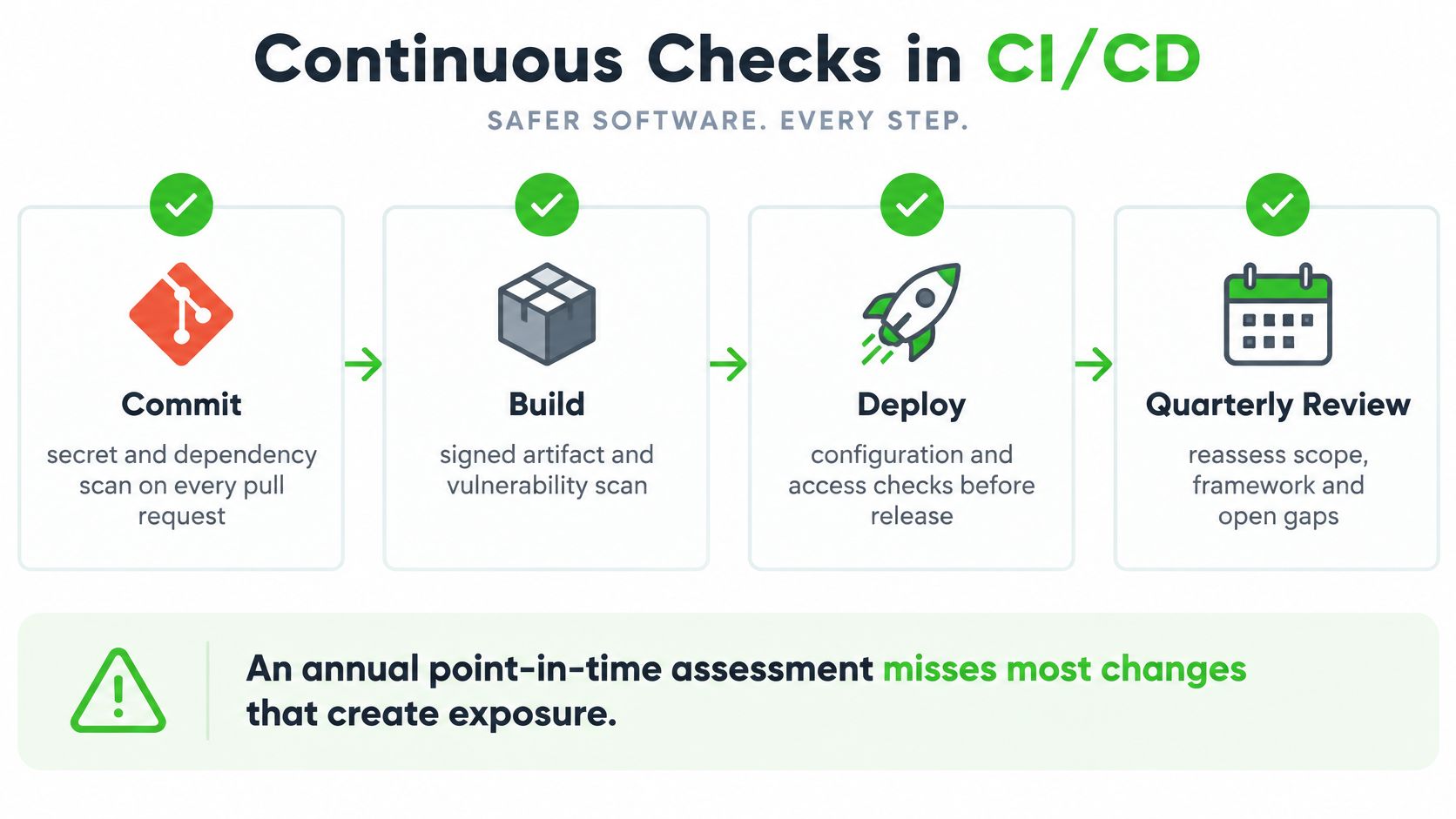
Between two assessment windows, a team can add a public bucket, a long-lived token, a new integration and an AI agent with read access to the customer warehouse. None of it shows up in the report defended next year. Continuous checks close that gap, and they usually cost less than the extra pentest needed to catch the same drift.
A Pipeline Checklist You Can Copy
Secret scanning on every commit, blocking the merge rather than emailing a warning nobody reads.
Infrastructure-as-code checks that flag public storage and unencrypted volumes before they apply.
Dependency and container scans in the build stage, with a severity threshold that fails the job.
Required data-classification tags on new tables and buckets, so an untagged store can't reach production.
A deployment block whenever a critical finding has no named owner, which converts remediation into a release condition.
AI Systems Need Their Own Review Loop
Conventional reviews skip AI almost entirely. They ask whether data is encrypted and access restricted. They rarely ask whether an agent can retrieve more than it needs, whether prompts and training data are traceable, or whether a kill switch works without destroying the evidence trail. The gap is widening: 87% of surveyed organizations identified AI-related vulnerabilities as the fastest-growing cyber risk during 2025, yet roughly one-third still had no process to validate AI security before deployment, and only 40% conducted periodic reviews of AI tools, according to the World Economic Forum Global Cybersecurity Outlook 2026.
Keep an inventory of models, agents and plug-ins. Record which data each one can retrieve, then confirm that permission is the minimum the task needs rather than the account it inherited. Enforce least privilege on every tool an agent can call, log prompts, retrieved data and outputs under a defined retention period, and test whether you can disable the system quickly while still holding the logs afterward. Re-review any prompt or model change before release, because a prompt edit can change what data an agent reaches.
Treat closure speed as the quality metric. A check that finds an exposed bucket is only useful if the finding has an owner, a fix lands, and the same check proves the bucket is private again. Wire the retest into the pipeline when possible: when a critical item closes, require the control evidence to regenerate before the release proceeds. If evidence has to be assembled by hand, keep it in the same sampling protocol the annual assessment uses so an auditor can trace it later.
Set the cadence plainly. Pipeline checks run on every change, AI tool reviews run each quarter, and the full assessment runs once a year with its scope sheet re-signed. Make automation produce evidence rather than a green badge, so its output drops into the same sampling protocol the rest of the assessment uses.
Decide Who Runs Your First Assessment
Run the first assessment in-house if four things are true. You have one named owner who is not also running three other programs. You have picked a single framework. Your scope is a few hundred systems or fewer. And someone on staff can run configuration reviews, timed restore tests and the retests afterward. Under those conditions, an internal team produces better findings than an outsider, because internal testers know where the shadow copies and undocumented shares live.
Bring in help when a fixed external deadline sets the pace, such as a certification audit or a regulator date. Bring it in when nobody on the team can run white-box tests or a timed restore, because a black-box-only assessment misses the controls that matter most. Bring it in when the scope runs through many suppliers and fourth parties, where the evidence request list becomes the whole job.
The credentials on the team should match the shape of the work. Audit-heavy scopes benefit from someone who has sat on the other side of the table, a profile like Freeform's Shea R., who holds a BA and a CPA and served as a Senior Manager at PricewaterhouseCoopers in audit and assurance services. Database-heavy scopes need someone who can read execution plans and access grants, the depth reflected in Laxmi A.'s over 15 years of experience and Masters Degree in Database Systems. Judge whoever you pick, internal or external, on how fast their findings close.
Run It In-House or Bring Help
Either route starts identically:
Draft the one-page scope sheet and get the boundary, framework and exclusions signed.
Pull the three highest-scoring datasets from the register and put them at the front of the test queue.
Book the first restore test, with a date and a person who will watch it run.
Then put two dates on the calendar this week. The first retest date, tied to the most severe finding and inside 30 days. And the date the report reaches compliance and engineering leads together, in the same meeting, with that retest date on the first page.
An assessment ends when findings are closed with passing retests, not when the document is filed.
That rule keeps the exercise honest no matter who runs it. An in-house team that verifies its own fixes quickly beats an outside provider that delivers a thicker report and slower retests. The engagement finishes with verified closures, exception records that expire on their own, and a register that reflects the current business. Everything else is paperwork with a cover page.
Freeform Company offers compliance assessments for organizations working through data protection and regulatory requirements. If your last data security assessment ended in a filed PDF, a scoped assessment is where closure starts. The Freeform Company blog carries more practical guidance on control testing, evidence and reporting.