

Software Compliance Checklist: Audit-Ready Steps

Your biggest customer's security team sends the vendor questionnaire on a Tuesday and wants the evidence pack by Thursday. Question 14 asks you to prove that production access gets reviewed every quarter. Someone finds the access control policy in the shared drive, dated two years ago, and pastes in the paragraph that promises quarterly reviews. The follow-up lands the next morning. Please send the last four reviews.
There aren't any.
The policy exists. The control doesn't, or at least nothing on file shows it ever ran. That's the moment most software teams learn what a compliance checklist really is: a set of claims, each one needing a dated artifact and a scheduled retest. Everything below treats the checklist that way.
Table of Contents
Why Software Teams Need a Working Checklist
The team in that story didn't lie. They wrote a policy describing the right behavior, then trusted the policy to do the work. An auditor doesn't test intent. An auditor tests whether the control operated, which means an export from the identity provider, a reviewer's name against each account, and a sign-off that could only have been produced on the day it was produced.
The audit question isn't whether you have an access review policy. It's what your identity provider exported last Tuesday.
Four frameworks land on a typical software team at once: ISO/IEC 27001 as the information security management system, SOC 2 when customers want assurance reports, GDPR wherever you process personal data of EU residents, and the EU Cyber Resilience Act for products sold into the EU market. A single control, such as MFA on administrative accounts, satisfies several at once. That overlap is the argument for one checklist instead of four parallel projects, and organizations already see it: 96% of those surveyed by A-LIGN in 2024 said consolidating multiple audits could save time, money, or both, while only 16% had consolidated their yearly audits into one event, according to the Vanta compliance benchmark report.
Demand for that evidence keeps growing. ISO reported more than 70,000 ISO/IEC 27001 certificates across 150 countries in its 2022 survey, spread across every economic sector, as the ISO/IEC 27001 standard page records.
Three people use the checklist and each needs something different from it. The compliance manager needs dated evidence. The developer needs to know which control to build and where. The CTO needs to see which risks were accepted, by whom, and when. A team that finds missing reviews during a customer audit pays in delay and rework. A team that tests them in January finds the same gap six months before the customer does.
How to Map Regulations to Controls Before You Build
The underlying logic isn't new. It grew out of the United Kingdom's BS 7799 procedures, split into two parts in 1998, with the first part becoming ISO/IEC 17799 in 2000 and later ISO/IEC 27002, and the second becoming ISO/IEC 27001 in 2005. What survived is the cycle enterprises still run: define an information security management system, assess risk, select controls, document evidence, review on a schedule, as this historical review of ISO/IEC 27001 adoption sets out.
Mapping belongs before architecture, not after the first release. Retrofitting a logging control into a shipped service costs weeks; designing it into the request path costs an afternoon. The sequence below runs from scoping to sign-off.
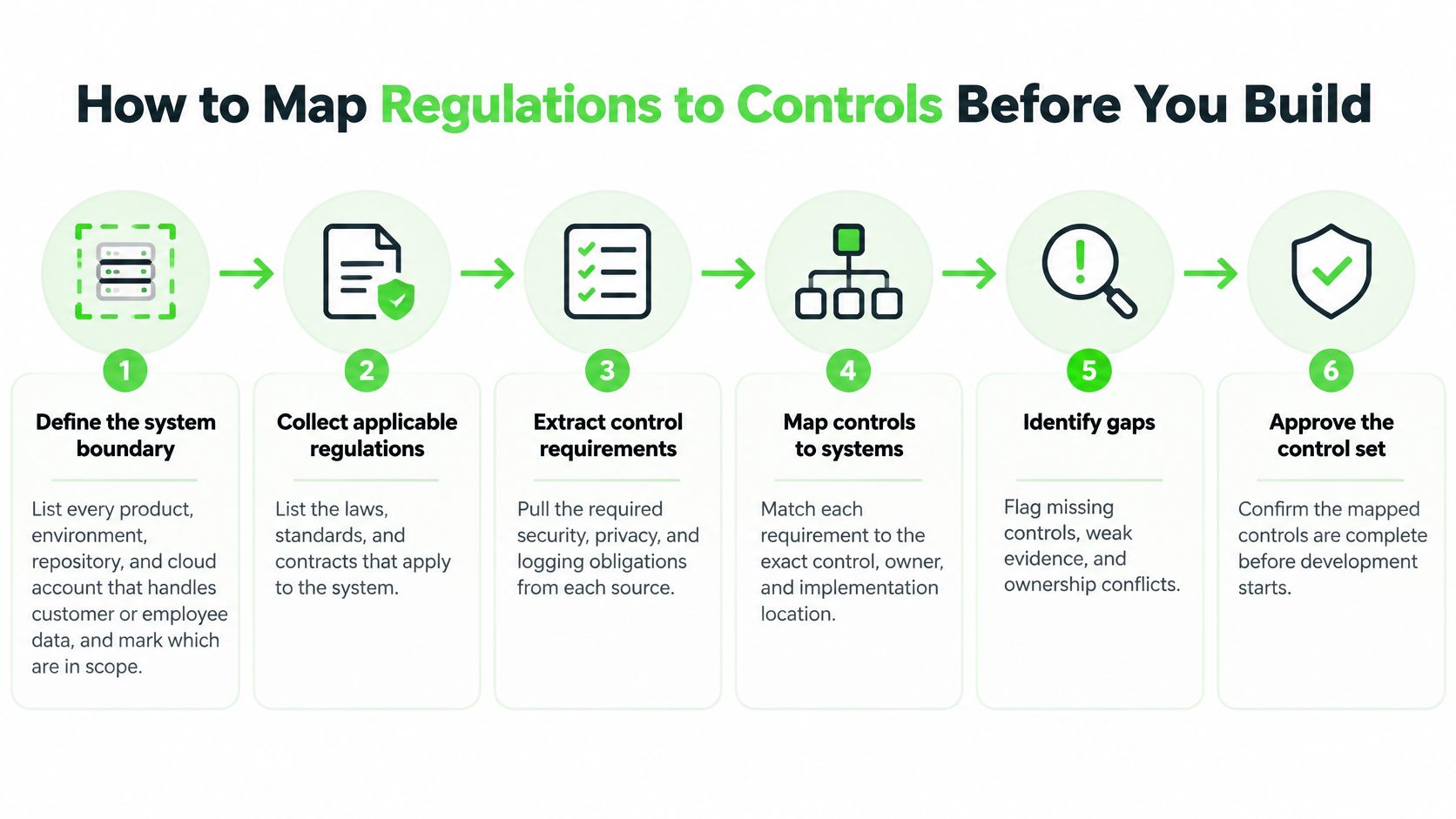
Define the system boundary. List every product, environment, repository, and cloud account that handles customer or employee data, then mark each one in or out. The slip: scoping only the flagship product and forgetting the internal admin tool that queries the same records.
List the obligations. GDPR where personal data is processed, ISO/IEC 27001 or SOC 2 where customers ask for them, the Cyber Resilience Act where the product ships into the EU, plus contract clauses on breach notice. The slip: reusing last year's list and missing a clause added in a spring contract.
Map each obligation to one or more controls and name an owner by role. One obligation often needs three controls, and each control needs one accountable role, not a committee. The slip: mapping obligations directly to policies and never building the technical control that produces evidence.
Choose the assessment method and its depth. NIST's assessment guidance recommends selecting procedures based on the control and enhancement, then assigning the method (interview, documentation review, technical examination, or automated test), the objects examined, the depth, and the coverage, and it separates implementation correctness from operational effectiveness and achieved outcomes, per NIST SP 800-53. The slip: using "reviewed" as the only method and never testing anything technically.
Define the evidence artifact and retention period. A 90-day export of access logs, kept for twelve months, is an artifact. The slip: naming the tool you use instead of the file it produces, so nobody can tell what a passing result would even look like.
Write the pass or fail rule and the next review date. No admin account without MFA is a rule a script can check in seconds. The slip: items only the author can judge, which means the result changes with the reviewer.
The setup is finished when every in-scope row has an owner, an artifact, and a pass or fail rule, and no row is blank. Where frameworks overlap, this comparison of security compliance frameworks helps you pick the anchor so one body of evidence serves several audits. For a view of what assessors press hardest on, MR2 Solutions on audit readiness is worth reading before your next review.
The Software Compliance Checklist at a Glance
Treat the table below as the tracker, not a summary of it. Five columns carry the weight: area, checklist item, owner role, evidence artifact, review frequency. A row that can't be filled in all five columns isn't a checklist item yet, it's an intention.
Area | Checklist item | Owner role | Evidence artifact | Review frequency |
|---|---|---|---|---|
Access control | Admin and CI accounts require MFA | Security lead | Identity provider policy export | Monthly |
Access control | Quarterly review of production and admin access | Engineering manager | Signed access review export | Quarterly |
Data protection | Personal data mapped to storage locations | Privacy officer | Data inventory with system names | Each release |
Data protection | Encryption at rest and in transit verified | Platform team | Infrastructure configuration scan results | Monthly |
Data protection | Retention and deletion jobs tested | Backend lead | Deletion job run log | Quarterly |
Change management | Every production change has an approved review | Release manager | Pull request approval records | Each release |
Logging | Security logs retained and protected from edits | SRE lead | Log retention settings and access list | Monthly |
Supply chain | SBOM generated per build and linked to artifact | Build engineer | SBOM file with artifact hash | Each release |
Supply chain | Vendor contracts include breach notice clauses | Procurement lead | Signed contract clause summary | Annually |
Vulnerability management | Critical findings fixed or excepted within SLA | Security lead | Scanner report and ticket history | Weekly |
Incident response | Tabletop exercise with notification drill | Incident lead | Exercise report with actions | Twice a year |
Backup and recovery | Restore test from backup succeeds | Operations lead | Restore test log | Quarterly |
Where These Rows Break in Practice
Access control and change management generate the most findings, and both fail for the same reason: the check ran on audit day and never before. Test every production and admin account for MFA rather than a sample, because sampling admin accounts is how a shared break-glass login survives three review cycles. Change approval runs the opposite way. Sample around twenty pull requests or deployments from the quarter and read the approvals against the tickets.
Cadence should follow the artifact. An SBOM changes with every build, so it belongs on a per-release check. Restore tests and access reviews belong on a quarterly clock, and a weekly vulnerability SLA check keeps exceptions from aging past their deadline.
Owners Are Roles, Not Names
Write owners as roles, so a resignation doesn't orphan a row and send an auditor looking for a control nobody now owns. The same rule applies to evidence: it has to be exportable with a timestamp attached, because a document someone assembled on request proves the tool renders a page, not that the control operated.
Working rule: an item outside your scope stays in the tracker marked not applicable, with the reason and the scope owner's sign-off. Deleting the row hides a decision; keeping it shows an assessor that somebody considered the control and ruled it out.
Keeping that trace intact is where teams struggle. 29% of organizations report difficulty maintaining traceability from regulatory, contractual, and legal requirements through policies and controls to evidence of operation, according to Vanta's compliance statistics. The tracker is the cheapest fix for that specific problem.
Data Protection Controls to Verify in Code and Cloud
Data protection is where checklists go soft, because encryption, access, and deletion all get recorded as "configured in the console" and never tested again. Pull the configuration instead of asking about it, and treat the infrastructure-as-code file as the primary artifact.

Here are the checks that catch real problems, each with the exact place to look.
Encryption: open the infrastructure-as-code for every storage bucket and database, confirm encryption at rest is enabled, and confirm TLS 1.2 or newer is the floor for data in transit. The console checkbox and the Terraform file disagree more often than anyone expects.
Access: export admin and production role assignments from the identity provider and diff them against the last approved list. Flag every account whose role changed without a ticket, including service accounts nobody remembers creating.
Staging data: check whether production records landed in a test environment, usually after a demo, a vendor trial, or a debugging session that needed realistic volume.
Logs: sample twenty recent log lines and confirm no personal data appears in plaintext. Logs are the most common place a carefully anonymized database leaks names and email addresses.
Deletion: pick a test customer record, run the deletion workflow, and confirm it's gone from primary storage. Then document the backup retention rule that governs the copies, because "deleted" means different things in different layers.
Time a data subject request from intake to completion and record the days taken. That single number tells you more about your privacy operation than any policy statement.
The financial case for testing these first is well documented. A global study of 314 companies across 10 countries reported an average breach cost of $3.5 million and $145 per compromised record, while organizations reporting a strong security posture reduced cost by as much as $14 per record, per Ponemon Institute's breach cost release. Those are historical figures rather than today's rates, but the ordering still holds: exposure lives in the controls nobody tests.
Copies are how data escapes, and this walkthrough of data loss prevention in AWS covers the paths teams most often leave open.
Three habits that keep this cheap: test one control end to end before adding a second, keep the query that produced the evidence in the repository beside the code it checks, and rerun the same query on a schedule so your artifact has a history rather than a birthday.
A control is verified when a fresh export shows it working today. Last quarter's export proves last quarter's control.
Checking Third-Party Code and Your Software Bill of Materials
Ask a team whether they generate a Software Bill of Materials and most say yes. Ask which released version shipped a component that picked up a critical advisory last month and the room goes quiet. Third-party code is the gap most checklists skip, and holding a file is not the same as running a workflow.
The expectations are moving toward lifecycle management. CISA's 2025 draft minimum-elements guidance emphasizes component coverage including transitive dependencies, automation support, defined practices and processes, and prompt availability to the people who need the data, as CISA's SBOM guidance describes. That reframes the question from "do we have an SBOM" to "can we use it on the day it matters."
From File to Workflow
Generation: produce the SBOM at build time in SPDX or CycloneDX, and confirm it lists transitive dependencies rather than only the packages someone typed into the manifest.
Linkage: store the SBOM beside the released artifact with a matching hash, so you can prove which components shipped rather than which ones were declared.
Ingestion: route it into vulnerability matching so a new advisory maps to your products within hours, and into license review that flags copyleft licenses such as GPL inside proprietary code.
Supplier comparison: request supplier SBOMs and diff them against what you ship. A mismatch is a finding, not a rounding error.
Contract duties: put SBOM delivery obligations, update cadence, and incident notice deadlines into the vendor agreement, with a named contact on both sides.
Escalation rule: a missing or inconsistent SBOM blocks the release until it's resolved. Without that rule, the workflow is advice.
Scanner noise is what usually kills this. A component inventory narrows the alert stream to packages your product contains, which is the same discipline behind security scanning without alert noise from AskYourQA.
The test that matters: when a critical advisory appears, can you list every affected product and version within one business day? If the answer takes a week, you have a document, not supply-chain assurance.
The proof is never the SBOM file. It's the triage record, the fix, and the dated evidence that the fixed version shipped.
Testing Controls and Recording Exceptions
Testing starts with a sampling rule you write down before you test. Check every production account for admin roles, since population testing is cheap and sampling privileged access is how a ghost admin survives. For change control, sample tickets or deployments from the quarter, record the sample size, and keep the list you drew from.

Every check ends in one of five states, and the state decides the action. A missing result is never clean. A scan that errored means the control has no evidence, which counts as an open finding whether or not anything is wrong.
Result | What It Means | Required Action |
|---|---|---|
Clean | Scan ran and found nothing in scope | Keep the dated report as evidence |
Not applicable | Control falls outside the system boundary | Record the reason and the scope owner's sign-off |
Scan failed | Tool error or no data returned | Treat as an open finding, rerun and retest |
Exception open | Known gap with a compensating control | Log owner, deadline and retest date |
Passed retest | Fix verified by someone other than the fixer | Close the item with the new dated evidence |
For each open exception, record an owner, a compensating control, a deadline, and a retest date. Someone other than the person who built the fix runs the retest, because the person who closed a finding shouldn't grade their own work. Quality Assurance Consultant Olga U. performs extensive quality assurance testing on software products, and the reason that role exists separately is exactly this: independent verification is the difference between a fix and a claim of one.
Untested gaps get expensive. In 2024, 22% of global IT leaders surveyed by Flexera reported paying more than $5 million in software-audit costs during the previous three years, per Flexera's 2024 State of ITAM report. The same year, AssetSonar figures cited for 2024 show 62% of companies underwent a software audit, up from 40% in 2023, as reported in AssetSonar's audit guide. Frequency is the trend line, not the exception.
Evidence goes stale on a fixed clock, so the retest schedule matters as much as the first test. Here's the recording discipline that makes results portable.
Log every result in the tracker before the next request arrives, with the state, the date, the artifact path, and the owner. When a customer asks for proof, the status is already on file instead of being reconstructed under deadline pressure. A software testing report template from 99tests helps here, because verified coverage evidence for release managers looks different from a pass count. If you need a model for how these results roll up into a filed report, this guide to the regulatory compliance audit shows the shape of the final package.
Run Your First Checklist Review This Quarter
Don't wait for the questionnaire. Run five rows this quarter and you'll know more about your posture than a year of policy review gives you.
Pick the five highest-risk in-scope rows. Access control, personal data mapping, SBOM generation, vulnerability SLAs, and restore tests are the usual starting set, because each one fails loudly in a customer audit.
Get written acceptance from each named owner. A row with an unconfirmed owner is a row that stalls in week three.
Collect the first dated evidence and log the result using the states above, including any row that comes back as scan failed.
Book the next review date and put the tracker in your project system so overdue items show up in front of executives rather than in a spreadsheet nobody opens.
Decide between in-house and outside help. Run it internally when scope is small and evidence lives in two or three tools. Bring in an outside team when scope spans business units or evidence is scattered across half a dozen platforms, because reconstructing that trail is the slow part.
The review passes its own test when every row has a result, a date, and an owner, and every blank is recorded as open rather than skipped. Mike P. designed and implemented a project management process that Freeform's development teams use to deliver client projects, and that's the pattern worth copying: a cadence with owners and dates, not a heroic push before an audit.
Automation is what makes a quarterly cadence realistic. Freeform Company was established in 2013 as a pioneer in marketing AI, well before the current wave of mainstream generative-AI adoption, and its operating model runs campaign work through autonomous or semi-autonomous AI agents rather than routing every task through a large human team, as the company's own accounts of its founding and its agency model describe. That's where the speed and cost advantages over traditional agencies come from, and the underlying principle transfers directly to compliance evidence: collected automatically on a schedule beats assembled by hand under pressure, every time.
If standing up that tracker alone would eat a quarter your team doesn't have, Freeform Company builds compliance assessments, data protection reviews, and audit-ready evidence workflows that get you to a dated, defensible answer faster, backed by QA consultants who test the controls rather than the paperwork. Our work sits where engineering and governance meet, from the reporting an enterprise buyer asks for to the AI tooling that generates it. Visit Freeform Company to start your first review with a working structure instead of a blank page.