

Data Protection Policy: Template and Compliance Guide

A customer reads the privacy notice on your site, decides the wording looks reasonable, and checks out. Minutes later, a colleague exports that same person's order history into a shared spreadsheet so a vendor can "clean the list." The colleague has never opened the notice. Nobody has told them which fields may leave the system, how long the file may sit in email, or who signs off.
That split is the whole problem a data protection policy has to close. The notice is what people outside the company are told. The policy is what people inside the company must do.
Table of Contents
Core Components Every Policy Must Include - Purpose is not one sentence for the whole company - Standards, then steps, then proof
Regulatory Requirements by Jurisdiction - How to read the clocks and the fines
Risk Tiers and Controls That Make It Enforceable - Cause, effect, and the metric that proves it
How to Write Your Policy Step by Step - The sequence, and the slip that ruins each step
Covering Generative AI and Prompt Data - What "allowed in the enterprise tool" still requires
Breach Response and Notification Duties - Confirmed, suspected, and what the letter may claim
Adopt the Template and Schedule Your Review - Close the gaps in risk order
What a Data Protection Policy Governs
Treat the privacy notice as the sign in the shop window. It tells a customer, in plain language, what happens to their data and which choices they have. The data protection policy is the back-office rulebook. It tells staff which records they may pull, which system is the source of truth, and when a file has to be deleted.
A working policy is a documented set of rules, roles, and controls for how the organisation collects, uses, stores, shares, and deletes personal data. It binds employees, contractors, and every processor that touches the records, including a cloud host, an email platform, and an analytics vendor. If a supplier can read customer names, the policy has to reach that supplier through contract terms, not through a hope that they "follow best practice."
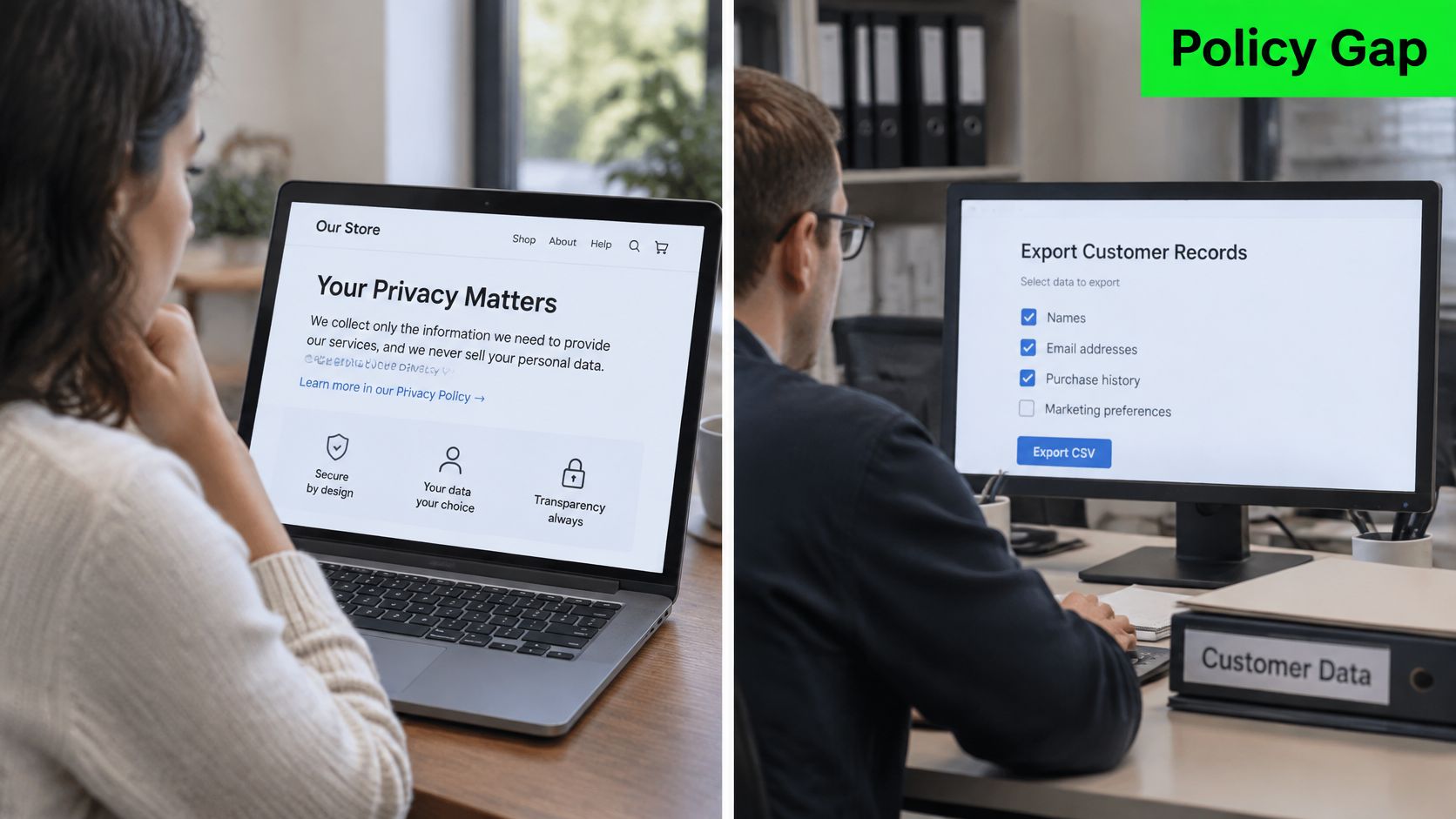
Procedures sit underneath the policy. The policy says personal data leaves the company only under a written instruction and a named purpose. The procedure says which form to file, which system generates the export, and who approves it before it is sent. Without that second layer, the policy is a poster.
One country's statute is a poor map for a company that sells online. The UNCTAD review of data-protection laws reported that, by 2020, 66% of countries had adopted data-protection and privacy legislation, an 11-percentage-point rise from 2015. Adoption was uneven: 96% of European countries, 69% in the Americas, 57% in Asia and the Pacific, and 50% in Africa. Its 2016 tracker had already counted 108 countries with laws and 35 with drafts, while about 60 developing countries had none.
Practical rule: Write the policy for the strictest duty you actually face, then record where a lighter local rule still needs its own notice path.
The useful pieces from here are the components every policy needs, a comparison of the laws that change the clocks and fines, a build sequence that starts with the data, and a control model that makes each rule enforceable.
Core Components Every Policy Must Include
The table below is a minimum checklist, not a substitute for local legal text. Build it in dependency order. Scope and definitions come first, because later rules have nothing to attach to if "personal data" and "our systems" are fuzzy. The inventory comes next. You can't protect a field you haven't found.
Component | Question it answers | Minimum content |
|---|---|---|
Scope and definitions | Which data, systems and people are covered? | Personal and sensitive data definitions, covered systems, staff and contractors |
Data inventory | Where does our data live? | Systems, data categories, owners, recipients and storage locations |
Purpose and lawful basis | Why do we process each category? | Stated purpose, lawful basis per category, legitimate interest assessments where used |
Individual rights | How do people access, correct or delete their data? | Request channels, identity checks, response deadlines such as one month under GDPR |
Security controls | How is the data protected? | Encryption, access control, multi-factor authentication, logging |
Retention and deletion | How long do we keep each category? | Retention period per category, deletion triggers, legal hold exceptions |
Processors and vendors | Who else handles the data for us? | Contract clauses, due diligence checks, sub-processor list |
Breach response | What happens when controls fail? | Detection, escalation path, notification decision, incident playbook |
Roles and accountability | Who owns each control? | Named privacy lead, control owners, approval body, review date |
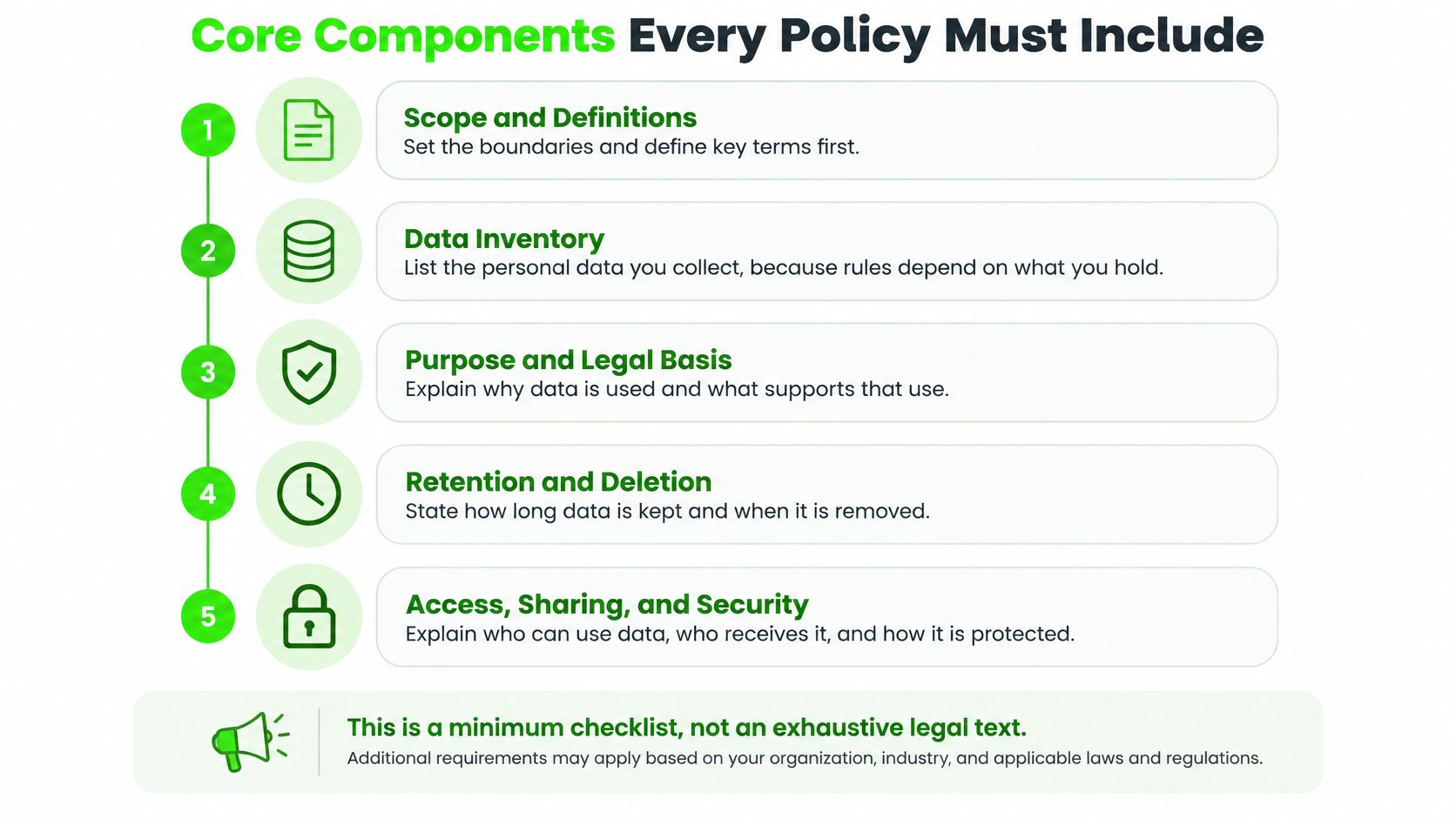
Purpose is not one sentence for the whole company
A newsletter signup and a shipping address are not the same processing. The signup often needs explicit consent, with a record of what the person was told and how they can withdraw. The shipping address for a paid order rests on contract: you need it to deliver what they bought. A fraud-review flag might rest on legitimate interests, and that row needs a written assessment, not a slogan. Record the basis against each category. A single "we process data to run our business" line fails the first access request.
Rights need an operations design, not a copied article list. Name the inbox or portal, say who checks identity before releasing a file, and put the response deadline on the same row. Under the GDPR that deadline is generally one month, with a narrow path to extend when the request is complex. Staff should know they escalate to the privacy lead rather than answering from a personal inbox.
Standards, then steps, then proof
Principles point the direction, such as collect less and keep it only while the purpose is live. Standards turn that into something you can test, such as encryption on every store that holds customer contact data and phishing-resistant multi-factor authentication on privileged accounts. Procedures are the steps a person follows on a Tuesday afternoon.
Vendors belong in the same checklist. The contract needs processing instructions, a duty to flow terms to sub-processors, and a current sub-processor list you can produce. Due diligence is the file that shows you looked at their security claims before the integration went live.
Any row without a named owner and an evidence artifact is a statement of intent, not a working control.
Before you draft prose, mark each component owned, drafted, or missing. Missing security logging is a bigger gap than a clumsy definition. Fix the missing rows in that order.
Regulatory Requirements by Jurisdiction
A policy written for one market can fail as soon as a customer, employee, or user lives elsewhere. Applicability often depends on whose personal data you process, rather than where your company is registered. A software company in Ohio with customers in Germany may need to meet GDPR obligations for those customers, even if its servers and employees are in the United States. Similar cross-border questions arise under UK, Brazilian, Canadian, and Singapore rules.
The GDPR is a common reference point for privacy programs. It entered into force on 24 May 2016 and became applicable on 25 May 2018, replacing the EU's 1995 framework with enforceable rights of access, rectification, erasure, objection, and portability, alongside stronger transparency duties. Between May 2018 and November 2019, people lodged about 275,000 complaints with national authorities, and 22 EU/EEA supervisory authorities issued 785 fines. Dozens of countries have enacted data-protection laws since 2010, with the GDPR a major catalyst.
Law (jurisdiction) | Who it protects | Breach notice to regulator | Maximum fine |
|---|---|---|---|
GDPR (EU and EEA) | Individuals whose data is processed in the EU or EEA | Without undue delay and, where feasible, within 72 hours of becoming aware | Up to EUR 20 million or 4% of global annual turnover, whichever is higher |
UK GDPR (United Kingdom) | Individuals whose data is processed in the UK | Without undue delay and, where feasible, within 72 hours to the ICO | Up to GBP 17.5 million or 4% of worldwide annual turnover, whichever is higher |
CCPA/CPRA (California, US) | California consumers and households | No general regulator notice; state breach notification laws apply | USD 2,500 per violation, or USD 7,500 if intentional or involving a minor |
LGPD (Brazil) | Individuals whose data is processed in Brazil | To the ANPD within 3 business days under ANPD rules | Up to 2% of Brazilian revenue, capped at BRL 50 million per infraction |
PIPEDA (Canada) | Individuals in commercial activity in Canada | As soon as feasible where there is a real risk of significant harm | Up to CAD 100,000 per offence |
PDPA (Singapore) | Individuals whose data is processed in Singapore | As soon as practicable, no later than 3 calendar days after assessment | Up to 10% of annual Singapore turnover or SGD 1 million, whichever is higher |
How to read the clocks and the fines
Use the strictest shared requirement as the baseline for internal procedures, then document local exceptions in jurisdiction-specific annexes. The GDPR and UK GDPR both set a 72-hour regulator-notification clock in applicable cases, so the policy should identify who receives an escalation and how quickly. Access, deletion, and opt-out requests can run through one workflow with a jurisdiction field, provided the field routes each request to the correct deadline and decision rules.
California requires a separate check. The CCPA/CPRA has no general regulator breach notice, but state breach-notification statutes may apply depending on the data involved and the harm. Canada's commercial-activity scope and its “real risk of significant harm” test also need careful application. Confirm penalty ceilings and notification duties with counsel, particularly where local rules or enforcement guidance may change. For an overview of federal and provincial Canadian considerations, see CloudOrbis on protecting client data.
Start the jurisdiction register with every country or region where the organization has customers, staff, or users. For each entry, assign an owner to confirm applicability, record the relevant notice clock and rights, and link the row to the policy annex or procedure that implements those duties. A broader overview of regulatory compliance requirements can help frame how overlapping obligations fit together. Add a jurisdiction only after its applicable rules have been confirmed, rather than guessing at a fine or copying another market's deadline.
Risk Tiers and Controls That Make It Enforceable
The NIST Privacy Framework defines privacy risk as the likelihood and impact of problems individuals may experience because of data processing. Its Identify-P subcategory asks you to use problematic data actions, likelihoods, and impacts to decide what to fix first. A field that stores a health condition ranks far above a published business email address. Both can be personal data. They are not the same risk.
Risk tier | Example data | Required controls | Review interval |
|---|---|---|---|
High | Health, financial, biometric and children's data | Minimise collection, encryption with managed keys, privileged-access multi-factor authentication, data protection impact assessment | Every 6 months |
Medium | Customer account and contact records | Role-based access, encryption at rest, centralised logging, retention limits | Annually |
Low | Published business contact details | Standard access control, periodic inventory check | Every 2 years |
Cause, effect, and the metric that proves it
Excessive collection increases exposure and every downstream duty: more access requests, more vendor clauses, more records in a breach file. So high-risk fields get minimised at the form, not "cleaned up later." Where the workflow doesn't need a direct identity, tokenise or de-identify. Deletion should fire when the purpose is finished, not when someone remembers an archive drive.
NIST treats safeguards as administrative, technical, and physical measures. Map each policy line to an owner, a control, an evidence artifact, a review interval, and a way to log exceptions. The inventory behind that map should record categories, purposes, systems, recipients, retention, and legal constraints. Scoring then combines how likely a bad event is with harm to the person, such as discrimination, financial loss, surveillance, or loss of confidentiality.
Track four numbers on the high tier:
Inventory coverage: percentage of sensitive repositories that are listed, with an owner.
Privileged access: share of privileged accounts covered by phishing-resistant multi-factor authentication.
Key hygiene: encryption-key rotation compliance against the schedule you set.
Restore proof: restore-test success, because an encrypted backup you can't restore is a paper control.
Automated detection helps analysts see odd exports faster. It doesn't replace a human decision on who may keep access, or on whether a retention exception is still justified. Physical disposal belongs in the same tiering. When hardware leaves service, protect business data on retired equipment the same way you protect the live database, or the high tier leaks out the loading dock.
Tie each category in the inventory to a tier, using a data classification framework your engineers can apply without a lawyer in the room. Attach at least one of the metrics above to every high-risk tier. If you can't measure it, you can't tell whether the policy is running.
How to Write Your Policy Step by Step
Teams that start with policy wording, before they know where the records are, write rules nobody can follow. A sentence like "we encrypt sensitive data" is empty until someone has listed the databases, the SaaS tools, and the shared drives. I would not draft a single principle until that map exists, even if counsel is impatient for a document.
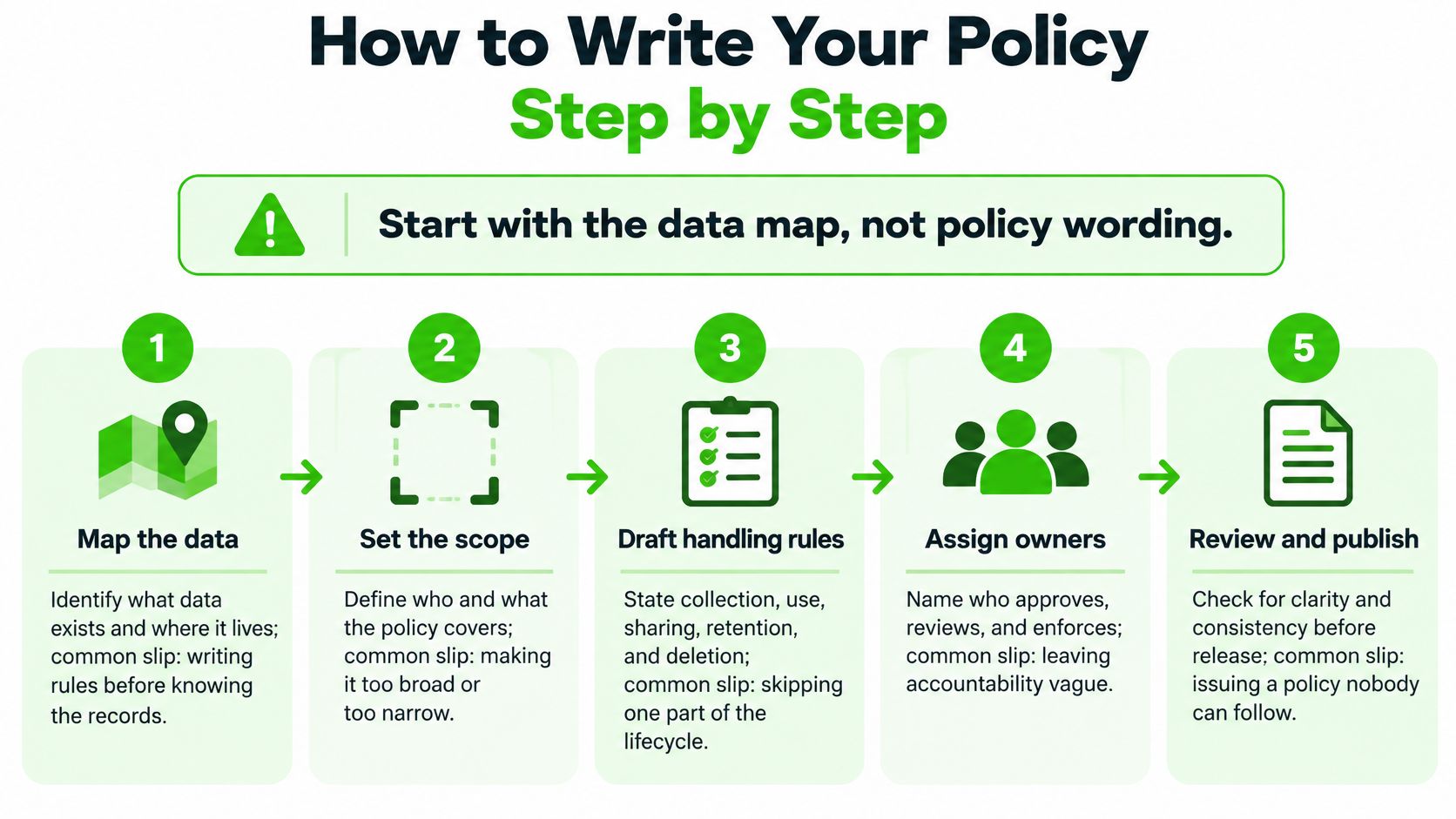
The walkthrough below is the build I use with compliance and engineering leads. A short briefing on why the order matters is worth watching before the workshop, so the room doesn't jump to wording.
The sequence, and the slip that ruins each step
Map the data. List systems, categories, owners, and recipients. A spreadsheet is enough to start. The slip is inventorying only the main customer database and ignoring support tools, ad platforms, and inboxes.
Classify each category. Use labels the business will apply: public, internal, confidential, personal, or regulated. Without a label, later controls have nothing to attach to. The slip is inventing a private taxonomy nobody outside security understands.
Set purpose and lawful basis per category. Record legitimate-interest assessments where you rely on them. The slip is one basis for everything, which collapses the moment someone asks why a marketing file and a payroll file share a justification.
Name owners. One owner per system, plus a privacy lead who can approve or refuse exceptions. The slip is "the team" as owner. Teams don't answer access requests on a deadline.
Set controls by risk tier. Every category gets a tier before anyone picks a tool. High-tier fields get minimisation, managed-key encryption, and privileged multi-factor authentication. Medium-tier account data gets role-based access, encryption at rest, logging, and a retention limit. The slip is buying a product and calling it the control.
Write the retention schedule. Each category needs a period and a deletion trigger, such as purpose completion, end of warranty, or close of the tax year. The slip is "we keep it as long as we need it."
Add vendor requirements. A data processing agreement, sub-processor disclosure, and audit rights. The slip is a security questionnaire with no contract clause behind it.
Draft rights and breach procedures. Contacts, identity checks, and clocks go in the procedure, not in a footnote. The slip is linking to a regulator's website and calling that your process.
Approve, publish, train, and date the review. The privacy lead drafts, legal and security review, and a named executive approves. Train people on the slices they use. A support agent needs the rights steps. A data engineer needs the tier rules. The slip is an all-hands email with a PDF nobody opens.
Step 1 takes the longest, and it has to. If the map misses the ticketing tool, every later control is aimed at the wrong system. Step 5 only works after each category already has a tier. Don't let the drafting group set "high" because a field feels important in the meeting.
Covering Generative AI and Prompt Data
A staff member pastes a customer support ticket into a chatbot to draft a reply. The policy must answer three operational questions before that happens: May staff enter customer data? Are prompts retained or used to train a model? Who approves a model before it connects to company data? “Do not put confidential data in ChatGPT” leaves those decisions unresolved.
OECD guidance on AI chatbots and privacy recommends explaining how prompt data is processed and whether it is used to train or refine models. It also discusses minimisation, anonymisation, and system rules that enforce policy. The EU AI Act already prohibits certain AI practices and phases in its wider obligations over the following years. Set policy controls to meet the applicable dates rather than waiting to revise the rules when enforcement begins.
Data class | Example prompt content | Public AI chatbot | Approved enterprise tool |
|---|---|---|---|
Public | Published product descriptions | Allowed | Allowed |
Internal | Draft internal memos with no names | Not allowed | Allowed with logging |
Confidential | Financial forecasts or contract terms | Not allowed | Allowed only where vendor terms bar training on inputs |
Personal data | Customer names, emails or support tickets | Not allowed | Allowed only after minimisation or de-identification and an impact assessment |
Regulated or special category | Health, biometric or children's data | Not allowed | Prohibited unless a legal basis and impact assessment are approved |

What "allowed in the enterprise tool" still requires
A support agent who pastes a ticket containing a customer's name and email is handling personal data, even if the request seems routine. The table prohibits that use in a public chatbot. In an approved enterprise tool, it is allowed only after minimisation or de-identification and an impact assessment.
Retrieval-augmented generation and fine-tuning need controls with assigned owners and evidence:
Access-controlled retrieval: Configure the model to surface only documents the user can already open. The access owner should verify the permissions.
Prompt logging with a retention limit: Keep logs for investigation, then delete them on schedule. Assign responsibility for access and expiry.
Vendor terms on training: Require the contract to state whether inputs train or refine models. If the terms do not rule out training, treat it as permitted and do not submit the data.
A deletion path: Ensure deletion reaches retrieval indexes and training sets, not only the CRM. Record completion.
Split approval: Require legal, security, product, and engineering approval before launch. If any approval is missing, keep the model off.
Put the rules where staff make the decision: in the prompt interface, vendor contract, and access request. A written policy alone will not block a prohibited prompt or produce evidence that a control ran. The table gives staff a rule they can apply without a meeting; broader accountability and decision rights belong in an AI governance strategy.
Breach Response and Notification Duties
A notice can meet a legal deadline and still fail the person who receives it. The 2025 Identity Theft Resource Center survey found that 80% of 1,040 respondents had received a breach notice in the preceding 12 months, and 39.6% had received three to five. 75% wanted a specific list of the personal data compromised. More letters don't protect people if the letters are vague.
Notification is not the end of the job. It is one stage in a sequence.
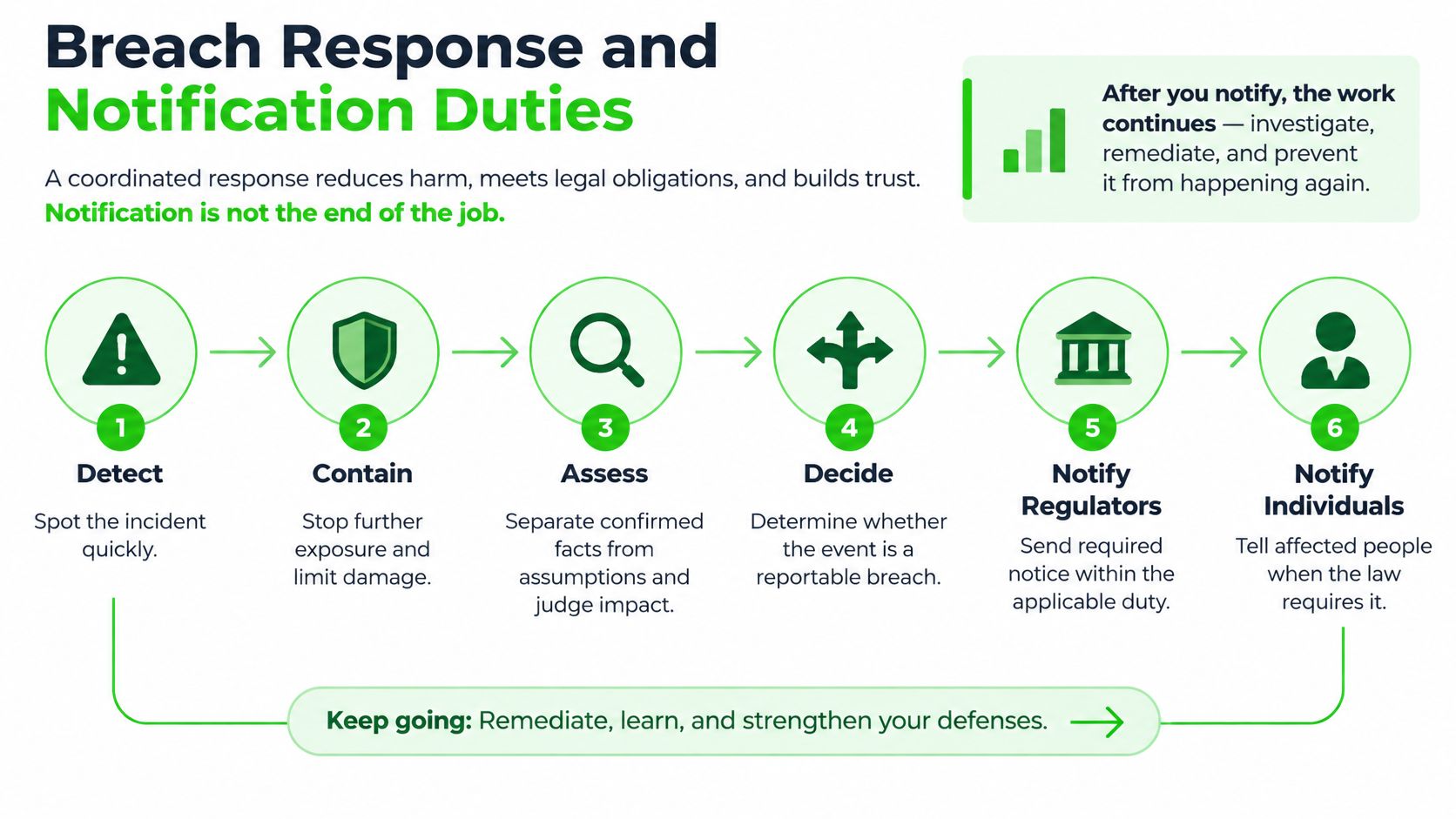
Confirmed, suspected, and what the letter may claim
Detect, contain, then assess. At assessment, label exposure as confirmed or suspected and write down which it is. A log that shows a file was opened is not the same as a log that shows a laptop is missing. Decide notice using severity tiers built from the type of data, the number of records, and the likelihood of harm. High-tier health or financial data can justify notice on a small count. A low-tier published business contact usually doesn't.
Individual notices need five things in plain language: what happened, which specific fields were involved, what that means for the reader, what they should do, and who to contact. "What they should do" is concrete, such as resetting a password or watching an account, not "remain vigilant." Describe the fields, such as email address and last four digits of a card, without publishing exploit detail. If forensics is unfinished, say what you know, what you don't, and when you will update. Don't claim "no evidence of misuse" unless the investigation supports that sentence.
Speed without a field list produces a letter people can't act on. Accuracy without a clock produces a letter that arrives too late.
When a processor holds the records, the contract has to say who identifies affected people and how fast. A cloud platform or an AI vendor that "will notify you of incidents" is not a plan if it never says by when, or in what format. When to notify affected customers should be decided from the severity tier and the statute that applies, not from how finished the press statement feels.
After the letters go out, measure two things. Remediation completion rate shows whether passwords were reset, tokens rotated, and vendors cut off. Repeat-contact rate shows whether people had to write back because the first notice didn't tell them which data was involved. If the second number stays high, the template failed even if the regulator clock was met.
Adopt the Template and Schedule Your Review
Use this skeleton to turn policy requirements into controls with clear owners and evidence. Populate it from the data inventory and risk tiers, and assign an owner to every rule before approval.
Purpose and scope
Definitions
Roles and accountability
Principles
Data inventory reference
Lawful bases and individual rights
Security standards by risk tier
Generative AI use rules
Retention and deletion schedule
Processor and vendor requirements
Breach response
Training
Exceptions process
Review and version history
Review the policy at least annually, and after a major system change, a new jurisdiction applies, a breach occurs, or a new AI tool is approved. The privacy lead drafts; legal and security review; a named executive approves. Record the approval date and version. Each exception needs an owner and an expiry date. Without one, an exception can become a permanent gap in the control set.
Close the gaps in risk order
Compare existing documents with this skeleton and the component checklist, then rank omissions by risk tier. A missing high-tier deletion trigger takes priority over an awkward definition. A missing prompt rule takes priority over polishing a privacy notice. Record each gap, its owner, the control needed, and the evidence that will show it has been addressed.
For a structured policy assessment, Mike P. oversees and manages Freeform's client work to ensure projects are delivered on time, on budget, and with an exceptionally high level of quality. He designed and implemented the project management process Freeform's development teams use to deliver client projects. Freeform's own account of its history
Freeform Company helps compliance, product, and engineering teams turn privacy requirements into owned controls, including assessments of how customer data moves through marketing and AI workflows. If your policy is still a notice that staff handling exports have not read, bring the inventory and gap list to a working session. Visit Freeform Company to learn about its digital compliance and data protection work alongside the systems your staff already use.